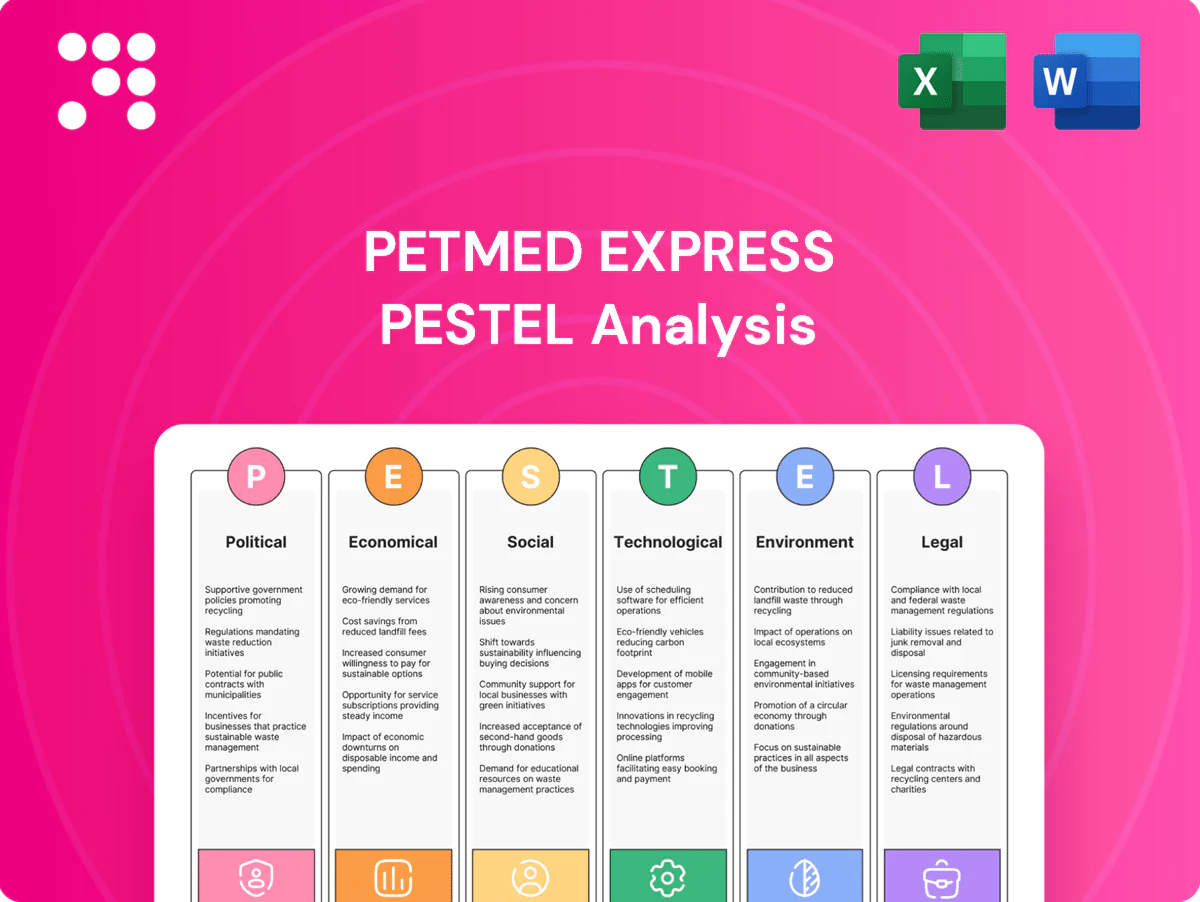
PetMed Express PESTLE Analysis

Your Shortcut to Market Insight Starts Here
Our PESTLE Analysis of PetMed Express reveals how political regulation, economic pressure, social pet-ownership trends, technological innovation, legal risks, and environmental concerns shape its outlook. Ideal for investors and strategists, this briefing highlights the most critical external drivers and threats. Purchase the full, editable report to access detailed insights and actionable recommendations.
Political factors

Veterinary regulatory oversight
US federal and state agencies, led by FDA Center for Veterinary Medicine, tightly regulate veterinary drug distribution and shape compliance for online dispensers serving PetMed Express. FDA/CVM policies and AVMA guidance on telemedicine and pharmacy standards directly affect online dispensing practices and recordkeeping. Shifts in public health priorities, such as zoonotic disease response, can prompt tighter controls on pet medication access. Heightened political focus on animal welfare increases scrutiny and targeted funding for enforcement.
Healthcare and pharma policy direction
Drug pricing debates that drove human pharma reforms also pressure veterinary drug pricing as the U.S. pet market exceeded $140 billion in 2024 per APPA, risking margin compression for PetMed Express. Importation rules and supply-chain localisation efforts raise costs and disrupt availability of key meds. Political scrutiny of compounding and generics tightens margins, while public animal-health programs can materially shift demand patterns.

Trade and tariffs on inputs
Tariffs on APIs, packaging or finished meds raise PetMed Expresss landed costs, especially given that an estimated 60–80% of global APIs originate in China and India; duties or tariffs on intermediates can add double‑digit percentage increases to input costs. Geopolitical tensions and export controls have previously disrupted cross‑border supply, creating multi‑week shortages. Improved trade facilitation and stable trade policy shorten lead times, cut inventory risk and support reliable sourcing.

Postal and delivery service governance
- USPS reach: ~160 million delivery points
- EV charging funding: ~$7.5 billion (Bipartisan Infrastructure Law)
- Increased oversight since 2020 affects last-mile policy
- Rural subsidies critical for remote customer access
Digital commerce policy priorities
Government emphasis on online consumer protection raises compliance costs for PetMed Express as US e-commerce sales reached roughly $1.03 trillion in 2023, while the EU Digital Markets Act and heightened US/EU antitrust scrutiny reshape platform competition and routing of marketplace fees.
Stricter cybersecurity rules (NIS2 transposition by Oct 2024) and the OECD Pillar Two minimum tax (agreed by 137 jurisdictions) increase data-protection and tax-related operating costs.
- Compliance: higher costs from DMA, NIS2
- Competition: stricter antitrust = platform access risk
- Data: elevated cybersecurity standards
- Tax: Pillar Two raises effective tax floor
Tighter regs, supply risks and tax floors pressure pet-pharma margins in $140B US market
Federal vets regs (FDA/CVM) and AVMA telemedicine guidance tighten online dispensing compliance, while drug-pricing debates risk margin pressure as US pet market hit ~$140B in 2024. Supply risks persist with 60–80% of APIs from China/India and tariffs raising landed costs; USPS rate shifts (≈160M delivery points) affect margins. Digital rules (DMA, NIS2) and OECD Pillar Two (137 jurisdictions) raise compliance and tax floors.
| Metric | Value |
|---|---|
| US pet market (2024) | $140B |
| APIs from China/India | 60–80% |
| USPS reach | 160M points |
| e‑com sales (2023) | $1.03T |
| Pillar Two jurisdictions | 137 |
What is included in the product
 Detailed Word Document
Explores how macro-environmental factors uniquely affect PetMed Express across Political, Economic, Social, Technological, Environmental, and Legal dimensions, with data-driven trends and specific examples for the pet pharmacy sector. Designed for executives and investors, it highlights threats, opportunities, and forward-looking insights ready for integration into plans, decks, or scenario strategies.

 Customizable Excel Spreadsheet
A clean, visually segmented PESTLE summary of PetMed Express that distills external risks and market drivers into concise, shareable slides, enabling quick team alignment and editable notes for local context or product lines.
Economic factors

Consumer spending and pet humanization
Pet care is semi-discretionary but resilient: about 70% of US households owned a pet in 2023 (APPA), and the US pet market exceeds $100 billion annually. Macroeconomic slowdowns and elevated inflation (peak CPI 9.1% in 2022) push buyers toward generics and promotions. Rising incomes and subscription models support premiumization and autoship adoption. Price elasticity is lower for chronic therapies than for acute treatments.
Inflation and cost pass-through
Input, labor and freight inflation—after US CPI fell from 9.1% in 2022 to low single digits by 2024—continue to squeeze PetMed Express margins as wages and shipping remain elevated; ocean freight fell ~70% from 2022 peaks but volatility persists. Ability to pass costs hinges on brand equity and competitive pricing; mix management, subscription discounts and AOV defense, plus supplier negotiations and currency/commodity hedges, materially affect margin recovery.

Carrier and fulfillment expenses
Parcel rate and fuel surcharge inflation in 2024 pressured unit economics for PetMed Express, with industry parcel rates rising in the mid-single-digit range and fuel surcharges fluctuating during the year. Elevated return rates magnify logistics cost per order by increasing handling and restocking overhead. Network optimization that reduces zones and delivery times and dynamic pricing to offset peak season surcharges are critical to protect margins.

Competitive pricing pressure
- e-commerce dominance: Amazon ~40% US online retail
- MAP policies: stabilize price floors
- differentiation: service, Rx speed, loyalty
- scale advantage: lower unit fulfillment costs
Interest rates and working capital
Higher interest rates (federal funds ~5.25–5.50% in 2024–25) raise PetMed Express working capital costs and inventory carrying expenses, squeezing margins on slow-moving SKUs.
Tighter credit increases the cost of financing marketing and tech projects, while faster inventory turns free cash for growth and reduce days inventory on hand.
Autoship predictability, representing a significant portion of repeat orders, smooths demand planning and lowers safety-stock needs.
- Interest rate impact: federal funds ~5.25–5.50% (2024–25)
- Faster turns = immediate cash release for capex/marketing
- Autoship = higher demand visibility, lower safety stock
- Tighter credit = constrained tech/marketing spend
Tighter regs, supply risks and tax floors pressure pet-pharma margins in $140B US market
Pet care demand resilient: ~70% US households owned pets (2023) and US pet market >$100B; buyers shift to generics during inflation spikes (CPI peak 9.1% in 2022). Input, labor and freight inflation (still elevated vs pre‑2022) squeeze margins; ability to pass costs depends on autoship, mix and supplier terms. E‑commerce scale (Amazon ~40% online) and Fed funds ~5.25–5.50% (2024–25) raise competitive and financing pressures.
| Metric | Value |
|---|---|
| Pet ownership (2023) | ~70% |
| US pet market | >$100B |
| Fed funds (2024–25) | 5.25–5.50% |
| Amazon share (online) | ~40% |
Full Version Awaits
PetMed Express PESTLE Analysis
The PetMed Express PESTLE Analysis provides a concise evaluation of political, economic, social, technological, legal and environmental factors affecting the company, with actionable implications for strategy and risk management. The layout includes clear headings, bulleted insights and data-driven observations for investor or management use. The preview shown here is the exact document you’ll receive after purchase—fully formatted and ready to use.

Your Shortcut to Market Insight Starts Here
Our PESTLE Analysis of PetMed Express reveals how political regulation, economic pressure, social pet-ownership trends, technological innovation, legal risks, and environmental concerns shape its outlook. Ideal for investors and strategists, this briefing highlights the most critical external drivers and threats. Purchase the full, editable report to access detailed insights and actionable recommendations.
Political factors
Veterinary regulatory oversight
US federal and state agencies, led by FDA Center for Veterinary Medicine, tightly regulate veterinary drug distribution and shape compliance for online dispensers serving PetMed Express. FDA/CVM policies and AVMA guidance on telemedicine and pharmacy standards directly affect online dispensing practices and recordkeeping. Shifts in public health priorities, such as zoonotic disease response, can prompt tighter controls on pet medication access. Heightened political focus on animal welfare increases scrutiny and targeted funding for enforcement.
Healthcare and pharma policy direction
Drug pricing debates that drove human pharma reforms also pressure veterinary drug pricing as the U.S. pet market exceeded $140 billion in 2024 per APPA, risking margin compression for PetMed Express. Importation rules and supply-chain localisation efforts raise costs and disrupt availability of key meds. Political scrutiny of compounding and generics tightens margins, while public animal-health programs can materially shift demand patterns.
Trade and tariffs on inputs
Tariffs on APIs, packaging or finished meds raise PetMed Expresss landed costs, especially given that an estimated 60–80% of global APIs originate in China and India; duties or tariffs on intermediates can add double‑digit percentage increases to input costs. Geopolitical tensions and export controls have previously disrupted cross‑border supply, creating multi‑week shortages. Improved trade facilitation and stable trade policy shorten lead times, cut inventory risk and support reliable sourcing.
Postal and delivery service governance
- USPS reach: ~160 million delivery points
- EV charging funding: ~$7.5 billion (Bipartisan Infrastructure Law)
- Increased oversight since 2020 affects last-mile policy
- Rural subsidies critical for remote customer access
Digital commerce policy priorities
Government emphasis on online consumer protection raises compliance costs for PetMed Express as US e-commerce sales reached roughly $1.03 trillion in 2023, while the EU Digital Markets Act and heightened US/EU antitrust scrutiny reshape platform competition and routing of marketplace fees.
Stricter cybersecurity rules (NIS2 transposition by Oct 2024) and the OECD Pillar Two minimum tax (agreed by 137 jurisdictions) increase data-protection and tax-related operating costs.
- Compliance: higher costs from DMA, NIS2
- Competition: stricter antitrust = platform access risk
- Data: elevated cybersecurity standards
- Tax: Pillar Two raises effective tax floor
Tighter regs, supply risks and tax floors pressure pet-pharma margins in $140B US market
Federal vets regs (FDA/CVM) and AVMA telemedicine guidance tighten online dispensing compliance, while drug-pricing debates risk margin pressure as US pet market hit ~$140B in 2024. Supply risks persist with 60–80% of APIs from China/India and tariffs raising landed costs; USPS rate shifts (≈160M delivery points) affect margins. Digital rules (DMA, NIS2) and OECD Pillar Two (137 jurisdictions) raise compliance and tax floors.
| Metric | Value |
|---|---|
| US pet market (2024) | $140B |
| APIs from China/India | 60–80% |
| USPS reach | 160M points |
| e‑com sales (2023) | $1.03T |
| Pillar Two jurisdictions | 137 |
What is included in the product
Detailed Word Document
Explores how macro-environmental factors uniquely affect PetMed Express across Political, Economic, Social, Technological, Environmental, and Legal dimensions, with data-driven trends and specific examples for the pet pharmacy sector. Designed for executives and investors, it highlights threats, opportunities, and forward-looking insights ready for integration into plans, decks, or scenario strategies.
Customizable Excel Spreadsheet
A clean, visually segmented PESTLE summary of PetMed Express that distills external risks and market drivers into concise, shareable slides, enabling quick team alignment and editable notes for local context or product lines.
Economic factors
Consumer spending and pet humanization
Pet care is semi-discretionary but resilient: about 70% of US households owned a pet in 2023 (APPA), and the US pet market exceeds $100 billion annually. Macroeconomic slowdowns and elevated inflation (peak CPI 9.1% in 2022) push buyers toward generics and promotions. Rising incomes and subscription models support premiumization and autoship adoption. Price elasticity is lower for chronic therapies than for acute treatments.
Inflation and cost pass-through
Input, labor and freight inflation—after US CPI fell from 9.1% in 2022 to low single digits by 2024—continue to squeeze PetMed Express margins as wages and shipping remain elevated; ocean freight fell ~70% from 2022 peaks but volatility persists. Ability to pass costs hinges on brand equity and competitive pricing; mix management, subscription discounts and AOV defense, plus supplier negotiations and currency/commodity hedges, materially affect margin recovery.
Carrier and fulfillment expenses
Parcel rate and fuel surcharge inflation in 2024 pressured unit economics for PetMed Express, with industry parcel rates rising in the mid-single-digit range and fuel surcharges fluctuating during the year. Elevated return rates magnify logistics cost per order by increasing handling and restocking overhead. Network optimization that reduces zones and delivery times and dynamic pricing to offset peak season surcharges are critical to protect margins.
Competitive pricing pressure
- e-commerce dominance: Amazon ~40% US online retail
- MAP policies: stabilize price floors
- differentiation: service, Rx speed, loyalty
- scale advantage: lower unit fulfillment costs
Interest rates and working capital
Higher interest rates (federal funds ~5.25–5.50% in 2024–25) raise PetMed Express working capital costs and inventory carrying expenses, squeezing margins on slow-moving SKUs.
Tighter credit increases the cost of financing marketing and tech projects, while faster inventory turns free cash for growth and reduce days inventory on hand.
Autoship predictability, representing a significant portion of repeat orders, smooths demand planning and lowers safety-stock needs.
- Interest rate impact: federal funds ~5.25–5.50% (2024–25)
- Faster turns = immediate cash release for capex/marketing
- Autoship = higher demand visibility, lower safety stock
- Tighter credit = constrained tech/marketing spend
Tighter regs, supply risks and tax floors pressure pet-pharma margins in $140B US market
Pet care demand resilient: ~70% US households owned pets (2023) and US pet market >$100B; buyers shift to generics during inflation spikes (CPI peak 9.1% in 2022). Input, labor and freight inflation (still elevated vs pre‑2022) squeeze margins; ability to pass costs depends on autoship, mix and supplier terms. E‑commerce scale (Amazon ~40% online) and Fed funds ~5.25–5.50% (2024–25) raise competitive and financing pressures.
| Metric | Value |
|---|---|
| Pet ownership (2023) | ~70% |
| US pet market | >$100B |
| Fed funds (2024–25) | 5.25–5.50% |
| Amazon share (online) | ~40% |
Full Version Awaits
PetMed Express PESTLE Analysis
The PetMed Express PESTLE Analysis provides a concise evaluation of political, economic, social, technological, legal and environmental factors affecting the company, with actionable implications for strategy and risk management. The layout includes clear headings, bulleted insights and data-driven observations for investor or management use. The preview shown here is the exact document you’ll receive after purchase—fully formatted and ready to use.
Original: $10.00
-65%$10.00
$3.50Description
Your Shortcut to Market Insight Starts Here
Our PESTLE Analysis of PetMed Express reveals how political regulation, economic pressure, social pet-ownership trends, technological innovation, legal risks, and environmental concerns shape its outlook. Ideal for investors and strategists, this briefing highlights the most critical external drivers and threats. Purchase the full, editable report to access detailed insights and actionable recommendations.
Political factors
Veterinary regulatory oversight
US federal and state agencies, led by FDA Center for Veterinary Medicine, tightly regulate veterinary drug distribution and shape compliance for online dispensers serving PetMed Express. FDA/CVM policies and AVMA guidance on telemedicine and pharmacy standards directly affect online dispensing practices and recordkeeping. Shifts in public health priorities, such as zoonotic disease response, can prompt tighter controls on pet medication access. Heightened political focus on animal welfare increases scrutiny and targeted funding for enforcement.
Healthcare and pharma policy direction
Drug pricing debates that drove human pharma reforms also pressure veterinary drug pricing as the U.S. pet market exceeded $140 billion in 2024 per APPA, risking margin compression for PetMed Express. Importation rules and supply-chain localisation efforts raise costs and disrupt availability of key meds. Political scrutiny of compounding and generics tightens margins, while public animal-health programs can materially shift demand patterns.
Trade and tariffs on inputs
Tariffs on APIs, packaging or finished meds raise PetMed Expresss landed costs, especially given that an estimated 60–80% of global APIs originate in China and India; duties or tariffs on intermediates can add double‑digit percentage increases to input costs. Geopolitical tensions and export controls have previously disrupted cross‑border supply, creating multi‑week shortages. Improved trade facilitation and stable trade policy shorten lead times, cut inventory risk and support reliable sourcing.
Postal and delivery service governance
- USPS reach: ~160 million delivery points
- EV charging funding: ~$7.5 billion (Bipartisan Infrastructure Law)
- Increased oversight since 2020 affects last-mile policy
- Rural subsidies critical for remote customer access
Digital commerce policy priorities
Government emphasis on online consumer protection raises compliance costs for PetMed Express as US e-commerce sales reached roughly $1.03 trillion in 2023, while the EU Digital Markets Act and heightened US/EU antitrust scrutiny reshape platform competition and routing of marketplace fees.
Stricter cybersecurity rules (NIS2 transposition by Oct 2024) and the OECD Pillar Two minimum tax (agreed by 137 jurisdictions) increase data-protection and tax-related operating costs.
- Compliance: higher costs from DMA, NIS2
- Competition: stricter antitrust = platform access risk
- Data: elevated cybersecurity standards
- Tax: Pillar Two raises effective tax floor
Tighter regs, supply risks and tax floors pressure pet-pharma margins in $140B US market
Federal vets regs (FDA/CVM) and AVMA telemedicine guidance tighten online dispensing compliance, while drug-pricing debates risk margin pressure as US pet market hit ~$140B in 2024. Supply risks persist with 60–80% of APIs from China/India and tariffs raising landed costs; USPS rate shifts (≈160M delivery points) affect margins. Digital rules (DMA, NIS2) and OECD Pillar Two (137 jurisdictions) raise compliance and tax floors.
| Metric | Value |
|---|---|
| US pet market (2024) | $140B |
| APIs from China/India | 60–80% |
| USPS reach | 160M points |
| e‑com sales (2023) | $1.03T |
| Pillar Two jurisdictions | 137 |
What is included in the product
Detailed Word Document
Explores how macro-environmental factors uniquely affect PetMed Express across Political, Economic, Social, Technological, Environmental, and Legal dimensions, with data-driven trends and specific examples for the pet pharmacy sector. Designed for executives and investors, it highlights threats, opportunities, and forward-looking insights ready for integration into plans, decks, or scenario strategies.
Customizable Excel Spreadsheet
A clean, visually segmented PESTLE summary of PetMed Express that distills external risks and market drivers into concise, shareable slides, enabling quick team alignment and editable notes for local context or product lines.
Economic factors
Consumer spending and pet humanization
Pet care is semi-discretionary but resilient: about 70% of US households owned a pet in 2023 (APPA), and the US pet market exceeds $100 billion annually. Macroeconomic slowdowns and elevated inflation (peak CPI 9.1% in 2022) push buyers toward generics and promotions. Rising incomes and subscription models support premiumization and autoship adoption. Price elasticity is lower for chronic therapies than for acute treatments.
Inflation and cost pass-through
Input, labor and freight inflation—after US CPI fell from 9.1% in 2022 to low single digits by 2024—continue to squeeze PetMed Express margins as wages and shipping remain elevated; ocean freight fell ~70% from 2022 peaks but volatility persists. Ability to pass costs hinges on brand equity and competitive pricing; mix management, subscription discounts and AOV defense, plus supplier negotiations and currency/commodity hedges, materially affect margin recovery.
Carrier and fulfillment expenses
Parcel rate and fuel surcharge inflation in 2024 pressured unit economics for PetMed Express, with industry parcel rates rising in the mid-single-digit range and fuel surcharges fluctuating during the year. Elevated return rates magnify logistics cost per order by increasing handling and restocking overhead. Network optimization that reduces zones and delivery times and dynamic pricing to offset peak season surcharges are critical to protect margins.
Competitive pricing pressure
- e-commerce dominance: Amazon ~40% US online retail
- MAP policies: stabilize price floors
- differentiation: service, Rx speed, loyalty
- scale advantage: lower unit fulfillment costs
Interest rates and working capital
Higher interest rates (federal funds ~5.25–5.50% in 2024–25) raise PetMed Express working capital costs and inventory carrying expenses, squeezing margins on slow-moving SKUs.
Tighter credit increases the cost of financing marketing and tech projects, while faster inventory turns free cash for growth and reduce days inventory on hand.
Autoship predictability, representing a significant portion of repeat orders, smooths demand planning and lowers safety-stock needs.
- Interest rate impact: federal funds ~5.25–5.50% (2024–25)
- Faster turns = immediate cash release for capex/marketing
- Autoship = higher demand visibility, lower safety stock
- Tighter credit = constrained tech/marketing spend
Tighter regs, supply risks and tax floors pressure pet-pharma margins in $140B US market
Pet care demand resilient: ~70% US households owned pets (2023) and US pet market >$100B; buyers shift to generics during inflation spikes (CPI peak 9.1% in 2022). Input, labor and freight inflation (still elevated vs pre‑2022) squeeze margins; ability to pass costs depends on autoship, mix and supplier terms. E‑commerce scale (Amazon ~40% online) and Fed funds ~5.25–5.50% (2024–25) raise competitive and financing pressures.
| Metric | Value |
|---|---|
| Pet ownership (2023) | ~70% |
| US pet market | >$100B |
| Fed funds (2024–25) | 5.25–5.50% |
| Amazon share (online) | ~40% |
Full Version Awaits
PetMed Express PESTLE Analysis
The PetMed Express PESTLE Analysis provides a concise evaluation of political, economic, social, technological, legal and environmental factors affecting the company, with actionable implications for strategy and risk management. The layout includes clear headings, bulleted insights and data-driven observations for investor or management use. The preview shown here is the exact document you’ll receive after purchase—fully formatted and ready to use.











