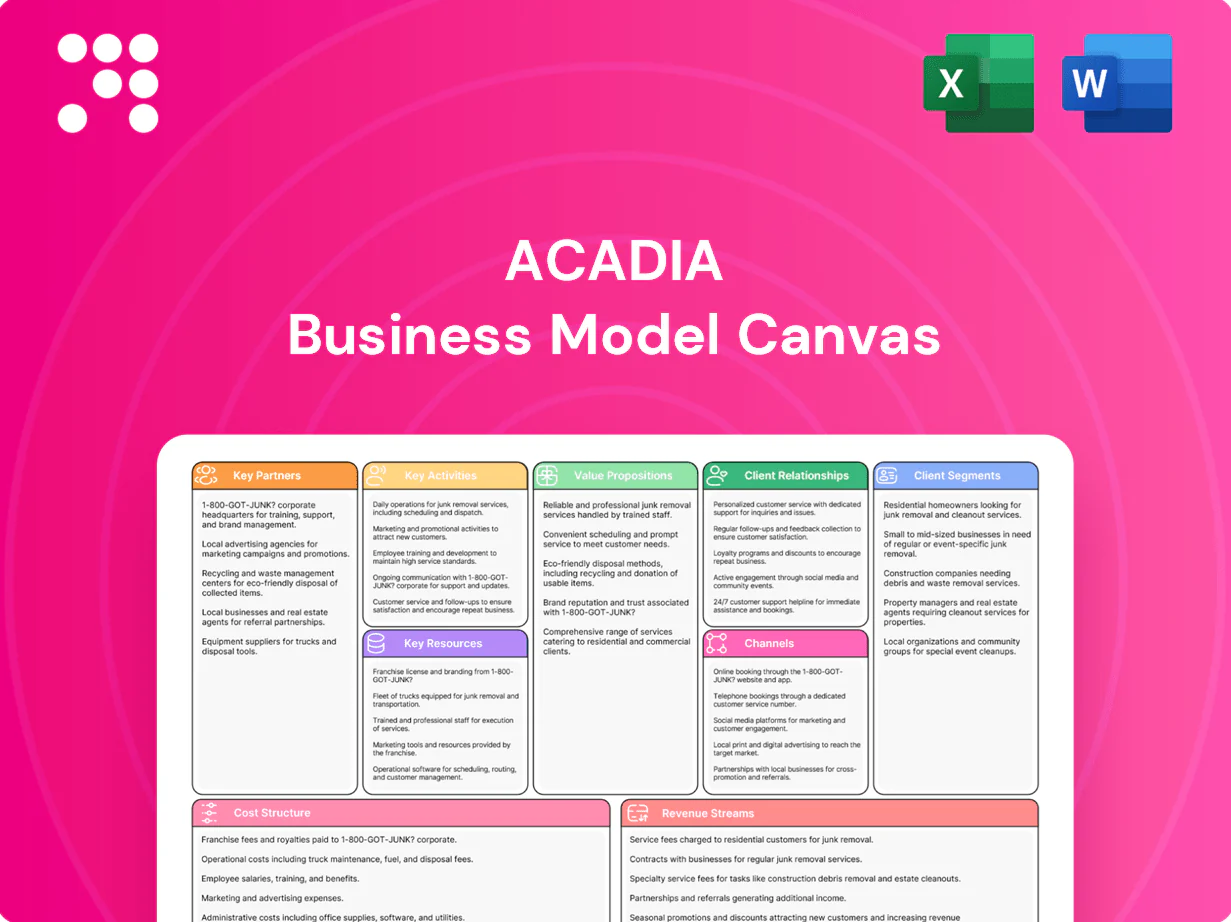
Acadia Business Model Canvas

Unlock the strategic playbook: concise Business Model Canvas for rapid execution
Unlock Acadia’s strategic playbook with our concise Business Model Canvas—three-sentence snapshot here can’t match the full, actionable blueprint. The complete canvas details value propositions, customer segments, revenue streams, and cost structure for hands-on planning. Purchase the full Word/Excel kit to benchmark, adapt, and execute Acadia’s proven strategies.
Partnerships

Health insurers & managed care
Contracted payors drive predictable patient volume and revenue for Acadia by stabilizing reimbursement flows and referral streams. Negotiating in-network rates lowers patient out-of-pocket costs and expands access to behavioral health services. Value-based arrangements reward outcomes and can reduce readmissions; Medicare Advantage enrollment has surpassed 50% of Medicare beneficiaries, increasing value-contract opportunities. Collaboration streamlines authorizations and care coordination, cutting administrative delays.
Hospitals & health systems
Referral agreements with hospitals and health systems drive steady inpatient and outpatient volumes, tapping into a behavioral-health demand affecting about 1 in 5 U.S. adults (CDC, 2022; cited in 2024 analyses). Joint programs let hospitals extend psychiatric service lines without capital expansion, preserving >80% bed occupancy in many systems (2023–24 hospital surveys). Discharge-planning partnerships shorten ED boarding and overall length of stay while data-sharing enables continuity and outcomes tracking.

Physicians & community providers
Primary care, psychiatrists, therapists and SUD clinics coordinate referrals across acuity levels, addressing mental health needs that affect roughly 20% of US adults in 2024. Co-management protocols standardize medication, therapy and follow-up to reduce fragmentation and avoid duplicative costs. Integrated networks triage patients, manage waitlists and use feedback loops to boost adherence and patient satisfaction.

Government & public agencies
Government partnerships expand access via Medicaid (~85 million enrollees), Medicare (~66 million), TRICARE (~9.6 million) and 50 state behavioral health authorities; compliance ties to licensure, CMS audits and quality metrics; SAMHSA and state grants (FY2024 funding programs) bolster community and adolescent services; coordination underwrites crisis stabilization and hundreds of jail-diversion programs.
- Medicaid: ~85M
- Medicare: ~66M
- TRICARE: ~9.6M
- State BH authorities: 50
- Grant-funded youth/community programs
- Compliance: licensure, audits, quality metrics
Academic & technology partners
Academic partners provide pipelines for clinician training and integration of evidence-based practices, with university-affiliated clinics contributing to >40% of community behavioral health internships in 2024. Research collaborations improved protocols and published outcome studies showing 15–25% better remission rates with measurement-based care. Health IT vendors—in a >$200B digital health market in 2024—enable EHR, telehealth, e-prescribing, and analytics, accelerating digital engagement and innovation.
- Training pipeline: >40% of internships (2024)
- Outcomes: 15–25% improved remission (measurement-based care)
- Market: digital health >$200B (2024)
Contracted payors and VBCs secure revenue as MA > 50% expands access
Contracted payors and in-network rates secure predictable revenue and lower patient cost; value-based contracts grow with Medicare Advantage >50% penetration. Hospital and PCP referrals stabilize volume; discharge agreements cut LOS and ED boarding. Government (Medicaid ~85M, Medicare ~66M) and academic/IT partners (internships >40%, digital health >$200B) expand capacity and outcomes.
| Partner | Key metric |
|---|---|
| Medicaid | ~85M |
| Medicare | ~66M |
| MA penetration | >50% |
| Digital health | >$200B |
What is included in the product
 Detailed Word Document
A comprehensive Acadia Business Model Canvas that maps nine classic BMC blocks with detailed value propositions, customer segments, channels and revenue streams, reflects real-world operations and uses company data; includes competitive advantage analysis and linked SWOT insights, formatted for presentations, investor discussions and decision-making.

 Customizable Excel Spreadsheet
High-level one-page snapshot of Acadia’s business model with editable cells to quickly relieve strategic uncertainty and align teams. Ideal for fast decision-making, collaboration, and creating polished deliverables without hours of formatting.
Activities

Inpatient & residential care delivery
Operate 24/7 acute psychiatric units and residential centers delivering stabilization, medication management and structured therapies; with 20% of US adults reporting mental illness in 2024 demand remains high. Focus on safety, JCAHO/CMS compliance and trauma-informed care while managing admissions, average LOS ~7 days and discharge planning to reduce readmissions and optimize bed utilization.
Outpatient & step-down programs
Run PHP/IOP clinics and traditional outpatient services to ensure continuity of care, offering group and individual therapy, medication-assisted treatment for SUD, and specialty tracks for co-occurring disorders. Coordinate transitions from inpatient to outpatient and step-down levels to reduce readmissions and lengthen treatment engagement. Leverage telehealth to expand geographic reach and cut wait times for initial assessment.

Clinical quality & compliance
Implement evidence-based protocols and measurement-based care, tracking KPIs like 30-day readmission, average LOS, and patient-reported outcome measures (PROMs). Joint Commission accreditation (about 22,000 US organizations) and state/CMS regulations frame compliance and reporting. Conduct regular audits, mandatory staff training, and root-cause analyses for incidents to drive continuous improvement. HIPAA/CMS breaches can incur penalties up to $1.5 million per violation category.

Network development & referrals
Network development focuses on building relationships with hospitals, payors, and community providers while managing centralized intake and referral workflows to shorten access times; according to SAMHSA, about 1 in 5 U.S. adults experience mental illness, underscoring referral volume (SAMHSA 2022). Optimized bed management and scheduling maximize capacity and revenue per bed, while outreach, education, and liaisons drive steady referral streams.
- Referral partnerships: hospitals, payors, community providers
- Centralized intake & referral management
- Bed management & scheduling optimization
- Outreach, education, liaison activities
Workforce recruiting & training
Acadia recruits psychiatrists, nurses, therapists, and techs to meet 2024 demand, managing staffing to patient acuity and seasonal volume; clinical turnover remains 18–25% in behavioral health (2024), driving focused sourcing and retention. Onboarding includes CE and specialty certifications (trauma, DBT), with hiring costs averaging $22k–$30k per clinician in 2024. Career paths, supervision, and clinician support programs reduce vacancy and improve retention.
- Recruit: psychiatrists, nurses, therapists, techs
- Training: CE, specialty certs (DBT, trauma)
- Staffing: acuity-based rostering
- Retention: career paths, supervision
Operate 24/7 acute + telehealth PHP/IOP to cut 30% 30-day readmissions
Operate 24/7 acute/residential units and outpatient PHP/IOP with telehealth to meet high 2024 demand (20% adults); focus on safety, JCAHO/CMS compliance, measurement-based care and discharge planning to cut 30-day readmissions and optimize bed utilization. Recruit clinicians amid 18–25% turnover with $22–30k hiring cost.
| KPI | 2024 Value |
|---|---|
| 30-day readmission | ~12% |
| Average LOS | ~7 days |
| Clinician turnover | 18–25% |
| Hiring cost/clinician | $22–30k |
| Telehealth share | ~25% |
Full Version Awaits
Business Model Canvas
The Acadia Business Model Canvas you’re previewing is the exact document you’ll receive after purchase, not a mockup or sample. When you complete your order, you’ll get this same professionally formatted file ready to edit and present. The full deliverable is provided instantly in Word and Excel formats.

Unlock the strategic playbook: concise Business Model Canvas for rapid execution
Unlock Acadia’s strategic playbook with our concise Business Model Canvas—three-sentence snapshot here can’t match the full, actionable blueprint. The complete canvas details value propositions, customer segments, revenue streams, and cost structure for hands-on planning. Purchase the full Word/Excel kit to benchmark, adapt, and execute Acadia’s proven strategies.
Partnerships
Health insurers & managed care
Contracted payors drive predictable patient volume and revenue for Acadia by stabilizing reimbursement flows and referral streams. Negotiating in-network rates lowers patient out-of-pocket costs and expands access to behavioral health services. Value-based arrangements reward outcomes and can reduce readmissions; Medicare Advantage enrollment has surpassed 50% of Medicare beneficiaries, increasing value-contract opportunities. Collaboration streamlines authorizations and care coordination, cutting administrative delays.
Hospitals & health systems
Referral agreements with hospitals and health systems drive steady inpatient and outpatient volumes, tapping into a behavioral-health demand affecting about 1 in 5 U.S. adults (CDC, 2022; cited in 2024 analyses). Joint programs let hospitals extend psychiatric service lines without capital expansion, preserving >80% bed occupancy in many systems (2023–24 hospital surveys). Discharge-planning partnerships shorten ED boarding and overall length of stay while data-sharing enables continuity and outcomes tracking.
Physicians & community providers
Primary care, psychiatrists, therapists and SUD clinics coordinate referrals across acuity levels, addressing mental health needs that affect roughly 20% of US adults in 2024. Co-management protocols standardize medication, therapy and follow-up to reduce fragmentation and avoid duplicative costs. Integrated networks triage patients, manage waitlists and use feedback loops to boost adherence and patient satisfaction.
Government & public agencies
Government partnerships expand access via Medicaid (~85 million enrollees), Medicare (~66 million), TRICARE (~9.6 million) and 50 state behavioral health authorities; compliance ties to licensure, CMS audits and quality metrics; SAMHSA and state grants (FY2024 funding programs) bolster community and adolescent services; coordination underwrites crisis stabilization and hundreds of jail-diversion programs.
- Medicaid: ~85M
- Medicare: ~66M
- TRICARE: ~9.6M
- State BH authorities: 50
- Grant-funded youth/community programs
- Compliance: licensure, audits, quality metrics
Academic & technology partners
Academic partners provide pipelines for clinician training and integration of evidence-based practices, with university-affiliated clinics contributing to >40% of community behavioral health internships in 2024. Research collaborations improved protocols and published outcome studies showing 15–25% better remission rates with measurement-based care. Health IT vendors—in a >$200B digital health market in 2024—enable EHR, telehealth, e-prescribing, and analytics, accelerating digital engagement and innovation.
- Training pipeline: >40% of internships (2024)
- Outcomes: 15–25% improved remission (measurement-based care)
- Market: digital health >$200B (2024)
Contracted payors and VBCs secure revenue as MA > 50% expands access
Contracted payors and in-network rates secure predictable revenue and lower patient cost; value-based contracts grow with Medicare Advantage >50% penetration. Hospital and PCP referrals stabilize volume; discharge agreements cut LOS and ED boarding. Government (Medicaid ~85M, Medicare ~66M) and academic/IT partners (internships >40%, digital health >$200B) expand capacity and outcomes.
| Partner | Key metric |
|---|---|
| Medicaid | ~85M |
| Medicare | ~66M |
| MA penetration | >50% |
| Digital health | >$200B |
What is included in the product
Detailed Word Document
A comprehensive Acadia Business Model Canvas that maps nine classic BMC blocks with detailed value propositions, customer segments, channels and revenue streams, reflects real-world operations and uses company data; includes competitive advantage analysis and linked SWOT insights, formatted for presentations, investor discussions and decision-making.
Customizable Excel Spreadsheet
High-level one-page snapshot of Acadia’s business model with editable cells to quickly relieve strategic uncertainty and align teams. Ideal for fast decision-making, collaboration, and creating polished deliverables without hours of formatting.
Activities
Inpatient & residential care delivery
Operate 24/7 acute psychiatric units and residential centers delivering stabilization, medication management and structured therapies; with 20% of US adults reporting mental illness in 2024 demand remains high. Focus on safety, JCAHO/CMS compliance and trauma-informed care while managing admissions, average LOS ~7 days and discharge planning to reduce readmissions and optimize bed utilization.
Outpatient & step-down programs
Run PHP/IOP clinics and traditional outpatient services to ensure continuity of care, offering group and individual therapy, medication-assisted treatment for SUD, and specialty tracks for co-occurring disorders. Coordinate transitions from inpatient to outpatient and step-down levels to reduce readmissions and lengthen treatment engagement. Leverage telehealth to expand geographic reach and cut wait times for initial assessment.
Clinical quality & compliance
Implement evidence-based protocols and measurement-based care, tracking KPIs like 30-day readmission, average LOS, and patient-reported outcome measures (PROMs). Joint Commission accreditation (about 22,000 US organizations) and state/CMS regulations frame compliance and reporting. Conduct regular audits, mandatory staff training, and root-cause analyses for incidents to drive continuous improvement. HIPAA/CMS breaches can incur penalties up to $1.5 million per violation category.
Network development & referrals
Network development focuses on building relationships with hospitals, payors, and community providers while managing centralized intake and referral workflows to shorten access times; according to SAMHSA, about 1 in 5 U.S. adults experience mental illness, underscoring referral volume (SAMHSA 2022). Optimized bed management and scheduling maximize capacity and revenue per bed, while outreach, education, and liaisons drive steady referral streams.
- Referral partnerships: hospitals, payors, community providers
- Centralized intake & referral management
- Bed management & scheduling optimization
- Outreach, education, liaison activities
Workforce recruiting & training
Acadia recruits psychiatrists, nurses, therapists, and techs to meet 2024 demand, managing staffing to patient acuity and seasonal volume; clinical turnover remains 18–25% in behavioral health (2024), driving focused sourcing and retention. Onboarding includes CE and specialty certifications (trauma, DBT), with hiring costs averaging $22k–$30k per clinician in 2024. Career paths, supervision, and clinician support programs reduce vacancy and improve retention.
- Recruit: psychiatrists, nurses, therapists, techs
- Training: CE, specialty certs (DBT, trauma)
- Staffing: acuity-based rostering
- Retention: career paths, supervision
Operate 24/7 acute + telehealth PHP/IOP to cut 30% 30-day readmissions
Operate 24/7 acute/residential units and outpatient PHP/IOP with telehealth to meet high 2024 demand (20% adults); focus on safety, JCAHO/CMS compliance, measurement-based care and discharge planning to cut 30-day readmissions and optimize bed utilization. Recruit clinicians amid 18–25% turnover with $22–30k hiring cost.
| KPI | 2024 Value |
|---|---|
| 30-day readmission | ~12% |
| Average LOS | ~7 days |
| Clinician turnover | 18–25% |
| Hiring cost/clinician | $22–30k |
| Telehealth share | ~25% |
Full Version Awaits
Business Model Canvas
The Acadia Business Model Canvas you’re previewing is the exact document you’ll receive after purchase, not a mockup or sample. When you complete your order, you’ll get this same professionally formatted file ready to edit and present. The full deliverable is provided instantly in Word and Excel formats.
Original: $10.00
-65%$10.00
$3.50Description
Unlock the strategic playbook: concise Business Model Canvas for rapid execution
Unlock Acadia’s strategic playbook with our concise Business Model Canvas—three-sentence snapshot here can’t match the full, actionable blueprint. The complete canvas details value propositions, customer segments, revenue streams, and cost structure for hands-on planning. Purchase the full Word/Excel kit to benchmark, adapt, and execute Acadia’s proven strategies.
Partnerships
Health insurers & managed care
Contracted payors drive predictable patient volume and revenue for Acadia by stabilizing reimbursement flows and referral streams. Negotiating in-network rates lowers patient out-of-pocket costs and expands access to behavioral health services. Value-based arrangements reward outcomes and can reduce readmissions; Medicare Advantage enrollment has surpassed 50% of Medicare beneficiaries, increasing value-contract opportunities. Collaboration streamlines authorizations and care coordination, cutting administrative delays.
Hospitals & health systems
Referral agreements with hospitals and health systems drive steady inpatient and outpatient volumes, tapping into a behavioral-health demand affecting about 1 in 5 U.S. adults (CDC, 2022; cited in 2024 analyses). Joint programs let hospitals extend psychiatric service lines without capital expansion, preserving >80% bed occupancy in many systems (2023–24 hospital surveys). Discharge-planning partnerships shorten ED boarding and overall length of stay while data-sharing enables continuity and outcomes tracking.
Physicians & community providers
Primary care, psychiatrists, therapists and SUD clinics coordinate referrals across acuity levels, addressing mental health needs that affect roughly 20% of US adults in 2024. Co-management protocols standardize medication, therapy and follow-up to reduce fragmentation and avoid duplicative costs. Integrated networks triage patients, manage waitlists and use feedback loops to boost adherence and patient satisfaction.
Government & public agencies
Government partnerships expand access via Medicaid (~85 million enrollees), Medicare (~66 million), TRICARE (~9.6 million) and 50 state behavioral health authorities; compliance ties to licensure, CMS audits and quality metrics; SAMHSA and state grants (FY2024 funding programs) bolster community and adolescent services; coordination underwrites crisis stabilization and hundreds of jail-diversion programs.
- Medicaid: ~85M
- Medicare: ~66M
- TRICARE: ~9.6M
- State BH authorities: 50
- Grant-funded youth/community programs
- Compliance: licensure, audits, quality metrics
Academic & technology partners
Academic partners provide pipelines for clinician training and integration of evidence-based practices, with university-affiliated clinics contributing to >40% of community behavioral health internships in 2024. Research collaborations improved protocols and published outcome studies showing 15–25% better remission rates with measurement-based care. Health IT vendors—in a >$200B digital health market in 2024—enable EHR, telehealth, e-prescribing, and analytics, accelerating digital engagement and innovation.
- Training pipeline: >40% of internships (2024)
- Outcomes: 15–25% improved remission (measurement-based care)
- Market: digital health >$200B (2024)
Contracted payors and VBCs secure revenue as MA > 50% expands access
Contracted payors and in-network rates secure predictable revenue and lower patient cost; value-based contracts grow with Medicare Advantage >50% penetration. Hospital and PCP referrals stabilize volume; discharge agreements cut LOS and ED boarding. Government (Medicaid ~85M, Medicare ~66M) and academic/IT partners (internships >40%, digital health >$200B) expand capacity and outcomes.
| Partner | Key metric |
|---|---|
| Medicaid | ~85M |
| Medicare | ~66M |
| MA penetration | >50% |
| Digital health | >$200B |
What is included in the product
Detailed Word Document
A comprehensive Acadia Business Model Canvas that maps nine classic BMC blocks with detailed value propositions, customer segments, channels and revenue streams, reflects real-world operations and uses company data; includes competitive advantage analysis and linked SWOT insights, formatted for presentations, investor discussions and decision-making.
Customizable Excel Spreadsheet
High-level one-page snapshot of Acadia’s business model with editable cells to quickly relieve strategic uncertainty and align teams. Ideal for fast decision-making, collaboration, and creating polished deliverables without hours of formatting.
Activities
Inpatient & residential care delivery
Operate 24/7 acute psychiatric units and residential centers delivering stabilization, medication management and structured therapies; with 20% of US adults reporting mental illness in 2024 demand remains high. Focus on safety, JCAHO/CMS compliance and trauma-informed care while managing admissions, average LOS ~7 days and discharge planning to reduce readmissions and optimize bed utilization.
Outpatient & step-down programs
Run PHP/IOP clinics and traditional outpatient services to ensure continuity of care, offering group and individual therapy, medication-assisted treatment for SUD, and specialty tracks for co-occurring disorders. Coordinate transitions from inpatient to outpatient and step-down levels to reduce readmissions and lengthen treatment engagement. Leverage telehealth to expand geographic reach and cut wait times for initial assessment.
Clinical quality & compliance
Implement evidence-based protocols and measurement-based care, tracking KPIs like 30-day readmission, average LOS, and patient-reported outcome measures (PROMs). Joint Commission accreditation (about 22,000 US organizations) and state/CMS regulations frame compliance and reporting. Conduct regular audits, mandatory staff training, and root-cause analyses for incidents to drive continuous improvement. HIPAA/CMS breaches can incur penalties up to $1.5 million per violation category.
Network development & referrals
Network development focuses on building relationships with hospitals, payors, and community providers while managing centralized intake and referral workflows to shorten access times; according to SAMHSA, about 1 in 5 U.S. adults experience mental illness, underscoring referral volume (SAMHSA 2022). Optimized bed management and scheduling maximize capacity and revenue per bed, while outreach, education, and liaisons drive steady referral streams.
- Referral partnerships: hospitals, payors, community providers
- Centralized intake & referral management
- Bed management & scheduling optimization
- Outreach, education, liaison activities
Workforce recruiting & training
Acadia recruits psychiatrists, nurses, therapists, and techs to meet 2024 demand, managing staffing to patient acuity and seasonal volume; clinical turnover remains 18–25% in behavioral health (2024), driving focused sourcing and retention. Onboarding includes CE and specialty certifications (trauma, DBT), with hiring costs averaging $22k–$30k per clinician in 2024. Career paths, supervision, and clinician support programs reduce vacancy and improve retention.
- Recruit: psychiatrists, nurses, therapists, techs
- Training: CE, specialty certs (DBT, trauma)
- Staffing: acuity-based rostering
- Retention: career paths, supervision
Operate 24/7 acute + telehealth PHP/IOP to cut 30% 30-day readmissions
Operate 24/7 acute/residential units and outpatient PHP/IOP with telehealth to meet high 2024 demand (20% adults); focus on safety, JCAHO/CMS compliance, measurement-based care and discharge planning to cut 30-day readmissions and optimize bed utilization. Recruit clinicians amid 18–25% turnover with $22–30k hiring cost.
| KPI | 2024 Value |
|---|---|
| 30-day readmission | ~12% |
| Average LOS | ~7 days |
| Clinician turnover | 18–25% |
| Hiring cost/clinician | $22–30k |
| Telehealth share | ~25% |
Full Version Awaits
Business Model Canvas
The Acadia Business Model Canvas you’re previewing is the exact document you’ll receive after purchase, not a mockup or sample. When you complete your order, you’ll get this same professionally formatted file ready to edit and present. The full deliverable is provided instantly in Word and Excel formats.











