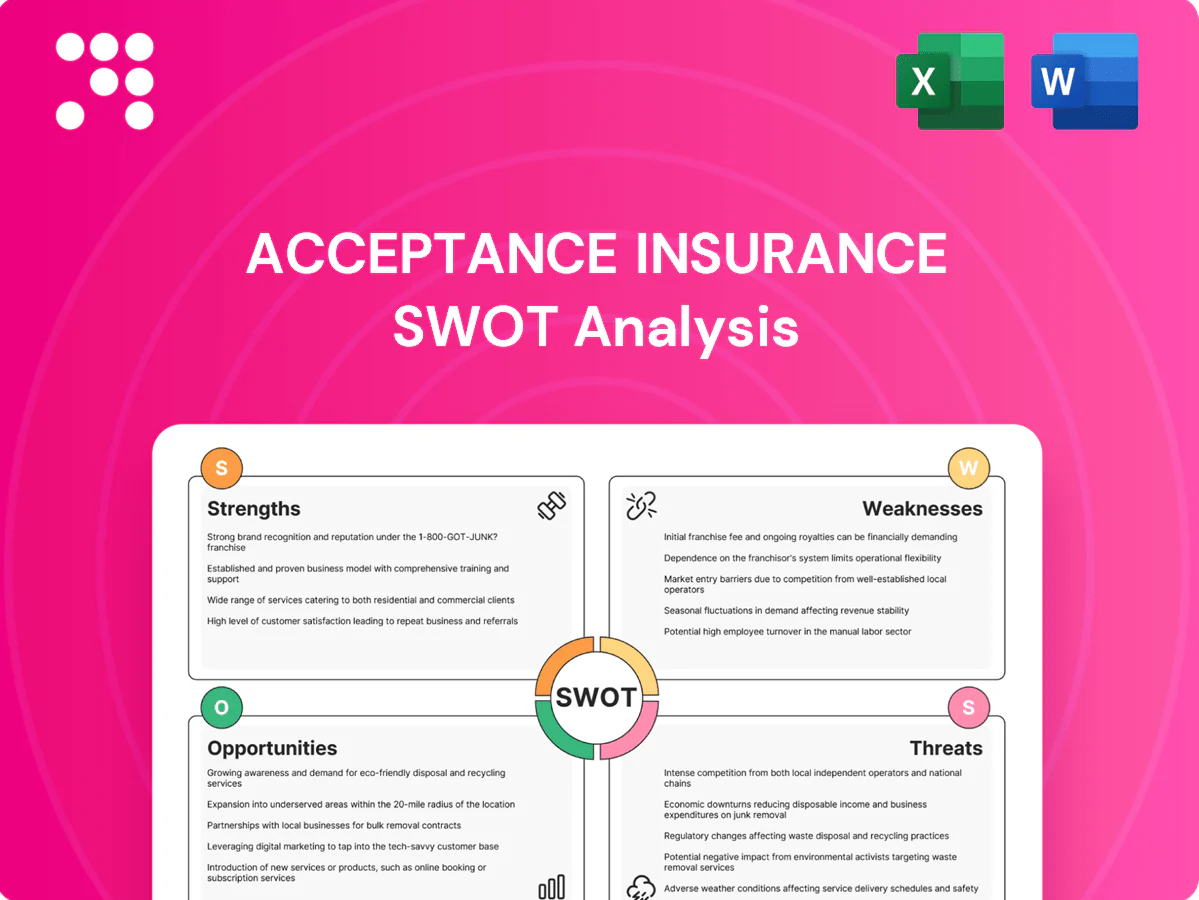
Acceptance Insurance SWOT Analysis

Dive Deeper Into the Company’s Strategic Blueprint
Explore a concise SWOT snapshot of Acceptance Insurance—highlighting its community-focused distribution strength, pricing pressures, regulatory exposure, and growth opportunities in digital underwriting. Want deeper strategic context, financial metrics, and editable deliverables? Purchase the full SWOT analysis for a professionally formatted Word report and Excel models to plan, pitch, or invest with confidence.
Strengths

Non-standard market specialization
Deep underwriting know-how for higher-risk drivers and SR-22 requirements enables tailored pricing and coverage, supporting a non-standard book that industry estimates at about 15% of U.S. private-passenger auto premiums. This niche focus reduces direct competition with standard carriers and supports disciplined risk selection, historically improving loss experience by roughly 5 percentage points versus broader markets. Experience-driven guidelines and state-specific regulatory expertise across core states enhance loss control and renewal economics.
Flexible payment options
Flexible installment plans, low down payments and convenient monthly billing increase accessibility and retention by allowing credit-constrained drivers to obtain and maintain coverage; predictable payment schedules also create more reliable premiums and cash flow. Smoothing affordability reduces lapse rates by addressing short-term affordability shocks and helps acquisition in underbanked segments. Integration with omnichannel collections and automated reminders further improves recovery and retention.

Multi-channel distribution
Acceptance’s retail stores, independent agents and digital platforms create synergy that widens reach and, per McKinsey 2024, can cut customer acquisition cost by up to 40% by blending low-cost funnels with high-trust touchpoints. LIMRA 2024 shows 41% of customers still prefer agents or local offices, where storefronts build trust while online quotes allow near-instant binds. Agents handle complex risks and drive cross-sell, and multi-channel redundancy dampens volume volatility.

Speedy underwriting and claims
- Streamlined underwriting tailored to non-standard auto
- STP for simple risks / same-day FNOL
- Triage + vendor network reduces cycle times
- Faster service links to higher retention and referrals
Pricing agility and data use
Acceptance Insurance files rates frequently and leverages granular segmentation plus driving history and territorial analytics to recalibrate risk rapidly; telematics and proxy data are used where available to refine pricing and reduce adverse selection. Robust feedback loops continuously map loss experience back into rating plans, giving the company pricing agility that serves as a competitive moat in volatile frequency and severity environments.
- Frequent filings
- Segmented risk models
- Driving history & territorial data
- Telematics/proxy integration
- Loss-to-rate feedback loops
- Agility as moat
Non-standard underwriting wins: 15% share, 5ppt better loss
Deep non-standard underwriting captures ~15% of US private-passenger auto premiums, delivering ~5ppt better loss experience versus market; flexible billing and omnichannel distribution cut lapses and lower CAC (McKinsey 2024: up to 40% reduction), while same-day FNOL and vendor networks speed claims and boost retention. Frequent filings, telematics use and feedback loops enable rapid repricing and margin protection.
| Metric | Value |
|---|---|
| Non-standard share | ~15% |
| Loss improvement | ~5 ppt |
| CAC reduction (multi-channel) | Up to 40% (McKinsey 2024) |
| Agent preference (LIMRA 2024) | 41% |
What is included in the product
 Detailed Word Document
Provides a concise SWOT analysis of Acceptance Insurance, highlighting its core strengths and weaknesses, identifying market opportunities for growth, and mapping external threats that could impact its competitive position and strategic direction.

 Customizable Excel Spreadsheet
Provides a concise, editable SWOT matrix for Acceptance Insurance that speeds strategic alignment, simplifies stakeholder-ready summaries, and allows quick updates as priorities change.
Weaknesses

Higher loss ratio volatility
Exposure to riskier drivers drives higher claims frequency and severity swings, contributing to historically wide loss ratio dispersion; industry analyses attribute roughly 20–30% higher liability severity since 2010 to social inflation. Sensitivity to social inflation, a ~5% medical-cost trend in 2024, and parts/repair inflation (peaked ~12% in 2022, ~4% in 2024) complicates forecasting and reserving. That volatility translates directly into earnings variability and heightened capital needs for Acceptance Insurance.
Brand awareness constraints
In mass-market auto, Acceptance’s regional footprint and brand recall lag national advertisers that spend over $1 billion annually, increasing customer acquisition costs. The company must rely heavily on agents and retail locations to compensate for lower direct-response reach. This can create a trust gap versus household names with national TV presence. Limited marketing scale hinders share gains in competitive media markets.

Technology debt and integration
Legacy policy and claims systems slow product updates and degrade digital UX, delaying feature releases by months and hampering the 70% of customers who prefer digital interactions. Integration pain across retail, agent and online channels creates manual work and inconsistent customer journeys. Data silos limit analytics and fraud detection, raising operational costs and contributing to expense ratios above the P&C industry average (~28% NAIC 2023).

Geographic and regulatory exposure
Acceptance Insurance’s concentration in a handful of states magnifies exposure to weather, legal, and regulatory shocks; delayed rate filings and Department of Insurance pushback have repeatedly constrained pricing actions and squeezed margins; use of non‑standard policy forms increases compliance complexity and filing fees; performance remains uneven across jurisdictions, with variable loss ratios and underwriting outcomes.
- Geographic concentration
- Rate filing delays
- DOI pushback
- Non‑standard form compliance
- Uneven jurisdictional performance
Limited diversification
Acceptance Insurance derives the majority of its premiums from personal auto—roughly 85%+ of net written premiums in 2024—creating revenue reliance on a single P&C segment. The narrow product mix limits cross-cycle resilience, exposing earnings to auto loss trends and rate-driven volatility. Cross-sell is constrained to basic ancillaries, keeping customer lifetime value low and amplifying earnings cyclicality.
- Personal auto concentration: ~85%+ of premiums (2024)
- Limited cross-sell beyond ancillaries
- Higher earnings volatility tied to auto loss cycles
Social inflation and medical/repair cost trends drive earnings swings; legacy tech boosts expenses
Claims volatility from social inflation (20–30% liability severity since 2010) and a ~5% medical-cost trend in 2024 drives earnings swings; parts/repair inflation (peak ~12% in 2022, ~4% in 2024) complicates reserving. Marketing lags national advertisers (> $1bn annual), raising acquisition costs and reliance on agents. Legacy systems and data silos push expense ratio above the NAIC 2023 average (~28%) and hinder fraud detection.
| Metric | Value |
|---|---|
| Personal auto concentration | 85%+ premiums (2024) |
| Expense ratio | ~28% (NAIC 2023) |
| Medical-cost trend | ~5% (2024) |
| Social inflation | 20–30% liability severity since 2010 |
| Parts/repair inflation | ~4% (2024); peak ~12% (2022) |
Preview the Actual Deliverable
Acceptance Insurance SWOT Analysis
This is the actual Acceptance Insurance SWOT analysis document you’ll receive upon purchase—no surprises, just professional quality and actionable insights. The preview below is taken directly from the full report and the complete, editable version is unlocked after checkout. Buy now to download the full, detailed analysis ready for use in strategy or investment decisions.

Dive Deeper Into the Company’s Strategic Blueprint
Explore a concise SWOT snapshot of Acceptance Insurance—highlighting its community-focused distribution strength, pricing pressures, regulatory exposure, and growth opportunities in digital underwriting. Want deeper strategic context, financial metrics, and editable deliverables? Purchase the full SWOT analysis for a professionally formatted Word report and Excel models to plan, pitch, or invest with confidence.
Strengths
Non-standard market specialization
Deep underwriting know-how for higher-risk drivers and SR-22 requirements enables tailored pricing and coverage, supporting a non-standard book that industry estimates at about 15% of U.S. private-passenger auto premiums. This niche focus reduces direct competition with standard carriers and supports disciplined risk selection, historically improving loss experience by roughly 5 percentage points versus broader markets. Experience-driven guidelines and state-specific regulatory expertise across core states enhance loss control and renewal economics.
Flexible payment options
Flexible installment plans, low down payments and convenient monthly billing increase accessibility and retention by allowing credit-constrained drivers to obtain and maintain coverage; predictable payment schedules also create more reliable premiums and cash flow. Smoothing affordability reduces lapse rates by addressing short-term affordability shocks and helps acquisition in underbanked segments. Integration with omnichannel collections and automated reminders further improves recovery and retention.
Multi-channel distribution
Acceptance’s retail stores, independent agents and digital platforms create synergy that widens reach and, per McKinsey 2024, can cut customer acquisition cost by up to 40% by blending low-cost funnels with high-trust touchpoints. LIMRA 2024 shows 41% of customers still prefer agents or local offices, where storefronts build trust while online quotes allow near-instant binds. Agents handle complex risks and drive cross-sell, and multi-channel redundancy dampens volume volatility.
Speedy underwriting and claims
- Streamlined underwriting tailored to non-standard auto
- STP for simple risks / same-day FNOL
- Triage + vendor network reduces cycle times
- Faster service links to higher retention and referrals
Pricing agility and data use
Acceptance Insurance files rates frequently and leverages granular segmentation plus driving history and territorial analytics to recalibrate risk rapidly; telematics and proxy data are used where available to refine pricing and reduce adverse selection. Robust feedback loops continuously map loss experience back into rating plans, giving the company pricing agility that serves as a competitive moat in volatile frequency and severity environments.
- Frequent filings
- Segmented risk models
- Driving history & territorial data
- Telematics/proxy integration
- Loss-to-rate feedback loops
- Agility as moat
Non-standard underwriting wins: 15% share, 5ppt better loss
Deep non-standard underwriting captures ~15% of US private-passenger auto premiums, delivering ~5ppt better loss experience versus market; flexible billing and omnichannel distribution cut lapses and lower CAC (McKinsey 2024: up to 40% reduction), while same-day FNOL and vendor networks speed claims and boost retention. Frequent filings, telematics use and feedback loops enable rapid repricing and margin protection.
| Metric | Value |
|---|---|
| Non-standard share | ~15% |
| Loss improvement | ~5 ppt |
| CAC reduction (multi-channel) | Up to 40% (McKinsey 2024) |
| Agent preference (LIMRA 2024) | 41% |
What is included in the product
Detailed Word Document
Provides a concise SWOT analysis of Acceptance Insurance, highlighting its core strengths and weaknesses, identifying market opportunities for growth, and mapping external threats that could impact its competitive position and strategic direction.
Customizable Excel Spreadsheet
Provides a concise, editable SWOT matrix for Acceptance Insurance that speeds strategic alignment, simplifies stakeholder-ready summaries, and allows quick updates as priorities change.
Weaknesses
Higher loss ratio volatility
Exposure to riskier drivers drives higher claims frequency and severity swings, contributing to historically wide loss ratio dispersion; industry analyses attribute roughly 20–30% higher liability severity since 2010 to social inflation. Sensitivity to social inflation, a ~5% medical-cost trend in 2024, and parts/repair inflation (peaked ~12% in 2022, ~4% in 2024) complicates forecasting and reserving. That volatility translates directly into earnings variability and heightened capital needs for Acceptance Insurance.
Brand awareness constraints
In mass-market auto, Acceptance’s regional footprint and brand recall lag national advertisers that spend over $1 billion annually, increasing customer acquisition costs. The company must rely heavily on agents and retail locations to compensate for lower direct-response reach. This can create a trust gap versus household names with national TV presence. Limited marketing scale hinders share gains in competitive media markets.
Technology debt and integration
Legacy policy and claims systems slow product updates and degrade digital UX, delaying feature releases by months and hampering the 70% of customers who prefer digital interactions. Integration pain across retail, agent and online channels creates manual work and inconsistent customer journeys. Data silos limit analytics and fraud detection, raising operational costs and contributing to expense ratios above the P&C industry average (~28% NAIC 2023).
Geographic and regulatory exposure
Acceptance Insurance’s concentration in a handful of states magnifies exposure to weather, legal, and regulatory shocks; delayed rate filings and Department of Insurance pushback have repeatedly constrained pricing actions and squeezed margins; use of non‑standard policy forms increases compliance complexity and filing fees; performance remains uneven across jurisdictions, with variable loss ratios and underwriting outcomes.
- Geographic concentration
- Rate filing delays
- DOI pushback
- Non‑standard form compliance
- Uneven jurisdictional performance
Limited diversification
Acceptance Insurance derives the majority of its premiums from personal auto—roughly 85%+ of net written premiums in 2024—creating revenue reliance on a single P&C segment. The narrow product mix limits cross-cycle resilience, exposing earnings to auto loss trends and rate-driven volatility. Cross-sell is constrained to basic ancillaries, keeping customer lifetime value low and amplifying earnings cyclicality.
- Personal auto concentration: ~85%+ of premiums (2024)
- Limited cross-sell beyond ancillaries
- Higher earnings volatility tied to auto loss cycles
Social inflation and medical/repair cost trends drive earnings swings; legacy tech boosts expenses
Claims volatility from social inflation (20–30% liability severity since 2010) and a ~5% medical-cost trend in 2024 drives earnings swings; parts/repair inflation (peak ~12% in 2022, ~4% in 2024) complicates reserving. Marketing lags national advertisers (> $1bn annual), raising acquisition costs and reliance on agents. Legacy systems and data silos push expense ratio above the NAIC 2023 average (~28%) and hinder fraud detection.
| Metric | Value |
|---|---|
| Personal auto concentration | 85%+ premiums (2024) |
| Expense ratio | ~28% (NAIC 2023) |
| Medical-cost trend | ~5% (2024) |
| Social inflation | 20–30% liability severity since 2010 |
| Parts/repair inflation | ~4% (2024); peak ~12% (2022) |
Preview the Actual Deliverable
Acceptance Insurance SWOT Analysis
This is the actual Acceptance Insurance SWOT analysis document you’ll receive upon purchase—no surprises, just professional quality and actionable insights. The preview below is taken directly from the full report and the complete, editable version is unlocked after checkout. Buy now to download the full, detailed analysis ready for use in strategy or investment decisions.
Original: $10.00
-65%$10.00
$3.50Description
Dive Deeper Into the Company’s Strategic Blueprint
Explore a concise SWOT snapshot of Acceptance Insurance—highlighting its community-focused distribution strength, pricing pressures, regulatory exposure, and growth opportunities in digital underwriting. Want deeper strategic context, financial metrics, and editable deliverables? Purchase the full SWOT analysis for a professionally formatted Word report and Excel models to plan, pitch, or invest with confidence.
Strengths
Non-standard market specialization
Deep underwriting know-how for higher-risk drivers and SR-22 requirements enables tailored pricing and coverage, supporting a non-standard book that industry estimates at about 15% of U.S. private-passenger auto premiums. This niche focus reduces direct competition with standard carriers and supports disciplined risk selection, historically improving loss experience by roughly 5 percentage points versus broader markets. Experience-driven guidelines and state-specific regulatory expertise across core states enhance loss control and renewal economics.
Flexible payment options
Flexible installment plans, low down payments and convenient monthly billing increase accessibility and retention by allowing credit-constrained drivers to obtain and maintain coverage; predictable payment schedules also create more reliable premiums and cash flow. Smoothing affordability reduces lapse rates by addressing short-term affordability shocks and helps acquisition in underbanked segments. Integration with omnichannel collections and automated reminders further improves recovery and retention.
Multi-channel distribution
Acceptance’s retail stores, independent agents and digital platforms create synergy that widens reach and, per McKinsey 2024, can cut customer acquisition cost by up to 40% by blending low-cost funnels with high-trust touchpoints. LIMRA 2024 shows 41% of customers still prefer agents or local offices, where storefronts build trust while online quotes allow near-instant binds. Agents handle complex risks and drive cross-sell, and multi-channel redundancy dampens volume volatility.
Speedy underwriting and claims
- Streamlined underwriting tailored to non-standard auto
- STP for simple risks / same-day FNOL
- Triage + vendor network reduces cycle times
- Faster service links to higher retention and referrals
Pricing agility and data use
Acceptance Insurance files rates frequently and leverages granular segmentation plus driving history and territorial analytics to recalibrate risk rapidly; telematics and proxy data are used where available to refine pricing and reduce adverse selection. Robust feedback loops continuously map loss experience back into rating plans, giving the company pricing agility that serves as a competitive moat in volatile frequency and severity environments.
- Frequent filings
- Segmented risk models
- Driving history & territorial data
- Telematics/proxy integration
- Loss-to-rate feedback loops
- Agility as moat
Non-standard underwriting wins: 15% share, 5ppt better loss
Deep non-standard underwriting captures ~15% of US private-passenger auto premiums, delivering ~5ppt better loss experience versus market; flexible billing and omnichannel distribution cut lapses and lower CAC (McKinsey 2024: up to 40% reduction), while same-day FNOL and vendor networks speed claims and boost retention. Frequent filings, telematics use and feedback loops enable rapid repricing and margin protection.
| Metric | Value |
|---|---|
| Non-standard share | ~15% |
| Loss improvement | ~5 ppt |
| CAC reduction (multi-channel) | Up to 40% (McKinsey 2024) |
| Agent preference (LIMRA 2024) | 41% |
What is included in the product
Detailed Word Document
Provides a concise SWOT analysis of Acceptance Insurance, highlighting its core strengths and weaknesses, identifying market opportunities for growth, and mapping external threats that could impact its competitive position and strategic direction.
Customizable Excel Spreadsheet
Provides a concise, editable SWOT matrix for Acceptance Insurance that speeds strategic alignment, simplifies stakeholder-ready summaries, and allows quick updates as priorities change.
Weaknesses
Higher loss ratio volatility
Exposure to riskier drivers drives higher claims frequency and severity swings, contributing to historically wide loss ratio dispersion; industry analyses attribute roughly 20–30% higher liability severity since 2010 to social inflation. Sensitivity to social inflation, a ~5% medical-cost trend in 2024, and parts/repair inflation (peaked ~12% in 2022, ~4% in 2024) complicates forecasting and reserving. That volatility translates directly into earnings variability and heightened capital needs for Acceptance Insurance.
Brand awareness constraints
In mass-market auto, Acceptance’s regional footprint and brand recall lag national advertisers that spend over $1 billion annually, increasing customer acquisition costs. The company must rely heavily on agents and retail locations to compensate for lower direct-response reach. This can create a trust gap versus household names with national TV presence. Limited marketing scale hinders share gains in competitive media markets.
Technology debt and integration
Legacy policy and claims systems slow product updates and degrade digital UX, delaying feature releases by months and hampering the 70% of customers who prefer digital interactions. Integration pain across retail, agent and online channels creates manual work and inconsistent customer journeys. Data silos limit analytics and fraud detection, raising operational costs and contributing to expense ratios above the P&C industry average (~28% NAIC 2023).
Geographic and regulatory exposure
Acceptance Insurance’s concentration in a handful of states magnifies exposure to weather, legal, and regulatory shocks; delayed rate filings and Department of Insurance pushback have repeatedly constrained pricing actions and squeezed margins; use of non‑standard policy forms increases compliance complexity and filing fees; performance remains uneven across jurisdictions, with variable loss ratios and underwriting outcomes.
- Geographic concentration
- Rate filing delays
- DOI pushback
- Non‑standard form compliance
- Uneven jurisdictional performance
Limited diversification
Acceptance Insurance derives the majority of its premiums from personal auto—roughly 85%+ of net written premiums in 2024—creating revenue reliance on a single P&C segment. The narrow product mix limits cross-cycle resilience, exposing earnings to auto loss trends and rate-driven volatility. Cross-sell is constrained to basic ancillaries, keeping customer lifetime value low and amplifying earnings cyclicality.
- Personal auto concentration: ~85%+ of premiums (2024)
- Limited cross-sell beyond ancillaries
- Higher earnings volatility tied to auto loss cycles
Social inflation and medical/repair cost trends drive earnings swings; legacy tech boosts expenses
Claims volatility from social inflation (20–30% liability severity since 2010) and a ~5% medical-cost trend in 2024 drives earnings swings; parts/repair inflation (peak ~12% in 2022, ~4% in 2024) complicates reserving. Marketing lags national advertisers (> $1bn annual), raising acquisition costs and reliance on agents. Legacy systems and data silos push expense ratio above the NAIC 2023 average (~28%) and hinder fraud detection.
| Metric | Value |
|---|---|
| Personal auto concentration | 85%+ premiums (2024) |
| Expense ratio | ~28% (NAIC 2023) |
| Medical-cost trend | ~5% (2024) |
| Social inflation | 20–30% liability severity since 2010 |
| Parts/repair inflation | ~4% (2024); peak ~12% (2022) |
Preview the Actual Deliverable
Acceptance Insurance SWOT Analysis
This is the actual Acceptance Insurance SWOT analysis document you’ll receive upon purchase—no surprises, just professional quality and actionable insights. The preview below is taken directly from the full report and the complete, editable version is unlocked after checkout. Buy now to download the full, detailed analysis ready for use in strategy or investment decisions.











