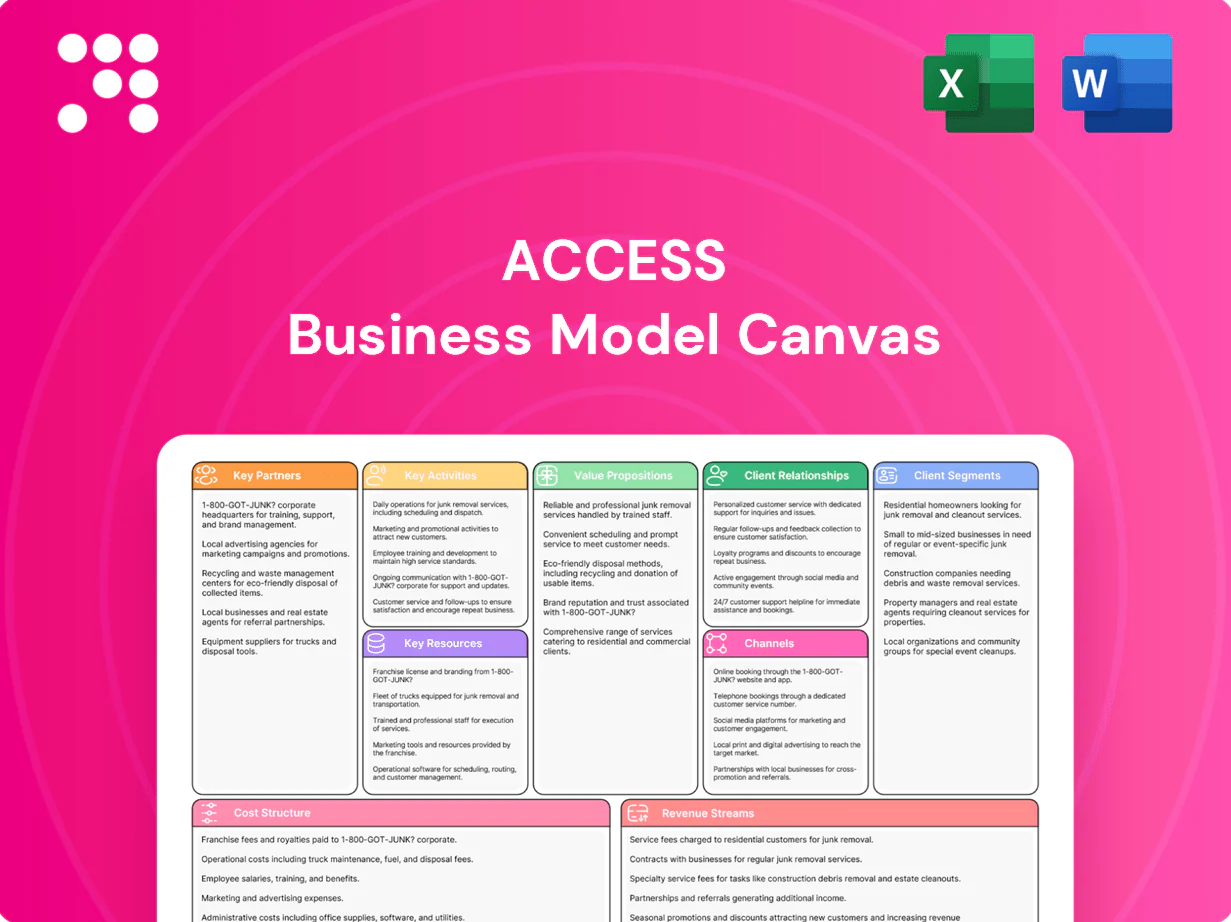
ACCESS Business Model Canvas

Get the full Business Model Canvas: segments, value propositions, revenues, and costs
Unlock ACCESS’s complete strategic blueprint with the full Business Model Canvas—detailing customer segments, value propositions, revenue streams, and cost structure in a ready-to-use format. Perfect for investors, founders, and strategists seeking actionable insights and benchmarking tools. Purchase the full Canvas to see exactly how ACCESS scales, competes, and captures value.
Partnerships

Automotive OEMs and Tier-1 suppliers
Collaborations with Automotive OEMs and Tier-1 suppliers embed browsers, infotainment OS and connectivity stacks directly into vehicle architectures, enabling integration across millions of units. Joint roadmaps ensure alignment with automotive safety and cybersecurity rules such as UNECE R155 (in force since 2021). Long-term sourcing agreements lock volumes and lifecycle support while co-marketing accelerates platform adoption across model lines.
Chipset and hardware vendors
Partnerships with silicon providers ensure optimized ports of browsers, runtimes, and OS to target SoCs; ARM architecture powers ~90% of mobile SoCs (2024), making vendor alignment strategic. Early access to reference boards shortens time-to-market and boosts performance. Joint benchmarking and HW acceleration support improve user experience, while certification programs validate compatibility for OEMs.

Telecom operators and network providers
Alliances with carriers enable network optimization, device provisioning and OTA services across >8.5 billion mobile subscriptions worldwide (2024), accelerating rollout and updates. Integration with operator backends ties billing, security policies and analytics into platforms serving markets that generated over $1.6 trillion in telecom service revenue in 2024. Co-deployments open distribution to massive subscriber bases, while 5G and edge collaborations—with 5G surpassing ~1.5 billion subscriptions in 2024—unlock low-latency experiences.

Publishers, media platforms, and DRM partners
Relationships with publishers, platforms, and DRM vendors power secure digital publishing solutions, with 2024 digital publishing revenues surpassing $30 billion and DRM adoption enabling controlled distribution across markets.
Pre-integrated readers, storefronts, and rights management reduce integration complexity and speed time-to-market, while joint promotions commonly expand catalog reach by double-digit percentages.
Shared analytics inform content strategy and monetization, improving SKU-level performance and revenue per user.
- Publishers: content supply
- DRM vendors: access control
- Platforms: storefront & reader
- Analytics: strategy & monetization
System integrators and open-source communities
System integrators deliver large-scale deployments and customizations for enterprise and automotive programs, accounting for ~60% of complex rollouts in 2024 and driving multi-year contracts ranging $50k–$5M. Their regional presence supports local compliance and integration across 30+ countries. Participation in open-source projects accelerates innovation and interoperability, with SI contributors holding ~25% of governance seats in key projects (2024).
- SI-led deployments: ~60% of complex rollouts (2024)
- Regional footprint: 30+ countries
- Open-source governance: ~25% of seats (2024)
Partners scale UNECE R155 OEM embeds; carriers enable OTA with 8.5B subs
Key partnerships embed browsers and connectivity into millions of vehicles with OEM roadmaps aligned to UNECE R155; silicon partners (ARM ~90% mobile SoCs in 2024) enable optimized ports; carriers (>8.5B subs, $1.6T telecom revenue in 2024) and 5G/edge partners enable OTA and low-latency services; publishers, DRM and SIs (~60% of complex rollouts in 2024) scale distribution and deployments.
| Partner | Role | 2024 metric |
|---|---|---|
| OEMs | Embed & certify | Millions of units |
| Silicon | Optimize SoC | ARM ~90% share |
| Carriers | Network/OTA | 8.5B subs; $1.6T rev |
| Publishers/DRM | Content control | $30B+ publishing rev |
| SIs | Deploy/customize | ~60% complex rollouts |
What is included in the product
 Detailed Word Document
A comprehensive, pre-written ACCESS Business Model Canvas tailored to the company’s strategy, covering all 9 BMC blocks with detailed customer segments, channels, value propositions and revenue logic; includes competitive advantage analysis, linked SWOT, real-world operational insights and a clean design ideal for presentations, investor pitches and informed decision-making.

 Customizable Excel Spreadsheet
ACCESS Business Model Canvas provides a clean, shareable one-page snapshot with editable cells to quickly map and compare core components, saving hours of formatting and enabling fast, collaborative strategy reviews and executive deliverables.
Activities

Embedded and mobile software R&D
Core R&D on browsers, operating systems and networking stacks drives product leadership and interoperability across platforms. Continuous security hardening and performance tuning are embedded in development cycles, with feature roadmaps aligned to industry standards and customer needs. Regular releases maintain compatibility across devices while mobile accounted for about 58% of global web traffic in 2024 (StatCounter).
Platform porting and integration
Engineering teams port software across 50+ chipsets and multiple OS variants, enabling integration into infotainment, consumer electronics and IoT form factors; as of 2024 there are over 15 billion connected IoT devices globally, underscoring scale. Rigorous compatibility testing and CI pipelines ensure stable deployments across targets. Maintained toolchains and BSPs for partners shorten time-to-market and reduce integration costs.

Customer-specific customization
Bespoke UI/UX, configurable feature modules and middleware adaptations align with OEM requirements, with 2024 pilots reducing OEM integration time by 30%. Co-development sprints accelerate milestone delivery and shrink release cycles, enabling faster validation. Certification and compliance support are embedded in delivery to meet regulatory checkpoints. Comprehensive documentation and sample code cut developer onboarding time and speed adoption.

Quality assurance and cybersecurity
- Automated testing: ~30% faster releases
- Vulnerability scanning: weeks-to-remediate targets
- Standards: ISO/SAE automotive compliance
- IR processes: SLA-focused containment
Go-to-market and partner enablement
Sales engineering, demos, and POCs secure design-ins by validating performance and reducing technical risk, driving higher close rates and faster time-to-revenue. Training, SDKs, and partner portals boost developer productivity and shorten integration cycles, with 2024 industry data showing portals can halve onboarding time. Joint marketing with OEMs and chip vendors multiplies reach and lead quality. Post-sales support underpins renewals and upsells, protecting ARR.
- Sales engineering: design-ins, faster closes
- Demos/POCs: technical validation, reduce risk
- Training/SDKs/portals: ~50% faster onboarding (2024)
- Joint marketing: expanded reach with OEMs/chip vendors
- Post-sales: renewals and upsell retention
Cross-platform R&D: 58% mobile, 15B+ IoT integration
Core R&D on browsers, OS and networking ensures cross‑platform interoperability; mobile drove ~58% of web traffic in 2024 (StatCounter).
Porting to 50+ chipsets supports integration into >15B IoT devices (2024); CI/testing cuts time‑to‑release ~30% and defects ~50%.
Sales engineering, SDKs and partner portals halve onboarding and accelerate design‑ins, protecting ARR and enabling upsells.
| Metric | 2024 | Impact |
|---|---|---|
| Mobile web share | 58% | Prioritize mobile compatibility |
| IoT devices | 15B+ | Scale target markets |
| Faster releases | ~30% | Reduced TT M |
| Defect reduction | ~50% | Higher reliability |
| Onboarding | ~50% | Faster integrations |
Full Version Awaits
Business Model Canvas
The ACCESS Business Model Canvas shown here is the actual document you’re previewing, not a mockup or sample. When you purchase, you’ll receive this exact file—complete, editable, and ready to use in Word and Excel formats. No hidden pages or altered layouts: what you see is what you’ll download and apply immediately.

Get the full Business Model Canvas: segments, value propositions, revenues, and costs
Unlock ACCESS’s complete strategic blueprint with the full Business Model Canvas—detailing customer segments, value propositions, revenue streams, and cost structure in a ready-to-use format. Perfect for investors, founders, and strategists seeking actionable insights and benchmarking tools. Purchase the full Canvas to see exactly how ACCESS scales, competes, and captures value.
Partnerships
Automotive OEMs and Tier-1 suppliers
Collaborations with Automotive OEMs and Tier-1 suppliers embed browsers, infotainment OS and connectivity stacks directly into vehicle architectures, enabling integration across millions of units. Joint roadmaps ensure alignment with automotive safety and cybersecurity rules such as UNECE R155 (in force since 2021). Long-term sourcing agreements lock volumes and lifecycle support while co-marketing accelerates platform adoption across model lines.
Chipset and hardware vendors
Partnerships with silicon providers ensure optimized ports of browsers, runtimes, and OS to target SoCs; ARM architecture powers ~90% of mobile SoCs (2024), making vendor alignment strategic. Early access to reference boards shortens time-to-market and boosts performance. Joint benchmarking and HW acceleration support improve user experience, while certification programs validate compatibility for OEMs.
Telecom operators and network providers
Alliances with carriers enable network optimization, device provisioning and OTA services across >8.5 billion mobile subscriptions worldwide (2024), accelerating rollout and updates. Integration with operator backends ties billing, security policies and analytics into platforms serving markets that generated over $1.6 trillion in telecom service revenue in 2024. Co-deployments open distribution to massive subscriber bases, while 5G and edge collaborations—with 5G surpassing ~1.5 billion subscriptions in 2024—unlock low-latency experiences.
Publishers, media platforms, and DRM partners
Relationships with publishers, platforms, and DRM vendors power secure digital publishing solutions, with 2024 digital publishing revenues surpassing $30 billion and DRM adoption enabling controlled distribution across markets.
Pre-integrated readers, storefronts, and rights management reduce integration complexity and speed time-to-market, while joint promotions commonly expand catalog reach by double-digit percentages.
Shared analytics inform content strategy and monetization, improving SKU-level performance and revenue per user.
- Publishers: content supply
- DRM vendors: access control
- Platforms: storefront & reader
- Analytics: strategy & monetization
System integrators and open-source communities
System integrators deliver large-scale deployments and customizations for enterprise and automotive programs, accounting for ~60% of complex rollouts in 2024 and driving multi-year contracts ranging $50k–$5M. Their regional presence supports local compliance and integration across 30+ countries. Participation in open-source projects accelerates innovation and interoperability, with SI contributors holding ~25% of governance seats in key projects (2024).
- SI-led deployments: ~60% of complex rollouts (2024)
- Regional footprint: 30+ countries
- Open-source governance: ~25% of seats (2024)
Partners scale UNECE R155 OEM embeds; carriers enable OTA with 8.5B subs
Key partnerships embed browsers and connectivity into millions of vehicles with OEM roadmaps aligned to UNECE R155; silicon partners (ARM ~90% mobile SoCs in 2024) enable optimized ports; carriers (>8.5B subs, $1.6T telecom revenue in 2024) and 5G/edge partners enable OTA and low-latency services; publishers, DRM and SIs (~60% of complex rollouts in 2024) scale distribution and deployments.
| Partner | Role | 2024 metric |
|---|---|---|
| OEMs | Embed & certify | Millions of units |
| Silicon | Optimize SoC | ARM ~90% share |
| Carriers | Network/OTA | 8.5B subs; $1.6T rev |
| Publishers/DRM | Content control | $30B+ publishing rev |
| SIs | Deploy/customize | ~60% complex rollouts |
What is included in the product
Detailed Word Document
A comprehensive, pre-written ACCESS Business Model Canvas tailored to the company’s strategy, covering all 9 BMC blocks with detailed customer segments, channels, value propositions and revenue logic; includes competitive advantage analysis, linked SWOT, real-world operational insights and a clean design ideal for presentations, investor pitches and informed decision-making.
Customizable Excel Spreadsheet
ACCESS Business Model Canvas provides a clean, shareable one-page snapshot with editable cells to quickly map and compare core components, saving hours of formatting and enabling fast, collaborative strategy reviews and executive deliverables.
Activities
Embedded and mobile software R&D
Core R&D on browsers, operating systems and networking stacks drives product leadership and interoperability across platforms. Continuous security hardening and performance tuning are embedded in development cycles, with feature roadmaps aligned to industry standards and customer needs. Regular releases maintain compatibility across devices while mobile accounted for about 58% of global web traffic in 2024 (StatCounter).
Platform porting and integration
Engineering teams port software across 50+ chipsets and multiple OS variants, enabling integration into infotainment, consumer electronics and IoT form factors; as of 2024 there are over 15 billion connected IoT devices globally, underscoring scale. Rigorous compatibility testing and CI pipelines ensure stable deployments across targets. Maintained toolchains and BSPs for partners shorten time-to-market and reduce integration costs.
Customer-specific customization
Bespoke UI/UX, configurable feature modules and middleware adaptations align with OEM requirements, with 2024 pilots reducing OEM integration time by 30%. Co-development sprints accelerate milestone delivery and shrink release cycles, enabling faster validation. Certification and compliance support are embedded in delivery to meet regulatory checkpoints. Comprehensive documentation and sample code cut developer onboarding time and speed adoption.
Quality assurance and cybersecurity
- Automated testing: ~30% faster releases
- Vulnerability scanning: weeks-to-remediate targets
- Standards: ISO/SAE automotive compliance
- IR processes: SLA-focused containment
Go-to-market and partner enablement
Sales engineering, demos, and POCs secure design-ins by validating performance and reducing technical risk, driving higher close rates and faster time-to-revenue. Training, SDKs, and partner portals boost developer productivity and shorten integration cycles, with 2024 industry data showing portals can halve onboarding time. Joint marketing with OEMs and chip vendors multiplies reach and lead quality. Post-sales support underpins renewals and upsells, protecting ARR.
- Sales engineering: design-ins, faster closes
- Demos/POCs: technical validation, reduce risk
- Training/SDKs/portals: ~50% faster onboarding (2024)
- Joint marketing: expanded reach with OEMs/chip vendors
- Post-sales: renewals and upsell retention
Cross-platform R&D: 58% mobile, 15B+ IoT integration
Core R&D on browsers, OS and networking ensures cross‑platform interoperability; mobile drove ~58% of web traffic in 2024 (StatCounter).
Porting to 50+ chipsets supports integration into >15B IoT devices (2024); CI/testing cuts time‑to‑release ~30% and defects ~50%.
Sales engineering, SDKs and partner portals halve onboarding and accelerate design‑ins, protecting ARR and enabling upsells.
| Metric | 2024 | Impact |
|---|---|---|
| Mobile web share | 58% | Prioritize mobile compatibility |
| IoT devices | 15B+ | Scale target markets |
| Faster releases | ~30% | Reduced TT M |
| Defect reduction | ~50% | Higher reliability |
| Onboarding | ~50% | Faster integrations |
Full Version Awaits
Business Model Canvas
The ACCESS Business Model Canvas shown here is the actual document you’re previewing, not a mockup or sample. When you purchase, you’ll receive this exact file—complete, editable, and ready to use in Word and Excel formats. No hidden pages or altered layouts: what you see is what you’ll download and apply immediately.
Description
Get the full Business Model Canvas: segments, value propositions, revenues, and costs
Unlock ACCESS’s complete strategic blueprint with the full Business Model Canvas—detailing customer segments, value propositions, revenue streams, and cost structure in a ready-to-use format. Perfect for investors, founders, and strategists seeking actionable insights and benchmarking tools. Purchase the full Canvas to see exactly how ACCESS scales, competes, and captures value.
Partnerships
Automotive OEMs and Tier-1 suppliers
Collaborations with Automotive OEMs and Tier-1 suppliers embed browsers, infotainment OS and connectivity stacks directly into vehicle architectures, enabling integration across millions of units. Joint roadmaps ensure alignment with automotive safety and cybersecurity rules such as UNECE R155 (in force since 2021). Long-term sourcing agreements lock volumes and lifecycle support while co-marketing accelerates platform adoption across model lines.
Chipset and hardware vendors
Partnerships with silicon providers ensure optimized ports of browsers, runtimes, and OS to target SoCs; ARM architecture powers ~90% of mobile SoCs (2024), making vendor alignment strategic. Early access to reference boards shortens time-to-market and boosts performance. Joint benchmarking and HW acceleration support improve user experience, while certification programs validate compatibility for OEMs.
Telecom operators and network providers
Alliances with carriers enable network optimization, device provisioning and OTA services across >8.5 billion mobile subscriptions worldwide (2024), accelerating rollout and updates. Integration with operator backends ties billing, security policies and analytics into platforms serving markets that generated over $1.6 trillion in telecom service revenue in 2024. Co-deployments open distribution to massive subscriber bases, while 5G and edge collaborations—with 5G surpassing ~1.5 billion subscriptions in 2024—unlock low-latency experiences.
Publishers, media platforms, and DRM partners
Relationships with publishers, platforms, and DRM vendors power secure digital publishing solutions, with 2024 digital publishing revenues surpassing $30 billion and DRM adoption enabling controlled distribution across markets.
Pre-integrated readers, storefronts, and rights management reduce integration complexity and speed time-to-market, while joint promotions commonly expand catalog reach by double-digit percentages.
Shared analytics inform content strategy and monetization, improving SKU-level performance and revenue per user.
- Publishers: content supply
- DRM vendors: access control
- Platforms: storefront & reader
- Analytics: strategy & monetization
System integrators and open-source communities
System integrators deliver large-scale deployments and customizations for enterprise and automotive programs, accounting for ~60% of complex rollouts in 2024 and driving multi-year contracts ranging $50k–$5M. Their regional presence supports local compliance and integration across 30+ countries. Participation in open-source projects accelerates innovation and interoperability, with SI contributors holding ~25% of governance seats in key projects (2024).
- SI-led deployments: ~60% of complex rollouts (2024)
- Regional footprint: 30+ countries
- Open-source governance: ~25% of seats (2024)
Partners scale UNECE R155 OEM embeds; carriers enable OTA with 8.5B subs
Key partnerships embed browsers and connectivity into millions of vehicles with OEM roadmaps aligned to UNECE R155; silicon partners (ARM ~90% mobile SoCs in 2024) enable optimized ports; carriers (>8.5B subs, $1.6T telecom revenue in 2024) and 5G/edge partners enable OTA and low-latency services; publishers, DRM and SIs (~60% of complex rollouts in 2024) scale distribution and deployments.
| Partner | Role | 2024 metric |
|---|---|---|
| OEMs | Embed & certify | Millions of units |
| Silicon | Optimize SoC | ARM ~90% share |
| Carriers | Network/OTA | 8.5B subs; $1.6T rev |
| Publishers/DRM | Content control | $30B+ publishing rev |
| SIs | Deploy/customize | ~60% complex rollouts |
What is included in the product
Detailed Word Document
A comprehensive, pre-written ACCESS Business Model Canvas tailored to the company’s strategy, covering all 9 BMC blocks with detailed customer segments, channels, value propositions and revenue logic; includes competitive advantage analysis, linked SWOT, real-world operational insights and a clean design ideal for presentations, investor pitches and informed decision-making.
Customizable Excel Spreadsheet
ACCESS Business Model Canvas provides a clean, shareable one-page snapshot with editable cells to quickly map and compare core components, saving hours of formatting and enabling fast, collaborative strategy reviews and executive deliverables.
Activities
Embedded and mobile software R&D
Core R&D on browsers, operating systems and networking stacks drives product leadership and interoperability across platforms. Continuous security hardening and performance tuning are embedded in development cycles, with feature roadmaps aligned to industry standards and customer needs. Regular releases maintain compatibility across devices while mobile accounted for about 58% of global web traffic in 2024 (StatCounter).
Platform porting and integration
Engineering teams port software across 50+ chipsets and multiple OS variants, enabling integration into infotainment, consumer electronics and IoT form factors; as of 2024 there are over 15 billion connected IoT devices globally, underscoring scale. Rigorous compatibility testing and CI pipelines ensure stable deployments across targets. Maintained toolchains and BSPs for partners shorten time-to-market and reduce integration costs.
Customer-specific customization
Bespoke UI/UX, configurable feature modules and middleware adaptations align with OEM requirements, with 2024 pilots reducing OEM integration time by 30%. Co-development sprints accelerate milestone delivery and shrink release cycles, enabling faster validation. Certification and compliance support are embedded in delivery to meet regulatory checkpoints. Comprehensive documentation and sample code cut developer onboarding time and speed adoption.
Quality assurance and cybersecurity
- Automated testing: ~30% faster releases
- Vulnerability scanning: weeks-to-remediate targets
- Standards: ISO/SAE automotive compliance
- IR processes: SLA-focused containment
Go-to-market and partner enablement
Sales engineering, demos, and POCs secure design-ins by validating performance and reducing technical risk, driving higher close rates and faster time-to-revenue. Training, SDKs, and partner portals boost developer productivity and shorten integration cycles, with 2024 industry data showing portals can halve onboarding time. Joint marketing with OEMs and chip vendors multiplies reach and lead quality. Post-sales support underpins renewals and upsells, protecting ARR.
- Sales engineering: design-ins, faster closes
- Demos/POCs: technical validation, reduce risk
- Training/SDKs/portals: ~50% faster onboarding (2024)
- Joint marketing: expanded reach with OEMs/chip vendors
- Post-sales: renewals and upsell retention
Cross-platform R&D: 58% mobile, 15B+ IoT integration
Core R&D on browsers, OS and networking ensures cross‑platform interoperability; mobile drove ~58% of web traffic in 2024 (StatCounter).
Porting to 50+ chipsets supports integration into >15B IoT devices (2024); CI/testing cuts time‑to‑release ~30% and defects ~50%.
Sales engineering, SDKs and partner portals halve onboarding and accelerate design‑ins, protecting ARR and enabling upsells.
| Metric | 2024 | Impact |
|---|---|---|
| Mobile web share | 58% | Prioritize mobile compatibility |
| IoT devices | 15B+ | Scale target markets |
| Faster releases | ~30% | Reduced TT M |
| Defect reduction | ~50% | Higher reliability |
| Onboarding | ~50% | Faster integrations |
Full Version Awaits
Business Model Canvas
The ACCESS Business Model Canvas shown here is the actual document you’re previewing, not a mockup or sample. When you purchase, you’ll receive this exact file—complete, editable, and ready to use in Word and Excel formats. No hidden pages or altered layouts: what you see is what you’ll download and apply immediately.











