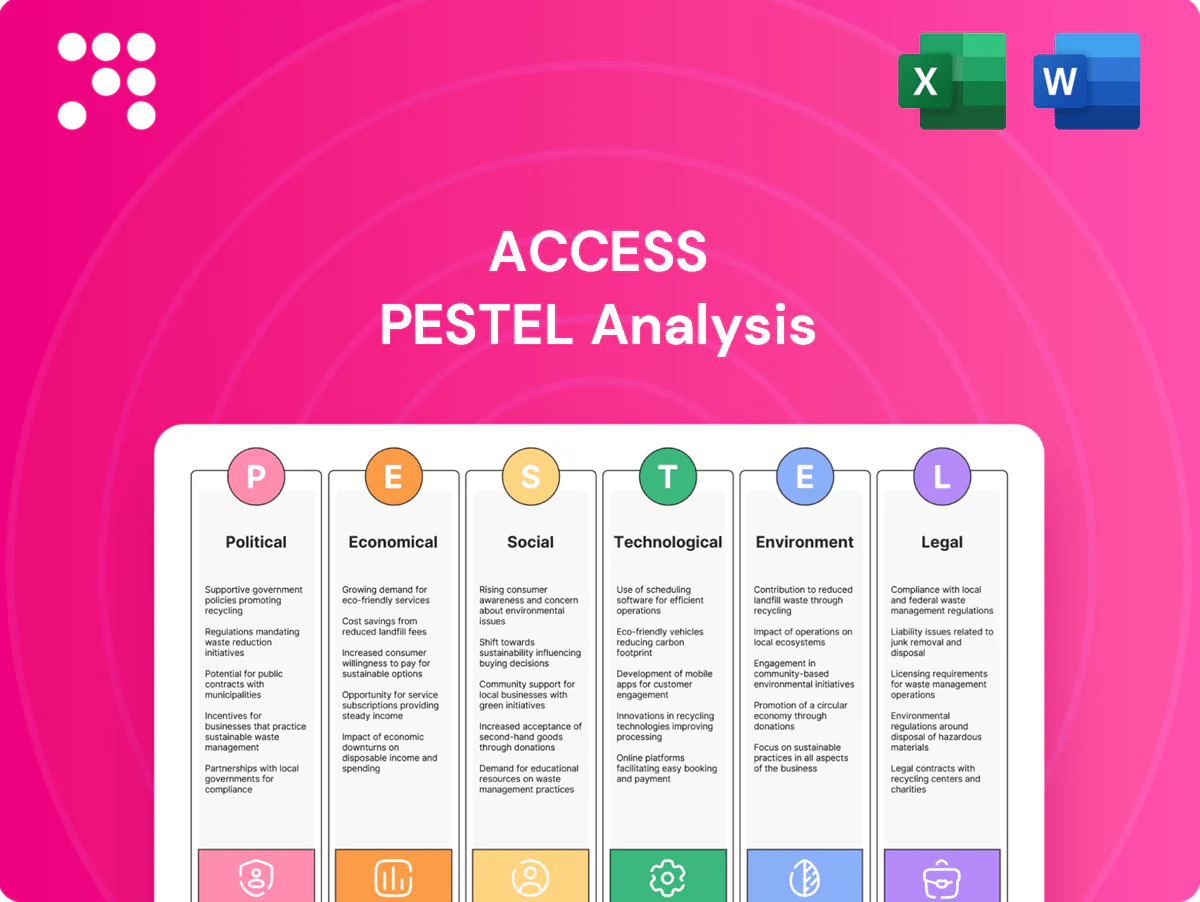
ACCESS PESTLE Analysis

Plan Smarter. Present Sharper. Compete Stronger.
Gain a strategic advantage with our PESTLE Analysis of ACCESS—clear, concise insights into political, economic, social, technological, legal, and environmental forces shaping the company’s future. Ideal for investors and strategists, the full report offers actionable intelligence and ready-to-use data. Purchase now to download the complete analysis instantly.
Political factors

Digital sovereignty and data localization
Governments increasingly require local storage and processing for consumer and vehicle data; China mandates local storage for critical/important data and India’s RBI requires payments data be stored in-country. ACCESS must architect regional clouds and data routing to respect localization and reduce latency. Non-compliance risks service blocks and fines (GDPR up to 4% of global turnover). Aligning with sovereign cloud partners de-risks deployments and expedites market access.
Trade tensions and export controls
US–China tech restrictions and tightened encryption export rules (US Commerce Entity List exceeded 1,000 entries by 2024) can block software components and markets; ACCESS must map supplier dependency chains and maintain export‑control compliant builds. Dual‑sourcing and modular designs cut replacement lead times (often months) and supply risk, while proactive licensing and automated screening sustain revenue continuity.

Public-sector digital subsidies
Public-sector digital subsidies—including the EU Digital Europe programme budgeted at €7.5bn for 2021–27—prioritize 5G, smart mobility and digital publishing modernization; ACCESS should align product roadmaps to meet grant and pilot criteria. Demonstrating measurable local ecosystem benefits raises award probabilities, while active tracking of national and EU tender calendars accelerates market entry and pilot wins.

Cybersecurity mandates in critical systems
Automotive and IoT now face security-by-design rules; ACCESS must embed secure boot, SBOMs and OTA patchability to meet buyer and regulator expectations. UNECE R155/R156 and EU rules make certification a commercial prerequisite, with the automotive cybersecurity market forecast near 13.5 billion USD by 2025, raising compliance value. Early certification can create a durable competitive moat by turning compliance into a sales enabler.
- Secure boot required
- SBOMs for provenance
- OTA patchability mandatory
- UNECE R155/R156 = sales prerequisite
Standards and regulatory harmonization
Fragmented standards across regions inflate engineering costs and delay product launches; ISO reports 167 national members and over 24,000 international standards as of 2024, underscoring the scale of the landscape. ACCESS should prioritize globally accepted stacks with region-specific compliance layers and maintain active participation in standards bodies to shape favorable outcomes and reduce redesign cycles and time-to-market.
- Prioritize global stacks + regional compliance
- Engage ISO/IEEE working groups
- Harmonization = fewer redesigns, faster launches
Regulatory squeeze: local data, export controls and secure regional clouds
Governments demand local data storage (China, India) and violate risks include GDPR fines up to 4% turnover; ACCESS must regionalize clouds to avoid blocks. Tech export controls (US Entity List >1,000 by 2024) and encryption rules force dual‑sourcing and compliant builds. Public subsidies (EU Digital Europe €7.5bn) and UNECE/autotech rules (R155/R156; auto cybersecurity market ~$13.5bn by 2025) favor certified, secure offerings.
| Factor | Key Metric |
|---|---|
| Data localization | GDPR fines ≤4% global turnover |
| Export controls | US Entity List >1,000 (2024) |
| Subsidies | EU Digital Europe €7.5bn (2021–27) |
| Auto security | Market ≈ $13.5bn (2025) |
What is included in the product
 Detailed Word Document
Explores how macro-environmental factors uniquely affect ACCESS across Political, Economic, Social, Technological, Environmental and Legal dimensions, providing data-backed, region- and industry-specific insights and forward-looking scenarios to help executives, consultants and entrepreneurs identify risks, opportunities and strategy-ready actions.

 Customizable Excel Spreadsheet
ACCESS PESTLE delivers a clean, visually segmented summary by PESTLE category that’s easily shareable and export-ready for presentations, with editable notes for regional or business-line context to speed alignment across teams.
Economic factors

IT spending cycles and macro volatility
Enterprise and OEM budgets swing with rates and growth—global IT spending was about 5.3 trillion in 2024 while policy rates (US fed funds ~5.25% in 2024) have tightened capex. ACCESS can balance long-cycle automotive contracts with shorter-cycle consumer and publishing work to smooth revenue. Flexible pricing and modular upsells help defend margins, and scenario planning guides capacity and staffing decisions.
Currency exposure (JPY vs. USD/EUR)
Global contracts expose ACCESS to JPY vs USD/EUR swings—USD/JPY traded roughly 140–160 during 2024–H1 2025, amplifying translation risk. Natural hedging through cost–revenue matching and FX forwards/options mitigates earnings volatility; cash-flow hedges and FX swaps are commonly used. Multi-currency pricing and local invoicing reduce transaction friction, while explicit FX-pass-through clauses stabilize operating cash flows.

Automotive and CE demand sensitivity
Global device shipments (~1.1–1.3 billion smartphones in 2024 per IDC) and vehicle production (≈79 million light vehicles in 2024, IHS Markit) drive embedded royalties, so ACCESS should diversify across OEM tiers and geographies to smooth volatility. Design wins on platforms with 5–10 year lifecycles cushion downturns, while the global automotive aftermarket and services (~$487B in 2024, Statista) add countercyclical revenue.

Shift to recurring SaaS and support
Transitioning from perpetual licenses to recurring SaaS smooths revenue and improves ARR predictability but often pressures near-term cash as upfront license fees convert to amortized subscription receipts; the global SaaS market was valued at about 197.6 billion USD in 2023 and is forecasted to grow to ~307.3 billion USD by 2026 (roughly 13% CAGR), underscoring the strategic imperative. CLEAR service tiers and SLA-backed offerings support measurable ARPU uplift, while land-and-expand OEM motions extend customer LTV; usage-based pricing further aligns monetization with adoption and can increase net retention.
- Revenue visibility: ARR replaces lumpy license spikes
- Cash impact: short-term cash conversion pressure
- ARPU: tiered SLAs enable premium pricing
- LTV: OEM land-and-expand boosts lifetime value
- Pricing: usage-based ties revenue to consumption
Industry consolidation and M&A
Industry consolidation is concentrating embedded software around full-stack vendors, enabling ACCESS to acquire niche security or edge-AI capabilities or form partnerships to scale distribution.
Rigorous integration discipline—standardized APIs, modular architectures and price/ops governance—preserves margins during roll-ups and partnerships.
Being an attractive acquisition target increases strategic optionality, unlocking premium exit valuations and joint-venture leverage.
- tags: consolidation, M&A, acquisitions, partnerships, security, edge-AI, integration, margins, strategic optionality
Regulatory squeeze: local data, export controls and secure regional clouds
ACCESS faces demand sensitivity to macro rates and IT spend (global IT ≈$5.3T in 2024; US fed funds ≈5.25%), FX translation risk (USD/JPY ~140–160 in 2024–H1 2025) and sector cyclicality from device (~1.2B smartphones 2024) and auto (≈79M light vehicles 2024). SaaS transition (market ≈$198B 2023) boosts ARR but pressures near-term cash; pricing flexibility and hedging mitigate volatility.
| Metric | Value | Implication |
|---|---|---|
| Global IT spend | $5.3T (2024) | Demand driver |
| Fed funds | ≈5.25% (2024) | Capex tightening |
| USD/JPY | 140–160 (2024–H1 2025) | FX volatility |
| Smartphones | ~1.2B (2024) | royalty tail |
| Light vehicles | ≈79M (2024) | embedded demand |
What You See Is What You Get
ACCESS PESTLE Analysis
The preview shown here is the exact ACCESS PESTLE Analysis document you’ll receive after purchase—fully formatted and ready to use. This is the real, final file with the same content, layout and structure visible in the preview. After checkout you’ll be able to download the identical, professionally structured report instantly.

Plan Smarter. Present Sharper. Compete Stronger.
Gain a strategic advantage with our PESTLE Analysis of ACCESS—clear, concise insights into political, economic, social, technological, legal, and environmental forces shaping the company’s future. Ideal for investors and strategists, the full report offers actionable intelligence and ready-to-use data. Purchase now to download the complete analysis instantly.
Political factors
Digital sovereignty and data localization
Governments increasingly require local storage and processing for consumer and vehicle data; China mandates local storage for critical/important data and India’s RBI requires payments data be stored in-country. ACCESS must architect regional clouds and data routing to respect localization and reduce latency. Non-compliance risks service blocks and fines (GDPR up to 4% of global turnover). Aligning with sovereign cloud partners de-risks deployments and expedites market access.
Trade tensions and export controls
US–China tech restrictions and tightened encryption export rules (US Commerce Entity List exceeded 1,000 entries by 2024) can block software components and markets; ACCESS must map supplier dependency chains and maintain export‑control compliant builds. Dual‑sourcing and modular designs cut replacement lead times (often months) and supply risk, while proactive licensing and automated screening sustain revenue continuity.
Public-sector digital subsidies
Public-sector digital subsidies—including the EU Digital Europe programme budgeted at €7.5bn for 2021–27—prioritize 5G, smart mobility and digital publishing modernization; ACCESS should align product roadmaps to meet grant and pilot criteria. Demonstrating measurable local ecosystem benefits raises award probabilities, while active tracking of national and EU tender calendars accelerates market entry and pilot wins.
Cybersecurity mandates in critical systems
Automotive and IoT now face security-by-design rules; ACCESS must embed secure boot, SBOMs and OTA patchability to meet buyer and regulator expectations. UNECE R155/R156 and EU rules make certification a commercial prerequisite, with the automotive cybersecurity market forecast near 13.5 billion USD by 2025, raising compliance value. Early certification can create a durable competitive moat by turning compliance into a sales enabler.
- Secure boot required
- SBOMs for provenance
- OTA patchability mandatory
- UNECE R155/R156 = sales prerequisite
Standards and regulatory harmonization
Fragmented standards across regions inflate engineering costs and delay product launches; ISO reports 167 national members and over 24,000 international standards as of 2024, underscoring the scale of the landscape. ACCESS should prioritize globally accepted stacks with region-specific compliance layers and maintain active participation in standards bodies to shape favorable outcomes and reduce redesign cycles and time-to-market.
- Prioritize global stacks + regional compliance
- Engage ISO/IEEE working groups
- Harmonization = fewer redesigns, faster launches
Regulatory squeeze: local data, export controls and secure regional clouds
Governments demand local data storage (China, India) and violate risks include GDPR fines up to 4% turnover; ACCESS must regionalize clouds to avoid blocks. Tech export controls (US Entity List >1,000 by 2024) and encryption rules force dual‑sourcing and compliant builds. Public subsidies (EU Digital Europe €7.5bn) and UNECE/autotech rules (R155/R156; auto cybersecurity market ~$13.5bn by 2025) favor certified, secure offerings.
| Factor | Key Metric |
|---|---|
| Data localization | GDPR fines ≤4% global turnover |
| Export controls | US Entity List >1,000 (2024) |
| Subsidies | EU Digital Europe €7.5bn (2021–27) |
| Auto security | Market ≈ $13.5bn (2025) |
What is included in the product
Detailed Word Document
Explores how macro-environmental factors uniquely affect ACCESS across Political, Economic, Social, Technological, Environmental and Legal dimensions, providing data-backed, region- and industry-specific insights and forward-looking scenarios to help executives, consultants and entrepreneurs identify risks, opportunities and strategy-ready actions.
Customizable Excel Spreadsheet
ACCESS PESTLE delivers a clean, visually segmented summary by PESTLE category that’s easily shareable and export-ready for presentations, with editable notes for regional or business-line context to speed alignment across teams.
Economic factors
IT spending cycles and macro volatility
Enterprise and OEM budgets swing with rates and growth—global IT spending was about 5.3 trillion in 2024 while policy rates (US fed funds ~5.25% in 2024) have tightened capex. ACCESS can balance long-cycle automotive contracts with shorter-cycle consumer and publishing work to smooth revenue. Flexible pricing and modular upsells help defend margins, and scenario planning guides capacity and staffing decisions.
Currency exposure (JPY vs. USD/EUR)
Global contracts expose ACCESS to JPY vs USD/EUR swings—USD/JPY traded roughly 140–160 during 2024–H1 2025, amplifying translation risk. Natural hedging through cost–revenue matching and FX forwards/options mitigates earnings volatility; cash-flow hedges and FX swaps are commonly used. Multi-currency pricing and local invoicing reduce transaction friction, while explicit FX-pass-through clauses stabilize operating cash flows.
Automotive and CE demand sensitivity
Global device shipments (~1.1–1.3 billion smartphones in 2024 per IDC) and vehicle production (≈79 million light vehicles in 2024, IHS Markit) drive embedded royalties, so ACCESS should diversify across OEM tiers and geographies to smooth volatility. Design wins on platforms with 5–10 year lifecycles cushion downturns, while the global automotive aftermarket and services (~$487B in 2024, Statista) add countercyclical revenue.
Shift to recurring SaaS and support
Transitioning from perpetual licenses to recurring SaaS smooths revenue and improves ARR predictability but often pressures near-term cash as upfront license fees convert to amortized subscription receipts; the global SaaS market was valued at about 197.6 billion USD in 2023 and is forecasted to grow to ~307.3 billion USD by 2026 (roughly 13% CAGR), underscoring the strategic imperative. CLEAR service tiers and SLA-backed offerings support measurable ARPU uplift, while land-and-expand OEM motions extend customer LTV; usage-based pricing further aligns monetization with adoption and can increase net retention.
- Revenue visibility: ARR replaces lumpy license spikes
- Cash impact: short-term cash conversion pressure
- ARPU: tiered SLAs enable premium pricing
- LTV: OEM land-and-expand boosts lifetime value
- Pricing: usage-based ties revenue to consumption
Industry consolidation and M&A
Industry consolidation is concentrating embedded software around full-stack vendors, enabling ACCESS to acquire niche security or edge-AI capabilities or form partnerships to scale distribution.
Rigorous integration discipline—standardized APIs, modular architectures and price/ops governance—preserves margins during roll-ups and partnerships.
Being an attractive acquisition target increases strategic optionality, unlocking premium exit valuations and joint-venture leverage.
- tags: consolidation, M&A, acquisitions, partnerships, security, edge-AI, integration, margins, strategic optionality
Regulatory squeeze: local data, export controls and secure regional clouds
ACCESS faces demand sensitivity to macro rates and IT spend (global IT ≈$5.3T in 2024; US fed funds ≈5.25%), FX translation risk (USD/JPY ~140–160 in 2024–H1 2025) and sector cyclicality from device (~1.2B smartphones 2024) and auto (≈79M light vehicles 2024). SaaS transition (market ≈$198B 2023) boosts ARR but pressures near-term cash; pricing flexibility and hedging mitigate volatility.
| Metric | Value | Implication |
|---|---|---|
| Global IT spend | $5.3T (2024) | Demand driver |
| Fed funds | ≈5.25% (2024) | Capex tightening |
| USD/JPY | 140–160 (2024–H1 2025) | FX volatility |
| Smartphones | ~1.2B (2024) | royalty tail |
| Light vehicles | ≈79M (2024) | embedded demand |
What You See Is What You Get
ACCESS PESTLE Analysis
The preview shown here is the exact ACCESS PESTLE Analysis document you’ll receive after purchase—fully formatted and ready to use. This is the real, final file with the same content, layout and structure visible in the preview. After checkout you’ll be able to download the identical, professionally structured report instantly.
Description
Plan Smarter. Present Sharper. Compete Stronger.
Gain a strategic advantage with our PESTLE Analysis of ACCESS—clear, concise insights into political, economic, social, technological, legal, and environmental forces shaping the company’s future. Ideal for investors and strategists, the full report offers actionable intelligence and ready-to-use data. Purchase now to download the complete analysis instantly.
Political factors
Digital sovereignty and data localization
Governments increasingly require local storage and processing for consumer and vehicle data; China mandates local storage for critical/important data and India’s RBI requires payments data be stored in-country. ACCESS must architect regional clouds and data routing to respect localization and reduce latency. Non-compliance risks service blocks and fines (GDPR up to 4% of global turnover). Aligning with sovereign cloud partners de-risks deployments and expedites market access.
Trade tensions and export controls
US–China tech restrictions and tightened encryption export rules (US Commerce Entity List exceeded 1,000 entries by 2024) can block software components and markets; ACCESS must map supplier dependency chains and maintain export‑control compliant builds. Dual‑sourcing and modular designs cut replacement lead times (often months) and supply risk, while proactive licensing and automated screening sustain revenue continuity.
Public-sector digital subsidies
Public-sector digital subsidies—including the EU Digital Europe programme budgeted at €7.5bn for 2021–27—prioritize 5G, smart mobility and digital publishing modernization; ACCESS should align product roadmaps to meet grant and pilot criteria. Demonstrating measurable local ecosystem benefits raises award probabilities, while active tracking of national and EU tender calendars accelerates market entry and pilot wins.
Cybersecurity mandates in critical systems
Automotive and IoT now face security-by-design rules; ACCESS must embed secure boot, SBOMs and OTA patchability to meet buyer and regulator expectations. UNECE R155/R156 and EU rules make certification a commercial prerequisite, with the automotive cybersecurity market forecast near 13.5 billion USD by 2025, raising compliance value. Early certification can create a durable competitive moat by turning compliance into a sales enabler.
- Secure boot required
- SBOMs for provenance
- OTA patchability mandatory
- UNECE R155/R156 = sales prerequisite
Standards and regulatory harmonization
Fragmented standards across regions inflate engineering costs and delay product launches; ISO reports 167 national members and over 24,000 international standards as of 2024, underscoring the scale of the landscape. ACCESS should prioritize globally accepted stacks with region-specific compliance layers and maintain active participation in standards bodies to shape favorable outcomes and reduce redesign cycles and time-to-market.
- Prioritize global stacks + regional compliance
- Engage ISO/IEEE working groups
- Harmonization = fewer redesigns, faster launches
Regulatory squeeze: local data, export controls and secure regional clouds
Governments demand local data storage (China, India) and violate risks include GDPR fines up to 4% turnover; ACCESS must regionalize clouds to avoid blocks. Tech export controls (US Entity List >1,000 by 2024) and encryption rules force dual‑sourcing and compliant builds. Public subsidies (EU Digital Europe €7.5bn) and UNECE/autotech rules (R155/R156; auto cybersecurity market ~$13.5bn by 2025) favor certified, secure offerings.
| Factor | Key Metric |
|---|---|
| Data localization | GDPR fines ≤4% global turnover |
| Export controls | US Entity List >1,000 (2024) |
| Subsidies | EU Digital Europe €7.5bn (2021–27) |
| Auto security | Market ≈ $13.5bn (2025) |
What is included in the product
Detailed Word Document
Explores how macro-environmental factors uniquely affect ACCESS across Political, Economic, Social, Technological, Environmental and Legal dimensions, providing data-backed, region- and industry-specific insights and forward-looking scenarios to help executives, consultants and entrepreneurs identify risks, opportunities and strategy-ready actions.
Customizable Excel Spreadsheet
ACCESS PESTLE delivers a clean, visually segmented summary by PESTLE category that’s easily shareable and export-ready for presentations, with editable notes for regional or business-line context to speed alignment across teams.
Economic factors
IT spending cycles and macro volatility
Enterprise and OEM budgets swing with rates and growth—global IT spending was about 5.3 trillion in 2024 while policy rates (US fed funds ~5.25% in 2024) have tightened capex. ACCESS can balance long-cycle automotive contracts with shorter-cycle consumer and publishing work to smooth revenue. Flexible pricing and modular upsells help defend margins, and scenario planning guides capacity and staffing decisions.
Currency exposure (JPY vs. USD/EUR)
Global contracts expose ACCESS to JPY vs USD/EUR swings—USD/JPY traded roughly 140–160 during 2024–H1 2025, amplifying translation risk. Natural hedging through cost–revenue matching and FX forwards/options mitigates earnings volatility; cash-flow hedges and FX swaps are commonly used. Multi-currency pricing and local invoicing reduce transaction friction, while explicit FX-pass-through clauses stabilize operating cash flows.
Automotive and CE demand sensitivity
Global device shipments (~1.1–1.3 billion smartphones in 2024 per IDC) and vehicle production (≈79 million light vehicles in 2024, IHS Markit) drive embedded royalties, so ACCESS should diversify across OEM tiers and geographies to smooth volatility. Design wins on platforms with 5–10 year lifecycles cushion downturns, while the global automotive aftermarket and services (~$487B in 2024, Statista) add countercyclical revenue.
Shift to recurring SaaS and support
Transitioning from perpetual licenses to recurring SaaS smooths revenue and improves ARR predictability but often pressures near-term cash as upfront license fees convert to amortized subscription receipts; the global SaaS market was valued at about 197.6 billion USD in 2023 and is forecasted to grow to ~307.3 billion USD by 2026 (roughly 13% CAGR), underscoring the strategic imperative. CLEAR service tiers and SLA-backed offerings support measurable ARPU uplift, while land-and-expand OEM motions extend customer LTV; usage-based pricing further aligns monetization with adoption and can increase net retention.
- Revenue visibility: ARR replaces lumpy license spikes
- Cash impact: short-term cash conversion pressure
- ARPU: tiered SLAs enable premium pricing
- LTV: OEM land-and-expand boosts lifetime value
- Pricing: usage-based ties revenue to consumption
Industry consolidation and M&A
Industry consolidation is concentrating embedded software around full-stack vendors, enabling ACCESS to acquire niche security or edge-AI capabilities or form partnerships to scale distribution.
Rigorous integration discipline—standardized APIs, modular architectures and price/ops governance—preserves margins during roll-ups and partnerships.
Being an attractive acquisition target increases strategic optionality, unlocking premium exit valuations and joint-venture leverage.
- tags: consolidation, M&A, acquisitions, partnerships, security, edge-AI, integration, margins, strategic optionality
Regulatory squeeze: local data, export controls and secure regional clouds
ACCESS faces demand sensitivity to macro rates and IT spend (global IT ≈$5.3T in 2024; US fed funds ≈5.25%), FX translation risk (USD/JPY ~140–160 in 2024–H1 2025) and sector cyclicality from device (~1.2B smartphones 2024) and auto (≈79M light vehicles 2024). SaaS transition (market ≈$198B 2023) boosts ARR but pressures near-term cash; pricing flexibility and hedging mitigate volatility.
| Metric | Value | Implication |
|---|---|---|
| Global IT spend | $5.3T (2024) | Demand driver |
| Fed funds | ≈5.25% (2024) | Capex tightening |
| USD/JPY | 140–160 (2024–H1 2025) | FX volatility |
| Smartphones | ~1.2B (2024) | royalty tail |
| Light vehicles | ≈79M (2024) | embedded demand |
What You See Is What You Get
ACCESS PESTLE Analysis
The preview shown here is the exact ACCESS PESTLE Analysis document you’ll receive after purchase—fully formatted and ready to use. This is the real, final file with the same content, layout and structure visible in the preview. After checkout you’ll be able to download the identical, professionally structured report instantly.











