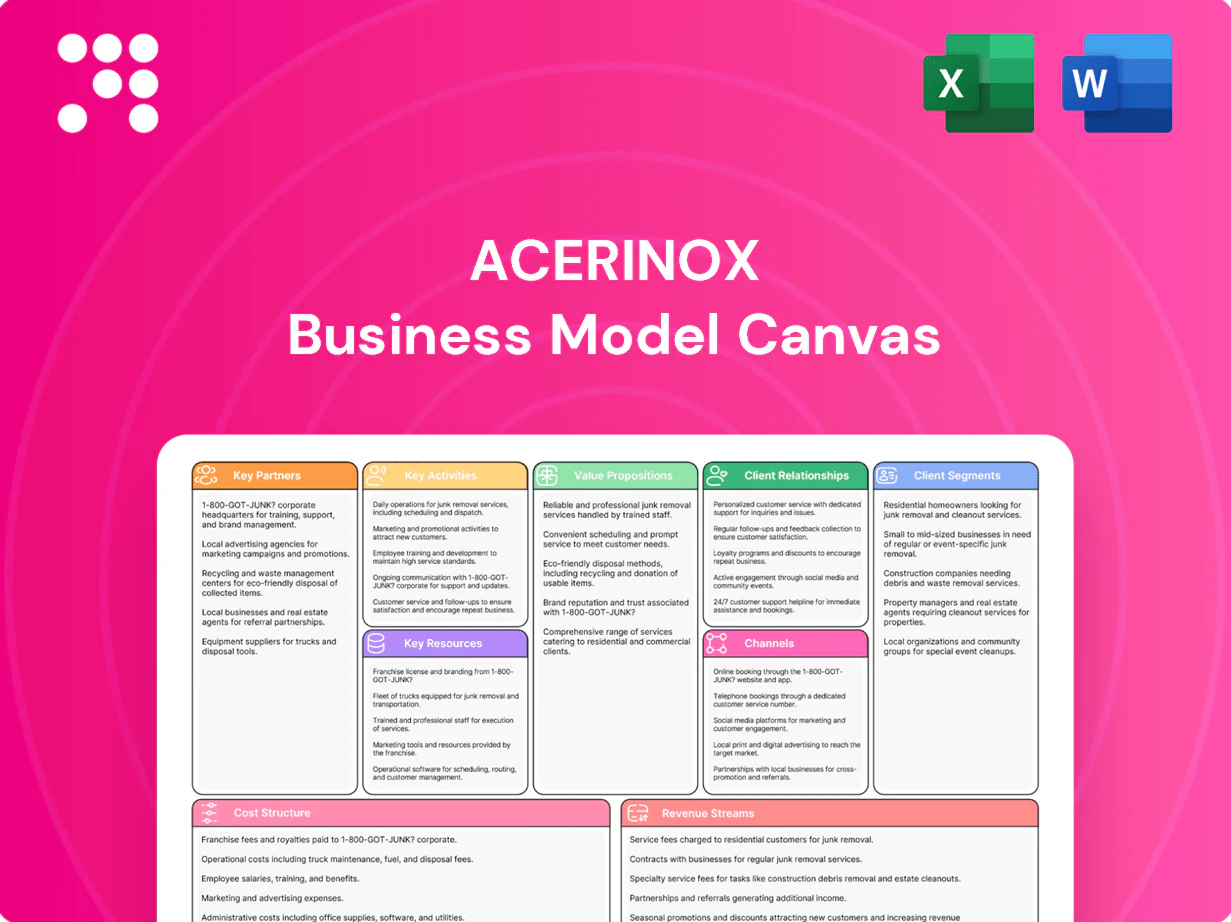
Acerinox Business Model Canvas

Business Model Canvas: Strategic Blueprint for Steel-Making Investors and Consultants
Unlock the full strategic blueprint behind Acerinox’s business model with our in-depth Business Model Canvas — a concise, actionable map of value propositions, key partners, revenue streams and cost structure. Perfect for investors, consultants and founders who need a ready-to-use strategic tool; download the complete Word & Excel files to benchmark, plan and scale with confidence.
Partnerships

Raw material suppliers
Acerinox partners with global miners and traders for nickel, chromium, molybdenum and ferroalloys through long-term contracts that secure volume and price stability. Close collaboration with suppliers enables strict quality control and traceability across the supply chain. Joint planning and integrated logistics reduce supply risk and minimize inventory swings, improving production continuity and working capital efficiency.
Energy and utilities
Steelmaking is highly energy-intensive and the global steel sector accounted for about 7% of CO2 emissions in recent years, so Acerinox relies on stable electricity and gas supplies. Partnerships with utilities secure competitive industrial tariffs and operational reliability, lowering production risk. Access to renewable power via PPAs supports decarbonization targets, while demand response and cogeneration improve overall energy efficiency and cost structure.

Equipment and technology OEMs
Alliances with furnace, rolling mill and automation OEMs sustain Acerinox operational excellence by optimizing melt-to-slab flows and throughput. Co-development agreements with equipment partners drive uptime and quality upgrades through joint engineering and retrofits. Digitalization partners enable predictive maintenance and process control, cutting unplanned downtime by up to 30% in industry studies. Technology roadmaps align upgrades and reduce capex timing risk.

Distributors and service centers
In 2024 Acerinox strengthened regional distributors and service centers to expand market reach and keep inventory close to customers, improving availability across key markets. On-site cutting and polishing services speed response and raise margins. Joint forecasting with distributors aligns production to real demand, while targeted incentive programs support share gains in core segments.
- Regional inventory proximity
- Value-added cutting & polishing
- Joint demand forecasting
- Incentive programs for market share
Logistics and port operators
Logistics and port operators ensure efficient inbound and outbound flows for Acerinox, optimizing ocean freight, warehousing and customs to support global stainless steel shipments and reduce inventory cycle times. Port proximity and multimodal options cut lead times and improve service reliability. Joint initiatives with operators target lower supply-chain emissions through modal shifts and port-efficiency measures.
- Optimize ocean freight
- Near-port warehousing
- Multimodal links
- Customs facilitation
- Emissions reduction
Steel producer secures raw materials and PPAs, cutting downtime up to 30%
Acerinox secures raw materials via long-term contracts and supplier integration, locks competitive energy via PPAs and utility deals to cut emissions, and co-develops with OEMs and digital partners to lower downtime by up to 30% (industry studies). In 2024 it reinforced regional distributors and logistics to tighten inventory proximity and service levels.
| Metric | 2024 figure | Source |
|---|---|---|
| Global steel CO2 share | ~7% | IEA |
| Unplanned downtime reduction | up to 30% | Industry studies |
What is included in the product
 Detailed Word Document
A concise, pre-written Acerinox Business Model Canvas mapping its stainless-steel production, global customer segments, distribution channels, and value propositions across the 9 BMC blocks; includes operational insights, competitive advantages, and linked SWOT to support presentations, investor discussions, and strategic decision-making.

 Customizable Excel Spreadsheet
High-level view of Acerinox’s business model with editable cells, condensing stainless-steel operations, supply chain and market positioning into a single page to relieve strategic alignment and reporting pain points.
Activities

Melting and refining
Primary steelmaking converts scrap and alloys into stainless slabs via electric arc furnaces, with inline process control ensuring chemistry accuracy and surface cleanliness across heat-to-heat operations. Energy management targets lower fuel use and emissions amid a 2024 EU ETS price near €100/tCO2 to cut costs. Compliance with occupational safety and environmental standards remains mandatory.
Hot and cold rolling
Rolling converts slabs into coils, sheets and plates with precise gauges, enabling Acerinox to meet tight tolerances across grades and applications. Cold rolling and annealing deliver the surface finishes and mechanical properties demanded by automotive and appliance customers, supporting the group’s quality targets. Continuous improvement programs and scheduling practices aim to minimize defects and yield loss while maximizing line utilization; Acerinox reported group sales of about €7.6bn in 2023.

Finishing and customization
Pickling, polishing, cutting and slitting adapt Acerinox sheet and coil to customer specs, with surface treatments addressing aesthetic and corrosion requirements; in 2024 the global stainless-steel market was about 54 million tonnes, driving demand for tailored finishes. Small-batch flexibility captures high-mix orders and premium margins. Rigorous quality assurance systems ensure repeatability and traceability across lots and batches.

Supply chain and demand planning
S&OP synchronises Acerinox mills with multi-sector demand cycles, supporting reported 2024 shipments of about 2.8 million tonnes and smoothing production across automotive, construction and energy segments. Inventory buffers hedge alloy and price volatility—notably nickel and chrome—reducing exposure to 2024 spot swings. Supplier coordination secures timely inputs from key alloy suppliers, while logistics planning meets global lead-time requirements across Europe, Americas and Africa.
- 2024 shipments: ~2.8 million tonnes
- Focus: S&OP alignment, alloy hedging, supplier coordination
- Coverage: Europe, Americas, Africa logistics
R&D and sustainability
R&D develops new stainless grades that raise product performance and lower unit costs, while process innovations target reduced energy use and CO2 intensity across melting and rolling stages. Recycling and scrap-optimization programs increase circularity and raw-material efficiency, and international certifications ensure customer regulatory and supply-chain compliance.
- R&D: new grades, cost reduction
- Processes: energy and CO2 cuts
- Circularity: scrap optimization
- Compliance: certifications
EAF stainless: €7.6bn sales, ~2.8Mt shipments, targeting CO2 cuts vs €100/tCO2
EAF primary steelmaking converts scrap into stainless slabs with inline controls; Acerinox reported group sales €7.6bn (2023) and targets energy/CO2 cuts amid a 2024 EU ETS price ~€100/tCO2. Rolling, cold-rolling and finishing produce coils/sheets to automotive/appliance specs; 2024 shipments ~2.8Mt. S&OP, alloy hedging and R&D on new grades and scrap optimization support margins and circularity.
| Metric | Value |
|---|---|
| Sales (2023) | €7.6bn |
| Shipments (2024) | ~2.8 million t |
| Global stainless market (2024) | ~54 million t |
| EU ETS price (2024) | ~€100/tCO2 |
Full Document Unlocks After Purchase
Business Model Canvas
The document you're previewing is the exact Acerinox Business Model Canvas you will receive—this is not a mockup or sample but a direct snapshot of the final file. After purchase you'll download the complete, editable document formatted exactly as shown, ready for presentation or customization. No surprises, just the full deliverable.

Business Model Canvas: Strategic Blueprint for Steel-Making Investors and Consultants
Unlock the full strategic blueprint behind Acerinox’s business model with our in-depth Business Model Canvas — a concise, actionable map of value propositions, key partners, revenue streams and cost structure. Perfect for investors, consultants and founders who need a ready-to-use strategic tool; download the complete Word & Excel files to benchmark, plan and scale with confidence.
Partnerships
Raw material suppliers
Acerinox partners with global miners and traders for nickel, chromium, molybdenum and ferroalloys through long-term contracts that secure volume and price stability. Close collaboration with suppliers enables strict quality control and traceability across the supply chain. Joint planning and integrated logistics reduce supply risk and minimize inventory swings, improving production continuity and working capital efficiency.
Energy and utilities
Steelmaking is highly energy-intensive and the global steel sector accounted for about 7% of CO2 emissions in recent years, so Acerinox relies on stable electricity and gas supplies. Partnerships with utilities secure competitive industrial tariffs and operational reliability, lowering production risk. Access to renewable power via PPAs supports decarbonization targets, while demand response and cogeneration improve overall energy efficiency and cost structure.
Equipment and technology OEMs
Alliances with furnace, rolling mill and automation OEMs sustain Acerinox operational excellence by optimizing melt-to-slab flows and throughput. Co-development agreements with equipment partners drive uptime and quality upgrades through joint engineering and retrofits. Digitalization partners enable predictive maintenance and process control, cutting unplanned downtime by up to 30% in industry studies. Technology roadmaps align upgrades and reduce capex timing risk.
Distributors and service centers
In 2024 Acerinox strengthened regional distributors and service centers to expand market reach and keep inventory close to customers, improving availability across key markets. On-site cutting and polishing services speed response and raise margins. Joint forecasting with distributors aligns production to real demand, while targeted incentive programs support share gains in core segments.
- Regional inventory proximity
- Value-added cutting & polishing
- Joint demand forecasting
- Incentive programs for market share
Logistics and port operators
Logistics and port operators ensure efficient inbound and outbound flows for Acerinox, optimizing ocean freight, warehousing and customs to support global stainless steel shipments and reduce inventory cycle times. Port proximity and multimodal options cut lead times and improve service reliability. Joint initiatives with operators target lower supply-chain emissions through modal shifts and port-efficiency measures.
- Optimize ocean freight
- Near-port warehousing
- Multimodal links
- Customs facilitation
- Emissions reduction
Steel producer secures raw materials and PPAs, cutting downtime up to 30%
Acerinox secures raw materials via long-term contracts and supplier integration, locks competitive energy via PPAs and utility deals to cut emissions, and co-develops with OEMs and digital partners to lower downtime by up to 30% (industry studies). In 2024 it reinforced regional distributors and logistics to tighten inventory proximity and service levels.
| Metric | 2024 figure | Source |
|---|---|---|
| Global steel CO2 share | ~7% | IEA |
| Unplanned downtime reduction | up to 30% | Industry studies |
What is included in the product
Detailed Word Document
A concise, pre-written Acerinox Business Model Canvas mapping its stainless-steel production, global customer segments, distribution channels, and value propositions across the 9 BMC blocks; includes operational insights, competitive advantages, and linked SWOT to support presentations, investor discussions, and strategic decision-making.
Customizable Excel Spreadsheet
High-level view of Acerinox’s business model with editable cells, condensing stainless-steel operations, supply chain and market positioning into a single page to relieve strategic alignment and reporting pain points.
Activities
Melting and refining
Primary steelmaking converts scrap and alloys into stainless slabs via electric arc furnaces, with inline process control ensuring chemistry accuracy and surface cleanliness across heat-to-heat operations. Energy management targets lower fuel use and emissions amid a 2024 EU ETS price near €100/tCO2 to cut costs. Compliance with occupational safety and environmental standards remains mandatory.
Hot and cold rolling
Rolling converts slabs into coils, sheets and plates with precise gauges, enabling Acerinox to meet tight tolerances across grades and applications. Cold rolling and annealing deliver the surface finishes and mechanical properties demanded by automotive and appliance customers, supporting the group’s quality targets. Continuous improvement programs and scheduling practices aim to minimize defects and yield loss while maximizing line utilization; Acerinox reported group sales of about €7.6bn in 2023.
Finishing and customization
Pickling, polishing, cutting and slitting adapt Acerinox sheet and coil to customer specs, with surface treatments addressing aesthetic and corrosion requirements; in 2024 the global stainless-steel market was about 54 million tonnes, driving demand for tailored finishes. Small-batch flexibility captures high-mix orders and premium margins. Rigorous quality assurance systems ensure repeatability and traceability across lots and batches.
Supply chain and demand planning
S&OP synchronises Acerinox mills with multi-sector demand cycles, supporting reported 2024 shipments of about 2.8 million tonnes and smoothing production across automotive, construction and energy segments. Inventory buffers hedge alloy and price volatility—notably nickel and chrome—reducing exposure to 2024 spot swings. Supplier coordination secures timely inputs from key alloy suppliers, while logistics planning meets global lead-time requirements across Europe, Americas and Africa.
- 2024 shipments: ~2.8 million tonnes
- Focus: S&OP alignment, alloy hedging, supplier coordination
- Coverage: Europe, Americas, Africa logistics
R&D and sustainability
R&D develops new stainless grades that raise product performance and lower unit costs, while process innovations target reduced energy use and CO2 intensity across melting and rolling stages. Recycling and scrap-optimization programs increase circularity and raw-material efficiency, and international certifications ensure customer regulatory and supply-chain compliance.
- R&D: new grades, cost reduction
- Processes: energy and CO2 cuts
- Circularity: scrap optimization
- Compliance: certifications
EAF stainless: €7.6bn sales, ~2.8Mt shipments, targeting CO2 cuts vs €100/tCO2
EAF primary steelmaking converts scrap into stainless slabs with inline controls; Acerinox reported group sales €7.6bn (2023) and targets energy/CO2 cuts amid a 2024 EU ETS price ~€100/tCO2. Rolling, cold-rolling and finishing produce coils/sheets to automotive/appliance specs; 2024 shipments ~2.8Mt. S&OP, alloy hedging and R&D on new grades and scrap optimization support margins and circularity.
| Metric | Value |
|---|---|
| Sales (2023) | €7.6bn |
| Shipments (2024) | ~2.8 million t |
| Global stainless market (2024) | ~54 million t |
| EU ETS price (2024) | ~€100/tCO2 |
Full Document Unlocks After Purchase
Business Model Canvas
The document you're previewing is the exact Acerinox Business Model Canvas you will receive—this is not a mockup or sample but a direct snapshot of the final file. After purchase you'll download the complete, editable document formatted exactly as shown, ready for presentation or customization. No surprises, just the full deliverable.
Description
Business Model Canvas: Strategic Blueprint for Steel-Making Investors and Consultants
Unlock the full strategic blueprint behind Acerinox’s business model with our in-depth Business Model Canvas — a concise, actionable map of value propositions, key partners, revenue streams and cost structure. Perfect for investors, consultants and founders who need a ready-to-use strategic tool; download the complete Word & Excel files to benchmark, plan and scale with confidence.
Partnerships
Raw material suppliers
Acerinox partners with global miners and traders for nickel, chromium, molybdenum and ferroalloys through long-term contracts that secure volume and price stability. Close collaboration with suppliers enables strict quality control and traceability across the supply chain. Joint planning and integrated logistics reduce supply risk and minimize inventory swings, improving production continuity and working capital efficiency.
Energy and utilities
Steelmaking is highly energy-intensive and the global steel sector accounted for about 7% of CO2 emissions in recent years, so Acerinox relies on stable electricity and gas supplies. Partnerships with utilities secure competitive industrial tariffs and operational reliability, lowering production risk. Access to renewable power via PPAs supports decarbonization targets, while demand response and cogeneration improve overall energy efficiency and cost structure.
Equipment and technology OEMs
Alliances with furnace, rolling mill and automation OEMs sustain Acerinox operational excellence by optimizing melt-to-slab flows and throughput. Co-development agreements with equipment partners drive uptime and quality upgrades through joint engineering and retrofits. Digitalization partners enable predictive maintenance and process control, cutting unplanned downtime by up to 30% in industry studies. Technology roadmaps align upgrades and reduce capex timing risk.
Distributors and service centers
In 2024 Acerinox strengthened regional distributors and service centers to expand market reach and keep inventory close to customers, improving availability across key markets. On-site cutting and polishing services speed response and raise margins. Joint forecasting with distributors aligns production to real demand, while targeted incentive programs support share gains in core segments.
- Regional inventory proximity
- Value-added cutting & polishing
- Joint demand forecasting
- Incentive programs for market share
Logistics and port operators
Logistics and port operators ensure efficient inbound and outbound flows for Acerinox, optimizing ocean freight, warehousing and customs to support global stainless steel shipments and reduce inventory cycle times. Port proximity and multimodal options cut lead times and improve service reliability. Joint initiatives with operators target lower supply-chain emissions through modal shifts and port-efficiency measures.
- Optimize ocean freight
- Near-port warehousing
- Multimodal links
- Customs facilitation
- Emissions reduction
Steel producer secures raw materials and PPAs, cutting downtime up to 30%
Acerinox secures raw materials via long-term contracts and supplier integration, locks competitive energy via PPAs and utility deals to cut emissions, and co-develops with OEMs and digital partners to lower downtime by up to 30% (industry studies). In 2024 it reinforced regional distributors and logistics to tighten inventory proximity and service levels.
| Metric | 2024 figure | Source |
|---|---|---|
| Global steel CO2 share | ~7% | IEA |
| Unplanned downtime reduction | up to 30% | Industry studies |
What is included in the product
Detailed Word Document
A concise, pre-written Acerinox Business Model Canvas mapping its stainless-steel production, global customer segments, distribution channels, and value propositions across the 9 BMC blocks; includes operational insights, competitive advantages, and linked SWOT to support presentations, investor discussions, and strategic decision-making.
Customizable Excel Spreadsheet
High-level view of Acerinox’s business model with editable cells, condensing stainless-steel operations, supply chain and market positioning into a single page to relieve strategic alignment and reporting pain points.
Activities
Melting and refining
Primary steelmaking converts scrap and alloys into stainless slabs via electric arc furnaces, with inline process control ensuring chemistry accuracy and surface cleanliness across heat-to-heat operations. Energy management targets lower fuel use and emissions amid a 2024 EU ETS price near €100/tCO2 to cut costs. Compliance with occupational safety and environmental standards remains mandatory.
Hot and cold rolling
Rolling converts slabs into coils, sheets and plates with precise gauges, enabling Acerinox to meet tight tolerances across grades and applications. Cold rolling and annealing deliver the surface finishes and mechanical properties demanded by automotive and appliance customers, supporting the group’s quality targets. Continuous improvement programs and scheduling practices aim to minimize defects and yield loss while maximizing line utilization; Acerinox reported group sales of about €7.6bn in 2023.
Finishing and customization
Pickling, polishing, cutting and slitting adapt Acerinox sheet and coil to customer specs, with surface treatments addressing aesthetic and corrosion requirements; in 2024 the global stainless-steel market was about 54 million tonnes, driving demand for tailored finishes. Small-batch flexibility captures high-mix orders and premium margins. Rigorous quality assurance systems ensure repeatability and traceability across lots and batches.
Supply chain and demand planning
S&OP synchronises Acerinox mills with multi-sector demand cycles, supporting reported 2024 shipments of about 2.8 million tonnes and smoothing production across automotive, construction and energy segments. Inventory buffers hedge alloy and price volatility—notably nickel and chrome—reducing exposure to 2024 spot swings. Supplier coordination secures timely inputs from key alloy suppliers, while logistics planning meets global lead-time requirements across Europe, Americas and Africa.
- 2024 shipments: ~2.8 million tonnes
- Focus: S&OP alignment, alloy hedging, supplier coordination
- Coverage: Europe, Americas, Africa logistics
R&D and sustainability
R&D develops new stainless grades that raise product performance and lower unit costs, while process innovations target reduced energy use and CO2 intensity across melting and rolling stages. Recycling and scrap-optimization programs increase circularity and raw-material efficiency, and international certifications ensure customer regulatory and supply-chain compliance.
- R&D: new grades, cost reduction
- Processes: energy and CO2 cuts
- Circularity: scrap optimization
- Compliance: certifications
EAF stainless: €7.6bn sales, ~2.8Mt shipments, targeting CO2 cuts vs €100/tCO2
EAF primary steelmaking converts scrap into stainless slabs with inline controls; Acerinox reported group sales €7.6bn (2023) and targets energy/CO2 cuts amid a 2024 EU ETS price ~€100/tCO2. Rolling, cold-rolling and finishing produce coils/sheets to automotive/appliance specs; 2024 shipments ~2.8Mt. S&OP, alloy hedging and R&D on new grades and scrap optimization support margins and circularity.
| Metric | Value |
|---|---|
| Sales (2023) | €7.6bn |
| Shipments (2024) | ~2.8 million t |
| Global stainless market (2024) | ~54 million t |
| EU ETS price (2024) | ~€100/tCO2 |
Full Document Unlocks After Purchase
Business Model Canvas
The document you're previewing is the exact Acerinox Business Model Canvas you will receive—this is not a mockup or sample but a direct snapshot of the final file. After purchase you'll download the complete, editable document formatted exactly as shown, ready for presentation or customization. No surprises, just the full deliverable.











