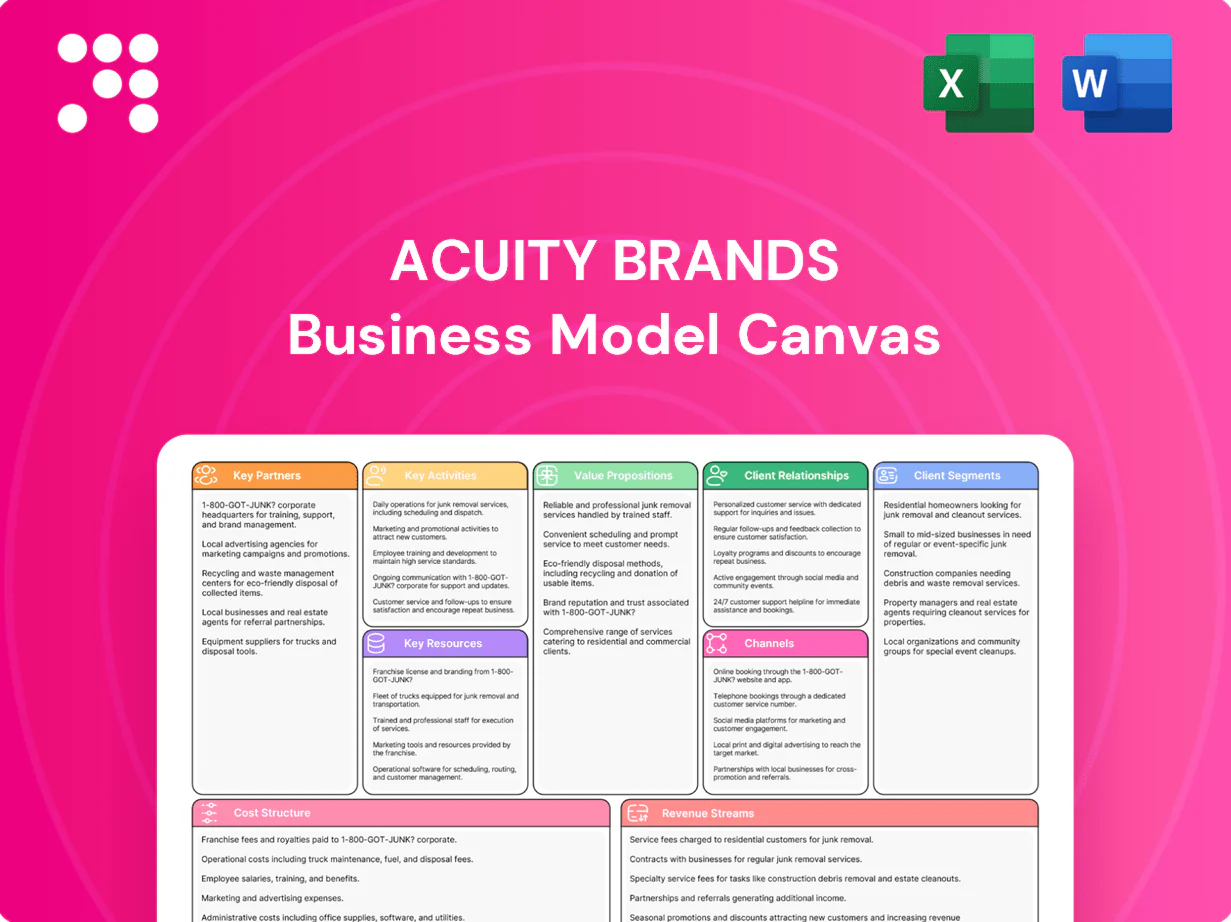
Acuity Brands Business Model Canvas

Unlock the strategic playbook with our concise Business Model Canvas preview.
Unlock Acuity Brands’ strategic playbook with our concise Business Model Canvas preview and see how product innovation, channel partnerships, and recurring revenue drive growth. This snapshot teases key levers; purchase the full, editable Canvas for the complete nine-block analysis, financial implications, and ready-to-use templates for benchmarking and strategy.
Partnerships

Tier-1 component suppliers (LEDs, drivers, sensors)
Tier-1 component suppliers (LEDs, drivers, sensors) secure quality and continuity for Acuity Brands, supporting fiscal 2024 net sales of about $3.86B; diversified sourcing reduces disruption risk. Long-term agreements stabilize pricing and availability, while co-development with vendors speeds efficiency and innovation. Joint compliance programs ensure safety certifications and regulatory alignment across products.
Technology and IoT ecosystem partners
Alliances with cloud, cybersecurity, and analytics providers boost Acuity Brands smart building capabilities, leveraging industry momentum as buildings account for roughly 40% of global energy use (IEA) and IoT device deployments exceeded 14 billion in 2024 (Statista). Open APIs and interoperability partnerships expand integration options and customer lock-in. Joint roadmaps shorten time-to-market for connected solutions while partnerships lower development risk and broaden feature sets.

Distribution, contractors, and ESCO alliances
Electrical distributors extend Acuity Brands reach and inventory availability across channels, supporting presence in a global lighting market valued at about $120 billion in 2024. Contractor networks drive specification, installation and retrofit execution, accelerating time-to-revenue. ESCO partnerships enable performance-based projects and financing, while coordinated distributor-contractor-ESCO programs materially improve sell-through and project success rates.

Standards bodies, utilities, and rebate programs
Engagement with standards bodies secures compliance and gives Acuity Brands influence on evolving codes, leveraging IRA-driven climate funds of 370 billion USD to shape market rules. Utility partnerships ensure product eligibility for incentive programs as U.S. utility efficiency budgets exceed 8 billion USD annually. Integrated rebates reduce customer project costs and joint education programs lift adoption of efficient solutions.
- Standards engagement: influence codes
- Utility alignment: incentive eligibility
- Rebates + education: lower cost, higher adoption
BMS integrators and strategic OEM alliances
System integrators connect lighting, HVAC, and security into unified platforms, enabling Acuity Brands to offer integrated BMS solutions; Acuity reported fiscal 2024 net sales of $3.9 billion. OEM collaborations fill portfolio gaps and enable white-label opportunities. Joint solutions deliver seamless building management experiences, and shared go-to-market expands addressable opportunities and enterprise pipeline.
- integrators: unified lighting/HVAC/security
- OEMs: fill gaps, white-label
- outcome: seamless BMS experiences
- scale: shared GTM expands market reach
Suppliers, cloud and channels drive continuity and scale into a $120B market
Tier-1 suppliers secure quality and continuity, supporting fiscal 2024 net sales of about $3.86B and reducing supply disruption risk.
Alliances with cloud, cybersecurity and analytics partners accelerate smart-building solutions as global IoT devices surpassed 14B in 2024.
Distributors, integrators, utilities and standards bodies expand go-to-market, tap ~$120B lighting market and $8B+ US utility efficiency budgets in 2024.
| Partner type | Role | 2024 metric |
|---|---|---|
| Suppliers | Quality/continuity | $3.86B net sales |
| Cloud/Cyber | Smart capabilities | 14B IoT devices |
| Channels | Reach/install | $120B market |
| Utilities/Standards | Incentives/compliance | $8B US budgets |
What is included in the product
 Detailed Word Document
A comprehensive Business Model Canvas for Acuity Brands outlining customer segments, channels, value propositions, revenue streams, key partners, activities, resources, cost structure, and customer relationships with narrative and insights. Ideal for presentations and investor discussions, it highlights competitive advantages, SWOT-linked opportunities, and validation using real company data.

 Customizable Excel Spreadsheet
High-level view of Acuity Brands’ business model with editable cells, relieving the pain of scattered analysis by consolidating strategy, revenue streams, and cost drivers in one place. Shareable and editable for team collaboration, saving hours of formatting and enabling fast, board-ready deliverables.
Activities

R&D in luminaires, controls, and software
Continuous luminaire design raises efficacy and optics, reducing lighting energy in buildings that account for about 36% of global final energy use (IEA); form‑factor innovation drives retrofits and new installs. Controls and firmware enable advanced sensing and automation for demand response. Software teams deliver scalable, secure building management platforms. Rigorous certification testing verifies performance and compliance.
Manufacturing, assembly, and quality assurance
Lean operations at Acuity drive scalable production with consistent quality, leveraging continuous improvement to maintain low variability and stable cycle times. Automated processes boost throughput (~20% faster) and lower cost per unit (≈15% reduction), improving margins. Rigorous QA programs cut defects and warranty claims, and flexible lines enable rapid product customization to meet fast-changing spec demands.

Supply chain planning and strategic sourcing
Forecasting and inventory management balance service levels and working capital, aligning safety stock with demand signals to protect margins. Multi-sourcing mitigates component risk by diversifying suppliers and alternate BOMs. Logistics optimization shortens lead times through network design and carrier strategies. Supplier performance management drives reliability and cost control via KPIs and continuous improvement.

Specification sales and solution engineering
Working with architects and lighting designers secures project specs and drove Acuity Brands to reported fiscal 2024 net sales of about $3.3 billion, underpinning specification-led growth. Pre-sales engineering customizes solutions to code and performance while ROI modeling validates business cases and rebate eligibility. Bid support raises win rates in competitive tenders by quantifying savings.
- Spec capture with designers
- Pre-sales engineering to code
- ROI/rebate qualification
- Bid support for higher win rates
Commissioning, training, and after-sales support
On-site and remote commissioning ensure systems perform as designed, supporting Acuity Brands' FY2024 net sales of about $4.1 billion; training programs upskill contractors and facility teams, with thousands trained annually. Support services sustain uptime and customer satisfaction, while feedback loops inform continuous product improvement and lower service costs.
- Commissioning: on-site + remote
- Training: thousands trained/year
- Support: uptime & CSAT focus
- Feedback: product iteration
Continuous luminaire innovation cuts building lighting energy; controls and lean ops scale impact
Continuous luminaire design and form‑factor innovation cut building lighting energy (buildings ≈36% of final energy use, IEA); controls/firmware enable sensing, automation and demand response. Software platforms and certification testing secure scalable deployments. Lean ops, automated lines (+20% throughput, ≈15% unit cost reduction) and supply diversification support FY2024 net sales ≈$4.1B and thousands trained annually.
| Metric | Value |
|---|---|
| FY2024 net sales | $4.1B |
| Buildings share of final energy | ≈36% (IEA) |
| Throughput | +20% |
| Unit cost reduction | ≈15% |
| Training | Thousands/year |
Full Document Unlocks After Purchase
Business Model Canvas
The Acuity Brands Business Model Canvas shown here is the actual deliverable, not a mockup or sample, and reflects the full structure and content you’ll receive after purchase. When you complete your order, you’ll get this exact file—ready-to-edit and formatted for practical use in Word and Excel. No placeholders, no surprises—what you preview is what you’ll download.

Unlock the strategic playbook with our concise Business Model Canvas preview.
Unlock Acuity Brands’ strategic playbook with our concise Business Model Canvas preview and see how product innovation, channel partnerships, and recurring revenue drive growth. This snapshot teases key levers; purchase the full, editable Canvas for the complete nine-block analysis, financial implications, and ready-to-use templates for benchmarking and strategy.
Partnerships
Tier-1 component suppliers (LEDs, drivers, sensors)
Tier-1 component suppliers (LEDs, drivers, sensors) secure quality and continuity for Acuity Brands, supporting fiscal 2024 net sales of about $3.86B; diversified sourcing reduces disruption risk. Long-term agreements stabilize pricing and availability, while co-development with vendors speeds efficiency and innovation. Joint compliance programs ensure safety certifications and regulatory alignment across products.
Technology and IoT ecosystem partners
Alliances with cloud, cybersecurity, and analytics providers boost Acuity Brands smart building capabilities, leveraging industry momentum as buildings account for roughly 40% of global energy use (IEA) and IoT device deployments exceeded 14 billion in 2024 (Statista). Open APIs and interoperability partnerships expand integration options and customer lock-in. Joint roadmaps shorten time-to-market for connected solutions while partnerships lower development risk and broaden feature sets.
Distribution, contractors, and ESCO alliances
Electrical distributors extend Acuity Brands reach and inventory availability across channels, supporting presence in a global lighting market valued at about $120 billion in 2024. Contractor networks drive specification, installation and retrofit execution, accelerating time-to-revenue. ESCO partnerships enable performance-based projects and financing, while coordinated distributor-contractor-ESCO programs materially improve sell-through and project success rates.
Standards bodies, utilities, and rebate programs
Engagement with standards bodies secures compliance and gives Acuity Brands influence on evolving codes, leveraging IRA-driven climate funds of 370 billion USD to shape market rules. Utility partnerships ensure product eligibility for incentive programs as U.S. utility efficiency budgets exceed 8 billion USD annually. Integrated rebates reduce customer project costs and joint education programs lift adoption of efficient solutions.
- Standards engagement: influence codes
- Utility alignment: incentive eligibility
- Rebates + education: lower cost, higher adoption
BMS integrators and strategic OEM alliances
System integrators connect lighting, HVAC, and security into unified platforms, enabling Acuity Brands to offer integrated BMS solutions; Acuity reported fiscal 2024 net sales of $3.9 billion. OEM collaborations fill portfolio gaps and enable white-label opportunities. Joint solutions deliver seamless building management experiences, and shared go-to-market expands addressable opportunities and enterprise pipeline.
- integrators: unified lighting/HVAC/security
- OEMs: fill gaps, white-label
- outcome: seamless BMS experiences
- scale: shared GTM expands market reach
Suppliers, cloud and channels drive continuity and scale into a $120B market
Tier-1 suppliers secure quality and continuity, supporting fiscal 2024 net sales of about $3.86B and reducing supply disruption risk.
Alliances with cloud, cybersecurity and analytics partners accelerate smart-building solutions as global IoT devices surpassed 14B in 2024.
Distributors, integrators, utilities and standards bodies expand go-to-market, tap ~$120B lighting market and $8B+ US utility efficiency budgets in 2024.
| Partner type | Role | 2024 metric |
|---|---|---|
| Suppliers | Quality/continuity | $3.86B net sales |
| Cloud/Cyber | Smart capabilities | 14B IoT devices |
| Channels | Reach/install | $120B market |
| Utilities/Standards | Incentives/compliance | $8B US budgets |
What is included in the product
Detailed Word Document
A comprehensive Business Model Canvas for Acuity Brands outlining customer segments, channels, value propositions, revenue streams, key partners, activities, resources, cost structure, and customer relationships with narrative and insights. Ideal for presentations and investor discussions, it highlights competitive advantages, SWOT-linked opportunities, and validation using real company data.
Customizable Excel Spreadsheet
High-level view of Acuity Brands’ business model with editable cells, relieving the pain of scattered analysis by consolidating strategy, revenue streams, and cost drivers in one place. Shareable and editable for team collaboration, saving hours of formatting and enabling fast, board-ready deliverables.
Activities
R&D in luminaires, controls, and software
Continuous luminaire design raises efficacy and optics, reducing lighting energy in buildings that account for about 36% of global final energy use (IEA); form‑factor innovation drives retrofits and new installs. Controls and firmware enable advanced sensing and automation for demand response. Software teams deliver scalable, secure building management platforms. Rigorous certification testing verifies performance and compliance.
Manufacturing, assembly, and quality assurance
Lean operations at Acuity drive scalable production with consistent quality, leveraging continuous improvement to maintain low variability and stable cycle times. Automated processes boost throughput (~20% faster) and lower cost per unit (≈15% reduction), improving margins. Rigorous QA programs cut defects and warranty claims, and flexible lines enable rapid product customization to meet fast-changing spec demands.
Supply chain planning and strategic sourcing
Forecasting and inventory management balance service levels and working capital, aligning safety stock with demand signals to protect margins. Multi-sourcing mitigates component risk by diversifying suppliers and alternate BOMs. Logistics optimization shortens lead times through network design and carrier strategies. Supplier performance management drives reliability and cost control via KPIs and continuous improvement.
Specification sales and solution engineering
Working with architects and lighting designers secures project specs and drove Acuity Brands to reported fiscal 2024 net sales of about $3.3 billion, underpinning specification-led growth. Pre-sales engineering customizes solutions to code and performance while ROI modeling validates business cases and rebate eligibility. Bid support raises win rates in competitive tenders by quantifying savings.
- Spec capture with designers
- Pre-sales engineering to code
- ROI/rebate qualification
- Bid support for higher win rates
Commissioning, training, and after-sales support
On-site and remote commissioning ensure systems perform as designed, supporting Acuity Brands' FY2024 net sales of about $4.1 billion; training programs upskill contractors and facility teams, with thousands trained annually. Support services sustain uptime and customer satisfaction, while feedback loops inform continuous product improvement and lower service costs.
- Commissioning: on-site + remote
- Training: thousands trained/year
- Support: uptime & CSAT focus
- Feedback: product iteration
Continuous luminaire innovation cuts building lighting energy; controls and lean ops scale impact
Continuous luminaire design and form‑factor innovation cut building lighting energy (buildings ≈36% of final energy use, IEA); controls/firmware enable sensing, automation and demand response. Software platforms and certification testing secure scalable deployments. Lean ops, automated lines (+20% throughput, ≈15% unit cost reduction) and supply diversification support FY2024 net sales ≈$4.1B and thousands trained annually.
| Metric | Value |
|---|---|
| FY2024 net sales | $4.1B |
| Buildings share of final energy | ≈36% (IEA) |
| Throughput | +20% |
| Unit cost reduction | ≈15% |
| Training | Thousands/year |
Full Document Unlocks After Purchase
Business Model Canvas
The Acuity Brands Business Model Canvas shown here is the actual deliverable, not a mockup or sample, and reflects the full structure and content you’ll receive after purchase. When you complete your order, you’ll get this exact file—ready-to-edit and formatted for practical use in Word and Excel. No placeholders, no surprises—what you preview is what you’ll download.
Original: $10.00
-65%$10.00
$3.50Description
Unlock the strategic playbook with our concise Business Model Canvas preview.
Unlock Acuity Brands’ strategic playbook with our concise Business Model Canvas preview and see how product innovation, channel partnerships, and recurring revenue drive growth. This snapshot teases key levers; purchase the full, editable Canvas for the complete nine-block analysis, financial implications, and ready-to-use templates for benchmarking and strategy.
Partnerships
Tier-1 component suppliers (LEDs, drivers, sensors)
Tier-1 component suppliers (LEDs, drivers, sensors) secure quality and continuity for Acuity Brands, supporting fiscal 2024 net sales of about $3.86B; diversified sourcing reduces disruption risk. Long-term agreements stabilize pricing and availability, while co-development with vendors speeds efficiency and innovation. Joint compliance programs ensure safety certifications and regulatory alignment across products.
Technology and IoT ecosystem partners
Alliances with cloud, cybersecurity, and analytics providers boost Acuity Brands smart building capabilities, leveraging industry momentum as buildings account for roughly 40% of global energy use (IEA) and IoT device deployments exceeded 14 billion in 2024 (Statista). Open APIs and interoperability partnerships expand integration options and customer lock-in. Joint roadmaps shorten time-to-market for connected solutions while partnerships lower development risk and broaden feature sets.
Distribution, contractors, and ESCO alliances
Electrical distributors extend Acuity Brands reach and inventory availability across channels, supporting presence in a global lighting market valued at about $120 billion in 2024. Contractor networks drive specification, installation and retrofit execution, accelerating time-to-revenue. ESCO partnerships enable performance-based projects and financing, while coordinated distributor-contractor-ESCO programs materially improve sell-through and project success rates.
Standards bodies, utilities, and rebate programs
Engagement with standards bodies secures compliance and gives Acuity Brands influence on evolving codes, leveraging IRA-driven climate funds of 370 billion USD to shape market rules. Utility partnerships ensure product eligibility for incentive programs as U.S. utility efficiency budgets exceed 8 billion USD annually. Integrated rebates reduce customer project costs and joint education programs lift adoption of efficient solutions.
- Standards engagement: influence codes
- Utility alignment: incentive eligibility
- Rebates + education: lower cost, higher adoption
BMS integrators and strategic OEM alliances
System integrators connect lighting, HVAC, and security into unified platforms, enabling Acuity Brands to offer integrated BMS solutions; Acuity reported fiscal 2024 net sales of $3.9 billion. OEM collaborations fill portfolio gaps and enable white-label opportunities. Joint solutions deliver seamless building management experiences, and shared go-to-market expands addressable opportunities and enterprise pipeline.
- integrators: unified lighting/HVAC/security
- OEMs: fill gaps, white-label
- outcome: seamless BMS experiences
- scale: shared GTM expands market reach
Suppliers, cloud and channels drive continuity and scale into a $120B market
Tier-1 suppliers secure quality and continuity, supporting fiscal 2024 net sales of about $3.86B and reducing supply disruption risk.
Alliances with cloud, cybersecurity and analytics partners accelerate smart-building solutions as global IoT devices surpassed 14B in 2024.
Distributors, integrators, utilities and standards bodies expand go-to-market, tap ~$120B lighting market and $8B+ US utility efficiency budgets in 2024.
| Partner type | Role | 2024 metric |
|---|---|---|
| Suppliers | Quality/continuity | $3.86B net sales |
| Cloud/Cyber | Smart capabilities | 14B IoT devices |
| Channels | Reach/install | $120B market |
| Utilities/Standards | Incentives/compliance | $8B US budgets |
What is included in the product
Detailed Word Document
A comprehensive Business Model Canvas for Acuity Brands outlining customer segments, channels, value propositions, revenue streams, key partners, activities, resources, cost structure, and customer relationships with narrative and insights. Ideal for presentations and investor discussions, it highlights competitive advantages, SWOT-linked opportunities, and validation using real company data.
Customizable Excel Spreadsheet
High-level view of Acuity Brands’ business model with editable cells, relieving the pain of scattered analysis by consolidating strategy, revenue streams, and cost drivers in one place. Shareable and editable for team collaboration, saving hours of formatting and enabling fast, board-ready deliverables.
Activities
R&D in luminaires, controls, and software
Continuous luminaire design raises efficacy and optics, reducing lighting energy in buildings that account for about 36% of global final energy use (IEA); form‑factor innovation drives retrofits and new installs. Controls and firmware enable advanced sensing and automation for demand response. Software teams deliver scalable, secure building management platforms. Rigorous certification testing verifies performance and compliance.
Manufacturing, assembly, and quality assurance
Lean operations at Acuity drive scalable production with consistent quality, leveraging continuous improvement to maintain low variability and stable cycle times. Automated processes boost throughput (~20% faster) and lower cost per unit (≈15% reduction), improving margins. Rigorous QA programs cut defects and warranty claims, and flexible lines enable rapid product customization to meet fast-changing spec demands.
Supply chain planning and strategic sourcing
Forecasting and inventory management balance service levels and working capital, aligning safety stock with demand signals to protect margins. Multi-sourcing mitigates component risk by diversifying suppliers and alternate BOMs. Logistics optimization shortens lead times through network design and carrier strategies. Supplier performance management drives reliability and cost control via KPIs and continuous improvement.
Specification sales and solution engineering
Working with architects and lighting designers secures project specs and drove Acuity Brands to reported fiscal 2024 net sales of about $3.3 billion, underpinning specification-led growth. Pre-sales engineering customizes solutions to code and performance while ROI modeling validates business cases and rebate eligibility. Bid support raises win rates in competitive tenders by quantifying savings.
- Spec capture with designers
- Pre-sales engineering to code
- ROI/rebate qualification
- Bid support for higher win rates
Commissioning, training, and after-sales support
On-site and remote commissioning ensure systems perform as designed, supporting Acuity Brands' FY2024 net sales of about $4.1 billion; training programs upskill contractors and facility teams, with thousands trained annually. Support services sustain uptime and customer satisfaction, while feedback loops inform continuous product improvement and lower service costs.
- Commissioning: on-site + remote
- Training: thousands trained/year
- Support: uptime & CSAT focus
- Feedback: product iteration
Continuous luminaire innovation cuts building lighting energy; controls and lean ops scale impact
Continuous luminaire design and form‑factor innovation cut building lighting energy (buildings ≈36% of final energy use, IEA); controls/firmware enable sensing, automation and demand response. Software platforms and certification testing secure scalable deployments. Lean ops, automated lines (+20% throughput, ≈15% unit cost reduction) and supply diversification support FY2024 net sales ≈$4.1B and thousands trained annually.
| Metric | Value |
|---|---|
| FY2024 net sales | $4.1B |
| Buildings share of final energy | ≈36% (IEA) |
| Throughput | +20% |
| Unit cost reduction | ≈15% |
| Training | Thousands/year |
Full Document Unlocks After Purchase
Business Model Canvas
The Acuity Brands Business Model Canvas shown here is the actual deliverable, not a mockup or sample, and reflects the full structure and content you’ll receive after purchase. When you complete your order, you’ll get this exact file—ready-to-edit and formatted for practical use in Word and Excel. No placeholders, no surprises—what you preview is what you’ll download.











