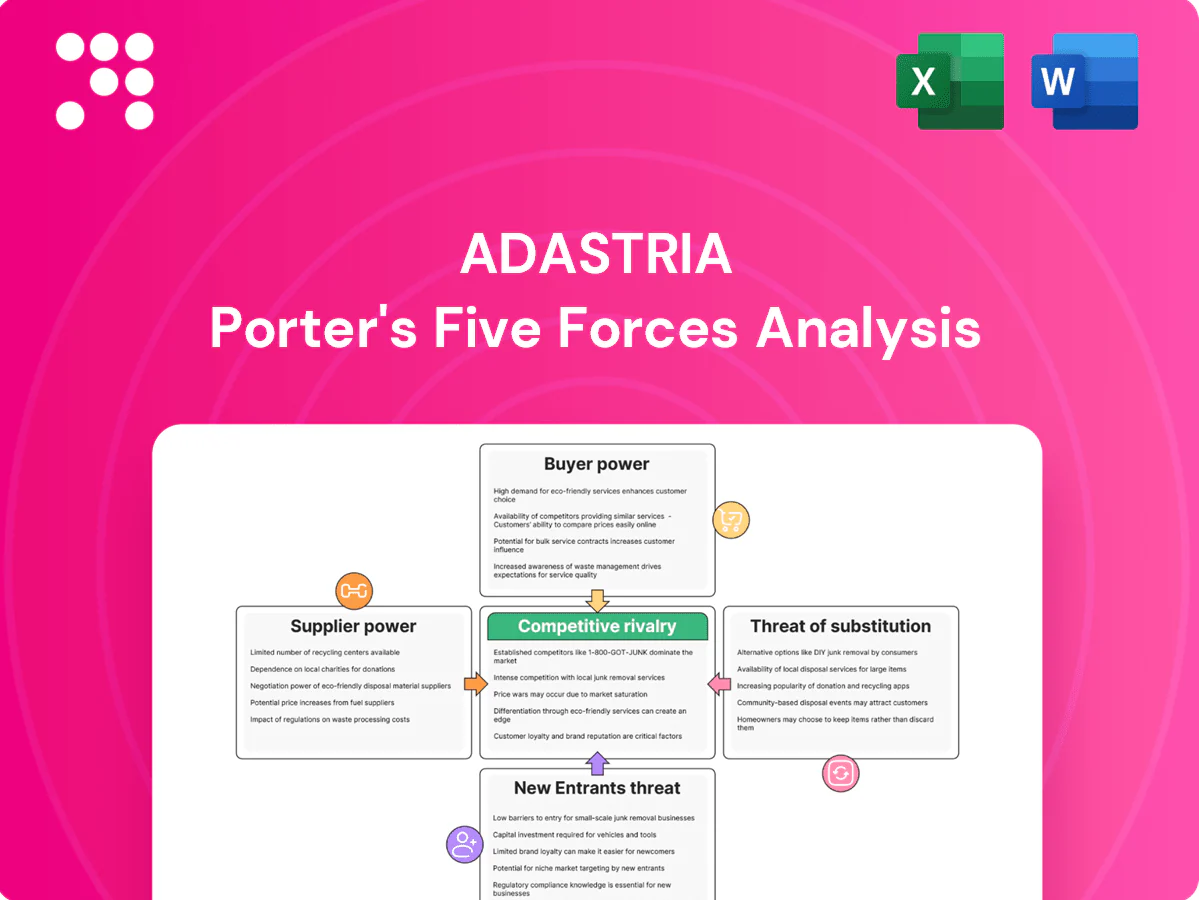
Adastria Porter's Five Forces Analysis

Don't Miss the Bigger Picture
Adastria faces mixed competitive pressures: strong buyer bargaining in fast-fashion segments, moderate supplier leverage, and a steady threat from substitutes and e-commerce rivals that squeeze margins and demand agility. Geographic diversification and private labels cushion some risks but new entrants and shifting consumer tastes intensify competitive dynamics. This brief snapshot only scratches the surface—unlock the full Porter's Five Forces Analysis to explore force-by-force ratings, visuals, and strategic implications for Adastria.
Suppliers Bargaining Power

Diverse supplier base dilutes leverage
Adastria sources from numerous mills, OEM/ODM partners and regional logistics providers, which limits any single supplier’s leverage and spreads risk across its multi-brand, multi-category purchasing portfolio.
Use of standardized fabrics and trims increases substitutability and negotiating power, though niche materials and small MOQs for fast-trend items create localized pockets of supplier dependence that can raise costs and lead times.
Scale buying provides negotiation power
Aggregate volumes across Adastria's roughly 30 brands and over 1,000 stores (2024) give the group negotiation power for better terms, shorter lead times, and improved payment conditions. Vendors value steady, year-round orders that reduce their capacity risk and favor long-term contracts. Long-term supplier relationships can lock in pricing tiers, yet scale benefits ebb if demand softens or inventory discipline weakens.

Input cost volatility passes through slowly
Fluctuations in cotton, synthetic fibers and freight put upward pressure on supplier pricing, yet fashion cycles and preset seasons limit retailers like Adastria from instant repricing, shifting margin stress upstream. Suppliers often impose surcharges during raw-material or freight spikes, and while hedging, dual-sourcing and calendar shifts reduce exposure, they do not eliminate pass-through risk.

Compliance and sustainability raise bar
Stricter ESG, traceability, and quality standards shrink the pool of eligible factories, strengthening compliant suppliers and increasing their bargaining power as Adastria and peers prioritize traceable supply chains.
Audits and certifications add cost and weeks to lead times, creating stickiness for preferred, certified suppliers, although industry-wide compliance uptake rose in 2024, reducing exclusivity over time.
- Compliance limits eligible factories
- Audits add cost and time
- Preferred suppliers gain stickiness
- 2024: industry compliance increasingly common
Logistics concentration risks
Port congestion and carrier capacity create choke points for Adastria, with the top 10 ocean carriers controlling roughly 85% of global container capacity in 2024 (Alphaliner), giving carriers leverage and driving peak-season rate spikes; a handful of 3PLs similarly hold operational sway in busy periods. Mode-switching between sea and air is costly and limited, while network diversification and nearshoring reduce risk but require significant capex.
- Port congestion → shipment delays, higher landed costs
- Top carriers concentration (~85% capacity) → pricing power
- 3PLs hold seasonal leverage
- Nearshoring/diversification reduces risk but needs investment
Multi-brand retailer scale limits supplier leverage; carrier concentration boosts logistics power
Adastria's multi-mill, OEM/ODM sourcing limits single-supplier leverage. Standardized fabrics boost substitutability, while niche trims and small MOQs create localized dependence. Scale across roughly 30 brands and over 1,000 stores (2024) strengthens purchasing terms. Carrier concentration (~85% container capacity, 2024 Alphaliner) raises logistics supplier power.
| Metric | 2024 Data |
|---|---|
| Brands | ~30 |
| Stores | >1,000 |
| Top carriers share | ~85% (Alphaliner) |
What is included in the product
 Detailed Word Document
Tailored Porter's Five Forces analysis for Adastria uncovering competitive drivers, supplier and buyer power, threat of substitutes and new entrants, plus disruptive forces and strategic implications for pricing and market share.

 Customizable Excel Spreadsheet
One-sheet Porter's Five Forces for Adastria—condenses competitive pressure into a clear, customizable view for quick decisions; tweak force levels with new data and export a spider chart-ready layout for decks or reports.
Customers Bargaining Power

Low switching costs across brands
Consumers can switch between Adastria and rival labels both online and in-store with ease, as e-commerce accounted for about 25% of Japanese apparel sales in 2024. Comparable styles and wide availability across multibrand platforms reduce differentiation, while minimal contractual lock-in creates immediate churn risk. Retention therefore depends heavily on distinctive design and superior fit to justify repeat purchases.
High price transparency online
Marketplaces and brand sites list prices and promotions side-by-side, driving shoppers to compare offers; about 60% of consumers compare prices online before buying. Discounting pressure spikes in seasonal clearances, with observed online markdowns commonly reaching 30–50%. Review scores now materially affect conversion rates, and loyalty perks must offset constant deal-seeking to retain margin.

Broad segment coverage tempers power
Adastria spans roughly 30 brands across value and premium tiers, lowering reliance on any single customer cohort and supporting internal cross-selling to retain spend within the portfolio. Its omnichannel push—store network of about 3,100 locations plus online—adds convenience value and loyalty levers. However, broad reach increases intragroup comparison, intensifying price and feature scrutiny among customers.

Trend sensitivity amplifies demands
Trend sensitivity amplifies demands as customers expect rapid refresh, full size availability and quick delivery; for Adastria, with about 1,633 stores as of Feb 2024 this raises pressure on omnichannel fulfillment. Stockouts or missed trends drive immediate defection, while social media compresses trend cycles and raises return costs. Agile replenishment and same-week assortments are crucial to keep bargaining power balanced.
- Customer expectations: rapid refresh, size in-stock, fast delivery
- Risk: immediate defection on stockouts driven by social media
- Response: agile replenishment to stabilize bargaining power
Returns and fit issues elevate leverage
Flexible return policies are now table stakes, shifting fulfillment and reverse-logistics risk to retailers; in 2024 global online apparel return rates hovered near 30%, driving higher exchange and refund volumes. Fit and quality inconsistencies amplify this leverage, forcing price/promotional concessions and stricter lifetime-value math. Investments in data-led sizing and QA cut return rates and reclaim margin.
- Return rate ~30% (2024)
- Return handling eats margin, prompts discounts
- Data sizing/QA reduces returns
25%, 60% compare, 30% returns — omni
Customers exert high bargaining power: easy switching online/in-store with e-commerce ~25% of Japan apparel sales (2024), widespread price comparison (~60% compare online) and ~30% return rates force discounting and tight margins. Adastria leans on design, omnichannel (≈1,633 stores Feb 2024) and multi‑brand breadth to retain spend amid fast trend-driven churn.
| Metric | 2024 |
|---|---|
| E‑commerce share (Japan) | ~25% |
| Online price comparison | ~60% |
| Return rate (online apparel) | ~30% |
| Adastria stores (Feb 2024) | ≈1,633 |
Preview the Actual Deliverable
Adastria Porter's Five Forces Analysis
This preview displays the complete Adastria Porter's Five Forces Analysis you’ll receive immediately after purchase—no samples, no placeholders. The file shown is professionally formatted and ready for download and use the moment you buy. What you see is exactly the deliverable you’ll get, instant and final.

Don't Miss the Bigger Picture
Adastria faces mixed competitive pressures: strong buyer bargaining in fast-fashion segments, moderate supplier leverage, and a steady threat from substitutes and e-commerce rivals that squeeze margins and demand agility. Geographic diversification and private labels cushion some risks but new entrants and shifting consumer tastes intensify competitive dynamics. This brief snapshot only scratches the surface—unlock the full Porter's Five Forces Analysis to explore force-by-force ratings, visuals, and strategic implications for Adastria.
Suppliers Bargaining Power
Diverse supplier base dilutes leverage
Adastria sources from numerous mills, OEM/ODM partners and regional logistics providers, which limits any single supplier’s leverage and spreads risk across its multi-brand, multi-category purchasing portfolio.
Use of standardized fabrics and trims increases substitutability and negotiating power, though niche materials and small MOQs for fast-trend items create localized pockets of supplier dependence that can raise costs and lead times.
Scale buying provides negotiation power
Aggregate volumes across Adastria's roughly 30 brands and over 1,000 stores (2024) give the group negotiation power for better terms, shorter lead times, and improved payment conditions. Vendors value steady, year-round orders that reduce their capacity risk and favor long-term contracts. Long-term supplier relationships can lock in pricing tiers, yet scale benefits ebb if demand softens or inventory discipline weakens.
Input cost volatility passes through slowly
Fluctuations in cotton, synthetic fibers and freight put upward pressure on supplier pricing, yet fashion cycles and preset seasons limit retailers like Adastria from instant repricing, shifting margin stress upstream. Suppliers often impose surcharges during raw-material or freight spikes, and while hedging, dual-sourcing and calendar shifts reduce exposure, they do not eliminate pass-through risk.
Compliance and sustainability raise bar
Stricter ESG, traceability, and quality standards shrink the pool of eligible factories, strengthening compliant suppliers and increasing their bargaining power as Adastria and peers prioritize traceable supply chains.
Audits and certifications add cost and weeks to lead times, creating stickiness for preferred, certified suppliers, although industry-wide compliance uptake rose in 2024, reducing exclusivity over time.
- Compliance limits eligible factories
- Audits add cost and time
- Preferred suppliers gain stickiness
- 2024: industry compliance increasingly common
Logistics concentration risks
Port congestion and carrier capacity create choke points for Adastria, with the top 10 ocean carriers controlling roughly 85% of global container capacity in 2024 (Alphaliner), giving carriers leverage and driving peak-season rate spikes; a handful of 3PLs similarly hold operational sway in busy periods. Mode-switching between sea and air is costly and limited, while network diversification and nearshoring reduce risk but require significant capex.
- Port congestion → shipment delays, higher landed costs
- Top carriers concentration (~85% capacity) → pricing power
- 3PLs hold seasonal leverage
- Nearshoring/diversification reduces risk but needs investment
Multi-brand retailer scale limits supplier leverage; carrier concentration boosts logistics power
Adastria's multi-mill, OEM/ODM sourcing limits single-supplier leverage. Standardized fabrics boost substitutability, while niche trims and small MOQs create localized dependence. Scale across roughly 30 brands and over 1,000 stores (2024) strengthens purchasing terms. Carrier concentration (~85% container capacity, 2024 Alphaliner) raises logistics supplier power.
| Metric | 2024 Data |
|---|---|
| Brands | ~30 |
| Stores | >1,000 |
| Top carriers share | ~85% (Alphaliner) |
What is included in the product
Detailed Word Document
Tailored Porter's Five Forces analysis for Adastria uncovering competitive drivers, supplier and buyer power, threat of substitutes and new entrants, plus disruptive forces and strategic implications for pricing and market share.
Customizable Excel Spreadsheet
One-sheet Porter's Five Forces for Adastria—condenses competitive pressure into a clear, customizable view for quick decisions; tweak force levels with new data and export a spider chart-ready layout for decks or reports.
Customers Bargaining Power
Low switching costs across brands
Consumers can switch between Adastria and rival labels both online and in-store with ease, as e-commerce accounted for about 25% of Japanese apparel sales in 2024. Comparable styles and wide availability across multibrand platforms reduce differentiation, while minimal contractual lock-in creates immediate churn risk. Retention therefore depends heavily on distinctive design and superior fit to justify repeat purchases.
High price transparency online
Marketplaces and brand sites list prices and promotions side-by-side, driving shoppers to compare offers; about 60% of consumers compare prices online before buying. Discounting pressure spikes in seasonal clearances, with observed online markdowns commonly reaching 30–50%. Review scores now materially affect conversion rates, and loyalty perks must offset constant deal-seeking to retain margin.
Broad segment coverage tempers power
Adastria spans roughly 30 brands across value and premium tiers, lowering reliance on any single customer cohort and supporting internal cross-selling to retain spend within the portfolio. Its omnichannel push—store network of about 3,100 locations plus online—adds convenience value and loyalty levers. However, broad reach increases intragroup comparison, intensifying price and feature scrutiny among customers.
Trend sensitivity amplifies demands
Trend sensitivity amplifies demands as customers expect rapid refresh, full size availability and quick delivery; for Adastria, with about 1,633 stores as of Feb 2024 this raises pressure on omnichannel fulfillment. Stockouts or missed trends drive immediate defection, while social media compresses trend cycles and raises return costs. Agile replenishment and same-week assortments are crucial to keep bargaining power balanced.
- Customer expectations: rapid refresh, size in-stock, fast delivery
- Risk: immediate defection on stockouts driven by social media
- Response: agile replenishment to stabilize bargaining power
Returns and fit issues elevate leverage
Flexible return policies are now table stakes, shifting fulfillment and reverse-logistics risk to retailers; in 2024 global online apparel return rates hovered near 30%, driving higher exchange and refund volumes. Fit and quality inconsistencies amplify this leverage, forcing price/promotional concessions and stricter lifetime-value math. Investments in data-led sizing and QA cut return rates and reclaim margin.
- Return rate ~30% (2024)
- Return handling eats margin, prompts discounts
- Data sizing/QA reduces returns
25%, 60% compare, 30% returns — omni
Customers exert high bargaining power: easy switching online/in-store with e-commerce ~25% of Japan apparel sales (2024), widespread price comparison (~60% compare online) and ~30% return rates force discounting and tight margins. Adastria leans on design, omnichannel (≈1,633 stores Feb 2024) and multi‑brand breadth to retain spend amid fast trend-driven churn.
| Metric | 2024 |
|---|---|
| E‑commerce share (Japan) | ~25% |
| Online price comparison | ~60% |
| Return rate (online apparel) | ~30% |
| Adastria stores (Feb 2024) | ≈1,633 |
Preview the Actual Deliverable
Adastria Porter's Five Forces Analysis
This preview displays the complete Adastria Porter's Five Forces Analysis you’ll receive immediately after purchase—no samples, no placeholders. The file shown is professionally formatted and ready for download and use the moment you buy. What you see is exactly the deliverable you’ll get, instant and final.
Original: $10.00
-65%$10.00
$3.50Description
Don't Miss the Bigger Picture
Adastria faces mixed competitive pressures: strong buyer bargaining in fast-fashion segments, moderate supplier leverage, and a steady threat from substitutes and e-commerce rivals that squeeze margins and demand agility. Geographic diversification and private labels cushion some risks but new entrants and shifting consumer tastes intensify competitive dynamics. This brief snapshot only scratches the surface—unlock the full Porter's Five Forces Analysis to explore force-by-force ratings, visuals, and strategic implications for Adastria.
Suppliers Bargaining Power
Diverse supplier base dilutes leverage
Adastria sources from numerous mills, OEM/ODM partners and regional logistics providers, which limits any single supplier’s leverage and spreads risk across its multi-brand, multi-category purchasing portfolio.
Use of standardized fabrics and trims increases substitutability and negotiating power, though niche materials and small MOQs for fast-trend items create localized pockets of supplier dependence that can raise costs and lead times.
Scale buying provides negotiation power
Aggregate volumes across Adastria's roughly 30 brands and over 1,000 stores (2024) give the group negotiation power for better terms, shorter lead times, and improved payment conditions. Vendors value steady, year-round orders that reduce their capacity risk and favor long-term contracts. Long-term supplier relationships can lock in pricing tiers, yet scale benefits ebb if demand softens or inventory discipline weakens.
Input cost volatility passes through slowly
Fluctuations in cotton, synthetic fibers and freight put upward pressure on supplier pricing, yet fashion cycles and preset seasons limit retailers like Adastria from instant repricing, shifting margin stress upstream. Suppliers often impose surcharges during raw-material or freight spikes, and while hedging, dual-sourcing and calendar shifts reduce exposure, they do not eliminate pass-through risk.
Compliance and sustainability raise bar
Stricter ESG, traceability, and quality standards shrink the pool of eligible factories, strengthening compliant suppliers and increasing their bargaining power as Adastria and peers prioritize traceable supply chains.
Audits and certifications add cost and weeks to lead times, creating stickiness for preferred, certified suppliers, although industry-wide compliance uptake rose in 2024, reducing exclusivity over time.
- Compliance limits eligible factories
- Audits add cost and time
- Preferred suppliers gain stickiness
- 2024: industry compliance increasingly common
Logistics concentration risks
Port congestion and carrier capacity create choke points for Adastria, with the top 10 ocean carriers controlling roughly 85% of global container capacity in 2024 (Alphaliner), giving carriers leverage and driving peak-season rate spikes; a handful of 3PLs similarly hold operational sway in busy periods. Mode-switching between sea and air is costly and limited, while network diversification and nearshoring reduce risk but require significant capex.
- Port congestion → shipment delays, higher landed costs
- Top carriers concentration (~85% capacity) → pricing power
- 3PLs hold seasonal leverage
- Nearshoring/diversification reduces risk but needs investment
Multi-brand retailer scale limits supplier leverage; carrier concentration boosts logistics power
Adastria's multi-mill, OEM/ODM sourcing limits single-supplier leverage. Standardized fabrics boost substitutability, while niche trims and small MOQs create localized dependence. Scale across roughly 30 brands and over 1,000 stores (2024) strengthens purchasing terms. Carrier concentration (~85% container capacity, 2024 Alphaliner) raises logistics supplier power.
| Metric | 2024 Data |
|---|---|
| Brands | ~30 |
| Stores | >1,000 |
| Top carriers share | ~85% (Alphaliner) |
What is included in the product
Detailed Word Document
Tailored Porter's Five Forces analysis for Adastria uncovering competitive drivers, supplier and buyer power, threat of substitutes and new entrants, plus disruptive forces and strategic implications for pricing and market share.
Customizable Excel Spreadsheet
One-sheet Porter's Five Forces for Adastria—condenses competitive pressure into a clear, customizable view for quick decisions; tweak force levels with new data and export a spider chart-ready layout for decks or reports.
Customers Bargaining Power
Low switching costs across brands
Consumers can switch between Adastria and rival labels both online and in-store with ease, as e-commerce accounted for about 25% of Japanese apparel sales in 2024. Comparable styles and wide availability across multibrand platforms reduce differentiation, while minimal contractual lock-in creates immediate churn risk. Retention therefore depends heavily on distinctive design and superior fit to justify repeat purchases.
High price transparency online
Marketplaces and brand sites list prices and promotions side-by-side, driving shoppers to compare offers; about 60% of consumers compare prices online before buying. Discounting pressure spikes in seasonal clearances, with observed online markdowns commonly reaching 30–50%. Review scores now materially affect conversion rates, and loyalty perks must offset constant deal-seeking to retain margin.
Broad segment coverage tempers power
Adastria spans roughly 30 brands across value and premium tiers, lowering reliance on any single customer cohort and supporting internal cross-selling to retain spend within the portfolio. Its omnichannel push—store network of about 3,100 locations plus online—adds convenience value and loyalty levers. However, broad reach increases intragroup comparison, intensifying price and feature scrutiny among customers.
Trend sensitivity amplifies demands
Trend sensitivity amplifies demands as customers expect rapid refresh, full size availability and quick delivery; for Adastria, with about 1,633 stores as of Feb 2024 this raises pressure on omnichannel fulfillment. Stockouts or missed trends drive immediate defection, while social media compresses trend cycles and raises return costs. Agile replenishment and same-week assortments are crucial to keep bargaining power balanced.
- Customer expectations: rapid refresh, size in-stock, fast delivery
- Risk: immediate defection on stockouts driven by social media
- Response: agile replenishment to stabilize bargaining power
Returns and fit issues elevate leverage
Flexible return policies are now table stakes, shifting fulfillment and reverse-logistics risk to retailers; in 2024 global online apparel return rates hovered near 30%, driving higher exchange and refund volumes. Fit and quality inconsistencies amplify this leverage, forcing price/promotional concessions and stricter lifetime-value math. Investments in data-led sizing and QA cut return rates and reclaim margin.
- Return rate ~30% (2024)
- Return handling eats margin, prompts discounts
- Data sizing/QA reduces returns
25%, 60% compare, 30% returns — omni
Customers exert high bargaining power: easy switching online/in-store with e-commerce ~25% of Japan apparel sales (2024), widespread price comparison (~60% compare online) and ~30% return rates force discounting and tight margins. Adastria leans on design, omnichannel (≈1,633 stores Feb 2024) and multi‑brand breadth to retain spend amid fast trend-driven churn.
| Metric | 2024 |
|---|---|
| E‑commerce share (Japan) | ~25% |
| Online price comparison | ~60% |
| Return rate (online apparel) | ~30% |
| Adastria stores (Feb 2024) | ≈1,633 |
Preview the Actual Deliverable
Adastria Porter's Five Forces Analysis
This preview displays the complete Adastria Porter's Five Forces Analysis you’ll receive immediately after purchase—no samples, no placeholders. The file shown is professionally formatted and ready for download and use the moment you buy. What you see is exactly the deliverable you’ll get, instant and final.











