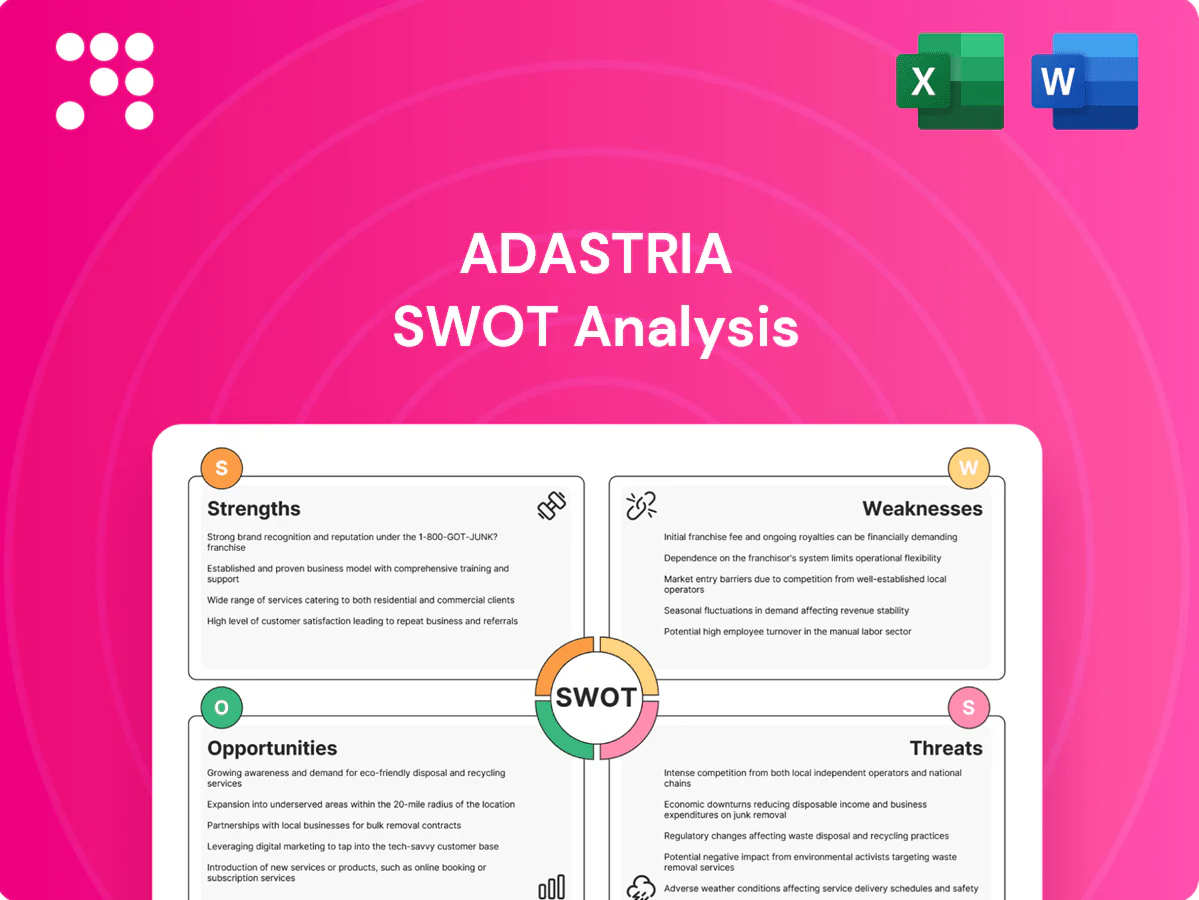
Adastria SWOT Analysis

Make Insightful Decisions Backed by Expert Research
Adastria combines a strong multi-brand retail portfolio and efficient supply chain with deep Japan-market penetration, but faces domestic concentration and margin pressure from fast-fashion competitors. Opportunities in omnichannel expansion, sustainability and selective overseas growth could drive upside, while macro slowdown and rising costs pose real risks. Purchase the full SWOT for a research-backed, editable Word and Excel package to strategize and invest confidently.
Strengths

Diversified multi-brand portfolio
Diversified multi-brand portfolio—operating over 25 brands across apparel, accessories and home goods—cuts reliance on any single label, enabling targeting of multiple demographics and price tiers; with roughly 1,900 stores and consolidated revenue of ¥236.8 billion in FY2024, this mix buffers demand volatility and seasonality and lets Adastria exit underperforming concepts quickly without jeopardizing the whole business.
Omnichannel reach and scale
Adastria leverages an omnichannel footprint with over 1,300 physical stores plus a growing e-commerce platform, boosting customer access and convenience. Click-and-collect, ship-from-store and unified inventory have raised sell-through rates and shortened fulfillment times. Omnichannel data feeds drive sharper merchandising decisions and personalized offers. Scale enhances bargaining power with suppliers and landlords, supporting margin resilience.

Design-to-retail control (SPA model)
Adastria's design-to-retail SPA model keeps design, sourcing and retail in-house, enabling trend response in weeks rather than months and shortening lead times to limit markdown risk. Vertical integration reduces intermediaries and supports healthier gross margins across its portfolio. Shorter cycles and direct feedback from over its store and online channels accelerate product iteration and assortment adjustments.

Broad price architecture
Adastria's broad price architecture, spanning value to premium, widens the addressable market and attracts value-conscious shoppers while retaining fashion-forward consumers. This mix supports traffic resilience in down cycles and enabled the group to maintain stable traffic during recent retail softening. It also facilitates trade-up and cross-selling across its multi-brand network of over 1,000 stores in Japan and Asia.
- Broader addressable market
- Down-cycle traffic resilience
- Enables trade-up & cross-sell
Brand recognition in Japan
Adastria's strong domestic presence in Japan, with over 1,000 stores nationwide, reinforces trust and repeat purchases by offering locally tailored assortments and optimal site selection based on deep market knowledge. Its loyalty programs, with millions of enrollees, boost retention and basket size. Strong word-of-mouth and social proof lower customer acquisition costs and improve marketing ROI.
- Domestic scale: 1,000+ stores
- Loyalty: millions of members
- Lower CAC via social proof
Diversified portfolio: 25+ brands, ~1,900 stores, ¥236.8bn FY2024 revenue
Diversified 25+ brand portfolio with ~1,900 stores and FY2024 revenue ¥236.8 billion reduces single-label risk and enables rapid portfolio optimization. Omnichannel reach (1,300+ stores integrated with e-commerce) improves fulfillment, sell-through and supplier bargaining. SPA vertical model and millions-strong loyalty base shorten lead times, cut markdowns and raise retention.
| Metric | Value |
|---|---|
| Brands | 25+ |
| Stores (total) | ~1,900 |
| FY2024 Revenue | ¥236.8bn |
| Loyalty members | millions |
What is included in the product
 Detailed Word Document
Provides a concise SWOT assessment of Adastria, highlighting internal strengths and weaknesses alongside external opportunities and threats that shape its competitive position and growth prospects.

 Customizable Excel Spreadsheet
Provides a focused SWOT summary of Adastria for rapid strategic alignment and stakeholder briefs, streamlining communication of risks and opportunities; editable format enables quick updates to reflect market shifts and changing priorities.
Weaknesses

High domestic market concentration
High domestic market concentration leaves Adastria heavily exposed to Japanese macro and demographic headwinds, with over 80% of revenue generated in Japan (FY2024), amplifying sensitivity to local GDP and population decline. Limited international diversification raises volatility and limits upside versus global peers. Tourist flows (≈32 million inbound in 2023) and domestic consumption cycles can swing sales. Geographic concentration caps growth optionality.
Fashion trend dependency
Style misses can force Adastria into rapid markdowns and margin compression, as short product lifecycles raise execution risk and shorten time to sell through. Fast-moving micro-trends make demand forecasting more complex, increasing inventory volatility and stockouts or excesses. If assortments lag consumer tastes, brand equity can erode quickly, weakening customer loyalty and price power.

Inventory intensity and working capital
Seasonal SKUs require tight inventory control to avoid obsolescence, and Adastria's broad brand portfolio increases SKU complexity. Excess stock often forces markdowns and promotions that dilute brand value. High holding costs and periodic write-downs strain cash flow. Accurate allocation across stores and online channels is operationally demanding and raises logistics and forecasting costs.

Mid-market margin pressure
Competing between value and premium segments squeezes Adastria’s pricing power, with shoppers rapidly comparing offers between fast fashion, DTC brands and in-store assortments; Adastria reported approximately ¥260bn in net sales in FY2023, exposing scale but limited margin tailwinds. Rising input and labor costs in 2024–25 have been hard to fully pass through, while promotional norms train customers to wait for discounts.
- Pricing squeeze
- Cross-channel comparison
- Input & labor cost pass-through
- Discount-dependent demand
Complex brand portfolio management
Complex brand portfolio—Adastria runs over 30 labels across 1,000+ retail points, raising overlap and cannibalization risks, while fragmented marketing budgets dilute ROI and consistent positioning; governance across many brands slows decisions and undermines loyalty.
- labels: over 30
- stores: 1,000+
- marketing fragmentation: lower ROI
- governance: slower decision-making
Japan-centric retailer: ≈80% revenue, ¥260bn sales, markdown risk and portfolio cannibalization
High Japan concentration (≈80% revenue FY2024) and limited international sales amplify exposure to GDP and demographic decline; net sales ≈¥260bn (FY2023). Fast-fashion volatility forces markdowns, raising inventory costs and margin pressure amid rising input/labor costs in 2024–25. Complex portfolio (30+ labels, 1,000+ stores) increases cannibalization and governance friction.
| Metric | Value |
|---|---|
| Japan revenue share FY2024 | ≈80% |
| Net sales FY2023 | ¥260bn |
| Inbound tourists 2023 | ≈32m |
| Brands / stores | 30+ / 1,000+ |
Preview the Actual Deliverable
Adastria SWOT Analysis
This is the actual Adastria SWOT analysis document you’ll receive upon purchase—no surprises, just professional quality. The preview below is taken directly from the full report you'll get, and the complete, editable version becomes available after checkout.

Make Insightful Decisions Backed by Expert Research
Adastria combines a strong multi-brand retail portfolio and efficient supply chain with deep Japan-market penetration, but faces domestic concentration and margin pressure from fast-fashion competitors. Opportunities in omnichannel expansion, sustainability and selective overseas growth could drive upside, while macro slowdown and rising costs pose real risks. Purchase the full SWOT for a research-backed, editable Word and Excel package to strategize and invest confidently.
Strengths
Diversified multi-brand portfolio
Diversified multi-brand portfolio—operating over 25 brands across apparel, accessories and home goods—cuts reliance on any single label, enabling targeting of multiple demographics and price tiers; with roughly 1,900 stores and consolidated revenue of ¥236.8 billion in FY2024, this mix buffers demand volatility and seasonality and lets Adastria exit underperforming concepts quickly without jeopardizing the whole business.
Omnichannel reach and scale
Adastria leverages an omnichannel footprint with over 1,300 physical stores plus a growing e-commerce platform, boosting customer access and convenience. Click-and-collect, ship-from-store and unified inventory have raised sell-through rates and shortened fulfillment times. Omnichannel data feeds drive sharper merchandising decisions and personalized offers. Scale enhances bargaining power with suppliers and landlords, supporting margin resilience.
Design-to-retail control (SPA model)
Adastria's design-to-retail SPA model keeps design, sourcing and retail in-house, enabling trend response in weeks rather than months and shortening lead times to limit markdown risk. Vertical integration reduces intermediaries and supports healthier gross margins across its portfolio. Shorter cycles and direct feedback from over its store and online channels accelerate product iteration and assortment adjustments.
Broad price architecture
Adastria's broad price architecture, spanning value to premium, widens the addressable market and attracts value-conscious shoppers while retaining fashion-forward consumers. This mix supports traffic resilience in down cycles and enabled the group to maintain stable traffic during recent retail softening. It also facilitates trade-up and cross-selling across its multi-brand network of over 1,000 stores in Japan and Asia.
- Broader addressable market
- Down-cycle traffic resilience
- Enables trade-up & cross-sell
Brand recognition in Japan
Adastria's strong domestic presence in Japan, with over 1,000 stores nationwide, reinforces trust and repeat purchases by offering locally tailored assortments and optimal site selection based on deep market knowledge. Its loyalty programs, with millions of enrollees, boost retention and basket size. Strong word-of-mouth and social proof lower customer acquisition costs and improve marketing ROI.
- Domestic scale: 1,000+ stores
- Loyalty: millions of members
- Lower CAC via social proof
Diversified portfolio: 25+ brands, ~1,900 stores, ¥236.8bn FY2024 revenue
Diversified 25+ brand portfolio with ~1,900 stores and FY2024 revenue ¥236.8 billion reduces single-label risk and enables rapid portfolio optimization. Omnichannel reach (1,300+ stores integrated with e-commerce) improves fulfillment, sell-through and supplier bargaining. SPA vertical model and millions-strong loyalty base shorten lead times, cut markdowns and raise retention.
| Metric | Value |
|---|---|
| Brands | 25+ |
| Stores (total) | ~1,900 |
| FY2024 Revenue | ¥236.8bn |
| Loyalty members | millions |
What is included in the product
Detailed Word Document
Provides a concise SWOT assessment of Adastria, highlighting internal strengths and weaknesses alongside external opportunities and threats that shape its competitive position and growth prospects.
Customizable Excel Spreadsheet
Provides a focused SWOT summary of Adastria for rapid strategic alignment and stakeholder briefs, streamlining communication of risks and opportunities; editable format enables quick updates to reflect market shifts and changing priorities.
Weaknesses
High domestic market concentration
High domestic market concentration leaves Adastria heavily exposed to Japanese macro and demographic headwinds, with over 80% of revenue generated in Japan (FY2024), amplifying sensitivity to local GDP and population decline. Limited international diversification raises volatility and limits upside versus global peers. Tourist flows (≈32 million inbound in 2023) and domestic consumption cycles can swing sales. Geographic concentration caps growth optionality.
Fashion trend dependency
Style misses can force Adastria into rapid markdowns and margin compression, as short product lifecycles raise execution risk and shorten time to sell through. Fast-moving micro-trends make demand forecasting more complex, increasing inventory volatility and stockouts or excesses. If assortments lag consumer tastes, brand equity can erode quickly, weakening customer loyalty and price power.
Inventory intensity and working capital
Seasonal SKUs require tight inventory control to avoid obsolescence, and Adastria's broad brand portfolio increases SKU complexity. Excess stock often forces markdowns and promotions that dilute brand value. High holding costs and periodic write-downs strain cash flow. Accurate allocation across stores and online channels is operationally demanding and raises logistics and forecasting costs.
Mid-market margin pressure
Competing between value and premium segments squeezes Adastria’s pricing power, with shoppers rapidly comparing offers between fast fashion, DTC brands and in-store assortments; Adastria reported approximately ¥260bn in net sales in FY2023, exposing scale but limited margin tailwinds. Rising input and labor costs in 2024–25 have been hard to fully pass through, while promotional norms train customers to wait for discounts.
- Pricing squeeze
- Cross-channel comparison
- Input & labor cost pass-through
- Discount-dependent demand
Complex brand portfolio management
Complex brand portfolio—Adastria runs over 30 labels across 1,000+ retail points, raising overlap and cannibalization risks, while fragmented marketing budgets dilute ROI and consistent positioning; governance across many brands slows decisions and undermines loyalty.
- labels: over 30
- stores: 1,000+
- marketing fragmentation: lower ROI
- governance: slower decision-making
Japan-centric retailer: ≈80% revenue, ¥260bn sales, markdown risk and portfolio cannibalization
High Japan concentration (≈80% revenue FY2024) and limited international sales amplify exposure to GDP and demographic decline; net sales ≈¥260bn (FY2023). Fast-fashion volatility forces markdowns, raising inventory costs and margin pressure amid rising input/labor costs in 2024–25. Complex portfolio (30+ labels, 1,000+ stores) increases cannibalization and governance friction.
| Metric | Value |
|---|---|
| Japan revenue share FY2024 | ≈80% |
| Net sales FY2023 | ¥260bn |
| Inbound tourists 2023 | ≈32m |
| Brands / stores | 30+ / 1,000+ |
Preview the Actual Deliverable
Adastria SWOT Analysis
This is the actual Adastria SWOT analysis document you’ll receive upon purchase—no surprises, just professional quality. The preview below is taken directly from the full report you'll get, and the complete, editable version becomes available after checkout.
Original: $10.00
-65%$10.00
$3.50Description
Make Insightful Decisions Backed by Expert Research
Adastria combines a strong multi-brand retail portfolio and efficient supply chain with deep Japan-market penetration, but faces domestic concentration and margin pressure from fast-fashion competitors. Opportunities in omnichannel expansion, sustainability and selective overseas growth could drive upside, while macro slowdown and rising costs pose real risks. Purchase the full SWOT for a research-backed, editable Word and Excel package to strategize and invest confidently.
Strengths
Diversified multi-brand portfolio
Diversified multi-brand portfolio—operating over 25 brands across apparel, accessories and home goods—cuts reliance on any single label, enabling targeting of multiple demographics and price tiers; with roughly 1,900 stores and consolidated revenue of ¥236.8 billion in FY2024, this mix buffers demand volatility and seasonality and lets Adastria exit underperforming concepts quickly without jeopardizing the whole business.
Omnichannel reach and scale
Adastria leverages an omnichannel footprint with over 1,300 physical stores plus a growing e-commerce platform, boosting customer access and convenience. Click-and-collect, ship-from-store and unified inventory have raised sell-through rates and shortened fulfillment times. Omnichannel data feeds drive sharper merchandising decisions and personalized offers. Scale enhances bargaining power with suppliers and landlords, supporting margin resilience.
Design-to-retail control (SPA model)
Adastria's design-to-retail SPA model keeps design, sourcing and retail in-house, enabling trend response in weeks rather than months and shortening lead times to limit markdown risk. Vertical integration reduces intermediaries and supports healthier gross margins across its portfolio. Shorter cycles and direct feedback from over its store and online channels accelerate product iteration and assortment adjustments.
Broad price architecture
Adastria's broad price architecture, spanning value to premium, widens the addressable market and attracts value-conscious shoppers while retaining fashion-forward consumers. This mix supports traffic resilience in down cycles and enabled the group to maintain stable traffic during recent retail softening. It also facilitates trade-up and cross-selling across its multi-brand network of over 1,000 stores in Japan and Asia.
- Broader addressable market
- Down-cycle traffic resilience
- Enables trade-up & cross-sell
Brand recognition in Japan
Adastria's strong domestic presence in Japan, with over 1,000 stores nationwide, reinforces trust and repeat purchases by offering locally tailored assortments and optimal site selection based on deep market knowledge. Its loyalty programs, with millions of enrollees, boost retention and basket size. Strong word-of-mouth and social proof lower customer acquisition costs and improve marketing ROI.
- Domestic scale: 1,000+ stores
- Loyalty: millions of members
- Lower CAC via social proof
Diversified portfolio: 25+ brands, ~1,900 stores, ¥236.8bn FY2024 revenue
Diversified 25+ brand portfolio with ~1,900 stores and FY2024 revenue ¥236.8 billion reduces single-label risk and enables rapid portfolio optimization. Omnichannel reach (1,300+ stores integrated with e-commerce) improves fulfillment, sell-through and supplier bargaining. SPA vertical model and millions-strong loyalty base shorten lead times, cut markdowns and raise retention.
| Metric | Value |
|---|---|
| Brands | 25+ |
| Stores (total) | ~1,900 |
| FY2024 Revenue | ¥236.8bn |
| Loyalty members | millions |
What is included in the product
Detailed Word Document
Provides a concise SWOT assessment of Adastria, highlighting internal strengths and weaknesses alongside external opportunities and threats that shape its competitive position and growth prospects.
Customizable Excel Spreadsheet
Provides a focused SWOT summary of Adastria for rapid strategic alignment and stakeholder briefs, streamlining communication of risks and opportunities; editable format enables quick updates to reflect market shifts and changing priorities.
Weaknesses
High domestic market concentration
High domestic market concentration leaves Adastria heavily exposed to Japanese macro and demographic headwinds, with over 80% of revenue generated in Japan (FY2024), amplifying sensitivity to local GDP and population decline. Limited international diversification raises volatility and limits upside versus global peers. Tourist flows (≈32 million inbound in 2023) and domestic consumption cycles can swing sales. Geographic concentration caps growth optionality.
Fashion trend dependency
Style misses can force Adastria into rapid markdowns and margin compression, as short product lifecycles raise execution risk and shorten time to sell through. Fast-moving micro-trends make demand forecasting more complex, increasing inventory volatility and stockouts or excesses. If assortments lag consumer tastes, brand equity can erode quickly, weakening customer loyalty and price power.
Inventory intensity and working capital
Seasonal SKUs require tight inventory control to avoid obsolescence, and Adastria's broad brand portfolio increases SKU complexity. Excess stock often forces markdowns and promotions that dilute brand value. High holding costs and periodic write-downs strain cash flow. Accurate allocation across stores and online channels is operationally demanding and raises logistics and forecasting costs.
Mid-market margin pressure
Competing between value and premium segments squeezes Adastria’s pricing power, with shoppers rapidly comparing offers between fast fashion, DTC brands and in-store assortments; Adastria reported approximately ¥260bn in net sales in FY2023, exposing scale but limited margin tailwinds. Rising input and labor costs in 2024–25 have been hard to fully pass through, while promotional norms train customers to wait for discounts.
- Pricing squeeze
- Cross-channel comparison
- Input & labor cost pass-through
- Discount-dependent demand
Complex brand portfolio management
Complex brand portfolio—Adastria runs over 30 labels across 1,000+ retail points, raising overlap and cannibalization risks, while fragmented marketing budgets dilute ROI and consistent positioning; governance across many brands slows decisions and undermines loyalty.
- labels: over 30
- stores: 1,000+
- marketing fragmentation: lower ROI
- governance: slower decision-making
Japan-centric retailer: ≈80% revenue, ¥260bn sales, markdown risk and portfolio cannibalization
High Japan concentration (≈80% revenue FY2024) and limited international sales amplify exposure to GDP and demographic decline; net sales ≈¥260bn (FY2023). Fast-fashion volatility forces markdowns, raising inventory costs and margin pressure amid rising input/labor costs in 2024–25. Complex portfolio (30+ labels, 1,000+ stores) increases cannibalization and governance friction.
| Metric | Value |
|---|---|
| Japan revenue share FY2024 | ≈80% |
| Net sales FY2023 | ¥260bn |
| Inbound tourists 2023 | ≈32m |
| Brands / stores | 30+ / 1,000+ |
Preview the Actual Deliverable
Adastria SWOT Analysis
This is the actual Adastria SWOT analysis document you’ll receive upon purchase—no surprises, just professional quality. The preview below is taken directly from the full report you'll get, and the complete, editable version becomes available after checkout.











