Adeia SWOT Analysis

Make Insightful Decisions Backed by Expert Research
Adeia's SWOT analysis highlights core competitive strengths, strategic weaknesses, and emerging market threats in a concise, actionable format. Our full report dives deeper into financial context, growth drivers, and mitigation strategies. Purchase the complete SWOT to get an editable, investor-ready package for planning and pitches.
Strengths

Deep, diversified IP portfolio
Adeia's deep, diversified IP portfolio comprises over 1,600 issued patents and applications across media delivery, content processing and UX, giving cross-device coverage and multi-domain value capture. The portfolio depth strengthens negotiating leverage with major platforms and operators, enabling multi-year license deals. Robust licensing historically produced roughly 65% of FY2024 revenue, underpinning durable royalty streams across technology cycles.
Global embedded reach across billions of devices
Technologies embedded in TVs, set-top boxes, mobile, streaming devices and network systems create an installed base exceeding 2 billion devices, generating broad royalty incidence and high renewal stickiness; continued device proliferation expands Adeia’s monetization footprint and reinforces relevance with OEMs and ecosystem gatekeepers, underpinning steady licensing cash flow and strategic leverage.

High-margin, recurring licensing economics
Licensing delivers high gross margins typically above 70%, outperforming product businesses and supporting strong profitability. Multi-year agreements and standards adoption drive recurring revenue visibility, with an estimated 80–90% of near-term backlog covered by multi-year contracts as of mid-2025. Audit and true-up mechanisms provide incremental upside, while capital-light operations enable FCF conversion often exceeding 80%.

Strong relationships with media and CE ecosystems
Longstanding ties with studios, pay-TV, streamers, CE OEMs and operators accelerate Adeia adoption by easing integration into existing content and device channels; global streaming subscriptions surpassed 1 billion by 2023, expanding the addressable market. Relationship capital reduces sales friction and shortens licensing cycles, supports cross-licensing and portfolio expansion, and boosts credibility for stronger enforcement and faster settlements.
- Faster adoption through entrenched channel partners
- Lower sales friction and shorter licensing cycles
- Enables cross-licensing, portfolio growth, and improved enforcement outcomes
Proven R&D and standards participation
Ongoing R&D sustains a high-quality patent pipeline and active participation in standards bodies aligns Adeia inventions with industry roadmaps, increasing the likelihood that assets become standard-essential and widely adopted, which supports defending rate cards and preserves negotiating leverage.
- R&D: strong patent pipeline
- Standards: roadmap alignment
- Essentiality: higher adoption likelihood
- Commercial: defends rates, preserves leverage
IP licensing: >1,600 patents, >2bn devices
Adeia holds >1,600 patents across media delivery and UX, enabling strong leverage with platforms; licensing contributed ~65% of FY2024 revenue and supports gross margins >70%. Installed base exceeds 2bn devices, generating recurring royalties and high renewal stickiness. Mid-2025 backlog coverage stood at ~80–90% via multi-year contracts with FCF conversion >80%.
| Metric | Value |
|---|---|
| Patents | >1,600 |
| Installed base | >2bn |
| Licensing rev | ~65% FY2024 |
| Gross margin | >70% |
What is included in the product
 Detailed Word Document
Examines Adeia’s internal capabilities and external market forces by outlining strengths, weaknesses, opportunities, and threats, highlighting its IP-centric business model, technology partnerships, monetization runway, competitive risks, and regulatory and market adoption challenges.

 Customizable Excel Spreadsheet
Provides a concise, high-level SWOT matrix tailored to Adeia for rapid strategic alignment, clarifying IP and market strengths while highlighting risks for quick stakeholder decision-making.
Weaknesses

Revenue concentration in large licensees
Dependence on a subset of major licensees raises revenue volatility for Adeia, so a delayed renewal or a commercial dispute with a large counterparty can materially affect quarterly results. Large licensees wield bargaining power that can compress rates and tighten contract terms. Management notes diversification is underway but progress may be gradual given long-term licensing cycles.
Exposure to litigation and enforcement costs
Monetizing Adeia’s IP often requires assertions that are costly and time-consuming, creating timing and cash-flow uncertainty from prolonged litigation.
Adverse rulings can materially impair portfolio value and licensing leverage, while settlement and enforcement expenses reduce net returns.
Management bandwidth is diverted from R&D and deal sourcing as legal strategies and responses consume executive and legal resources.

Limited brand and product control
As a licensor, Adeia lacks control over end-user experiences and go-to-market execution, relying on partners to implement and showcase its innovations. Revenue is indirect and tied to partner adoption and shipment volumes, so royalty recognition can lag product wins. This dependency can mute the near-term impact of new inventions and makes market visibility and timing dependent on third-party commercialization cycles.

Sector focus on entertainment technologies
Adeia’s concentration in media delivery and UX raises exposure to the streaming ecosystem’s cyclicality; the global video streaming market was around $184B in 2023, intensifying platform-driven swings. Shifts in codec strategy or platform priorities can quickly reduce demand; expanding into adjacent verticals will require additional time and capital, limiting strategic optionality.
- High cyclicality
- Platform/codec risk
- Capital/time to diversify
- Limited optionality
Renewal timing and audit lumpiness
Renewal timing, periodic audits and catch-up payments drive pronounced quarter-to-quarter revenue swings that can mask true subscription run-rate and ARR stability.
Recognition patterns tied to lump-sum audit settlements obscure recurring revenue trends, while negotiation timing—often set by customer cycles and audit schedules—is not fully controllable.
These factors complicate short-term forecasting and increase model variance for investors relying on smooth growth assumptions.
- renewal-driven quarter volatility
- audit lumpiness masks run-rate
- negotiation timing beyond control
- forecasting variance for investors
License concentration and lumpy royalties threaten predictability in $184B streaming market
Concentration among a few major licensees creates material revenue volatility and bargaining pressure; delayed renewals or disputes can swing quarterly results. Enforcement-driven monetization is costly and slow, producing timing and cash-flow uncertainty. Royalty recognition is lumpy—renewals, audits and settlements obscure ARR and complicate forecasting in a streaming market (global video streaming ~$184B in 2023).
| Metric | Fact |
|---|---|
| Streaming market (2023) | $184B |
Preview Before You Purchase
Adeia SWOT Analysis
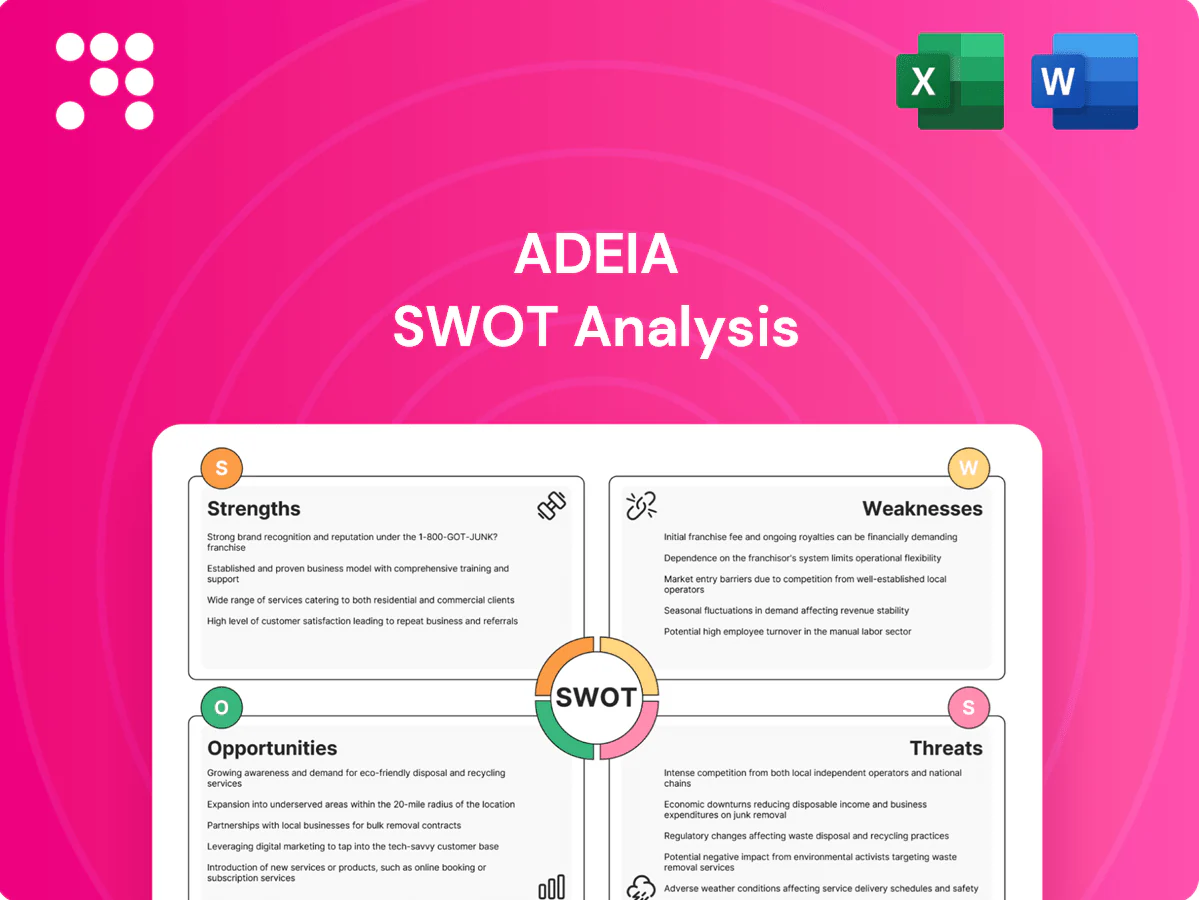
This is the actual SWOT analysis document you’ll receive upon purchase—no surprises, just professional quality. The preview below is taken directly from the full SWOT report you'll get; buy to unlock the complete, editable version. You’re viewing a live preview of the real, structured file available immediately after checkout.

Make Insightful Decisions Backed by Expert Research
Adeia's SWOT analysis highlights core competitive strengths, strategic weaknesses, and emerging market threats in a concise, actionable format. Our full report dives deeper into financial context, growth drivers, and mitigation strategies. Purchase the complete SWOT to get an editable, investor-ready package for planning and pitches.
Strengths
Deep, diversified IP portfolio
Adeia's deep, diversified IP portfolio comprises over 1,600 issued patents and applications across media delivery, content processing and UX, giving cross-device coverage and multi-domain value capture. The portfolio depth strengthens negotiating leverage with major platforms and operators, enabling multi-year license deals. Robust licensing historically produced roughly 65% of FY2024 revenue, underpinning durable royalty streams across technology cycles.
Global embedded reach across billions of devices
Technologies embedded in TVs, set-top boxes, mobile, streaming devices and network systems create an installed base exceeding 2 billion devices, generating broad royalty incidence and high renewal stickiness; continued device proliferation expands Adeia’s monetization footprint and reinforces relevance with OEMs and ecosystem gatekeepers, underpinning steady licensing cash flow and strategic leverage.
High-margin, recurring licensing economics
Licensing delivers high gross margins typically above 70%, outperforming product businesses and supporting strong profitability. Multi-year agreements and standards adoption drive recurring revenue visibility, with an estimated 80–90% of near-term backlog covered by multi-year contracts as of mid-2025. Audit and true-up mechanisms provide incremental upside, while capital-light operations enable FCF conversion often exceeding 80%.
Strong relationships with media and CE ecosystems
Longstanding ties with studios, pay-TV, streamers, CE OEMs and operators accelerate Adeia adoption by easing integration into existing content and device channels; global streaming subscriptions surpassed 1 billion by 2023, expanding the addressable market. Relationship capital reduces sales friction and shortens licensing cycles, supports cross-licensing and portfolio expansion, and boosts credibility for stronger enforcement and faster settlements.
- Faster adoption through entrenched channel partners
- Lower sales friction and shorter licensing cycles
- Enables cross-licensing, portfolio growth, and improved enforcement outcomes
Proven R&D and standards participation
Ongoing R&D sustains a high-quality patent pipeline and active participation in standards bodies aligns Adeia inventions with industry roadmaps, increasing the likelihood that assets become standard-essential and widely adopted, which supports defending rate cards and preserves negotiating leverage.
- R&D: strong patent pipeline
- Standards: roadmap alignment
- Essentiality: higher adoption likelihood
- Commercial: defends rates, preserves leverage
IP licensing: >1,600 patents, >2bn devices
Adeia holds >1,600 patents across media delivery and UX, enabling strong leverage with platforms; licensing contributed ~65% of FY2024 revenue and supports gross margins >70%. Installed base exceeds 2bn devices, generating recurring royalties and high renewal stickiness. Mid-2025 backlog coverage stood at ~80–90% via multi-year contracts with FCF conversion >80%.
| Metric | Value |
|---|---|
| Patents | >1,600 |
| Installed base | >2bn |
| Licensing rev | ~65% FY2024 |
| Gross margin | >70% |
What is included in the product
Detailed Word Document
Examines Adeia’s internal capabilities and external market forces by outlining strengths, weaknesses, opportunities, and threats, highlighting its IP-centric business model, technology partnerships, monetization runway, competitive risks, and regulatory and market adoption challenges.
Customizable Excel Spreadsheet
Provides a concise, high-level SWOT matrix tailored to Adeia for rapid strategic alignment, clarifying IP and market strengths while highlighting risks for quick stakeholder decision-making.
Weaknesses
Revenue concentration in large licensees
Dependence on a subset of major licensees raises revenue volatility for Adeia, so a delayed renewal or a commercial dispute with a large counterparty can materially affect quarterly results. Large licensees wield bargaining power that can compress rates and tighten contract terms. Management notes diversification is underway but progress may be gradual given long-term licensing cycles.
Exposure to litigation and enforcement costs
Monetizing Adeia’s IP often requires assertions that are costly and time-consuming, creating timing and cash-flow uncertainty from prolonged litigation.
Adverse rulings can materially impair portfolio value and licensing leverage, while settlement and enforcement expenses reduce net returns.
Management bandwidth is diverted from R&D and deal sourcing as legal strategies and responses consume executive and legal resources.
Limited brand and product control
As a licensor, Adeia lacks control over end-user experiences and go-to-market execution, relying on partners to implement and showcase its innovations. Revenue is indirect and tied to partner adoption and shipment volumes, so royalty recognition can lag product wins. This dependency can mute the near-term impact of new inventions and makes market visibility and timing dependent on third-party commercialization cycles.
Sector focus on entertainment technologies
Adeia’s concentration in media delivery and UX raises exposure to the streaming ecosystem’s cyclicality; the global video streaming market was around $184B in 2023, intensifying platform-driven swings. Shifts in codec strategy or platform priorities can quickly reduce demand; expanding into adjacent verticals will require additional time and capital, limiting strategic optionality.
- High cyclicality
- Platform/codec risk
- Capital/time to diversify
- Limited optionality
Renewal timing and audit lumpiness
Renewal timing, periodic audits and catch-up payments drive pronounced quarter-to-quarter revenue swings that can mask true subscription run-rate and ARR stability.
Recognition patterns tied to lump-sum audit settlements obscure recurring revenue trends, while negotiation timing—often set by customer cycles and audit schedules—is not fully controllable.
These factors complicate short-term forecasting and increase model variance for investors relying on smooth growth assumptions.
- renewal-driven quarter volatility
- audit lumpiness masks run-rate
- negotiation timing beyond control
- forecasting variance for investors
License concentration and lumpy royalties threaten predictability in $184B streaming market
Concentration among a few major licensees creates material revenue volatility and bargaining pressure; delayed renewals or disputes can swing quarterly results. Enforcement-driven monetization is costly and slow, producing timing and cash-flow uncertainty. Royalty recognition is lumpy—renewals, audits and settlements obscure ARR and complicate forecasting in a streaming market (global video streaming ~$184B in 2023).
| Metric | Fact |
|---|---|
| Streaming market (2023) | $184B |
Preview Before You Purchase
Adeia SWOT Analysis
This is the actual SWOT analysis document you’ll receive upon purchase—no surprises, just professional quality. The preview below is taken directly from the full SWOT report you'll get; buy to unlock the complete, editable version. You’re viewing a live preview of the real, structured file available immediately after checkout.
Description
Make Insightful Decisions Backed by Expert Research
Adeia's SWOT analysis highlights core competitive strengths, strategic weaknesses, and emerging market threats in a concise, actionable format. Our full report dives deeper into financial context, growth drivers, and mitigation strategies. Purchase the complete SWOT to get an editable, investor-ready package for planning and pitches.
Strengths
Deep, diversified IP portfolio
Adeia's deep, diversified IP portfolio comprises over 1,600 issued patents and applications across media delivery, content processing and UX, giving cross-device coverage and multi-domain value capture. The portfolio depth strengthens negotiating leverage with major platforms and operators, enabling multi-year license deals. Robust licensing historically produced roughly 65% of FY2024 revenue, underpinning durable royalty streams across technology cycles.
Global embedded reach across billions of devices
Technologies embedded in TVs, set-top boxes, mobile, streaming devices and network systems create an installed base exceeding 2 billion devices, generating broad royalty incidence and high renewal stickiness; continued device proliferation expands Adeia’s monetization footprint and reinforces relevance with OEMs and ecosystem gatekeepers, underpinning steady licensing cash flow and strategic leverage.
High-margin, recurring licensing economics
Licensing delivers high gross margins typically above 70%, outperforming product businesses and supporting strong profitability. Multi-year agreements and standards adoption drive recurring revenue visibility, with an estimated 80–90% of near-term backlog covered by multi-year contracts as of mid-2025. Audit and true-up mechanisms provide incremental upside, while capital-light operations enable FCF conversion often exceeding 80%.
Strong relationships with media and CE ecosystems
Longstanding ties with studios, pay-TV, streamers, CE OEMs and operators accelerate Adeia adoption by easing integration into existing content and device channels; global streaming subscriptions surpassed 1 billion by 2023, expanding the addressable market. Relationship capital reduces sales friction and shortens licensing cycles, supports cross-licensing and portfolio expansion, and boosts credibility for stronger enforcement and faster settlements.
- Faster adoption through entrenched channel partners
- Lower sales friction and shorter licensing cycles
- Enables cross-licensing, portfolio growth, and improved enforcement outcomes
Proven R&D and standards participation
Ongoing R&D sustains a high-quality patent pipeline and active participation in standards bodies aligns Adeia inventions with industry roadmaps, increasing the likelihood that assets become standard-essential and widely adopted, which supports defending rate cards and preserves negotiating leverage.
- R&D: strong patent pipeline
- Standards: roadmap alignment
- Essentiality: higher adoption likelihood
- Commercial: defends rates, preserves leverage
IP licensing: >1,600 patents, >2bn devices
Adeia holds >1,600 patents across media delivery and UX, enabling strong leverage with platforms; licensing contributed ~65% of FY2024 revenue and supports gross margins >70%. Installed base exceeds 2bn devices, generating recurring royalties and high renewal stickiness. Mid-2025 backlog coverage stood at ~80–90% via multi-year contracts with FCF conversion >80%.
| Metric | Value |
|---|---|
| Patents | >1,600 |
| Installed base | >2bn |
| Licensing rev | ~65% FY2024 |
| Gross margin | >70% |
What is included in the product
Detailed Word Document
Examines Adeia’s internal capabilities and external market forces by outlining strengths, weaknesses, opportunities, and threats, highlighting its IP-centric business model, technology partnerships, monetization runway, competitive risks, and regulatory and market adoption challenges.
Customizable Excel Spreadsheet
Provides a concise, high-level SWOT matrix tailored to Adeia for rapid strategic alignment, clarifying IP and market strengths while highlighting risks for quick stakeholder decision-making.
Weaknesses
Revenue concentration in large licensees
Dependence on a subset of major licensees raises revenue volatility for Adeia, so a delayed renewal or a commercial dispute with a large counterparty can materially affect quarterly results. Large licensees wield bargaining power that can compress rates and tighten contract terms. Management notes diversification is underway but progress may be gradual given long-term licensing cycles.
Exposure to litigation and enforcement costs
Monetizing Adeia’s IP often requires assertions that are costly and time-consuming, creating timing and cash-flow uncertainty from prolonged litigation.
Adverse rulings can materially impair portfolio value and licensing leverage, while settlement and enforcement expenses reduce net returns.
Management bandwidth is diverted from R&D and deal sourcing as legal strategies and responses consume executive and legal resources.
Limited brand and product control
As a licensor, Adeia lacks control over end-user experiences and go-to-market execution, relying on partners to implement and showcase its innovations. Revenue is indirect and tied to partner adoption and shipment volumes, so royalty recognition can lag product wins. This dependency can mute the near-term impact of new inventions and makes market visibility and timing dependent on third-party commercialization cycles.
Sector focus on entertainment technologies
Adeia’s concentration in media delivery and UX raises exposure to the streaming ecosystem’s cyclicality; the global video streaming market was around $184B in 2023, intensifying platform-driven swings. Shifts in codec strategy or platform priorities can quickly reduce demand; expanding into adjacent verticals will require additional time and capital, limiting strategic optionality.
- High cyclicality
- Platform/codec risk
- Capital/time to diversify
- Limited optionality
Renewal timing and audit lumpiness
Renewal timing, periodic audits and catch-up payments drive pronounced quarter-to-quarter revenue swings that can mask true subscription run-rate and ARR stability.
Recognition patterns tied to lump-sum audit settlements obscure recurring revenue trends, while negotiation timing—often set by customer cycles and audit schedules—is not fully controllable.
These factors complicate short-term forecasting and increase model variance for investors relying on smooth growth assumptions.
- renewal-driven quarter volatility
- audit lumpiness masks run-rate
- negotiation timing beyond control
- forecasting variance for investors
License concentration and lumpy royalties threaten predictability in $184B streaming market
Concentration among a few major licensees creates material revenue volatility and bargaining pressure; delayed renewals or disputes can swing quarterly results. Enforcement-driven monetization is costly and slow, producing timing and cash-flow uncertainty. Royalty recognition is lumpy—renewals, audits and settlements obscure ARR and complicate forecasting in a streaming market (global video streaming ~$184B in 2023).
| Metric | Fact |
|---|---|
| Streaming market (2023) | $184B |
Preview Before You Purchase
Adeia SWOT Analysis
This is the actual SWOT analysis document you’ll receive upon purchase—no surprises, just professional quality. The preview below is taken directly from the full SWOT report you'll get; buy to unlock the complete, editable version. You’re viewing a live preview of the real, structured file available immediately after checkout.











