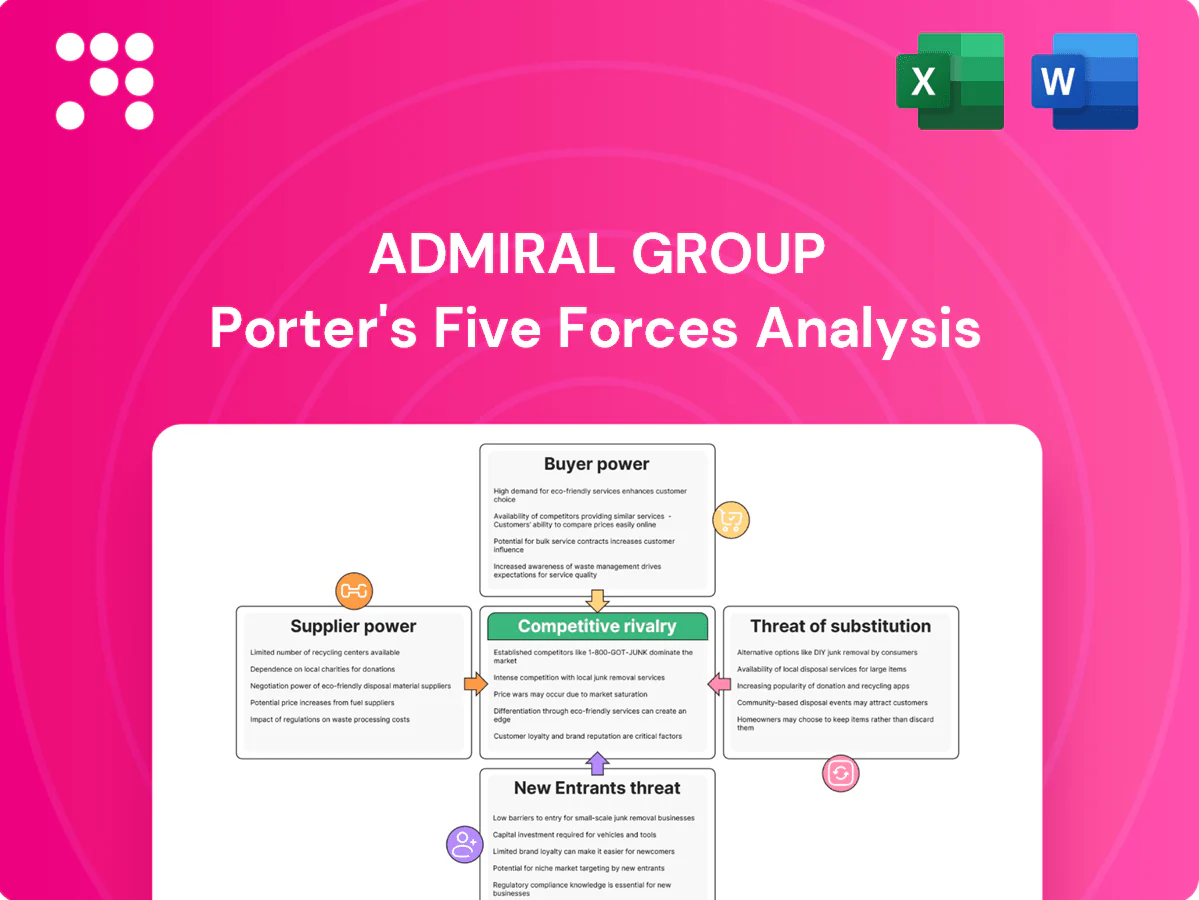
Admiral Group Porter's Five Forces Analysis

Elevate Your Analysis with the Complete Porter's Five Forces Analysis
Admiral Group faces intense price competition, rising regulatory scrutiny, and evolving customer expectations that pressure margins and growth prospects; supplier leverage is low but digital entrants and insurtechs raise the threat of disruption. This snapshot highlights key tensions but omits force-by-force ratings and quantified impact. Unlock the full Porter's Five Forces Analysis to get detailed ratings, visuals, and strategic recommendations tailored to Admiral.
Suppliers Bargaining Power

Reinsurers hold key capacity
Admiral relies on global reinsurers to manage peak motor and home risk and to optimise capital efficiency; concentration among top reinsurers can push up pricing and tighten terms during hard markets, making renewal rounds materially sensitive. Long-standing relationships and Admiral’s scale help, while diversification of panels and quota-share arrangements reduce counterparty leverage and spread renewal risk.
Data, telematics, and scoring vendors
External data (credit, claims histories, telematics, geospatial) underpins Admiral's pricing and fraud controls; in 2024 reliance on specialist suppliers remained material. Switching costs and model revalidation give vendors moderate bargaining power, while in-house analytics reduce dependence but cannot replace some proprietary datasets. Vendor outages or policy changes can quickly disrupt underwriting throughput and customer onboarding.

Claims supply chain dependence
Body shops, parts suppliers, repair networks and medical/legal firms materially affect Admiral's loss costs and cycle times; industry parts and labor inflation ran around 10% in 2023–24, tightening supplier bargaining power and capacity. Preferred repair networks and long-term contracts help Admiral negotiate rates and service levels, while vertical coordination and digital FNOL reduce leakage and speed settlements, improving claims efficiency.

Cloud, core systems, and IT partners
Core policy admin, cloud infrastructure and cybersecurity providers are mission-critical for Admiral; Flexera 2024 shows 94% of enterprises use cloud and the public cloud market was roughly $600B in 2024, giving suppliers pricing and SLA leverage due to high switching costs and compliance demands. Multi-cloud and modular architectures reduce lock-in but migration complexity and regulator resilience expectations keep substitution costly.
- Mission-critical: high supplier leverage
- 94% cloud adoption (Flexera 2024)
- Public cloud ~ $600B (2024)
- Multi-cloud lowers, but regs increase, switching costs
Aggregators and distribution partners
Price comparison websites remain major UK acquisition channels in 2024 and command placement fees, concentrating consumer traffic and increasing Admiral’s dependency and contestability of shelf position; however Admiral’s strong brand, direct channels and multi-brand strategy reduce that supplier power. Marketing analytics and A/B testing across channels improve targeting, allowing Admiral to negotiate better CPC and lead-share terms with aggregators.
- aggregation: price comparison sites dominate online motor leads
- dependency: shelf position drives contestability
- counterbalance: Admiral brand + direct channels
- leverage: analytics + multi-brand placement
Insurer faces supplier power as 10% parts inflation and 94% cloud adoption
Admiral faces moderate–high supplier power from reinsurers, specialist data vendors, repair networks and cloud providers; 2024 pressures (parts/labour inflation ~10%, cloud adoption 94%, public cloud ~$600B) raise costs and switching friction. Scale, multi-brand distribution, in-house analytics and multi-cloud architectures reduce but do not eliminate dependency.
| Supplier | 2024 metric | Impact |
|---|---|---|
| Repair networks/parts | Inflation ~10% | Higher loss costs |
| Cloud providers | 94% adoption; market ~$600B | High switching costs |
| Data/reinsurance | Concentrated panels | Renewal pricing volatility |
What is included in the product
 Detailed Word Document
Tailored Porter’s Five Forces analysis for Admiral Group revealing competitive intensity, buyer and supplier power, threat of new entrants and substitutes, and regulatory/disruptive risks; provides strategic insights to safeguard market share and margins.

 Customizable Excel Spreadsheet
A one-sheet Porter's Five Forces for Admiral Group that highlights competitive threats, regulatory pressure, and supplier/customer bargaining power—ideal for quick strategic decisions and board decks. Editable radar chart and clean layout let non-finance users tailor assumptions and run scenario comparisons without macros.
Customers Bargaining Power

High price transparency via aggregators
High price transparency from aggregators lets UK motor buyers compare dozens of quotes instantly, intensifying price competition and compressing margins. Low switching costs at renewal amplify buyer power, forcing Admiral to continuously optimize pricing algorithms and targeted offers. Loyalty schemes and service differentiation, including bundled cover and claims experience, can reduce churn and partially offset price-driven switching.
Commoditized core products
With commoditized car and home covers, c.60% of UK buyers in 2024 cited price as the primary decision factor, making small premium gaps highly influential. Limited perceived differentiation gives customers strong bargaining leverage and drives comparison-site churn. Admiral's c.9% UK motor market share (2024) underscores competition on price. Emphasizing bundled features, add-ons and clear claims service KPIs (speed, payout rates) can reframe value beyond premium alone.

Multi-product cross-sell moderates power
Admiral’s offering of home, travel, pet and loans enables bundled pricing and loyalty incentives that raise switching friction and lower churn through cross-holdings, while data synergies support more granular, tailored pricing and risk segmentation; nevertheless buyers still price-check each policy independently, with around 70% of UK consumers using price comparison sites in 2024.

Digital and UX expectations
Customers now expect instant quotes, seamless self-service and rapid claims settlement; poor UX accelerates switching and increases bargaining power in price-sensitive segments.
Superior apps and telematics can lock in drivers by reducing churn and enabling usage-based pricing; transparency on claims outcomes builds trust and stickiness.
- Instant digital quotes drive conversion
- Self-service lowers costs, raises expectations
- Telematics improves retention of price-sensitive customers
- Claims transparency increases loyalty
Segment heterogeneity
Segment heterogeneity weakens buyer power: young drivers, high-risk and telematics users prioritize safety features and personalized pricing over lowest sticker price, and in 2024 Admiral continues targeting these niches through its multi-brand approach to dilute single-buyer leverage.
Price transparency empowers buyers; telematics, bundling and service differentiation boost retention
High price transparency and 70% of UK buyers using comparison sites in 2024 make price the primary factor for c.60% of customers, compressing Admiral’s margins despite its c.9% UK motor share. Low renewal switching costs boost buyer leverage; telematics, bundling and service differentiation raise switching friction and improve retention.
| Metric | 2024 |
|---|---|
| Comparison site usage | 70% |
| Buyers citing price primary | 60% |
| Admiral UK motor share | c.9% |
Preview the Actual Deliverable
Admiral Group Porter's Five Forces Analysis
This preview shows the Admiral Group Porter's Five Forces Analysis exactly as delivered—no samples or placeholders. It is the full, professionally written assessment of competitive rivalry, buyer and supplier power, threats of entry and substitution, ready to download instantly after purchase. Use it immediately for strategy or valuation.

Elevate Your Analysis with the Complete Porter's Five Forces Analysis
Admiral Group faces intense price competition, rising regulatory scrutiny, and evolving customer expectations that pressure margins and growth prospects; supplier leverage is low but digital entrants and insurtechs raise the threat of disruption. This snapshot highlights key tensions but omits force-by-force ratings and quantified impact. Unlock the full Porter's Five Forces Analysis to get detailed ratings, visuals, and strategic recommendations tailored to Admiral.
Suppliers Bargaining Power
Reinsurers hold key capacity
Admiral relies on global reinsurers to manage peak motor and home risk and to optimise capital efficiency; concentration among top reinsurers can push up pricing and tighten terms during hard markets, making renewal rounds materially sensitive. Long-standing relationships and Admiral’s scale help, while diversification of panels and quota-share arrangements reduce counterparty leverage and spread renewal risk.
Data, telematics, and scoring vendors
External data (credit, claims histories, telematics, geospatial) underpins Admiral's pricing and fraud controls; in 2024 reliance on specialist suppliers remained material. Switching costs and model revalidation give vendors moderate bargaining power, while in-house analytics reduce dependence but cannot replace some proprietary datasets. Vendor outages or policy changes can quickly disrupt underwriting throughput and customer onboarding.
Claims supply chain dependence
Body shops, parts suppliers, repair networks and medical/legal firms materially affect Admiral's loss costs and cycle times; industry parts and labor inflation ran around 10% in 2023–24, tightening supplier bargaining power and capacity. Preferred repair networks and long-term contracts help Admiral negotiate rates and service levels, while vertical coordination and digital FNOL reduce leakage and speed settlements, improving claims efficiency.
Cloud, core systems, and IT partners
Core policy admin, cloud infrastructure and cybersecurity providers are mission-critical for Admiral; Flexera 2024 shows 94% of enterprises use cloud and the public cloud market was roughly $600B in 2024, giving suppliers pricing and SLA leverage due to high switching costs and compliance demands. Multi-cloud and modular architectures reduce lock-in but migration complexity and regulator resilience expectations keep substitution costly.
- Mission-critical: high supplier leverage
- 94% cloud adoption (Flexera 2024)
- Public cloud ~ $600B (2024)
- Multi-cloud lowers, but regs increase, switching costs
Aggregators and distribution partners
Price comparison websites remain major UK acquisition channels in 2024 and command placement fees, concentrating consumer traffic and increasing Admiral’s dependency and contestability of shelf position; however Admiral’s strong brand, direct channels and multi-brand strategy reduce that supplier power. Marketing analytics and A/B testing across channels improve targeting, allowing Admiral to negotiate better CPC and lead-share terms with aggregators.
- aggregation: price comparison sites dominate online motor leads
- dependency: shelf position drives contestability
- counterbalance: Admiral brand + direct channels
- leverage: analytics + multi-brand placement
Insurer faces supplier power as 10% parts inflation and 94% cloud adoption
Admiral faces moderate–high supplier power from reinsurers, specialist data vendors, repair networks and cloud providers; 2024 pressures (parts/labour inflation ~10%, cloud adoption 94%, public cloud ~$600B) raise costs and switching friction. Scale, multi-brand distribution, in-house analytics and multi-cloud architectures reduce but do not eliminate dependency.
| Supplier | 2024 metric | Impact |
|---|---|---|
| Repair networks/parts | Inflation ~10% | Higher loss costs |
| Cloud providers | 94% adoption; market ~$600B | High switching costs |
| Data/reinsurance | Concentrated panels | Renewal pricing volatility |
What is included in the product
Detailed Word Document
Tailored Porter’s Five Forces analysis for Admiral Group revealing competitive intensity, buyer and supplier power, threat of new entrants and substitutes, and regulatory/disruptive risks; provides strategic insights to safeguard market share and margins.
Customizable Excel Spreadsheet
A one-sheet Porter's Five Forces for Admiral Group that highlights competitive threats, regulatory pressure, and supplier/customer bargaining power—ideal for quick strategic decisions and board decks. Editable radar chart and clean layout let non-finance users tailor assumptions and run scenario comparisons without macros.
Customers Bargaining Power
High price transparency via aggregators
High price transparency from aggregators lets UK motor buyers compare dozens of quotes instantly, intensifying price competition and compressing margins. Low switching costs at renewal amplify buyer power, forcing Admiral to continuously optimize pricing algorithms and targeted offers. Loyalty schemes and service differentiation, including bundled cover and claims experience, can reduce churn and partially offset price-driven switching.
Commoditized core products
With commoditized car and home covers, c.60% of UK buyers in 2024 cited price as the primary decision factor, making small premium gaps highly influential. Limited perceived differentiation gives customers strong bargaining leverage and drives comparison-site churn. Admiral's c.9% UK motor market share (2024) underscores competition on price. Emphasizing bundled features, add-ons and clear claims service KPIs (speed, payout rates) can reframe value beyond premium alone.
Multi-product cross-sell moderates power
Admiral’s offering of home, travel, pet and loans enables bundled pricing and loyalty incentives that raise switching friction and lower churn through cross-holdings, while data synergies support more granular, tailored pricing and risk segmentation; nevertheless buyers still price-check each policy independently, with around 70% of UK consumers using price comparison sites in 2024.
Digital and UX expectations
Customers now expect instant quotes, seamless self-service and rapid claims settlement; poor UX accelerates switching and increases bargaining power in price-sensitive segments.
Superior apps and telematics can lock in drivers by reducing churn and enabling usage-based pricing; transparency on claims outcomes builds trust and stickiness.
- Instant digital quotes drive conversion
- Self-service lowers costs, raises expectations
- Telematics improves retention of price-sensitive customers
- Claims transparency increases loyalty
Segment heterogeneity
Segment heterogeneity weakens buyer power: young drivers, high-risk and telematics users prioritize safety features and personalized pricing over lowest sticker price, and in 2024 Admiral continues targeting these niches through its multi-brand approach to dilute single-buyer leverage.
Price transparency empowers buyers; telematics, bundling and service differentiation boost retention
High price transparency and 70% of UK buyers using comparison sites in 2024 make price the primary factor for c.60% of customers, compressing Admiral’s margins despite its c.9% UK motor share. Low renewal switching costs boost buyer leverage; telematics, bundling and service differentiation raise switching friction and improve retention.
| Metric | 2024 |
|---|---|
| Comparison site usage | 70% |
| Buyers citing price primary | 60% |
| Admiral UK motor share | c.9% |
Preview the Actual Deliverable
Admiral Group Porter's Five Forces Analysis
This preview shows the Admiral Group Porter's Five Forces Analysis exactly as delivered—no samples or placeholders. It is the full, professionally written assessment of competitive rivalry, buyer and supplier power, threats of entry and substitution, ready to download instantly after purchase. Use it immediately for strategy or valuation.
Original: $10.00
-65%$10.00
$3.50Description
Elevate Your Analysis with the Complete Porter's Five Forces Analysis
Admiral Group faces intense price competition, rising regulatory scrutiny, and evolving customer expectations that pressure margins and growth prospects; supplier leverage is low but digital entrants and insurtechs raise the threat of disruption. This snapshot highlights key tensions but omits force-by-force ratings and quantified impact. Unlock the full Porter's Five Forces Analysis to get detailed ratings, visuals, and strategic recommendations tailored to Admiral.
Suppliers Bargaining Power
Reinsurers hold key capacity
Admiral relies on global reinsurers to manage peak motor and home risk and to optimise capital efficiency; concentration among top reinsurers can push up pricing and tighten terms during hard markets, making renewal rounds materially sensitive. Long-standing relationships and Admiral’s scale help, while diversification of panels and quota-share arrangements reduce counterparty leverage and spread renewal risk.
Data, telematics, and scoring vendors
External data (credit, claims histories, telematics, geospatial) underpins Admiral's pricing and fraud controls; in 2024 reliance on specialist suppliers remained material. Switching costs and model revalidation give vendors moderate bargaining power, while in-house analytics reduce dependence but cannot replace some proprietary datasets. Vendor outages or policy changes can quickly disrupt underwriting throughput and customer onboarding.
Claims supply chain dependence
Body shops, parts suppliers, repair networks and medical/legal firms materially affect Admiral's loss costs and cycle times; industry parts and labor inflation ran around 10% in 2023–24, tightening supplier bargaining power and capacity. Preferred repair networks and long-term contracts help Admiral negotiate rates and service levels, while vertical coordination and digital FNOL reduce leakage and speed settlements, improving claims efficiency.
Cloud, core systems, and IT partners
Core policy admin, cloud infrastructure and cybersecurity providers are mission-critical for Admiral; Flexera 2024 shows 94% of enterprises use cloud and the public cloud market was roughly $600B in 2024, giving suppliers pricing and SLA leverage due to high switching costs and compliance demands. Multi-cloud and modular architectures reduce lock-in but migration complexity and regulator resilience expectations keep substitution costly.
- Mission-critical: high supplier leverage
- 94% cloud adoption (Flexera 2024)
- Public cloud ~ $600B (2024)
- Multi-cloud lowers, but regs increase, switching costs
Aggregators and distribution partners
Price comparison websites remain major UK acquisition channels in 2024 and command placement fees, concentrating consumer traffic and increasing Admiral’s dependency and contestability of shelf position; however Admiral’s strong brand, direct channels and multi-brand strategy reduce that supplier power. Marketing analytics and A/B testing across channels improve targeting, allowing Admiral to negotiate better CPC and lead-share terms with aggregators.
- aggregation: price comparison sites dominate online motor leads
- dependency: shelf position drives contestability
- counterbalance: Admiral brand + direct channels
- leverage: analytics + multi-brand placement
Insurer faces supplier power as 10% parts inflation and 94% cloud adoption
Admiral faces moderate–high supplier power from reinsurers, specialist data vendors, repair networks and cloud providers; 2024 pressures (parts/labour inflation ~10%, cloud adoption 94%, public cloud ~$600B) raise costs and switching friction. Scale, multi-brand distribution, in-house analytics and multi-cloud architectures reduce but do not eliminate dependency.
| Supplier | 2024 metric | Impact |
|---|---|---|
| Repair networks/parts | Inflation ~10% | Higher loss costs |
| Cloud providers | 94% adoption; market ~$600B | High switching costs |
| Data/reinsurance | Concentrated panels | Renewal pricing volatility |
What is included in the product
Detailed Word Document
Tailored Porter’s Five Forces analysis for Admiral Group revealing competitive intensity, buyer and supplier power, threat of new entrants and substitutes, and regulatory/disruptive risks; provides strategic insights to safeguard market share and margins.
Customizable Excel Spreadsheet
A one-sheet Porter's Five Forces for Admiral Group that highlights competitive threats, regulatory pressure, and supplier/customer bargaining power—ideal for quick strategic decisions and board decks. Editable radar chart and clean layout let non-finance users tailor assumptions and run scenario comparisons without macros.
Customers Bargaining Power
High price transparency via aggregators
High price transparency from aggregators lets UK motor buyers compare dozens of quotes instantly, intensifying price competition and compressing margins. Low switching costs at renewal amplify buyer power, forcing Admiral to continuously optimize pricing algorithms and targeted offers. Loyalty schemes and service differentiation, including bundled cover and claims experience, can reduce churn and partially offset price-driven switching.
Commoditized core products
With commoditized car and home covers, c.60% of UK buyers in 2024 cited price as the primary decision factor, making small premium gaps highly influential. Limited perceived differentiation gives customers strong bargaining leverage and drives comparison-site churn. Admiral's c.9% UK motor market share (2024) underscores competition on price. Emphasizing bundled features, add-ons and clear claims service KPIs (speed, payout rates) can reframe value beyond premium alone.
Multi-product cross-sell moderates power
Admiral’s offering of home, travel, pet and loans enables bundled pricing and loyalty incentives that raise switching friction and lower churn through cross-holdings, while data synergies support more granular, tailored pricing and risk segmentation; nevertheless buyers still price-check each policy independently, with around 70% of UK consumers using price comparison sites in 2024.
Digital and UX expectations
Customers now expect instant quotes, seamless self-service and rapid claims settlement; poor UX accelerates switching and increases bargaining power in price-sensitive segments.
Superior apps and telematics can lock in drivers by reducing churn and enabling usage-based pricing; transparency on claims outcomes builds trust and stickiness.
- Instant digital quotes drive conversion
- Self-service lowers costs, raises expectations
- Telematics improves retention of price-sensitive customers
- Claims transparency increases loyalty
Segment heterogeneity
Segment heterogeneity weakens buyer power: young drivers, high-risk and telematics users prioritize safety features and personalized pricing over lowest sticker price, and in 2024 Admiral continues targeting these niches through its multi-brand approach to dilute single-buyer leverage.
Price transparency empowers buyers; telematics, bundling and service differentiation boost retention
High price transparency and 70% of UK buyers using comparison sites in 2024 make price the primary factor for c.60% of customers, compressing Admiral’s margins despite its c.9% UK motor share. Low renewal switching costs boost buyer leverage; telematics, bundling and service differentiation raise switching friction and improve retention.
| Metric | 2024 |
|---|---|
| Comparison site usage | 70% |
| Buyers citing price primary | 60% |
| Admiral UK motor share | c.9% |
Preview the Actual Deliverable
Admiral Group Porter's Five Forces Analysis
This preview shows the Admiral Group Porter's Five Forces Analysis exactly as delivered—no samples or placeholders. It is the full, professionally written assessment of competitive rivalry, buyer and supplier power, threats of entry and substitution, ready to download instantly after purchase. Use it immediately for strategy or valuation.











