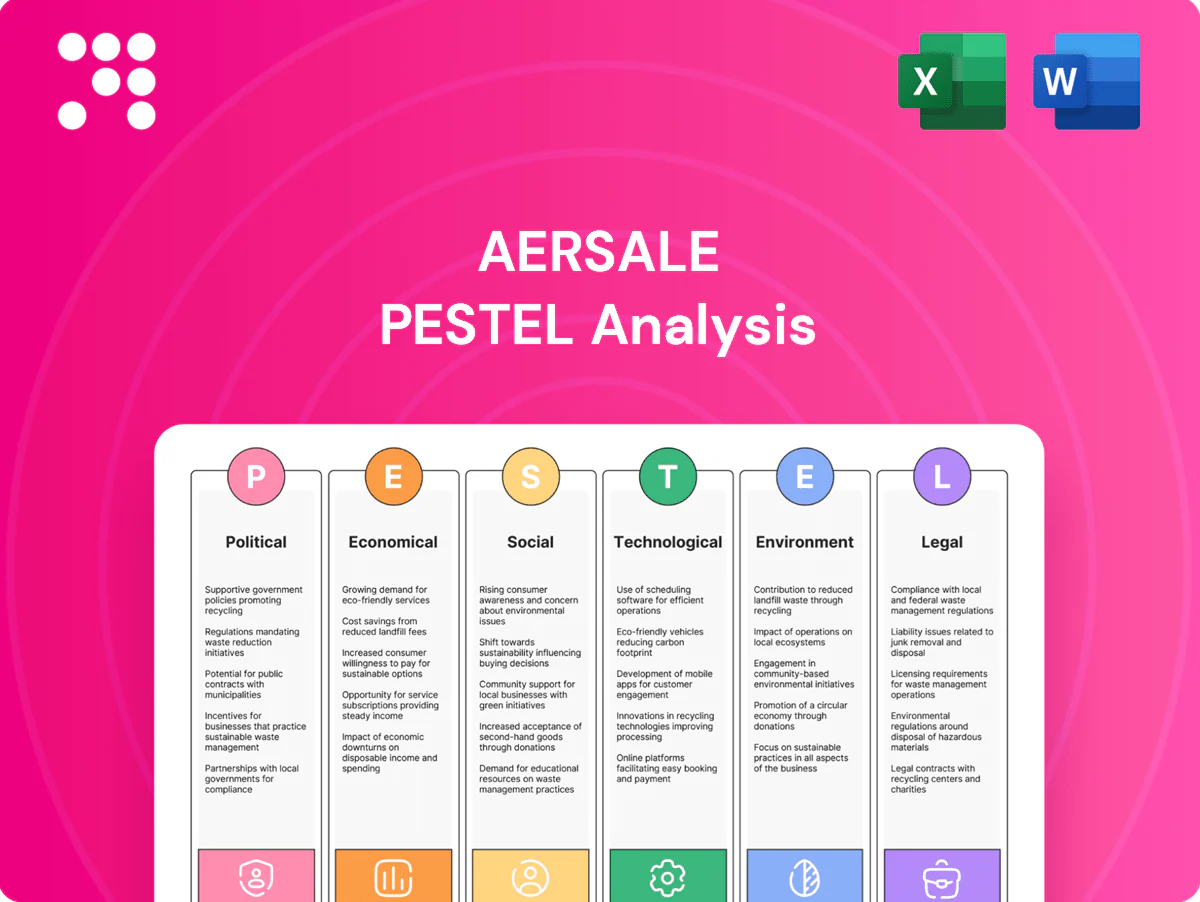
AerSale PESTLE Analysis

Your Shortcut to Market Insight Starts Here
Gain a strategic edge with our PESTLE Analysis of AerSale—spot political, economic, and regulatory drivers shaping its growth and risk. Ideal for investors, consultants, and executives, it translates global trends into actionable strategy. Buy the full, ready-to-use report now for an instant, editable deep-dive you can deploy in decisions and presentations.
Political factors

Export controls and sanctions
Transacting used aircraft and engines crosses multiple jurisdictions subject to ITAR/EAR and OFAC regimes, complicating cross-border sales. Sanctions can instantly restrict customers, routes and spare-part flows, impacting access to parts in the global MRO market (roughly $95B in 2024). OFAC/BIS enforcement has produced multi-million-dollar penalties and shipment detentions, so AerSale must maintain robust screening and documentation. Diversifying suppliers and end-markets reduces geopolitical chokepoint risk.
Geopolitical instability and air-traffic patterns
Geopolitical conflicts reroute corridors and shift utilization, cutting flying and raising teardown/parts demand while rebounds push AerSale’s MRO throughput; IATA reported 2024 global passenger traffic roughly returned to pre‑pandemic levels, intensifying cyclical swings. AerSale’s teardown/parts network and global facilities enable capacity reallocation but abrupt airspace closures strain logistics; scenario planning reduces volatility.

Trade policy and tariffs on aviation parts
Tariffs on aerospace inputs — notably U.S. steel at 25% and aluminum at 10% under Section 232 — raise AerSale’s component costs and can distort sourcing and teardown economics. Rapid shifts in trade deals and regional tariffs can advantange or penalize MRO hubs across North America, Europe and Asia. Mitigations like bonded warehouses and U.S. foreign-trade zones allow duty deferral/avoidance, while flexible pricing and contract clauses are needed to pass through tariff shocks.

Government aviation policy and infrastructure
Government aviation policy and infrastructure—airport privatizations, slot reforms and airspace modernization—directly shape AerSale’s fleet deployment and maintenance timing; global MRO demand was roughly 95 billion USD in 2024, underpinning storage and shop utilization. Public investment in regional airports increases local storage and MRO needs, while cargo-hub support has driven higher freighter conversions and parts demand. AerSale should align capacity to policy-driven traffic shifts and hub growth.
- Airport privatizations: impacts on slot access and storage
- Slot/airspace policy: alters deployment and maintenance timing
- Regional airport investment: boosts MRO/storage demand
- Cargo hub support: raises conversion activity
- Action: match capacity to policy-led traffic flows
Defense and state-carrier procurement influence
Government-backed airlines and defense fleets shape secondary-market asset availability; US FY2024 defense spending was about 858 billion USD, driving select retirements and parts releases that benefit teardown specialists like AerSale.
Retirements driven by public budgets often release frames and parts for teardown; state procurement cycles in 2024–25 increased supply of 50+ narrowbodies from military and flag-carrier retirements.
Preferential sourcing and offset rules can restrict award eligibility, so building compliance-readiness and domestic-content documentation enhances participation in state tenders.
- Tag: defense-budget ~858B (US FY2024)
- Tag: asset-supply spike 50+ narrowbodies (2024–25)
- Tag: compliance-readiness boosts tender eligibility
Sanctions, tariffs and def. spend reshape $95B MRO market, boost teardowns
Cross-border ITAR/EAR/OFAC regimes and sanctions create compliance risk for AerSale, affecting parts flows within a $95B MRO market (2024). Geopolitical reroutes boost teardown demand as passenger traffic returned to near‑pre‑pandemic levels in 2024. Tariffs (US steel 25%, aluminum 10%) and US FY2024 defense spending ~$858B drive costs and asset supply (50+ narrowbodies 2024–25).
| Tag | Figure | Implication |
|---|---|---|
| MRO market | $95B (2024) | Core demand |
| Defense budget | $858B (FY2024) | Asset supply |
| Tariffs | Steel 25%/Al 10% | Input cost |
What is included in the product
 Detailed Word Document
Explores how macro-environmental factors uniquely affect AerSale across Political, Economic, Social, Technological, Environmental, and Legal dimensions, with data-backed trends, industry-specific examples, forward-looking insights, and actionable implications for executives, investors, and strategists.

 Customizable Excel Spreadsheet
A concise, PESTLE-segmented summary of AerSale's external risks and opportunities, easily dropped into presentations or shared across teams, editable for region- or business-specific notes and ideal for strategy and planning sessions.
Economic factors

Airline profitability and demand cycles
Airline cash flows directly drive spending on MRO, leases and component exchanges, with IATA reporting global RPKs recovered to about 98% of 2019 levels in 2024, tightening airline budgets in downturns and expanding activity in upcycles. Downturns push deferrals and cannibalization of fleets, while upturns increase heavy checks and leasing demand. AerSale benefits from counter-cyclical teardown sales plus cyclical MRO revenues. A balanced services‑asset mix smooths topline volatility.
Interest rates and lease financing
Rising policy rates (US federal funds ~5.25% mid-2025) lift lease yields but exert downward pressure on aircraft values and transaction volumes, often by double-digit percentage moves in past rate cycles. Airlines shift toward used aircraft versus new deliveries when credit tightens. AerSale’s cost of capital directly affects inventory holding and conversion project timing. Hedging and flexible lease structures can smooth ROI across rate cycles.

Fuel prices and fleet efficiency
When Brent crude averaged about $83 per barrel in 2024, higher fuel costs accelerated retirements of fuel-inefficient aircraft and raised demand for performance upgrades, while episodes of cheaper jet fuel through early 2025 helped extend older fleets and supported used-part sales and MRO revenue. AerSale can pivot between teardown supply and modification packages as fuel economics shift, with engine shop activity closely tracking these dynamics.

Labor costs and supply-chain inflation
Rising skilled technician wages and parts inflation squeeze AerSale's MRO gross margins, while prolonged OEM lead times and production backlogs through 2024 have elevated the value and demand for serviceable used material.
Strategic inventory holdings and supplier partnerships act as margin defenses, and pricing models must incorporate cost-pass-throughs and indexation to reflect volatile input costs.
- Skilled-wages: margin pressure
- Parts inflation: higher COGS
- Lead-times/backlogs 2024: uplifts SSM value
- Inventory & supplier ties: margin defence
- Pricing: include indexation/escrows
Currency fluctuations
USD strength, supported by U.S. policy rates at 5.25–5.50% in 2024–2025, reduces non-U.S. customer affordability and raises costs for dollar-priced part sourcing; AerSale faces exposure when assets are USD-denominated but revenues are local-currency. Natural hedges and formal FX policies have cut earnings volatility historically, while regional pricing adjustments help preserve competitiveness.
- FX-DRIVERS: Fed funds 5.25–5.50% (2024–2025)
- EXPOSURE: USD assets vs local revenues
- MITIGATION: natural hedges, FX policy
- STRATEGY: regional pricing to protect share
Sanctions, tariffs and def. spend reshape $95B MRO market, boost teardowns
Airline cash flows (IATA RPKs ~98% of 2019 in 2024) drive MRO, lease and teardown demand; AerSale benefits from counter‑cyclical teardown sales and cyclical MRO. Fed funds ~5.25–5.50% (2024–mid‑2025) lifts lease yields but pressures asset values; Brent ~$83/bbl (2024) shifts retirements and upgrade demand. USD strength (DXY ~104 mid‑2025) raises local‑currency affordability risks.
| Metric | Value |
|---|---|
| IATA RPKs (2024) | ~98% of 2019 |
| Fed funds | 5.25–5.50% |
| Brent (2024) | $83/bbl |
| DXY (mid‑2025) | ~104 |
Preview Before You Purchase
AerSale PESTLE Analysis
The preview shown here is the exact AerSale PESTLE Analysis document you’ll receive after purchase—fully formatted and ready to use. The content, structure, and professional layout in this screenshot match the downloadable file with no placeholders or surprises. After checkout you’ll instantly get this same final report for immediate use.

Your Shortcut to Market Insight Starts Here
Gain a strategic edge with our PESTLE Analysis of AerSale—spot political, economic, and regulatory drivers shaping its growth and risk. Ideal for investors, consultants, and executives, it translates global trends into actionable strategy. Buy the full, ready-to-use report now for an instant, editable deep-dive you can deploy in decisions and presentations.
Political factors
Export controls and sanctions
Transacting used aircraft and engines crosses multiple jurisdictions subject to ITAR/EAR and OFAC regimes, complicating cross-border sales. Sanctions can instantly restrict customers, routes and spare-part flows, impacting access to parts in the global MRO market (roughly $95B in 2024). OFAC/BIS enforcement has produced multi-million-dollar penalties and shipment detentions, so AerSale must maintain robust screening and documentation. Diversifying suppliers and end-markets reduces geopolitical chokepoint risk.
Geopolitical instability and air-traffic patterns
Geopolitical conflicts reroute corridors and shift utilization, cutting flying and raising teardown/parts demand while rebounds push AerSale’s MRO throughput; IATA reported 2024 global passenger traffic roughly returned to pre‑pandemic levels, intensifying cyclical swings. AerSale’s teardown/parts network and global facilities enable capacity reallocation but abrupt airspace closures strain logistics; scenario planning reduces volatility.
Trade policy and tariffs on aviation parts
Tariffs on aerospace inputs — notably U.S. steel at 25% and aluminum at 10% under Section 232 — raise AerSale’s component costs and can distort sourcing and teardown economics. Rapid shifts in trade deals and regional tariffs can advantange or penalize MRO hubs across North America, Europe and Asia. Mitigations like bonded warehouses and U.S. foreign-trade zones allow duty deferral/avoidance, while flexible pricing and contract clauses are needed to pass through tariff shocks.
Government aviation policy and infrastructure
Government aviation policy and infrastructure—airport privatizations, slot reforms and airspace modernization—directly shape AerSale’s fleet deployment and maintenance timing; global MRO demand was roughly 95 billion USD in 2024, underpinning storage and shop utilization. Public investment in regional airports increases local storage and MRO needs, while cargo-hub support has driven higher freighter conversions and parts demand. AerSale should align capacity to policy-driven traffic shifts and hub growth.
- Airport privatizations: impacts on slot access and storage
- Slot/airspace policy: alters deployment and maintenance timing
- Regional airport investment: boosts MRO/storage demand
- Cargo hub support: raises conversion activity
- Action: match capacity to policy-led traffic flows
Defense and state-carrier procurement influence
Government-backed airlines and defense fleets shape secondary-market asset availability; US FY2024 defense spending was about 858 billion USD, driving select retirements and parts releases that benefit teardown specialists like AerSale.
Retirements driven by public budgets often release frames and parts for teardown; state procurement cycles in 2024–25 increased supply of 50+ narrowbodies from military and flag-carrier retirements.
Preferential sourcing and offset rules can restrict award eligibility, so building compliance-readiness and domestic-content documentation enhances participation in state tenders.
- Tag: defense-budget ~858B (US FY2024)
- Tag: asset-supply spike 50+ narrowbodies (2024–25)
- Tag: compliance-readiness boosts tender eligibility
Sanctions, tariffs and def. spend reshape $95B MRO market, boost teardowns
Cross-border ITAR/EAR/OFAC regimes and sanctions create compliance risk for AerSale, affecting parts flows within a $95B MRO market (2024). Geopolitical reroutes boost teardown demand as passenger traffic returned to near‑pre‑pandemic levels in 2024. Tariffs (US steel 25%, aluminum 10%) and US FY2024 defense spending ~$858B drive costs and asset supply (50+ narrowbodies 2024–25).
| Tag | Figure | Implication |
|---|---|---|
| MRO market | $95B (2024) | Core demand |
| Defense budget | $858B (FY2024) | Asset supply |
| Tariffs | Steel 25%/Al 10% | Input cost |
What is included in the product
Detailed Word Document
Explores how macro-environmental factors uniquely affect AerSale across Political, Economic, Social, Technological, Environmental, and Legal dimensions, with data-backed trends, industry-specific examples, forward-looking insights, and actionable implications for executives, investors, and strategists.
Customizable Excel Spreadsheet
A concise, PESTLE-segmented summary of AerSale's external risks and opportunities, easily dropped into presentations or shared across teams, editable for region- or business-specific notes and ideal for strategy and planning sessions.
Economic factors
Airline profitability and demand cycles
Airline cash flows directly drive spending on MRO, leases and component exchanges, with IATA reporting global RPKs recovered to about 98% of 2019 levels in 2024, tightening airline budgets in downturns and expanding activity in upcycles. Downturns push deferrals and cannibalization of fleets, while upturns increase heavy checks and leasing demand. AerSale benefits from counter-cyclical teardown sales plus cyclical MRO revenues. A balanced services‑asset mix smooths topline volatility.
Interest rates and lease financing
Rising policy rates (US federal funds ~5.25% mid-2025) lift lease yields but exert downward pressure on aircraft values and transaction volumes, often by double-digit percentage moves in past rate cycles. Airlines shift toward used aircraft versus new deliveries when credit tightens. AerSale’s cost of capital directly affects inventory holding and conversion project timing. Hedging and flexible lease structures can smooth ROI across rate cycles.
Fuel prices and fleet efficiency
When Brent crude averaged about $83 per barrel in 2024, higher fuel costs accelerated retirements of fuel-inefficient aircraft and raised demand for performance upgrades, while episodes of cheaper jet fuel through early 2025 helped extend older fleets and supported used-part sales and MRO revenue. AerSale can pivot between teardown supply and modification packages as fuel economics shift, with engine shop activity closely tracking these dynamics.
Labor costs and supply-chain inflation
Rising skilled technician wages and parts inflation squeeze AerSale's MRO gross margins, while prolonged OEM lead times and production backlogs through 2024 have elevated the value and demand for serviceable used material.
Strategic inventory holdings and supplier partnerships act as margin defenses, and pricing models must incorporate cost-pass-throughs and indexation to reflect volatile input costs.
- Skilled-wages: margin pressure
- Parts inflation: higher COGS
- Lead-times/backlogs 2024: uplifts SSM value
- Inventory & supplier ties: margin defence
- Pricing: include indexation/escrows
Currency fluctuations
USD strength, supported by U.S. policy rates at 5.25–5.50% in 2024–2025, reduces non-U.S. customer affordability and raises costs for dollar-priced part sourcing; AerSale faces exposure when assets are USD-denominated but revenues are local-currency. Natural hedges and formal FX policies have cut earnings volatility historically, while regional pricing adjustments help preserve competitiveness.
- FX-DRIVERS: Fed funds 5.25–5.50% (2024–2025)
- EXPOSURE: USD assets vs local revenues
- MITIGATION: natural hedges, FX policy
- STRATEGY: regional pricing to protect share
Sanctions, tariffs and def. spend reshape $95B MRO market, boost teardowns
Airline cash flows (IATA RPKs ~98% of 2019 in 2024) drive MRO, lease and teardown demand; AerSale benefits from counter‑cyclical teardown sales and cyclical MRO. Fed funds ~5.25–5.50% (2024–mid‑2025) lifts lease yields but pressures asset values; Brent ~$83/bbl (2024) shifts retirements and upgrade demand. USD strength (DXY ~104 mid‑2025) raises local‑currency affordability risks.
| Metric | Value |
|---|---|
| IATA RPKs (2024) | ~98% of 2019 |
| Fed funds | 5.25–5.50% |
| Brent (2024) | $83/bbl |
| DXY (mid‑2025) | ~104 |
Preview Before You Purchase
AerSale PESTLE Analysis
The preview shown here is the exact AerSale PESTLE Analysis document you’ll receive after purchase—fully formatted and ready to use. The content, structure, and professional layout in this screenshot match the downloadable file with no placeholders or surprises. After checkout you’ll instantly get this same final report for immediate use.
Original: $10.00
-65%$10.00
$3.50Description
Your Shortcut to Market Insight Starts Here
Gain a strategic edge with our PESTLE Analysis of AerSale—spot political, economic, and regulatory drivers shaping its growth and risk. Ideal for investors, consultants, and executives, it translates global trends into actionable strategy. Buy the full, ready-to-use report now for an instant, editable deep-dive you can deploy in decisions and presentations.
Political factors
Export controls and sanctions
Transacting used aircraft and engines crosses multiple jurisdictions subject to ITAR/EAR and OFAC regimes, complicating cross-border sales. Sanctions can instantly restrict customers, routes and spare-part flows, impacting access to parts in the global MRO market (roughly $95B in 2024). OFAC/BIS enforcement has produced multi-million-dollar penalties and shipment detentions, so AerSale must maintain robust screening and documentation. Diversifying suppliers and end-markets reduces geopolitical chokepoint risk.
Geopolitical instability and air-traffic patterns
Geopolitical conflicts reroute corridors and shift utilization, cutting flying and raising teardown/parts demand while rebounds push AerSale’s MRO throughput; IATA reported 2024 global passenger traffic roughly returned to pre‑pandemic levels, intensifying cyclical swings. AerSale’s teardown/parts network and global facilities enable capacity reallocation but abrupt airspace closures strain logistics; scenario planning reduces volatility.
Trade policy and tariffs on aviation parts
Tariffs on aerospace inputs — notably U.S. steel at 25% and aluminum at 10% under Section 232 — raise AerSale’s component costs and can distort sourcing and teardown economics. Rapid shifts in trade deals and regional tariffs can advantange or penalize MRO hubs across North America, Europe and Asia. Mitigations like bonded warehouses and U.S. foreign-trade zones allow duty deferral/avoidance, while flexible pricing and contract clauses are needed to pass through tariff shocks.
Government aviation policy and infrastructure
Government aviation policy and infrastructure—airport privatizations, slot reforms and airspace modernization—directly shape AerSale’s fleet deployment and maintenance timing; global MRO demand was roughly 95 billion USD in 2024, underpinning storage and shop utilization. Public investment in regional airports increases local storage and MRO needs, while cargo-hub support has driven higher freighter conversions and parts demand. AerSale should align capacity to policy-driven traffic shifts and hub growth.
- Airport privatizations: impacts on slot access and storage
- Slot/airspace policy: alters deployment and maintenance timing
- Regional airport investment: boosts MRO/storage demand
- Cargo hub support: raises conversion activity
- Action: match capacity to policy-led traffic flows
Defense and state-carrier procurement influence
Government-backed airlines and defense fleets shape secondary-market asset availability; US FY2024 defense spending was about 858 billion USD, driving select retirements and parts releases that benefit teardown specialists like AerSale.
Retirements driven by public budgets often release frames and parts for teardown; state procurement cycles in 2024–25 increased supply of 50+ narrowbodies from military and flag-carrier retirements.
Preferential sourcing and offset rules can restrict award eligibility, so building compliance-readiness and domestic-content documentation enhances participation in state tenders.
- Tag: defense-budget ~858B (US FY2024)
- Tag: asset-supply spike 50+ narrowbodies (2024–25)
- Tag: compliance-readiness boosts tender eligibility
Sanctions, tariffs and def. spend reshape $95B MRO market, boost teardowns
Cross-border ITAR/EAR/OFAC regimes and sanctions create compliance risk for AerSale, affecting parts flows within a $95B MRO market (2024). Geopolitical reroutes boost teardown demand as passenger traffic returned to near‑pre‑pandemic levels in 2024. Tariffs (US steel 25%, aluminum 10%) and US FY2024 defense spending ~$858B drive costs and asset supply (50+ narrowbodies 2024–25).
| Tag | Figure | Implication |
|---|---|---|
| MRO market | $95B (2024) | Core demand |
| Defense budget | $858B (FY2024) | Asset supply |
| Tariffs | Steel 25%/Al 10% | Input cost |
What is included in the product
Detailed Word Document
Explores how macro-environmental factors uniquely affect AerSale across Political, Economic, Social, Technological, Environmental, and Legal dimensions, with data-backed trends, industry-specific examples, forward-looking insights, and actionable implications for executives, investors, and strategists.
Customizable Excel Spreadsheet
A concise, PESTLE-segmented summary of AerSale's external risks and opportunities, easily dropped into presentations or shared across teams, editable for region- or business-specific notes and ideal for strategy and planning sessions.
Economic factors
Airline profitability and demand cycles
Airline cash flows directly drive spending on MRO, leases and component exchanges, with IATA reporting global RPKs recovered to about 98% of 2019 levels in 2024, tightening airline budgets in downturns and expanding activity in upcycles. Downturns push deferrals and cannibalization of fleets, while upturns increase heavy checks and leasing demand. AerSale benefits from counter-cyclical teardown sales plus cyclical MRO revenues. A balanced services‑asset mix smooths topline volatility.
Interest rates and lease financing
Rising policy rates (US federal funds ~5.25% mid-2025) lift lease yields but exert downward pressure on aircraft values and transaction volumes, often by double-digit percentage moves in past rate cycles. Airlines shift toward used aircraft versus new deliveries when credit tightens. AerSale’s cost of capital directly affects inventory holding and conversion project timing. Hedging and flexible lease structures can smooth ROI across rate cycles.
Fuel prices and fleet efficiency
When Brent crude averaged about $83 per barrel in 2024, higher fuel costs accelerated retirements of fuel-inefficient aircraft and raised demand for performance upgrades, while episodes of cheaper jet fuel through early 2025 helped extend older fleets and supported used-part sales and MRO revenue. AerSale can pivot between teardown supply and modification packages as fuel economics shift, with engine shop activity closely tracking these dynamics.
Labor costs and supply-chain inflation
Rising skilled technician wages and parts inflation squeeze AerSale's MRO gross margins, while prolonged OEM lead times and production backlogs through 2024 have elevated the value and demand for serviceable used material.
Strategic inventory holdings and supplier partnerships act as margin defenses, and pricing models must incorporate cost-pass-throughs and indexation to reflect volatile input costs.
- Skilled-wages: margin pressure
- Parts inflation: higher COGS
- Lead-times/backlogs 2024: uplifts SSM value
- Inventory & supplier ties: margin defence
- Pricing: include indexation/escrows
Currency fluctuations
USD strength, supported by U.S. policy rates at 5.25–5.50% in 2024–2025, reduces non-U.S. customer affordability and raises costs for dollar-priced part sourcing; AerSale faces exposure when assets are USD-denominated but revenues are local-currency. Natural hedges and formal FX policies have cut earnings volatility historically, while regional pricing adjustments help preserve competitiveness.
- FX-DRIVERS: Fed funds 5.25–5.50% (2024–2025)
- EXPOSURE: USD assets vs local revenues
- MITIGATION: natural hedges, FX policy
- STRATEGY: regional pricing to protect share
Sanctions, tariffs and def. spend reshape $95B MRO market, boost teardowns
Airline cash flows (IATA RPKs ~98% of 2019 in 2024) drive MRO, lease and teardown demand; AerSale benefits from counter‑cyclical teardown sales and cyclical MRO. Fed funds ~5.25–5.50% (2024–mid‑2025) lifts lease yields but pressures asset values; Brent ~$83/bbl (2024) shifts retirements and upgrade demand. USD strength (DXY ~104 mid‑2025) raises local‑currency affordability risks.
| Metric | Value |
|---|---|
| IATA RPKs (2024) | ~98% of 2019 |
| Fed funds | 5.25–5.50% |
| Brent (2024) | $83/bbl |
| DXY (mid‑2025) | ~104 |
Preview Before You Purchase
AerSale PESTLE Analysis
The preview shown here is the exact AerSale PESTLE Analysis document you’ll receive after purchase—fully formatted and ready to use. The content, structure, and professional layout in this screenshot match the downloadable file with no placeholders or surprises. After checkout you’ll instantly get this same final report for immediate use.











