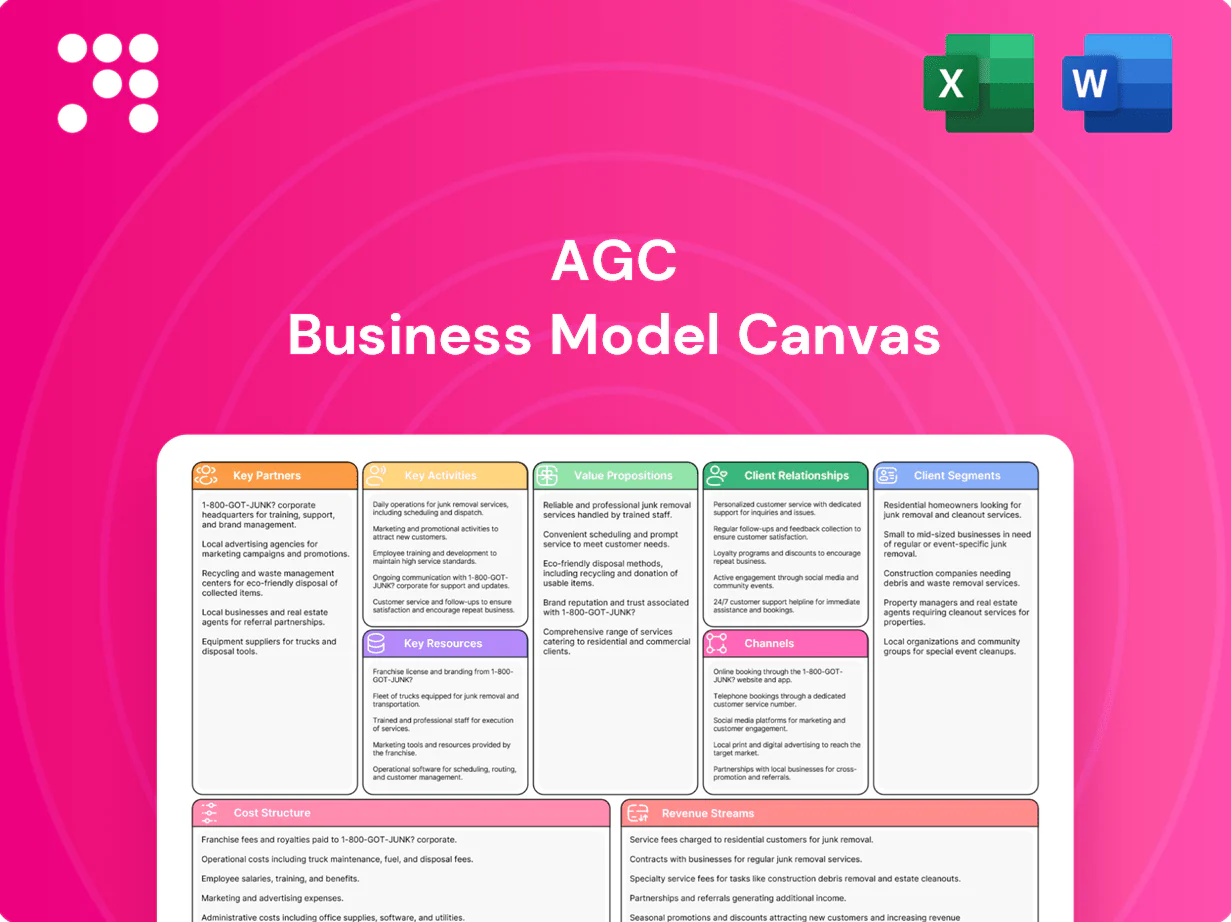
AGC Business Model Canvas

Unlock a concise Business Model Canvas for strategic benchmarking and investor-ready plans
Unlock AGC’s strategic blueprint with a concise Business Model Canvas that maps customer segments, value propositions, revenue streams and key partners. This 3–5 sentence snapshot teases actionable insights; the full, editable Word/Excel canvas provides section-by-section detail for benchmarking, strategy and investor use—purchase to access the complete plan.
Partnerships

Global OEM alliances
AGC partners with automotive and electronics OEMs through co-development and long-term supply agreements, aligning qualification roadmaps to secure volume visibility; the global automotive glass market was estimated at about $17.8 billion in 2024. Joint design-in with OEMs improves product fit and reduced time-to-market for new models. Strategic multi-year contracts stabilize pricing and enable capacity planning across AGC production sites.
Raw material suppliers
Partnerships with silica (70–75% of glass), soda ash (12–15%), specialty chemicals and rare gases ensure feedstock quality and continuity. Long-term contracts mitigate 2024 market volatility and shortages by locking prices and volumes. Co-innovation with suppliers has improved yields and reduced CO2 intensity in trials. Dual-sourcing across regions cuts supply risk and exposure to local disruptions.

Equipment and tool vendors
AGC partners with furnace, float line, coating and deposition equipment makers to co-develop customized tools that have driven throughput gains up to 20% and tightened product spec variance. Predictive maintenance and strategic spare-parts programs have cut unplanned downtime by as much as 50% in manufacturer case studies. Joint pilots accelerate process upgrades, shortening scale-up timelines by roughly 30%.

Research and academic institutions
Universities and consortia accelerate AGC’s advanced materials, coatings and process modeling through joint research and validated simulation tools. Shared labs and pilot facilities de-risk early-stage R&D and shorten scale-up timelines. Access to academic talent and IP broadens AGC’s innovation funnel, while public grants such as Horizon Europe (€95.5bn 2021–27) leverage external funding for breakthrough projects.
- Academic partnerships: advanced modeling
- Shared labs: de-risking
- Talent & IP: pipeline expansion
- Public grants: co-funding (Horizon Europe €95.5bn)
Logistics and channel partners
Specialized logistics firms handle oversized glass and hazardous chemicals for AGC, enabling compliance with ADR/IMDG rules and reducing damage-related losses; regional distributors extend reach to mid-sized customers across EMEA and APAC. VMI and hub-and-spoke networks optimize inventory — VMI can cut inventory up to 30% and hub-and-spoke trims transport costs ~10–15%. Cold-chain and clean handling meet stringent pharma and semiconductor specs, supporting temperature-controlled and particle-free supply requirements.
- specialized oversized & hazardous carriers
- regional distributors for mid-market reach
- VMI: inventory cut up to 30%
- hub-and-spoke: transport savings ~10–15%
- cold-chain & clean handling for pharma/semiconductor
OEM design-in cuts time-to-market 30%; throughput +20%
AGC secures OEM co-development and multi-year supply contracts (automotive glass market ~$17.8bn in 2024) to lock volume and accelerate design-in, reducing time-to-market by ~30%. Long-term feedstock and dual-sourcing for silica/soda ash stabilize costs amid 2024 volatility. Equipment and maintenance partnerships raised throughput up to 20% and cut unplanned downtime ~50%. Logistics and VMI lower inventory ~30% and transport costs 10–15%.
| Partnership type | Key metric | 2024 impact |
|---|---|---|
| OEMs | Design-in & contracts | Market ~$17.8bn; time-to-market -30% |
| Suppliers | Feedstock security | Price/volume stability |
| Equipment | Throughput/downtime | Throughput +20%; downtime -50% |
| Logistics | VMI/hub-and-spoke | Inventory -30%; transport -10–15% |
What is included in the product
 Detailed Word Document
A concise, pre-written AGC Business Model Canvas mapping nine BMC blocks with detailed customer segments, value propositions, channels and revenue streams, plus embedded SWOT and competitive-advantage analysis to support presentations, funding discussions and strategic decision-making.

 Customizable Excel Spreadsheet
Streamlines mapping of core components into one editable page, eliminating hours of formatting and enabling teams to align strategy quickly; perfect for fast deliverables, comparisons, or boardroom-ready summaries.
Activities

High-precision manufacturing
Operating multiple float glass lines, autoclaves, coating/lamination plants and large-scale chemical synthesis facilities enables AGC to deliver optical clarity and material purity through tight process control. Continuous improvement programs in 2024 lifted yields and reduced scrap via SPC and TPM methodologies, while compliance with ISO 9001 and IATF 16949 ensures global qualification for automotive and architectural markets. production and quality metrics are tracked in real time to maintain consistent outputs.
Materials R&D and prototyping
Materials R&D and prototyping focus on new glass compositions, functional coatings and advanced composites, backed by AGC’s 2024 R&D investment of over ¥40 billion and a global patent portfolio exceeding 8,000 filings; pilot lines enable rapid prototyping and customer trials with turnaround weeks-to-months; IP generation and protection secure core tech while close collaboration with key customers aligns developments to emerging specs and regulatory shifts.

Quality assurance and certification
Metrology and ISO/IEC 17025‑accredited labs underpin reliability testing and regulatory certification across industries; PPAP and ISO 9001:2015 processes and sector‑specific audits are maintained to OEM and regulator requirements. Traceability systems (lot/batch serialization, digital logs) ensure compliance and streamline recalls, while real‑world field feedback loops drive corrective actions and reduce repeat failures in 2024 operations.

Supply chain and capacity planning
Supply chain and capacity planning at AGC centers on monthly S&OP with a 95% fill-rate target, global inventory optimization via 60-day safety-stock buffers and multi-site coordination for redundancy and lead-time control, plus contracting to hedge critical-input risk and flexible capacity ramps to meet cyclical demand.
- Monthly S&OP
- 95% fill-rate target
- 60-day safety stock
- Multi-site redundancy
- Contracts for critical inputs
- Flexible capacity for cycles
Customer engineering support
Customer engineering support combines application engineering, on-site technical support and co-design to embed AGC materials into customer processes. Teams conduct failure analysis and process tuning at customer lines to sustain yields and reduce downtime, provide training for safe handling and integration, and deliver post-sales service with 24/7 support and periodic performance audits.
- application-engineering
- on-site-support
- co-design
- failure-analysis-process-tuning
- training-post-sales-service
Advanced manufacturing: ¥40B R&D, 8,000+ patents, 95% fill-rate goal
AGC operates float lines, autoclaves, coating/lamination and large chemical plants driving tight quality control and real‑time metrics; 2024 programs improved yields via SPC/TPM. R&D spent ¥40 billion in 2024 with 8,000+ patents and rapid pilot prototyping. S&OP targets 95% fill rate with 60‑day safety stock and multi‑site redundancy; customer engineering offers 24/7 support and co‑design.
| Metric | 2024 Value |
|---|---|
| R&D spend | ¥40 billion |
| Patents | 8,000+ |
| Fill rate target | 95% |
| Safety stock | 60 days |
Full Version Awaits
Business Model Canvas
The document you’re previewing is the exact AGC Business Model Canvas you’ll receive after purchase, not a mockup or sample; it’s a live snapshot of the final deliverable. Upon completing your order you’ll instantly download this same, fully editable file formatted for presentation and use. No surprises—what you see is what you get.

Unlock a concise Business Model Canvas for strategic benchmarking and investor-ready plans
Unlock AGC’s strategic blueprint with a concise Business Model Canvas that maps customer segments, value propositions, revenue streams and key partners. This 3–5 sentence snapshot teases actionable insights; the full, editable Word/Excel canvas provides section-by-section detail for benchmarking, strategy and investor use—purchase to access the complete plan.
Partnerships
Global OEM alliances
AGC partners with automotive and electronics OEMs through co-development and long-term supply agreements, aligning qualification roadmaps to secure volume visibility; the global automotive glass market was estimated at about $17.8 billion in 2024. Joint design-in with OEMs improves product fit and reduced time-to-market for new models. Strategic multi-year contracts stabilize pricing and enable capacity planning across AGC production sites.
Raw material suppliers
Partnerships with silica (70–75% of glass), soda ash (12–15%), specialty chemicals and rare gases ensure feedstock quality and continuity. Long-term contracts mitigate 2024 market volatility and shortages by locking prices and volumes. Co-innovation with suppliers has improved yields and reduced CO2 intensity in trials. Dual-sourcing across regions cuts supply risk and exposure to local disruptions.
Equipment and tool vendors
AGC partners with furnace, float line, coating and deposition equipment makers to co-develop customized tools that have driven throughput gains up to 20% and tightened product spec variance. Predictive maintenance and strategic spare-parts programs have cut unplanned downtime by as much as 50% in manufacturer case studies. Joint pilots accelerate process upgrades, shortening scale-up timelines by roughly 30%.
Research and academic institutions
Universities and consortia accelerate AGC’s advanced materials, coatings and process modeling through joint research and validated simulation tools. Shared labs and pilot facilities de-risk early-stage R&D and shorten scale-up timelines. Access to academic talent and IP broadens AGC’s innovation funnel, while public grants such as Horizon Europe (€95.5bn 2021–27) leverage external funding for breakthrough projects.
- Academic partnerships: advanced modeling
- Shared labs: de-risking
- Talent & IP: pipeline expansion
- Public grants: co-funding (Horizon Europe €95.5bn)
Logistics and channel partners
Specialized logistics firms handle oversized glass and hazardous chemicals for AGC, enabling compliance with ADR/IMDG rules and reducing damage-related losses; regional distributors extend reach to mid-sized customers across EMEA and APAC. VMI and hub-and-spoke networks optimize inventory — VMI can cut inventory up to 30% and hub-and-spoke trims transport costs ~10–15%. Cold-chain and clean handling meet stringent pharma and semiconductor specs, supporting temperature-controlled and particle-free supply requirements.
- specialized oversized & hazardous carriers
- regional distributors for mid-market reach
- VMI: inventory cut up to 30%
- hub-and-spoke: transport savings ~10–15%
- cold-chain & clean handling for pharma/semiconductor
OEM design-in cuts time-to-market 30%; throughput +20%
AGC secures OEM co-development and multi-year supply contracts (automotive glass market ~$17.8bn in 2024) to lock volume and accelerate design-in, reducing time-to-market by ~30%. Long-term feedstock and dual-sourcing for silica/soda ash stabilize costs amid 2024 volatility. Equipment and maintenance partnerships raised throughput up to 20% and cut unplanned downtime ~50%. Logistics and VMI lower inventory ~30% and transport costs 10–15%.
| Partnership type | Key metric | 2024 impact |
|---|---|---|
| OEMs | Design-in & contracts | Market ~$17.8bn; time-to-market -30% |
| Suppliers | Feedstock security | Price/volume stability |
| Equipment | Throughput/downtime | Throughput +20%; downtime -50% |
| Logistics | VMI/hub-and-spoke | Inventory -30%; transport -10–15% |
What is included in the product
Detailed Word Document
A concise, pre-written AGC Business Model Canvas mapping nine BMC blocks with detailed customer segments, value propositions, channels and revenue streams, plus embedded SWOT and competitive-advantage analysis to support presentations, funding discussions and strategic decision-making.
Customizable Excel Spreadsheet
Streamlines mapping of core components into one editable page, eliminating hours of formatting and enabling teams to align strategy quickly; perfect for fast deliverables, comparisons, or boardroom-ready summaries.
Activities
High-precision manufacturing
Operating multiple float glass lines, autoclaves, coating/lamination plants and large-scale chemical synthesis facilities enables AGC to deliver optical clarity and material purity through tight process control. Continuous improvement programs in 2024 lifted yields and reduced scrap via SPC and TPM methodologies, while compliance with ISO 9001 and IATF 16949 ensures global qualification for automotive and architectural markets. production and quality metrics are tracked in real time to maintain consistent outputs.
Materials R&D and prototyping
Materials R&D and prototyping focus on new glass compositions, functional coatings and advanced composites, backed by AGC’s 2024 R&D investment of over ¥40 billion and a global patent portfolio exceeding 8,000 filings; pilot lines enable rapid prototyping and customer trials with turnaround weeks-to-months; IP generation and protection secure core tech while close collaboration with key customers aligns developments to emerging specs and regulatory shifts.
Quality assurance and certification
Metrology and ISO/IEC 17025‑accredited labs underpin reliability testing and regulatory certification across industries; PPAP and ISO 9001:2015 processes and sector‑specific audits are maintained to OEM and regulator requirements. Traceability systems (lot/batch serialization, digital logs) ensure compliance and streamline recalls, while real‑world field feedback loops drive corrective actions and reduce repeat failures in 2024 operations.
Supply chain and capacity planning
Supply chain and capacity planning at AGC centers on monthly S&OP with a 95% fill-rate target, global inventory optimization via 60-day safety-stock buffers and multi-site coordination for redundancy and lead-time control, plus contracting to hedge critical-input risk and flexible capacity ramps to meet cyclical demand.
- Monthly S&OP
- 95% fill-rate target
- 60-day safety stock
- Multi-site redundancy
- Contracts for critical inputs
- Flexible capacity for cycles
Customer engineering support
Customer engineering support combines application engineering, on-site technical support and co-design to embed AGC materials into customer processes. Teams conduct failure analysis and process tuning at customer lines to sustain yields and reduce downtime, provide training for safe handling and integration, and deliver post-sales service with 24/7 support and periodic performance audits.
- application-engineering
- on-site-support
- co-design
- failure-analysis-process-tuning
- training-post-sales-service
Advanced manufacturing: ¥40B R&D, 8,000+ patents, 95% fill-rate goal
AGC operates float lines, autoclaves, coating/lamination and large chemical plants driving tight quality control and real‑time metrics; 2024 programs improved yields via SPC/TPM. R&D spent ¥40 billion in 2024 with 8,000+ patents and rapid pilot prototyping. S&OP targets 95% fill rate with 60‑day safety stock and multi‑site redundancy; customer engineering offers 24/7 support and co‑design.
| Metric | 2024 Value |
|---|---|
| R&D spend | ¥40 billion |
| Patents | 8,000+ |
| Fill rate target | 95% |
| Safety stock | 60 days |
Full Version Awaits
Business Model Canvas
The document you’re previewing is the exact AGC Business Model Canvas you’ll receive after purchase, not a mockup or sample; it’s a live snapshot of the final deliverable. Upon completing your order you’ll instantly download this same, fully editable file formatted for presentation and use. No surprises—what you see is what you get.
Description
Unlock a concise Business Model Canvas for strategic benchmarking and investor-ready plans
Unlock AGC’s strategic blueprint with a concise Business Model Canvas that maps customer segments, value propositions, revenue streams and key partners. This 3–5 sentence snapshot teases actionable insights; the full, editable Word/Excel canvas provides section-by-section detail for benchmarking, strategy and investor use—purchase to access the complete plan.
Partnerships
Global OEM alliances
AGC partners with automotive and electronics OEMs through co-development and long-term supply agreements, aligning qualification roadmaps to secure volume visibility; the global automotive glass market was estimated at about $17.8 billion in 2024. Joint design-in with OEMs improves product fit and reduced time-to-market for new models. Strategic multi-year contracts stabilize pricing and enable capacity planning across AGC production sites.
Raw material suppliers
Partnerships with silica (70–75% of glass), soda ash (12–15%), specialty chemicals and rare gases ensure feedstock quality and continuity. Long-term contracts mitigate 2024 market volatility and shortages by locking prices and volumes. Co-innovation with suppliers has improved yields and reduced CO2 intensity in trials. Dual-sourcing across regions cuts supply risk and exposure to local disruptions.
Equipment and tool vendors
AGC partners with furnace, float line, coating and deposition equipment makers to co-develop customized tools that have driven throughput gains up to 20% and tightened product spec variance. Predictive maintenance and strategic spare-parts programs have cut unplanned downtime by as much as 50% in manufacturer case studies. Joint pilots accelerate process upgrades, shortening scale-up timelines by roughly 30%.
Research and academic institutions
Universities and consortia accelerate AGC’s advanced materials, coatings and process modeling through joint research and validated simulation tools. Shared labs and pilot facilities de-risk early-stage R&D and shorten scale-up timelines. Access to academic talent and IP broadens AGC’s innovation funnel, while public grants such as Horizon Europe (€95.5bn 2021–27) leverage external funding for breakthrough projects.
- Academic partnerships: advanced modeling
- Shared labs: de-risking
- Talent & IP: pipeline expansion
- Public grants: co-funding (Horizon Europe €95.5bn)
Logistics and channel partners
Specialized logistics firms handle oversized glass and hazardous chemicals for AGC, enabling compliance with ADR/IMDG rules and reducing damage-related losses; regional distributors extend reach to mid-sized customers across EMEA and APAC. VMI and hub-and-spoke networks optimize inventory — VMI can cut inventory up to 30% and hub-and-spoke trims transport costs ~10–15%. Cold-chain and clean handling meet stringent pharma and semiconductor specs, supporting temperature-controlled and particle-free supply requirements.
- specialized oversized & hazardous carriers
- regional distributors for mid-market reach
- VMI: inventory cut up to 30%
- hub-and-spoke: transport savings ~10–15%
- cold-chain & clean handling for pharma/semiconductor
OEM design-in cuts time-to-market 30%; throughput +20%
AGC secures OEM co-development and multi-year supply contracts (automotive glass market ~$17.8bn in 2024) to lock volume and accelerate design-in, reducing time-to-market by ~30%. Long-term feedstock and dual-sourcing for silica/soda ash stabilize costs amid 2024 volatility. Equipment and maintenance partnerships raised throughput up to 20% and cut unplanned downtime ~50%. Logistics and VMI lower inventory ~30% and transport costs 10–15%.
| Partnership type | Key metric | 2024 impact |
|---|---|---|
| OEMs | Design-in & contracts | Market ~$17.8bn; time-to-market -30% |
| Suppliers | Feedstock security | Price/volume stability |
| Equipment | Throughput/downtime | Throughput +20%; downtime -50% |
| Logistics | VMI/hub-and-spoke | Inventory -30%; transport -10–15% |
What is included in the product
Detailed Word Document
A concise, pre-written AGC Business Model Canvas mapping nine BMC blocks with detailed customer segments, value propositions, channels and revenue streams, plus embedded SWOT and competitive-advantage analysis to support presentations, funding discussions and strategic decision-making.
Customizable Excel Spreadsheet
Streamlines mapping of core components into one editable page, eliminating hours of formatting and enabling teams to align strategy quickly; perfect for fast deliverables, comparisons, or boardroom-ready summaries.
Activities
High-precision manufacturing
Operating multiple float glass lines, autoclaves, coating/lamination plants and large-scale chemical synthesis facilities enables AGC to deliver optical clarity and material purity through tight process control. Continuous improvement programs in 2024 lifted yields and reduced scrap via SPC and TPM methodologies, while compliance with ISO 9001 and IATF 16949 ensures global qualification for automotive and architectural markets. production and quality metrics are tracked in real time to maintain consistent outputs.
Materials R&D and prototyping
Materials R&D and prototyping focus on new glass compositions, functional coatings and advanced composites, backed by AGC’s 2024 R&D investment of over ¥40 billion and a global patent portfolio exceeding 8,000 filings; pilot lines enable rapid prototyping and customer trials with turnaround weeks-to-months; IP generation and protection secure core tech while close collaboration with key customers aligns developments to emerging specs and regulatory shifts.
Quality assurance and certification
Metrology and ISO/IEC 17025‑accredited labs underpin reliability testing and regulatory certification across industries; PPAP and ISO 9001:2015 processes and sector‑specific audits are maintained to OEM and regulator requirements. Traceability systems (lot/batch serialization, digital logs) ensure compliance and streamline recalls, while real‑world field feedback loops drive corrective actions and reduce repeat failures in 2024 operations.
Supply chain and capacity planning
Supply chain and capacity planning at AGC centers on monthly S&OP with a 95% fill-rate target, global inventory optimization via 60-day safety-stock buffers and multi-site coordination for redundancy and lead-time control, plus contracting to hedge critical-input risk and flexible capacity ramps to meet cyclical demand.
- Monthly S&OP
- 95% fill-rate target
- 60-day safety stock
- Multi-site redundancy
- Contracts for critical inputs
- Flexible capacity for cycles
Customer engineering support
Customer engineering support combines application engineering, on-site technical support and co-design to embed AGC materials into customer processes. Teams conduct failure analysis and process tuning at customer lines to sustain yields and reduce downtime, provide training for safe handling and integration, and deliver post-sales service with 24/7 support and periodic performance audits.
- application-engineering
- on-site-support
- co-design
- failure-analysis-process-tuning
- training-post-sales-service
Advanced manufacturing: ¥40B R&D, 8,000+ patents, 95% fill-rate goal
AGC operates float lines, autoclaves, coating/lamination and large chemical plants driving tight quality control and real‑time metrics; 2024 programs improved yields via SPC/TPM. R&D spent ¥40 billion in 2024 with 8,000+ patents and rapid pilot prototyping. S&OP targets 95% fill rate with 60‑day safety stock and multi‑site redundancy; customer engineering offers 24/7 support and co‑design.
| Metric | 2024 Value |
|---|---|
| R&D spend | ¥40 billion |
| Patents | 8,000+ |
| Fill rate target | 95% |
| Safety stock | 60 days |
Full Version Awaits
Business Model Canvas
The document you’re previewing is the exact AGC Business Model Canvas you’ll receive after purchase, not a mockup or sample; it’s a live snapshot of the final deliverable. Upon completing your order you’ll instantly download this same, fully editable file formatted for presentation and use. No surprises—what you see is what you get.











