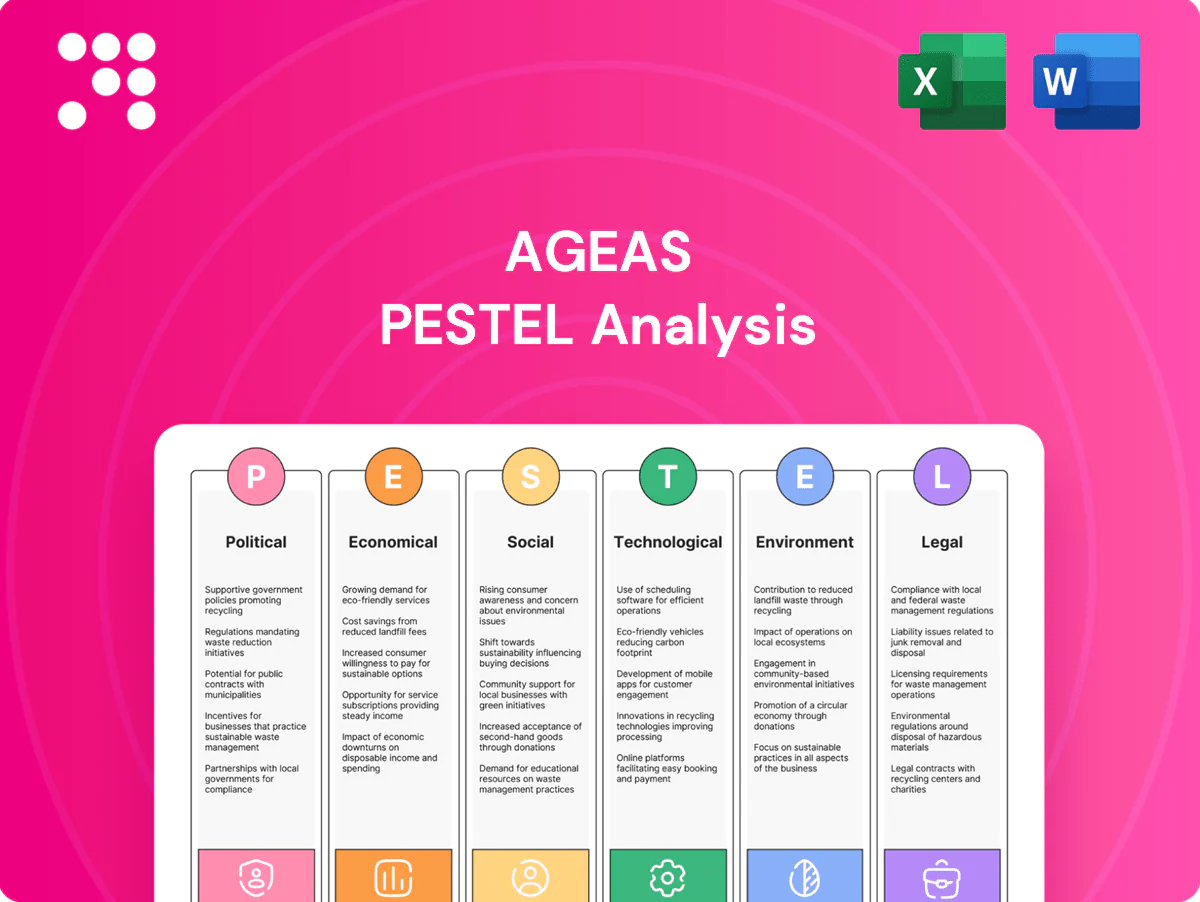
Ageas PESTLE Analysis

Plan Smarter. Present Sharper. Compete Stronger.
Unlock strategic clarity with our PESTLE Analysis of Ageas — concise, current, and focused on the external forces shaping its insurance and financial services footprint. Ideal for investors, advisors, and strategists, this report translates macro trends into actionable risks and opportunities. Buy the full version now for the complete, editable breakdown and immediate insights.
Political factors

EU/Asia regulatory alignment
Ageas must navigate divergent regimes across the EU and multiple Asian jurisdictions; the EU Solvency II framework (effective 2016, major review concluded 2023) can harmonize capital and product rules, while local Asian rules often force bespoke structures. Constant engagement with supervisors is crucial for approvals and rollouts, since regulatory shifts directly affect solvency, pricing and distribution models.
Geopolitical tensions
Geopolitical tensions — wars, sanctions and regional conflicts — disrupt investment portfolios and reinsurance markets; Aon reported global insured losses of about $94bn in 2023, driving reinsurance demand. Political risk raises market volatility and counterparty risk, pressuring capital buffers and solvency ratios for insurers like Ageas. Supply-chain shocks lift motor and property claims costs, while strategic geographic diversification reduces concentration risk.

Public pension/health reforms
Government pension and health reforms can expand or shrink private insurance demand; Eurostat projects the EU old-age dependency ratio to rise from about 35% in 2020 to ~57% by 2050, driving shifts toward private pillars and opportunities in life, health and pensions, while expanded public coverage can compress margins and volumes—Ageas must realign products to changing state benefits and incentive structures.

Disaster policy and subsidies
State catastrophe pools, subsidies and building codes materially shape Ageas’s property risk transfer: Swiss Re reported global insured natural catastrophe losses at about USD 95bn in 2023, underscoring the role of public backstops in pricing and capacity. Political willingness to fund disaster backstops affects availability and premium levels; mandated coverages can raise penetration while constraining profitability. Active engagement with policymakers improves market stability and resilience.
- State pools influence capacity and pricing
- Public backstops alter availability of cover
- Mandates increase penetration but cap margins
- Policy engagement reduces systemic risk
Trade and investment policy
Capital controls and 49% foreign-ownership caps in several Asian markets, plus JV approval rules, materially shape Ageas partnerships; tariffs and US–China trade frictions elevate insured corporate exposures and claims volatility. Investment restrictions on foreign bonds/local currency limits compress asset yields versus Europe, so proactive compliance preserves licences and growth optionality.
- 49% foreign-ownership cap common
- JV approval required in key markets
- Trade frictions raise corporate exposure
- Local investment limits reduce yields
- Compliance preserves licences
EU-Asia regimes reshape capital/JVs; 2023 losses ~USD95bn spur reinsurance
Ageas faces divergent EU and Asian regimes; Solvency II review (finalised 2023) and local Asian ownership caps (commonly 49%) force bespoke capital and JV structures. Geopolitical shocks drove global insured losses ~USD94–95bn in 2023, raising reinsurance demand and capital pressure. Demographics: EU old-age dependency ratio projected ~57% by 2050, boosting private pensions and life demand.
| Metric | Value |
|---|---|
| Global insured losses 2023 (Aon/Swiss Re) | USD94–95bn |
| EU old-age dependency 2050 | ~57% |
What is included in the product
 Detailed Word Document
Explores how Political, Economic, Social, Technological, Environmental and Legal forces uniquely affect Ageas, linking data and trends to sector- and region-specific risks and opportunities; designed for executives, investors and advisors to inform strategy, risk management and scenario planning.

 Customizable Excel Spreadsheet
A concise, visually segmented Ageas PESTLE summary that eases meeting prep and strategy workshops by highlighting key external risks and opportunities in simple language, editable for region- or line-specific notes and instantly shareable across teams.
Economic factors

Interest rate cycles
Higher rates (Fed funds ~5.25–5.50% mid-2025) boost Ageas investment income and can widen new-life margins, but they stress existing guaranteed books through lapses and reserve dynamics. Duration matching is increasingly critical to control ALM risk as bond yields and curve volatility rise. Pricing and credit risk in portfolios require tighter oversight to avoid mark-to-market and default-driven losses.
Inflation and claims severity
Inflation raised repair, medical and rebuild costs—Euro area CPI moderated to about 2.5% in 2024 but claims severity in P&C rose roughly 10% year-on-year, lifting loss ratios. Indexation in life benefits (wage/price links) can squeeze life profitability as reserves face higher nominal payouts. Pricing agility and tighter claims supply-chain management have become decisive to restore margins. Reinsurance structures and attachment points may need recalibration to protect earnings.

GDP growth divergence
Slower Euro area GDP (around 0.6% in 2024) versus faster Asian growth—Emerging Asia ~5% and China ~5.2%, India ~7%—creates a mixed demand profile for Ageas, with stronger premium growth potential in Asia. Rising emerging middle classes lift demand for protection and health products. Corporate activity cycles in Europe and Asia drive commercial lines volumes. A balanced geographic and product portfolio helps smooth earnings volatility.

FX volatility
Currency swings materially affect reported results and solvency ratios for multinational insurers; global FX markets trade about 7.5 trillion USD daily (BIS 2022), so translation shifts can move IFRS earnings by multiple percentage points in a volatile period.
Hedging reduces translation risk but adds cost and balance-sheet complexity, increasing operational hedging expenses and counterparty exposures while smoothing volatility in reported capital ratios.
Local-currency profitability remains the core value driver; product and asset localization—matching liabilities with local assets and premiums—significantly lessens FX exposure and preserves underlying economic returns.
- FX market size: BIS 7.5 trillion USD/day
- Hedging trade-off: volatility reduction vs added cost/complexity
- Value driver: local-currency profits over translated results
- Mitigation: product/asset localization to cut FX risk
Employment and income trends
Employment and income trends shape Ageas exposure: Belgium unemployment at 5.6% (Eurostat, Jun 2024) and wage growth around 3.8% in 2024 support premium affordability and new-business resilience, while downturns compress demand and raise lapse risk; SME sector (99.8% of EU firms) drives commercial-lines penetration; flexible premiums and modular products can stabilize retention.
- Unemployment: 5.6% (Belgium, Jun 2024)
- Wage growth: ~3.8% (2024)
- SMEs: 99.8% of EU firms
- Mitigation: flexible premiums, modular products
EU-Asia regimes reshape capital/JVs; 2023 losses ~USD95bn spur reinsurance
Higher rates (Fed funds ~5.25–5.50% mid-2025) lift investment income but raise ALM and reserve strain; inflation (Euro CPI ~2.5% in 2024) increased claims severity ~+10% YoY. Slower Euro GDP ~0.6% (2024) vs Emerging Asia ~5% shifts growth to Asia; FX volatility (BIS FX turnover ~7.5trn USD/day) makes hedging costly but localization preserves local-currency profits.
| Metric | Value |
|---|---|
| Fed funds | 5.25–5.50% (mid-2025) |
| Euro CPI | ~2.5% (2024) |
| Euro GDP | ~0.6% (2024) |
| Emerg. Asia GDP | ~5% (2024) |
| Belgium unemployment | 5.6% (Jun 2024) |
Preview Before You Purchase
Ageas PESTLE Analysis
The preview shown here is the exact document you’ll receive after purchase—fully formatted and ready to use. This Ageas PESTLE Analysis offers concise, actionable coverage of political, economic, social, technological, legal and environmental factors affecting the insurer, with implications for strategy and risk. The file is the final version and available for instant download after payment.

Plan Smarter. Present Sharper. Compete Stronger.
Unlock strategic clarity with our PESTLE Analysis of Ageas — concise, current, and focused on the external forces shaping its insurance and financial services footprint. Ideal for investors, advisors, and strategists, this report translates macro trends into actionable risks and opportunities. Buy the full version now for the complete, editable breakdown and immediate insights.
Political factors
EU/Asia regulatory alignment
Ageas must navigate divergent regimes across the EU and multiple Asian jurisdictions; the EU Solvency II framework (effective 2016, major review concluded 2023) can harmonize capital and product rules, while local Asian rules often force bespoke structures. Constant engagement with supervisors is crucial for approvals and rollouts, since regulatory shifts directly affect solvency, pricing and distribution models.
Geopolitical tensions
Geopolitical tensions — wars, sanctions and regional conflicts — disrupt investment portfolios and reinsurance markets; Aon reported global insured losses of about $94bn in 2023, driving reinsurance demand. Political risk raises market volatility and counterparty risk, pressuring capital buffers and solvency ratios for insurers like Ageas. Supply-chain shocks lift motor and property claims costs, while strategic geographic diversification reduces concentration risk.
Public pension/health reforms
Government pension and health reforms can expand or shrink private insurance demand; Eurostat projects the EU old-age dependency ratio to rise from about 35% in 2020 to ~57% by 2050, driving shifts toward private pillars and opportunities in life, health and pensions, while expanded public coverage can compress margins and volumes—Ageas must realign products to changing state benefits and incentive structures.
Disaster policy and subsidies
State catastrophe pools, subsidies and building codes materially shape Ageas’s property risk transfer: Swiss Re reported global insured natural catastrophe losses at about USD 95bn in 2023, underscoring the role of public backstops in pricing and capacity. Political willingness to fund disaster backstops affects availability and premium levels; mandated coverages can raise penetration while constraining profitability. Active engagement with policymakers improves market stability and resilience.
- State pools influence capacity and pricing
- Public backstops alter availability of cover
- Mandates increase penetration but cap margins
- Policy engagement reduces systemic risk
Trade and investment policy
Capital controls and 49% foreign-ownership caps in several Asian markets, plus JV approval rules, materially shape Ageas partnerships; tariffs and US–China trade frictions elevate insured corporate exposures and claims volatility. Investment restrictions on foreign bonds/local currency limits compress asset yields versus Europe, so proactive compliance preserves licences and growth optionality.
- 49% foreign-ownership cap common
- JV approval required in key markets
- Trade frictions raise corporate exposure
- Local investment limits reduce yields
- Compliance preserves licences
EU-Asia regimes reshape capital/JVs; 2023 losses ~USD95bn spur reinsurance
Ageas faces divergent EU and Asian regimes; Solvency II review (finalised 2023) and local Asian ownership caps (commonly 49%) force bespoke capital and JV structures. Geopolitical shocks drove global insured losses ~USD94–95bn in 2023, raising reinsurance demand and capital pressure. Demographics: EU old-age dependency ratio projected ~57% by 2050, boosting private pensions and life demand.
| Metric | Value |
|---|---|
| Global insured losses 2023 (Aon/Swiss Re) | USD94–95bn |
| EU old-age dependency 2050 | ~57% |
What is included in the product
Detailed Word Document
Explores how Political, Economic, Social, Technological, Environmental and Legal forces uniquely affect Ageas, linking data and trends to sector- and region-specific risks and opportunities; designed for executives, investors and advisors to inform strategy, risk management and scenario planning.
Customizable Excel Spreadsheet
A concise, visually segmented Ageas PESTLE summary that eases meeting prep and strategy workshops by highlighting key external risks and opportunities in simple language, editable for region- or line-specific notes and instantly shareable across teams.
Economic factors
Interest rate cycles
Higher rates (Fed funds ~5.25–5.50% mid-2025) boost Ageas investment income and can widen new-life margins, but they stress existing guaranteed books through lapses and reserve dynamics. Duration matching is increasingly critical to control ALM risk as bond yields and curve volatility rise. Pricing and credit risk in portfolios require tighter oversight to avoid mark-to-market and default-driven losses.
Inflation and claims severity
Inflation raised repair, medical and rebuild costs—Euro area CPI moderated to about 2.5% in 2024 but claims severity in P&C rose roughly 10% year-on-year, lifting loss ratios. Indexation in life benefits (wage/price links) can squeeze life profitability as reserves face higher nominal payouts. Pricing agility and tighter claims supply-chain management have become decisive to restore margins. Reinsurance structures and attachment points may need recalibration to protect earnings.
GDP growth divergence
Slower Euro area GDP (around 0.6% in 2024) versus faster Asian growth—Emerging Asia ~5% and China ~5.2%, India ~7%—creates a mixed demand profile for Ageas, with stronger premium growth potential in Asia. Rising emerging middle classes lift demand for protection and health products. Corporate activity cycles in Europe and Asia drive commercial lines volumes. A balanced geographic and product portfolio helps smooth earnings volatility.
FX volatility
Currency swings materially affect reported results and solvency ratios for multinational insurers; global FX markets trade about 7.5 trillion USD daily (BIS 2022), so translation shifts can move IFRS earnings by multiple percentage points in a volatile period.
Hedging reduces translation risk but adds cost and balance-sheet complexity, increasing operational hedging expenses and counterparty exposures while smoothing volatility in reported capital ratios.
Local-currency profitability remains the core value driver; product and asset localization—matching liabilities with local assets and premiums—significantly lessens FX exposure and preserves underlying economic returns.
- FX market size: BIS 7.5 trillion USD/day
- Hedging trade-off: volatility reduction vs added cost/complexity
- Value driver: local-currency profits over translated results
- Mitigation: product/asset localization to cut FX risk
Employment and income trends
Employment and income trends shape Ageas exposure: Belgium unemployment at 5.6% (Eurostat, Jun 2024) and wage growth around 3.8% in 2024 support premium affordability and new-business resilience, while downturns compress demand and raise lapse risk; SME sector (99.8% of EU firms) drives commercial-lines penetration; flexible premiums and modular products can stabilize retention.
- Unemployment: 5.6% (Belgium, Jun 2024)
- Wage growth: ~3.8% (2024)
- SMEs: 99.8% of EU firms
- Mitigation: flexible premiums, modular products
EU-Asia regimes reshape capital/JVs; 2023 losses ~USD95bn spur reinsurance
Higher rates (Fed funds ~5.25–5.50% mid-2025) lift investment income but raise ALM and reserve strain; inflation (Euro CPI ~2.5% in 2024) increased claims severity ~+10% YoY. Slower Euro GDP ~0.6% (2024) vs Emerging Asia ~5% shifts growth to Asia; FX volatility (BIS FX turnover ~7.5trn USD/day) makes hedging costly but localization preserves local-currency profits.
| Metric | Value |
|---|---|
| Fed funds | 5.25–5.50% (mid-2025) |
| Euro CPI | ~2.5% (2024) |
| Euro GDP | ~0.6% (2024) |
| Emerg. Asia GDP | ~5% (2024) |
| Belgium unemployment | 5.6% (Jun 2024) |
Preview Before You Purchase
Ageas PESTLE Analysis
The preview shown here is the exact document you’ll receive after purchase—fully formatted and ready to use. This Ageas PESTLE Analysis offers concise, actionable coverage of political, economic, social, technological, legal and environmental factors affecting the insurer, with implications for strategy and risk. The file is the final version and available for instant download after payment.
Description
Plan Smarter. Present Sharper. Compete Stronger.
Unlock strategic clarity with our PESTLE Analysis of Ageas — concise, current, and focused on the external forces shaping its insurance and financial services footprint. Ideal for investors, advisors, and strategists, this report translates macro trends into actionable risks and opportunities. Buy the full version now for the complete, editable breakdown and immediate insights.
Political factors
EU/Asia regulatory alignment
Ageas must navigate divergent regimes across the EU and multiple Asian jurisdictions; the EU Solvency II framework (effective 2016, major review concluded 2023) can harmonize capital and product rules, while local Asian rules often force bespoke structures. Constant engagement with supervisors is crucial for approvals and rollouts, since regulatory shifts directly affect solvency, pricing and distribution models.
Geopolitical tensions
Geopolitical tensions — wars, sanctions and regional conflicts — disrupt investment portfolios and reinsurance markets; Aon reported global insured losses of about $94bn in 2023, driving reinsurance demand. Political risk raises market volatility and counterparty risk, pressuring capital buffers and solvency ratios for insurers like Ageas. Supply-chain shocks lift motor and property claims costs, while strategic geographic diversification reduces concentration risk.
Public pension/health reforms
Government pension and health reforms can expand or shrink private insurance demand; Eurostat projects the EU old-age dependency ratio to rise from about 35% in 2020 to ~57% by 2050, driving shifts toward private pillars and opportunities in life, health and pensions, while expanded public coverage can compress margins and volumes—Ageas must realign products to changing state benefits and incentive structures.
Disaster policy and subsidies
State catastrophe pools, subsidies and building codes materially shape Ageas’s property risk transfer: Swiss Re reported global insured natural catastrophe losses at about USD 95bn in 2023, underscoring the role of public backstops in pricing and capacity. Political willingness to fund disaster backstops affects availability and premium levels; mandated coverages can raise penetration while constraining profitability. Active engagement with policymakers improves market stability and resilience.
- State pools influence capacity and pricing
- Public backstops alter availability of cover
- Mandates increase penetration but cap margins
- Policy engagement reduces systemic risk
Trade and investment policy
Capital controls and 49% foreign-ownership caps in several Asian markets, plus JV approval rules, materially shape Ageas partnerships; tariffs and US–China trade frictions elevate insured corporate exposures and claims volatility. Investment restrictions on foreign bonds/local currency limits compress asset yields versus Europe, so proactive compliance preserves licences and growth optionality.
- 49% foreign-ownership cap common
- JV approval required in key markets
- Trade frictions raise corporate exposure
- Local investment limits reduce yields
- Compliance preserves licences
EU-Asia regimes reshape capital/JVs; 2023 losses ~USD95bn spur reinsurance
Ageas faces divergent EU and Asian regimes; Solvency II review (finalised 2023) and local Asian ownership caps (commonly 49%) force bespoke capital and JV structures. Geopolitical shocks drove global insured losses ~USD94–95bn in 2023, raising reinsurance demand and capital pressure. Demographics: EU old-age dependency ratio projected ~57% by 2050, boosting private pensions and life demand.
| Metric | Value |
|---|---|
| Global insured losses 2023 (Aon/Swiss Re) | USD94–95bn |
| EU old-age dependency 2050 | ~57% |
What is included in the product
Detailed Word Document
Explores how Political, Economic, Social, Technological, Environmental and Legal forces uniquely affect Ageas, linking data and trends to sector- and region-specific risks and opportunities; designed for executives, investors and advisors to inform strategy, risk management and scenario planning.
Customizable Excel Spreadsheet
A concise, visually segmented Ageas PESTLE summary that eases meeting prep and strategy workshops by highlighting key external risks and opportunities in simple language, editable for region- or line-specific notes and instantly shareable across teams.
Economic factors
Interest rate cycles
Higher rates (Fed funds ~5.25–5.50% mid-2025) boost Ageas investment income and can widen new-life margins, but they stress existing guaranteed books through lapses and reserve dynamics. Duration matching is increasingly critical to control ALM risk as bond yields and curve volatility rise. Pricing and credit risk in portfolios require tighter oversight to avoid mark-to-market and default-driven losses.
Inflation and claims severity
Inflation raised repair, medical and rebuild costs—Euro area CPI moderated to about 2.5% in 2024 but claims severity in P&C rose roughly 10% year-on-year, lifting loss ratios. Indexation in life benefits (wage/price links) can squeeze life profitability as reserves face higher nominal payouts. Pricing agility and tighter claims supply-chain management have become decisive to restore margins. Reinsurance structures and attachment points may need recalibration to protect earnings.
GDP growth divergence
Slower Euro area GDP (around 0.6% in 2024) versus faster Asian growth—Emerging Asia ~5% and China ~5.2%, India ~7%—creates a mixed demand profile for Ageas, with stronger premium growth potential in Asia. Rising emerging middle classes lift demand for protection and health products. Corporate activity cycles in Europe and Asia drive commercial lines volumes. A balanced geographic and product portfolio helps smooth earnings volatility.
FX volatility
Currency swings materially affect reported results and solvency ratios for multinational insurers; global FX markets trade about 7.5 trillion USD daily (BIS 2022), so translation shifts can move IFRS earnings by multiple percentage points in a volatile period.
Hedging reduces translation risk but adds cost and balance-sheet complexity, increasing operational hedging expenses and counterparty exposures while smoothing volatility in reported capital ratios.
Local-currency profitability remains the core value driver; product and asset localization—matching liabilities with local assets and premiums—significantly lessens FX exposure and preserves underlying economic returns.
- FX market size: BIS 7.5 trillion USD/day
- Hedging trade-off: volatility reduction vs added cost/complexity
- Value driver: local-currency profits over translated results
- Mitigation: product/asset localization to cut FX risk
Employment and income trends
Employment and income trends shape Ageas exposure: Belgium unemployment at 5.6% (Eurostat, Jun 2024) and wage growth around 3.8% in 2024 support premium affordability and new-business resilience, while downturns compress demand and raise lapse risk; SME sector (99.8% of EU firms) drives commercial-lines penetration; flexible premiums and modular products can stabilize retention.
- Unemployment: 5.6% (Belgium, Jun 2024)
- Wage growth: ~3.8% (2024)
- SMEs: 99.8% of EU firms
- Mitigation: flexible premiums, modular products
EU-Asia regimes reshape capital/JVs; 2023 losses ~USD95bn spur reinsurance
Higher rates (Fed funds ~5.25–5.50% mid-2025) lift investment income but raise ALM and reserve strain; inflation (Euro CPI ~2.5% in 2024) increased claims severity ~+10% YoY. Slower Euro GDP ~0.6% (2024) vs Emerging Asia ~5% shifts growth to Asia; FX volatility (BIS FX turnover ~7.5trn USD/day) makes hedging costly but localization preserves local-currency profits.
| Metric | Value |
|---|---|
| Fed funds | 5.25–5.50% (mid-2025) |
| Euro CPI | ~2.5% (2024) |
| Euro GDP | ~0.6% (2024) |
| Emerg. Asia GDP | ~5% (2024) |
| Belgium unemployment | 5.6% (Jun 2024) |
Preview Before You Purchase
Ageas PESTLE Analysis
The preview shown here is the exact document you’ll receive after purchase—fully formatted and ready to use. This Ageas PESTLE Analysis offers concise, actionable coverage of political, economic, social, technological, legal and environmental factors affecting the insurer, with implications for strategy and risk. The file is the final version and available for instant download after payment.











