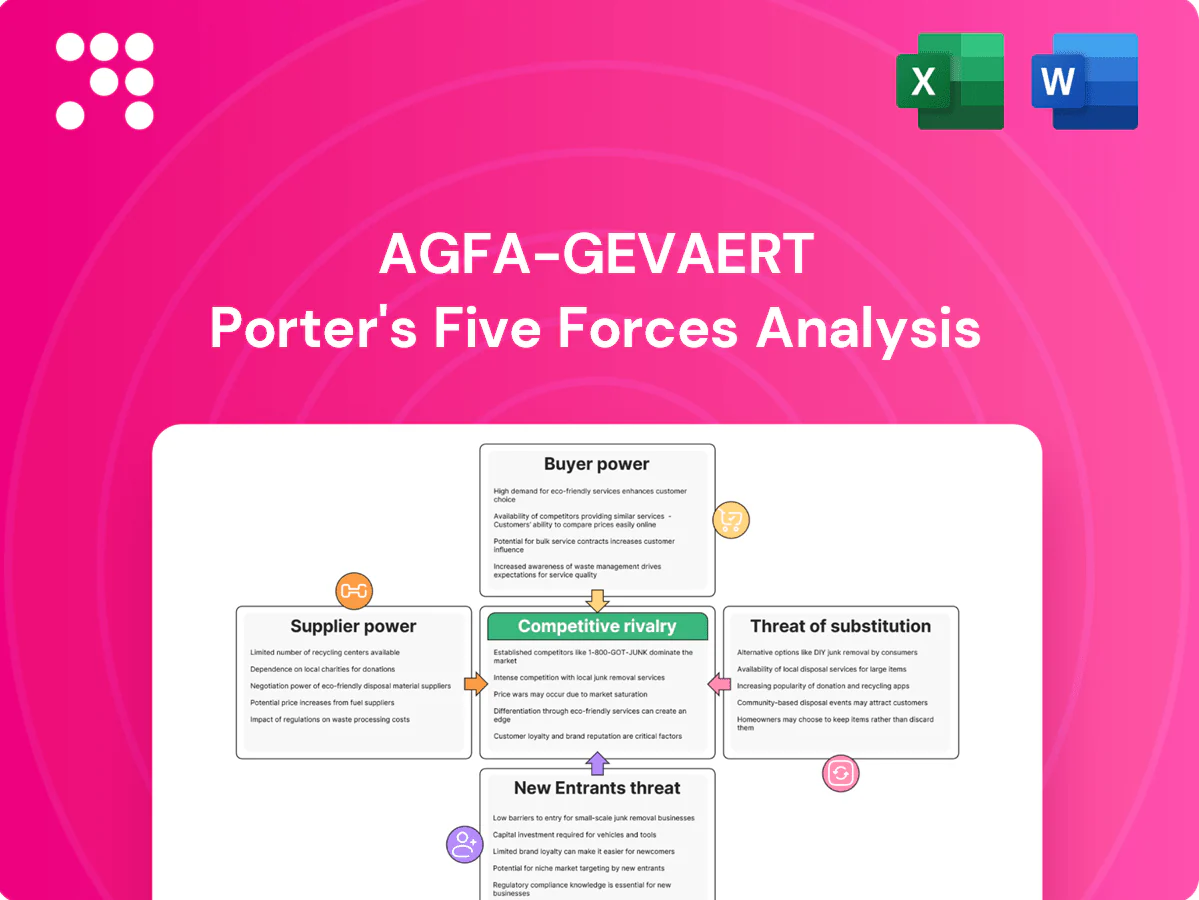
Agfa-Gevaert Porter's Five Forces Analysis

From Overview to Strategy Blueprint
Agfa-Gevaert faces moderate supplier power from niche imaging component providers and strong buyer power driven by large institutional customers and price sensitivity in printing and healthcare segments. Intense industry rivalry and digital substitute threats pressure margins, while regulatory and capital barriers limit new entrants. This preview is just the beginning. The full analysis provides a complete strategic snapshot with force-by-force ratings, visuals, and business implications tailored to Agfa-Gevaert.
Suppliers Bargaining Power

Specialty raw materials
Agfa depends on specialty inputs—aluminum (LME avg ~$2,300/t in 2024), silver halides (silver avg ~$26/oz in 2024), pigments and resins—markets dominated by a few global producers, so supplier consolidation raises bargaining power during price spikes. REACH and other environmental rules increase compliance costs and risk of supply tightening. Long-term contracts and recycling programs mitigate exposure, but strict quality specs limit quick switching.
Imaging components
Detectors, print heads and precision rollers are supplied by specialized OEMs with proprietary designs, creating high supplier bargaining power. Qualification cycles often exceed 12 months, driving dependence and switching costs. Vendors influence lead times and pricing via roadmap control, with lead times commonly stretching beyond six months. Multi-sourcing is possible but typically adds months of validation and significant incremental CAPEX.

Software and cloud inputs
Healthcare IT relies on databases, middleware, cybersecurity tools and cloud infra where hyperscalers hold ~33% (AWS), ~22% (Azure), ~12% (GCP) market share in 2024, giving suppliers leverage via platform lock-in and certification needs (HIPAA, HITRUST). Open standards and containerization (Kubernetes) can reduce switching costs. Negotiated enterprise agreements typically cut unit costs ~20–40% at scale.

Energy and utilities
Chemical and plate manufacturing at Agfa-Gevaert is energy-intensive, making margins sensitive to utility price swings; EU industrial electricity averaged about €0.14–0.17/kWh in 2024, keeping input costs material to gross margins. Regional energy shocks (2022–24 volatility in European gas and power markets) can temporarily shift bargaining power to suppliers. Hedging programs and efficiency CAPEX reduce but do not eliminate exposure; diversifying plant footprint lowers localized risk.
- Energy intensity: high for chemicals/plates
- 2024 EU industrial power ~€0.14–0.17/kWh
- Hedging + efficiency: partial mitigation
- Plant diversification: reduces regional supplier leverage
Logistics and compliance
Global distribution of hazardous chemicals and films depends on specialized hazmat carriers and customs brokers; 2024 disruptions have pushed logistics premiums an estimated 10–25% and can delay shipments by weeks, amplifying supplier leverage. Building 30–90 day buffer inventory and regional warehouses reduces delays and mitigates cost spikes.
- Specialized carriers: high dependency
- Regulatory complexity: increases influence
- Disruptions: +10–25% cost impact
- Mitigation: 30–90 day buffers, regional hubs
Supplier power lifts costs: aluminum $2.3k/t, silver $26/oz, logistics +10-25%
Agfa faces high supplier power: specialty inputs (aluminum ~$2,300/t, silver ~$26/oz in 2024), proprietary OEMs (qualification >12 months, lead times >6 months), hyperscaler cloud share (AWS ~33%, Azure ~22%, GCP ~12% 2024) and EU industrial power €0.14–0.17/kWh elevate costs; logistics disruptions +10–25% amplify leverage; hedging, multi-sourcing and 30–90 day buffers mitigate risk.
| Factor | 2024 data |
|---|---|
| Aluminum | ~$2,300/t |
| Silver | ~$26/oz |
| Cloud share | AWS 33% / Azure 22% / GCP 12% |
| EU power | €0.14–0.17/kWh |
| Logistics premium | +10–25% |
What is included in the product
 Detailed Word Document
Uncovers key drivers of competition, customer influence, supplier power, entry barriers and substitution risk specific to Agfa-Gevaert, highlighting how industry dynamics shape its pricing and profitability; includes strategic commentary on disruptive threats and protective factors that affect its market position.

 Customizable Excel Spreadsheet
A concise, one-sheet Porter's Five Forces for Agfa‑Gevaert—clarifies competitive pressures and relief points for strategic decisions; customizable pressure levels and radar visualization make it board-ready for scenario testing and slide insertion.
Customers Bargaining Power

Consolidated hospital buyers
Health systems, GPOs, and national tenders aggregate demand for PACS/RIS and X‑ray film, running competitive RFPs with strict SLAs that compress margins; GPOs cover over 90% of U.S. hospitals (AHA, 2024). These tenders pressure prices and service levels, though material switching costs from system integration and data migration moderate customer leverage. Increasing outcomes‑based contracting further shifts negotiations toward performance metrics and shared risk.
Large print houses
Large consolidated commercial printers buy plates, inks and service in high volumes, enabling bulk pricing and strong negotiating leverage. Offset plates remain partly commoditized, prompting frequent price comparisons and sourcing shifts. Bundled service, workflow integration and recurring maintenance create customer stickiness but not full immunity. Industry print volumes declined roughly 3–4% y/y in 2023–2024, strengthening buyer power in downturns.

Spec-driven quality needs
Buyers demand color fidelity, high uptime and diagnostic clinical image quality, while certification and audits (FDA, CE, ISO 13485) raise vendor compliance costs without proportional price recognition. Performance differentiation through superior image quality and tighter SLAs can blunt buyer power when clinical stakes are high. Contractual penalties for downtime keep pricing pressure acute and favor vendors that can demonstrably reduce operational risk.

Alternative sources
Competing offers from Fujifilm, Kodak, Heidelberg, GE, Philips and Sectra give buyers clear alternatives across imaging and IT, while international plate producers frequently submit low-cost bids in public tenders; cloud-native PACS further expands choice by reducing upfront capital, pressuring margins. Agfa must emphasize total cost of ownership, lifecycle service and integrated workflow value to retain customers.
- Multiple OEMs increase buyer leverage
- Low-cost plate entrants intensify tender competition
- Cloud PACS cuts upfront spend, raising switching risk
- Focus on TCO and service as competitive counter
Data and integration lock-in
EMR adoption exceeded 90% in hospitals in 2024, and growing VNA use means Agfa-Gevaert’s healthcare IT integrations create significant exit barriers tied to data and workflow continuity. Print workflows bound to proprietary RIP/DFE raise migration risk and training needs, tempering buyer willingness to switch despite ongoing price pressure. Strong support contracts and roadmap transparency materially sustain customer retention.
- High EMR/VNA integration: >90% EMR adoption (2024)
- RIP/DFE lock-in: increases migration cost and training burden
- Buyer power reduced short-term despite price sensitivity
- Support + transparent roadmap = higher retention
GPO consolidation, EMR shifts and falling print volumes squeeze medical imaging margins
Health GPOs cover >90% of US hospitals (AHA, 2024), compressing margins via tenders; print volumes fell ~3–4% y/y in 2023–2024, strengthening buyer leverage; EMR/VNA adoption >90% (2024) raises switching costs but not price immunity; multiple OEMs (Fujifilm, Kodak, Heidelberg, GE, Philips, Sectra) and low‑cost plate entrants keep tender pressure high.
| Metric | Value (2023–24) | Implication |
|---|---|---|
| GPO hospital coverage | >90% | High buyer aggregation |
| Print volume change | -3–4% y/y | Stronger price pressure |
| EMR/VNA adoption | >90% | Higher switching costs |
Same Document Delivered
Agfa-Gevaert Porter's Five Forces Analysis
This preview shows the exact Porter's Five Forces analysis for Agfa‑Gevaert you'll receive immediately after purchase—no placeholders or mockups. The file is fully formatted, professionally written, and ready for download and use upon payment. It covers supplier power, buyer power, competitive rivalry, threat of substitutes, and barriers to entry with actionable insights for strategic decisions.

From Overview to Strategy Blueprint
Agfa-Gevaert faces moderate supplier power from niche imaging component providers and strong buyer power driven by large institutional customers and price sensitivity in printing and healthcare segments. Intense industry rivalry and digital substitute threats pressure margins, while regulatory and capital barriers limit new entrants. This preview is just the beginning. The full analysis provides a complete strategic snapshot with force-by-force ratings, visuals, and business implications tailored to Agfa-Gevaert.
Suppliers Bargaining Power
Specialty raw materials
Agfa depends on specialty inputs—aluminum (LME avg ~$2,300/t in 2024), silver halides (silver avg ~$26/oz in 2024), pigments and resins—markets dominated by a few global producers, so supplier consolidation raises bargaining power during price spikes. REACH and other environmental rules increase compliance costs and risk of supply tightening. Long-term contracts and recycling programs mitigate exposure, but strict quality specs limit quick switching.
Imaging components
Detectors, print heads and precision rollers are supplied by specialized OEMs with proprietary designs, creating high supplier bargaining power. Qualification cycles often exceed 12 months, driving dependence and switching costs. Vendors influence lead times and pricing via roadmap control, with lead times commonly stretching beyond six months. Multi-sourcing is possible but typically adds months of validation and significant incremental CAPEX.
Software and cloud inputs
Healthcare IT relies on databases, middleware, cybersecurity tools and cloud infra where hyperscalers hold ~33% (AWS), ~22% (Azure), ~12% (GCP) market share in 2024, giving suppliers leverage via platform lock-in and certification needs (HIPAA, HITRUST). Open standards and containerization (Kubernetes) can reduce switching costs. Negotiated enterprise agreements typically cut unit costs ~20–40% at scale.
Energy and utilities
Chemical and plate manufacturing at Agfa-Gevaert is energy-intensive, making margins sensitive to utility price swings; EU industrial electricity averaged about €0.14–0.17/kWh in 2024, keeping input costs material to gross margins. Regional energy shocks (2022–24 volatility in European gas and power markets) can temporarily shift bargaining power to suppliers. Hedging programs and efficiency CAPEX reduce but do not eliminate exposure; diversifying plant footprint lowers localized risk.
- Energy intensity: high for chemicals/plates
- 2024 EU industrial power ~€0.14–0.17/kWh
- Hedging + efficiency: partial mitigation
- Plant diversification: reduces regional supplier leverage
Logistics and compliance
Global distribution of hazardous chemicals and films depends on specialized hazmat carriers and customs brokers; 2024 disruptions have pushed logistics premiums an estimated 10–25% and can delay shipments by weeks, amplifying supplier leverage. Building 30–90 day buffer inventory and regional warehouses reduces delays and mitigates cost spikes.
- Specialized carriers: high dependency
- Regulatory complexity: increases influence
- Disruptions: +10–25% cost impact
- Mitigation: 30–90 day buffers, regional hubs
Supplier power lifts costs: aluminum $2.3k/t, silver $26/oz, logistics +10-25%
Agfa faces high supplier power: specialty inputs (aluminum ~$2,300/t, silver ~$26/oz in 2024), proprietary OEMs (qualification >12 months, lead times >6 months), hyperscaler cloud share (AWS ~33%, Azure ~22%, GCP ~12% 2024) and EU industrial power €0.14–0.17/kWh elevate costs; logistics disruptions +10–25% amplify leverage; hedging, multi-sourcing and 30–90 day buffers mitigate risk.
| Factor | 2024 data |
|---|---|
| Aluminum | ~$2,300/t |
| Silver | ~$26/oz |
| Cloud share | AWS 33% / Azure 22% / GCP 12% |
| EU power | €0.14–0.17/kWh |
| Logistics premium | +10–25% |
What is included in the product
Detailed Word Document
Uncovers key drivers of competition, customer influence, supplier power, entry barriers and substitution risk specific to Agfa-Gevaert, highlighting how industry dynamics shape its pricing and profitability; includes strategic commentary on disruptive threats and protective factors that affect its market position.
Customizable Excel Spreadsheet
A concise, one-sheet Porter's Five Forces for Agfa‑Gevaert—clarifies competitive pressures and relief points for strategic decisions; customizable pressure levels and radar visualization make it board-ready for scenario testing and slide insertion.
Customers Bargaining Power
Consolidated hospital buyers
Health systems, GPOs, and national tenders aggregate demand for PACS/RIS and X‑ray film, running competitive RFPs with strict SLAs that compress margins; GPOs cover over 90% of U.S. hospitals (AHA, 2024). These tenders pressure prices and service levels, though material switching costs from system integration and data migration moderate customer leverage. Increasing outcomes‑based contracting further shifts negotiations toward performance metrics and shared risk.
Large print houses
Large consolidated commercial printers buy plates, inks and service in high volumes, enabling bulk pricing and strong negotiating leverage. Offset plates remain partly commoditized, prompting frequent price comparisons and sourcing shifts. Bundled service, workflow integration and recurring maintenance create customer stickiness but not full immunity. Industry print volumes declined roughly 3–4% y/y in 2023–2024, strengthening buyer power in downturns.
Spec-driven quality needs
Buyers demand color fidelity, high uptime and diagnostic clinical image quality, while certification and audits (FDA, CE, ISO 13485) raise vendor compliance costs without proportional price recognition. Performance differentiation through superior image quality and tighter SLAs can blunt buyer power when clinical stakes are high. Contractual penalties for downtime keep pricing pressure acute and favor vendors that can demonstrably reduce operational risk.
Alternative sources
Competing offers from Fujifilm, Kodak, Heidelberg, GE, Philips and Sectra give buyers clear alternatives across imaging and IT, while international plate producers frequently submit low-cost bids in public tenders; cloud-native PACS further expands choice by reducing upfront capital, pressuring margins. Agfa must emphasize total cost of ownership, lifecycle service and integrated workflow value to retain customers.
- Multiple OEMs increase buyer leverage
- Low-cost plate entrants intensify tender competition
- Cloud PACS cuts upfront spend, raising switching risk
- Focus on TCO and service as competitive counter
Data and integration lock-in
EMR adoption exceeded 90% in hospitals in 2024, and growing VNA use means Agfa-Gevaert’s healthcare IT integrations create significant exit barriers tied to data and workflow continuity. Print workflows bound to proprietary RIP/DFE raise migration risk and training needs, tempering buyer willingness to switch despite ongoing price pressure. Strong support contracts and roadmap transparency materially sustain customer retention.
- High EMR/VNA integration: >90% EMR adoption (2024)
- RIP/DFE lock-in: increases migration cost and training burden
- Buyer power reduced short-term despite price sensitivity
- Support + transparent roadmap = higher retention
GPO consolidation, EMR shifts and falling print volumes squeeze medical imaging margins
Health GPOs cover >90% of US hospitals (AHA, 2024), compressing margins via tenders; print volumes fell ~3–4% y/y in 2023–2024, strengthening buyer leverage; EMR/VNA adoption >90% (2024) raises switching costs but not price immunity; multiple OEMs (Fujifilm, Kodak, Heidelberg, GE, Philips, Sectra) and low‑cost plate entrants keep tender pressure high.
| Metric | Value (2023–24) | Implication |
|---|---|---|
| GPO hospital coverage | >90% | High buyer aggregation |
| Print volume change | -3–4% y/y | Stronger price pressure |
| EMR/VNA adoption | >90% | Higher switching costs |
Same Document Delivered
Agfa-Gevaert Porter's Five Forces Analysis
This preview shows the exact Porter's Five Forces analysis for Agfa‑Gevaert you'll receive immediately after purchase—no placeholders or mockups. The file is fully formatted, professionally written, and ready for download and use upon payment. It covers supplier power, buyer power, competitive rivalry, threat of substitutes, and barriers to entry with actionable insights for strategic decisions.
Original: $10.00
-65%$10.00
$3.50Description
From Overview to Strategy Blueprint
Agfa-Gevaert faces moderate supplier power from niche imaging component providers and strong buyer power driven by large institutional customers and price sensitivity in printing and healthcare segments. Intense industry rivalry and digital substitute threats pressure margins, while regulatory and capital barriers limit new entrants. This preview is just the beginning. The full analysis provides a complete strategic snapshot with force-by-force ratings, visuals, and business implications tailored to Agfa-Gevaert.
Suppliers Bargaining Power
Specialty raw materials
Agfa depends on specialty inputs—aluminum (LME avg ~$2,300/t in 2024), silver halides (silver avg ~$26/oz in 2024), pigments and resins—markets dominated by a few global producers, so supplier consolidation raises bargaining power during price spikes. REACH and other environmental rules increase compliance costs and risk of supply tightening. Long-term contracts and recycling programs mitigate exposure, but strict quality specs limit quick switching.
Imaging components
Detectors, print heads and precision rollers are supplied by specialized OEMs with proprietary designs, creating high supplier bargaining power. Qualification cycles often exceed 12 months, driving dependence and switching costs. Vendors influence lead times and pricing via roadmap control, with lead times commonly stretching beyond six months. Multi-sourcing is possible but typically adds months of validation and significant incremental CAPEX.
Software and cloud inputs
Healthcare IT relies on databases, middleware, cybersecurity tools and cloud infra where hyperscalers hold ~33% (AWS), ~22% (Azure), ~12% (GCP) market share in 2024, giving suppliers leverage via platform lock-in and certification needs (HIPAA, HITRUST). Open standards and containerization (Kubernetes) can reduce switching costs. Negotiated enterprise agreements typically cut unit costs ~20–40% at scale.
Energy and utilities
Chemical and plate manufacturing at Agfa-Gevaert is energy-intensive, making margins sensitive to utility price swings; EU industrial electricity averaged about €0.14–0.17/kWh in 2024, keeping input costs material to gross margins. Regional energy shocks (2022–24 volatility in European gas and power markets) can temporarily shift bargaining power to suppliers. Hedging programs and efficiency CAPEX reduce but do not eliminate exposure; diversifying plant footprint lowers localized risk.
- Energy intensity: high for chemicals/plates
- 2024 EU industrial power ~€0.14–0.17/kWh
- Hedging + efficiency: partial mitigation
- Plant diversification: reduces regional supplier leverage
Logistics and compliance
Global distribution of hazardous chemicals and films depends on specialized hazmat carriers and customs brokers; 2024 disruptions have pushed logistics premiums an estimated 10–25% and can delay shipments by weeks, amplifying supplier leverage. Building 30–90 day buffer inventory and regional warehouses reduces delays and mitigates cost spikes.
- Specialized carriers: high dependency
- Regulatory complexity: increases influence
- Disruptions: +10–25% cost impact
- Mitigation: 30–90 day buffers, regional hubs
Supplier power lifts costs: aluminum $2.3k/t, silver $26/oz, logistics +10-25%
Agfa faces high supplier power: specialty inputs (aluminum ~$2,300/t, silver ~$26/oz in 2024), proprietary OEMs (qualification >12 months, lead times >6 months), hyperscaler cloud share (AWS ~33%, Azure ~22%, GCP ~12% 2024) and EU industrial power €0.14–0.17/kWh elevate costs; logistics disruptions +10–25% amplify leverage; hedging, multi-sourcing and 30–90 day buffers mitigate risk.
| Factor | 2024 data |
|---|---|
| Aluminum | ~$2,300/t |
| Silver | ~$26/oz |
| Cloud share | AWS 33% / Azure 22% / GCP 12% |
| EU power | €0.14–0.17/kWh |
| Logistics premium | +10–25% |
What is included in the product
Detailed Word Document
Uncovers key drivers of competition, customer influence, supplier power, entry barriers and substitution risk specific to Agfa-Gevaert, highlighting how industry dynamics shape its pricing and profitability; includes strategic commentary on disruptive threats and protective factors that affect its market position.
Customizable Excel Spreadsheet
A concise, one-sheet Porter's Five Forces for Agfa‑Gevaert—clarifies competitive pressures and relief points for strategic decisions; customizable pressure levels and radar visualization make it board-ready for scenario testing and slide insertion.
Customers Bargaining Power
Consolidated hospital buyers
Health systems, GPOs, and national tenders aggregate demand for PACS/RIS and X‑ray film, running competitive RFPs with strict SLAs that compress margins; GPOs cover over 90% of U.S. hospitals (AHA, 2024). These tenders pressure prices and service levels, though material switching costs from system integration and data migration moderate customer leverage. Increasing outcomes‑based contracting further shifts negotiations toward performance metrics and shared risk.
Large print houses
Large consolidated commercial printers buy plates, inks and service in high volumes, enabling bulk pricing and strong negotiating leverage. Offset plates remain partly commoditized, prompting frequent price comparisons and sourcing shifts. Bundled service, workflow integration and recurring maintenance create customer stickiness but not full immunity. Industry print volumes declined roughly 3–4% y/y in 2023–2024, strengthening buyer power in downturns.
Spec-driven quality needs
Buyers demand color fidelity, high uptime and diagnostic clinical image quality, while certification and audits (FDA, CE, ISO 13485) raise vendor compliance costs without proportional price recognition. Performance differentiation through superior image quality and tighter SLAs can blunt buyer power when clinical stakes are high. Contractual penalties for downtime keep pricing pressure acute and favor vendors that can demonstrably reduce operational risk.
Alternative sources
Competing offers from Fujifilm, Kodak, Heidelberg, GE, Philips and Sectra give buyers clear alternatives across imaging and IT, while international plate producers frequently submit low-cost bids in public tenders; cloud-native PACS further expands choice by reducing upfront capital, pressuring margins. Agfa must emphasize total cost of ownership, lifecycle service and integrated workflow value to retain customers.
- Multiple OEMs increase buyer leverage
- Low-cost plate entrants intensify tender competition
- Cloud PACS cuts upfront spend, raising switching risk
- Focus on TCO and service as competitive counter
Data and integration lock-in
EMR adoption exceeded 90% in hospitals in 2024, and growing VNA use means Agfa-Gevaert’s healthcare IT integrations create significant exit barriers tied to data and workflow continuity. Print workflows bound to proprietary RIP/DFE raise migration risk and training needs, tempering buyer willingness to switch despite ongoing price pressure. Strong support contracts and roadmap transparency materially sustain customer retention.
- High EMR/VNA integration: >90% EMR adoption (2024)
- RIP/DFE lock-in: increases migration cost and training burden
- Buyer power reduced short-term despite price sensitivity
- Support + transparent roadmap = higher retention
GPO consolidation, EMR shifts and falling print volumes squeeze medical imaging margins
Health GPOs cover >90% of US hospitals (AHA, 2024), compressing margins via tenders; print volumes fell ~3–4% y/y in 2023–2024, strengthening buyer leverage; EMR/VNA adoption >90% (2024) raises switching costs but not price immunity; multiple OEMs (Fujifilm, Kodak, Heidelberg, GE, Philips, Sectra) and low‑cost plate entrants keep tender pressure high.
| Metric | Value (2023–24) | Implication |
|---|---|---|
| GPO hospital coverage | >90% | High buyer aggregation |
| Print volume change | -3–4% y/y | Stronger price pressure |
| EMR/VNA adoption | >90% | Higher switching costs |
Same Document Delivered
Agfa-Gevaert Porter's Five Forces Analysis
This preview shows the exact Porter's Five Forces analysis for Agfa‑Gevaert you'll receive immediately after purchase—no placeholders or mockups. The file is fully formatted, professionally written, and ready for download and use upon payment. It covers supplier power, buyer power, competitive rivalry, threat of substitutes, and barriers to entry with actionable insights for strategic decisions.











