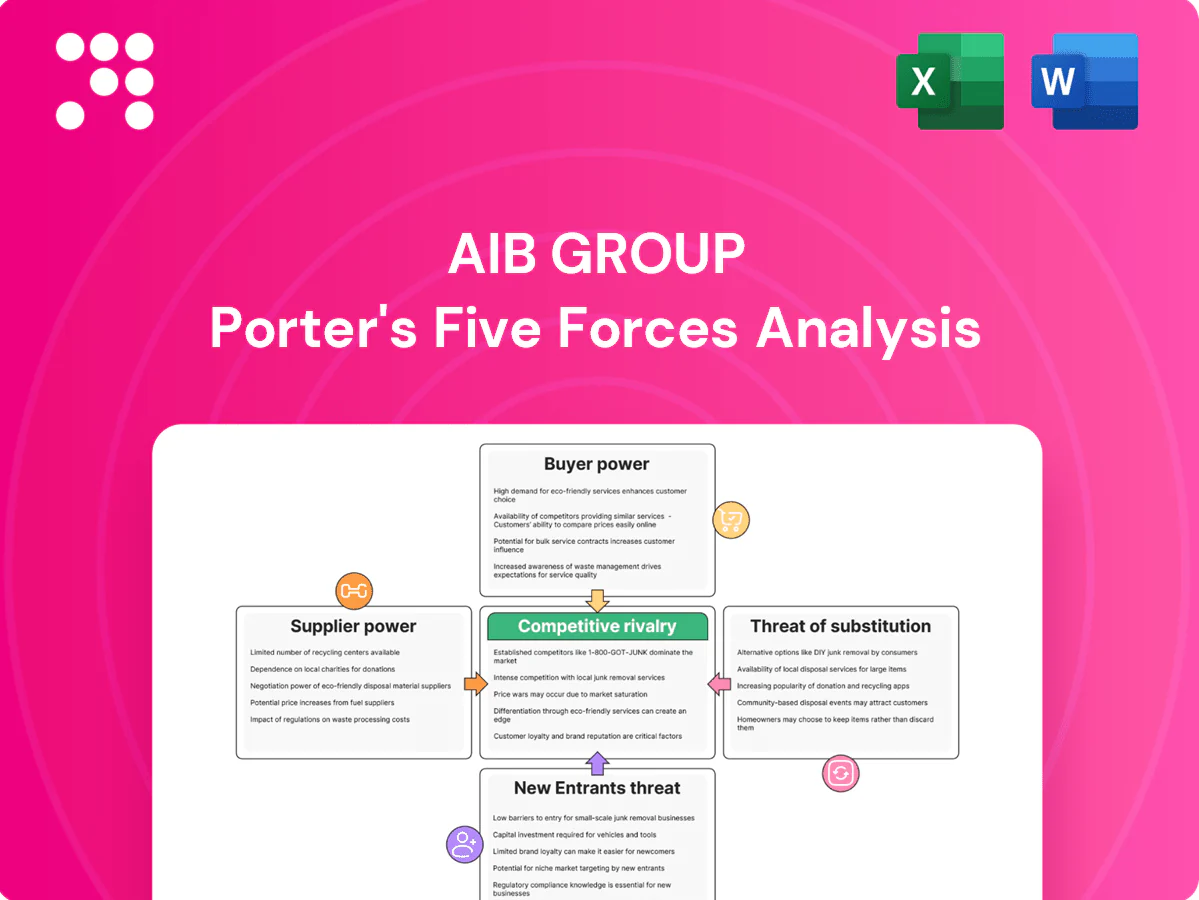
AIB Group Porter's Five Forces Analysis

A Must-Have Tool for Decision-Makers
AIB Group faces moderate competitive rivalry, strong regulatory oversight, rising fintech disruption, and concentrated corporate client influence that together shape margins and growth prospects. This snapshot highlights key pressures but omits force-by-force ratings, scenarios, and visuals. Unlock the full Porter's Five Forces Analysis to get a detailed, actionable strategic assessment tailored to AIB Group.
Suppliers Bargaining Power

Reliance on critical tech and payment vendors
AIB depends on core banking platforms, cloud providers, card schemes and cybersecurity partners that are few and hard to switch. Global cloud market share in 2024 was led by AWS 32% and Azure 22%, while Visa and Mastercard made up about 85% of card transactions, concentrating supplier leverage. Certification requirements (PCI DSS, ISO 27001) and outage/compliance risks increase dependence; multi-vendor strategies mitigate risk but raise integration costs.
Wholesale funding and capital providers
Wholesale funding via covered bonds, securitisations and interbank lines materially supplements AIB’s deposits through cycles; market risk premia and investor sentiment can rapidly reprice costs and ratings actions amplify this pressure. AIB’s strong capital (CET1 ~16% in 2024) and liquidity above regulatory LCR 100% with diversified maturities temper exposure.

Talent and specialist skills
Competition for data, risk, compliance and engineering talent is intense; hiring premiums in Dublin and London exceeded 20% for specialist roles in 2024 (Hays/Robert Walters reports). Scarcity lifts wage costs and retention packages, increasing fixed personnel spend for banks like AIB. Union influence and regulatory certification requirements add rigidity to redeployment. Automation and nearshoring offset only a portion of these cost pressures.

Data, analytics, and identity infrastructure
KYC utilities, credit bureaux and identity providers act as gatekeepers for AIB onboarding and risk; in 2024 the global identity verification market was about $15.8bn, underscoring supplier concentration and pricing power. Integration complexity and regulatory accreditation create switching frictions that often take months and can cost six figures, making pricing sticky due to embedded workflows. Open standards reduce lock-in, but vendor roadmaps still shape AIB’s capabilities and timing.
- Gatekeepers: KYC, bureaux, ID providers
- Market size 2024: $15.8bn identity verification
- Switching friction: months, €100k+ implementation
- Sticky pricing: embedded workflows
- Mitigant: open standards but vendor roadmaps matter
Regulatory and scheme dependencies
Central banks and payment schemes act as de facto suppliers for AIB: ECB/SSM macroprudential decisions and EU rules like the Interchange Fee Regulation (caps at 0.2% debit, 0.3% credit) and the Deposit Guarantee Scheme (coverage 100,000 euros) reshape margins; liquidity (LCR ≥100%) and capital mandates force timing-driven compliance that limits negotiating leverage; proactive regulator engagement helps anticipate but cannot prevent rule changes.
- Interchange caps: 0.2% debit / 0.3% credit
- Deposit cover: 100,000 euros
- LCR standard: ≥100%
- Regulatory timelines constrain negotiation
Concentrated tech & card power: AWS 32%/Azure 22%, cards ~85%
AIB faces high supplier power from concentrated tech and payments: AWS 32%/Azure 22% cloud share and Visa+Mastercard ~85% of card flows. Identity verification market ~$15.8bn in 2024 and switching costs (months, €100k+) embed vendor leverage. Covered bonds/interbank funding and market repricing raise cost exposure despite CET1 ~16% and LCR >100%.
| Metric | 2024 value |
|---|---|
| AWS market share | 32% |
| Azure market share | 22% |
| Visa+Mastercard | ~85% |
| Identity market | $15.8bn |
| CET1 | ~16% |
| LCR | >100% |
What is included in the product
 Detailed Word Document
Concise Porter's Five Forces analysis of AIB Group highlighting competitive rivalry, customer and supplier bargaining power, threat of new entrants and substitutes, and regulatory pressures; identifies strategic vulnerabilities and defensive advantages tailored to AIB's banking operations. Ideal for investor briefings, strategy decks, or academic use.

 Customizable Excel Spreadsheet
A concise one-sheet Porter's Five Forces for AIB Group—instantly pinpoints competitive pressures and regulatory risks, relieving analysis bottlenecks for faster strategic decisions and board-ready insights.
Customers Bargaining Power

High price sensitivity in lending and deposits
Customers actively compare mortgage rates, SME loan pricing and savings yields across Irish banks, with ECB policy rates near 4% in 2024 increasing sensitivity to offered deposit and lending spreads. Rate-transparency and online comparison tools amplify bargaining power and force margin compression when peers reprice. Deep relationship bundling (accounts + mortgages + business services) can mitigate pure price shopping.
Digital convenience and service expectations
AIB customers demand fast onboarding, 24/7 servicing and seamless apps, with 78% of consumers in 2024 using mobile banking, raising switching risk when UX falters. Poor app experience or outages prompt multi-banking and rapid churn; AIB reported notable customer complaints after major outages in recent years. Continuous feature rollout and reliability improvements are essential to retain engagement and reduce bargaining leverage.

Multi-banking and low switching frictions
Open banking driven by PSD2 (effective 2018) and easier account switching has enabled customers to multi-bank and cherry-pick products (mortgages here, savings elsewhere), diluting AIBs cross-sell opportunities and lifting acquisition costs. This fragmentation pressures margin per customer and increases marketing spend to win primary relationships. Loyalty incentives and ecosystem plays (bundles, partner platforms) are used to counteract wallet dilution.

Corporate and institutional negotiation power
Larger corporates routinely tender cash management, FX and lending across banks; mandates pivot on pricing, credit limits and service SLAs, with 2024 market dynamics keeping liquidity and FX hedging central to decisions.
- Pricing pressure: bespoke fees and waivers requested
- Credit limits: decisive for mandate awards
- Service SLAs: uptime and responsiveness critical
- Defensive edge: deep relationships and sector expertise preserve margins
Consumer protections and complaints regimes
Strong 2024 Irish and UK conduct rules materially increase customer leverage in disputes with AIB, raising remediation and fine risk that compels conservative product design and pricing; complaint escalation channels to ombudsmen and regulators force faster resolution timelines, while transparent communication lowers chances of adverse outcomes and supervisory action.
- Regulatory pressure: 2024 conduct rules
- Remediation risk: increases conservative pricing
- Escalation: ombudsman/regulator channels speed resolution
- Transparency: reduces adverse outcomes
ECB ~4.0% and 78% mobile adoption boost pricing pressure
Customers exert strong price and service pressure: ECB policy rates ~4.0% in 2024 raise sensitivity to deposit/lending spreads, while 78% mobile banking adoption in 2024 increases switching risk. Open Banking (PSD2) and easier switching fragment wallets; corporates tender on pricing, credit limits and SLAs. Strong 2024 conduct rules boost remediation and complaint leverage.
| Metric | Value |
|---|---|
| ECB policy rate (2024) | ~4.0% |
| Mobile banking users (Ireland, 2024) | 78% |
| PSD2 | Effective 2018 |
| Regulatory conduct (impact) | Higher remediation/complaint leverage (2024) |
Preview the Actual Deliverable
AIB Group Porter's Five Forces Analysis
This preview shows the exact AIB Group Porter's Five Forces analysis you'll receive after purchase—comprehensive, professionally formatted and ready to use. It examines competitive rivalry, threat of new entrants, bargaining power of suppliers and buyers, and threat of substitutes with concise, actionable insights. No placeholders or mockups; this is the final file available for immediate download upon payment.

A Must-Have Tool for Decision-Makers
AIB Group faces moderate competitive rivalry, strong regulatory oversight, rising fintech disruption, and concentrated corporate client influence that together shape margins and growth prospects. This snapshot highlights key pressures but omits force-by-force ratings, scenarios, and visuals. Unlock the full Porter's Five Forces Analysis to get a detailed, actionable strategic assessment tailored to AIB Group.
Suppliers Bargaining Power
Reliance on critical tech and payment vendors
AIB depends on core banking platforms, cloud providers, card schemes and cybersecurity partners that are few and hard to switch. Global cloud market share in 2024 was led by AWS 32% and Azure 22%, while Visa and Mastercard made up about 85% of card transactions, concentrating supplier leverage. Certification requirements (PCI DSS, ISO 27001) and outage/compliance risks increase dependence; multi-vendor strategies mitigate risk but raise integration costs.
Wholesale funding and capital providers
Wholesale funding via covered bonds, securitisations and interbank lines materially supplements AIB’s deposits through cycles; market risk premia and investor sentiment can rapidly reprice costs and ratings actions amplify this pressure. AIB’s strong capital (CET1 ~16% in 2024) and liquidity above regulatory LCR 100% with diversified maturities temper exposure.
Talent and specialist skills
Competition for data, risk, compliance and engineering talent is intense; hiring premiums in Dublin and London exceeded 20% for specialist roles in 2024 (Hays/Robert Walters reports). Scarcity lifts wage costs and retention packages, increasing fixed personnel spend for banks like AIB. Union influence and regulatory certification requirements add rigidity to redeployment. Automation and nearshoring offset only a portion of these cost pressures.
Data, analytics, and identity infrastructure
KYC utilities, credit bureaux and identity providers act as gatekeepers for AIB onboarding and risk; in 2024 the global identity verification market was about $15.8bn, underscoring supplier concentration and pricing power. Integration complexity and regulatory accreditation create switching frictions that often take months and can cost six figures, making pricing sticky due to embedded workflows. Open standards reduce lock-in, but vendor roadmaps still shape AIB’s capabilities and timing.
- Gatekeepers: KYC, bureaux, ID providers
- Market size 2024: $15.8bn identity verification
- Switching friction: months, €100k+ implementation
- Sticky pricing: embedded workflows
- Mitigant: open standards but vendor roadmaps matter
Regulatory and scheme dependencies
Central banks and payment schemes act as de facto suppliers for AIB: ECB/SSM macroprudential decisions and EU rules like the Interchange Fee Regulation (caps at 0.2% debit, 0.3% credit) and the Deposit Guarantee Scheme (coverage 100,000 euros) reshape margins; liquidity (LCR ≥100%) and capital mandates force timing-driven compliance that limits negotiating leverage; proactive regulator engagement helps anticipate but cannot prevent rule changes.
- Interchange caps: 0.2% debit / 0.3% credit
- Deposit cover: 100,000 euros
- LCR standard: ≥100%
- Regulatory timelines constrain negotiation
Concentrated tech & card power: AWS 32%/Azure 22%, cards ~85%
AIB faces high supplier power from concentrated tech and payments: AWS 32%/Azure 22% cloud share and Visa+Mastercard ~85% of card flows. Identity verification market ~$15.8bn in 2024 and switching costs (months, €100k+) embed vendor leverage. Covered bonds/interbank funding and market repricing raise cost exposure despite CET1 ~16% and LCR >100%.
| Metric | 2024 value |
|---|---|
| AWS market share | 32% |
| Azure market share | 22% |
| Visa+Mastercard | ~85% |
| Identity market | $15.8bn |
| CET1 | ~16% |
| LCR | >100% |
What is included in the product
Detailed Word Document
Concise Porter's Five Forces analysis of AIB Group highlighting competitive rivalry, customer and supplier bargaining power, threat of new entrants and substitutes, and regulatory pressures; identifies strategic vulnerabilities and defensive advantages tailored to AIB's banking operations. Ideal for investor briefings, strategy decks, or academic use.
Customizable Excel Spreadsheet
A concise one-sheet Porter's Five Forces for AIB Group—instantly pinpoints competitive pressures and regulatory risks, relieving analysis bottlenecks for faster strategic decisions and board-ready insights.
Customers Bargaining Power
High price sensitivity in lending and deposits
Customers actively compare mortgage rates, SME loan pricing and savings yields across Irish banks, with ECB policy rates near 4% in 2024 increasing sensitivity to offered deposit and lending spreads. Rate-transparency and online comparison tools amplify bargaining power and force margin compression when peers reprice. Deep relationship bundling (accounts + mortgages + business services) can mitigate pure price shopping.
Digital convenience and service expectations
AIB customers demand fast onboarding, 24/7 servicing and seamless apps, with 78% of consumers in 2024 using mobile banking, raising switching risk when UX falters. Poor app experience or outages prompt multi-banking and rapid churn; AIB reported notable customer complaints after major outages in recent years. Continuous feature rollout and reliability improvements are essential to retain engagement and reduce bargaining leverage.
Multi-banking and low switching frictions
Open banking driven by PSD2 (effective 2018) and easier account switching has enabled customers to multi-bank and cherry-pick products (mortgages here, savings elsewhere), diluting AIBs cross-sell opportunities and lifting acquisition costs. This fragmentation pressures margin per customer and increases marketing spend to win primary relationships. Loyalty incentives and ecosystem plays (bundles, partner platforms) are used to counteract wallet dilution.
Corporate and institutional negotiation power
Larger corporates routinely tender cash management, FX and lending across banks; mandates pivot on pricing, credit limits and service SLAs, with 2024 market dynamics keeping liquidity and FX hedging central to decisions.
- Pricing pressure: bespoke fees and waivers requested
- Credit limits: decisive for mandate awards
- Service SLAs: uptime and responsiveness critical
- Defensive edge: deep relationships and sector expertise preserve margins
Consumer protections and complaints regimes
Strong 2024 Irish and UK conduct rules materially increase customer leverage in disputes with AIB, raising remediation and fine risk that compels conservative product design and pricing; complaint escalation channels to ombudsmen and regulators force faster resolution timelines, while transparent communication lowers chances of adverse outcomes and supervisory action.
- Regulatory pressure: 2024 conduct rules
- Remediation risk: increases conservative pricing
- Escalation: ombudsman/regulator channels speed resolution
- Transparency: reduces adverse outcomes
ECB ~4.0% and 78% mobile adoption boost pricing pressure
Customers exert strong price and service pressure: ECB policy rates ~4.0% in 2024 raise sensitivity to deposit/lending spreads, while 78% mobile banking adoption in 2024 increases switching risk. Open Banking (PSD2) and easier switching fragment wallets; corporates tender on pricing, credit limits and SLAs. Strong 2024 conduct rules boost remediation and complaint leverage.
| Metric | Value |
|---|---|
| ECB policy rate (2024) | ~4.0% |
| Mobile banking users (Ireland, 2024) | 78% |
| PSD2 | Effective 2018 |
| Regulatory conduct (impact) | Higher remediation/complaint leverage (2024) |
Preview the Actual Deliverable
AIB Group Porter's Five Forces Analysis
This preview shows the exact AIB Group Porter's Five Forces analysis you'll receive after purchase—comprehensive, professionally formatted and ready to use. It examines competitive rivalry, threat of new entrants, bargaining power of suppliers and buyers, and threat of substitutes with concise, actionable insights. No placeholders or mockups; this is the final file available for immediate download upon payment.
Description
A Must-Have Tool for Decision-Makers
AIB Group faces moderate competitive rivalry, strong regulatory oversight, rising fintech disruption, and concentrated corporate client influence that together shape margins and growth prospects. This snapshot highlights key pressures but omits force-by-force ratings, scenarios, and visuals. Unlock the full Porter's Five Forces Analysis to get a detailed, actionable strategic assessment tailored to AIB Group.
Suppliers Bargaining Power
Reliance on critical tech and payment vendors
AIB depends on core banking platforms, cloud providers, card schemes and cybersecurity partners that are few and hard to switch. Global cloud market share in 2024 was led by AWS 32% and Azure 22%, while Visa and Mastercard made up about 85% of card transactions, concentrating supplier leverage. Certification requirements (PCI DSS, ISO 27001) and outage/compliance risks increase dependence; multi-vendor strategies mitigate risk but raise integration costs.
Wholesale funding and capital providers
Wholesale funding via covered bonds, securitisations and interbank lines materially supplements AIB’s deposits through cycles; market risk premia and investor sentiment can rapidly reprice costs and ratings actions amplify this pressure. AIB’s strong capital (CET1 ~16% in 2024) and liquidity above regulatory LCR 100% with diversified maturities temper exposure.
Talent and specialist skills
Competition for data, risk, compliance and engineering talent is intense; hiring premiums in Dublin and London exceeded 20% for specialist roles in 2024 (Hays/Robert Walters reports). Scarcity lifts wage costs and retention packages, increasing fixed personnel spend for banks like AIB. Union influence and regulatory certification requirements add rigidity to redeployment. Automation and nearshoring offset only a portion of these cost pressures.
Data, analytics, and identity infrastructure
KYC utilities, credit bureaux and identity providers act as gatekeepers for AIB onboarding and risk; in 2024 the global identity verification market was about $15.8bn, underscoring supplier concentration and pricing power. Integration complexity and regulatory accreditation create switching frictions that often take months and can cost six figures, making pricing sticky due to embedded workflows. Open standards reduce lock-in, but vendor roadmaps still shape AIB’s capabilities and timing.
- Gatekeepers: KYC, bureaux, ID providers
- Market size 2024: $15.8bn identity verification
- Switching friction: months, €100k+ implementation
- Sticky pricing: embedded workflows
- Mitigant: open standards but vendor roadmaps matter
Regulatory and scheme dependencies
Central banks and payment schemes act as de facto suppliers for AIB: ECB/SSM macroprudential decisions and EU rules like the Interchange Fee Regulation (caps at 0.2% debit, 0.3% credit) and the Deposit Guarantee Scheme (coverage 100,000 euros) reshape margins; liquidity (LCR ≥100%) and capital mandates force timing-driven compliance that limits negotiating leverage; proactive regulator engagement helps anticipate but cannot prevent rule changes.
- Interchange caps: 0.2% debit / 0.3% credit
- Deposit cover: 100,000 euros
- LCR standard: ≥100%
- Regulatory timelines constrain negotiation
Concentrated tech & card power: AWS 32%/Azure 22%, cards ~85%
AIB faces high supplier power from concentrated tech and payments: AWS 32%/Azure 22% cloud share and Visa+Mastercard ~85% of card flows. Identity verification market ~$15.8bn in 2024 and switching costs (months, €100k+) embed vendor leverage. Covered bonds/interbank funding and market repricing raise cost exposure despite CET1 ~16% and LCR >100%.
| Metric | 2024 value |
|---|---|
| AWS market share | 32% |
| Azure market share | 22% |
| Visa+Mastercard | ~85% |
| Identity market | $15.8bn |
| CET1 | ~16% |
| LCR | >100% |
What is included in the product
Detailed Word Document
Concise Porter's Five Forces analysis of AIB Group highlighting competitive rivalry, customer and supplier bargaining power, threat of new entrants and substitutes, and regulatory pressures; identifies strategic vulnerabilities and defensive advantages tailored to AIB's banking operations. Ideal for investor briefings, strategy decks, or academic use.
Customizable Excel Spreadsheet
A concise one-sheet Porter's Five Forces for AIB Group—instantly pinpoints competitive pressures and regulatory risks, relieving analysis bottlenecks for faster strategic decisions and board-ready insights.
Customers Bargaining Power
High price sensitivity in lending and deposits
Customers actively compare mortgage rates, SME loan pricing and savings yields across Irish banks, with ECB policy rates near 4% in 2024 increasing sensitivity to offered deposit and lending spreads. Rate-transparency and online comparison tools amplify bargaining power and force margin compression when peers reprice. Deep relationship bundling (accounts + mortgages + business services) can mitigate pure price shopping.
Digital convenience and service expectations
AIB customers demand fast onboarding, 24/7 servicing and seamless apps, with 78% of consumers in 2024 using mobile banking, raising switching risk when UX falters. Poor app experience or outages prompt multi-banking and rapid churn; AIB reported notable customer complaints after major outages in recent years. Continuous feature rollout and reliability improvements are essential to retain engagement and reduce bargaining leverage.
Multi-banking and low switching frictions
Open banking driven by PSD2 (effective 2018) and easier account switching has enabled customers to multi-bank and cherry-pick products (mortgages here, savings elsewhere), diluting AIBs cross-sell opportunities and lifting acquisition costs. This fragmentation pressures margin per customer and increases marketing spend to win primary relationships. Loyalty incentives and ecosystem plays (bundles, partner platforms) are used to counteract wallet dilution.
Corporate and institutional negotiation power
Larger corporates routinely tender cash management, FX and lending across banks; mandates pivot on pricing, credit limits and service SLAs, with 2024 market dynamics keeping liquidity and FX hedging central to decisions.
- Pricing pressure: bespoke fees and waivers requested
- Credit limits: decisive for mandate awards
- Service SLAs: uptime and responsiveness critical
- Defensive edge: deep relationships and sector expertise preserve margins
Consumer protections and complaints regimes
Strong 2024 Irish and UK conduct rules materially increase customer leverage in disputes with AIB, raising remediation and fine risk that compels conservative product design and pricing; complaint escalation channels to ombudsmen and regulators force faster resolution timelines, while transparent communication lowers chances of adverse outcomes and supervisory action.
- Regulatory pressure: 2024 conduct rules
- Remediation risk: increases conservative pricing
- Escalation: ombudsman/regulator channels speed resolution
- Transparency: reduces adverse outcomes
ECB ~4.0% and 78% mobile adoption boost pricing pressure
Customers exert strong price and service pressure: ECB policy rates ~4.0% in 2024 raise sensitivity to deposit/lending spreads, while 78% mobile banking adoption in 2024 increases switching risk. Open Banking (PSD2) and easier switching fragment wallets; corporates tender on pricing, credit limits and SLAs. Strong 2024 conduct rules boost remediation and complaint leverage.
| Metric | Value |
|---|---|
| ECB policy rate (2024) | ~4.0% |
| Mobile banking users (Ireland, 2024) | 78% |
| PSD2 | Effective 2018 |
| Regulatory conduct (impact) | Higher remediation/complaint leverage (2024) |
Preview the Actual Deliverable
AIB Group Porter's Five Forces Analysis
This preview shows the exact AIB Group Porter's Five Forces analysis you'll receive after purchase—comprehensive, professionally formatted and ready to use. It examines competitive rivalry, threat of new entrants, bargaining power of suppliers and buyers, and threat of substitutes with concise, actionable insights. No placeholders or mockups; this is the final file available for immediate download upon payment.











