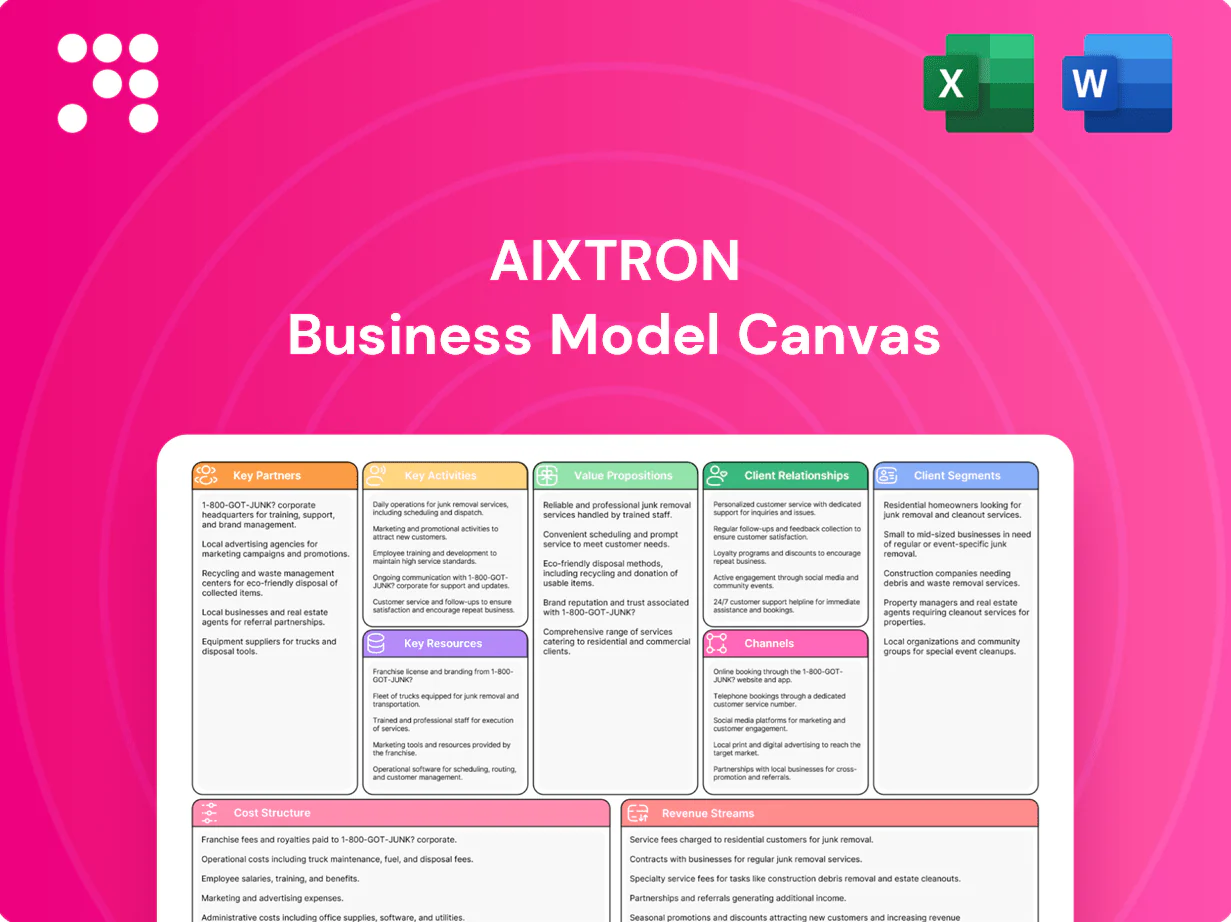
AIXTRON Business Model Canvas

Unlock a semiconductor-equipment strategic playbook with a ready Business Model Canvas
Unlock AIXTRON’s strategic playbook with our full Business Model Canvas — a concise, actionable breakdown of how the company creates value, scales operations, and captures market share. Perfect for investors, consultants, and founders seeking a ready-to-use template for benchmarking and strategic planning. Download the complete Word and Excel files to apply these insights directly to your analysis or presentation.
Partnerships

Compound precursor and materials suppliers
Partnerships with metal-organic precursor vendors secure consistent quality and supply for MOCVD processes and joint work optimizes chemistries such as TMGa, TMAl and Cp2Mg to improve yield and throughput. Multi-sourcing combined with multi-year (3–5 year) contracts reduces price volatility and lead-time risk. Co-development agreements accelerate qualification of new materials for power, RF and display nodes.
Subsystem and component OEMs
Alliances with vacuum, gas delivery, MFC, plasma, thermal and automation OEMs raise tool reliability and performance, cutting defect rates and enabling uptime targets above 99% seen across production fabs in 2024. Early integration shortens time-to-market for new platforms by up to 30%, accelerating customer product launches. Shared roadmaps align upgrades and lifecycle support, reducing retrofit cycles and compatibility risks. Preferential pricing and service SLAs typically stabilize cost of ownership by ~10% while improving predictability for customers.

Foundries, IDMs, and OSATs
Strategic accounts with foundries, IDMs and OSATs co-develop process recipes and designate AIXTRON tools as tool-of-record, accelerating qualification timelines. Joint demonstrations validate device performance across GaN, SiC and photonics flows, de-risking customer adoption. Multi-year purchase frameworks flatten demand cycles and improve capacity planning. Continuous feedback loops from partners shape next-gen platform specs and software feature roadmaps.

Universities and research institutes
Academic labs and consortia validate novel epitaxy approaches and materials, shortening development cycles for AIXTRON tools and enabling reproducible benchmarks for 2024 microLED and silicon photonics pilots.
- Validation: academic benchmarks for epitaxy
- Metrology: accelerates learning cycles
- Credibility: 2024 publications support frontier apps
- Talent: pipelines for specialized hires
Government agencies and standards bodies
Partnerships with government agencies and standards bodies let AIXTRON co‑fund and de‑risk emerging tooling, tapping programs such as Horizon Europe (budget €95.5 billion 2021–27) to accelerate commercialization. Active standards engagement ensures safety, interoperability and faster customer adoption while aligning incentives that encourage localized manufacturing. Policy visibility from agencies guides capacity planning and regional service footprints.
- De‑risking via funded programs: Horizon Europe €95.5bn
- Standards: ensures safety & interoperability
- Incentives: support customer localization
- Policy visibility: informs capacity & regional services
Partnerships cut time-to-market 30%, uptime >99%, TCO ~10%
Partnerships with precursor vendors, OEMs, foundries, academia and agencies secure supply, co‑development and standards, driving uptime >99% (2024), 3–5yr contracts and ~10% lower TCO while cutting time‑to‑market up to 30%. Academic/consortium work validated microLED and photonics pilots in 2024. Horizon Europe (€95.5bn) co‑funding de‑risks scale‑up.
| Partner Type | Role | Impact (2024) |
|---|---|---|
| Precursors | Supply + chem co‑dev | 3–5yr contracts, yield↑ |
| OEMs | Integration & SLA | Uptime>99%, TCO↓~10% |
| Academia/Agencies | Validation & funding | microLED/photonic pilots; Horizon €95.5bn |
What is included in the product
 Detailed Word Document
A concise, pre-written Business Model Canvas for AIXTRON detailing customer segments, channels, value propositions, revenue streams, key partners, activities, resources, cost structure and governance across nine blocks. Tailored to AIXTRON’s silicon-carbide and MOCVD equipment strategy, it includes competitive advantages, linked SWOT insights and a polished format for investor presentations and strategic planning.

 Customizable Excel Spreadsheet
Condenses AIXTRON’s strategic and operational components into a one-page, editable canvas to quickly identify core value drivers and relieve analysis bottlenecks.
Activities

Advanced epitaxy R&D and process engineering
Advanced epitaxy R&D and process engineering focuses on developing recipes for GaN, GaAs, InP, SiC and related stacks, with uniformity targets under 2% and defect densities driven toward <1 cm-2 across production wafers. DOE campaigns and in-situ monitoring—dozens of experiments annually—sharpen control windows and cut process variability by ~20–30%. Continuous innovation and ~10% of revenue reinvested in R&D sustain competitive tool performance.
Tool design, manufacturing, and quality assurance
Engineering teams design scalable reactors and advanced thermal management systems tailored for high-throughput deposition and uniformity across wafer sizes. Manufacturing assembles, tests, and certifies systems to tight specifications with automated acceptance protocols. Rigorous supplier qualification and ISO-grade quality assurance maintain reliability while continuous value engineering lowers unit cost without degrading performance.

Installation, commissioning, and ramp support
Field teams deploy AIXTRON tools at customer fabs worldwide, performing site acceptance testing to validate process specs and uptime. Ramp services focus on stabilizing yield and throughput during production scale-up, with knowledge transfer to customer production teams for handover. The global semiconductor equipment market was roughly $105 billion in 2024, underpinning demand for these services.

After-sales service, spares, and upgrades
After-sales service combines preventive maintenance and rapid-response repairs to sustain >99% uptime; spares logistics cut mean time to repair by ~40%, while hardware and software upgrades extend tool lifecycles by 3–5 years; 2024 service analytics deployments yielded ~30% fewer unplanned stops, enabling predictive interventions and higher tool throughput.
- Preventive maintenance: >99% uptime
- Spares logistics: ~40% MTTR reduction
- Upgrades: +3–5 years lifecycle
- Analytics: ~30% fewer unplanned stops (2024)
Application support and customer training
Process experts provide device-specific optimization at customer sites, shortening ramp-up and improving yield through hands-on adjustments and recipe tuning.
Structured training programs cover safety, operation, and troubleshooting, while documentation and e-learning modules reinforce best practices and knowledge retention.
Joint problem-solving with customers accelerates time-to-yield and reduces downtime, supported by targeted workshops and remote diagnostics.
- device optimization
- safety & operation training
- troubleshooting workshops
- documentation & e-learning
- faster time-to-yield
Advanced epitaxy R&D reinvesting ~10%, process work reduces unplanned stops 30%
AIXTRON focuses on advanced epitaxy R&D (≈10% revenue reinvested) and DOE campaigns cutting process variability ~20–30% to reach <1 cm-2 defect targets. Engineering scales reactors for high-throughput uniformity; manufacturing and supplier QA drive cost down and reliability with >99% service uptime. Field ramp, device optimization and analytics reduced unplanned stops ~30% in 2024 and shorten time-to-yield.
| Metric | 2024 |
|---|---|
| R&D spend | ~10% rev |
| Market size | $105B |
| Uptime | >99% |
| Unplanned stops | -30% |
Full Version Awaits
Business Model Canvas
The AIXTRON Business Model Canvas shown here is the exact document you’ll receive after purchase, not a mockup or sample. It contains the same structure, content and formatting visible in this preview. Upon purchase you’ll instantly download the complete, editable file—ready to present, edit, and apply.

Unlock a semiconductor-equipment strategic playbook with a ready Business Model Canvas
Unlock AIXTRON’s strategic playbook with our full Business Model Canvas — a concise, actionable breakdown of how the company creates value, scales operations, and captures market share. Perfect for investors, consultants, and founders seeking a ready-to-use template for benchmarking and strategic planning. Download the complete Word and Excel files to apply these insights directly to your analysis or presentation.
Partnerships
Compound precursor and materials suppliers
Partnerships with metal-organic precursor vendors secure consistent quality and supply for MOCVD processes and joint work optimizes chemistries such as TMGa, TMAl and Cp2Mg to improve yield and throughput. Multi-sourcing combined with multi-year (3–5 year) contracts reduces price volatility and lead-time risk. Co-development agreements accelerate qualification of new materials for power, RF and display nodes.
Subsystem and component OEMs
Alliances with vacuum, gas delivery, MFC, plasma, thermal and automation OEMs raise tool reliability and performance, cutting defect rates and enabling uptime targets above 99% seen across production fabs in 2024. Early integration shortens time-to-market for new platforms by up to 30%, accelerating customer product launches. Shared roadmaps align upgrades and lifecycle support, reducing retrofit cycles and compatibility risks. Preferential pricing and service SLAs typically stabilize cost of ownership by ~10% while improving predictability for customers.
Foundries, IDMs, and OSATs
Strategic accounts with foundries, IDMs and OSATs co-develop process recipes and designate AIXTRON tools as tool-of-record, accelerating qualification timelines. Joint demonstrations validate device performance across GaN, SiC and photonics flows, de-risking customer adoption. Multi-year purchase frameworks flatten demand cycles and improve capacity planning. Continuous feedback loops from partners shape next-gen platform specs and software feature roadmaps.
Universities and research institutes
Academic labs and consortia validate novel epitaxy approaches and materials, shortening development cycles for AIXTRON tools and enabling reproducible benchmarks for 2024 microLED and silicon photonics pilots.
- Validation: academic benchmarks for epitaxy
- Metrology: accelerates learning cycles
- Credibility: 2024 publications support frontier apps
- Talent: pipelines for specialized hires
Government agencies and standards bodies
Partnerships with government agencies and standards bodies let AIXTRON co‑fund and de‑risk emerging tooling, tapping programs such as Horizon Europe (budget €95.5 billion 2021–27) to accelerate commercialization. Active standards engagement ensures safety, interoperability and faster customer adoption while aligning incentives that encourage localized manufacturing. Policy visibility from agencies guides capacity planning and regional service footprints.
- De‑risking via funded programs: Horizon Europe €95.5bn
- Standards: ensures safety & interoperability
- Incentives: support customer localization
- Policy visibility: informs capacity & regional services
Partnerships cut time-to-market 30%, uptime >99%, TCO ~10%
Partnerships with precursor vendors, OEMs, foundries, academia and agencies secure supply, co‑development and standards, driving uptime >99% (2024), 3–5yr contracts and ~10% lower TCO while cutting time‑to‑market up to 30%. Academic/consortium work validated microLED and photonics pilots in 2024. Horizon Europe (€95.5bn) co‑funding de‑risks scale‑up.
| Partner Type | Role | Impact (2024) |
|---|---|---|
| Precursors | Supply + chem co‑dev | 3–5yr contracts, yield↑ |
| OEMs | Integration & SLA | Uptime>99%, TCO↓~10% |
| Academia/Agencies | Validation & funding | microLED/photonic pilots; Horizon €95.5bn |
What is included in the product
Detailed Word Document
A concise, pre-written Business Model Canvas for AIXTRON detailing customer segments, channels, value propositions, revenue streams, key partners, activities, resources, cost structure and governance across nine blocks. Tailored to AIXTRON’s silicon-carbide and MOCVD equipment strategy, it includes competitive advantages, linked SWOT insights and a polished format for investor presentations and strategic planning.
Customizable Excel Spreadsheet
Condenses AIXTRON’s strategic and operational components into a one-page, editable canvas to quickly identify core value drivers and relieve analysis bottlenecks.
Activities
Advanced epitaxy R&D and process engineering
Advanced epitaxy R&D and process engineering focuses on developing recipes for GaN, GaAs, InP, SiC and related stacks, with uniformity targets under 2% and defect densities driven toward <1 cm-2 across production wafers. DOE campaigns and in-situ monitoring—dozens of experiments annually—sharpen control windows and cut process variability by ~20–30%. Continuous innovation and ~10% of revenue reinvested in R&D sustain competitive tool performance.
Tool design, manufacturing, and quality assurance
Engineering teams design scalable reactors and advanced thermal management systems tailored for high-throughput deposition and uniformity across wafer sizes. Manufacturing assembles, tests, and certifies systems to tight specifications with automated acceptance protocols. Rigorous supplier qualification and ISO-grade quality assurance maintain reliability while continuous value engineering lowers unit cost without degrading performance.
Installation, commissioning, and ramp support
Field teams deploy AIXTRON tools at customer fabs worldwide, performing site acceptance testing to validate process specs and uptime. Ramp services focus on stabilizing yield and throughput during production scale-up, with knowledge transfer to customer production teams for handover. The global semiconductor equipment market was roughly $105 billion in 2024, underpinning demand for these services.
After-sales service, spares, and upgrades
After-sales service combines preventive maintenance and rapid-response repairs to sustain >99% uptime; spares logistics cut mean time to repair by ~40%, while hardware and software upgrades extend tool lifecycles by 3–5 years; 2024 service analytics deployments yielded ~30% fewer unplanned stops, enabling predictive interventions and higher tool throughput.
- Preventive maintenance: >99% uptime
- Spares logistics: ~40% MTTR reduction
- Upgrades: +3–5 years lifecycle
- Analytics: ~30% fewer unplanned stops (2024)
Application support and customer training
Process experts provide device-specific optimization at customer sites, shortening ramp-up and improving yield through hands-on adjustments and recipe tuning.
Structured training programs cover safety, operation, and troubleshooting, while documentation and e-learning modules reinforce best practices and knowledge retention.
Joint problem-solving with customers accelerates time-to-yield and reduces downtime, supported by targeted workshops and remote diagnostics.
- device optimization
- safety & operation training
- troubleshooting workshops
- documentation & e-learning
- faster time-to-yield
Advanced epitaxy R&D reinvesting ~10%, process work reduces unplanned stops 30%
AIXTRON focuses on advanced epitaxy R&D (≈10% revenue reinvested) and DOE campaigns cutting process variability ~20–30% to reach <1 cm-2 defect targets. Engineering scales reactors for high-throughput uniformity; manufacturing and supplier QA drive cost down and reliability with >99% service uptime. Field ramp, device optimization and analytics reduced unplanned stops ~30% in 2024 and shorten time-to-yield.
| Metric | 2024 |
|---|---|
| R&D spend | ~10% rev |
| Market size | $105B |
| Uptime | >99% |
| Unplanned stops | -30% |
Full Version Awaits
Business Model Canvas
The AIXTRON Business Model Canvas shown here is the exact document you’ll receive after purchase, not a mockup or sample. It contains the same structure, content and formatting visible in this preview. Upon purchase you’ll instantly download the complete, editable file—ready to present, edit, and apply.
Original: $10.00
-65%$10.00
$3.50Description
Unlock a semiconductor-equipment strategic playbook with a ready Business Model Canvas
Unlock AIXTRON’s strategic playbook with our full Business Model Canvas — a concise, actionable breakdown of how the company creates value, scales operations, and captures market share. Perfect for investors, consultants, and founders seeking a ready-to-use template for benchmarking and strategic planning. Download the complete Word and Excel files to apply these insights directly to your analysis or presentation.
Partnerships
Compound precursor and materials suppliers
Partnerships with metal-organic precursor vendors secure consistent quality and supply for MOCVD processes and joint work optimizes chemistries such as TMGa, TMAl and Cp2Mg to improve yield and throughput. Multi-sourcing combined with multi-year (3–5 year) contracts reduces price volatility and lead-time risk. Co-development agreements accelerate qualification of new materials for power, RF and display nodes.
Subsystem and component OEMs
Alliances with vacuum, gas delivery, MFC, plasma, thermal and automation OEMs raise tool reliability and performance, cutting defect rates and enabling uptime targets above 99% seen across production fabs in 2024. Early integration shortens time-to-market for new platforms by up to 30%, accelerating customer product launches. Shared roadmaps align upgrades and lifecycle support, reducing retrofit cycles and compatibility risks. Preferential pricing and service SLAs typically stabilize cost of ownership by ~10% while improving predictability for customers.
Foundries, IDMs, and OSATs
Strategic accounts with foundries, IDMs and OSATs co-develop process recipes and designate AIXTRON tools as tool-of-record, accelerating qualification timelines. Joint demonstrations validate device performance across GaN, SiC and photonics flows, de-risking customer adoption. Multi-year purchase frameworks flatten demand cycles and improve capacity planning. Continuous feedback loops from partners shape next-gen platform specs and software feature roadmaps.
Universities and research institutes
Academic labs and consortia validate novel epitaxy approaches and materials, shortening development cycles for AIXTRON tools and enabling reproducible benchmarks for 2024 microLED and silicon photonics pilots.
- Validation: academic benchmarks for epitaxy
- Metrology: accelerates learning cycles
- Credibility: 2024 publications support frontier apps
- Talent: pipelines for specialized hires
Government agencies and standards bodies
Partnerships with government agencies and standards bodies let AIXTRON co‑fund and de‑risk emerging tooling, tapping programs such as Horizon Europe (budget €95.5 billion 2021–27) to accelerate commercialization. Active standards engagement ensures safety, interoperability and faster customer adoption while aligning incentives that encourage localized manufacturing. Policy visibility from agencies guides capacity planning and regional service footprints.
- De‑risking via funded programs: Horizon Europe €95.5bn
- Standards: ensures safety & interoperability
- Incentives: support customer localization
- Policy visibility: informs capacity & regional services
Partnerships cut time-to-market 30%, uptime >99%, TCO ~10%
Partnerships with precursor vendors, OEMs, foundries, academia and agencies secure supply, co‑development and standards, driving uptime >99% (2024), 3–5yr contracts and ~10% lower TCO while cutting time‑to‑market up to 30%. Academic/consortium work validated microLED and photonics pilots in 2024. Horizon Europe (€95.5bn) co‑funding de‑risks scale‑up.
| Partner Type | Role | Impact (2024) |
|---|---|---|
| Precursors | Supply + chem co‑dev | 3–5yr contracts, yield↑ |
| OEMs | Integration & SLA | Uptime>99%, TCO↓~10% |
| Academia/Agencies | Validation & funding | microLED/photonic pilots; Horizon €95.5bn |
What is included in the product
Detailed Word Document
A concise, pre-written Business Model Canvas for AIXTRON detailing customer segments, channels, value propositions, revenue streams, key partners, activities, resources, cost structure and governance across nine blocks. Tailored to AIXTRON’s silicon-carbide and MOCVD equipment strategy, it includes competitive advantages, linked SWOT insights and a polished format for investor presentations and strategic planning.
Customizable Excel Spreadsheet
Condenses AIXTRON’s strategic and operational components into a one-page, editable canvas to quickly identify core value drivers and relieve analysis bottlenecks.
Activities
Advanced epitaxy R&D and process engineering
Advanced epitaxy R&D and process engineering focuses on developing recipes for GaN, GaAs, InP, SiC and related stacks, with uniformity targets under 2% and defect densities driven toward <1 cm-2 across production wafers. DOE campaigns and in-situ monitoring—dozens of experiments annually—sharpen control windows and cut process variability by ~20–30%. Continuous innovation and ~10% of revenue reinvested in R&D sustain competitive tool performance.
Tool design, manufacturing, and quality assurance
Engineering teams design scalable reactors and advanced thermal management systems tailored for high-throughput deposition and uniformity across wafer sizes. Manufacturing assembles, tests, and certifies systems to tight specifications with automated acceptance protocols. Rigorous supplier qualification and ISO-grade quality assurance maintain reliability while continuous value engineering lowers unit cost without degrading performance.
Installation, commissioning, and ramp support
Field teams deploy AIXTRON tools at customer fabs worldwide, performing site acceptance testing to validate process specs and uptime. Ramp services focus on stabilizing yield and throughput during production scale-up, with knowledge transfer to customer production teams for handover. The global semiconductor equipment market was roughly $105 billion in 2024, underpinning demand for these services.
After-sales service, spares, and upgrades
After-sales service combines preventive maintenance and rapid-response repairs to sustain >99% uptime; spares logistics cut mean time to repair by ~40%, while hardware and software upgrades extend tool lifecycles by 3–5 years; 2024 service analytics deployments yielded ~30% fewer unplanned stops, enabling predictive interventions and higher tool throughput.
- Preventive maintenance: >99% uptime
- Spares logistics: ~40% MTTR reduction
- Upgrades: +3–5 years lifecycle
- Analytics: ~30% fewer unplanned stops (2024)
Application support and customer training
Process experts provide device-specific optimization at customer sites, shortening ramp-up and improving yield through hands-on adjustments and recipe tuning.
Structured training programs cover safety, operation, and troubleshooting, while documentation and e-learning modules reinforce best practices and knowledge retention.
Joint problem-solving with customers accelerates time-to-yield and reduces downtime, supported by targeted workshops and remote diagnostics.
- device optimization
- safety & operation training
- troubleshooting workshops
- documentation & e-learning
- faster time-to-yield
Advanced epitaxy R&D reinvesting ~10%, process work reduces unplanned stops 30%
AIXTRON focuses on advanced epitaxy R&D (≈10% revenue reinvested) and DOE campaigns cutting process variability ~20–30% to reach <1 cm-2 defect targets. Engineering scales reactors for high-throughput uniformity; manufacturing and supplier QA drive cost down and reliability with >99% service uptime. Field ramp, device optimization and analytics reduced unplanned stops ~30% in 2024 and shorten time-to-yield.
| Metric | 2024 |
|---|---|
| R&D spend | ~10% rev |
| Market size | $105B |
| Uptime | >99% |
| Unplanned stops | -30% |
Full Version Awaits
Business Model Canvas
The AIXTRON Business Model Canvas shown here is the exact document you’ll receive after purchase, not a mockup or sample. It contains the same structure, content and formatting visible in this preview. Upon purchase you’ll instantly download the complete, editable file—ready to present, edit, and apply.











