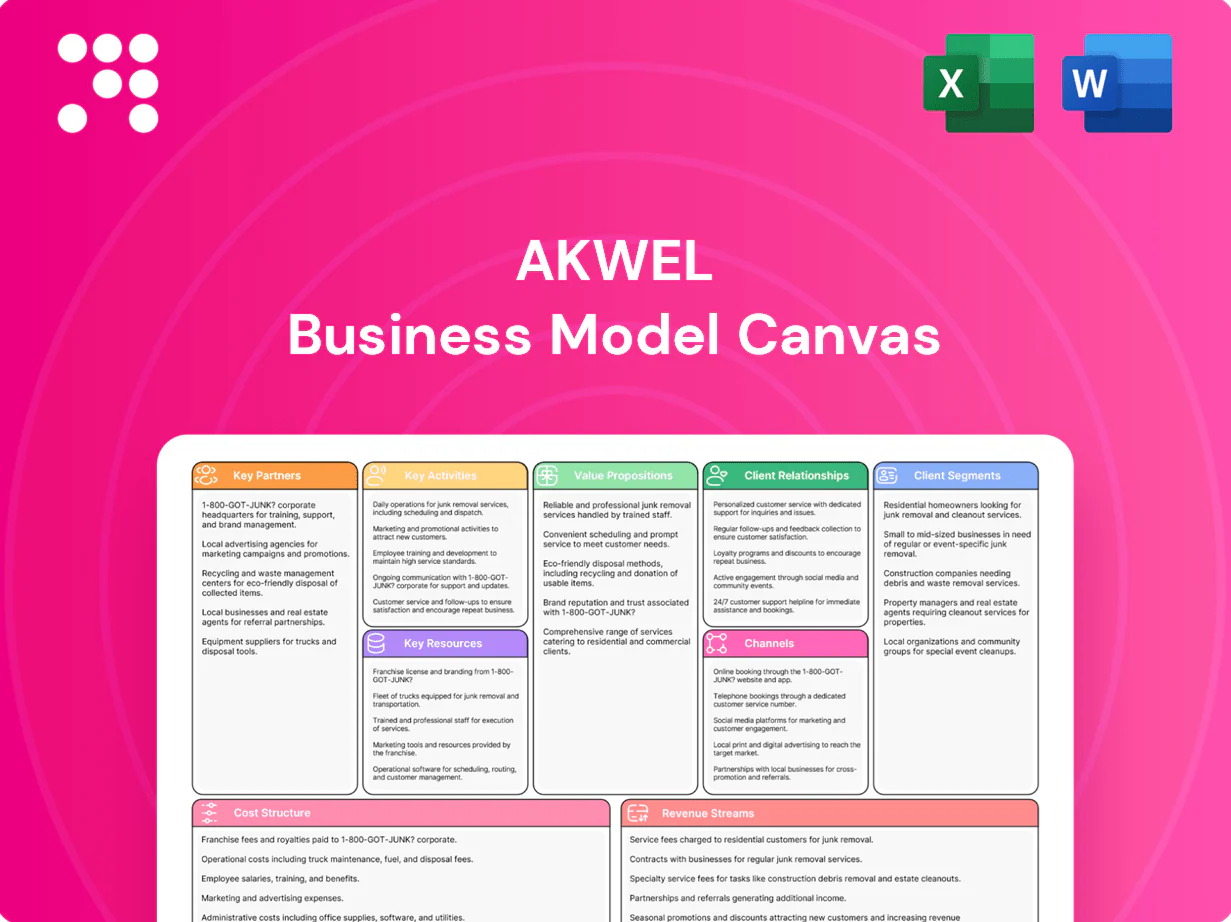
AKWEL Business Model Canvas

Explore the Automotive Supplier Business Model Canvas: Fluid Management & Mechatronics
Dive into AKWEL’s Business Model Canvas to uncover how the automotive supplier creates and captures value through innovative fluid management and mechatronic solutions. This concise analysis highlights key partners, revenue streams, and scaling levers. Purchase the full, editable Canvas for detailed, actionable insights and ready-to-use templates.
Partnerships

Global OEM co-development alliances
Joint engineering with major automakers aligns component specifications with vehicle platforms early, enabling AKWEL to shorten validation cycles and de-risk launches. Strategic OEM nominations routinely convert into multi-year serial production awards, securing program continuity. Collaboration covers ICE, hybrid, and EV programs across AKWELs global footprint.
Advanced material and component suppliers
Partnerships with polymer, elastomer and metal suppliers secure consistent quality and cost through joint specifications and supplier audits, while co-innovation on lightweight and heat‑resistant materials enhances component performance and fuel efficiency. Long-term supplier contracts stabilize pricing and availability and reduce supply-chain volatility. Compliance with REACH (in force since 2007) and regional regulations is contractually enforced.

Tooling, automation, and equipment vendors
Close ties with mold makers, extrusion-die specialists and robotic integrators shorten industrialization and enable rapid tooling changes across platforms; early DFM/DFA inputs typically cut scrap by up to 30% and cycle time by 15–25%. Predictive maintenance and targeted automation upgrades can reduce unplanned downtime by as much as 50%, preserving OEE and supporting scalable, high-mix production in 2024 supply chains.

Research institutes and universities
External R&D partners extend AKWEL capabilities in mechatronics, thermal modeling and recyclability; joint labs accelerate prototyping and IP generation, leveraging Horizon Europe funding (€95.5bn 2021-27) and consortium grants to reduce development cost. Talent pipelines from partner universities supply engineers to meet future skills needs.
- Horizon Europe €95.5bn: grant access
- Joint labs: faster prototypes/IP
- Consortiums: lower dev cost
- University talent: engineering pipeline
Logistics and tier integration partners
3PLs and sequencing partners secure JIT/JIS deliveries near OEM plants, leveraging a global 3PL market valued at over $1 trillion in 2024 to scale capacity; module integrator collaboration aligns interface specs and packaging to cut assembly rework. Regional hubs shorten lead times and lower freight risk, while digital tracking increases end-to-end visibility for suppliers and OEMs.
- 3PL scale: >$1T (2024)
- JIT/JIS proximity to OEMs
- Module integrator spec alignment
- Regional hubs: lower lead time & freight risk
- Digital tracking: improved visibility
Joint engineering reduces scrap 30% and downtime 50%, unlocking a >$1T 3PL market
Joint engineering with OEMs secures multi‑year serial awards, shortening validations and de‑risking launches. Supplier partnerships lock material specs and long‑term contracts; co‑innovation improves lightweighting and compliance. Tooling, automation and 3PL ties cut scrap up to 30%, unplanned downtime up to 50% and leverage a >$1T 3PL market (2024).
| Partner | Benefit | KPI/fact |
|---|---|---|
| OEMs | Program continuity | Multi‑year awards |
| Suppliers | Material cost/quality | REACH compliance |
| 3PLs | Logistics scale | >$1T market (2024) |
What is included in the product
 Detailed Word Document
A comprehensive Business Model Canvas for AKWEL outlining customer segments, channels, value propositions, key activities, resources, partners, cost structure and revenue streams across the 9 BMC blocks. Designed for presentations and investor discussions, it includes SWOT-linked insights and competitive advantages to support strategic decisions and validation using real company data.

 Customizable Excel Spreadsheet
Condenses AKWEL’s automotive components strategy into a digestible one-page canvas with editable cells—quickly identify pain points, align supplier and R&D priorities, and save hours on structuring strategic reviews for fast team collaboration.
Activities

Design, simulation, and prototyping
Modeling of fluid and thermal behavior optimizes system efficiency via CFD-driven design, reducing dependence on costly physical tests. Rapid prototyping validates fit, function and durability, shortening validation cycles and informing iterations. DFMEA and structured risk reviews prevent late-stage rework; iterations feed into PPAP deliverables, which comprise 18 elements for production approval.
Industrialization and process engineering
Industrialization scales prototypes to serial production with engineered repeatability, tuning injection molding, extrusion, metal forming and assembly lines to takt time to sustain output and reduce variation. Automation and poka-yoke lower defects—field results commonly show defect reductions of 30–50% and first-pass yield gains of 10–25%. Tooling life and changeover agility are monitored to minimize downtime and capex per part.

Quality assurance and validation testing
Leak, vibration, thermal shock and endurance tests certify component reliability, feeding data into FMEA and 8D root-cause analyses to drive continuous improvement. Quality governance follows APQPs five phases, PPAPs 18 submission elements and IATF 16949:2016 requirements. Lot-level traceability and document retention ensure audit readiness and compliance.

Supply chain and program management
End-to-end planning at AKWEL synchronizes raw materials, WIP and deliveries to optimize flow and shorten lead times; cross-functional program teams control timing, cost and scope across programs, while EDI links streamline RFQs, forecasts and call-offs. Risk management in 2024 emphasizes dual sourcing and mitigation of geo-disruptions.
- End-to-end synchronization
- Cross-functional program teams
- EDI for RFQs/forecasts/call-offs
- Dual sourcing & geo-risk mitigation (2024 focus)
Sustainability and compliance initiatives
Sustainability and compliance initiatives focus on material substitution and increased recycled content to reduce product footprint, while energy-efficiency and waste-reduction programs lower manufacturing costs and emissions. Compliance with ELV, RoHS and regional standards is continuously maintained through updated certifications and supplier audits. LCA reporting is delivered to OEMs to support their ESG disclosure and design-for-recycling targets.
- Material substitution: recycled polymers and aluminum
- Energy/waste: continuous improvement projects
- Regulatory: ELV, RoHS, regional compliance
- LCA: OEM ESG reporting support
CFD-led design, DFMEA/PPAP enable 30–50% defect cuts and 10–25% FPY gains
CFD-led design and rapid prototyping shorten validation cycles; DFMEA and PPAP (18 elements) ensure production readiness. Industrialization and automation cut defects 30–50% and raise first-pass yield 10–25% while tooling life and changeover agility reduce downtime. Quality follows APQP/IATF 16949 and 2024 focus on dual sourcing and supplier audits.
| Metric | Value |
|---|---|
| Defect reduction | 30–50% |
| FPY gain | 10–25% |
Preview Before You Purchase
Business Model Canvas
The AKWEL Business Model Canvas you’re previewing is the actual deliverable—not a mockup—and contains the same structured content you’ll receive after purchase. Upon completing your order you’ll get the full file in editable formats (Word and Excel), formatted exactly as shown. No placeholders, no surprises—ready to edit, present, or share for strategic planning and analysis.

Explore the Automotive Supplier Business Model Canvas: Fluid Management & Mechatronics
Dive into AKWEL’s Business Model Canvas to uncover how the automotive supplier creates and captures value through innovative fluid management and mechatronic solutions. This concise analysis highlights key partners, revenue streams, and scaling levers. Purchase the full, editable Canvas for detailed, actionable insights and ready-to-use templates.
Partnerships
Global OEM co-development alliances
Joint engineering with major automakers aligns component specifications with vehicle platforms early, enabling AKWEL to shorten validation cycles and de-risk launches. Strategic OEM nominations routinely convert into multi-year serial production awards, securing program continuity. Collaboration covers ICE, hybrid, and EV programs across AKWELs global footprint.
Advanced material and component suppliers
Partnerships with polymer, elastomer and metal suppliers secure consistent quality and cost through joint specifications and supplier audits, while co-innovation on lightweight and heat‑resistant materials enhances component performance and fuel efficiency. Long-term supplier contracts stabilize pricing and availability and reduce supply-chain volatility. Compliance with REACH (in force since 2007) and regional regulations is contractually enforced.
Tooling, automation, and equipment vendors
Close ties with mold makers, extrusion-die specialists and robotic integrators shorten industrialization and enable rapid tooling changes across platforms; early DFM/DFA inputs typically cut scrap by up to 30% and cycle time by 15–25%. Predictive maintenance and targeted automation upgrades can reduce unplanned downtime by as much as 50%, preserving OEE and supporting scalable, high-mix production in 2024 supply chains.
Research institutes and universities
External R&D partners extend AKWEL capabilities in mechatronics, thermal modeling and recyclability; joint labs accelerate prototyping and IP generation, leveraging Horizon Europe funding (€95.5bn 2021-27) and consortium grants to reduce development cost. Talent pipelines from partner universities supply engineers to meet future skills needs.
- Horizon Europe €95.5bn: grant access
- Joint labs: faster prototypes/IP
- Consortiums: lower dev cost
- University talent: engineering pipeline
Logistics and tier integration partners
3PLs and sequencing partners secure JIT/JIS deliveries near OEM plants, leveraging a global 3PL market valued at over $1 trillion in 2024 to scale capacity; module integrator collaboration aligns interface specs and packaging to cut assembly rework. Regional hubs shorten lead times and lower freight risk, while digital tracking increases end-to-end visibility for suppliers and OEMs.
- 3PL scale: >$1T (2024)
- JIT/JIS proximity to OEMs
- Module integrator spec alignment
- Regional hubs: lower lead time & freight risk
- Digital tracking: improved visibility
Joint engineering reduces scrap 30% and downtime 50%, unlocking a >$1T 3PL market
Joint engineering with OEMs secures multi‑year serial awards, shortening validations and de‑risking launches. Supplier partnerships lock material specs and long‑term contracts; co‑innovation improves lightweighting and compliance. Tooling, automation and 3PL ties cut scrap up to 30%, unplanned downtime up to 50% and leverage a >$1T 3PL market (2024).
| Partner | Benefit | KPI/fact |
|---|---|---|
| OEMs | Program continuity | Multi‑year awards |
| Suppliers | Material cost/quality | REACH compliance |
| 3PLs | Logistics scale | >$1T market (2024) |
What is included in the product
Detailed Word Document
A comprehensive Business Model Canvas for AKWEL outlining customer segments, channels, value propositions, key activities, resources, partners, cost structure and revenue streams across the 9 BMC blocks. Designed for presentations and investor discussions, it includes SWOT-linked insights and competitive advantages to support strategic decisions and validation using real company data.
Customizable Excel Spreadsheet
Condenses AKWEL’s automotive components strategy into a digestible one-page canvas with editable cells—quickly identify pain points, align supplier and R&D priorities, and save hours on structuring strategic reviews for fast team collaboration.
Activities
Design, simulation, and prototyping
Modeling of fluid and thermal behavior optimizes system efficiency via CFD-driven design, reducing dependence on costly physical tests. Rapid prototyping validates fit, function and durability, shortening validation cycles and informing iterations. DFMEA and structured risk reviews prevent late-stage rework; iterations feed into PPAP deliverables, which comprise 18 elements for production approval.
Industrialization and process engineering
Industrialization scales prototypes to serial production with engineered repeatability, tuning injection molding, extrusion, metal forming and assembly lines to takt time to sustain output and reduce variation. Automation and poka-yoke lower defects—field results commonly show defect reductions of 30–50% and first-pass yield gains of 10–25%. Tooling life and changeover agility are monitored to minimize downtime and capex per part.
Quality assurance and validation testing
Leak, vibration, thermal shock and endurance tests certify component reliability, feeding data into FMEA and 8D root-cause analyses to drive continuous improvement. Quality governance follows APQPs five phases, PPAPs 18 submission elements and IATF 16949:2016 requirements. Lot-level traceability and document retention ensure audit readiness and compliance.
Supply chain and program management
End-to-end planning at AKWEL synchronizes raw materials, WIP and deliveries to optimize flow and shorten lead times; cross-functional program teams control timing, cost and scope across programs, while EDI links streamline RFQs, forecasts and call-offs. Risk management in 2024 emphasizes dual sourcing and mitigation of geo-disruptions.
- End-to-end synchronization
- Cross-functional program teams
- EDI for RFQs/forecasts/call-offs
- Dual sourcing & geo-risk mitigation (2024 focus)
Sustainability and compliance initiatives
Sustainability and compliance initiatives focus on material substitution and increased recycled content to reduce product footprint, while energy-efficiency and waste-reduction programs lower manufacturing costs and emissions. Compliance with ELV, RoHS and regional standards is continuously maintained through updated certifications and supplier audits. LCA reporting is delivered to OEMs to support their ESG disclosure and design-for-recycling targets.
- Material substitution: recycled polymers and aluminum
- Energy/waste: continuous improvement projects
- Regulatory: ELV, RoHS, regional compliance
- LCA: OEM ESG reporting support
CFD-led design, DFMEA/PPAP enable 30–50% defect cuts and 10–25% FPY gains
CFD-led design and rapid prototyping shorten validation cycles; DFMEA and PPAP (18 elements) ensure production readiness. Industrialization and automation cut defects 30–50% and raise first-pass yield 10–25% while tooling life and changeover agility reduce downtime. Quality follows APQP/IATF 16949 and 2024 focus on dual sourcing and supplier audits.
| Metric | Value |
|---|---|
| Defect reduction | 30–50% |
| FPY gain | 10–25% |
Preview Before You Purchase
Business Model Canvas
The AKWEL Business Model Canvas you’re previewing is the actual deliverable—not a mockup—and contains the same structured content you’ll receive after purchase. Upon completing your order you’ll get the full file in editable formats (Word and Excel), formatted exactly as shown. No placeholders, no surprises—ready to edit, present, or share for strategic planning and analysis.
Original: $10.00
-65%$10.00
$3.50Description
Explore the Automotive Supplier Business Model Canvas: Fluid Management & Mechatronics
Dive into AKWEL’s Business Model Canvas to uncover how the automotive supplier creates and captures value through innovative fluid management and mechatronic solutions. This concise analysis highlights key partners, revenue streams, and scaling levers. Purchase the full, editable Canvas for detailed, actionable insights and ready-to-use templates.
Partnerships
Global OEM co-development alliances
Joint engineering with major automakers aligns component specifications with vehicle platforms early, enabling AKWEL to shorten validation cycles and de-risk launches. Strategic OEM nominations routinely convert into multi-year serial production awards, securing program continuity. Collaboration covers ICE, hybrid, and EV programs across AKWELs global footprint.
Advanced material and component suppliers
Partnerships with polymer, elastomer and metal suppliers secure consistent quality and cost through joint specifications and supplier audits, while co-innovation on lightweight and heat‑resistant materials enhances component performance and fuel efficiency. Long-term supplier contracts stabilize pricing and availability and reduce supply-chain volatility. Compliance with REACH (in force since 2007) and regional regulations is contractually enforced.
Tooling, automation, and equipment vendors
Close ties with mold makers, extrusion-die specialists and robotic integrators shorten industrialization and enable rapid tooling changes across platforms; early DFM/DFA inputs typically cut scrap by up to 30% and cycle time by 15–25%. Predictive maintenance and targeted automation upgrades can reduce unplanned downtime by as much as 50%, preserving OEE and supporting scalable, high-mix production in 2024 supply chains.
Research institutes and universities
External R&D partners extend AKWEL capabilities in mechatronics, thermal modeling and recyclability; joint labs accelerate prototyping and IP generation, leveraging Horizon Europe funding (€95.5bn 2021-27) and consortium grants to reduce development cost. Talent pipelines from partner universities supply engineers to meet future skills needs.
- Horizon Europe €95.5bn: grant access
- Joint labs: faster prototypes/IP
- Consortiums: lower dev cost
- University talent: engineering pipeline
Logistics and tier integration partners
3PLs and sequencing partners secure JIT/JIS deliveries near OEM plants, leveraging a global 3PL market valued at over $1 trillion in 2024 to scale capacity; module integrator collaboration aligns interface specs and packaging to cut assembly rework. Regional hubs shorten lead times and lower freight risk, while digital tracking increases end-to-end visibility for suppliers and OEMs.
- 3PL scale: >$1T (2024)
- JIT/JIS proximity to OEMs
- Module integrator spec alignment
- Regional hubs: lower lead time & freight risk
- Digital tracking: improved visibility
Joint engineering reduces scrap 30% and downtime 50%, unlocking a >$1T 3PL market
Joint engineering with OEMs secures multi‑year serial awards, shortening validations and de‑risking launches. Supplier partnerships lock material specs and long‑term contracts; co‑innovation improves lightweighting and compliance. Tooling, automation and 3PL ties cut scrap up to 30%, unplanned downtime up to 50% and leverage a >$1T 3PL market (2024).
| Partner | Benefit | KPI/fact |
|---|---|---|
| OEMs | Program continuity | Multi‑year awards |
| Suppliers | Material cost/quality | REACH compliance |
| 3PLs | Logistics scale | >$1T market (2024) |
What is included in the product
Detailed Word Document
A comprehensive Business Model Canvas for AKWEL outlining customer segments, channels, value propositions, key activities, resources, partners, cost structure and revenue streams across the 9 BMC blocks. Designed for presentations and investor discussions, it includes SWOT-linked insights and competitive advantages to support strategic decisions and validation using real company data.
Customizable Excel Spreadsheet
Condenses AKWEL’s automotive components strategy into a digestible one-page canvas with editable cells—quickly identify pain points, align supplier and R&D priorities, and save hours on structuring strategic reviews for fast team collaboration.
Activities
Design, simulation, and prototyping
Modeling of fluid and thermal behavior optimizes system efficiency via CFD-driven design, reducing dependence on costly physical tests. Rapid prototyping validates fit, function and durability, shortening validation cycles and informing iterations. DFMEA and structured risk reviews prevent late-stage rework; iterations feed into PPAP deliverables, which comprise 18 elements for production approval.
Industrialization and process engineering
Industrialization scales prototypes to serial production with engineered repeatability, tuning injection molding, extrusion, metal forming and assembly lines to takt time to sustain output and reduce variation. Automation and poka-yoke lower defects—field results commonly show defect reductions of 30–50% and first-pass yield gains of 10–25%. Tooling life and changeover agility are monitored to minimize downtime and capex per part.
Quality assurance and validation testing
Leak, vibration, thermal shock and endurance tests certify component reliability, feeding data into FMEA and 8D root-cause analyses to drive continuous improvement. Quality governance follows APQPs five phases, PPAPs 18 submission elements and IATF 16949:2016 requirements. Lot-level traceability and document retention ensure audit readiness and compliance.
Supply chain and program management
End-to-end planning at AKWEL synchronizes raw materials, WIP and deliveries to optimize flow and shorten lead times; cross-functional program teams control timing, cost and scope across programs, while EDI links streamline RFQs, forecasts and call-offs. Risk management in 2024 emphasizes dual sourcing and mitigation of geo-disruptions.
- End-to-end synchronization
- Cross-functional program teams
- EDI for RFQs/forecasts/call-offs
- Dual sourcing & geo-risk mitigation (2024 focus)
Sustainability and compliance initiatives
Sustainability and compliance initiatives focus on material substitution and increased recycled content to reduce product footprint, while energy-efficiency and waste-reduction programs lower manufacturing costs and emissions. Compliance with ELV, RoHS and regional standards is continuously maintained through updated certifications and supplier audits. LCA reporting is delivered to OEMs to support their ESG disclosure and design-for-recycling targets.
- Material substitution: recycled polymers and aluminum
- Energy/waste: continuous improvement projects
- Regulatory: ELV, RoHS, regional compliance
- LCA: OEM ESG reporting support
CFD-led design, DFMEA/PPAP enable 30–50% defect cuts and 10–25% FPY gains
CFD-led design and rapid prototyping shorten validation cycles; DFMEA and PPAP (18 elements) ensure production readiness. Industrialization and automation cut defects 30–50% and raise first-pass yield 10–25% while tooling life and changeover agility reduce downtime. Quality follows APQP/IATF 16949 and 2024 focus on dual sourcing and supplier audits.
| Metric | Value |
|---|---|
| Defect reduction | 30–50% |
| FPY gain | 10–25% |
Preview Before You Purchase
Business Model Canvas
The AKWEL Business Model Canvas you’re previewing is the actual deliverable—not a mockup—and contains the same structured content you’ll receive after purchase. Upon completing your order you’ll get the full file in editable formats (Word and Excel), formatted exactly as shown. No placeholders, no surprises—ready to edit, present, or share for strategic planning and analysis.











