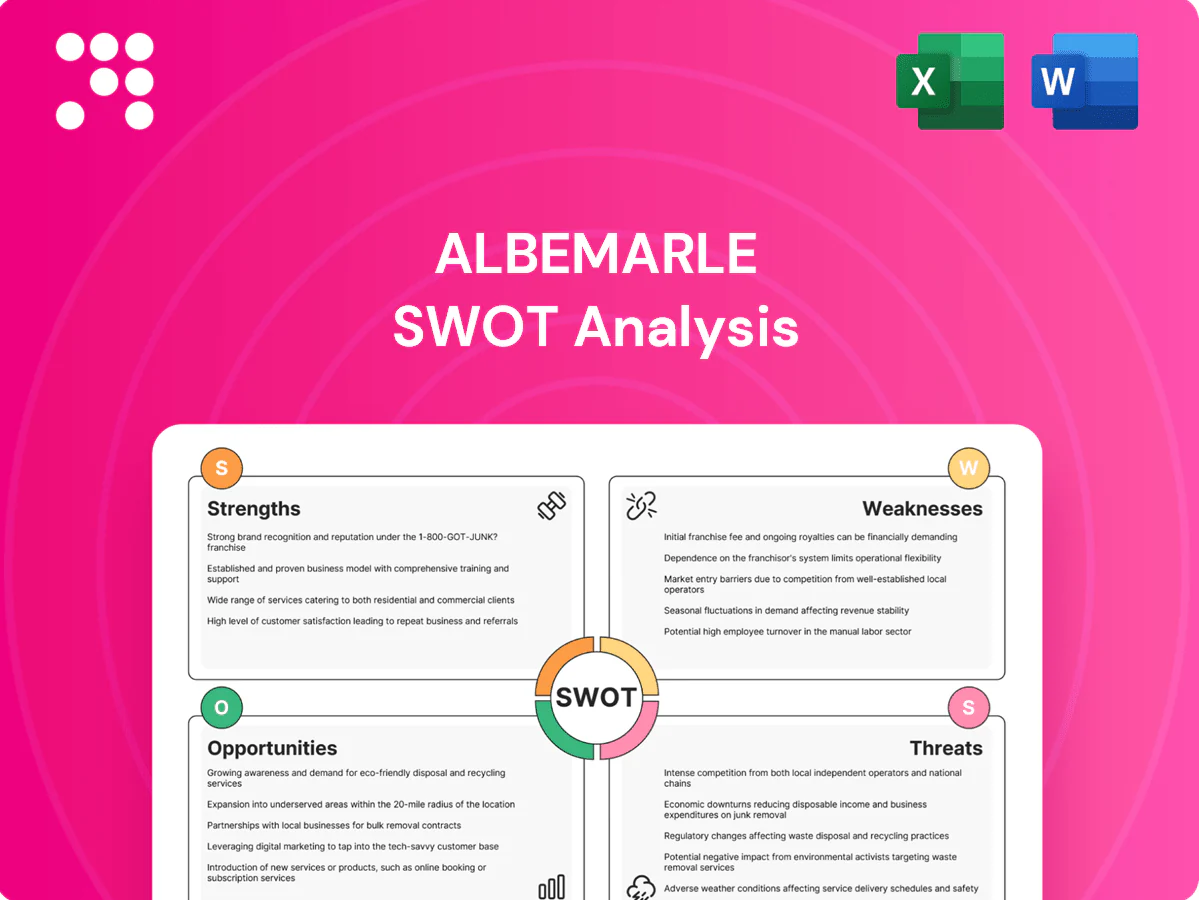
Albemarle SWOT Analysis

Dive Deeper Into the Company’s Strategic Blueprint
Albemarle’s dominant lithium position and integrated supply chain drive strong growth potential, but exposure to commodity cycles, geopolitical risks, and regulatory shifts could pressure margins. Our full SWOT digs into financial implications, competitive moves, and strategic levers. Purchase the complete, editable SWOT (Word + Excel) to plan, pitch, or invest with confidence.
Strengths

Global lithium leadership
Albemarle is among the world’s largest lithium producers, controlling roughly 20% of global lithium production capacity, which underpins cost efficiencies and stronger negotiating power with OEMs and cell makers. That scale helps secure prime resource access and accelerate customer qualifications. It also enables faster ramp-up of new conversion capacity to meet EV and energy storage demand.
Diverse portfolio in bromine and catalysts
Exposure to bromine and catalysts gives Albemarle revenue diversity beyond lithium cycles, with bromine products used in fire safety and electronics providing steady, non-lithium demand; catalysts underpin refining and renewable-fuel conversion, supporting downstream margins. This product mix helps smooth earnings through commodity volatility and cyclicality across energy and electronics markets.

Vertical integration and advanced processing
Vertical integration spans resource extraction, conversion and specialty materials, giving Albemarle end-to-end control that supports quality, cost management and supply reliability; its process know-how in lithium hydroxide and carbonate underpins product differentiation and helps secure long-term offtake with strategic customers, supporting Albemarle’s position as a top-3 global lithium producer in 2024.

Strong customer relationships and qualifications
Albemarle’s long-standing technical support and proven qualification track record with automotive and battery customers creates substantial switching costs across lengthy qualification cycles, supporting stable multi-year offtake arrangements and enhanced volume visibility. Close collaboration with OEMs and battery makers accelerates next-generation chemistries and tightens performance specifications, reinforcing customer lock-in and margin resilience.
- Lengthy qualification cycles → high switching costs
- Multi-year offtakes → volume visibility
- Technical support → stronger customer ties
- Collaborations → faster chemistry R&D
Global footprint and resource access
Albemarle’s operations and JVs across the Americas, Asia‑Pacific and EMEA reduce supply concentration and support local‑for‑local sourcing; 2024 revenue totaled about $8.7 billion, reflecting diversified end markets. Ownership of both brine and hard‑rock assets boosts feedstock flexibility and production resilience. The geographic spread improves responsiveness to trade friction, regulatory shifts and logistics disruptions.
- Global footprint: Americas, APAC, EMEA
- Resource mix: brine + hard rock
- 2024 revenue: ~$8.7B
- Enables local‑for‑local and regulatory agility
~20% global lithium capacity, top-3 scale with vertical integration and diversified chemicals reach
Albemarle holds roughly 20% of global lithium production capacity and was a top‑3 lithium producer in 2024, underpinning scale advantages and OEM negotiating power. Vertical integration across extraction, conversion and specialty chemicals supports cost control and supply reliability. Diversified revenue from bromine and catalysts plus global operations (Americas, APAC, EMEA) smooth cyclicality and enable local‑for‑local supply.
| Metric | Value |
|---|---|
| Global lithium capacity share | ~20% |
| 2024 revenue | ~$8.7B |
| Geographic footprint | Americas / APAC / EMEA |
What is included in the product
 Detailed Word Document
Provides a clear SWOT framework for analyzing Albemarle’s strategic strengths, operational weaknesses, market opportunities, and external threats, highlighting key growth drivers and risks that shape its competitive position and future outlook.

 Customizable Excel Spreadsheet
Provides a concise Albemarle-focused SWOT matrix for fast, visual strategy alignment across lithium and specialty chemicals businesses.
Weaknesses

High exposure to lithium price volatility
Albemarle's revenues and margins move closely with lithium carbonate and hydroxide prices, which fell roughly 70–80% from 2022 peaks into 2023–mid‑2024, amplifying earnings volatility. Sharp down-cycles compress cash flow and forced delays in some project investments. Hedging depth and duration for lithium are limited, making forecasting and capital planning especially challenging.
Capital intensity and project execution risk
Albemarle's new mines and conversion plants require multi-billion-dollar upfront investment, exposing returns to delays, cost overruns and ramp-up shortfalls. Complex permitting and supply-chain constraints, especially for specialty chemicals and battery raw materials, add execution uncertainty and can extend timelines. During the post-2022 lithium price downturn, stretched payback horizons further erode project IRRs.

ESG and water-intensive operations
Brine extraction at Salar de Atacama and water-intensive chemical processing expose Albemarle to heightened ESG scrutiny, with Chilean and local communities intensifying oversight in 2024–25. Community and regulatory pressures have already constrained permits and ramp timing, raising monitoring and compliance costs. Any water-related incident could materially damage brand reputation and jeopardize operating licenses.

Geographic and regulatory concentration
Legacy exposure to refining catalysts cycles
- Refining demand sensitivity
- Electrification caps growth
- Customer consolidation → margin pressure
- Continuous R&D/capex needs
Lithium slump squeezes cashflow; multi-billion capex, permitting and ESG risks loom
Albemarle faces earnings volatility after lithium carbonate/hydroxide prices fell ~70–80% from 2022 peaks into 2023–mid‑2024, compressing cash flow and delaying projects. Multi‑billion dollar project capex and permitting/supply‑chain risks raise execution and IRR uncertainty. Geographic concentration (>60% 2024 lithium volumes from Chile/Australia) and water/ESG scrutiny amplify policy and reputational risks.
| Metric | Value |
|---|---|
| Lithium price drop | ~70–80% |
| Chile/Australia share | >60% (2024) |
Same Document Delivered
Albemarle SWOT Analysis
This is the actual Albemarle SWOT analysis document you’ll receive upon purchase—no surprises, just professional quality. The preview below is taken directly from the full report you'll get. Once purchased, the complete, editable version is unlocked. Buy now to access the full, detailed file.

Dive Deeper Into the Company’s Strategic Blueprint
Albemarle’s dominant lithium position and integrated supply chain drive strong growth potential, but exposure to commodity cycles, geopolitical risks, and regulatory shifts could pressure margins. Our full SWOT digs into financial implications, competitive moves, and strategic levers. Purchase the complete, editable SWOT (Word + Excel) to plan, pitch, or invest with confidence.
Strengths
Global lithium leadership
Albemarle is among the world’s largest lithium producers, controlling roughly 20% of global lithium production capacity, which underpins cost efficiencies and stronger negotiating power with OEMs and cell makers. That scale helps secure prime resource access and accelerate customer qualifications. It also enables faster ramp-up of new conversion capacity to meet EV and energy storage demand.
Diverse portfolio in bromine and catalysts
Exposure to bromine and catalysts gives Albemarle revenue diversity beyond lithium cycles, with bromine products used in fire safety and electronics providing steady, non-lithium demand; catalysts underpin refining and renewable-fuel conversion, supporting downstream margins. This product mix helps smooth earnings through commodity volatility and cyclicality across energy and electronics markets.
Vertical integration and advanced processing
Vertical integration spans resource extraction, conversion and specialty materials, giving Albemarle end-to-end control that supports quality, cost management and supply reliability; its process know-how in lithium hydroxide and carbonate underpins product differentiation and helps secure long-term offtake with strategic customers, supporting Albemarle’s position as a top-3 global lithium producer in 2024.
Strong customer relationships and qualifications
Albemarle’s long-standing technical support and proven qualification track record with automotive and battery customers creates substantial switching costs across lengthy qualification cycles, supporting stable multi-year offtake arrangements and enhanced volume visibility. Close collaboration with OEMs and battery makers accelerates next-generation chemistries and tightens performance specifications, reinforcing customer lock-in and margin resilience.
- Lengthy qualification cycles → high switching costs
- Multi-year offtakes → volume visibility
- Technical support → stronger customer ties
- Collaborations → faster chemistry R&D
Global footprint and resource access
Albemarle’s operations and JVs across the Americas, Asia‑Pacific and EMEA reduce supply concentration and support local‑for‑local sourcing; 2024 revenue totaled about $8.7 billion, reflecting diversified end markets. Ownership of both brine and hard‑rock assets boosts feedstock flexibility and production resilience. The geographic spread improves responsiveness to trade friction, regulatory shifts and logistics disruptions.
- Global footprint: Americas, APAC, EMEA
- Resource mix: brine + hard rock
- 2024 revenue: ~$8.7B
- Enables local‑for‑local and regulatory agility
~20% global lithium capacity, top-3 scale with vertical integration and diversified chemicals reach
Albemarle holds roughly 20% of global lithium production capacity and was a top‑3 lithium producer in 2024, underpinning scale advantages and OEM negotiating power. Vertical integration across extraction, conversion and specialty chemicals supports cost control and supply reliability. Diversified revenue from bromine and catalysts plus global operations (Americas, APAC, EMEA) smooth cyclicality and enable local‑for‑local supply.
| Metric | Value |
|---|---|
| Global lithium capacity share | ~20% |
| 2024 revenue | ~$8.7B |
| Geographic footprint | Americas / APAC / EMEA |
What is included in the product
Detailed Word Document
Provides a clear SWOT framework for analyzing Albemarle’s strategic strengths, operational weaknesses, market opportunities, and external threats, highlighting key growth drivers and risks that shape its competitive position and future outlook.
Customizable Excel Spreadsheet
Provides a concise Albemarle-focused SWOT matrix for fast, visual strategy alignment across lithium and specialty chemicals businesses.
Weaknesses
High exposure to lithium price volatility
Albemarle's revenues and margins move closely with lithium carbonate and hydroxide prices, which fell roughly 70–80% from 2022 peaks into 2023–mid‑2024, amplifying earnings volatility. Sharp down-cycles compress cash flow and forced delays in some project investments. Hedging depth and duration for lithium are limited, making forecasting and capital planning especially challenging.
Capital intensity and project execution risk
Albemarle's new mines and conversion plants require multi-billion-dollar upfront investment, exposing returns to delays, cost overruns and ramp-up shortfalls. Complex permitting and supply-chain constraints, especially for specialty chemicals and battery raw materials, add execution uncertainty and can extend timelines. During the post-2022 lithium price downturn, stretched payback horizons further erode project IRRs.
ESG and water-intensive operations
Brine extraction at Salar de Atacama and water-intensive chemical processing expose Albemarle to heightened ESG scrutiny, with Chilean and local communities intensifying oversight in 2024–25. Community and regulatory pressures have already constrained permits and ramp timing, raising monitoring and compliance costs. Any water-related incident could materially damage brand reputation and jeopardize operating licenses.
Geographic and regulatory concentration
Legacy exposure to refining catalysts cycles
- Refining demand sensitivity
- Electrification caps growth
- Customer consolidation → margin pressure
- Continuous R&D/capex needs
Lithium slump squeezes cashflow; multi-billion capex, permitting and ESG risks loom
Albemarle faces earnings volatility after lithium carbonate/hydroxide prices fell ~70–80% from 2022 peaks into 2023–mid‑2024, compressing cash flow and delaying projects. Multi‑billion dollar project capex and permitting/supply‑chain risks raise execution and IRR uncertainty. Geographic concentration (>60% 2024 lithium volumes from Chile/Australia) and water/ESG scrutiny amplify policy and reputational risks.
| Metric | Value |
|---|---|
| Lithium price drop | ~70–80% |
| Chile/Australia share | >60% (2024) |
Same Document Delivered
Albemarle SWOT Analysis
This is the actual Albemarle SWOT analysis document you’ll receive upon purchase—no surprises, just professional quality. The preview below is taken directly from the full report you'll get. Once purchased, the complete, editable version is unlocked. Buy now to access the full, detailed file.
Original: $10.00
-65%$10.00
$3.50Description
Dive Deeper Into the Company’s Strategic Blueprint
Albemarle’s dominant lithium position and integrated supply chain drive strong growth potential, but exposure to commodity cycles, geopolitical risks, and regulatory shifts could pressure margins. Our full SWOT digs into financial implications, competitive moves, and strategic levers. Purchase the complete, editable SWOT (Word + Excel) to plan, pitch, or invest with confidence.
Strengths
Global lithium leadership
Albemarle is among the world’s largest lithium producers, controlling roughly 20% of global lithium production capacity, which underpins cost efficiencies and stronger negotiating power with OEMs and cell makers. That scale helps secure prime resource access and accelerate customer qualifications. It also enables faster ramp-up of new conversion capacity to meet EV and energy storage demand.
Diverse portfolio in bromine and catalysts
Exposure to bromine and catalysts gives Albemarle revenue diversity beyond lithium cycles, with bromine products used in fire safety and electronics providing steady, non-lithium demand; catalysts underpin refining and renewable-fuel conversion, supporting downstream margins. This product mix helps smooth earnings through commodity volatility and cyclicality across energy and electronics markets.
Vertical integration and advanced processing
Vertical integration spans resource extraction, conversion and specialty materials, giving Albemarle end-to-end control that supports quality, cost management and supply reliability; its process know-how in lithium hydroxide and carbonate underpins product differentiation and helps secure long-term offtake with strategic customers, supporting Albemarle’s position as a top-3 global lithium producer in 2024.
Strong customer relationships and qualifications
Albemarle’s long-standing technical support and proven qualification track record with automotive and battery customers creates substantial switching costs across lengthy qualification cycles, supporting stable multi-year offtake arrangements and enhanced volume visibility. Close collaboration with OEMs and battery makers accelerates next-generation chemistries and tightens performance specifications, reinforcing customer lock-in and margin resilience.
- Lengthy qualification cycles → high switching costs
- Multi-year offtakes → volume visibility
- Technical support → stronger customer ties
- Collaborations → faster chemistry R&D
Global footprint and resource access
Albemarle’s operations and JVs across the Americas, Asia‑Pacific and EMEA reduce supply concentration and support local‑for‑local sourcing; 2024 revenue totaled about $8.7 billion, reflecting diversified end markets. Ownership of both brine and hard‑rock assets boosts feedstock flexibility and production resilience. The geographic spread improves responsiveness to trade friction, regulatory shifts and logistics disruptions.
- Global footprint: Americas, APAC, EMEA
- Resource mix: brine + hard rock
- 2024 revenue: ~$8.7B
- Enables local‑for‑local and regulatory agility
~20% global lithium capacity, top-3 scale with vertical integration and diversified chemicals reach
Albemarle holds roughly 20% of global lithium production capacity and was a top‑3 lithium producer in 2024, underpinning scale advantages and OEM negotiating power. Vertical integration across extraction, conversion and specialty chemicals supports cost control and supply reliability. Diversified revenue from bromine and catalysts plus global operations (Americas, APAC, EMEA) smooth cyclicality and enable local‑for‑local supply.
| Metric | Value |
|---|---|
| Global lithium capacity share | ~20% |
| 2024 revenue | ~$8.7B |
| Geographic footprint | Americas / APAC / EMEA |
What is included in the product
Detailed Word Document
Provides a clear SWOT framework for analyzing Albemarle’s strategic strengths, operational weaknesses, market opportunities, and external threats, highlighting key growth drivers and risks that shape its competitive position and future outlook.
Customizable Excel Spreadsheet
Provides a concise Albemarle-focused SWOT matrix for fast, visual strategy alignment across lithium and specialty chemicals businesses.
Weaknesses
High exposure to lithium price volatility
Albemarle's revenues and margins move closely with lithium carbonate and hydroxide prices, which fell roughly 70–80% from 2022 peaks into 2023–mid‑2024, amplifying earnings volatility. Sharp down-cycles compress cash flow and forced delays in some project investments. Hedging depth and duration for lithium are limited, making forecasting and capital planning especially challenging.
Capital intensity and project execution risk
Albemarle's new mines and conversion plants require multi-billion-dollar upfront investment, exposing returns to delays, cost overruns and ramp-up shortfalls. Complex permitting and supply-chain constraints, especially for specialty chemicals and battery raw materials, add execution uncertainty and can extend timelines. During the post-2022 lithium price downturn, stretched payback horizons further erode project IRRs.
ESG and water-intensive operations
Brine extraction at Salar de Atacama and water-intensive chemical processing expose Albemarle to heightened ESG scrutiny, with Chilean and local communities intensifying oversight in 2024–25. Community and regulatory pressures have already constrained permits and ramp timing, raising monitoring and compliance costs. Any water-related incident could materially damage brand reputation and jeopardize operating licenses.
Geographic and regulatory concentration
Legacy exposure to refining catalysts cycles
- Refining demand sensitivity
- Electrification caps growth
- Customer consolidation → margin pressure
- Continuous R&D/capex needs
Lithium slump squeezes cashflow; multi-billion capex, permitting and ESG risks loom
Albemarle faces earnings volatility after lithium carbonate/hydroxide prices fell ~70–80% from 2022 peaks into 2023–mid‑2024, compressing cash flow and delaying projects. Multi‑billion dollar project capex and permitting/supply‑chain risks raise execution and IRR uncertainty. Geographic concentration (>60% 2024 lithium volumes from Chile/Australia) and water/ESG scrutiny amplify policy and reputational risks.
| Metric | Value |
|---|---|
| Lithium price drop | ~70–80% |
| Chile/Australia share | >60% (2024) |
Same Document Delivered
Albemarle SWOT Analysis
This is the actual Albemarle SWOT analysis document you’ll receive upon purchase—no surprises, just professional quality. The preview below is taken directly from the full report you'll get. Once purchased, the complete, editable version is unlocked. Buy now to access the full, detailed file.











