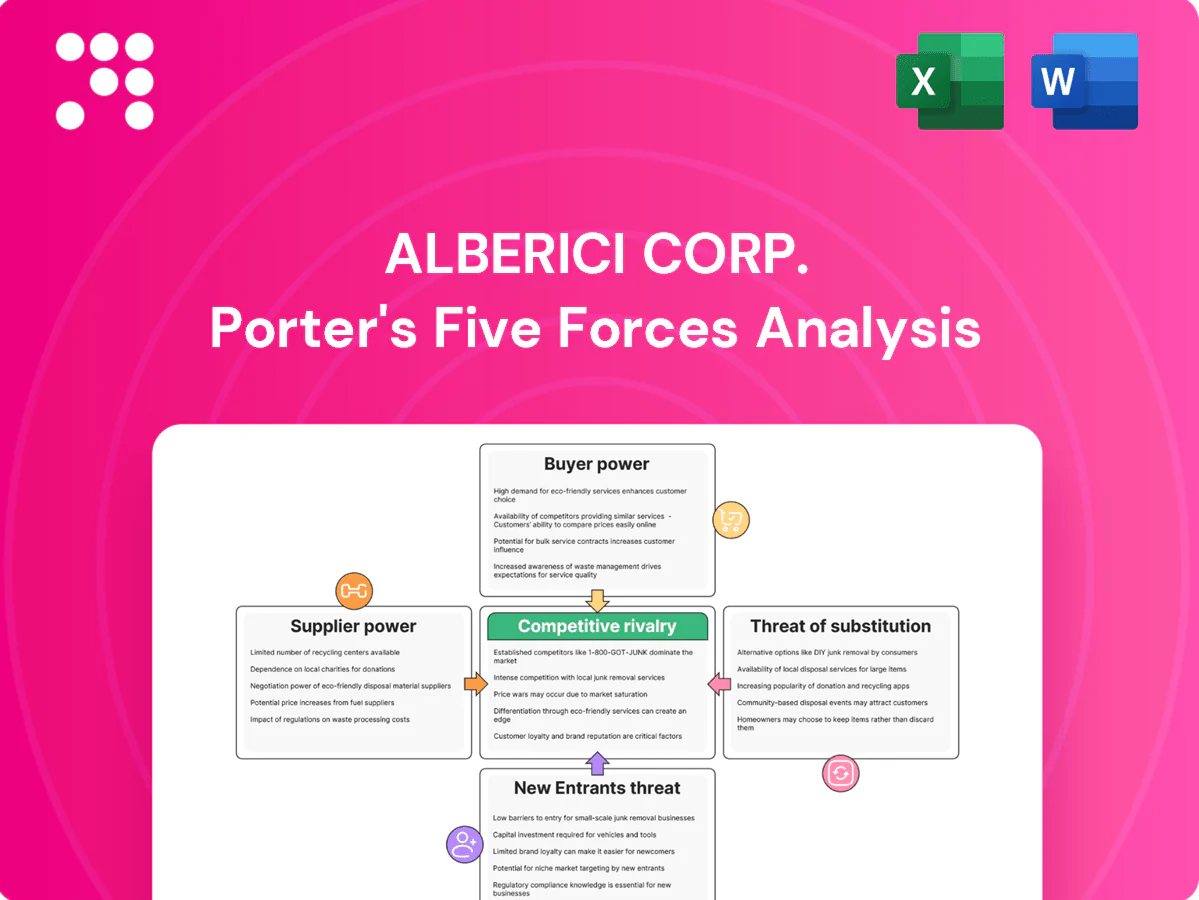
Alberici Corp. Porter's Five Forces Analysis

Go Beyond the Preview—Access the Full Strategic Report
Alberici Corp. faces moderate supplier power and high buyer leverage in project bidding, with entry barriers supported by technical expertise and capital needs; rivalry among regional contractors is intense while substitute threats remain low for specialized infrastructure services. This brief snapshot only scratches the surface. Unlock the full Porter's Five Forces Analysis to explore Alberici Corp.’s competitive dynamics, market pressures, and strategic advantages in detail.
Suppliers Bargaining Power

Self-perform dampens dependence
In 2024 Alberici’s self-perform model reduces reliance on third-party subcontractors and niche trades, curbing supplier leverage on price and schedule. Internal crews, owned equipment and on-site fabrication capacity provide fallback options that strengthen negotiating posture. This structure enables tighter cost and quality control across project phases and mitigates exposure to subcontractor-driven delays and margin pressure.
Commodity and OEM concentration
Steel, cement, aggregates and fuel are global commodities with concentrated supply—top 10 steel producers account for roughly half of global crude steel—producing pronounced price volatility that squeezes Alberici’s margins. Specialty OEMs for turbines, switchgear and large pumps are highly concentrated, with lead times of 12–24 months and tight technical specs that lock vendors early and raise supplier power. Hedging, dual-sourcing and early procurement reduce exposure but do not eliminate supply or price risk.

Prequalification and framework deals
Alberici’s vendor prequalification and long-term framework agreements standardize terms and discounts, concentrating spend and improving margin predictability. Volume bundling across projects strengthens negotiating leverage with suppliers and secures more favorable lead times. Preferred-supplier lists boost schedule reliability and quality control by routing work to proven partners. Performance scorecards enable timely switching away from underperformers to protect project outcomes.

Logistics and capacity constraints
Heavy haul, port access, and just-in-time delivery increase Alberici’s dependence on external logistics providers, making tight capacity for drivers, vessels and railcars a direct supplier pressure that can spike costs and extend schedules. International projects add customs clearance and geopolitical risk, raising the probability of delays and contingency spend in 2024. Early logistics engineering and planning of alternative routes mitigate bottlenecks and preserve project timelines.
- Dependence: heavy haul, JIT, port access
- Capacity squeeze: drivers, vessels, railcars
- International risk: customs, geopolitics
- Mitigation: early logistics engineering, alternative routes
Skilled labor and union dynamics
Skilled labor and union dynamics raise supplier power for Alberici as regional craft shortages and union agreements drive up costs and reduce schedule flexibility; an AGC survey found 77% of contractors had trouble finding qualified craft workers (2023) while US union membership was 10.1% in 2024 (BLS). Self-perform mitigates but does not remove wage and overtime pressure; training pipelines and multi-region mobility lower exposure.
- Trade labor availability: 77% difficulty finding craft workers (AGC 2023)
- Union backdrop: 10.1% US membership (BLS 2024)
- Self-perform: partial offset; wage/overtime risk persists
- Mitigants: training pipelines, multi-region mobility
Self-perform limits supplier leverage, but steel concentration and long OEM lead times sustain risk
Alberici’s self-perform model, owned equipment and on-site fabrication reduce supplier leverage, but concentrated commodities (top 10 steel producers ~50% of crude steel) and long OEM lead times (12–24 months) sustain price/schedule risk. Logistics capacity squeezes (drivers/vessels/rail) and skilled labor shortages (77% contractors report craft shortages, AGC 2023) keep supplier power elevated.
| Factor | 2024 Metric |
|---|---|
| Steel concentration | Top10 ≈50% |
| OEM lead times | 12–24 months |
| Craft shortage | 77% (AGC 2023) |
What is included in the product
 Detailed Word Document
Tailored exclusively for Alberici Corp., this Porter's Five Forces analysis uncovers key drivers of competition, supplier and buyer power, entry barriers, substitutes, and identifies disruptive threats and strategic levers affecting its pricing, profitability and market position.

 Customizable Excel Spreadsheet
A concise one-sheet Porter's Five Forces for Alberici Corp — highlights supplier/buyer power, rivalry, substitutes, and entry threats to pinpoint strategic pain points and prioritize mitigations quickly, ready to drop into decks or stress-test under different market scenarios.
Customers Bargaining Power

Sophisticated owners with scale
Industrial manufacturers, utilities, and public agencies run professional procurements and, backed by programs like the US IIJA providing roughly 550 billion in new infrastructure funding, bring multi-year pipelines that bolster price leverage. Owners insist on risk transfer in EPC contracts, strict warranties, and liquidated damages, and their negotiation power peaks during competitive tendering.
Competitive tendering and benchmarking
Competitive tendering for Alberici sees design-build/EPC bids benchmarked across multiple Tier-1 EPCs, with 2024 procurement practices emphasizing transparency in unit rates and productivity data that shifts leverage to buyers. Value-engineering contests routinely compress contractor margins as owners press for cost savings. Best-value criteria permit non-price differentiation, yet price often remains the pivotal award factor.

Switching costs and project phase
Pre-award switching costs for Alberici are low, with clients routinely re-bidding projects and shortlisting multiple contractors, which drives aggressive initial pricing. Post-award switching costs rise sharply—integration, mobilization and design IP lock-in often consume 5–10% of contract value, discouraging changes. That dynamic incentivizes margin compression up front while strong execution preserves barriers and secures repeat work.

Performance guarantees and LDs
Buyers press Alberici for stringent schedule, performance and availability guarantees, using liquidated damages and bonus/malus clauses to transfer delivery and uptime risk to contractors, expanding buyer leverage over contract terms and contingency assumptions. A strong proven delivery record strengthens Alberici’s position to negotiate more balanced LD thresholds and shared-risk mechanisms.
- Buyers shift schedule/performance risk
- LDs and bonus/malus increase buyer leverage
- Proven delivery record improves negotiating power
Relationship and past performance
Repeat clients and sector expertise temper buyer power for Alberici; the company reported a 2024 backlog near $1.0 billion, signaling strong recurring demand and reduced reliance on price-only bids.
Safety, quality, and on-time delivery drive negotiated work and early contractor involvement, with referenceability allowing Alberici to convert relationship advantages into premium contract terms.
Trusted partnerships help bypass pure low-bid outcomes, lowering customer bargaining leverage and supporting margin resilience.
- Repeat clients: backlog ~1.0B (2024)
- Competitive lever: safety/quality → negotiated work
- Outcome: referenceability reduces price-only selection
Buyers compress margins despite backlog; IIJA support $550B
Buyers wield strong leverage through competitive tendering, LDs and bonus/malus clauses, compressing contractor margins despite Alberici’s niche expertise. Protracted IIJA-funded pipelines (≈550 billion) support multi-year demand but emphasize price transparency and unit-rate benchmarking. Alberici’s 2024 backlog ≈1.0B and proven delivery raise switching costs post-award (mobilization/design lock-in ~5–10%), enabling negotiated premium work.
| Metric | 2024 Value | Effect on Bargaining Power |
|---|---|---|
| Backlog | $1.0B | Reduces buyer leverage |
| IIJA pipeline | $550B | Supports demand, but favors buyers in procurement |
| Post-award lock-in | 5–10% contract value | Raises switching costs |
Preview the Actual Deliverable
Alberici Corp. Porter's Five Forces Analysis
This preview shows the exact Porter’s Five Forces analysis of Alberici Corp you’ll receive—no placeholders. It assesses supplier and buyer power, competitive rivalry, threat of entrants and substitutes, with clear implications for strategy and valuation. The document is fully formatted and ready for immediate download after purchase.

Go Beyond the Preview—Access the Full Strategic Report
Alberici Corp. faces moderate supplier power and high buyer leverage in project bidding, with entry barriers supported by technical expertise and capital needs; rivalry among regional contractors is intense while substitute threats remain low for specialized infrastructure services. This brief snapshot only scratches the surface. Unlock the full Porter's Five Forces Analysis to explore Alberici Corp.’s competitive dynamics, market pressures, and strategic advantages in detail.
Suppliers Bargaining Power
Self-perform dampens dependence
In 2024 Alberici’s self-perform model reduces reliance on third-party subcontractors and niche trades, curbing supplier leverage on price and schedule. Internal crews, owned equipment and on-site fabrication capacity provide fallback options that strengthen negotiating posture. This structure enables tighter cost and quality control across project phases and mitigates exposure to subcontractor-driven delays and margin pressure.
Commodity and OEM concentration
Steel, cement, aggregates and fuel are global commodities with concentrated supply—top 10 steel producers account for roughly half of global crude steel—producing pronounced price volatility that squeezes Alberici’s margins. Specialty OEMs for turbines, switchgear and large pumps are highly concentrated, with lead times of 12–24 months and tight technical specs that lock vendors early and raise supplier power. Hedging, dual-sourcing and early procurement reduce exposure but do not eliminate supply or price risk.
Prequalification and framework deals
Alberici’s vendor prequalification and long-term framework agreements standardize terms and discounts, concentrating spend and improving margin predictability. Volume bundling across projects strengthens negotiating leverage with suppliers and secures more favorable lead times. Preferred-supplier lists boost schedule reliability and quality control by routing work to proven partners. Performance scorecards enable timely switching away from underperformers to protect project outcomes.
Logistics and capacity constraints
Heavy haul, port access, and just-in-time delivery increase Alberici’s dependence on external logistics providers, making tight capacity for drivers, vessels and railcars a direct supplier pressure that can spike costs and extend schedules. International projects add customs clearance and geopolitical risk, raising the probability of delays and contingency spend in 2024. Early logistics engineering and planning of alternative routes mitigate bottlenecks and preserve project timelines.
- Dependence: heavy haul, JIT, port access
- Capacity squeeze: drivers, vessels, railcars
- International risk: customs, geopolitics
- Mitigation: early logistics engineering, alternative routes
Skilled labor and union dynamics
Skilled labor and union dynamics raise supplier power for Alberici as regional craft shortages and union agreements drive up costs and reduce schedule flexibility; an AGC survey found 77% of contractors had trouble finding qualified craft workers (2023) while US union membership was 10.1% in 2024 (BLS). Self-perform mitigates but does not remove wage and overtime pressure; training pipelines and multi-region mobility lower exposure.
- Trade labor availability: 77% difficulty finding craft workers (AGC 2023)
- Union backdrop: 10.1% US membership (BLS 2024)
- Self-perform: partial offset; wage/overtime risk persists
- Mitigants: training pipelines, multi-region mobility
Self-perform limits supplier leverage, but steel concentration and long OEM lead times sustain risk
Alberici’s self-perform model, owned equipment and on-site fabrication reduce supplier leverage, but concentrated commodities (top 10 steel producers ~50% of crude steel) and long OEM lead times (12–24 months) sustain price/schedule risk. Logistics capacity squeezes (drivers/vessels/rail) and skilled labor shortages (77% contractors report craft shortages, AGC 2023) keep supplier power elevated.
| Factor | 2024 Metric |
|---|---|
| Steel concentration | Top10 ≈50% |
| OEM lead times | 12–24 months |
| Craft shortage | 77% (AGC 2023) |
What is included in the product
Detailed Word Document
Tailored exclusively for Alberici Corp., this Porter's Five Forces analysis uncovers key drivers of competition, supplier and buyer power, entry barriers, substitutes, and identifies disruptive threats and strategic levers affecting its pricing, profitability and market position.
Customizable Excel Spreadsheet
A concise one-sheet Porter's Five Forces for Alberici Corp — highlights supplier/buyer power, rivalry, substitutes, and entry threats to pinpoint strategic pain points and prioritize mitigations quickly, ready to drop into decks or stress-test under different market scenarios.
Customers Bargaining Power
Sophisticated owners with scale
Industrial manufacturers, utilities, and public agencies run professional procurements and, backed by programs like the US IIJA providing roughly 550 billion in new infrastructure funding, bring multi-year pipelines that bolster price leverage. Owners insist on risk transfer in EPC contracts, strict warranties, and liquidated damages, and their negotiation power peaks during competitive tendering.
Competitive tendering and benchmarking
Competitive tendering for Alberici sees design-build/EPC bids benchmarked across multiple Tier-1 EPCs, with 2024 procurement practices emphasizing transparency in unit rates and productivity data that shifts leverage to buyers. Value-engineering contests routinely compress contractor margins as owners press for cost savings. Best-value criteria permit non-price differentiation, yet price often remains the pivotal award factor.
Switching costs and project phase
Pre-award switching costs for Alberici are low, with clients routinely re-bidding projects and shortlisting multiple contractors, which drives aggressive initial pricing. Post-award switching costs rise sharply—integration, mobilization and design IP lock-in often consume 5–10% of contract value, discouraging changes. That dynamic incentivizes margin compression up front while strong execution preserves barriers and secures repeat work.
Performance guarantees and LDs
Buyers press Alberici for stringent schedule, performance and availability guarantees, using liquidated damages and bonus/malus clauses to transfer delivery and uptime risk to contractors, expanding buyer leverage over contract terms and contingency assumptions. A strong proven delivery record strengthens Alberici’s position to negotiate more balanced LD thresholds and shared-risk mechanisms.
- Buyers shift schedule/performance risk
- LDs and bonus/malus increase buyer leverage
- Proven delivery record improves negotiating power
Relationship and past performance
Repeat clients and sector expertise temper buyer power for Alberici; the company reported a 2024 backlog near $1.0 billion, signaling strong recurring demand and reduced reliance on price-only bids.
Safety, quality, and on-time delivery drive negotiated work and early contractor involvement, with referenceability allowing Alberici to convert relationship advantages into premium contract terms.
Trusted partnerships help bypass pure low-bid outcomes, lowering customer bargaining leverage and supporting margin resilience.
- Repeat clients: backlog ~1.0B (2024)
- Competitive lever: safety/quality → negotiated work
- Outcome: referenceability reduces price-only selection
Buyers compress margins despite backlog; IIJA support $550B
Buyers wield strong leverage through competitive tendering, LDs and bonus/malus clauses, compressing contractor margins despite Alberici’s niche expertise. Protracted IIJA-funded pipelines (≈550 billion) support multi-year demand but emphasize price transparency and unit-rate benchmarking. Alberici’s 2024 backlog ≈1.0B and proven delivery raise switching costs post-award (mobilization/design lock-in ~5–10%), enabling negotiated premium work.
| Metric | 2024 Value | Effect on Bargaining Power |
|---|---|---|
| Backlog | $1.0B | Reduces buyer leverage |
| IIJA pipeline | $550B | Supports demand, but favors buyers in procurement |
| Post-award lock-in | 5–10% contract value | Raises switching costs |
Preview the Actual Deliverable
Alberici Corp. Porter's Five Forces Analysis
This preview shows the exact Porter’s Five Forces analysis of Alberici Corp you’ll receive—no placeholders. It assesses supplier and buyer power, competitive rivalry, threat of entrants and substitutes, with clear implications for strategy and valuation. The document is fully formatted and ready for immediate download after purchase.
Original: $10.00
-65%$10.00
$3.50Description
Go Beyond the Preview—Access the Full Strategic Report
Alberici Corp. faces moderate supplier power and high buyer leverage in project bidding, with entry barriers supported by technical expertise and capital needs; rivalry among regional contractors is intense while substitute threats remain low for specialized infrastructure services. This brief snapshot only scratches the surface. Unlock the full Porter's Five Forces Analysis to explore Alberici Corp.’s competitive dynamics, market pressures, and strategic advantages in detail.
Suppliers Bargaining Power
Self-perform dampens dependence
In 2024 Alberici’s self-perform model reduces reliance on third-party subcontractors and niche trades, curbing supplier leverage on price and schedule. Internal crews, owned equipment and on-site fabrication capacity provide fallback options that strengthen negotiating posture. This structure enables tighter cost and quality control across project phases and mitigates exposure to subcontractor-driven delays and margin pressure.
Commodity and OEM concentration
Steel, cement, aggregates and fuel are global commodities with concentrated supply—top 10 steel producers account for roughly half of global crude steel—producing pronounced price volatility that squeezes Alberici’s margins. Specialty OEMs for turbines, switchgear and large pumps are highly concentrated, with lead times of 12–24 months and tight technical specs that lock vendors early and raise supplier power. Hedging, dual-sourcing and early procurement reduce exposure but do not eliminate supply or price risk.
Prequalification and framework deals
Alberici’s vendor prequalification and long-term framework agreements standardize terms and discounts, concentrating spend and improving margin predictability. Volume bundling across projects strengthens negotiating leverage with suppliers and secures more favorable lead times. Preferred-supplier lists boost schedule reliability and quality control by routing work to proven partners. Performance scorecards enable timely switching away from underperformers to protect project outcomes.
Logistics and capacity constraints
Heavy haul, port access, and just-in-time delivery increase Alberici’s dependence on external logistics providers, making tight capacity for drivers, vessels and railcars a direct supplier pressure that can spike costs and extend schedules. International projects add customs clearance and geopolitical risk, raising the probability of delays and contingency spend in 2024. Early logistics engineering and planning of alternative routes mitigate bottlenecks and preserve project timelines.
- Dependence: heavy haul, JIT, port access
- Capacity squeeze: drivers, vessels, railcars
- International risk: customs, geopolitics
- Mitigation: early logistics engineering, alternative routes
Skilled labor and union dynamics
Skilled labor and union dynamics raise supplier power for Alberici as regional craft shortages and union agreements drive up costs and reduce schedule flexibility; an AGC survey found 77% of contractors had trouble finding qualified craft workers (2023) while US union membership was 10.1% in 2024 (BLS). Self-perform mitigates but does not remove wage and overtime pressure; training pipelines and multi-region mobility lower exposure.
- Trade labor availability: 77% difficulty finding craft workers (AGC 2023)
- Union backdrop: 10.1% US membership (BLS 2024)
- Self-perform: partial offset; wage/overtime risk persists
- Mitigants: training pipelines, multi-region mobility
Self-perform limits supplier leverage, but steel concentration and long OEM lead times sustain risk
Alberici’s self-perform model, owned equipment and on-site fabrication reduce supplier leverage, but concentrated commodities (top 10 steel producers ~50% of crude steel) and long OEM lead times (12–24 months) sustain price/schedule risk. Logistics capacity squeezes (drivers/vessels/rail) and skilled labor shortages (77% contractors report craft shortages, AGC 2023) keep supplier power elevated.
| Factor | 2024 Metric |
|---|---|
| Steel concentration | Top10 ≈50% |
| OEM lead times | 12–24 months |
| Craft shortage | 77% (AGC 2023) |
What is included in the product
Detailed Word Document
Tailored exclusively for Alberici Corp., this Porter's Five Forces analysis uncovers key drivers of competition, supplier and buyer power, entry barriers, substitutes, and identifies disruptive threats and strategic levers affecting its pricing, profitability and market position.
Customizable Excel Spreadsheet
A concise one-sheet Porter's Five Forces for Alberici Corp — highlights supplier/buyer power, rivalry, substitutes, and entry threats to pinpoint strategic pain points and prioritize mitigations quickly, ready to drop into decks or stress-test under different market scenarios.
Customers Bargaining Power
Sophisticated owners with scale
Industrial manufacturers, utilities, and public agencies run professional procurements and, backed by programs like the US IIJA providing roughly 550 billion in new infrastructure funding, bring multi-year pipelines that bolster price leverage. Owners insist on risk transfer in EPC contracts, strict warranties, and liquidated damages, and their negotiation power peaks during competitive tendering.
Competitive tendering and benchmarking
Competitive tendering for Alberici sees design-build/EPC bids benchmarked across multiple Tier-1 EPCs, with 2024 procurement practices emphasizing transparency in unit rates and productivity data that shifts leverage to buyers. Value-engineering contests routinely compress contractor margins as owners press for cost savings. Best-value criteria permit non-price differentiation, yet price often remains the pivotal award factor.
Switching costs and project phase
Pre-award switching costs for Alberici are low, with clients routinely re-bidding projects and shortlisting multiple contractors, which drives aggressive initial pricing. Post-award switching costs rise sharply—integration, mobilization and design IP lock-in often consume 5–10% of contract value, discouraging changes. That dynamic incentivizes margin compression up front while strong execution preserves barriers and secures repeat work.
Performance guarantees and LDs
Buyers press Alberici for stringent schedule, performance and availability guarantees, using liquidated damages and bonus/malus clauses to transfer delivery and uptime risk to contractors, expanding buyer leverage over contract terms and contingency assumptions. A strong proven delivery record strengthens Alberici’s position to negotiate more balanced LD thresholds and shared-risk mechanisms.
- Buyers shift schedule/performance risk
- LDs and bonus/malus increase buyer leverage
- Proven delivery record improves negotiating power
Relationship and past performance
Repeat clients and sector expertise temper buyer power for Alberici; the company reported a 2024 backlog near $1.0 billion, signaling strong recurring demand and reduced reliance on price-only bids.
Safety, quality, and on-time delivery drive negotiated work and early contractor involvement, with referenceability allowing Alberici to convert relationship advantages into premium contract terms.
Trusted partnerships help bypass pure low-bid outcomes, lowering customer bargaining leverage and supporting margin resilience.
- Repeat clients: backlog ~1.0B (2024)
- Competitive lever: safety/quality → negotiated work
- Outcome: referenceability reduces price-only selection
Buyers compress margins despite backlog; IIJA support $550B
Buyers wield strong leverage through competitive tendering, LDs and bonus/malus clauses, compressing contractor margins despite Alberici’s niche expertise. Protracted IIJA-funded pipelines (≈550 billion) support multi-year demand but emphasize price transparency and unit-rate benchmarking. Alberici’s 2024 backlog ≈1.0B and proven delivery raise switching costs post-award (mobilization/design lock-in ~5–10%), enabling negotiated premium work.
| Metric | 2024 Value | Effect on Bargaining Power |
|---|---|---|
| Backlog | $1.0B | Reduces buyer leverage |
| IIJA pipeline | $550B | Supports demand, but favors buyers in procurement |
| Post-award lock-in | 5–10% contract value | Raises switching costs |
Preview the Actual Deliverable
Alberici Corp. Porter's Five Forces Analysis
This preview shows the exact Porter’s Five Forces analysis of Alberici Corp you’ll receive—no placeholders. It assesses supplier and buyer power, competitive rivalry, threat of entrants and substitutes, with clear implications for strategy and valuation. The document is fully formatted and ready for immediate download after purchase.











