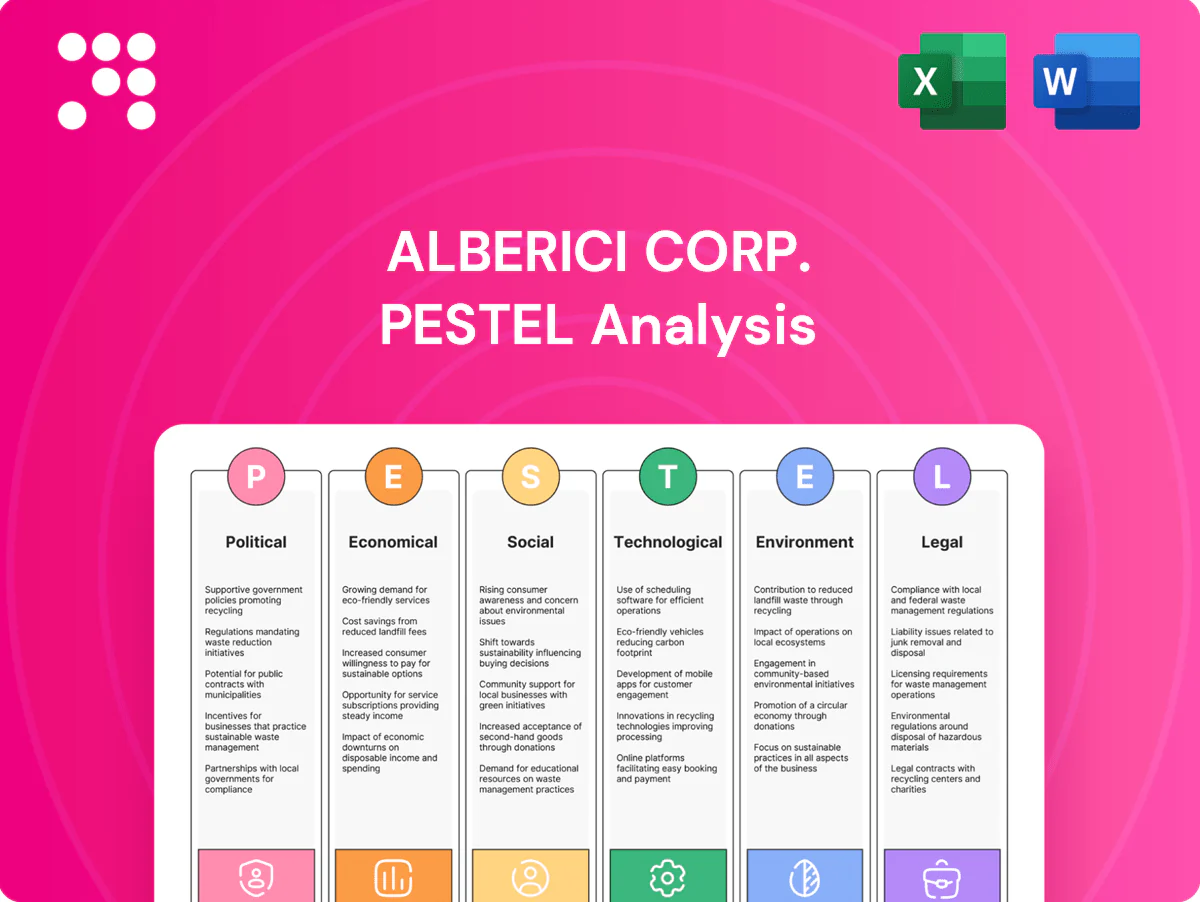
Alberici Corp. PESTLE Analysis

Plan Smarter. Present Sharper. Compete Stronger.
Alberici Corp.'s PESTLE reveals how regulation, infrastructure cycles, and sustainability trends shape its construction and engineering margins; geopolitical supply risks and tech adoption create both disruption and opportunity. Purchase the full PESTLE for actionable insights, forecasts, and ready-to-use slides to inform investment or strategy decisions.
Political factors

Infrastructure funding cycles
IIJA’s $1.2 trillion package, including $550 billion in new federal investment, has created multi-year EPC pipelines through 2026 that drive power and infrastructure backlogs; shifts in congressional appropriations and grant timing can accelerate or delay awards, so Alberici must align bidding with multi-year appropriations and diversify across states and federal programs to smooth revenue volatility.
Trade and procurement policy
Tariffs such as the US 25% steel tariff and expanded Buy America/Buy American provisions from IIJA (2021) and IRA (2022) shift material sourcing and bid competitiveness for Alberici. Compliance affects steel, heavy equipment and specialty components, often forcing supplier reconfiguration and increased domestic fabrication. Sudden policy changes can produce mid‑project cost volatility and schedule risk.

Energy transition agendas

Permitting and approvals
Complex federal, state and municipal approvals frequently elongate Alberici project schedules and can add an industry-standard 15-30% to preconstruction timelines, raising cost and execution risk.
Political pressure at federal and state levels to streamline permitting—visible in 2023–2025 reform proposals—can improve throughput and reduce backlog exposure.
International projects add sovereignty and local-authority layers; early stakeholder engagement consistently mitigates delays and dispute-related costs.
Geopolitical and country risk
Alberici’s international operations contend with currency controls, sanctions exposure and political instability; UNCTAD reports global FDI flows fell 12% in 2023, heightening cross-border project risk. Robust contract risk-sharing and political-risk insurance become critical to protect margins and balance sheet. Geopolitical tensions can disrupt supply-chain routes, so selective market entry limits downside exposure.
- Currency controls: hedge/escrow requirements
- Sanctions: third-party compliance checks
- Insurance: political-risk and war caps
- Market entry: selective, staged investments
IIJA $1.2T, IRA $369B drive EPC; tariffs 25%, permitting +15–30%
IIJA’s $1.2T and IRA’s ~369B drive multi-year EPC pipelines; shifts in appropriations and tariffs (25% steel) affect bid timing and margins. US 50–52% GHG by 2030 redirects work to renewables/transmission; permitting adds ~15–30% to preconstruction. UNCTAD: global FDI -12% in 2023; political‑risk insurance and selective market entry mitigate cross‑border exposure.
| Metric | Value |
|---|---|
| IIJA | $1.2T |
| IRA | $369B |
| US 2030 GHG target | 50–52% |
| FDI change 2023 | -12% |
What is included in the product
 Detailed Word Document
Explores how Political, Economic, Social, Technological, Environmental and Legal forces uniquely impact Alberici Corp., with data-backed trends and region-specific regulatory context; designed to help executives and investors identify risks, opportunities and forward-looking scenarios for strategic planning.

 Customizable Excel Spreadsheet
A compact, visually segmented Alberici Corp. PESTLE summary that distills external risks and opportunities for quick reference during meetings or strategy sessions. Editable and easily shareable, it supports cross‑team alignment and can be dropped into presentations or planning packs to streamline decision-making.
Economic factors

Interest rates and capital costs
Higher policy rates — US federal funds at 5.25–5.50% in Dec 2024 — raise owners’ WACC, delaying NTPs and shrinking project scopes while increasing EPC working capital needs and bonding costs, compressing margins.
Rate declines can quickly revive deferred investments as financing becomes cheaper and NTPs reset.
Hedging interest exposure and milestone billing clauses protect cash flows and limit timing risk.
Material and labor inflation
Volatility in steel, cement and heavy equipment—steel prices swung roughly +/-25% 2021–24—heightens GMP and lump-sum contract risk for Alberici by widening input-cost uncertainty. Skilled craft wage escalation (craft wages rose about 6% in 2024) compresses margins on self-perform work. Use of escalation clauses and indexed pricing and strategic procurement, including bulk buys and long-lead contracts, materially reduces exposure.

Industrial reshoring trends
Industrial reshoring driven by CHIPS Act incentives (about 52.7 billion USD) and IRA energy tax measures (~369 billion USD) has expanded EPC pipelines in semiconductors, EVs and advanced manufacturing, with over 200 billion USD in announced U.S. projects by 2024; public incentives continue to catalyze private capex. Alberici’s self-perform capabilities favor fast-track scopes, while geographic clustering improves labor and equipment utilization.

Currency and FX exposure
International projects expose Alberici to currency and FX risk in both revenues and input costs, and mismatches between contract currency and local costs can quickly erode project margins. Forward contracts and natural hedges (local sourcing, currency-linked contracts) mitigate volatility. Bid pricing should incorporate volatility premiums to preserve target returns.
- FX risk: revenues vs inputs
- Hedging: forwards and natural hedges
- Pricing: include volatility premium
Business cycle sensitivity
Construction demand for Alberici closely follows macro cycles, with project starts ebbing in downturns and recovering in expansions, though sectoral exposure matters.
Power and infrastructure contracts historically show steadier bid pipelines than private manufacturing work, helping stabilize revenues.
Diverse backlog composition and scenario-based capacity planning reduce cyclicality and align staffing with pipeline shifts.
- Sector sensitivity: infrastructure/power steadier
- Backlog diversity: lowers revenue volatility
- Scenario planning: matches capacity to demand
IIJA $1.2T, IRA $369B drive EPC; tariffs 25%, permitting +15–30%
Higher policy rates (fed funds 5.25–5.50% Dec 2024) raise WACC, delay NTPs and compress margins; rate cuts can rapidly restart deferred capex. Input volatility (steel +/-25% 2021–24; craft wages +6% in 2024) and FX risk raise pricing risk; escalation clauses, hedges and strategic procurement mitigate. Industrial reshoring (CHIPS $52.7B; IRA ~$369B; >$200B projects by 2024) supports pipelines.
| Metric | Value |
|---|---|
| Fed funds (Dec 2024) | 5.25–5.50% |
| Steel volatility 2021–24 | ±25% |
| Craft wage change 2024 | +6% |
| Public incentives | CHIPS $52.7B; IRA ~$369B |
What You See Is What You Get
Alberici Corp. PESTLE Analysis
The preview shown here is the exact Alberici Corp PESTLE Analysis you’ll receive after purchase—fully formatted and ready to use. It covers Political, Economic, Social, Technological, Legal and Environmental factors with actionable insights. No placeholders or teasers—this is the final, downloadable file.

Plan Smarter. Present Sharper. Compete Stronger.
Alberici Corp.'s PESTLE reveals how regulation, infrastructure cycles, and sustainability trends shape its construction and engineering margins; geopolitical supply risks and tech adoption create both disruption and opportunity. Purchase the full PESTLE for actionable insights, forecasts, and ready-to-use slides to inform investment or strategy decisions.
Political factors
Infrastructure funding cycles
IIJA’s $1.2 trillion package, including $550 billion in new federal investment, has created multi-year EPC pipelines through 2026 that drive power and infrastructure backlogs; shifts in congressional appropriations and grant timing can accelerate or delay awards, so Alberici must align bidding with multi-year appropriations and diversify across states and federal programs to smooth revenue volatility.
Trade and procurement policy
Tariffs such as the US 25% steel tariff and expanded Buy America/Buy American provisions from IIJA (2021) and IRA (2022) shift material sourcing and bid competitiveness for Alberici. Compliance affects steel, heavy equipment and specialty components, often forcing supplier reconfiguration and increased domestic fabrication. Sudden policy changes can produce mid‑project cost volatility and schedule risk.
Energy transition agendas
Permitting and approvals
Complex federal, state and municipal approvals frequently elongate Alberici project schedules and can add an industry-standard 15-30% to preconstruction timelines, raising cost and execution risk.
Political pressure at federal and state levels to streamline permitting—visible in 2023–2025 reform proposals—can improve throughput and reduce backlog exposure.
International projects add sovereignty and local-authority layers; early stakeholder engagement consistently mitigates delays and dispute-related costs.
Geopolitical and country risk
Alberici’s international operations contend with currency controls, sanctions exposure and political instability; UNCTAD reports global FDI flows fell 12% in 2023, heightening cross-border project risk. Robust contract risk-sharing and political-risk insurance become critical to protect margins and balance sheet. Geopolitical tensions can disrupt supply-chain routes, so selective market entry limits downside exposure.
- Currency controls: hedge/escrow requirements
- Sanctions: third-party compliance checks
- Insurance: political-risk and war caps
- Market entry: selective, staged investments
IIJA $1.2T, IRA $369B drive EPC; tariffs 25%, permitting +15–30%
IIJA’s $1.2T and IRA’s ~369B drive multi-year EPC pipelines; shifts in appropriations and tariffs (25% steel) affect bid timing and margins. US 50–52% GHG by 2030 redirects work to renewables/transmission; permitting adds ~15–30% to preconstruction. UNCTAD: global FDI -12% in 2023; political‑risk insurance and selective market entry mitigate cross‑border exposure.
| Metric | Value |
|---|---|
| IIJA | $1.2T |
| IRA | $369B |
| US 2030 GHG target | 50–52% |
| FDI change 2023 | -12% |
What is included in the product
Detailed Word Document
Explores how Political, Economic, Social, Technological, Environmental and Legal forces uniquely impact Alberici Corp., with data-backed trends and region-specific regulatory context; designed to help executives and investors identify risks, opportunities and forward-looking scenarios for strategic planning.
Customizable Excel Spreadsheet
A compact, visually segmented Alberici Corp. PESTLE summary that distills external risks and opportunities for quick reference during meetings or strategy sessions. Editable and easily shareable, it supports cross‑team alignment and can be dropped into presentations or planning packs to streamline decision-making.
Economic factors
Interest rates and capital costs
Higher policy rates — US federal funds at 5.25–5.50% in Dec 2024 — raise owners’ WACC, delaying NTPs and shrinking project scopes while increasing EPC working capital needs and bonding costs, compressing margins.
Rate declines can quickly revive deferred investments as financing becomes cheaper and NTPs reset.
Hedging interest exposure and milestone billing clauses protect cash flows and limit timing risk.
Material and labor inflation
Volatility in steel, cement and heavy equipment—steel prices swung roughly +/-25% 2021–24—heightens GMP and lump-sum contract risk for Alberici by widening input-cost uncertainty. Skilled craft wage escalation (craft wages rose about 6% in 2024) compresses margins on self-perform work. Use of escalation clauses and indexed pricing and strategic procurement, including bulk buys and long-lead contracts, materially reduces exposure.
Industrial reshoring trends
Industrial reshoring driven by CHIPS Act incentives (about 52.7 billion USD) and IRA energy tax measures (~369 billion USD) has expanded EPC pipelines in semiconductors, EVs and advanced manufacturing, with over 200 billion USD in announced U.S. projects by 2024; public incentives continue to catalyze private capex. Alberici’s self-perform capabilities favor fast-track scopes, while geographic clustering improves labor and equipment utilization.
Currency and FX exposure
International projects expose Alberici to currency and FX risk in both revenues and input costs, and mismatches between contract currency and local costs can quickly erode project margins. Forward contracts and natural hedges (local sourcing, currency-linked contracts) mitigate volatility. Bid pricing should incorporate volatility premiums to preserve target returns.
- FX risk: revenues vs inputs
- Hedging: forwards and natural hedges
- Pricing: include volatility premium
Business cycle sensitivity
Construction demand for Alberici closely follows macro cycles, with project starts ebbing in downturns and recovering in expansions, though sectoral exposure matters.
Power and infrastructure contracts historically show steadier bid pipelines than private manufacturing work, helping stabilize revenues.
Diverse backlog composition and scenario-based capacity planning reduce cyclicality and align staffing with pipeline shifts.
- Sector sensitivity: infrastructure/power steadier
- Backlog diversity: lowers revenue volatility
- Scenario planning: matches capacity to demand
IIJA $1.2T, IRA $369B drive EPC; tariffs 25%, permitting +15–30%
Higher policy rates (fed funds 5.25–5.50% Dec 2024) raise WACC, delay NTPs and compress margins; rate cuts can rapidly restart deferred capex. Input volatility (steel +/-25% 2021–24; craft wages +6% in 2024) and FX risk raise pricing risk; escalation clauses, hedges and strategic procurement mitigate. Industrial reshoring (CHIPS $52.7B; IRA ~$369B; >$200B projects by 2024) supports pipelines.
| Metric | Value |
|---|---|
| Fed funds (Dec 2024) | 5.25–5.50% |
| Steel volatility 2021–24 | ±25% |
| Craft wage change 2024 | +6% |
| Public incentives | CHIPS $52.7B; IRA ~$369B |
What You See Is What You Get
Alberici Corp. PESTLE Analysis
The preview shown here is the exact Alberici Corp PESTLE Analysis you’ll receive after purchase—fully formatted and ready to use. It covers Political, Economic, Social, Technological, Legal and Environmental factors with actionable insights. No placeholders or teasers—this is the final, downloadable file.
Original: $10.00
-65%$10.00
$3.50Description
Plan Smarter. Present Sharper. Compete Stronger.
Alberici Corp.'s PESTLE reveals how regulation, infrastructure cycles, and sustainability trends shape its construction and engineering margins; geopolitical supply risks and tech adoption create both disruption and opportunity. Purchase the full PESTLE for actionable insights, forecasts, and ready-to-use slides to inform investment or strategy decisions.
Political factors
Infrastructure funding cycles
IIJA’s $1.2 trillion package, including $550 billion in new federal investment, has created multi-year EPC pipelines through 2026 that drive power and infrastructure backlogs; shifts in congressional appropriations and grant timing can accelerate or delay awards, so Alberici must align bidding with multi-year appropriations and diversify across states and federal programs to smooth revenue volatility.
Trade and procurement policy
Tariffs such as the US 25% steel tariff and expanded Buy America/Buy American provisions from IIJA (2021) and IRA (2022) shift material sourcing and bid competitiveness for Alberici. Compliance affects steel, heavy equipment and specialty components, often forcing supplier reconfiguration and increased domestic fabrication. Sudden policy changes can produce mid‑project cost volatility and schedule risk.
Energy transition agendas
Permitting and approvals
Complex federal, state and municipal approvals frequently elongate Alberici project schedules and can add an industry-standard 15-30% to preconstruction timelines, raising cost and execution risk.
Political pressure at federal and state levels to streamline permitting—visible in 2023–2025 reform proposals—can improve throughput and reduce backlog exposure.
International projects add sovereignty and local-authority layers; early stakeholder engagement consistently mitigates delays and dispute-related costs.
Geopolitical and country risk
Alberici’s international operations contend with currency controls, sanctions exposure and political instability; UNCTAD reports global FDI flows fell 12% in 2023, heightening cross-border project risk. Robust contract risk-sharing and political-risk insurance become critical to protect margins and balance sheet. Geopolitical tensions can disrupt supply-chain routes, so selective market entry limits downside exposure.
- Currency controls: hedge/escrow requirements
- Sanctions: third-party compliance checks
- Insurance: political-risk and war caps
- Market entry: selective, staged investments
IIJA $1.2T, IRA $369B drive EPC; tariffs 25%, permitting +15–30%
IIJA’s $1.2T and IRA’s ~369B drive multi-year EPC pipelines; shifts in appropriations and tariffs (25% steel) affect bid timing and margins. US 50–52% GHG by 2030 redirects work to renewables/transmission; permitting adds ~15–30% to preconstruction. UNCTAD: global FDI -12% in 2023; political‑risk insurance and selective market entry mitigate cross‑border exposure.
| Metric | Value |
|---|---|
| IIJA | $1.2T |
| IRA | $369B |
| US 2030 GHG target | 50–52% |
| FDI change 2023 | -12% |
What is included in the product
Detailed Word Document
Explores how Political, Economic, Social, Technological, Environmental and Legal forces uniquely impact Alberici Corp., with data-backed trends and region-specific regulatory context; designed to help executives and investors identify risks, opportunities and forward-looking scenarios for strategic planning.
Customizable Excel Spreadsheet
A compact, visually segmented Alberici Corp. PESTLE summary that distills external risks and opportunities for quick reference during meetings or strategy sessions. Editable and easily shareable, it supports cross‑team alignment and can be dropped into presentations or planning packs to streamline decision-making.
Economic factors
Interest rates and capital costs
Higher policy rates — US federal funds at 5.25–5.50% in Dec 2024 — raise owners’ WACC, delaying NTPs and shrinking project scopes while increasing EPC working capital needs and bonding costs, compressing margins.
Rate declines can quickly revive deferred investments as financing becomes cheaper and NTPs reset.
Hedging interest exposure and milestone billing clauses protect cash flows and limit timing risk.
Material and labor inflation
Volatility in steel, cement and heavy equipment—steel prices swung roughly +/-25% 2021–24—heightens GMP and lump-sum contract risk for Alberici by widening input-cost uncertainty. Skilled craft wage escalation (craft wages rose about 6% in 2024) compresses margins on self-perform work. Use of escalation clauses and indexed pricing and strategic procurement, including bulk buys and long-lead contracts, materially reduces exposure.
Industrial reshoring trends
Industrial reshoring driven by CHIPS Act incentives (about 52.7 billion USD) and IRA energy tax measures (~369 billion USD) has expanded EPC pipelines in semiconductors, EVs and advanced manufacturing, with over 200 billion USD in announced U.S. projects by 2024; public incentives continue to catalyze private capex. Alberici’s self-perform capabilities favor fast-track scopes, while geographic clustering improves labor and equipment utilization.
Currency and FX exposure
International projects expose Alberici to currency and FX risk in both revenues and input costs, and mismatches between contract currency and local costs can quickly erode project margins. Forward contracts and natural hedges (local sourcing, currency-linked contracts) mitigate volatility. Bid pricing should incorporate volatility premiums to preserve target returns.
- FX risk: revenues vs inputs
- Hedging: forwards and natural hedges
- Pricing: include volatility premium
Business cycle sensitivity
Construction demand for Alberici closely follows macro cycles, with project starts ebbing in downturns and recovering in expansions, though sectoral exposure matters.
Power and infrastructure contracts historically show steadier bid pipelines than private manufacturing work, helping stabilize revenues.
Diverse backlog composition and scenario-based capacity planning reduce cyclicality and align staffing with pipeline shifts.
- Sector sensitivity: infrastructure/power steadier
- Backlog diversity: lowers revenue volatility
- Scenario planning: matches capacity to demand
IIJA $1.2T, IRA $369B drive EPC; tariffs 25%, permitting +15–30%
Higher policy rates (fed funds 5.25–5.50% Dec 2024) raise WACC, delay NTPs and compress margins; rate cuts can rapidly restart deferred capex. Input volatility (steel +/-25% 2021–24; craft wages +6% in 2024) and FX risk raise pricing risk; escalation clauses, hedges and strategic procurement mitigate. Industrial reshoring (CHIPS $52.7B; IRA ~$369B; >$200B projects by 2024) supports pipelines.
| Metric | Value |
|---|---|
| Fed funds (Dec 2024) | 5.25–5.50% |
| Steel volatility 2021–24 | ±25% |
| Craft wage change 2024 | +6% |
| Public incentives | CHIPS $52.7B; IRA ~$369B |
What You See Is What You Get
Alberici Corp. PESTLE Analysis
The preview shown here is the exact Alberici Corp PESTLE Analysis you’ll receive after purchase—fully formatted and ready to use. It covers Political, Economic, Social, Technological, Legal and Environmental factors with actionable insights. No placeholders or teasers—this is the final, downloadable file.











