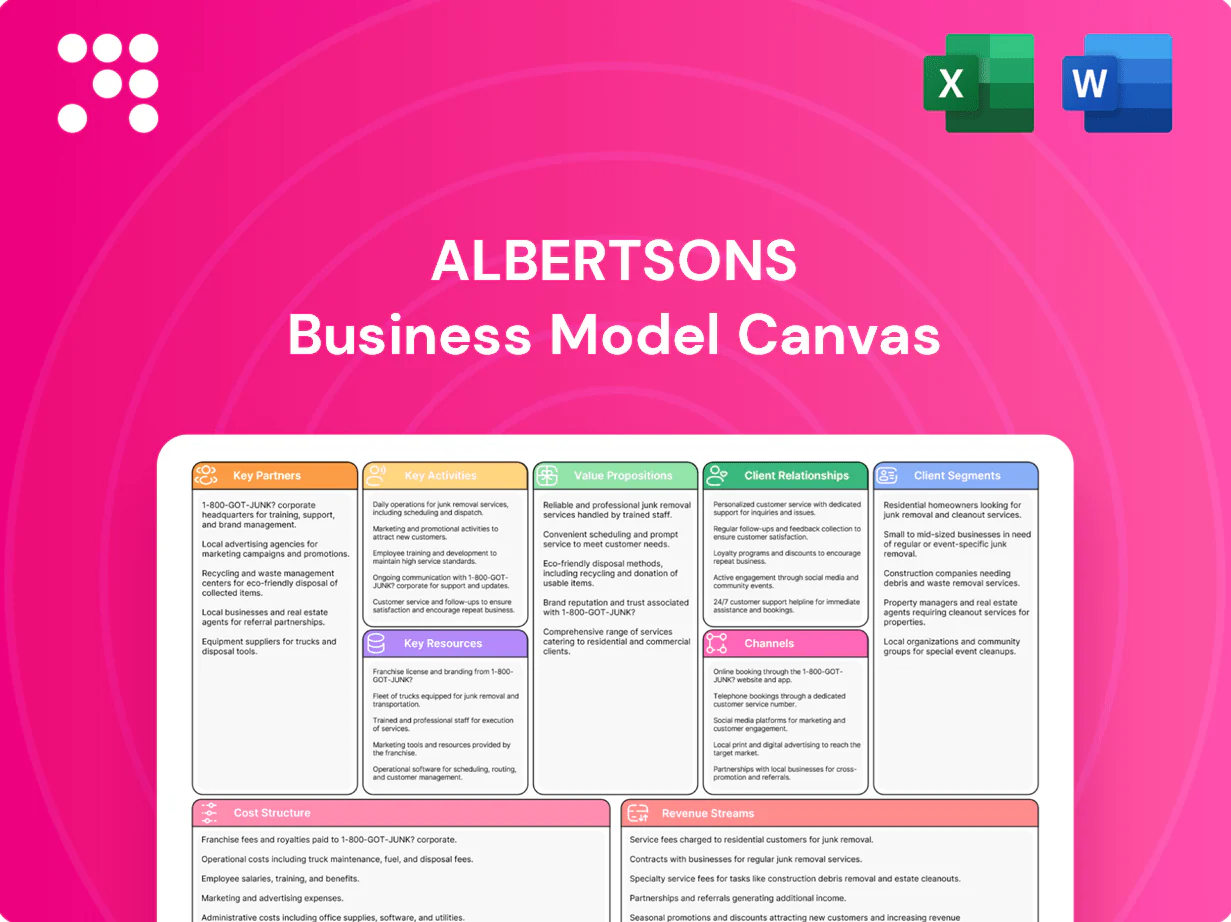
Albertsons Business Model Canvas

Grocery Industry Business Model Canvas — Value, Customers, Channels, Revenue
Unlock the full strategic blueprint behind Albertsons with our in-depth Business Model Canvas—mapping value propositions, customer segments, channels, and revenue streams in one clear file. Ideal for investors, consultants, and founders seeking practical insights. Download the editable Word & Excel canvases to benchmark, plan, and act on proven grocery-industry strategies.
Partnerships

National CPG suppliers
Strategic relationships with major CPG manufacturers secure breadth, depth, and promotional funding across Albertsons' network of over 2,200 stores in 2024. These partners co-plan assortments, trade promotions, and in-store activations to drive traffic. Collaboration improves fill rates and reduces out-of-stocks, lowering lost sales. Joint business planning supports margin mix and category growth through targeted promotional investments.
Local farmers and producers
Regional sourcing from local farmers and producers gives Albertsons over 2,200 stores fresher, seasonally relevant assortments that drive differentiation and shopper loyalty. Direct relationships with hundreds of regional suppliers shorten lead times and enhance traceability for food safety and quality. Local assortments bolster community positioning, advance sustainability goals, and diversify sources to mitigate supply risk.

Logistics and cold-chain providers
Third-party carriers and temperature-controlled logistics complement Albertsons’ internal fleets, supporting distribution to more than 2,200 stores across 34 states and DC (2024). These partners flex capacity during demand spikes and severe weather to maintain on-shelf availability. Reliable cold-chain preserves food safety and quality. Joint KPI tracking with providers reduces cost per case and spoilage through coordinated metrics and accountability.

Digital, data, and payments vendors
Digital, data, and payments vendors — from cloud platforms and POS to personalization engines and payment processors — underpin Albertsons omnichannel operations across its ~2,200 stores and roughly 26 million weekly customers, enabling loyalty targeting, fraud prevention, and seamless checkout.
Co-development with vendors accelerates feature rollout at scale while API integrations cut IT complexity and downtime, improving uptime and deployment velocity for in-store and online channels.
- cloud platforms: scalable hosting for omnichannel traffic
- POS & payment processors: seamless checkout, fraud prevention
- personalization engines: targeted loyalty offers
- API integrations: reduced IT complexity and downtime
Delivery and pharmacy ecosystem partners
- ≈2,200 stores (Albertsons, 2024)
- Third‑party delivery: boosts same‑day reach
- PBMs/insurers: support reimbursements
- Vaccine partners: drive visits & baskets
Partnership-led omnichannel cuts stockouts, boosts margins across 2,200 stores, 26M weekly customers
Key partnerships with major CPGs, regional suppliers, logistics providers, digital vendors, third‑party delivery and PBMs sustain assortments, cold‑chain, omnichannel reach and pharmacy margins across ~2,200 stores and ~26M weekly customers (2024). Joint promotions, direct sourcing and API integrations cut stockouts, drive traffic and improve margins.
| Partner | Role | 2024 Impact |
|---|---|---|
| CPGs | Promos/assortment | Drives traffic |
| Regional | Fresh supply | Differentiation |
| Logistics | Cold‑chain | On‑shelf avail. |
What is included in the product
 Detailed Word Document
A comprehensive pre-written Business Model Canvas mapping Albertsons’ nine blocks—customer segments, channels, value propositions, revenue streams, key activities, resources, partners, cost structure and customer relationships—reflecting its omnichannel grocery operations, private-label strategy and supply-chain efficiencies; ideal for presentations and investor discussions with competitive analysis and SWOT-linked insights.

 Customizable Excel Spreadsheet
High-level, editable one-page Business Model Canvas for Albertsons that condenses strategy into a clean snapshot, saving hours of formatting and making it easy for teams to identify pain points and adapt solutions quickly.
Activities

End-to-end merchandising
End-to-end merchandising at Albertsons ties category planning, assortment optimization and shelf execution to higher sales and margins, using vendor negotiations to secure trade rates and co-marketing. Planograms and space management boost turns and SKU productivity, while continuous price checks keep competitiveness. In 2024 Albertsons operated about 2,200 stores, leveraging scale to negotiate promotions and optimize assortment.
Supply chain and replenishment
Albertsons leverages ~21 distribution centers and ~2,200 stores (2024) to centralize DC operations, advanced forecasting and inventory control that reduce stockouts and waste; strict cold-chain adherence preserves perishables; route optimization trims transport costs and emissions; demand-sensing tools align local buys with shopper preferences across its ~270,000 workforce-supported network.

Omnichannel fulfillment
Omnichannel fulfillment at Albertsons picks, packs, and stages orders for curbside, delivery, and ship-to-home, leveraging slotting and batching to lift labor productivity—micro-fulfillment implementations can raise throughput up to 4x. Last-mile orchestration balances speed and cost across carrier mixes, while service-level monitoring preserves on-time, in-full performance amid an 11% US online grocery penetration in 2024.

Private label development
Albertsons develops private labels (Signature SELECT, O Organics, Open Nature, Lucerne) through brand design, sourcing, and QA to create differentiated SKUs; tiered offers target value, core, and premium niches and drive higher margins and loyalty. In 2024 US private‑label share was about 18%, and private brands typically deliver margin premiums versus national brands. Continuous testing refines specs and taste profiles to stay competitive.
- Brand design: differentiated SKUs
- Sourcing & QA: consistent specs
- Tiers: value/core/premium
- 2024 US private‑label share: ~18%
- Higher margins → loyalty
Pharmacy and health services
Prescription dispensing, vaccinations, and pharmacist consultations drive traffic and trust; Albertsons offered pharmacy services across more than 2,200 stores in 2024. Compliance, licensing, and HIPAA‑secure data handling are core operational controls. Clinical programs such as med sync and MTM support adherence and outcomes while cross-selling links health, fresh, and wellness baskets.
- Prescription dispensing: retail scale across 2,200+ locations (2024)
- Vaccinations/consults: boost foot traffic and loyalty
- Regulatory: HIPAA, state licensing, controlled‑substance compliance
- Clinical programs: med sync, MTM for adherence
- Cross‑sell: pharmacy → fresh/wellness baskets
Centralized logistics and omnichannel drive margin lift across ~2,200 stores
Albertsons runs end-to-end merchandising, assortment and category planning to lift sales and margins across ~2,200 stores (2024). Centralized logistics via ~21 DCs and ~270,000 employees reduces waste and stockouts. Omnichannel fulfillment and micro-fulfillment scale curbside/delivery amid 11% US online grocery penetration. Private labels (18% share) and in-store pharmacy broaden margins and loyalty.
| Metric | 2024 |
|---|---|
| Stores | ~2,200 |
| Distribution centers | ~21 |
| Workforce | ~270,000 |
| Private‑label share | ~18% |
| Online grocery | ~11% |
Preview Before You Purchase
Business Model Canvas
The document previewed here is the actual Albertsons Business Model Canvas you’ll receive—this is not a mockup or sample. Upon purchase you’ll instantly download the complete file, formatted and structured exactly as shown. The deliverable is ready to edit, present, and share in the provided Word and Excel formats, with no hidden content or surprises.

Grocery Industry Business Model Canvas — Value, Customers, Channels, Revenue
Unlock the full strategic blueprint behind Albertsons with our in-depth Business Model Canvas—mapping value propositions, customer segments, channels, and revenue streams in one clear file. Ideal for investors, consultants, and founders seeking practical insights. Download the editable Word & Excel canvases to benchmark, plan, and act on proven grocery-industry strategies.
Partnerships
National CPG suppliers
Strategic relationships with major CPG manufacturers secure breadth, depth, and promotional funding across Albertsons' network of over 2,200 stores in 2024. These partners co-plan assortments, trade promotions, and in-store activations to drive traffic. Collaboration improves fill rates and reduces out-of-stocks, lowering lost sales. Joint business planning supports margin mix and category growth through targeted promotional investments.
Local farmers and producers
Regional sourcing from local farmers and producers gives Albertsons over 2,200 stores fresher, seasonally relevant assortments that drive differentiation and shopper loyalty. Direct relationships with hundreds of regional suppliers shorten lead times and enhance traceability for food safety and quality. Local assortments bolster community positioning, advance sustainability goals, and diversify sources to mitigate supply risk.
Logistics and cold-chain providers
Third-party carriers and temperature-controlled logistics complement Albertsons’ internal fleets, supporting distribution to more than 2,200 stores across 34 states and DC (2024). These partners flex capacity during demand spikes and severe weather to maintain on-shelf availability. Reliable cold-chain preserves food safety and quality. Joint KPI tracking with providers reduces cost per case and spoilage through coordinated metrics and accountability.
Digital, data, and payments vendors
Digital, data, and payments vendors — from cloud platforms and POS to personalization engines and payment processors — underpin Albertsons omnichannel operations across its ~2,200 stores and roughly 26 million weekly customers, enabling loyalty targeting, fraud prevention, and seamless checkout.
Co-development with vendors accelerates feature rollout at scale while API integrations cut IT complexity and downtime, improving uptime and deployment velocity for in-store and online channels.
- cloud platforms: scalable hosting for omnichannel traffic
- POS & payment processors: seamless checkout, fraud prevention
- personalization engines: targeted loyalty offers
- API integrations: reduced IT complexity and downtime
Delivery and pharmacy ecosystem partners
- ≈2,200 stores (Albertsons, 2024)
- Third‑party delivery: boosts same‑day reach
- PBMs/insurers: support reimbursements
- Vaccine partners: drive visits & baskets
Partnership-led omnichannel cuts stockouts, boosts margins across 2,200 stores, 26M weekly customers
Key partnerships with major CPGs, regional suppliers, logistics providers, digital vendors, third‑party delivery and PBMs sustain assortments, cold‑chain, omnichannel reach and pharmacy margins across ~2,200 stores and ~26M weekly customers (2024). Joint promotions, direct sourcing and API integrations cut stockouts, drive traffic and improve margins.
| Partner | Role | 2024 Impact |
|---|---|---|
| CPGs | Promos/assortment | Drives traffic |
| Regional | Fresh supply | Differentiation |
| Logistics | Cold‑chain | On‑shelf avail. |
What is included in the product
Detailed Word Document
A comprehensive pre-written Business Model Canvas mapping Albertsons’ nine blocks—customer segments, channels, value propositions, revenue streams, key activities, resources, partners, cost structure and customer relationships—reflecting its omnichannel grocery operations, private-label strategy and supply-chain efficiencies; ideal for presentations and investor discussions with competitive analysis and SWOT-linked insights.
Customizable Excel Spreadsheet
High-level, editable one-page Business Model Canvas for Albertsons that condenses strategy into a clean snapshot, saving hours of formatting and making it easy for teams to identify pain points and adapt solutions quickly.
Activities
End-to-end merchandising
End-to-end merchandising at Albertsons ties category planning, assortment optimization and shelf execution to higher sales and margins, using vendor negotiations to secure trade rates and co-marketing. Planograms and space management boost turns and SKU productivity, while continuous price checks keep competitiveness. In 2024 Albertsons operated about 2,200 stores, leveraging scale to negotiate promotions and optimize assortment.
Supply chain and replenishment
Albertsons leverages ~21 distribution centers and ~2,200 stores (2024) to centralize DC operations, advanced forecasting and inventory control that reduce stockouts and waste; strict cold-chain adherence preserves perishables; route optimization trims transport costs and emissions; demand-sensing tools align local buys with shopper preferences across its ~270,000 workforce-supported network.
Omnichannel fulfillment
Omnichannel fulfillment at Albertsons picks, packs, and stages orders for curbside, delivery, and ship-to-home, leveraging slotting and batching to lift labor productivity—micro-fulfillment implementations can raise throughput up to 4x. Last-mile orchestration balances speed and cost across carrier mixes, while service-level monitoring preserves on-time, in-full performance amid an 11% US online grocery penetration in 2024.
Private label development
Albertsons develops private labels (Signature SELECT, O Organics, Open Nature, Lucerne) through brand design, sourcing, and QA to create differentiated SKUs; tiered offers target value, core, and premium niches and drive higher margins and loyalty. In 2024 US private‑label share was about 18%, and private brands typically deliver margin premiums versus national brands. Continuous testing refines specs and taste profiles to stay competitive.
- Brand design: differentiated SKUs
- Sourcing & QA: consistent specs
- Tiers: value/core/premium
- 2024 US private‑label share: ~18%
- Higher margins → loyalty
Pharmacy and health services
Prescription dispensing, vaccinations, and pharmacist consultations drive traffic and trust; Albertsons offered pharmacy services across more than 2,200 stores in 2024. Compliance, licensing, and HIPAA‑secure data handling are core operational controls. Clinical programs such as med sync and MTM support adherence and outcomes while cross-selling links health, fresh, and wellness baskets.
- Prescription dispensing: retail scale across 2,200+ locations (2024)
- Vaccinations/consults: boost foot traffic and loyalty
- Regulatory: HIPAA, state licensing, controlled‑substance compliance
- Clinical programs: med sync, MTM for adherence
- Cross‑sell: pharmacy → fresh/wellness baskets
Centralized logistics and omnichannel drive margin lift across ~2,200 stores
Albertsons runs end-to-end merchandising, assortment and category planning to lift sales and margins across ~2,200 stores (2024). Centralized logistics via ~21 DCs and ~270,000 employees reduces waste and stockouts. Omnichannel fulfillment and micro-fulfillment scale curbside/delivery amid 11% US online grocery penetration. Private labels (18% share) and in-store pharmacy broaden margins and loyalty.
| Metric | 2024 |
|---|---|
| Stores | ~2,200 |
| Distribution centers | ~21 |
| Workforce | ~270,000 |
| Private‑label share | ~18% |
| Online grocery | ~11% |
Preview Before You Purchase
Business Model Canvas
The document previewed here is the actual Albertsons Business Model Canvas you’ll receive—this is not a mockup or sample. Upon purchase you’ll instantly download the complete file, formatted and structured exactly as shown. The deliverable is ready to edit, present, and share in the provided Word and Excel formats, with no hidden content or surprises.
Original: $10.00
-65%$10.00
$3.50Description
Grocery Industry Business Model Canvas — Value, Customers, Channels, Revenue
Unlock the full strategic blueprint behind Albertsons with our in-depth Business Model Canvas—mapping value propositions, customer segments, channels, and revenue streams in one clear file. Ideal for investors, consultants, and founders seeking practical insights. Download the editable Word & Excel canvases to benchmark, plan, and act on proven grocery-industry strategies.
Partnerships
National CPG suppliers
Strategic relationships with major CPG manufacturers secure breadth, depth, and promotional funding across Albertsons' network of over 2,200 stores in 2024. These partners co-plan assortments, trade promotions, and in-store activations to drive traffic. Collaboration improves fill rates and reduces out-of-stocks, lowering lost sales. Joint business planning supports margin mix and category growth through targeted promotional investments.
Local farmers and producers
Regional sourcing from local farmers and producers gives Albertsons over 2,200 stores fresher, seasonally relevant assortments that drive differentiation and shopper loyalty. Direct relationships with hundreds of regional suppliers shorten lead times and enhance traceability for food safety and quality. Local assortments bolster community positioning, advance sustainability goals, and diversify sources to mitigate supply risk.
Logistics and cold-chain providers
Third-party carriers and temperature-controlled logistics complement Albertsons’ internal fleets, supporting distribution to more than 2,200 stores across 34 states and DC (2024). These partners flex capacity during demand spikes and severe weather to maintain on-shelf availability. Reliable cold-chain preserves food safety and quality. Joint KPI tracking with providers reduces cost per case and spoilage through coordinated metrics and accountability.
Digital, data, and payments vendors
Digital, data, and payments vendors — from cloud platforms and POS to personalization engines and payment processors — underpin Albertsons omnichannel operations across its ~2,200 stores and roughly 26 million weekly customers, enabling loyalty targeting, fraud prevention, and seamless checkout.
Co-development with vendors accelerates feature rollout at scale while API integrations cut IT complexity and downtime, improving uptime and deployment velocity for in-store and online channels.
- cloud platforms: scalable hosting for omnichannel traffic
- POS & payment processors: seamless checkout, fraud prevention
- personalization engines: targeted loyalty offers
- API integrations: reduced IT complexity and downtime
Delivery and pharmacy ecosystem partners
- ≈2,200 stores (Albertsons, 2024)
- Third‑party delivery: boosts same‑day reach
- PBMs/insurers: support reimbursements
- Vaccine partners: drive visits & baskets
Partnership-led omnichannel cuts stockouts, boosts margins across 2,200 stores, 26M weekly customers
Key partnerships with major CPGs, regional suppliers, logistics providers, digital vendors, third‑party delivery and PBMs sustain assortments, cold‑chain, omnichannel reach and pharmacy margins across ~2,200 stores and ~26M weekly customers (2024). Joint promotions, direct sourcing and API integrations cut stockouts, drive traffic and improve margins.
| Partner | Role | 2024 Impact |
|---|---|---|
| CPGs | Promos/assortment | Drives traffic |
| Regional | Fresh supply | Differentiation |
| Logistics | Cold‑chain | On‑shelf avail. |
What is included in the product
Detailed Word Document
A comprehensive pre-written Business Model Canvas mapping Albertsons’ nine blocks—customer segments, channels, value propositions, revenue streams, key activities, resources, partners, cost structure and customer relationships—reflecting its omnichannel grocery operations, private-label strategy and supply-chain efficiencies; ideal for presentations and investor discussions with competitive analysis and SWOT-linked insights.
Customizable Excel Spreadsheet
High-level, editable one-page Business Model Canvas for Albertsons that condenses strategy into a clean snapshot, saving hours of formatting and making it easy for teams to identify pain points and adapt solutions quickly.
Activities
End-to-end merchandising
End-to-end merchandising at Albertsons ties category planning, assortment optimization and shelf execution to higher sales and margins, using vendor negotiations to secure trade rates and co-marketing. Planograms and space management boost turns and SKU productivity, while continuous price checks keep competitiveness. In 2024 Albertsons operated about 2,200 stores, leveraging scale to negotiate promotions and optimize assortment.
Supply chain and replenishment
Albertsons leverages ~21 distribution centers and ~2,200 stores (2024) to centralize DC operations, advanced forecasting and inventory control that reduce stockouts and waste; strict cold-chain adherence preserves perishables; route optimization trims transport costs and emissions; demand-sensing tools align local buys with shopper preferences across its ~270,000 workforce-supported network.
Omnichannel fulfillment
Omnichannel fulfillment at Albertsons picks, packs, and stages orders for curbside, delivery, and ship-to-home, leveraging slotting and batching to lift labor productivity—micro-fulfillment implementations can raise throughput up to 4x. Last-mile orchestration balances speed and cost across carrier mixes, while service-level monitoring preserves on-time, in-full performance amid an 11% US online grocery penetration in 2024.
Private label development
Albertsons develops private labels (Signature SELECT, O Organics, Open Nature, Lucerne) through brand design, sourcing, and QA to create differentiated SKUs; tiered offers target value, core, and premium niches and drive higher margins and loyalty. In 2024 US private‑label share was about 18%, and private brands typically deliver margin premiums versus national brands. Continuous testing refines specs and taste profiles to stay competitive.
- Brand design: differentiated SKUs
- Sourcing & QA: consistent specs
- Tiers: value/core/premium
- 2024 US private‑label share: ~18%
- Higher margins → loyalty
Pharmacy and health services
Prescription dispensing, vaccinations, and pharmacist consultations drive traffic and trust; Albertsons offered pharmacy services across more than 2,200 stores in 2024. Compliance, licensing, and HIPAA‑secure data handling are core operational controls. Clinical programs such as med sync and MTM support adherence and outcomes while cross-selling links health, fresh, and wellness baskets.
- Prescription dispensing: retail scale across 2,200+ locations (2024)
- Vaccinations/consults: boost foot traffic and loyalty
- Regulatory: HIPAA, state licensing, controlled‑substance compliance
- Clinical programs: med sync, MTM for adherence
- Cross‑sell: pharmacy → fresh/wellness baskets
Centralized logistics and omnichannel drive margin lift across ~2,200 stores
Albertsons runs end-to-end merchandising, assortment and category planning to lift sales and margins across ~2,200 stores (2024). Centralized logistics via ~21 DCs and ~270,000 employees reduces waste and stockouts. Omnichannel fulfillment and micro-fulfillment scale curbside/delivery amid 11% US online grocery penetration. Private labels (18% share) and in-store pharmacy broaden margins and loyalty.
| Metric | 2024 |
|---|---|
| Stores | ~2,200 |
| Distribution centers | ~21 |
| Workforce | ~270,000 |
| Private‑label share | ~18% |
| Online grocery | ~11% |
Preview Before You Purchase
Business Model Canvas
The document previewed here is the actual Albertsons Business Model Canvas you’ll receive—this is not a mockup or sample. Upon purchase you’ll instantly download the complete file, formatted and structured exactly as shown. The deliverable is ready to edit, present, and share in the provided Word and Excel formats, with no hidden content or surprises.











