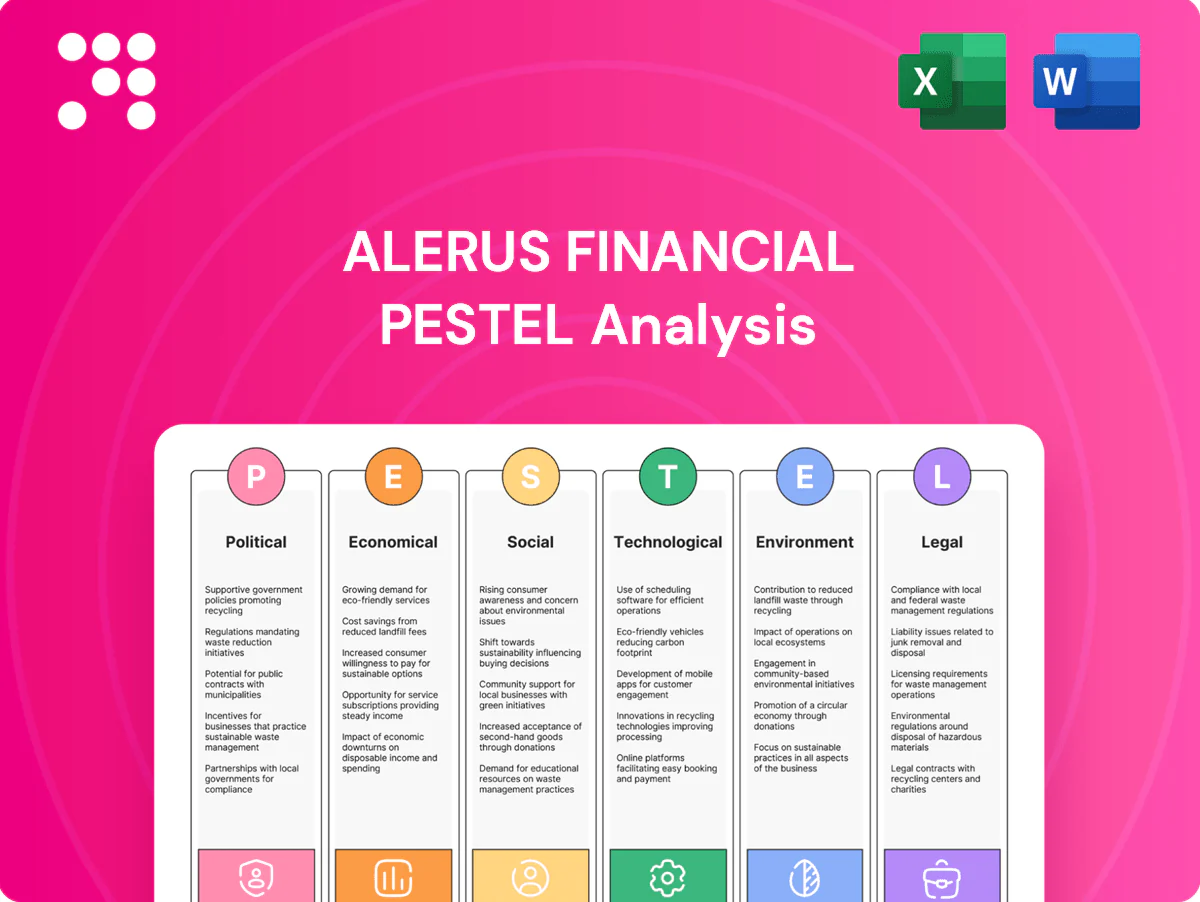
Alerus Financial PESTLE Analysis

Skip the Research. Get the Strategy.
Gain a strategic edge with our PESTLE Analysis of Alerus Financial—spot regulatory risks, economic trends, and tech shifts shaping its future. Ideal for investors, advisors, and planners, it's ready to use and fully editable. Purchase the full report for the complete, actionable breakdown.
Political factors

Banking oversight shifts
Changes in federal banking policy, appointments, and supervisory intensity—heightened after three high-profile bank failures in 2023—can shift capital, liquidity, and stress-testing expectations for regional banks like Alerus. Alerus must monitor Federal Reserve, FDIC, and OCC priorities affecting mid-sized/community banks to anticipate higher compliance costs that can constrain growth. Conversely, regulators' moves toward tailored rules for smaller institutions could materially ease regulatory burden.
Fiscal policy and stimulus
Federal infrastructure programs, notably the Bipartisan Infrastructure Law’s roughly 550 billion in new spending, can lift deposit inflows and business-loan demand in the Upper Midwest; withdrawal of pandemic stimulus (CARES Act was about 2.2 trillion) tightened liquidity and pressures fee businesses such as wealth and mortgage. Alerus should align pipelines with public project cycles, while municipal finance dynamics (muni market ~4 trillion) affect treasury and cash management demand.

Retirement policy direction
Congressional changes like SECURE Act 2.0, which raised 401(k) catch-up limits to $10,000 for ages 60–63 effective 2024, directly shift Alerus’s retirement plan administration volumes and fee revenue mix. Policy stability supports multi-year recordkeeping investments and amortization of technology costs. Sudden rule changes trigger operational surges, compliance risk and increased short-term costs, which active advocacy and product agility can mitigate.

Healthcare and housing agendas
Political focus on healthcare and affordable housing drives mortgage demand and small-business credit: 30-year mortgage rates averaged about 7% in 2024 and the affordable housing shortfall is roughly 7.2 million units, which can redirect lender appetite toward subsidized lending. Subsidies or government guarantees reduce capital charges and risk weights, while zoning caps and regulatory limits can choke local loan pipelines; partnerships with community development programs can open low-risk lending corridors.
- mortgage-rate-2024: ~7%
- affordable-housing-shortfall: ~7.2M units
- guarantees-lower-risk-weights
- zoning-constraints-dampen-pipelines
- community-partnerships-unlock-lending
Regional development priorities
State and local incentives across the Upper Midwest shape SME growth, deposit formation, and Alerus branch strategy; Alerus reported about $6.7 billion in total assets in 2024, amplifying sensitivity to regional incentives. Shifts in agricultural and manufacturing policy directly affect borrower credit health and loan mix. Cross-state political heterogeneity forces adaptable compliance and product design, while civic engagement boosts brand and stakeholder goodwill.
- Incentives drive SME deposits and branch placement
- Ag/manufacturing policy alters borrower risk
- Cross-state rules require flexible compliance
- Civic engagement strengthens local trust
Post-2023 scrutiny and SECURE Act 2.0 raise compliance for $6.7B firm
Heightened post‑2023 supervisory scrutiny, federal rule shifts and SECURE Act 2.0 (401k catch‑up $10k from 2024) raise compliance and servicing demands for Alerus (assets ~$6.7B in 2024). Infrastructure spending (~$550B) and 2024 mortgage rates ~7% drive treasury, mortgage and municipal demand, while a 7.2M affordable‑housing shortfall redirects credit toward subsidized programs.
| Metric | Value |
|---|---|
| Alerus assets (2024) | $6.7B |
| Mortgage rate (2024 avg) | ~7% |
| Affordable housing gap | 7.2M units |
| Infrastructure spending | ~$550B |
What is included in the product
 Detailed Word Document
Explores how macro-environmental factors impact Alerus Financial across Political, Economic, Social, Technological, Environmental and Legal dimensions, with data-backed trends and region-specific regulatory context. Designed for executives and investors, the analysis offers detailed sub-points, forward-looking scenarios and actionable insights ready for inclusion in business plans or pitch decks.

 Customizable Excel Spreadsheet
Condenses Alerus Financial's full PESTLE into a clean, shareable summary segmented by category for quick interpretation in meetings or presentations, with editable notes for regional or business-line context to support risk discussions and client-facing reports.
Economic factors

Interest rate cycles
Net interest margin at Alerus is highly sensitive to Fed policy—with the effective federal funds rate at 5.25–5.50% during the 2023–24 tightening, deposit betas and asset repricing lags compressed NIM; rapid hikes elevate funding costs and credit risk, while cuts pressure NIM but can revive mortgage origination; balance-sheet hedging, mix management, and fee diversification help cushion volatility.
Credit quality and delinquencies
Late-cycle stress in CRE, small business and consumer credit can raise provisions as higher rates tighten cashflows; the federal funds rate at 5.25–5.50% (mid‑2025) heightens that risk. Alerus must monitor sectoral exposures in its regional footprint. Proactive underwriting and early-warning analytics reduce loss severity. Building countercyclical reserves preserves capital flexibility.

Housing market dynamics
Mortgage volumes for Alerus remain highly rate-sensitive: the 30-year fixed averaged about 7% mid-2025 (Freddie Mac), while national origination activity slowed to roughly $1.6 trillion in 2024, pressuring pipelines and fee income. Refinancing waves historically boost noninterest income, whereas rate stability compresses margins. Geographic concentration in the Upper Midwest creates strong spring/summer seasonality. Partnerships and efficient secondary-market execution improve loan velocity and margins.

Labor and wage trends
Tight labor markets (US unemployment ~3.6% in 2024) are lifting compensation for bankers, advisors and tech staff, with average wage growth near 4% YoY in 2024, pressuring noninterest expenses for Alerus.
Productivity tools and process automation sustain efficiency ratios; client wage pressures can boost loan demand but compress deposit margins; retention of relationship bankers and advisors is critical for wealth and commercial growth.
- Labor tightness: unemployment ~3.6% (2024)
- Wage growth: ~4% YoY (2024)
- Automation: supports efficiency ratios
- Retention: key to fee and deposit growth
Liquidity and deposit competition
Disintermediation to money market funds and T-bills in 2024-25 intensified funding pressure as short-term yields rose, pulling liquidity from regional banks including Alerus.
Relationship pricing and cash-management features—sweep accounts and tiered rates—help defend core deposits and lower retail attrition.
Brokered and wholesale funding raises funding cost and repricing risk, while diversified fee income from wealth, payments and treasury services reduces reliance on net interest margin.
- MMF/T-bill outflows increase funding volatility
- Deposit sticks: relationship pricing, cash mgmt
- Brokered funding = higher cost + rate risk
- Fee income diversifies revenue mix
Post-2023 scrutiny and SECURE Act 2.0 raise compliance for $6.7B firm
Higher fed funds (5.25–5.50% mid‑2025) compress NIM and raise credit costs; 30‑yr mortgage ~7% (mid‑2025) and $1.6T origination (2024) depress mortgage fees. Unemployment ~3.6% and wage growth ~4% (2024) lift noninterest expense; MMF/T‑bill flows increase funding volatility, while fee diversification and deposit relationship tools mitigate pressure.
| Metric | Value |
|---|---|
| Fed funds | 5.25–5.50% (mid‑2025) |
| 30‑yr mortgage | ~7% (mid‑2025) |
| Unemployment | ~3.6% (2024) |
| Mortgage origination | $1.6T (2024) |
Preview the Actual Deliverable
Alerus Financial PESTLE Analysis
The Alerus Financial PESTLE Analysis preview shown here is the exact document you’ll receive after purchase—fully formatted and ready to use. This is the real, finished file with complete content, structure, and professional layout. After checkout you’ll be able to download this same, ready-to-use report instantly.

Skip the Research. Get the Strategy.
Gain a strategic edge with our PESTLE Analysis of Alerus Financial—spot regulatory risks, economic trends, and tech shifts shaping its future. Ideal for investors, advisors, and planners, it's ready to use and fully editable. Purchase the full report for the complete, actionable breakdown.
Political factors
Banking oversight shifts
Changes in federal banking policy, appointments, and supervisory intensity—heightened after three high-profile bank failures in 2023—can shift capital, liquidity, and stress-testing expectations for regional banks like Alerus. Alerus must monitor Federal Reserve, FDIC, and OCC priorities affecting mid-sized/community banks to anticipate higher compliance costs that can constrain growth. Conversely, regulators' moves toward tailored rules for smaller institutions could materially ease regulatory burden.
Fiscal policy and stimulus
Federal infrastructure programs, notably the Bipartisan Infrastructure Law’s roughly 550 billion in new spending, can lift deposit inflows and business-loan demand in the Upper Midwest; withdrawal of pandemic stimulus (CARES Act was about 2.2 trillion) tightened liquidity and pressures fee businesses such as wealth and mortgage. Alerus should align pipelines with public project cycles, while municipal finance dynamics (muni market ~4 trillion) affect treasury and cash management demand.
Retirement policy direction
Congressional changes like SECURE Act 2.0, which raised 401(k) catch-up limits to $10,000 for ages 60–63 effective 2024, directly shift Alerus’s retirement plan administration volumes and fee revenue mix. Policy stability supports multi-year recordkeeping investments and amortization of technology costs. Sudden rule changes trigger operational surges, compliance risk and increased short-term costs, which active advocacy and product agility can mitigate.
Healthcare and housing agendas
Political focus on healthcare and affordable housing drives mortgage demand and small-business credit: 30-year mortgage rates averaged about 7% in 2024 and the affordable housing shortfall is roughly 7.2 million units, which can redirect lender appetite toward subsidized lending. Subsidies or government guarantees reduce capital charges and risk weights, while zoning caps and regulatory limits can choke local loan pipelines; partnerships with community development programs can open low-risk lending corridors.
- mortgage-rate-2024: ~7%
- affordable-housing-shortfall: ~7.2M units
- guarantees-lower-risk-weights
- zoning-constraints-dampen-pipelines
- community-partnerships-unlock-lending
Regional development priorities
State and local incentives across the Upper Midwest shape SME growth, deposit formation, and Alerus branch strategy; Alerus reported about $6.7 billion in total assets in 2024, amplifying sensitivity to regional incentives. Shifts in agricultural and manufacturing policy directly affect borrower credit health and loan mix. Cross-state political heterogeneity forces adaptable compliance and product design, while civic engagement boosts brand and stakeholder goodwill.
- Incentives drive SME deposits and branch placement
- Ag/manufacturing policy alters borrower risk
- Cross-state rules require flexible compliance
- Civic engagement strengthens local trust
Post-2023 scrutiny and SECURE Act 2.0 raise compliance for $6.7B firm
Heightened post‑2023 supervisory scrutiny, federal rule shifts and SECURE Act 2.0 (401k catch‑up $10k from 2024) raise compliance and servicing demands for Alerus (assets ~$6.7B in 2024). Infrastructure spending (~$550B) and 2024 mortgage rates ~7% drive treasury, mortgage and municipal demand, while a 7.2M affordable‑housing shortfall redirects credit toward subsidized programs.
| Metric | Value |
|---|---|
| Alerus assets (2024) | $6.7B |
| Mortgage rate (2024 avg) | ~7% |
| Affordable housing gap | 7.2M units |
| Infrastructure spending | ~$550B |
What is included in the product
Detailed Word Document
Explores how macro-environmental factors impact Alerus Financial across Political, Economic, Social, Technological, Environmental and Legal dimensions, with data-backed trends and region-specific regulatory context. Designed for executives and investors, the analysis offers detailed sub-points, forward-looking scenarios and actionable insights ready for inclusion in business plans or pitch decks.
Customizable Excel Spreadsheet
Condenses Alerus Financial's full PESTLE into a clean, shareable summary segmented by category for quick interpretation in meetings or presentations, with editable notes for regional or business-line context to support risk discussions and client-facing reports.
Economic factors
Interest rate cycles
Net interest margin at Alerus is highly sensitive to Fed policy—with the effective federal funds rate at 5.25–5.50% during the 2023–24 tightening, deposit betas and asset repricing lags compressed NIM; rapid hikes elevate funding costs and credit risk, while cuts pressure NIM but can revive mortgage origination; balance-sheet hedging, mix management, and fee diversification help cushion volatility.
Credit quality and delinquencies
Late-cycle stress in CRE, small business and consumer credit can raise provisions as higher rates tighten cashflows; the federal funds rate at 5.25–5.50% (mid‑2025) heightens that risk. Alerus must monitor sectoral exposures in its regional footprint. Proactive underwriting and early-warning analytics reduce loss severity. Building countercyclical reserves preserves capital flexibility.
Housing market dynamics
Mortgage volumes for Alerus remain highly rate-sensitive: the 30-year fixed averaged about 7% mid-2025 (Freddie Mac), while national origination activity slowed to roughly $1.6 trillion in 2024, pressuring pipelines and fee income. Refinancing waves historically boost noninterest income, whereas rate stability compresses margins. Geographic concentration in the Upper Midwest creates strong spring/summer seasonality. Partnerships and efficient secondary-market execution improve loan velocity and margins.
Labor and wage trends
Tight labor markets (US unemployment ~3.6% in 2024) are lifting compensation for bankers, advisors and tech staff, with average wage growth near 4% YoY in 2024, pressuring noninterest expenses for Alerus.
Productivity tools and process automation sustain efficiency ratios; client wage pressures can boost loan demand but compress deposit margins; retention of relationship bankers and advisors is critical for wealth and commercial growth.
- Labor tightness: unemployment ~3.6% (2024)
- Wage growth: ~4% YoY (2024)
- Automation: supports efficiency ratios
- Retention: key to fee and deposit growth
Liquidity and deposit competition
Disintermediation to money market funds and T-bills in 2024-25 intensified funding pressure as short-term yields rose, pulling liquidity from regional banks including Alerus.
Relationship pricing and cash-management features—sweep accounts and tiered rates—help defend core deposits and lower retail attrition.
Brokered and wholesale funding raises funding cost and repricing risk, while diversified fee income from wealth, payments and treasury services reduces reliance on net interest margin.
- MMF/T-bill outflows increase funding volatility
- Deposit sticks: relationship pricing, cash mgmt
- Brokered funding = higher cost + rate risk
- Fee income diversifies revenue mix
Post-2023 scrutiny and SECURE Act 2.0 raise compliance for $6.7B firm
Higher fed funds (5.25–5.50% mid‑2025) compress NIM and raise credit costs; 30‑yr mortgage ~7% (mid‑2025) and $1.6T origination (2024) depress mortgage fees. Unemployment ~3.6% and wage growth ~4% (2024) lift noninterest expense; MMF/T‑bill flows increase funding volatility, while fee diversification and deposit relationship tools mitigate pressure.
| Metric | Value |
|---|---|
| Fed funds | 5.25–5.50% (mid‑2025) |
| 30‑yr mortgage | ~7% (mid‑2025) |
| Unemployment | ~3.6% (2024) |
| Mortgage origination | $1.6T (2024) |
Preview the Actual Deliverable
Alerus Financial PESTLE Analysis
The Alerus Financial PESTLE Analysis preview shown here is the exact document you’ll receive after purchase—fully formatted and ready to use. This is the real, finished file with complete content, structure, and professional layout. After checkout you’ll be able to download this same, ready-to-use report instantly.
Original: $10.00
-65%$10.00
$3.50Description
Skip the Research. Get the Strategy.
Gain a strategic edge with our PESTLE Analysis of Alerus Financial—spot regulatory risks, economic trends, and tech shifts shaping its future. Ideal for investors, advisors, and planners, it's ready to use and fully editable. Purchase the full report for the complete, actionable breakdown.
Political factors
Banking oversight shifts
Changes in federal banking policy, appointments, and supervisory intensity—heightened after three high-profile bank failures in 2023—can shift capital, liquidity, and stress-testing expectations for regional banks like Alerus. Alerus must monitor Federal Reserve, FDIC, and OCC priorities affecting mid-sized/community banks to anticipate higher compliance costs that can constrain growth. Conversely, regulators' moves toward tailored rules for smaller institutions could materially ease regulatory burden.
Fiscal policy and stimulus
Federal infrastructure programs, notably the Bipartisan Infrastructure Law’s roughly 550 billion in new spending, can lift deposit inflows and business-loan demand in the Upper Midwest; withdrawal of pandemic stimulus (CARES Act was about 2.2 trillion) tightened liquidity and pressures fee businesses such as wealth and mortgage. Alerus should align pipelines with public project cycles, while municipal finance dynamics (muni market ~4 trillion) affect treasury and cash management demand.
Retirement policy direction
Congressional changes like SECURE Act 2.0, which raised 401(k) catch-up limits to $10,000 for ages 60–63 effective 2024, directly shift Alerus’s retirement plan administration volumes and fee revenue mix. Policy stability supports multi-year recordkeeping investments and amortization of technology costs. Sudden rule changes trigger operational surges, compliance risk and increased short-term costs, which active advocacy and product agility can mitigate.
Healthcare and housing agendas
Political focus on healthcare and affordable housing drives mortgage demand and small-business credit: 30-year mortgage rates averaged about 7% in 2024 and the affordable housing shortfall is roughly 7.2 million units, which can redirect lender appetite toward subsidized lending. Subsidies or government guarantees reduce capital charges and risk weights, while zoning caps and regulatory limits can choke local loan pipelines; partnerships with community development programs can open low-risk lending corridors.
- mortgage-rate-2024: ~7%
- affordable-housing-shortfall: ~7.2M units
- guarantees-lower-risk-weights
- zoning-constraints-dampen-pipelines
- community-partnerships-unlock-lending
Regional development priorities
State and local incentives across the Upper Midwest shape SME growth, deposit formation, and Alerus branch strategy; Alerus reported about $6.7 billion in total assets in 2024, amplifying sensitivity to regional incentives. Shifts in agricultural and manufacturing policy directly affect borrower credit health and loan mix. Cross-state political heterogeneity forces adaptable compliance and product design, while civic engagement boosts brand and stakeholder goodwill.
- Incentives drive SME deposits and branch placement
- Ag/manufacturing policy alters borrower risk
- Cross-state rules require flexible compliance
- Civic engagement strengthens local trust
Post-2023 scrutiny and SECURE Act 2.0 raise compliance for $6.7B firm
Heightened post‑2023 supervisory scrutiny, federal rule shifts and SECURE Act 2.0 (401k catch‑up $10k from 2024) raise compliance and servicing demands for Alerus (assets ~$6.7B in 2024). Infrastructure spending (~$550B) and 2024 mortgage rates ~7% drive treasury, mortgage and municipal demand, while a 7.2M affordable‑housing shortfall redirects credit toward subsidized programs.
| Metric | Value |
|---|---|
| Alerus assets (2024) | $6.7B |
| Mortgage rate (2024 avg) | ~7% |
| Affordable housing gap | 7.2M units |
| Infrastructure spending | ~$550B |
What is included in the product
Detailed Word Document
Explores how macro-environmental factors impact Alerus Financial across Political, Economic, Social, Technological, Environmental and Legal dimensions, with data-backed trends and region-specific regulatory context. Designed for executives and investors, the analysis offers detailed sub-points, forward-looking scenarios and actionable insights ready for inclusion in business plans or pitch decks.
Customizable Excel Spreadsheet
Condenses Alerus Financial's full PESTLE into a clean, shareable summary segmented by category for quick interpretation in meetings or presentations, with editable notes for regional or business-line context to support risk discussions and client-facing reports.
Economic factors
Interest rate cycles
Net interest margin at Alerus is highly sensitive to Fed policy—with the effective federal funds rate at 5.25–5.50% during the 2023–24 tightening, deposit betas and asset repricing lags compressed NIM; rapid hikes elevate funding costs and credit risk, while cuts pressure NIM but can revive mortgage origination; balance-sheet hedging, mix management, and fee diversification help cushion volatility.
Credit quality and delinquencies
Late-cycle stress in CRE, small business and consumer credit can raise provisions as higher rates tighten cashflows; the federal funds rate at 5.25–5.50% (mid‑2025) heightens that risk. Alerus must monitor sectoral exposures in its regional footprint. Proactive underwriting and early-warning analytics reduce loss severity. Building countercyclical reserves preserves capital flexibility.
Housing market dynamics
Mortgage volumes for Alerus remain highly rate-sensitive: the 30-year fixed averaged about 7% mid-2025 (Freddie Mac), while national origination activity slowed to roughly $1.6 trillion in 2024, pressuring pipelines and fee income. Refinancing waves historically boost noninterest income, whereas rate stability compresses margins. Geographic concentration in the Upper Midwest creates strong spring/summer seasonality. Partnerships and efficient secondary-market execution improve loan velocity and margins.
Labor and wage trends
Tight labor markets (US unemployment ~3.6% in 2024) are lifting compensation for bankers, advisors and tech staff, with average wage growth near 4% YoY in 2024, pressuring noninterest expenses for Alerus.
Productivity tools and process automation sustain efficiency ratios; client wage pressures can boost loan demand but compress deposit margins; retention of relationship bankers and advisors is critical for wealth and commercial growth.
- Labor tightness: unemployment ~3.6% (2024)
- Wage growth: ~4% YoY (2024)
- Automation: supports efficiency ratios
- Retention: key to fee and deposit growth
Liquidity and deposit competition
Disintermediation to money market funds and T-bills in 2024-25 intensified funding pressure as short-term yields rose, pulling liquidity from regional banks including Alerus.
Relationship pricing and cash-management features—sweep accounts and tiered rates—help defend core deposits and lower retail attrition.
Brokered and wholesale funding raises funding cost and repricing risk, while diversified fee income from wealth, payments and treasury services reduces reliance on net interest margin.
- MMF/T-bill outflows increase funding volatility
- Deposit sticks: relationship pricing, cash mgmt
- Brokered funding = higher cost + rate risk
- Fee income diversifies revenue mix
Post-2023 scrutiny and SECURE Act 2.0 raise compliance for $6.7B firm
Higher fed funds (5.25–5.50% mid‑2025) compress NIM and raise credit costs; 30‑yr mortgage ~7% (mid‑2025) and $1.6T origination (2024) depress mortgage fees. Unemployment ~3.6% and wage growth ~4% (2024) lift noninterest expense; MMF/T‑bill flows increase funding volatility, while fee diversification and deposit relationship tools mitigate pressure.
| Metric | Value |
|---|---|
| Fed funds | 5.25–5.50% (mid‑2025) |
| 30‑yr mortgage | ~7% (mid‑2025) |
| Unemployment | ~3.6% (2024) |
| Mortgage origination | $1.6T (2024) |
Preview the Actual Deliverable
Alerus Financial PESTLE Analysis
The Alerus Financial PESTLE Analysis preview shown here is the exact document you’ll receive after purchase—fully formatted and ready to use. This is the real, finished file with complete content, structure, and professional layout. After checkout you’ll be able to download this same, ready-to-use report instantly.











