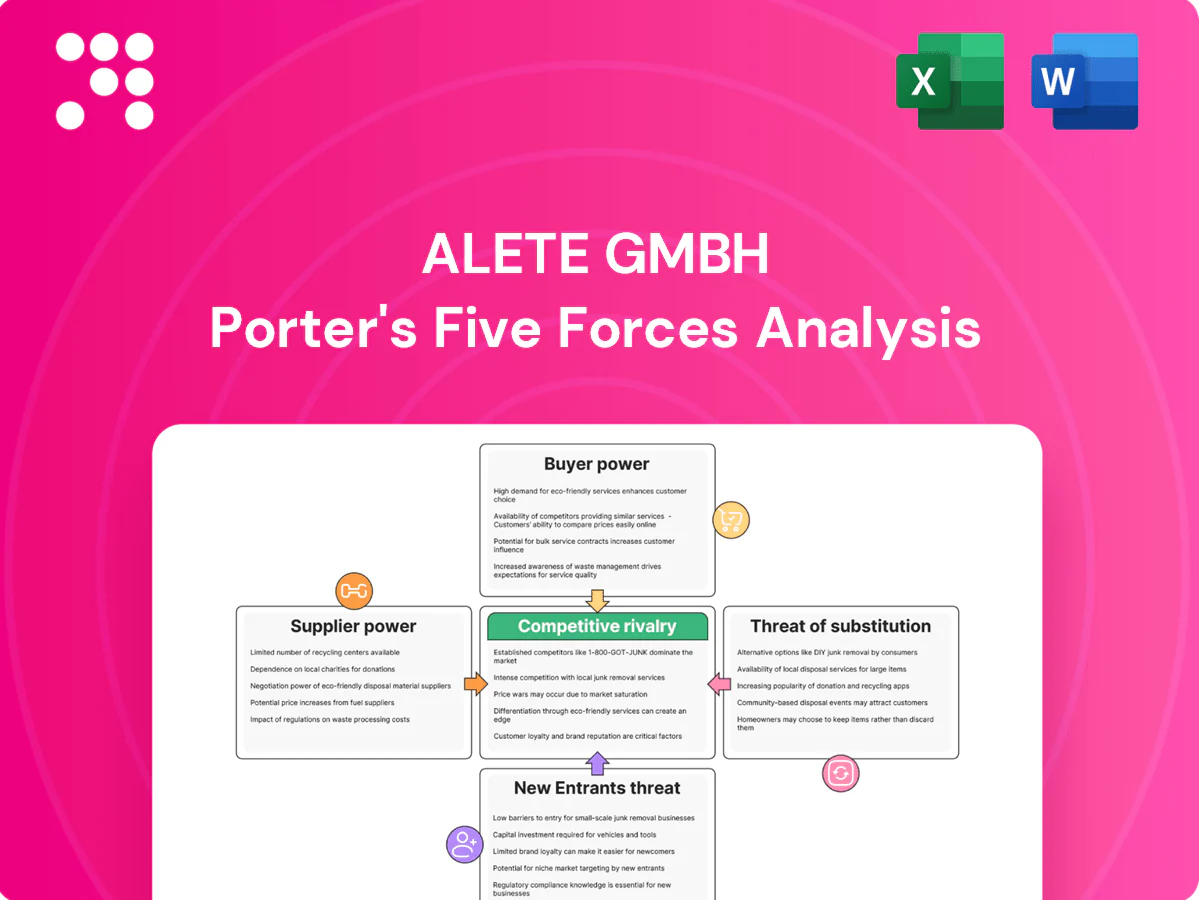
Alete GmbH Porter's Five Forces Analysis

Go Beyond the Preview—Access the Full Strategic Report
A concise Porter's Five Forces snapshot of Alete GmbH highlights moderate supplier power, strong buyer expectations, limited threat of new entrants, and rising substitute pressure from private-label baby foods. Tactical gaps in distribution and branding present both risks and opportunities. Deeper force-by-force ratings and visuals reveal strategic priorities. Unlock the full Porter's Five Forces Analysis to explore actionable insights.
Suppliers Bargaining Power

Dairy and grain inputs concentration
Milk powder and cereal grains are regionally concentrated inputs—New Zealand alone supplies roughly 30% of global milk powder exports while top grain exporters collectively account for about 70% of cereal trade—giving suppliers meaningful leverage. Seasonal volatility and strict quality/certification needs narrow Alete GmbH’s sourcing, pushing prices and limits on switching. Long-term contracts and hedging reduce price swings, and diversifying origins plus supplier development lowers exposure.
Specialized packaging and closures
Specialized BPA-free jars, retort pouches and child-safe caps come from niche vendors, raising switching costs via tooling (often $50,000–250,000), regulatory validation and 3–12 month shelf-life testing. Volume commitments can secure 5–15% pricing concessions, yet resin and glass input cost volatility transmits upstream pricing power. Dual-sourcing and standardizing formats can re-balance terms and reduce lead-time risk.

Fortified nutrients and additives
Vitamins, minerals and probiotics for baby foods demand pharma‑grade suppliers under GMP and frequent audits, concentrating supply and elevating supplier bargaining power; the global vitamins market surpassed $170 billion in 2024, underscoring scale and supplier leverage. Limited approved alternatives and audit burdens make switching costly, as reformulation requires new stability and safety studies and regulatory filings. Strategic partnerships and co‑development can secure priority allocation and improved commercial terms.

Organic and traceable ingredients
Organic fruits, grains and pasture-based dairy for Alete must meet certifier standards with full traceability, creating a limited supplier pool; supply tightness during poor harvests increases supplier leverage. Organic/no-added-sugar premiums (typically 15–25% in 2024) compress margins if not passed to consumers. Building farmer networks and pre-financing crops can secure supply and reduce price volatility.
- Traceability required
- Supply finite, weather-sensitive
- Premiums 15–25% (2024)
- Farmer networks and pre-finance lock supply
Logistics and sterilization services
Cold-chain niches and limited contract sterilization/retort capacity create bottlenecks for Alete GmbH, with typical external lead times of 3–6 months during peak seasons; regional tightness enables service providers to push rates higher and impose minimums. Compliance with infant-food sterilization standards raises switching costs, so Alete mitigates risk via in-house investments or long-term capacity reservations.
- High seasonal lead times 3–6 months
- Switching constrained by infant-food standards
- Mitigation: in-house capacity or long-term contracts
Supplier leverage: NZ milk ~30%, top grains ~70%, vitamins $170B—high premiums & long lead times
Suppliers hold meaningful leverage: New Zealand supplies ~30% of milk powder exports and top grain exporters account for ~70% of cereal trade, while vitamins market size reached $170B in 2024. Organic premiums (15–25% in 2024), niche packaging tooling ($50k–250k) and 3–6 month cold‑chain lead times raise switching costs; long‑term contracts, dual‑sourcing and farmer financing mitigate risk.
| Metric | Value | Implication |
|---|---|---|
| NZ milk powder | ~30% | Supplier concentration |
| Top grain exporters | ~70% | Price leverage |
| Vitamins market (2024) | $170B | Supplier scale |
| Organic premium (2024) | 15–25% | Margin pressure |
| Tooling cost | $50k–250k | High switching cost |
| Lead times | 3–6 months | Capacity tightness |
What is included in the product
 Detailed Word Document
Tailored Porter's Five Forces analysis for Alete GmbH that uncovers key competitive drivers, buyer and supplier power, threats from substitutes and new entrants, and disruptive market shifts affecting pricing and profitability—delivered in editable Word format for easy inclusion in investor materials, strategy decks, or academic work.

 Customizable Excel Spreadsheet
A clear one-sheet Porter's Five Forces for Alete GmbH—instantly visualizes competitive pressure with a spider chart and customizable inputs so non-finance teams can copy into decks and adapt scenarios without macros.
Customers Bargaining Power

Large retailers and drugstores
Grocery chains, discounters and drugstores (top 4 grocery retailers ~80% of German market; DM+Rossmann ~60% of drugstore sales in 2024) control shelf access and extract trade spend, with manufacturers allocating roughly 15% of sales to promotions. Rising private‑label penetration (≈48% in German grocery, 2024) increases price pressure and slotting fee demands, while high volume concentration strengthens negotiation leverage; joint business planning can secure space via exclusives.
E-commerce platforms and quick commerce
Marketplaces and quick-commerce apps drive price transparency and instant comparison in a global e-commerce market surpassing $5 trillion in 2024, increasing customer price sensitivity. Algorithmic rankings and commission structures amplify customer power by tying visibility to fees and engagement metrics. With 87% of shoppers consulting reviews, negative feedback quickly depresses conversion in sensitive baby categories, while optimized content and direct-to-consumer channels reduce platform dependence.

Parents’ safety and nutrition sensitivity
Parents are highly informed and risk-averse, so Alete faces amplified sensitivity to recalls—global surveys in 2024 showed about 70% of parents would switch brands after a safety incident. Brand trust is hard-won and easily lost, increasing switching leverage and driving demand for clean labels and allergen clarity, which raises reformulation costs. Transparent QA and certifications (organic, HACCP) allow Alete to justify premium pricing.

Healthcare influencers
Healthcare influencers such as pediatricians, midwives and clinics strongly shape Alete GmbH product choice; endorsements or guideline shifts can rapidly swing demand and affect market access and reimbursement in certain countries.
Medical detailing and robust clinical evidence anchor prescriber preference, creating indirect buyer power that can outweigh individual consumer price sensitivity.
- Pediatrician/midwife recommendations drive clinical acceptance
- Guideline changes can rapidly reallocate demand
- Reimbursement sensitivity in some markets amplifies influence
- Clinical evidence and detailing secure prescriber preference
International distributors
In export markets master distributors aggregate demand and typically push margins of 10–30%, requesting marketing subsidies and extended payment terms commonly stretching 60–120 days; regulatory registrations (eg China NMPA, EU national dossiers) tie SKUs to local partners, raising distributor leverage. Performance-based contracts and staged exclusivity help rebalance power.
- Distributor margins: 10–30%
- Payment terms: 60–120 days
- Regulatory lock-in: NMPA/EU dossiers
Retail consolidation, 48% private label and 15% promo squeeze makers
Grocery chains (top 4 ≈80% Germany) and DM+Rossmann (≈60% drugstore sales, 2024) extract trade spend while private label (~48% grocery, 2024) raises price pressure; manufacturers spend ~15% of sales on promotions. E-commerce (> $5T global, 2024) and 87% review consultation increase price transparency. 70% of parents would switch after a safety incident (2024), boosting demand for certifications. Export distributors take 10–30% margins and 60–120 day terms.
| Metric | Value (2024) |
|---|---|
| Top4 grocery share Germany | ≈80% |
| Private label grocery | ≈48% |
| Drugstore DM+Rossmann | ≈60% |
| Promotion spend (mfr) | ≈15% sales |
| Global e‑commerce | > $5T |
| Shoppers checking reviews | 87% |
| Parents switch after incident | 70% |
| Distributor margins / terms | 10–30% / 60–120 days |
Same Document Delivered
Alete GmbH Porter's Five Forces Analysis
This preview shows the Alete GmbH Porter's Five Forces analysis exactly as delivered after purchase—no placeholders or samples. The full, professionally formatted document is ready for immediate download and use the moment you complete payment. What you see is what you get, complete and actionable.

Go Beyond the Preview—Access the Full Strategic Report
A concise Porter's Five Forces snapshot of Alete GmbH highlights moderate supplier power, strong buyer expectations, limited threat of new entrants, and rising substitute pressure from private-label baby foods. Tactical gaps in distribution and branding present both risks and opportunities. Deeper force-by-force ratings and visuals reveal strategic priorities. Unlock the full Porter's Five Forces Analysis to explore actionable insights.
Suppliers Bargaining Power
Dairy and grain inputs concentration
Milk powder and cereal grains are regionally concentrated inputs—New Zealand alone supplies roughly 30% of global milk powder exports while top grain exporters collectively account for about 70% of cereal trade—giving suppliers meaningful leverage. Seasonal volatility and strict quality/certification needs narrow Alete GmbH’s sourcing, pushing prices and limits on switching. Long-term contracts and hedging reduce price swings, and diversifying origins plus supplier development lowers exposure.
Specialized packaging and closures
Specialized BPA-free jars, retort pouches and child-safe caps come from niche vendors, raising switching costs via tooling (often $50,000–250,000), regulatory validation and 3–12 month shelf-life testing. Volume commitments can secure 5–15% pricing concessions, yet resin and glass input cost volatility transmits upstream pricing power. Dual-sourcing and standardizing formats can re-balance terms and reduce lead-time risk.
Fortified nutrients and additives
Vitamins, minerals and probiotics for baby foods demand pharma‑grade suppliers under GMP and frequent audits, concentrating supply and elevating supplier bargaining power; the global vitamins market surpassed $170 billion in 2024, underscoring scale and supplier leverage. Limited approved alternatives and audit burdens make switching costly, as reformulation requires new stability and safety studies and regulatory filings. Strategic partnerships and co‑development can secure priority allocation and improved commercial terms.
Organic and traceable ingredients
Organic fruits, grains and pasture-based dairy for Alete must meet certifier standards with full traceability, creating a limited supplier pool; supply tightness during poor harvests increases supplier leverage. Organic/no-added-sugar premiums (typically 15–25% in 2024) compress margins if not passed to consumers. Building farmer networks and pre-financing crops can secure supply and reduce price volatility.
- Traceability required
- Supply finite, weather-sensitive
- Premiums 15–25% (2024)
- Farmer networks and pre-finance lock supply
Logistics and sterilization services
Cold-chain niches and limited contract sterilization/retort capacity create bottlenecks for Alete GmbH, with typical external lead times of 3–6 months during peak seasons; regional tightness enables service providers to push rates higher and impose minimums. Compliance with infant-food sterilization standards raises switching costs, so Alete mitigates risk via in-house investments or long-term capacity reservations.
- High seasonal lead times 3–6 months
- Switching constrained by infant-food standards
- Mitigation: in-house capacity or long-term contracts
Supplier leverage: NZ milk ~30%, top grains ~70%, vitamins $170B—high premiums & long lead times
Suppliers hold meaningful leverage: New Zealand supplies ~30% of milk powder exports and top grain exporters account for ~70% of cereal trade, while vitamins market size reached $170B in 2024. Organic premiums (15–25% in 2024), niche packaging tooling ($50k–250k) and 3–6 month cold‑chain lead times raise switching costs; long‑term contracts, dual‑sourcing and farmer financing mitigate risk.
| Metric | Value | Implication |
|---|---|---|
| NZ milk powder | ~30% | Supplier concentration |
| Top grain exporters | ~70% | Price leverage |
| Vitamins market (2024) | $170B | Supplier scale |
| Organic premium (2024) | 15–25% | Margin pressure |
| Tooling cost | $50k–250k | High switching cost |
| Lead times | 3–6 months | Capacity tightness |
What is included in the product
Detailed Word Document
Tailored Porter's Five Forces analysis for Alete GmbH that uncovers key competitive drivers, buyer and supplier power, threats from substitutes and new entrants, and disruptive market shifts affecting pricing and profitability—delivered in editable Word format for easy inclusion in investor materials, strategy decks, or academic work.
Customizable Excel Spreadsheet
A clear one-sheet Porter's Five Forces for Alete GmbH—instantly visualizes competitive pressure with a spider chart and customizable inputs so non-finance teams can copy into decks and adapt scenarios without macros.
Customers Bargaining Power
Large retailers and drugstores
Grocery chains, discounters and drugstores (top 4 grocery retailers ~80% of German market; DM+Rossmann ~60% of drugstore sales in 2024) control shelf access and extract trade spend, with manufacturers allocating roughly 15% of sales to promotions. Rising private‑label penetration (≈48% in German grocery, 2024) increases price pressure and slotting fee demands, while high volume concentration strengthens negotiation leverage; joint business planning can secure space via exclusives.
E-commerce platforms and quick commerce
Marketplaces and quick-commerce apps drive price transparency and instant comparison in a global e-commerce market surpassing $5 trillion in 2024, increasing customer price sensitivity. Algorithmic rankings and commission structures amplify customer power by tying visibility to fees and engagement metrics. With 87% of shoppers consulting reviews, negative feedback quickly depresses conversion in sensitive baby categories, while optimized content and direct-to-consumer channels reduce platform dependence.
Parents’ safety and nutrition sensitivity
Parents are highly informed and risk-averse, so Alete faces amplified sensitivity to recalls—global surveys in 2024 showed about 70% of parents would switch brands after a safety incident. Brand trust is hard-won and easily lost, increasing switching leverage and driving demand for clean labels and allergen clarity, which raises reformulation costs. Transparent QA and certifications (organic, HACCP) allow Alete to justify premium pricing.
Healthcare influencers
Healthcare influencers such as pediatricians, midwives and clinics strongly shape Alete GmbH product choice; endorsements or guideline shifts can rapidly swing demand and affect market access and reimbursement in certain countries.
Medical detailing and robust clinical evidence anchor prescriber preference, creating indirect buyer power that can outweigh individual consumer price sensitivity.
- Pediatrician/midwife recommendations drive clinical acceptance
- Guideline changes can rapidly reallocate demand
- Reimbursement sensitivity in some markets amplifies influence
- Clinical evidence and detailing secure prescriber preference
International distributors
In export markets master distributors aggregate demand and typically push margins of 10–30%, requesting marketing subsidies and extended payment terms commonly stretching 60–120 days; regulatory registrations (eg China NMPA, EU national dossiers) tie SKUs to local partners, raising distributor leverage. Performance-based contracts and staged exclusivity help rebalance power.
- Distributor margins: 10–30%
- Payment terms: 60–120 days
- Regulatory lock-in: NMPA/EU dossiers
Retail consolidation, 48% private label and 15% promo squeeze makers
Grocery chains (top 4 ≈80% Germany) and DM+Rossmann (≈60% drugstore sales, 2024) extract trade spend while private label (~48% grocery, 2024) raises price pressure; manufacturers spend ~15% of sales on promotions. E-commerce (> $5T global, 2024) and 87% review consultation increase price transparency. 70% of parents would switch after a safety incident (2024), boosting demand for certifications. Export distributors take 10–30% margins and 60–120 day terms.
| Metric | Value (2024) |
|---|---|
| Top4 grocery share Germany | ≈80% |
| Private label grocery | ≈48% |
| Drugstore DM+Rossmann | ≈60% |
| Promotion spend (mfr) | ≈15% sales |
| Global e‑commerce | > $5T |
| Shoppers checking reviews | 87% |
| Parents switch after incident | 70% |
| Distributor margins / terms | 10–30% / 60–120 days |
Same Document Delivered
Alete GmbH Porter's Five Forces Analysis
This preview shows the Alete GmbH Porter's Five Forces analysis exactly as delivered after purchase—no placeholders or samples. The full, professionally formatted document is ready for immediate download and use the moment you complete payment. What you see is what you get, complete and actionable.
Original: $10.00
-65%$10.00
$3.50Description
Go Beyond the Preview—Access the Full Strategic Report
A concise Porter's Five Forces snapshot of Alete GmbH highlights moderate supplier power, strong buyer expectations, limited threat of new entrants, and rising substitute pressure from private-label baby foods. Tactical gaps in distribution and branding present both risks and opportunities. Deeper force-by-force ratings and visuals reveal strategic priorities. Unlock the full Porter's Five Forces Analysis to explore actionable insights.
Suppliers Bargaining Power
Dairy and grain inputs concentration
Milk powder and cereal grains are regionally concentrated inputs—New Zealand alone supplies roughly 30% of global milk powder exports while top grain exporters collectively account for about 70% of cereal trade—giving suppliers meaningful leverage. Seasonal volatility and strict quality/certification needs narrow Alete GmbH’s sourcing, pushing prices and limits on switching. Long-term contracts and hedging reduce price swings, and diversifying origins plus supplier development lowers exposure.
Specialized packaging and closures
Specialized BPA-free jars, retort pouches and child-safe caps come from niche vendors, raising switching costs via tooling (often $50,000–250,000), regulatory validation and 3–12 month shelf-life testing. Volume commitments can secure 5–15% pricing concessions, yet resin and glass input cost volatility transmits upstream pricing power. Dual-sourcing and standardizing formats can re-balance terms and reduce lead-time risk.
Fortified nutrients and additives
Vitamins, minerals and probiotics for baby foods demand pharma‑grade suppliers under GMP and frequent audits, concentrating supply and elevating supplier bargaining power; the global vitamins market surpassed $170 billion in 2024, underscoring scale and supplier leverage. Limited approved alternatives and audit burdens make switching costly, as reformulation requires new stability and safety studies and regulatory filings. Strategic partnerships and co‑development can secure priority allocation and improved commercial terms.
Organic and traceable ingredients
Organic fruits, grains and pasture-based dairy for Alete must meet certifier standards with full traceability, creating a limited supplier pool; supply tightness during poor harvests increases supplier leverage. Organic/no-added-sugar premiums (typically 15–25% in 2024) compress margins if not passed to consumers. Building farmer networks and pre-financing crops can secure supply and reduce price volatility.
- Traceability required
- Supply finite, weather-sensitive
- Premiums 15–25% (2024)
- Farmer networks and pre-finance lock supply
Logistics and sterilization services
Cold-chain niches and limited contract sterilization/retort capacity create bottlenecks for Alete GmbH, with typical external lead times of 3–6 months during peak seasons; regional tightness enables service providers to push rates higher and impose minimums. Compliance with infant-food sterilization standards raises switching costs, so Alete mitigates risk via in-house investments or long-term capacity reservations.
- High seasonal lead times 3–6 months
- Switching constrained by infant-food standards
- Mitigation: in-house capacity or long-term contracts
Supplier leverage: NZ milk ~30%, top grains ~70%, vitamins $170B—high premiums & long lead times
Suppliers hold meaningful leverage: New Zealand supplies ~30% of milk powder exports and top grain exporters account for ~70% of cereal trade, while vitamins market size reached $170B in 2024. Organic premiums (15–25% in 2024), niche packaging tooling ($50k–250k) and 3–6 month cold‑chain lead times raise switching costs; long‑term contracts, dual‑sourcing and farmer financing mitigate risk.
| Metric | Value | Implication |
|---|---|---|
| NZ milk powder | ~30% | Supplier concentration |
| Top grain exporters | ~70% | Price leverage |
| Vitamins market (2024) | $170B | Supplier scale |
| Organic premium (2024) | 15–25% | Margin pressure |
| Tooling cost | $50k–250k | High switching cost |
| Lead times | 3–6 months | Capacity tightness |
What is included in the product
Detailed Word Document
Tailored Porter's Five Forces analysis for Alete GmbH that uncovers key competitive drivers, buyer and supplier power, threats from substitutes and new entrants, and disruptive market shifts affecting pricing and profitability—delivered in editable Word format for easy inclusion in investor materials, strategy decks, or academic work.
Customizable Excel Spreadsheet
A clear one-sheet Porter's Five Forces for Alete GmbH—instantly visualizes competitive pressure with a spider chart and customizable inputs so non-finance teams can copy into decks and adapt scenarios without macros.
Customers Bargaining Power
Large retailers and drugstores
Grocery chains, discounters and drugstores (top 4 grocery retailers ~80% of German market; DM+Rossmann ~60% of drugstore sales in 2024) control shelf access and extract trade spend, with manufacturers allocating roughly 15% of sales to promotions. Rising private‑label penetration (≈48% in German grocery, 2024) increases price pressure and slotting fee demands, while high volume concentration strengthens negotiation leverage; joint business planning can secure space via exclusives.
E-commerce platforms and quick commerce
Marketplaces and quick-commerce apps drive price transparency and instant comparison in a global e-commerce market surpassing $5 trillion in 2024, increasing customer price sensitivity. Algorithmic rankings and commission structures amplify customer power by tying visibility to fees and engagement metrics. With 87% of shoppers consulting reviews, negative feedback quickly depresses conversion in sensitive baby categories, while optimized content and direct-to-consumer channels reduce platform dependence.
Parents’ safety and nutrition sensitivity
Parents are highly informed and risk-averse, so Alete faces amplified sensitivity to recalls—global surveys in 2024 showed about 70% of parents would switch brands after a safety incident. Brand trust is hard-won and easily lost, increasing switching leverage and driving demand for clean labels and allergen clarity, which raises reformulation costs. Transparent QA and certifications (organic, HACCP) allow Alete to justify premium pricing.
Healthcare influencers
Healthcare influencers such as pediatricians, midwives and clinics strongly shape Alete GmbH product choice; endorsements or guideline shifts can rapidly swing demand and affect market access and reimbursement in certain countries.
Medical detailing and robust clinical evidence anchor prescriber preference, creating indirect buyer power that can outweigh individual consumer price sensitivity.
- Pediatrician/midwife recommendations drive clinical acceptance
- Guideline changes can rapidly reallocate demand
- Reimbursement sensitivity in some markets amplifies influence
- Clinical evidence and detailing secure prescriber preference
International distributors
In export markets master distributors aggregate demand and typically push margins of 10–30%, requesting marketing subsidies and extended payment terms commonly stretching 60–120 days; regulatory registrations (eg China NMPA, EU national dossiers) tie SKUs to local partners, raising distributor leverage. Performance-based contracts and staged exclusivity help rebalance power.
- Distributor margins: 10–30%
- Payment terms: 60–120 days
- Regulatory lock-in: NMPA/EU dossiers
Retail consolidation, 48% private label and 15% promo squeeze makers
Grocery chains (top 4 ≈80% Germany) and DM+Rossmann (≈60% drugstore sales, 2024) extract trade spend while private label (~48% grocery, 2024) raises price pressure; manufacturers spend ~15% of sales on promotions. E-commerce (> $5T global, 2024) and 87% review consultation increase price transparency. 70% of parents would switch after a safety incident (2024), boosting demand for certifications. Export distributors take 10–30% margins and 60–120 day terms.
| Metric | Value (2024) |
|---|---|
| Top4 grocery share Germany | ≈80% |
| Private label grocery | ≈48% |
| Drugstore DM+Rossmann | ≈60% |
| Promotion spend (mfr) | ≈15% sales |
| Global e‑commerce | > $5T |
| Shoppers checking reviews | 87% |
| Parents switch after incident | 70% |
| Distributor margins / terms | 10–30% / 60–120 days |
Same Document Delivered
Alete GmbH Porter's Five Forces Analysis
This preview shows the Alete GmbH Porter's Five Forces analysis exactly as delivered after purchase—no placeholders or samples. The full, professionally formatted document is ready for immediate download and use the moment you complete payment. What you see is what you get, complete and actionable.











