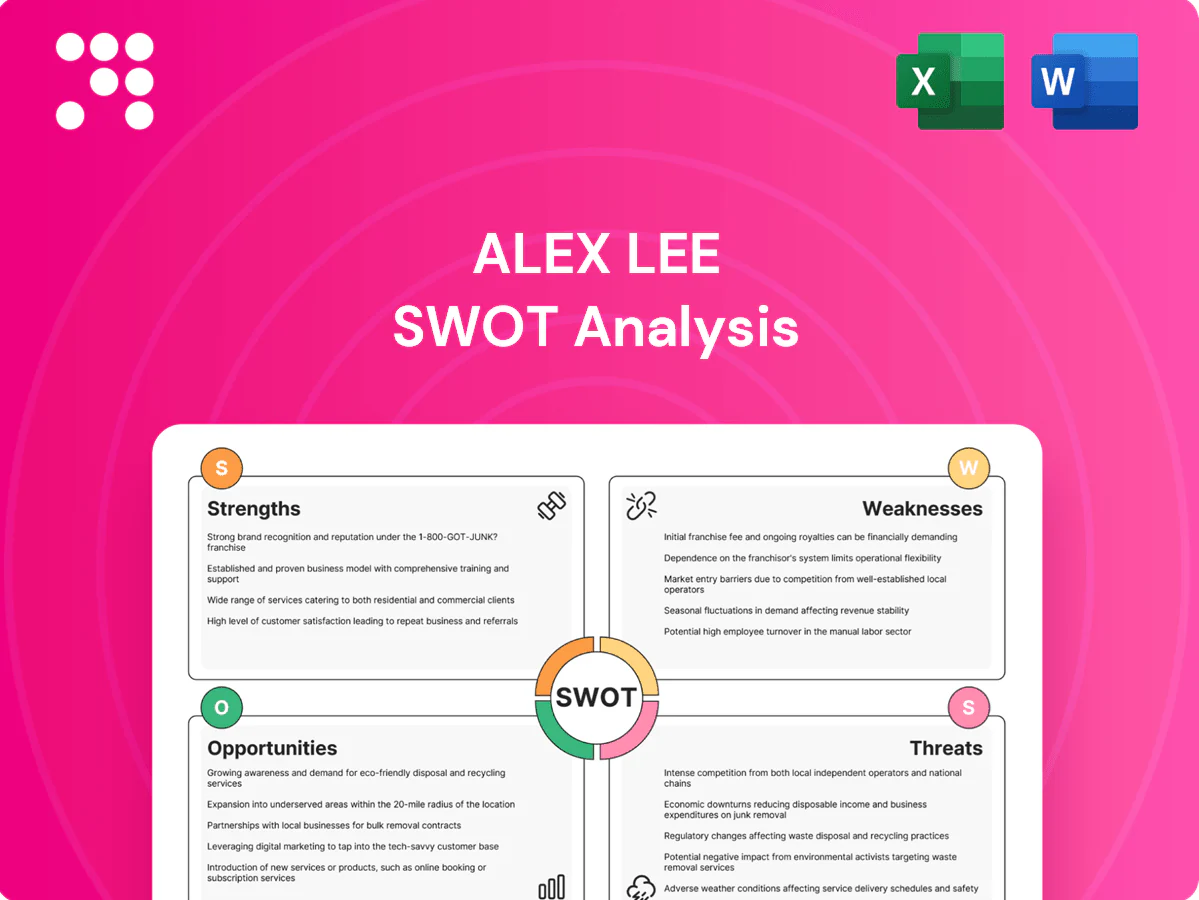
Alex Lee SWOT Analysis

Your Strategic Toolkit Starts Here
Discover how Alex Lee’s competitive foothold, supply-chain strengths, and regional retail reach shape risks and opportunities in our concise SWOT preview. Want the full strategic picture—detailed strengths, quantified risks, and growth scenarios? Purchase the complete SWOT analysis for a professionally formatted Word report and editable Excel matrix to support investing, planning, and presentations.
Strengths

Integrated wholesale–retail model
Owning both MDI and Lowes Foods creates vertical integration that captures margin across the value chain and supports scale efficiencies; Lowes Foods operates roughly 96 stores in the Carolinas. Retail insights flow back into wholesale merchandising and assortment, enabling coordinated promotions and sharper pricing. This structure improves demand forecasting and inventory turns and reduces dependence on external partners.
Diverse revenue from multiple banners
Wholesale distribution via Merchants Distributors, Inc. balances cyclicality of Lowes Foods’ own-store retail, with Lowes Foods operating about 100 stores across the Carolinas.
Customer mix spanning urban, suburban and rural independent grocers across the Southeast spreads geographic and demand risk.
Broad category mix in food and non-food merchandise stabilizes topline and cushions shocks in any single segment.

Strong regional footprint and relationships
Longstanding ties with independent grocers and the company’s Lowes Foods banner (about 100 stores) create sticky accounts and steady repeat volume. Regional expertise across the Southeast improves local assortment, perishables quality and service levels, supporting higher basket rings and lower shrink. Close proximity to customers shortens lead times and trims logistics costs, while a solid reputation strengthens supplier terms and aids new account wins.

Private ownership and long-term focus
Being privately held allows Alex Lee to invest through cycles without quarterly pressure. Management can prioritize network optimization, technology, and store formats across Lowes Foods and Merchants Distributors Inc.; company founded 1931 and headquartered in Hickory, NC. Cultural continuity supports execution discipline and drives steady operational improvements like store remodels and omnichannel rollout.
- Long-term investment horizon
- Network, tech, format prioritization
- Stable culture and execution discipline
- Consistent operational improvements
Operational logistics capabilities
MDI’s Hickory-based distribution network enables broad SKU depth and reliable service across company and wholesale clients, supporting Lowes Foods’ ~95 stores; centralized procurement at Alex Lee yields scale benefits in vendor negotiation and inventory turns. Higher route density and warehouse optimization reduce unit distribution costs, strengthening price and service competitiveness for both wholesale customers and retail outlets.
- Distribution reach: centralized MDI network
- Procurement: consolidated purchasing scale
- Cost efficiency: route density and warehouse optimization
Integrated retail-distribution ownership captures margins and lowers costs for ~95-100 stores
Owning MDI and Lowes Foods captures margin across the value chain and supports scale; Lowes Foods operates ~95–100 stores in the Carolinas. MDI’s Hickory distribution network centralizes procurement, increases route density and lowers unit distribution costs for retail and wholesale customers. Private ownership (founded 1931, HQ Hickory, NC) enables long-term investment and steady operational improvements.
| Metric | Value |
|---|---|
| Lowes Foods stores | ~95–100 |
| Company founded | 1931 |
| Headquarters | Hickory, NC |
What is included in the product
 Detailed Word Document
Provides a clear SWOT framework for analyzing Alex Lee’s business strategy, highlighting internal capabilities, market strengths, operational gaps, and external opportunities and threats shaping its competitive position.

 Customizable Excel Spreadsheet
Provides a compact, actionable SWOT matrix tailored to Alex Lee for rapid identification and resolution of strategic pain points.
Weaknesses

Geographic concentration risk
Geographic concentration in the Southeast—Lowes Foods operates about 95 stores (company data, 2023)—limits exposure to faster-growing Sun Belt and national urban markets. This regional focus raises vulnerability to localized economic slowdowns and weather shocks (hurricanes) that can sharply cut weekly sales. Limited scale vs national chains weakens supplier leverage and makes expansion capital-intensive; Alex Lee reported roughly $4.4bn in net sales in 2023, constraining rapid rollouts.
Lower brand recognition vs nationals
Lowes Foods, part of Alex Lee, competes against national chains—Walmart held roughly 25% of U.S. grocery sales in 2023—giving rivals much larger advertising budgets and broader mindshare in contested markets. This disparity can pressure pricing power and foot traffic, forcing tighter margins. Greater marketing efficiency and targeted local spend are needed to offset scale disadvantages and defend share.

Dependence on independents’ health
Alex Lee’s wholesale volumes hinge on independent grocers’ competitiveness, and the company’s throughput can swing materially if independents lose market share; Alex Lee (NASDAQ: ALX) reported roughly $5.6 billion in 2024 net sales, underscoring scale tied to independents. Independents face margin pressure from big-box, club and discounters, squeezing order sizes and frequency. Store closures or consolidations among smaller chains directly reduce MDI throughput, while credit exposure to smaller accounts raises receivables risk.

Technology investment gap potential
Large peers deploy advanced data science, automation and hyper-personalization at scale, and matching these capabilities requires sustained capex and specialized talent that Alex Lee currently underallocates.
Legacy POS and ERP systems constrain true omnichannel fulfillment and real-time inventory visibility, increasing stockouts and markdown risk.
If investment and talent acquisition are not accelerated, the technology gap versus competitors will widen, reducing market share and margin resilience.
- Underinvestment in tech versus peers
- Legacy systems limit omnichannel/real-time inventory
- Requires sustained capex and specialized hires
- Gap can compound quickly without aggressive action
Exposure to perishables complexity
High perishables mix raises shrink and logistics complexity; US food waste is estimated at 30–40% of the food supply, increasing cost exposure. Temperature control and forecasting accuracy are critical to limit spoilage and recalls. Supply volatility and food-safety risks heighten operating burden and can sharply amplify cost and reputational impact.
- Shrink exposure: higher spoilage risk
- Operational: strict cold-chain & forecasting
- Risk: recalls, volatile supply
Regional grocer faces concentrated footprint, tech gaps and perishables exposure
Regional concentration (≈95 Lowes Foods stores, company 2023) and $5.6bn Alex Lee net sales (2024) limit national scale and raise exposure to local economic/weather shocks. Technology underinvestment and legacy POS/ERP hinder omnichannel and personalized pricing. Heavy perishables mix and dependency on independents amplify shrink, supply volatility and receivables risk.
| Metric | Value | Impact |
|---|---|---|
| Stores | ≈95 (2023) | Regional risk |
| Net sales | $5.6bn (2024) | Scale limits |
Preview Before You Purchase
Alex Lee SWOT Analysis
This preview is an authentic excerpt from the Alex Lee SWOT analysis you’ll receive upon purchase—no surprises, just professional quality. The full, editable report matches this file exactly. Buy now to unlock the complete, detailed document.

Your Strategic Toolkit Starts Here
Discover how Alex Lee’s competitive foothold, supply-chain strengths, and regional retail reach shape risks and opportunities in our concise SWOT preview. Want the full strategic picture—detailed strengths, quantified risks, and growth scenarios? Purchase the complete SWOT analysis for a professionally formatted Word report and editable Excel matrix to support investing, planning, and presentations.
Strengths
Integrated wholesale–retail model
Owning both MDI and Lowes Foods creates vertical integration that captures margin across the value chain and supports scale efficiencies; Lowes Foods operates roughly 96 stores in the Carolinas. Retail insights flow back into wholesale merchandising and assortment, enabling coordinated promotions and sharper pricing. This structure improves demand forecasting and inventory turns and reduces dependence on external partners.
Diverse revenue from multiple banners
Wholesale distribution via Merchants Distributors, Inc. balances cyclicality of Lowes Foods’ own-store retail, with Lowes Foods operating about 100 stores across the Carolinas.
Customer mix spanning urban, suburban and rural independent grocers across the Southeast spreads geographic and demand risk.
Broad category mix in food and non-food merchandise stabilizes topline and cushions shocks in any single segment.
Strong regional footprint and relationships
Longstanding ties with independent grocers and the company’s Lowes Foods banner (about 100 stores) create sticky accounts and steady repeat volume. Regional expertise across the Southeast improves local assortment, perishables quality and service levels, supporting higher basket rings and lower shrink. Close proximity to customers shortens lead times and trims logistics costs, while a solid reputation strengthens supplier terms and aids new account wins.
Private ownership and long-term focus
Being privately held allows Alex Lee to invest through cycles without quarterly pressure. Management can prioritize network optimization, technology, and store formats across Lowes Foods and Merchants Distributors Inc.; company founded 1931 and headquartered in Hickory, NC. Cultural continuity supports execution discipline and drives steady operational improvements like store remodels and omnichannel rollout.
- Long-term investment horizon
- Network, tech, format prioritization
- Stable culture and execution discipline
- Consistent operational improvements
Operational logistics capabilities
MDI’s Hickory-based distribution network enables broad SKU depth and reliable service across company and wholesale clients, supporting Lowes Foods’ ~95 stores; centralized procurement at Alex Lee yields scale benefits in vendor negotiation and inventory turns. Higher route density and warehouse optimization reduce unit distribution costs, strengthening price and service competitiveness for both wholesale customers and retail outlets.
- Distribution reach: centralized MDI network
- Procurement: consolidated purchasing scale
- Cost efficiency: route density and warehouse optimization
Integrated retail-distribution ownership captures margins and lowers costs for ~95-100 stores
Owning MDI and Lowes Foods captures margin across the value chain and supports scale; Lowes Foods operates ~95–100 stores in the Carolinas. MDI’s Hickory distribution network centralizes procurement, increases route density and lowers unit distribution costs for retail and wholesale customers. Private ownership (founded 1931, HQ Hickory, NC) enables long-term investment and steady operational improvements.
| Metric | Value |
|---|---|
| Lowes Foods stores | ~95–100 |
| Company founded | 1931 |
| Headquarters | Hickory, NC |
What is included in the product
Detailed Word Document
Provides a clear SWOT framework for analyzing Alex Lee’s business strategy, highlighting internal capabilities, market strengths, operational gaps, and external opportunities and threats shaping its competitive position.
Customizable Excel Spreadsheet
Provides a compact, actionable SWOT matrix tailored to Alex Lee for rapid identification and resolution of strategic pain points.
Weaknesses
Geographic concentration risk
Geographic concentration in the Southeast—Lowes Foods operates about 95 stores (company data, 2023)—limits exposure to faster-growing Sun Belt and national urban markets. This regional focus raises vulnerability to localized economic slowdowns and weather shocks (hurricanes) that can sharply cut weekly sales. Limited scale vs national chains weakens supplier leverage and makes expansion capital-intensive; Alex Lee reported roughly $4.4bn in net sales in 2023, constraining rapid rollouts.
Lower brand recognition vs nationals
Lowes Foods, part of Alex Lee, competes against national chains—Walmart held roughly 25% of U.S. grocery sales in 2023—giving rivals much larger advertising budgets and broader mindshare in contested markets. This disparity can pressure pricing power and foot traffic, forcing tighter margins. Greater marketing efficiency and targeted local spend are needed to offset scale disadvantages and defend share.
Dependence on independents’ health
Alex Lee’s wholesale volumes hinge on independent grocers’ competitiveness, and the company’s throughput can swing materially if independents lose market share; Alex Lee (NASDAQ: ALX) reported roughly $5.6 billion in 2024 net sales, underscoring scale tied to independents. Independents face margin pressure from big-box, club and discounters, squeezing order sizes and frequency. Store closures or consolidations among smaller chains directly reduce MDI throughput, while credit exposure to smaller accounts raises receivables risk.
Technology investment gap potential
Large peers deploy advanced data science, automation and hyper-personalization at scale, and matching these capabilities requires sustained capex and specialized talent that Alex Lee currently underallocates.
Legacy POS and ERP systems constrain true omnichannel fulfillment and real-time inventory visibility, increasing stockouts and markdown risk.
If investment and talent acquisition are not accelerated, the technology gap versus competitors will widen, reducing market share and margin resilience.
- Underinvestment in tech versus peers
- Legacy systems limit omnichannel/real-time inventory
- Requires sustained capex and specialized hires
- Gap can compound quickly without aggressive action
Exposure to perishables complexity
High perishables mix raises shrink and logistics complexity; US food waste is estimated at 30–40% of the food supply, increasing cost exposure. Temperature control and forecasting accuracy are critical to limit spoilage and recalls. Supply volatility and food-safety risks heighten operating burden and can sharply amplify cost and reputational impact.
- Shrink exposure: higher spoilage risk
- Operational: strict cold-chain & forecasting
- Risk: recalls, volatile supply
Regional grocer faces concentrated footprint, tech gaps and perishables exposure
Regional concentration (≈95 Lowes Foods stores, company 2023) and $5.6bn Alex Lee net sales (2024) limit national scale and raise exposure to local economic/weather shocks. Technology underinvestment and legacy POS/ERP hinder omnichannel and personalized pricing. Heavy perishables mix and dependency on independents amplify shrink, supply volatility and receivables risk.
| Metric | Value | Impact |
|---|---|---|
| Stores | ≈95 (2023) | Regional risk |
| Net sales | $5.6bn (2024) | Scale limits |
Preview Before You Purchase
Alex Lee SWOT Analysis
This preview is an authentic excerpt from the Alex Lee SWOT analysis you’ll receive upon purchase—no surprises, just professional quality. The full, editable report matches this file exactly. Buy now to unlock the complete, detailed document.
Description
Your Strategic Toolkit Starts Here
Discover how Alex Lee’s competitive foothold, supply-chain strengths, and regional retail reach shape risks and opportunities in our concise SWOT preview. Want the full strategic picture—detailed strengths, quantified risks, and growth scenarios? Purchase the complete SWOT analysis for a professionally formatted Word report and editable Excel matrix to support investing, planning, and presentations.
Strengths
Integrated wholesale–retail model
Owning both MDI and Lowes Foods creates vertical integration that captures margin across the value chain and supports scale efficiencies; Lowes Foods operates roughly 96 stores in the Carolinas. Retail insights flow back into wholesale merchandising and assortment, enabling coordinated promotions and sharper pricing. This structure improves demand forecasting and inventory turns and reduces dependence on external partners.
Diverse revenue from multiple banners
Wholesale distribution via Merchants Distributors, Inc. balances cyclicality of Lowes Foods’ own-store retail, with Lowes Foods operating about 100 stores across the Carolinas.
Customer mix spanning urban, suburban and rural independent grocers across the Southeast spreads geographic and demand risk.
Broad category mix in food and non-food merchandise stabilizes topline and cushions shocks in any single segment.
Strong regional footprint and relationships
Longstanding ties with independent grocers and the company’s Lowes Foods banner (about 100 stores) create sticky accounts and steady repeat volume. Regional expertise across the Southeast improves local assortment, perishables quality and service levels, supporting higher basket rings and lower shrink. Close proximity to customers shortens lead times and trims logistics costs, while a solid reputation strengthens supplier terms and aids new account wins.
Private ownership and long-term focus
Being privately held allows Alex Lee to invest through cycles without quarterly pressure. Management can prioritize network optimization, technology, and store formats across Lowes Foods and Merchants Distributors Inc.; company founded 1931 and headquartered in Hickory, NC. Cultural continuity supports execution discipline and drives steady operational improvements like store remodels and omnichannel rollout.
- Long-term investment horizon
- Network, tech, format prioritization
- Stable culture and execution discipline
- Consistent operational improvements
Operational logistics capabilities
MDI’s Hickory-based distribution network enables broad SKU depth and reliable service across company and wholesale clients, supporting Lowes Foods’ ~95 stores; centralized procurement at Alex Lee yields scale benefits in vendor negotiation and inventory turns. Higher route density and warehouse optimization reduce unit distribution costs, strengthening price and service competitiveness for both wholesale customers and retail outlets.
- Distribution reach: centralized MDI network
- Procurement: consolidated purchasing scale
- Cost efficiency: route density and warehouse optimization
Integrated retail-distribution ownership captures margins and lowers costs for ~95-100 stores
Owning MDI and Lowes Foods captures margin across the value chain and supports scale; Lowes Foods operates ~95–100 stores in the Carolinas. MDI’s Hickory distribution network centralizes procurement, increases route density and lowers unit distribution costs for retail and wholesale customers. Private ownership (founded 1931, HQ Hickory, NC) enables long-term investment and steady operational improvements.
| Metric | Value |
|---|---|
| Lowes Foods stores | ~95–100 |
| Company founded | 1931 |
| Headquarters | Hickory, NC |
What is included in the product
Detailed Word Document
Provides a clear SWOT framework for analyzing Alex Lee’s business strategy, highlighting internal capabilities, market strengths, operational gaps, and external opportunities and threats shaping its competitive position.
Customizable Excel Spreadsheet
Provides a compact, actionable SWOT matrix tailored to Alex Lee for rapid identification and resolution of strategic pain points.
Weaknesses
Geographic concentration risk
Geographic concentration in the Southeast—Lowes Foods operates about 95 stores (company data, 2023)—limits exposure to faster-growing Sun Belt and national urban markets. This regional focus raises vulnerability to localized economic slowdowns and weather shocks (hurricanes) that can sharply cut weekly sales. Limited scale vs national chains weakens supplier leverage and makes expansion capital-intensive; Alex Lee reported roughly $4.4bn in net sales in 2023, constraining rapid rollouts.
Lower brand recognition vs nationals
Lowes Foods, part of Alex Lee, competes against national chains—Walmart held roughly 25% of U.S. grocery sales in 2023—giving rivals much larger advertising budgets and broader mindshare in contested markets. This disparity can pressure pricing power and foot traffic, forcing tighter margins. Greater marketing efficiency and targeted local spend are needed to offset scale disadvantages and defend share.
Dependence on independents’ health
Alex Lee’s wholesale volumes hinge on independent grocers’ competitiveness, and the company’s throughput can swing materially if independents lose market share; Alex Lee (NASDAQ: ALX) reported roughly $5.6 billion in 2024 net sales, underscoring scale tied to independents. Independents face margin pressure from big-box, club and discounters, squeezing order sizes and frequency. Store closures or consolidations among smaller chains directly reduce MDI throughput, while credit exposure to smaller accounts raises receivables risk.
Technology investment gap potential
Large peers deploy advanced data science, automation and hyper-personalization at scale, and matching these capabilities requires sustained capex and specialized talent that Alex Lee currently underallocates.
Legacy POS and ERP systems constrain true omnichannel fulfillment and real-time inventory visibility, increasing stockouts and markdown risk.
If investment and talent acquisition are not accelerated, the technology gap versus competitors will widen, reducing market share and margin resilience.
- Underinvestment in tech versus peers
- Legacy systems limit omnichannel/real-time inventory
- Requires sustained capex and specialized hires
- Gap can compound quickly without aggressive action
Exposure to perishables complexity
High perishables mix raises shrink and logistics complexity; US food waste is estimated at 30–40% of the food supply, increasing cost exposure. Temperature control and forecasting accuracy are critical to limit spoilage and recalls. Supply volatility and food-safety risks heighten operating burden and can sharply amplify cost and reputational impact.
- Shrink exposure: higher spoilage risk
- Operational: strict cold-chain & forecasting
- Risk: recalls, volatile supply
Regional grocer faces concentrated footprint, tech gaps and perishables exposure
Regional concentration (≈95 Lowes Foods stores, company 2023) and $5.6bn Alex Lee net sales (2024) limit national scale and raise exposure to local economic/weather shocks. Technology underinvestment and legacy POS/ERP hinder omnichannel and personalized pricing. Heavy perishables mix and dependency on independents amplify shrink, supply volatility and receivables risk.
| Metric | Value | Impact |
|---|---|---|
| Stores | ≈95 (2023) | Regional risk |
| Net sales | $5.6bn (2024) | Scale limits |
Preview Before You Purchase
Alex Lee SWOT Analysis
This preview is an authentic excerpt from the Alex Lee SWOT analysis you’ll receive upon purchase—no surprises, just professional quality. The full, editable report matches this file exactly. Buy now to unlock the complete, detailed document.











