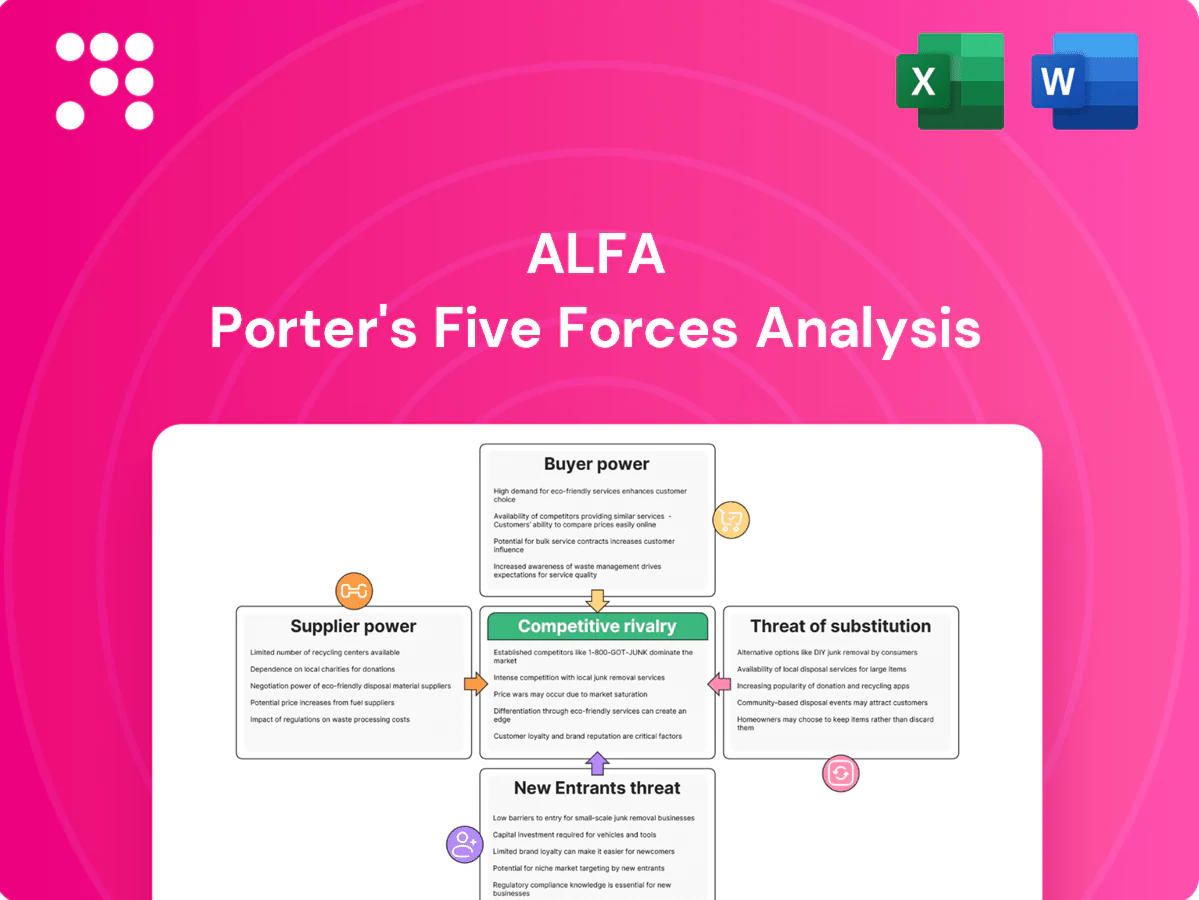
ALFA Porter's Five Forces Analysis

Elevate Your Analysis with the Complete Porter's Five Forces Analysis
ALFA's Porter's Five Forces snapshot highlights supplier leverage, buyer power, rivalry intensity, and threats from entrants and substitutes, plus strategic levers ALFA can use to strengthen its position. This brief preview only scratches the surface—unlock the full Porter's Five Forces Analysis for force-by-force ratings, visuals, and actionable recommendations to inform investment and strategy.
Suppliers Bargaining Power

Critical feedstocks concentrate power
Alpek relies heavily on crude-derived PX and MEG and on utilities supplied by a relatively concentrated upstream petrochemical and energy sector, amplifying supplier leverage; Brent averaged about 86 USD/bbl in 2024 and Henry Hub roughly 3.1 USD/MMBtu, tightening margins during shortages. Long-term contracts and hedges reduce volatility but leave basis risk intact. Regional energy policies and logistics bottlenecks in North and Latin America can further raise supplier power.
Agricultural inputs volatile but diversified
Sigma sources meat, dairy, grains and packaging from broad, fragmented supplier bases, which reduces individual supplier leverage and keeps input concentration low. However, disease outbreaks, climate shocks and commodity cycles can amplify collective supplier power—soybean and corn spot prices swung roughly 25% year‑on‑year in 2024. Private‑label and co‑packing partners can press terms during tight capacity periods. Multi‑sourcing and inventory buffers have tempered disruption risk.

Specialized alloys and tooling for Nemak
Specialized high-spec aluminum alloys, casting equipment and die tooling for Nemak create high switching costs and qualification hurdles, with requalification timelines in 2024 commonly taking 6–12 months. OEM quality standards and certified-vendor lists increase dependence on a narrow supplier pool, raising supplier bargaining power. Multi-million-dollar tooling investments and process know-how solidify suppliers’ leverage, though strategic partnerships and vertical process integration partially offset this.

Telecom network vendors exert leverage
Axtel depends on a narrow set of telecom equipment and software suppliers, creating vendor lock-in; Ericsson, Huawei and Nokia represented roughly two-thirds of the global RAN market in 2023–2024 (DellOro). Proprietary tech and long maintenance contracts raise switching costs, while spectrum access and wholesale backbone providers can push prices. Open standards and virtualization initiatives are reducing dependency over time.
- Vendor concentration: two-thirds RAN share (2023–24)
- Lock-in: proprietary stacks + maintenance contracts
- Pricing pressure: spectrum and backbone suppliers
- Mitigation: virtualization, open standards
Logistics and energy as systemic inputs
Freight, ports, and power availability are critical across ALFA’s footprint; major hubs like the Port of Los Angeles handled about 9.2m TEU in 2023, and tight trucking markets can push contract rates up 15–25%, shifting leverage to logistics providers while grid constraints in parts of Mexico and the US tighten supply reliability.
- Take-or-pay: often covers 70–100% of capacity
- Port throughput: LA ~9.2m TEU (2023)
- Trucking rate spikes: +15–25% in tight markets
- Geographic diversification: reduces localized utility/logistics risk
Supplier power moderate-to-high as petrochemical, energy and logistics concentration
Supplier power for ALFA is moderate‑to‑high: petrochemical and energy inputs concentrate upstream (Brent ~86 USD/bbl, Henry Hub ~3.1 USD/MMBtu in 2024) and logistics/providers (Port of LA ~9.2m TEU 2023) exert pricing leverage; specialized tooling and telecom vendors create lock‑in but multi‑sourcing and virtualization partially mitigate risk.
| Supplier | Concentration | 2023–24 metric | Mitigation |
|---|---|---|---|
| Energy/PX/MEG | High | Brent 86 USD/bbl (2024) | Hedges, long‑term contracts |
| Logistics | Medium | LA 9.2m TEU (2023) | Diversify ports |
What is included in the product
 Detailed Word Document
Comprehensive Porter's Five Forces analysis tailored for ALFA that uncovers competitive drivers, supplier and buyer power, substitutes and entrant threats, and disruptive market forces, with strategic commentary and actionable insights to inform pricing, entry barriers, and defensive positioning.

 Customizable Excel Spreadsheet
A concise Porter's Five Forces one-sheet for ALFA that instantly highlights strategic pressures with a clear spider chart and customizable scores—perfect for quick decisions, slide-ready reporting, and seamless integration into broader financial dashboards.
Customers Bargaining Power

Retail chains and foodservice have clout
Sigma sells into large modern-trade retailers and QSR chains that leverage scale and private-label programs to negotiate pricing, promotions and shelf space, exerting significant bargaining power. Strong brands and a broad product portfolio help Sigma defend margins and secure placements. Growing private-label penetration in processed foods increases buyer price sensitivity, pressuring industry-wide pricing and promotional intensity.
Auto OEMs are few and demanding
Nemak serves a concentrated set of global automakers—top 10 OEMs account for roughly 70% of light-vehicle production in 2024—giving customers high bargaining power. Platform sourcing, annual price-downs (commonly 1–3%) and performance penalties are standard, forcing suppliers to deliver cost leadership. Winning business requires innovation in lightweighting and EV components; multi-year awards (typically 3–5 years) provide volume visibility but compress margins.

Petrochemical customers are price-driven
Alpek’s PTA, PET and fiber buyers are highly price-driven, switching suppliers when prices and specifications align, which compresses seller margins. Transparent commodity benchmarks and exchange-traded indices reduce product differentiation and enable easy price comparison. Long-term contracts exist but commonly use formula-based pricing with raw-material pass-throughs, limiting margin protection. Downstream converters can dual-source, intensifying pressure during oversupplied cycles.

Enterprise and wholesale telecom buyers negotiate
Enterprise and wholesale buyers force Axtel into competitive bids, with enterprise RFPs often driving price concessions of 10–25% and SLAs targeting sub-1% monthly downtime penalties in 2024, increasing buyer leverage and churn risk.
Offering bundled value-added services (cloud, SD-WAN) shifts negotiations from pure price to total-value, while wholesale deals depend on scale and interconnection terms such as capacity tiers and port fees.
- RFP-driven discounts: 10–25%
- SLA pressure: <1% downtime targets
- Value-adds: cloud/SD-WAN reduce price focus
- Wholesale hinge: scale, interconnection fees
Global footprint dilutes single-buyer risk
Global footprint dilutes single-buyer risk: diverse geographies and end-markets lower dependence on any one customer, while cross-selling and a broad product portfolio create negotiating alternatives. Segment-level concentration (top OEMs) can still sway contract terms, but deep relationships and high service quality help retain key accounts and protect margins.
- Diverse geographies reduce buyer concentration
- Portfolio breadth enables cross-selling
- Top OEMs drive segment-level bargaining
- Service depth secures key accounts
Buyers squeeze prices; OEMs ~70%, RFPs demand 10–25%
Customers exert high bargaining power: modern retail/QSRs push pricing, promotions and shelf placement; Sigma offsets via brand and broad portfolio. OEMs concentrate power—top 10 account for ~70% of light-vehicle output in 2024—driving 1–3% annual price-downs and 3–5 year awards. Enterprise RFPs force 10–25% discounts and sub-1% SLA downtime targets, while value-added bundles partially shift focus from price.
| Segment | Metric | 2024 value |
|---|---|---|
| Retail / QSR | Promotions & private-label pressure | high |
| OEMs | Production share | ~70% |
| Enterprise | RFP discounts / SLA | 10–25% / <1% |
Same Document Delivered
ALFA Porter's Five Forces Analysis
This preview shows the exact ALFA Porter's Five Forces analysis you'll receive immediately after purchase—no placeholders or mockups. It covers competitive rivalry, buyer and supplier power, and threats of new entrants and substitutes with actionable strategic implications. The file is fully formatted, ready-to-use, and available instantly after payment.

Elevate Your Analysis with the Complete Porter's Five Forces Analysis
ALFA's Porter's Five Forces snapshot highlights supplier leverage, buyer power, rivalry intensity, and threats from entrants and substitutes, plus strategic levers ALFA can use to strengthen its position. This brief preview only scratches the surface—unlock the full Porter's Five Forces Analysis for force-by-force ratings, visuals, and actionable recommendations to inform investment and strategy.
Suppliers Bargaining Power
Critical feedstocks concentrate power
Alpek relies heavily on crude-derived PX and MEG and on utilities supplied by a relatively concentrated upstream petrochemical and energy sector, amplifying supplier leverage; Brent averaged about 86 USD/bbl in 2024 and Henry Hub roughly 3.1 USD/MMBtu, tightening margins during shortages. Long-term contracts and hedges reduce volatility but leave basis risk intact. Regional energy policies and logistics bottlenecks in North and Latin America can further raise supplier power.
Agricultural inputs volatile but diversified
Sigma sources meat, dairy, grains and packaging from broad, fragmented supplier bases, which reduces individual supplier leverage and keeps input concentration low. However, disease outbreaks, climate shocks and commodity cycles can amplify collective supplier power—soybean and corn spot prices swung roughly 25% year‑on‑year in 2024. Private‑label and co‑packing partners can press terms during tight capacity periods. Multi‑sourcing and inventory buffers have tempered disruption risk.
Specialized alloys and tooling for Nemak
Specialized high-spec aluminum alloys, casting equipment and die tooling for Nemak create high switching costs and qualification hurdles, with requalification timelines in 2024 commonly taking 6–12 months. OEM quality standards and certified-vendor lists increase dependence on a narrow supplier pool, raising supplier bargaining power. Multi-million-dollar tooling investments and process know-how solidify suppliers’ leverage, though strategic partnerships and vertical process integration partially offset this.
Telecom network vendors exert leverage
Axtel depends on a narrow set of telecom equipment and software suppliers, creating vendor lock-in; Ericsson, Huawei and Nokia represented roughly two-thirds of the global RAN market in 2023–2024 (DellOro). Proprietary tech and long maintenance contracts raise switching costs, while spectrum access and wholesale backbone providers can push prices. Open standards and virtualization initiatives are reducing dependency over time.
- Vendor concentration: two-thirds RAN share (2023–24)
- Lock-in: proprietary stacks + maintenance contracts
- Pricing pressure: spectrum and backbone suppliers
- Mitigation: virtualization, open standards
Logistics and energy as systemic inputs
Freight, ports, and power availability are critical across ALFA’s footprint; major hubs like the Port of Los Angeles handled about 9.2m TEU in 2023, and tight trucking markets can push contract rates up 15–25%, shifting leverage to logistics providers while grid constraints in parts of Mexico and the US tighten supply reliability.
- Take-or-pay: often covers 70–100% of capacity
- Port throughput: LA ~9.2m TEU (2023)
- Trucking rate spikes: +15–25% in tight markets
- Geographic diversification: reduces localized utility/logistics risk
Supplier power moderate-to-high as petrochemical, energy and logistics concentration
Supplier power for ALFA is moderate‑to‑high: petrochemical and energy inputs concentrate upstream (Brent ~86 USD/bbl, Henry Hub ~3.1 USD/MMBtu in 2024) and logistics/providers (Port of LA ~9.2m TEU 2023) exert pricing leverage; specialized tooling and telecom vendors create lock‑in but multi‑sourcing and virtualization partially mitigate risk.
| Supplier | Concentration | 2023–24 metric | Mitigation |
|---|---|---|---|
| Energy/PX/MEG | High | Brent 86 USD/bbl (2024) | Hedges, long‑term contracts |
| Logistics | Medium | LA 9.2m TEU (2023) | Diversify ports |
What is included in the product
Detailed Word Document
Comprehensive Porter's Five Forces analysis tailored for ALFA that uncovers competitive drivers, supplier and buyer power, substitutes and entrant threats, and disruptive market forces, with strategic commentary and actionable insights to inform pricing, entry barriers, and defensive positioning.
Customizable Excel Spreadsheet
A concise Porter's Five Forces one-sheet for ALFA that instantly highlights strategic pressures with a clear spider chart and customizable scores—perfect for quick decisions, slide-ready reporting, and seamless integration into broader financial dashboards.
Customers Bargaining Power
Retail chains and foodservice have clout
Sigma sells into large modern-trade retailers and QSR chains that leverage scale and private-label programs to negotiate pricing, promotions and shelf space, exerting significant bargaining power. Strong brands and a broad product portfolio help Sigma defend margins and secure placements. Growing private-label penetration in processed foods increases buyer price sensitivity, pressuring industry-wide pricing and promotional intensity.
Auto OEMs are few and demanding
Nemak serves a concentrated set of global automakers—top 10 OEMs account for roughly 70% of light-vehicle production in 2024—giving customers high bargaining power. Platform sourcing, annual price-downs (commonly 1–3%) and performance penalties are standard, forcing suppliers to deliver cost leadership. Winning business requires innovation in lightweighting and EV components; multi-year awards (typically 3–5 years) provide volume visibility but compress margins.
Petrochemical customers are price-driven
Alpek’s PTA, PET and fiber buyers are highly price-driven, switching suppliers when prices and specifications align, which compresses seller margins. Transparent commodity benchmarks and exchange-traded indices reduce product differentiation and enable easy price comparison. Long-term contracts exist but commonly use formula-based pricing with raw-material pass-throughs, limiting margin protection. Downstream converters can dual-source, intensifying pressure during oversupplied cycles.
Enterprise and wholesale telecom buyers negotiate
Enterprise and wholesale buyers force Axtel into competitive bids, with enterprise RFPs often driving price concessions of 10–25% and SLAs targeting sub-1% monthly downtime penalties in 2024, increasing buyer leverage and churn risk.
Offering bundled value-added services (cloud, SD-WAN) shifts negotiations from pure price to total-value, while wholesale deals depend on scale and interconnection terms such as capacity tiers and port fees.
- RFP-driven discounts: 10–25%
- SLA pressure: <1% downtime targets
- Value-adds: cloud/SD-WAN reduce price focus
- Wholesale hinge: scale, interconnection fees
Global footprint dilutes single-buyer risk
Global footprint dilutes single-buyer risk: diverse geographies and end-markets lower dependence on any one customer, while cross-selling and a broad product portfolio create negotiating alternatives. Segment-level concentration (top OEMs) can still sway contract terms, but deep relationships and high service quality help retain key accounts and protect margins.
- Diverse geographies reduce buyer concentration
- Portfolio breadth enables cross-selling
- Top OEMs drive segment-level bargaining
- Service depth secures key accounts
Buyers squeeze prices; OEMs ~70%, RFPs demand 10–25%
Customers exert high bargaining power: modern retail/QSRs push pricing, promotions and shelf placement; Sigma offsets via brand and broad portfolio. OEMs concentrate power—top 10 account for ~70% of light-vehicle output in 2024—driving 1–3% annual price-downs and 3–5 year awards. Enterprise RFPs force 10–25% discounts and sub-1% SLA downtime targets, while value-added bundles partially shift focus from price.
| Segment | Metric | 2024 value |
|---|---|---|
| Retail / QSR | Promotions & private-label pressure | high |
| OEMs | Production share | ~70% |
| Enterprise | RFP discounts / SLA | 10–25% / <1% |
Same Document Delivered
ALFA Porter's Five Forces Analysis
This preview shows the exact ALFA Porter's Five Forces analysis you'll receive immediately after purchase—no placeholders or mockups. It covers competitive rivalry, buyer and supplier power, and threats of new entrants and substitutes with actionable strategic implications. The file is fully formatted, ready-to-use, and available instantly after payment.
Original: $10.00
-65%$10.00
$3.50Description
Elevate Your Analysis with the Complete Porter's Five Forces Analysis
ALFA's Porter's Five Forces snapshot highlights supplier leverage, buyer power, rivalry intensity, and threats from entrants and substitutes, plus strategic levers ALFA can use to strengthen its position. This brief preview only scratches the surface—unlock the full Porter's Five Forces Analysis for force-by-force ratings, visuals, and actionable recommendations to inform investment and strategy.
Suppliers Bargaining Power
Critical feedstocks concentrate power
Alpek relies heavily on crude-derived PX and MEG and on utilities supplied by a relatively concentrated upstream petrochemical and energy sector, amplifying supplier leverage; Brent averaged about 86 USD/bbl in 2024 and Henry Hub roughly 3.1 USD/MMBtu, tightening margins during shortages. Long-term contracts and hedges reduce volatility but leave basis risk intact. Regional energy policies and logistics bottlenecks in North and Latin America can further raise supplier power.
Agricultural inputs volatile but diversified
Sigma sources meat, dairy, grains and packaging from broad, fragmented supplier bases, which reduces individual supplier leverage and keeps input concentration low. However, disease outbreaks, climate shocks and commodity cycles can amplify collective supplier power—soybean and corn spot prices swung roughly 25% year‑on‑year in 2024. Private‑label and co‑packing partners can press terms during tight capacity periods. Multi‑sourcing and inventory buffers have tempered disruption risk.
Specialized alloys and tooling for Nemak
Specialized high-spec aluminum alloys, casting equipment and die tooling for Nemak create high switching costs and qualification hurdles, with requalification timelines in 2024 commonly taking 6–12 months. OEM quality standards and certified-vendor lists increase dependence on a narrow supplier pool, raising supplier bargaining power. Multi-million-dollar tooling investments and process know-how solidify suppliers’ leverage, though strategic partnerships and vertical process integration partially offset this.
Telecom network vendors exert leverage
Axtel depends on a narrow set of telecom equipment and software suppliers, creating vendor lock-in; Ericsson, Huawei and Nokia represented roughly two-thirds of the global RAN market in 2023–2024 (DellOro). Proprietary tech and long maintenance contracts raise switching costs, while spectrum access and wholesale backbone providers can push prices. Open standards and virtualization initiatives are reducing dependency over time.
- Vendor concentration: two-thirds RAN share (2023–24)
- Lock-in: proprietary stacks + maintenance contracts
- Pricing pressure: spectrum and backbone suppliers
- Mitigation: virtualization, open standards
Logistics and energy as systemic inputs
Freight, ports, and power availability are critical across ALFA’s footprint; major hubs like the Port of Los Angeles handled about 9.2m TEU in 2023, and tight trucking markets can push contract rates up 15–25%, shifting leverage to logistics providers while grid constraints in parts of Mexico and the US tighten supply reliability.
- Take-or-pay: often covers 70–100% of capacity
- Port throughput: LA ~9.2m TEU (2023)
- Trucking rate spikes: +15–25% in tight markets
- Geographic diversification: reduces localized utility/logistics risk
Supplier power moderate-to-high as petrochemical, energy and logistics concentration
Supplier power for ALFA is moderate‑to‑high: petrochemical and energy inputs concentrate upstream (Brent ~86 USD/bbl, Henry Hub ~3.1 USD/MMBtu in 2024) and logistics/providers (Port of LA ~9.2m TEU 2023) exert pricing leverage; specialized tooling and telecom vendors create lock‑in but multi‑sourcing and virtualization partially mitigate risk.
| Supplier | Concentration | 2023–24 metric | Mitigation |
|---|---|---|---|
| Energy/PX/MEG | High | Brent 86 USD/bbl (2024) | Hedges, long‑term contracts |
| Logistics | Medium | LA 9.2m TEU (2023) | Diversify ports |
What is included in the product
Detailed Word Document
Comprehensive Porter's Five Forces analysis tailored for ALFA that uncovers competitive drivers, supplier and buyer power, substitutes and entrant threats, and disruptive market forces, with strategic commentary and actionable insights to inform pricing, entry barriers, and defensive positioning.
Customizable Excel Spreadsheet
A concise Porter's Five Forces one-sheet for ALFA that instantly highlights strategic pressures with a clear spider chart and customizable scores—perfect for quick decisions, slide-ready reporting, and seamless integration into broader financial dashboards.
Customers Bargaining Power
Retail chains and foodservice have clout
Sigma sells into large modern-trade retailers and QSR chains that leverage scale and private-label programs to negotiate pricing, promotions and shelf space, exerting significant bargaining power. Strong brands and a broad product portfolio help Sigma defend margins and secure placements. Growing private-label penetration in processed foods increases buyer price sensitivity, pressuring industry-wide pricing and promotional intensity.
Auto OEMs are few and demanding
Nemak serves a concentrated set of global automakers—top 10 OEMs account for roughly 70% of light-vehicle production in 2024—giving customers high bargaining power. Platform sourcing, annual price-downs (commonly 1–3%) and performance penalties are standard, forcing suppliers to deliver cost leadership. Winning business requires innovation in lightweighting and EV components; multi-year awards (typically 3–5 years) provide volume visibility but compress margins.
Petrochemical customers are price-driven
Alpek’s PTA, PET and fiber buyers are highly price-driven, switching suppliers when prices and specifications align, which compresses seller margins. Transparent commodity benchmarks and exchange-traded indices reduce product differentiation and enable easy price comparison. Long-term contracts exist but commonly use formula-based pricing with raw-material pass-throughs, limiting margin protection. Downstream converters can dual-source, intensifying pressure during oversupplied cycles.
Enterprise and wholesale telecom buyers negotiate
Enterprise and wholesale buyers force Axtel into competitive bids, with enterprise RFPs often driving price concessions of 10–25% and SLAs targeting sub-1% monthly downtime penalties in 2024, increasing buyer leverage and churn risk.
Offering bundled value-added services (cloud, SD-WAN) shifts negotiations from pure price to total-value, while wholesale deals depend on scale and interconnection terms such as capacity tiers and port fees.
- RFP-driven discounts: 10–25%
- SLA pressure: <1% downtime targets
- Value-adds: cloud/SD-WAN reduce price focus
- Wholesale hinge: scale, interconnection fees
Global footprint dilutes single-buyer risk
Global footprint dilutes single-buyer risk: diverse geographies and end-markets lower dependence on any one customer, while cross-selling and a broad product portfolio create negotiating alternatives. Segment-level concentration (top OEMs) can still sway contract terms, but deep relationships and high service quality help retain key accounts and protect margins.
- Diverse geographies reduce buyer concentration
- Portfolio breadth enables cross-selling
- Top OEMs drive segment-level bargaining
- Service depth secures key accounts
Buyers squeeze prices; OEMs ~70%, RFPs demand 10–25%
Customers exert high bargaining power: modern retail/QSRs push pricing, promotions and shelf placement; Sigma offsets via brand and broad portfolio. OEMs concentrate power—top 10 account for ~70% of light-vehicle output in 2024—driving 1–3% annual price-downs and 3–5 year awards. Enterprise RFPs force 10–25% discounts and sub-1% SLA downtime targets, while value-added bundles partially shift focus from price.
| Segment | Metric | 2024 value |
|---|---|---|
| Retail / QSR | Promotions & private-label pressure | high |
| OEMs | Production share | ~70% |
| Enterprise | RFP discounts / SLA | 10–25% / <1% |
Same Document Delivered
ALFA Porter's Five Forces Analysis
This preview shows the exact ALFA Porter's Five Forces analysis you'll receive immediately after purchase—no placeholders or mockups. It covers competitive rivalry, buyer and supplier power, and threats of new entrants and substitutes with actionable strategic implications. The file is fully formatted, ready-to-use, and available instantly after payment.











