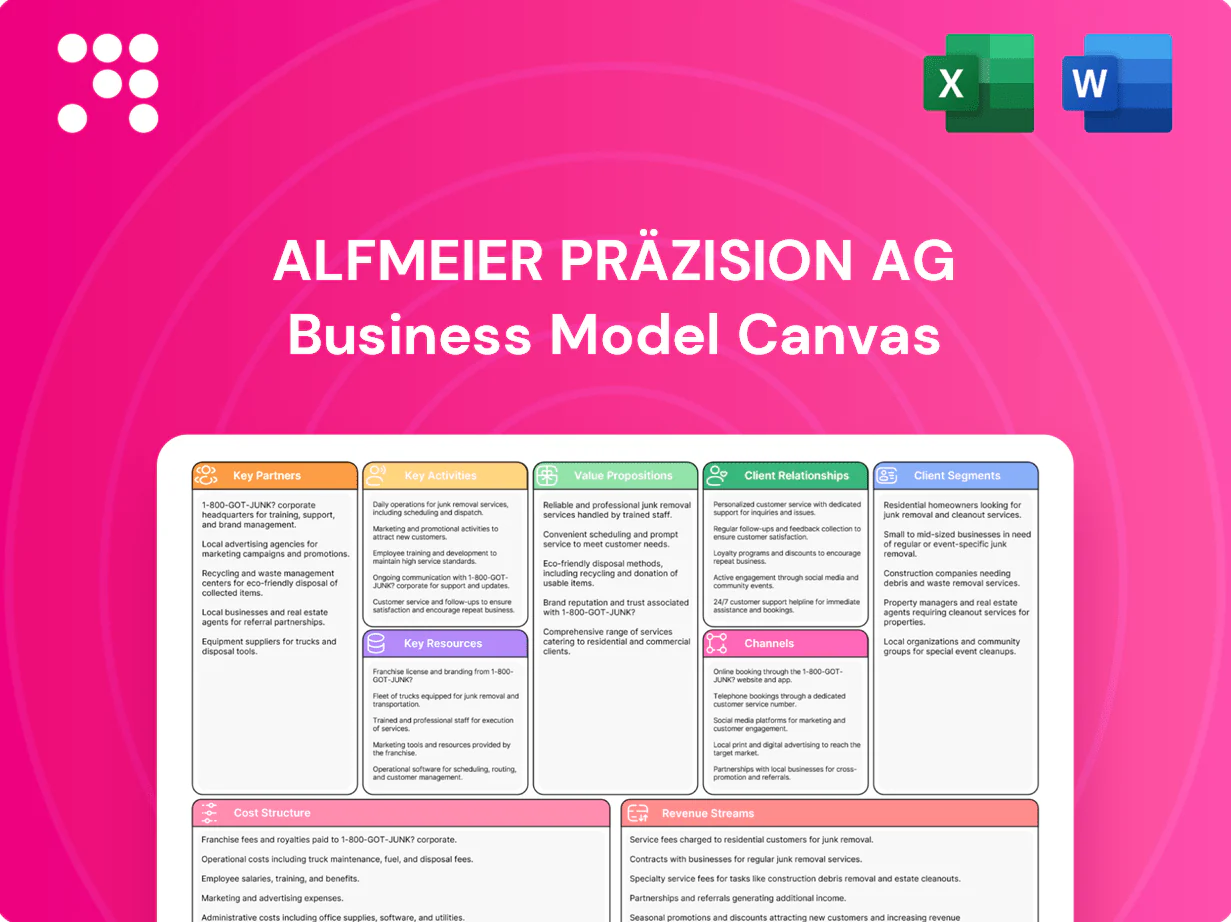
Alfmeier Präzision AG Business Model Canvas

Business Model Canvas: Strategic Blueprint for a Global Precision Automotive Supplier
Unlock the full strategic blueprint behind Alfmeier Präzision AG's business model. This in-depth Business Model Canvas reveals how the company creates value, captures market share and optimizes costs across nine building blocks. Purchase the full, editable Canvas (Word & Excel) to benchmark, plan strategy, and uncover growth opportunities.
Partnerships

Global OEM alliances
Partner with leading automakers in 2024 to win platform programs and long-term supply awards, jointly defining specs for fuel, fluid and seat comfort modules during vehicle development. Secure nomination letters and lifetime volume commitments to stabilize capacity planning and reduce rollout risk. Build mutual roadmaps with OEMs for next-gen efficiency and comfort features aligned to 2024 electrification and weight-reduction targets.
Tier-1 system integrators
Collaborate with seat-system and thermal-management Tier-1s to integrate valves, pumps and active climate modules, aligning interfaces, packaging and software control strategies; in 2024 joint validation programs target PPAP timing reductions of 20–30% and enable plug-and-play subassemblies for seat and fluid systems to accelerate OEM ramp-up.

Advanced materials suppliers
Partner with advanced materials suppliers to source high-performance polymers, elastomers and precision metals that deliver durability and chemical resistance for fuel-system components. Co-develop low-permeation fuel paths and lightweight structures under automotive-grade certifications such as IATF 16949 and ISO 9001 while ensuring REACH and RoHS compliance. Secure quality and cost via dual-sourcing strategies and vendor-managed inventory (VMI) programs to stabilize supply in 2024.

Automation and tooling partners
Partner with machine builders to deliver custom assembly lines and test rigs, co-designing jigs, vision systems and leak-testing stations to drive toward zero-defect targets; implement scalable automation for ramp-ups and model-mix production. Maintain uptime via predictive maintenance, which industry reports in 2024 show can cut unplanned downtime by about 30%.
- custom-assembly-lines
- co-design-jigs-vision-leaktest
- scalable-automation-model-mix
- predictive-maintenance-30%downtime
Research and testing institutes
Alfmeier partners with universities and independent labs for CFD, tribology and NVH research, leveraging UNECE R155/R156 enforcement in 2024 and IATF 16949/ISO 9001 frameworks to validate compliance; access to climatic chambers (typical range −40 to +150°C) and endurance rigs enables accelerated life testing and feed-forward into next‑gen precision fluid and comfort designs.
- R155/R156 2024 compliance
- IATF 16949 / ISO 9001 validation
- Climatic chambers −40 to +150°C
- CFD, tribology, NVH research partnerships
OEM partnerships for platform nominations, 20–30% PPAP cut and ≈30% downtime savings
Partner with OEMs in 2024 for platform nominations and lifetime volume commitments; joint roadmaps align next-gen comfort and electrification targets. Collaborate with Tier‑1s to cut PPAP timing 20–30% and enable plug‑and‑play subassemblies. Dual-source materials, VMI and predictive maintenance to reduce unplanned downtime ~30% and ensure compliance (IATF 16949, UNECE R155/R156).
| Metric | 2024 Target |
|---|---|
| PPAP reduction | 20–30% |
| Downtime reduction | ≈30% |
| Climatic range | −40 to +150°C |
What is included in the product
 Detailed Word Document
A tailored Business Model Canvas for Alfmeier Präzision AG detailing all 9 blocks—customer segments, channels, value propositions, key activities, partners, resources, cost structure and revenue streams—reflecting its precision automotive components strategy, competitive advantages and linked SWOT, ideal for investor presentations and strategic decision-making.

 Customizable Excel Spreadsheet
High-level, editable Business Model Canvas tailored to Alfmeier Präzision AG that condenses its precision components, customer value and supply chain into a one-page snapshot, saving hours of structuring and enabling quick boardroom reviews, team collaboration and side-by-side comparisons.
Activities

Precision product R&D
Design valves, pumps and active seat climate modules optimized for efficiency and comfort, using flow, acoustics and thermal simulations to validate performance; rapid prototyping with OEM feedback drives 4–6 week iteration cycles and IP protection via patents and secured CAD files; industry R&D intensity hovered around 5% of revenue in 2024, guiding resource allocation.
High-precision manufacturing
Operate fully automated molding, machining, assembly and in-line testing lines to sustain cycle times and quality targets, maintaining tight tolerances down to 5 µm for leak-free, low-noise performance. Apply statistical process control and full component and lot-level traceability to hold defect rates below 100 ppm. Scale capacity to meet SOPs and facelifts with ramp-up flexibility up to 30% within six months.

Quality and regulatory compliance
Execute APQP and PPAP workflows in line with IATF 16949 requirements, integrating endurance, burst and environmental tests into program gates; endurance and environmental validation are standard for every product release. Manage change control through documented procedures and 8D problem-solving for supplier or internal nonconformities. Audit suppliers and internal processes regularly to drive continuous improvement.

Supply chain orchestration
Supply chain orchestration aligns materials and logistics to OEM call-offs and EDI schedules, ensuring just-in-time deliveries and transparent order flows while qualifying dual sources and holding safety stock for critical parts to preserve production continuity. Cost optimization occurs through VA/VE programs and localization of supply chains to reduce freight and tariff exposure. Risk is mitigated via scenario planning, contingency routing and rapid supplier-switch protocols.
- Align to OEM call-offs + EDI
- Dual-source + safety stock for critical parts
- VA/VE and localization to cut cost
- Scenario planning and contingency routing
Program and customer management
Coordinate cross-functional teams from RFQ to SOP and EOP, tracking timelines, budgets and milestones with defined gateways; provide on-site support during launches and ramp-ups and manage engineering changes and lifecycle updates to ensure product readiness and quality.
- Cross-functional coordination: RFQ → SOP → EOP
- Program control: timelines, budgets, gateways
- On-site launch & ramp-up support
- Engineering change & lifecycle management
Rapid prototyping: 4–6w cycles, 5% R&D, under 100 ppm defects
Design and rapid-prototype valves, pumps and active seat climate modules with 4–6 week iteration cycles and R&D at 5% of revenue in 2024.
Run automated molding, machining and assembly with tolerances to 5 µm, defect rates <100 ppm and ramp-up flexibility +30% within six months.
Execute APQP/PPAP per IATF 16949, JIT supply aligned to OEM call-offs/EDI, dual-sourcing and VA/VE to lower cost.
| Metric | 2024 | Target |
|---|---|---|
| R&D spend | 5% revenue | — |
| Defect rate | <100 ppm | <50 ppm |
| Tolerance | 5 µm | ≤5 µm |
| Ramp-up | +30% / 6 months | +30% |
| Iteration cycle | 4–6 weeks | 4 weeks |
Delivered as Displayed
Business Model Canvas
The document previewed here is the actual Alfmeier Präzision AG Business Model Canvas, not a mockup, and shows live content from the final deliverable. Upon purchase you will receive this exact file—complete and editable—in Word and Excel formats. No placeholders, no surprises, ready to present or adapt for strategy use.

Business Model Canvas: Strategic Blueprint for a Global Precision Automotive Supplier
Unlock the full strategic blueprint behind Alfmeier Präzision AG's business model. This in-depth Business Model Canvas reveals how the company creates value, captures market share and optimizes costs across nine building blocks. Purchase the full, editable Canvas (Word & Excel) to benchmark, plan strategy, and uncover growth opportunities.
Partnerships
Global OEM alliances
Partner with leading automakers in 2024 to win platform programs and long-term supply awards, jointly defining specs for fuel, fluid and seat comfort modules during vehicle development. Secure nomination letters and lifetime volume commitments to stabilize capacity planning and reduce rollout risk. Build mutual roadmaps with OEMs for next-gen efficiency and comfort features aligned to 2024 electrification and weight-reduction targets.
Tier-1 system integrators
Collaborate with seat-system and thermal-management Tier-1s to integrate valves, pumps and active climate modules, aligning interfaces, packaging and software control strategies; in 2024 joint validation programs target PPAP timing reductions of 20–30% and enable plug-and-play subassemblies for seat and fluid systems to accelerate OEM ramp-up.
Advanced materials suppliers
Partner with advanced materials suppliers to source high-performance polymers, elastomers and precision metals that deliver durability and chemical resistance for fuel-system components. Co-develop low-permeation fuel paths and lightweight structures under automotive-grade certifications such as IATF 16949 and ISO 9001 while ensuring REACH and RoHS compliance. Secure quality and cost via dual-sourcing strategies and vendor-managed inventory (VMI) programs to stabilize supply in 2024.
Automation and tooling partners
Partner with machine builders to deliver custom assembly lines and test rigs, co-designing jigs, vision systems and leak-testing stations to drive toward zero-defect targets; implement scalable automation for ramp-ups and model-mix production. Maintain uptime via predictive maintenance, which industry reports in 2024 show can cut unplanned downtime by about 30%.
- custom-assembly-lines
- co-design-jigs-vision-leaktest
- scalable-automation-model-mix
- predictive-maintenance-30%downtime
Research and testing institutes
Alfmeier partners with universities and independent labs for CFD, tribology and NVH research, leveraging UNECE R155/R156 enforcement in 2024 and IATF 16949/ISO 9001 frameworks to validate compliance; access to climatic chambers (typical range −40 to +150°C) and endurance rigs enables accelerated life testing and feed-forward into next‑gen precision fluid and comfort designs.
- R155/R156 2024 compliance
- IATF 16949 / ISO 9001 validation
- Climatic chambers −40 to +150°C
- CFD, tribology, NVH research partnerships
OEM partnerships for platform nominations, 20–30% PPAP cut and ≈30% downtime savings
Partner with OEMs in 2024 for platform nominations and lifetime volume commitments; joint roadmaps align next-gen comfort and electrification targets. Collaborate with Tier‑1s to cut PPAP timing 20–30% and enable plug‑and‑play subassemblies. Dual-source materials, VMI and predictive maintenance to reduce unplanned downtime ~30% and ensure compliance (IATF 16949, UNECE R155/R156).
| Metric | 2024 Target |
|---|---|
| PPAP reduction | 20–30% |
| Downtime reduction | ≈30% |
| Climatic range | −40 to +150°C |
What is included in the product
Detailed Word Document
A tailored Business Model Canvas for Alfmeier Präzision AG detailing all 9 blocks—customer segments, channels, value propositions, key activities, partners, resources, cost structure and revenue streams—reflecting its precision automotive components strategy, competitive advantages and linked SWOT, ideal for investor presentations and strategic decision-making.
Customizable Excel Spreadsheet
High-level, editable Business Model Canvas tailored to Alfmeier Präzision AG that condenses its precision components, customer value and supply chain into a one-page snapshot, saving hours of structuring and enabling quick boardroom reviews, team collaboration and side-by-side comparisons.
Activities
Precision product R&D
Design valves, pumps and active seat climate modules optimized for efficiency and comfort, using flow, acoustics and thermal simulations to validate performance; rapid prototyping with OEM feedback drives 4–6 week iteration cycles and IP protection via patents and secured CAD files; industry R&D intensity hovered around 5% of revenue in 2024, guiding resource allocation.
High-precision manufacturing
Operate fully automated molding, machining, assembly and in-line testing lines to sustain cycle times and quality targets, maintaining tight tolerances down to 5 µm for leak-free, low-noise performance. Apply statistical process control and full component and lot-level traceability to hold defect rates below 100 ppm. Scale capacity to meet SOPs and facelifts with ramp-up flexibility up to 30% within six months.
Quality and regulatory compliance
Execute APQP and PPAP workflows in line with IATF 16949 requirements, integrating endurance, burst and environmental tests into program gates; endurance and environmental validation are standard for every product release. Manage change control through documented procedures and 8D problem-solving for supplier or internal nonconformities. Audit suppliers and internal processes regularly to drive continuous improvement.
Supply chain orchestration
Supply chain orchestration aligns materials and logistics to OEM call-offs and EDI schedules, ensuring just-in-time deliveries and transparent order flows while qualifying dual sources and holding safety stock for critical parts to preserve production continuity. Cost optimization occurs through VA/VE programs and localization of supply chains to reduce freight and tariff exposure. Risk is mitigated via scenario planning, contingency routing and rapid supplier-switch protocols.
- Align to OEM call-offs + EDI
- Dual-source + safety stock for critical parts
- VA/VE and localization to cut cost
- Scenario planning and contingency routing
Program and customer management
Coordinate cross-functional teams from RFQ to SOP and EOP, tracking timelines, budgets and milestones with defined gateways; provide on-site support during launches and ramp-ups and manage engineering changes and lifecycle updates to ensure product readiness and quality.
- Cross-functional coordination: RFQ → SOP → EOP
- Program control: timelines, budgets, gateways
- On-site launch & ramp-up support
- Engineering change & lifecycle management
Rapid prototyping: 4–6w cycles, 5% R&D, under 100 ppm defects
Design and rapid-prototype valves, pumps and active seat climate modules with 4–6 week iteration cycles and R&D at 5% of revenue in 2024.
Run automated molding, machining and assembly with tolerances to 5 µm, defect rates <100 ppm and ramp-up flexibility +30% within six months.
Execute APQP/PPAP per IATF 16949, JIT supply aligned to OEM call-offs/EDI, dual-sourcing and VA/VE to lower cost.
| Metric | 2024 | Target |
|---|---|---|
| R&D spend | 5% revenue | — |
| Defect rate | <100 ppm | <50 ppm |
| Tolerance | 5 µm | ≤5 µm |
| Ramp-up | +30% / 6 months | +30% |
| Iteration cycle | 4–6 weeks | 4 weeks |
Delivered as Displayed
Business Model Canvas
The document previewed here is the actual Alfmeier Präzision AG Business Model Canvas, not a mockup, and shows live content from the final deliverable. Upon purchase you will receive this exact file—complete and editable—in Word and Excel formats. No placeholders, no surprises, ready to present or adapt for strategy use.
Original: $10.00
-65%$10.00
$3.50Description
Business Model Canvas: Strategic Blueprint for a Global Precision Automotive Supplier
Unlock the full strategic blueprint behind Alfmeier Präzision AG's business model. This in-depth Business Model Canvas reveals how the company creates value, captures market share and optimizes costs across nine building blocks. Purchase the full, editable Canvas (Word & Excel) to benchmark, plan strategy, and uncover growth opportunities.
Partnerships
Global OEM alliances
Partner with leading automakers in 2024 to win platform programs and long-term supply awards, jointly defining specs for fuel, fluid and seat comfort modules during vehicle development. Secure nomination letters and lifetime volume commitments to stabilize capacity planning and reduce rollout risk. Build mutual roadmaps with OEMs for next-gen efficiency and comfort features aligned to 2024 electrification and weight-reduction targets.
Tier-1 system integrators
Collaborate with seat-system and thermal-management Tier-1s to integrate valves, pumps and active climate modules, aligning interfaces, packaging and software control strategies; in 2024 joint validation programs target PPAP timing reductions of 20–30% and enable plug-and-play subassemblies for seat and fluid systems to accelerate OEM ramp-up.
Advanced materials suppliers
Partner with advanced materials suppliers to source high-performance polymers, elastomers and precision metals that deliver durability and chemical resistance for fuel-system components. Co-develop low-permeation fuel paths and lightweight structures under automotive-grade certifications such as IATF 16949 and ISO 9001 while ensuring REACH and RoHS compliance. Secure quality and cost via dual-sourcing strategies and vendor-managed inventory (VMI) programs to stabilize supply in 2024.
Automation and tooling partners
Partner with machine builders to deliver custom assembly lines and test rigs, co-designing jigs, vision systems and leak-testing stations to drive toward zero-defect targets; implement scalable automation for ramp-ups and model-mix production. Maintain uptime via predictive maintenance, which industry reports in 2024 show can cut unplanned downtime by about 30%.
- custom-assembly-lines
- co-design-jigs-vision-leaktest
- scalable-automation-model-mix
- predictive-maintenance-30%downtime
Research and testing institutes
Alfmeier partners with universities and independent labs for CFD, tribology and NVH research, leveraging UNECE R155/R156 enforcement in 2024 and IATF 16949/ISO 9001 frameworks to validate compliance; access to climatic chambers (typical range −40 to +150°C) and endurance rigs enables accelerated life testing and feed-forward into next‑gen precision fluid and comfort designs.
- R155/R156 2024 compliance
- IATF 16949 / ISO 9001 validation
- Climatic chambers −40 to +150°C
- CFD, tribology, NVH research partnerships
OEM partnerships for platform nominations, 20–30% PPAP cut and ≈30% downtime savings
Partner with OEMs in 2024 for platform nominations and lifetime volume commitments; joint roadmaps align next-gen comfort and electrification targets. Collaborate with Tier‑1s to cut PPAP timing 20–30% and enable plug‑and‑play subassemblies. Dual-source materials, VMI and predictive maintenance to reduce unplanned downtime ~30% and ensure compliance (IATF 16949, UNECE R155/R156).
| Metric | 2024 Target |
|---|---|
| PPAP reduction | 20–30% |
| Downtime reduction | ≈30% |
| Climatic range | −40 to +150°C |
What is included in the product
Detailed Word Document
A tailored Business Model Canvas for Alfmeier Präzision AG detailing all 9 blocks—customer segments, channels, value propositions, key activities, partners, resources, cost structure and revenue streams—reflecting its precision automotive components strategy, competitive advantages and linked SWOT, ideal for investor presentations and strategic decision-making.
Customizable Excel Spreadsheet
High-level, editable Business Model Canvas tailored to Alfmeier Präzision AG that condenses its precision components, customer value and supply chain into a one-page snapshot, saving hours of structuring and enabling quick boardroom reviews, team collaboration and side-by-side comparisons.
Activities
Precision product R&D
Design valves, pumps and active seat climate modules optimized for efficiency and comfort, using flow, acoustics and thermal simulations to validate performance; rapid prototyping with OEM feedback drives 4–6 week iteration cycles and IP protection via patents and secured CAD files; industry R&D intensity hovered around 5% of revenue in 2024, guiding resource allocation.
High-precision manufacturing
Operate fully automated molding, machining, assembly and in-line testing lines to sustain cycle times and quality targets, maintaining tight tolerances down to 5 µm for leak-free, low-noise performance. Apply statistical process control and full component and lot-level traceability to hold defect rates below 100 ppm. Scale capacity to meet SOPs and facelifts with ramp-up flexibility up to 30% within six months.
Quality and regulatory compliance
Execute APQP and PPAP workflows in line with IATF 16949 requirements, integrating endurance, burst and environmental tests into program gates; endurance and environmental validation are standard for every product release. Manage change control through documented procedures and 8D problem-solving for supplier or internal nonconformities. Audit suppliers and internal processes regularly to drive continuous improvement.
Supply chain orchestration
Supply chain orchestration aligns materials and logistics to OEM call-offs and EDI schedules, ensuring just-in-time deliveries and transparent order flows while qualifying dual sources and holding safety stock for critical parts to preserve production continuity. Cost optimization occurs through VA/VE programs and localization of supply chains to reduce freight and tariff exposure. Risk is mitigated via scenario planning, contingency routing and rapid supplier-switch protocols.
- Align to OEM call-offs + EDI
- Dual-source + safety stock for critical parts
- VA/VE and localization to cut cost
- Scenario planning and contingency routing
Program and customer management
Coordinate cross-functional teams from RFQ to SOP and EOP, tracking timelines, budgets and milestones with defined gateways; provide on-site support during launches and ramp-ups and manage engineering changes and lifecycle updates to ensure product readiness and quality.
- Cross-functional coordination: RFQ → SOP → EOP
- Program control: timelines, budgets, gateways
- On-site launch & ramp-up support
- Engineering change & lifecycle management
Rapid prototyping: 4–6w cycles, 5% R&D, under 100 ppm defects
Design and rapid-prototype valves, pumps and active seat climate modules with 4–6 week iteration cycles and R&D at 5% of revenue in 2024.
Run automated molding, machining and assembly with tolerances to 5 µm, defect rates <100 ppm and ramp-up flexibility +30% within six months.
Execute APQP/PPAP per IATF 16949, JIT supply aligned to OEM call-offs/EDI, dual-sourcing and VA/VE to lower cost.
| Metric | 2024 | Target |
|---|---|---|
| R&D spend | 5% revenue | — |
| Defect rate | <100 ppm | <50 ppm |
| Tolerance | 5 µm | ≤5 µm |
| Ramp-up | +30% / 6 months | +30% |
| Iteration cycle | 4–6 weeks | 4 weeks |
Delivered as Displayed
Business Model Canvas
The document previewed here is the actual Alfmeier Präzision AG Business Model Canvas, not a mockup, and shows live content from the final deliverable. Upon purchase you will receive this exact file—complete and editable—in Word and Excel formats. No placeholders, no surprises, ready to present or adapt for strategy use.











