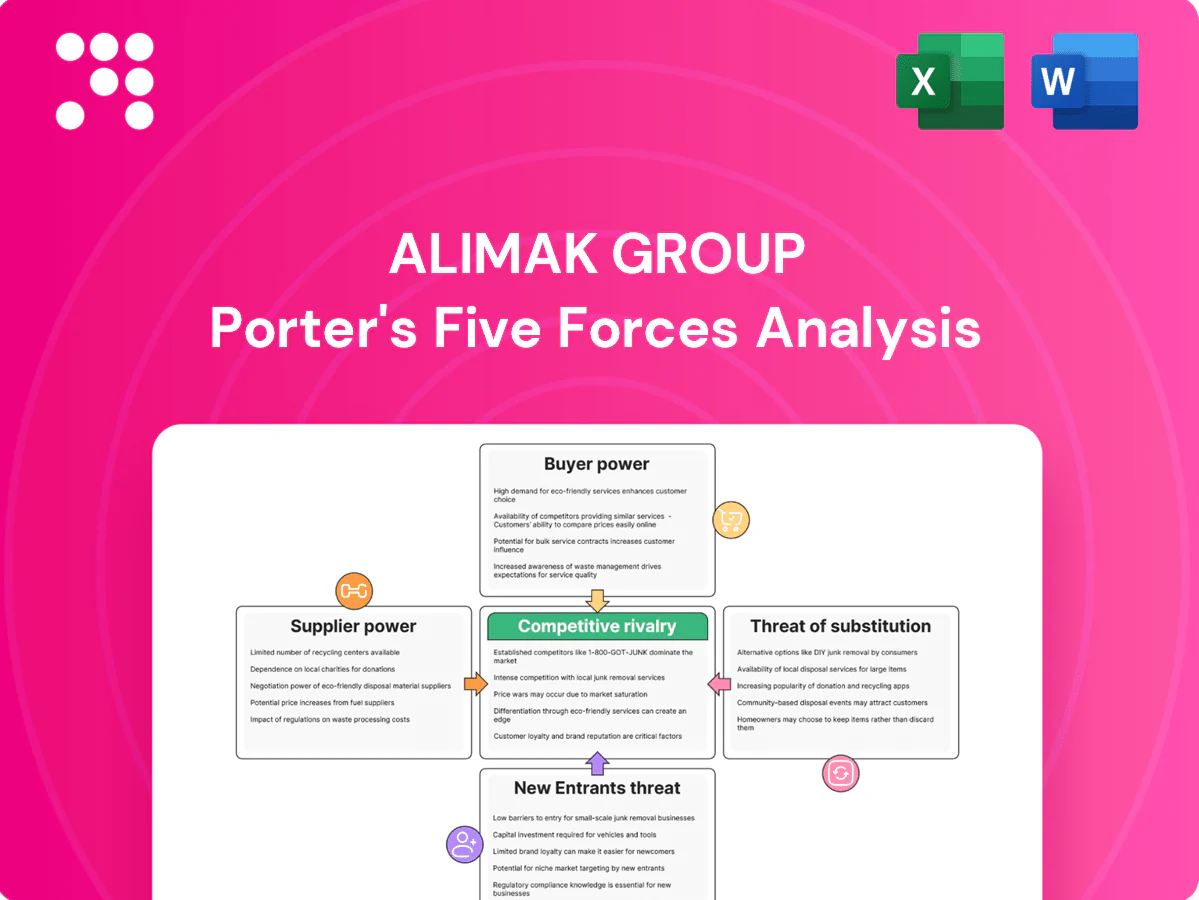
Alimak Group Porter's Five Forces Analysis

Don't Miss the Bigger Picture
Alimak Group faces moderate supplier power, high buyer expectations, and evolving substitute threats as robotics and rental models reshape access to industrial access solutions. Competitive rivalry is intense among global lift and access providers, while barriers to entry remain significant but narrowing. This brief snapshot only scratches the surface. Unlock the full Porter's Five Forces Analysis to explore Alimak Group’s competitive dynamics, market pressures, and strategic advantages in detail.
Suppliers Bargaining Power

Specialized components
Alimak depends on precision gearboxes, certified safety brakes and control systems produced by a limited pool of suppliers, which raises switching costs and often pushes lead times beyond 12 weeks. Supplier concentration gives vendors clear pricing leverage, contributing to margin pressure on specialized projects. Alimak mitigates exposure through dual-sourcing and expanded in-house engineering capacity, which cut disruption risk but do not fully eliminate supplier dependency.
Steel and motors volatility
Core inputs such as structural steel, electric motors and electronics exhibited marked commodity and logistics volatility in 2024, allowing suppliers to pass through higher input costs and squeeze Alimak Group margins. Tight-market pass-through was evident as supplier leverage increased during regional shortages and shipping disruptions. Long-term contracts and hedging mitigated price spikes but limited procurement flexibility. Global supply-chain shocks in 2024 amplified supplier influence on pricing and lead times.

Compliance and certification
Components for Alimak Group must meet stringent safety and industry standards such as EN and ANSI, which restricts the pool of approved suppliers and increases dependence on certified vendors. Requalification of new vendors involves lengthy audits and validation processes that are costly and time-consuming, slowing supplier substitution. This regulatory moat therefore incidentally elevates supplier bargaining power.

Aftermarket parts dependence
Aftermarket parts dependence is high as lifecycle service requires reliable OEM-grade parts; proprietary designs give select suppliers quasi-locked demand, allowing parts price increases to pass through with a delay. Alimak’s growing service footprint and scale — service revenues ~30% of group sales in 2024 — partially offset supplier power via volume bargaining.
- OEM-grade parts critical
- Proprietary designs create quasi-locked suppliers
- Price increases pass through with lag
- Service footprint (~30% of sales 2024) boosts bargaining
Geographic concentration
Geographic concentration of key Alimak subassemblies—often clustered in specific regions—raises currency and geopolitical exposure, increasing supplier leverage and disruption risk, especially when capacity tightness shifts freight cost volatility in suppliers favor.
- Concentration heightens disruption and bargaining power
- Nearshoring/multi-region sourcing reduces exposure but raises complexity
- Freight cost spikes during tight capacity further tilt power to suppliers
Lead times > 12wks squeeze margins; services ~30% cushion
Alimak relies on a small set of certified suppliers, pushing typical lead times beyond 12 weeks and giving vendors pricing leverage that pressured margins in 2024. Dual-sourcing and in-house engineering reduced but did not eliminate supplier dependency. Aftermarket/OEM parts and service scale (~30% of sales in 2024) partially offset supplier power through volume bargaining.
| Metric | 2024 |
|---|---|
| Avg supplier lead time | >12 weeks |
| Service revenue share | ~30% of group sales |
| Supplier concentration (top suppliers) | N/A |
What is included in the product
 Detailed Word Document
Concise Porter’s Five Forces analysis tailored to Alimak Group, assessing competitive rivalry, supplier and buyer power, threat of new entrants and substitutes, and identifying disruptive forces and entry barriers affecting pricing, margins, and strategic positioning.

 Customizable Excel Spreadsheet
A concise Porter's Five Forces snapshot for Alimak Group—quickly identify supplier, buyer, entrant, substitute and rivalry pressures to relieve strategic uncertainty; update inputs or export clean visuals for pitch decks and boardroom decisions.
Customers Bargaining Power

Large project buyers
Construction majors, industrial operators and rental fleets buy Alimak elevators and platforms in sizable lots, giving them leverage to demand lower prices and tighter service SLAs. Framework agreements routinely trade guaranteed volume for tiered discounts and priority support. Losing a single large account can materially reduce utilization of manufacturing lines and rental fleets, amplifying buyer bargaining power.
Specification-driven procurement
Buyers often issue performance-based specifications requiring certified equipment, and public procurement represents about 12% of global GDP (World Bank), underscoring the market stakes. When Alimak is explicitly specified switching costs decline and buyer bargaining power moderates. Open specifications invite competitive bids and heightened price pressure. Reference lists and proven safety records increase chances of preferred-supplier status.

Total cost of ownership focus
Professional buyers prioritize lifecycle cost, uptime and safety over capex, with 2024 surveys showing uptime/lifecycle cost as top procurement criteria; demonstrable durability and rapid service response allow Alimak to sustain premium pricing. Predictive maintenance and remote monitoring cut downtime by up to 30% in 2024 case studies, lowering price sensitivity, while weak service coverage increases buyer leverage.

Alternative sourcing and rentals
Rental market depth gives buyers flexibility to buy or lease, boosting customer bargaining power as cross-renting increases options and price leverage; Alimak’s owned rental channels can internalize some pressure by offering on-demand alternatives. Multi-year service bundles and contracts reduce churn and shift negotiating balance back toward Alimak.
- Rental vs buy flexibility
- Cross-rent increases leverage
- Alimak rental channels mitigate pressure
- Multi-year service bundles lock-in
Global competition visibility
Global competition visibility increases buyer power as customers benchmark across international suppliers for comparable models; Alimak Group’s global footprint in 30+ markets means pricing and specs are easily compared. Transparent pricing and digital tendering escalate leverage, while customization, advanced safety features, and operator training shift negotiations away from pure price. Strong local service and spare-parts networks remain decisive.
- Benchmarking: international suppliers compared
- Digital tenders: higher price transparency
- Value drivers: customization, safety, training
- Decisive: local support & parts availability
Buyers squeeze pricing; 30+ markets; downtime falls 30%
Large construction, industrial and rental buyers exert strong price and SLA pressure through volume deals and framework agreements. Public procurement equals ~12% of global GDP, increasing specification-driven sourcing; Alimak’s 30+ market footprint raises benchmarking and digital tendering. 2024 case studies show predictive maintenance can cut downtime up to 30%, supporting premium pricing and reducing buyer leverage.
| Metric | Value |
|---|---|
| Public procurement | ~12% global GDP |
| Alimak footprint | 30+ markets |
| Downtime reduction (2024) | Up to 30% |
Same Document Delivered
Alimak Group Porter's Five Forces Analysis
This preview shows the Alimak Group Porter's Five Forces analysis exactly as delivered after purchase—fully written, formatted and complete. It covers industry rivalry, supplier and buyer power, threat of substitutes and barriers to entry with supporting evidence. You’ll receive this same file instantly after payment, ready to download and use.

Don't Miss the Bigger Picture
Alimak Group faces moderate supplier power, high buyer expectations, and evolving substitute threats as robotics and rental models reshape access to industrial access solutions. Competitive rivalry is intense among global lift and access providers, while barriers to entry remain significant but narrowing. This brief snapshot only scratches the surface. Unlock the full Porter's Five Forces Analysis to explore Alimak Group’s competitive dynamics, market pressures, and strategic advantages in detail.
Suppliers Bargaining Power
Specialized components
Alimak depends on precision gearboxes, certified safety brakes and control systems produced by a limited pool of suppliers, which raises switching costs and often pushes lead times beyond 12 weeks. Supplier concentration gives vendors clear pricing leverage, contributing to margin pressure on specialized projects. Alimak mitigates exposure through dual-sourcing and expanded in-house engineering capacity, which cut disruption risk but do not fully eliminate supplier dependency.
Steel and motors volatility
Core inputs such as structural steel, electric motors and electronics exhibited marked commodity and logistics volatility in 2024, allowing suppliers to pass through higher input costs and squeeze Alimak Group margins. Tight-market pass-through was evident as supplier leverage increased during regional shortages and shipping disruptions. Long-term contracts and hedging mitigated price spikes but limited procurement flexibility. Global supply-chain shocks in 2024 amplified supplier influence on pricing and lead times.
Compliance and certification
Components for Alimak Group must meet stringent safety and industry standards such as EN and ANSI, which restricts the pool of approved suppliers and increases dependence on certified vendors. Requalification of new vendors involves lengthy audits and validation processes that are costly and time-consuming, slowing supplier substitution. This regulatory moat therefore incidentally elevates supplier bargaining power.
Aftermarket parts dependence
Aftermarket parts dependence is high as lifecycle service requires reliable OEM-grade parts; proprietary designs give select suppliers quasi-locked demand, allowing parts price increases to pass through with a delay. Alimak’s growing service footprint and scale — service revenues ~30% of group sales in 2024 — partially offset supplier power via volume bargaining.
- OEM-grade parts critical
- Proprietary designs create quasi-locked suppliers
- Price increases pass through with lag
- Service footprint (~30% of sales 2024) boosts bargaining
Geographic concentration
Geographic concentration of key Alimak subassemblies—often clustered in specific regions—raises currency and geopolitical exposure, increasing supplier leverage and disruption risk, especially when capacity tightness shifts freight cost volatility in suppliers favor.
- Concentration heightens disruption and bargaining power
- Nearshoring/multi-region sourcing reduces exposure but raises complexity
- Freight cost spikes during tight capacity further tilt power to suppliers
Lead times > 12wks squeeze margins; services ~30% cushion
Alimak relies on a small set of certified suppliers, pushing typical lead times beyond 12 weeks and giving vendors pricing leverage that pressured margins in 2024. Dual-sourcing and in-house engineering reduced but did not eliminate supplier dependency. Aftermarket/OEM parts and service scale (~30% of sales in 2024) partially offset supplier power through volume bargaining.
| Metric | 2024 |
|---|---|
| Avg supplier lead time | >12 weeks |
| Service revenue share | ~30% of group sales |
| Supplier concentration (top suppliers) | N/A |
What is included in the product
Detailed Word Document
Concise Porter’s Five Forces analysis tailored to Alimak Group, assessing competitive rivalry, supplier and buyer power, threat of new entrants and substitutes, and identifying disruptive forces and entry barriers affecting pricing, margins, and strategic positioning.
Customizable Excel Spreadsheet
A concise Porter's Five Forces snapshot for Alimak Group—quickly identify supplier, buyer, entrant, substitute and rivalry pressures to relieve strategic uncertainty; update inputs or export clean visuals for pitch decks and boardroom decisions.
Customers Bargaining Power
Large project buyers
Construction majors, industrial operators and rental fleets buy Alimak elevators and platforms in sizable lots, giving them leverage to demand lower prices and tighter service SLAs. Framework agreements routinely trade guaranteed volume for tiered discounts and priority support. Losing a single large account can materially reduce utilization of manufacturing lines and rental fleets, amplifying buyer bargaining power.
Specification-driven procurement
Buyers often issue performance-based specifications requiring certified equipment, and public procurement represents about 12% of global GDP (World Bank), underscoring the market stakes. When Alimak is explicitly specified switching costs decline and buyer bargaining power moderates. Open specifications invite competitive bids and heightened price pressure. Reference lists and proven safety records increase chances of preferred-supplier status.
Total cost of ownership focus
Professional buyers prioritize lifecycle cost, uptime and safety over capex, with 2024 surveys showing uptime/lifecycle cost as top procurement criteria; demonstrable durability and rapid service response allow Alimak to sustain premium pricing. Predictive maintenance and remote monitoring cut downtime by up to 30% in 2024 case studies, lowering price sensitivity, while weak service coverage increases buyer leverage.
Alternative sourcing and rentals
Rental market depth gives buyers flexibility to buy or lease, boosting customer bargaining power as cross-renting increases options and price leverage; Alimak’s owned rental channels can internalize some pressure by offering on-demand alternatives. Multi-year service bundles and contracts reduce churn and shift negotiating balance back toward Alimak.
- Rental vs buy flexibility
- Cross-rent increases leverage
- Alimak rental channels mitigate pressure
- Multi-year service bundles lock-in
Global competition visibility
Global competition visibility increases buyer power as customers benchmark across international suppliers for comparable models; Alimak Group’s global footprint in 30+ markets means pricing and specs are easily compared. Transparent pricing and digital tendering escalate leverage, while customization, advanced safety features, and operator training shift negotiations away from pure price. Strong local service and spare-parts networks remain decisive.
- Benchmarking: international suppliers compared
- Digital tenders: higher price transparency
- Value drivers: customization, safety, training
- Decisive: local support & parts availability
Buyers squeeze pricing; 30+ markets; downtime falls 30%
Large construction, industrial and rental buyers exert strong price and SLA pressure through volume deals and framework agreements. Public procurement equals ~12% of global GDP, increasing specification-driven sourcing; Alimak’s 30+ market footprint raises benchmarking and digital tendering. 2024 case studies show predictive maintenance can cut downtime up to 30%, supporting premium pricing and reducing buyer leverage.
| Metric | Value |
|---|---|
| Public procurement | ~12% global GDP |
| Alimak footprint | 30+ markets |
| Downtime reduction (2024) | Up to 30% |
Same Document Delivered
Alimak Group Porter's Five Forces Analysis
This preview shows the Alimak Group Porter's Five Forces analysis exactly as delivered after purchase—fully written, formatted and complete. It covers industry rivalry, supplier and buyer power, threat of substitutes and barriers to entry with supporting evidence. You’ll receive this same file instantly after payment, ready to download and use.
Original: $10.00
-65%$10.00
$3.50Description
Don't Miss the Bigger Picture
Alimak Group faces moderate supplier power, high buyer expectations, and evolving substitute threats as robotics and rental models reshape access to industrial access solutions. Competitive rivalry is intense among global lift and access providers, while barriers to entry remain significant but narrowing. This brief snapshot only scratches the surface. Unlock the full Porter's Five Forces Analysis to explore Alimak Group’s competitive dynamics, market pressures, and strategic advantages in detail.
Suppliers Bargaining Power
Specialized components
Alimak depends on precision gearboxes, certified safety brakes and control systems produced by a limited pool of suppliers, which raises switching costs and often pushes lead times beyond 12 weeks. Supplier concentration gives vendors clear pricing leverage, contributing to margin pressure on specialized projects. Alimak mitigates exposure through dual-sourcing and expanded in-house engineering capacity, which cut disruption risk but do not fully eliminate supplier dependency.
Steel and motors volatility
Core inputs such as structural steel, electric motors and electronics exhibited marked commodity and logistics volatility in 2024, allowing suppliers to pass through higher input costs and squeeze Alimak Group margins. Tight-market pass-through was evident as supplier leverage increased during regional shortages and shipping disruptions. Long-term contracts and hedging mitigated price spikes but limited procurement flexibility. Global supply-chain shocks in 2024 amplified supplier influence on pricing and lead times.
Compliance and certification
Components for Alimak Group must meet stringent safety and industry standards such as EN and ANSI, which restricts the pool of approved suppliers and increases dependence on certified vendors. Requalification of new vendors involves lengthy audits and validation processes that are costly and time-consuming, slowing supplier substitution. This regulatory moat therefore incidentally elevates supplier bargaining power.
Aftermarket parts dependence
Aftermarket parts dependence is high as lifecycle service requires reliable OEM-grade parts; proprietary designs give select suppliers quasi-locked demand, allowing parts price increases to pass through with a delay. Alimak’s growing service footprint and scale — service revenues ~30% of group sales in 2024 — partially offset supplier power via volume bargaining.
- OEM-grade parts critical
- Proprietary designs create quasi-locked suppliers
- Price increases pass through with lag
- Service footprint (~30% of sales 2024) boosts bargaining
Geographic concentration
Geographic concentration of key Alimak subassemblies—often clustered in specific regions—raises currency and geopolitical exposure, increasing supplier leverage and disruption risk, especially when capacity tightness shifts freight cost volatility in suppliers favor.
- Concentration heightens disruption and bargaining power
- Nearshoring/multi-region sourcing reduces exposure but raises complexity
- Freight cost spikes during tight capacity further tilt power to suppliers
Lead times > 12wks squeeze margins; services ~30% cushion
Alimak relies on a small set of certified suppliers, pushing typical lead times beyond 12 weeks and giving vendors pricing leverage that pressured margins in 2024. Dual-sourcing and in-house engineering reduced but did not eliminate supplier dependency. Aftermarket/OEM parts and service scale (~30% of sales in 2024) partially offset supplier power through volume bargaining.
| Metric | 2024 |
|---|---|
| Avg supplier lead time | >12 weeks |
| Service revenue share | ~30% of group sales |
| Supplier concentration (top suppliers) | N/A |
What is included in the product
Detailed Word Document
Concise Porter’s Five Forces analysis tailored to Alimak Group, assessing competitive rivalry, supplier and buyer power, threat of new entrants and substitutes, and identifying disruptive forces and entry barriers affecting pricing, margins, and strategic positioning.
Customizable Excel Spreadsheet
A concise Porter's Five Forces snapshot for Alimak Group—quickly identify supplier, buyer, entrant, substitute and rivalry pressures to relieve strategic uncertainty; update inputs or export clean visuals for pitch decks and boardroom decisions.
Customers Bargaining Power
Large project buyers
Construction majors, industrial operators and rental fleets buy Alimak elevators and platforms in sizable lots, giving them leverage to demand lower prices and tighter service SLAs. Framework agreements routinely trade guaranteed volume for tiered discounts and priority support. Losing a single large account can materially reduce utilization of manufacturing lines and rental fleets, amplifying buyer bargaining power.
Specification-driven procurement
Buyers often issue performance-based specifications requiring certified equipment, and public procurement represents about 12% of global GDP (World Bank), underscoring the market stakes. When Alimak is explicitly specified switching costs decline and buyer bargaining power moderates. Open specifications invite competitive bids and heightened price pressure. Reference lists and proven safety records increase chances of preferred-supplier status.
Total cost of ownership focus
Professional buyers prioritize lifecycle cost, uptime and safety over capex, with 2024 surveys showing uptime/lifecycle cost as top procurement criteria; demonstrable durability and rapid service response allow Alimak to sustain premium pricing. Predictive maintenance and remote monitoring cut downtime by up to 30% in 2024 case studies, lowering price sensitivity, while weak service coverage increases buyer leverage.
Alternative sourcing and rentals
Rental market depth gives buyers flexibility to buy or lease, boosting customer bargaining power as cross-renting increases options and price leverage; Alimak’s owned rental channels can internalize some pressure by offering on-demand alternatives. Multi-year service bundles and contracts reduce churn and shift negotiating balance back toward Alimak.
- Rental vs buy flexibility
- Cross-rent increases leverage
- Alimak rental channels mitigate pressure
- Multi-year service bundles lock-in
Global competition visibility
Global competition visibility increases buyer power as customers benchmark across international suppliers for comparable models; Alimak Group’s global footprint in 30+ markets means pricing and specs are easily compared. Transparent pricing and digital tendering escalate leverage, while customization, advanced safety features, and operator training shift negotiations away from pure price. Strong local service and spare-parts networks remain decisive.
- Benchmarking: international suppliers compared
- Digital tenders: higher price transparency
- Value drivers: customization, safety, training
- Decisive: local support & parts availability
Buyers squeeze pricing; 30+ markets; downtime falls 30%
Large construction, industrial and rental buyers exert strong price and SLA pressure through volume deals and framework agreements. Public procurement equals ~12% of global GDP, increasing specification-driven sourcing; Alimak’s 30+ market footprint raises benchmarking and digital tendering. 2024 case studies show predictive maintenance can cut downtime up to 30%, supporting premium pricing and reducing buyer leverage.
| Metric | Value |
|---|---|
| Public procurement | ~12% global GDP |
| Alimak footprint | 30+ markets |
| Downtime reduction (2024) | Up to 30% |
Same Document Delivered
Alimak Group Porter's Five Forces Analysis
This preview shows the Alimak Group Porter's Five Forces analysis exactly as delivered after purchase—fully written, formatted and complete. It covers industry rivalry, supplier and buyer power, threat of substitutes and barriers to entry with supporting evidence. You’ll receive this same file instantly after payment, ready to download and use.











