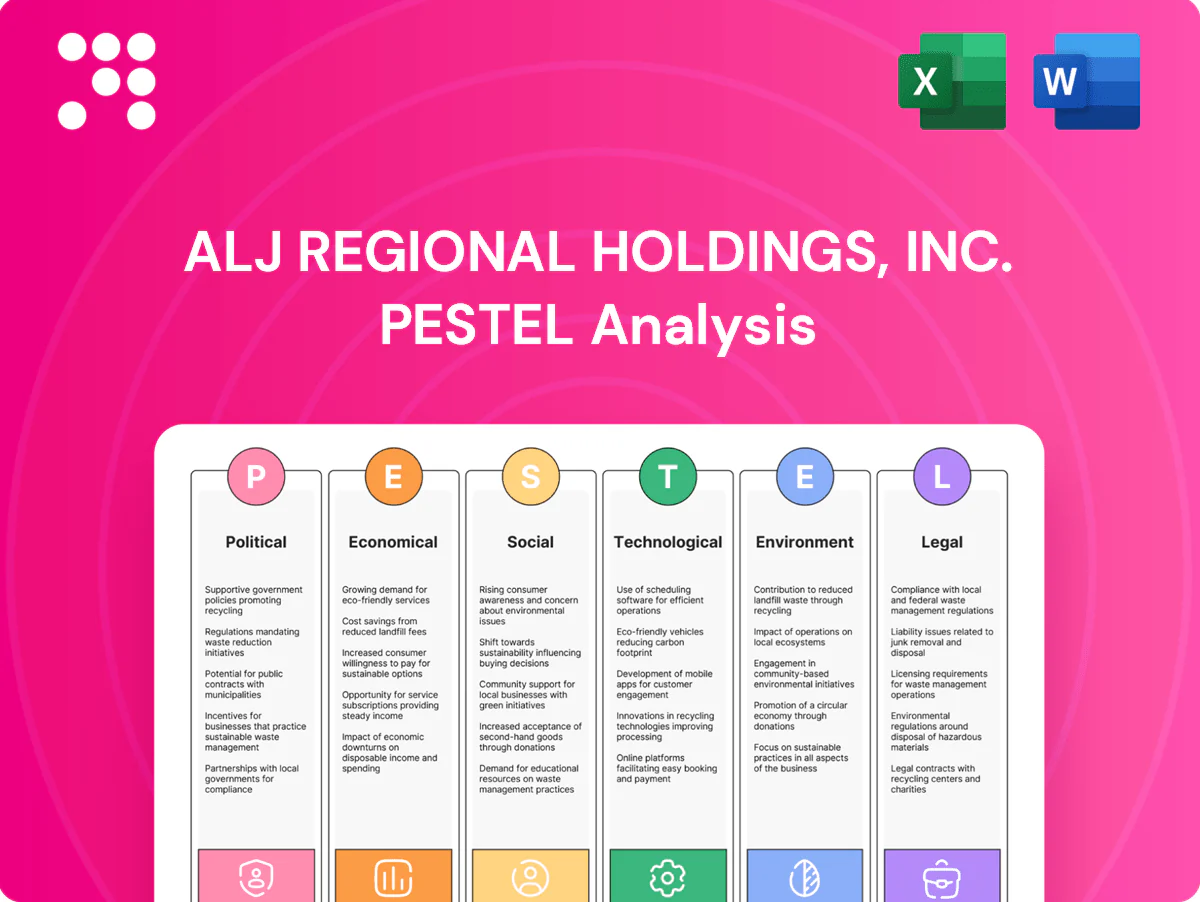
ALJ Regional Holdings, Inc. PESTLE Analysis

Your Shortcut to Market Insight Starts Here
ALJ Regional Holdings' PESTLE reveals regulatory pressures, economic headwinds, shifting consumer trends, and tech-driven operational shifts that could reshape regional performance. Our analysis pinpoints risks and opportunities for investors and strategists. Download the full PESTLE now for actionable, ready-to-use insights.
Political factors

Government contracting exposure
If Faneuil serves federal, state or municipal contracts, budget cycles and election outcomes such as the 2024 US cycle can materially swing volumes and pricing. Shifts in public‑sector outsourcing preferences and policy priorities—for example the $1.2 trillion Infrastructure Investment and Jobs Act—can reallocate spend between transportation, healthcare and tolling. Contracting rules under the Federal Acquisition Regulation favor incumbents but raise compliance costs and audit risk.
Labor and minimum wage policy
Contact center economics for ALJ Regional Holdings are highly sensitive to federal and state wage floors: federal minimum remains $7.25/hr (since 2009) while over 20 states plus DC had $15+ by 2025, and labor typically represents ~60% of contact-center OPEX. Aggressive state wage hikes can compress margins unless offset by pricing or automation, with AI/automation reducing handle time by up to ~30% in industry pilots. Rising union sentiment and organizing drives can constrain scheduling flexibility and increase benefits costs, influencing site-level labor agreements. Regional policy arbitrage drives footprint choices toward lower-wage states such as Texas and Tennessee to preserve margins.

Trade and industrial policy
Tariffs on paper, inks and equipment—including Section 301 levies of roughly 7.5–25% on many Chinese-made inputs—raise Phoenix Color’s input costs and margin pressure; U.S. paper imports were about $11 billion in 2023, amplifying exposure. Buy American clauses and reshoring incentives for domestic components boost local sourcing, while any relaxation of trade barriers would favor cheaper imports. Export-promotion grants and EX‑IM support can subsidize international sales growth.

Data governance stance
National cybersecurity directives and privacy frameworks force ALJ Regional Holdings to tighten BPO data handling; the average global cost of a data breach was about 4.45 million USD (IBM 2023), raising measurable compliance stakes. Stricter rules increase overhead but raise barriers to entry and defend margins; over 60 countries maintain some data localization or transfer controls. Cross-border transfer limits constrain offshoring choices, and many US public-sector contracts and FedRAMP/O MB guidance effectively mandate US-only data residency for sensitive workloads.
- Compliance cost: IBM 2023 avg breach cost 4.45M USD
- Localization scope: over 60 countries with restrictions
- Barrier effect: tighter rules raise entry costs
- Public-sector: US-only residency common for sensitive contracts
State incentives and siting
State tax credits and training grants materially steer ALJ Regional Holdings site choices, with Good Jobs First reporting roughly 50 billion USD in state/local incentives annually in recent years (2023–2024), prompting prioritization of states offering payroll credits or workforce grants. Local political backing speeds permits and utility access, while midstream policy reversals have historically reduced expected benefits and competitive states frequently trigger bidding wars for job-creation packages.
- Incentives: ~50B USD state/local annually (Good Jobs First 2023–24)
- Permitting: local support cuts lead time by months
- Risk: policy reversals can void commitments
- Competition: states bid for projects, raising incentive costs
2024 election, $1.2T IIJA and wage surge reshape volumes; input $11B, cyber $4.45M risks
Faneuil exposure to 2024 election-driven budget shifts and the $1.2T IIJA can swing volumes/pricing. Labor: federal min $7.25, 20+ states $15+ by 2025; labor ≈60% contact-center OPEX. Input/tariff risk: US paper imports $11B (2023); avg breach cost $4.45M (IBM 2023); state/local incentives ≈$50B (2023–24).
| Factor | Key metric |
|---|---|
| Infrastructure | $1.2T IIJA |
| Labor | $7.25 min; 20+ states $15+ |
| Trade/inputs | $11B paper imports (2023) |
| Cyber/compliance | $4.45M avg breach (2023) |
What is included in the product
 Detailed Word Document
Explores how Political, Economic, Social, Technological, Environmental and Legal forces uniquely shape ALJ Regional Holdings, delivering data-backed, region- and industry-specific insights, forward-looking risks and opportunities to inform strategy, investor briefs and scenario planning.

 Customizable Excel Spreadsheet
A concise, visually segmented PESTLE summary for ALJ Regional Holdings that highlights external risks and market positioning, easily dropped into presentations or shared across teams to streamline strategic discussions and client reports.
Economic factors

Macro cycles and demand
Consumer spending growth of 2.3% in 2024 (BEA) and a 2024 average unemployment rate of 3.7% (BLS) directly drive contact volumes for Faneuil’s clients, with lower employment leading to fewer shopper interactions and higher service churn.
Publishing cycles constrain Phoenix Color’s run lengths and title pipelines; US trade book unit sales declined about 1.8% in 2024 (NPD), compressing print runs and throughput.
Recessions compress pricing and raise bad‑debt risk—historically defaults and receivable days spike—and recoveries restore volumes but with lagged mix shifts toward lower‑margin or digital formats.
Wage inflation and talent markets
Tight U.S. labor markets pushed wage inflation to roughly 4–5% in 2024–25, raising agent pay and training costs for ALJ Regional Holdings and similar dealer/service networks. Attrition spikes—turnover rates of 30–40% in retail/service roles in 2024—expand recruiting spend and quality risk. Optimizing nearshore/onshore mixes is now critical to control payroll, while productivity tools must offset higher unit labor costs and lift per-agent output.

Input and logistics costs
Pulp, paper and energy costs remain key margin drivers for ALJ Regional Holdings; input prices spiked in 2021–22 and stayed elevated into 2024, pressuring print component margins as energy volatility persisted. Freight rates and carrier capacity swings—container rates having fallen sharply from 2021 peaks by 2024 (World Bank)—affect delivery reliability and inventory lead times. Vendor consolidation in paper and logistics markets reduces bargaining power, so ALJ uses hedging instruments and multi‑sourcing strategies to mitigate price and supply volatility.

Interest rates and capital access
Higher policy rates (federal funds target 5.25–5.50% as of July 2025) raise borrowing costs for equipment, facility upgrades and M&A, while higher discount rates push up hurdle rates and reduce valuations. A strong balance sheet enables opportunistic acquisitions in downturns, but debt covenants can constrain investment timing.
- Higher policy rate: 5.25–5.50% (Jul 2025)
- Raises capex/M&A costs
- Increases discount/hurdle rates
- Balance-sheet flexibility = acquisition optionality
- Covenants limit timing
Client concentration and pricing power
BPO contracts for ALJ Regional Holdings often concentrate revenue in a few large programs, with renewal cycles of 1–5 years creating periodic pricing resets that can swing margins. Diversifying end-markets into utilities, healthcare, government and publishing smooths cyclicality; the global BPO market was estimated at about $260 billion in 2024. Scale improves procurement leverage and overhead absorption, boosting unit economics.
- Client concentration: few programs drive revenue
- Renewal cycles: 1–5 years, pricing resets
- End-market mix: utilities, healthcare, government, publishing
- Scale benefits: procurement leverage, overhead absorption
2024 election, $1.2T IIJA and wage surge reshape volumes; input $11B, cyber $4.45M risks
Consumer spending +2.3% (2024 BEA) and 3.7% avg unemployment (2024 BLS) drive contact volumes; wage inflation 4–5% (2024–25) raises agent costs and turnover (30–40% 2024). Input/energy and paper price volatility compress print margins; Fed funds 5.25–5.50% (Jul 2025) lifts capex/M&A costs; global BPO ~$260B (2024) favors scale.
| Metric | Value |
|---|---|
| Consumer spending | +2.3% (2024) |
| Unemployment | 3.7% (2024) |
| Wage inflation | 4–5% (2024–25) |
| Fed funds | 5.25–5.50% (Jul 2025) |
| BPO market | $260B (2024) |
Preview Before You Purchase
ALJ Regional Holdings, Inc. PESTLE Analysis
The ALJ Regional Holdings, Inc. PESTLE Analysis provides a concise review of political, economic, social, technological, legal, and environmental factors affecting the company and its markets, with actionable implications for strategy and risk management. The preview shown here is the exact document you’ll receive after purchase—fully formatted and ready to use. No placeholders or surprises: this is the final, downloadable file.

Your Shortcut to Market Insight Starts Here
ALJ Regional Holdings' PESTLE reveals regulatory pressures, economic headwinds, shifting consumer trends, and tech-driven operational shifts that could reshape regional performance. Our analysis pinpoints risks and opportunities for investors and strategists. Download the full PESTLE now for actionable, ready-to-use insights.
Political factors
Government contracting exposure
If Faneuil serves federal, state or municipal contracts, budget cycles and election outcomes such as the 2024 US cycle can materially swing volumes and pricing. Shifts in public‑sector outsourcing preferences and policy priorities—for example the $1.2 trillion Infrastructure Investment and Jobs Act—can reallocate spend between transportation, healthcare and tolling. Contracting rules under the Federal Acquisition Regulation favor incumbents but raise compliance costs and audit risk.
Labor and minimum wage policy
Contact center economics for ALJ Regional Holdings are highly sensitive to federal and state wage floors: federal minimum remains $7.25/hr (since 2009) while over 20 states plus DC had $15+ by 2025, and labor typically represents ~60% of contact-center OPEX. Aggressive state wage hikes can compress margins unless offset by pricing or automation, with AI/automation reducing handle time by up to ~30% in industry pilots. Rising union sentiment and organizing drives can constrain scheduling flexibility and increase benefits costs, influencing site-level labor agreements. Regional policy arbitrage drives footprint choices toward lower-wage states such as Texas and Tennessee to preserve margins.
Trade and industrial policy
Tariffs on paper, inks and equipment—including Section 301 levies of roughly 7.5–25% on many Chinese-made inputs—raise Phoenix Color’s input costs and margin pressure; U.S. paper imports were about $11 billion in 2023, amplifying exposure. Buy American clauses and reshoring incentives for domestic components boost local sourcing, while any relaxation of trade barriers would favor cheaper imports. Export-promotion grants and EX‑IM support can subsidize international sales growth.
Data governance stance
National cybersecurity directives and privacy frameworks force ALJ Regional Holdings to tighten BPO data handling; the average global cost of a data breach was about 4.45 million USD (IBM 2023), raising measurable compliance stakes. Stricter rules increase overhead but raise barriers to entry and defend margins; over 60 countries maintain some data localization or transfer controls. Cross-border transfer limits constrain offshoring choices, and many US public-sector contracts and FedRAMP/O MB guidance effectively mandate US-only data residency for sensitive workloads.
- Compliance cost: IBM 2023 avg breach cost 4.45M USD
- Localization scope: over 60 countries with restrictions
- Barrier effect: tighter rules raise entry costs
- Public-sector: US-only residency common for sensitive contracts
State incentives and siting
State tax credits and training grants materially steer ALJ Regional Holdings site choices, with Good Jobs First reporting roughly 50 billion USD in state/local incentives annually in recent years (2023–2024), prompting prioritization of states offering payroll credits or workforce grants. Local political backing speeds permits and utility access, while midstream policy reversals have historically reduced expected benefits and competitive states frequently trigger bidding wars for job-creation packages.
- Incentives: ~50B USD state/local annually (Good Jobs First 2023–24)
- Permitting: local support cuts lead time by months
- Risk: policy reversals can void commitments
- Competition: states bid for projects, raising incentive costs
2024 election, $1.2T IIJA and wage surge reshape volumes; input $11B, cyber $4.45M risks
Faneuil exposure to 2024 election-driven budget shifts and the $1.2T IIJA can swing volumes/pricing. Labor: federal min $7.25, 20+ states $15+ by 2025; labor ≈60% contact-center OPEX. Input/tariff risk: US paper imports $11B (2023); avg breach cost $4.45M (IBM 2023); state/local incentives ≈$50B (2023–24).
| Factor | Key metric |
|---|---|
| Infrastructure | $1.2T IIJA |
| Labor | $7.25 min; 20+ states $15+ |
| Trade/inputs | $11B paper imports (2023) |
| Cyber/compliance | $4.45M avg breach (2023) |
What is included in the product
Detailed Word Document
Explores how Political, Economic, Social, Technological, Environmental and Legal forces uniquely shape ALJ Regional Holdings, delivering data-backed, region- and industry-specific insights, forward-looking risks and opportunities to inform strategy, investor briefs and scenario planning.
Customizable Excel Spreadsheet
A concise, visually segmented PESTLE summary for ALJ Regional Holdings that highlights external risks and market positioning, easily dropped into presentations or shared across teams to streamline strategic discussions and client reports.
Economic factors
Macro cycles and demand
Consumer spending growth of 2.3% in 2024 (BEA) and a 2024 average unemployment rate of 3.7% (BLS) directly drive contact volumes for Faneuil’s clients, with lower employment leading to fewer shopper interactions and higher service churn.
Publishing cycles constrain Phoenix Color’s run lengths and title pipelines; US trade book unit sales declined about 1.8% in 2024 (NPD), compressing print runs and throughput.
Recessions compress pricing and raise bad‑debt risk—historically defaults and receivable days spike—and recoveries restore volumes but with lagged mix shifts toward lower‑margin or digital formats.
Wage inflation and talent markets
Tight U.S. labor markets pushed wage inflation to roughly 4–5% in 2024–25, raising agent pay and training costs for ALJ Regional Holdings and similar dealer/service networks. Attrition spikes—turnover rates of 30–40% in retail/service roles in 2024—expand recruiting spend and quality risk. Optimizing nearshore/onshore mixes is now critical to control payroll, while productivity tools must offset higher unit labor costs and lift per-agent output.
Input and logistics costs
Pulp, paper and energy costs remain key margin drivers for ALJ Regional Holdings; input prices spiked in 2021–22 and stayed elevated into 2024, pressuring print component margins as energy volatility persisted. Freight rates and carrier capacity swings—container rates having fallen sharply from 2021 peaks by 2024 (World Bank)—affect delivery reliability and inventory lead times. Vendor consolidation in paper and logistics markets reduces bargaining power, so ALJ uses hedging instruments and multi‑sourcing strategies to mitigate price and supply volatility.
Interest rates and capital access
Higher policy rates (federal funds target 5.25–5.50% as of July 2025) raise borrowing costs for equipment, facility upgrades and M&A, while higher discount rates push up hurdle rates and reduce valuations. A strong balance sheet enables opportunistic acquisitions in downturns, but debt covenants can constrain investment timing.
- Higher policy rate: 5.25–5.50% (Jul 2025)
- Raises capex/M&A costs
- Increases discount/hurdle rates
- Balance-sheet flexibility = acquisition optionality
- Covenants limit timing
Client concentration and pricing power
BPO contracts for ALJ Regional Holdings often concentrate revenue in a few large programs, with renewal cycles of 1–5 years creating periodic pricing resets that can swing margins. Diversifying end-markets into utilities, healthcare, government and publishing smooths cyclicality; the global BPO market was estimated at about $260 billion in 2024. Scale improves procurement leverage and overhead absorption, boosting unit economics.
- Client concentration: few programs drive revenue
- Renewal cycles: 1–5 years, pricing resets
- End-market mix: utilities, healthcare, government, publishing
- Scale benefits: procurement leverage, overhead absorption
2024 election, $1.2T IIJA and wage surge reshape volumes; input $11B, cyber $4.45M risks
Consumer spending +2.3% (2024 BEA) and 3.7% avg unemployment (2024 BLS) drive contact volumes; wage inflation 4–5% (2024–25) raises agent costs and turnover (30–40% 2024). Input/energy and paper price volatility compress print margins; Fed funds 5.25–5.50% (Jul 2025) lifts capex/M&A costs; global BPO ~$260B (2024) favors scale.
| Metric | Value |
|---|---|
| Consumer spending | +2.3% (2024) |
| Unemployment | 3.7% (2024) |
| Wage inflation | 4–5% (2024–25) |
| Fed funds | 5.25–5.50% (Jul 2025) |
| BPO market | $260B (2024) |
Preview Before You Purchase
ALJ Regional Holdings, Inc. PESTLE Analysis
The ALJ Regional Holdings, Inc. PESTLE Analysis provides a concise review of political, economic, social, technological, legal, and environmental factors affecting the company and its markets, with actionable implications for strategy and risk management. The preview shown here is the exact document you’ll receive after purchase—fully formatted and ready to use. No placeholders or surprises: this is the final, downloadable file.
Original: $10.00
-65%$10.00
$3.50Description
Your Shortcut to Market Insight Starts Here
ALJ Regional Holdings' PESTLE reveals regulatory pressures, economic headwinds, shifting consumer trends, and tech-driven operational shifts that could reshape regional performance. Our analysis pinpoints risks and opportunities for investors and strategists. Download the full PESTLE now for actionable, ready-to-use insights.
Political factors
Government contracting exposure
If Faneuil serves federal, state or municipal contracts, budget cycles and election outcomes such as the 2024 US cycle can materially swing volumes and pricing. Shifts in public‑sector outsourcing preferences and policy priorities—for example the $1.2 trillion Infrastructure Investment and Jobs Act—can reallocate spend between transportation, healthcare and tolling. Contracting rules under the Federal Acquisition Regulation favor incumbents but raise compliance costs and audit risk.
Labor and minimum wage policy
Contact center economics for ALJ Regional Holdings are highly sensitive to federal and state wage floors: federal minimum remains $7.25/hr (since 2009) while over 20 states plus DC had $15+ by 2025, and labor typically represents ~60% of contact-center OPEX. Aggressive state wage hikes can compress margins unless offset by pricing or automation, with AI/automation reducing handle time by up to ~30% in industry pilots. Rising union sentiment and organizing drives can constrain scheduling flexibility and increase benefits costs, influencing site-level labor agreements. Regional policy arbitrage drives footprint choices toward lower-wage states such as Texas and Tennessee to preserve margins.
Trade and industrial policy
Tariffs on paper, inks and equipment—including Section 301 levies of roughly 7.5–25% on many Chinese-made inputs—raise Phoenix Color’s input costs and margin pressure; U.S. paper imports were about $11 billion in 2023, amplifying exposure. Buy American clauses and reshoring incentives for domestic components boost local sourcing, while any relaxation of trade barriers would favor cheaper imports. Export-promotion grants and EX‑IM support can subsidize international sales growth.
Data governance stance
National cybersecurity directives and privacy frameworks force ALJ Regional Holdings to tighten BPO data handling; the average global cost of a data breach was about 4.45 million USD (IBM 2023), raising measurable compliance stakes. Stricter rules increase overhead but raise barriers to entry and defend margins; over 60 countries maintain some data localization or transfer controls. Cross-border transfer limits constrain offshoring choices, and many US public-sector contracts and FedRAMP/O MB guidance effectively mandate US-only data residency for sensitive workloads.
- Compliance cost: IBM 2023 avg breach cost 4.45M USD
- Localization scope: over 60 countries with restrictions
- Barrier effect: tighter rules raise entry costs
- Public-sector: US-only residency common for sensitive contracts
State incentives and siting
State tax credits and training grants materially steer ALJ Regional Holdings site choices, with Good Jobs First reporting roughly 50 billion USD in state/local incentives annually in recent years (2023–2024), prompting prioritization of states offering payroll credits or workforce grants. Local political backing speeds permits and utility access, while midstream policy reversals have historically reduced expected benefits and competitive states frequently trigger bidding wars for job-creation packages.
- Incentives: ~50B USD state/local annually (Good Jobs First 2023–24)
- Permitting: local support cuts lead time by months
- Risk: policy reversals can void commitments
- Competition: states bid for projects, raising incentive costs
2024 election, $1.2T IIJA and wage surge reshape volumes; input $11B, cyber $4.45M risks
Faneuil exposure to 2024 election-driven budget shifts and the $1.2T IIJA can swing volumes/pricing. Labor: federal min $7.25, 20+ states $15+ by 2025; labor ≈60% contact-center OPEX. Input/tariff risk: US paper imports $11B (2023); avg breach cost $4.45M (IBM 2023); state/local incentives ≈$50B (2023–24).
| Factor | Key metric |
|---|---|
| Infrastructure | $1.2T IIJA |
| Labor | $7.25 min; 20+ states $15+ |
| Trade/inputs | $11B paper imports (2023) |
| Cyber/compliance | $4.45M avg breach (2023) |
What is included in the product
Detailed Word Document
Explores how Political, Economic, Social, Technological, Environmental and Legal forces uniquely shape ALJ Regional Holdings, delivering data-backed, region- and industry-specific insights, forward-looking risks and opportunities to inform strategy, investor briefs and scenario planning.
Customizable Excel Spreadsheet
A concise, visually segmented PESTLE summary for ALJ Regional Holdings that highlights external risks and market positioning, easily dropped into presentations or shared across teams to streamline strategic discussions and client reports.
Economic factors
Macro cycles and demand
Consumer spending growth of 2.3% in 2024 (BEA) and a 2024 average unemployment rate of 3.7% (BLS) directly drive contact volumes for Faneuil’s clients, with lower employment leading to fewer shopper interactions and higher service churn.
Publishing cycles constrain Phoenix Color’s run lengths and title pipelines; US trade book unit sales declined about 1.8% in 2024 (NPD), compressing print runs and throughput.
Recessions compress pricing and raise bad‑debt risk—historically defaults and receivable days spike—and recoveries restore volumes but with lagged mix shifts toward lower‑margin or digital formats.
Wage inflation and talent markets
Tight U.S. labor markets pushed wage inflation to roughly 4–5% in 2024–25, raising agent pay and training costs for ALJ Regional Holdings and similar dealer/service networks. Attrition spikes—turnover rates of 30–40% in retail/service roles in 2024—expand recruiting spend and quality risk. Optimizing nearshore/onshore mixes is now critical to control payroll, while productivity tools must offset higher unit labor costs and lift per-agent output.
Input and logistics costs
Pulp, paper and energy costs remain key margin drivers for ALJ Regional Holdings; input prices spiked in 2021–22 and stayed elevated into 2024, pressuring print component margins as energy volatility persisted. Freight rates and carrier capacity swings—container rates having fallen sharply from 2021 peaks by 2024 (World Bank)—affect delivery reliability and inventory lead times. Vendor consolidation in paper and logistics markets reduces bargaining power, so ALJ uses hedging instruments and multi‑sourcing strategies to mitigate price and supply volatility.
Interest rates and capital access
Higher policy rates (federal funds target 5.25–5.50% as of July 2025) raise borrowing costs for equipment, facility upgrades and M&A, while higher discount rates push up hurdle rates and reduce valuations. A strong balance sheet enables opportunistic acquisitions in downturns, but debt covenants can constrain investment timing.
- Higher policy rate: 5.25–5.50% (Jul 2025)
- Raises capex/M&A costs
- Increases discount/hurdle rates
- Balance-sheet flexibility = acquisition optionality
- Covenants limit timing
Client concentration and pricing power
BPO contracts for ALJ Regional Holdings often concentrate revenue in a few large programs, with renewal cycles of 1–5 years creating periodic pricing resets that can swing margins. Diversifying end-markets into utilities, healthcare, government and publishing smooths cyclicality; the global BPO market was estimated at about $260 billion in 2024. Scale improves procurement leverage and overhead absorption, boosting unit economics.
- Client concentration: few programs drive revenue
- Renewal cycles: 1–5 years, pricing resets
- End-market mix: utilities, healthcare, government, publishing
- Scale benefits: procurement leverage, overhead absorption
2024 election, $1.2T IIJA and wage surge reshape volumes; input $11B, cyber $4.45M risks
Consumer spending +2.3% (2024 BEA) and 3.7% avg unemployment (2024 BLS) drive contact volumes; wage inflation 4–5% (2024–25) raises agent costs and turnover (30–40% 2024). Input/energy and paper price volatility compress print margins; Fed funds 5.25–5.50% (Jul 2025) lifts capex/M&A costs; global BPO ~$260B (2024) favors scale.
| Metric | Value |
|---|---|
| Consumer spending | +2.3% (2024) |
| Unemployment | 3.7% (2024) |
| Wage inflation | 4–5% (2024–25) |
| Fed funds | 5.25–5.50% (Jul 2025) |
| BPO market | $260B (2024) |
Preview Before You Purchase
ALJ Regional Holdings, Inc. PESTLE Analysis
The ALJ Regional Holdings, Inc. PESTLE Analysis provides a concise review of political, economic, social, technological, legal, and environmental factors affecting the company and its markets, with actionable implications for strategy and risk management. The preview shown here is the exact document you’ll receive after purchase—fully formatted and ready to use. No placeholders or surprises: this is the final, downloadable file.











