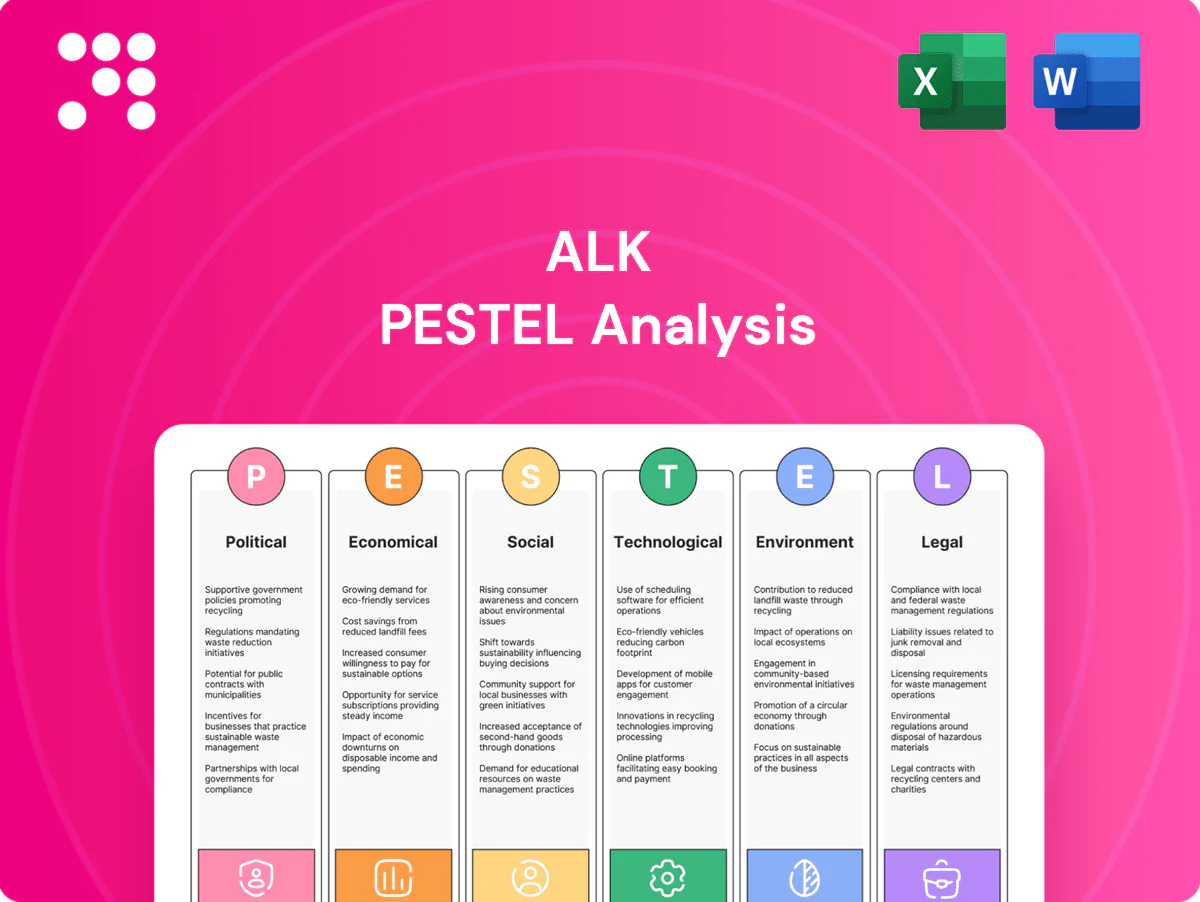
Alk PESTLE Analysis

Make Smarter Strategic Decisions with a Complete PESTEL View
Discover how political shifts, economic trends, social dynamics, technological advances, legal changes, and environmental pressures are shaping Alk’s strategic outlook in our concise PESTLE Analysis. Tailored for investors and strategists, this briefing highlights risks and opportunities you need now. Purchase the full PESTLE report to unlock detailed insights, ready-to-use recommendations, and downloadable files for immediate action.
Political factors

HTA and reimbursement politics
National HTA bodies such as NICE and country agencies determine AIT access and pricing, with median time to reimbursement in Europe around 12 months, affecting launch pace. Favorable appraisals can unlock broad coverage and rapid uptake; negative or delayed decisions often add 6–24 months and compress margins. ALK must tailor evidence dossiers to each country’s HTA framework and thresholds.
Public health allergy priorities
Government focus on chronic respiratory diseases—WHO reported about 262 million people with asthma in 2019—shapes funding toward preventive programs and can boost AIT investment; the global allergy immunotherapy market was roughly USD 5.0 billion in 2023. Inclusion of AIT in national allergy action plans correlates with higher physician adoption and reimbursement. Limited prioritization shifts budgets to acute care and vaccines, while targeted advocacy and real-world effectiveness data are raising AIT on policy agendas.

Trade and supply chain policy
Tariffs, customs delays, and localization rules can add material cost and lead times to biological inputs and finished goods; WTO data shows average applied MFN tariffs near 3% in 2024, while customs processing can add multi-day delays that disrupt cold‑chain shipments.
Diverse sourcing of allergens and excipients—spreading suppliers across 3+ regions—reduces exposure to single‑country policy shocks and import restrictions.
Alignment with international standards (ICH/GMP) eases cross‑border registration and cut average approval friction; policy shifts force agile logistics, with firms holding 4–8 weeks of inventory buffers to maintain supply continuity.

Regulatory harmonization initiatives
Regulatory harmonization initiatives by EMA, FDA and ICH streamline requirements for AIT quality and safety, reducing inconsistent data demands and enabling common CMC and clinical expectations. Convergence lowers duplication across dossiers, while regulatory divergence forces parallel pathways, increasing time and development cost. ALK gains from early scientific advice and worksharing procedures that can de-risk programs and align endpoints.
- EMA/FDA/ICH: streamlined AIT quality and safety standards
- Convergence: less duplication in clinical and CMC packages
- Divergence: parallel pathways, higher cost and time
- ALK advantage: early scientific advice and worksharing
Geopolitical stability and health funding
Geopolitical stability affects Alk revenue as stable governments enable predictable procurement cycles, while budget reallocations in crises can defer elective treatments like AIT—elective procedures fell up to 48% globally during COVID-19 (2020). Currency controls and sanctions have disrupted affiliate operations and supply chains. Scenario planning across regions reduces revenue volatility.
- Stable procurement: predictable contracts
- Budget risk: deferred elective AIT
- Sanctions/currency: supply/revenue disruption
- Mitigation: scenario planning
HTA timelines and tariffs dictate allergy immunotherapy access, margins and supply resilience
National HTA timelines (median ~12 months in Europe) and favorable appraisals drive AIT access and margins; negative/delayed decisions can add 6–24 months. Global allergy immunotherapy market ~USD 5.0bn (2023) and asthma prevalence ~262M (2019) underpin policy focus, while average applied MFN tariffs ~3% (2024) and customs delays raise costs. ALK mitigates shocks via 4–8 week inventory and country‑tailored HTA dossiers.
| Metric | Value | Impact |
|---|---|---|
| HTA median reimbursement (EU) | ~12 months | Launch pace, pricing |
| Global AIT market (2023) | USD 5.0bn | Investment pull |
| Asthma prevalence (2019) | 262M | Policy priority |
| Applied MFN tariffs (2024) | ~3% | Cost/headwind |
| Inventory buffer | 4–8 weeks | Supply continuity |
What is included in the product
 Detailed Word Document
Explores how external macro-environmental factors uniquely affect the Alk across Political, Economic, Social, Technological, Environmental and Legal dimensions, with data-backed subpoints and examples specific to the business and region. Designed for executives and investors, it reflects current market and regulatory dynamics, offers forward-looking insights for scenario planning, and is delivery-ready for plans, decks, or reports.

 Customizable Excel Spreadsheet
A concise, visually segmented Alk PESTLE summary that teams can drop into presentations, add notes for local context, and share across departments to speed risk discussions and strategic alignment.
Economic factors

Healthcare spending cycles
Macro growth and public budgets determine reimbursement headroom for specialty therapies as OECD countries spent about 8.8% of GDP on health and the global pharma market reached roughly $1.6 trillion in 2024; constrained public budgets with ~1–2% real growth in many advanced markets limit willingness to pay. Austerity periods intensify price pressure and tendering, while budget expansions support broader guideline adoption. ALK must align pricing to demonstrated value and outcomes to weather these cycles.
Out-of-pocket burden
Patient co-pays materially affect initiation and persistence in AIT: real-world persistence falls to about 30–40% at 3 years, with cost a leading cited barrier. High OOP in private US markets often runs into several hundred dollars per year and dampens demand despite proven efficacy. Flexible payment plans and starter programs have been shown to lift adherence. Channel mix management (clinic vs mail-order) optimizes affordability and margins.

Exchange rate volatility
Revenue earned in diverse currencies creates translation risk versus the DKK/EUR peg (central parity 7.46038 DKK per EUR), so local currency weakening can compress realized prices and margins in reporting currency. Hedging programs and natural offsets across markets materially reduce short‑term volatility. Pricing corridors and staggered contract rollovers further smooth revenue and protect profitability.

Market growth in respiratory care
Rising prevalence of allergic rhinitis (10–30% globally) and asthma (≈262 million people per WHO 2019) expands AIT addressable market; global allergy immunotherapy market estimated ~4.2 billion USD in 2023 with ~8–9% CAGR to 2030. Competing symptomatic therapies (OTC antihistamines vs biologics like dupilumab ~38,000 USD/yr) anchor willingness-to-pay, while AIT’s disease-modifying value supports premium positioning; forecasting must factor strong seasonality and pollen-driven Q2–Q3 peaks in temperate markets.
- Market size: ~4.2B USD (2023)
- Addressable: allergic rhinitis 10–30%, asthma ~262M
- WTP anchors: OTC low-cost vs biologics ~38k USD/yr
- Seasonality: Q2–Q3 pollen peaks impact demand
Cost of clinical development
Large, multi-season allergen immunotherapy trials drive capital needs—Phase III allergy trials typically range from $30–100m and extended follow-up adds years of expense. Efficient adaptive designs and validated surrogate endpoints can cut time and costs by roughly 20–30%. Partnerships, EU/NIH grants and industry collaborations commonly offset 10–30% of R&D burn. Portfolio prioritization steers spend to highest-ROI allergens and growth geographies.
- Phase III cost range: $30–100m
- Surrogate/endpoints savings: ~20–30%
- Partnerships/grants offset: ~10–30%
- Focus: high-ROI allergens & geographies
HTA timelines and tariffs dictate allergy immunotherapy access, margins and supply resilience
Macro budget limits reimbursement as OECD spent ~8.8% GDP on health and global pharma reached ~$1.6T in 2024, capping willingness-to-pay. OOP reduces AIT persistence to ~30–40% at 3 years; US annual patient costs often several hundred USD. FX risk vs DKK/EUR 7.46038 parity and Phase III costs $30–100M compress margins.
| Metric | Value |
|---|---|
| Allergy market (2023) | $4.2B |
| Asthma prevalence | ~262M (WHO 2019) |
| Dupilumab annual price | ~$38,000 |
Same Document Delivered
Alk PESTLE Analysis
The preview shown here is the exact Alk PESTLE Analysis document you’ll receive after purchase—fully formatted, professionally structured, and ready to use. No placeholders or teasers: the content, layout, and findings visible now are the final file you’ll download immediately after checkout. Use it as-is for strategic planning, reporting, or presentation.

Make Smarter Strategic Decisions with a Complete PESTEL View
Discover how political shifts, economic trends, social dynamics, technological advances, legal changes, and environmental pressures are shaping Alk’s strategic outlook in our concise PESTLE Analysis. Tailored for investors and strategists, this briefing highlights risks and opportunities you need now. Purchase the full PESTLE report to unlock detailed insights, ready-to-use recommendations, and downloadable files for immediate action.
Political factors
HTA and reimbursement politics
National HTA bodies such as NICE and country agencies determine AIT access and pricing, with median time to reimbursement in Europe around 12 months, affecting launch pace. Favorable appraisals can unlock broad coverage and rapid uptake; negative or delayed decisions often add 6–24 months and compress margins. ALK must tailor evidence dossiers to each country’s HTA framework and thresholds.
Public health allergy priorities
Government focus on chronic respiratory diseases—WHO reported about 262 million people with asthma in 2019—shapes funding toward preventive programs and can boost AIT investment; the global allergy immunotherapy market was roughly USD 5.0 billion in 2023. Inclusion of AIT in national allergy action plans correlates with higher physician adoption and reimbursement. Limited prioritization shifts budgets to acute care and vaccines, while targeted advocacy and real-world effectiveness data are raising AIT on policy agendas.
Trade and supply chain policy
Tariffs, customs delays, and localization rules can add material cost and lead times to biological inputs and finished goods; WTO data shows average applied MFN tariffs near 3% in 2024, while customs processing can add multi-day delays that disrupt cold‑chain shipments.
Diverse sourcing of allergens and excipients—spreading suppliers across 3+ regions—reduces exposure to single‑country policy shocks and import restrictions.
Alignment with international standards (ICH/GMP) eases cross‑border registration and cut average approval friction; policy shifts force agile logistics, with firms holding 4–8 weeks of inventory buffers to maintain supply continuity.
Regulatory harmonization initiatives
Regulatory harmonization initiatives by EMA, FDA and ICH streamline requirements for AIT quality and safety, reducing inconsistent data demands and enabling common CMC and clinical expectations. Convergence lowers duplication across dossiers, while regulatory divergence forces parallel pathways, increasing time and development cost. ALK gains from early scientific advice and worksharing procedures that can de-risk programs and align endpoints.
- EMA/FDA/ICH: streamlined AIT quality and safety standards
- Convergence: less duplication in clinical and CMC packages
- Divergence: parallel pathways, higher cost and time
- ALK advantage: early scientific advice and worksharing
Geopolitical stability and health funding
Geopolitical stability affects Alk revenue as stable governments enable predictable procurement cycles, while budget reallocations in crises can defer elective treatments like AIT—elective procedures fell up to 48% globally during COVID-19 (2020). Currency controls and sanctions have disrupted affiliate operations and supply chains. Scenario planning across regions reduces revenue volatility.
- Stable procurement: predictable contracts
- Budget risk: deferred elective AIT
- Sanctions/currency: supply/revenue disruption
- Mitigation: scenario planning
HTA timelines and tariffs dictate allergy immunotherapy access, margins and supply resilience
National HTA timelines (median ~12 months in Europe) and favorable appraisals drive AIT access and margins; negative/delayed decisions can add 6–24 months. Global allergy immunotherapy market ~USD 5.0bn (2023) and asthma prevalence ~262M (2019) underpin policy focus, while average applied MFN tariffs ~3% (2024) and customs delays raise costs. ALK mitigates shocks via 4–8 week inventory and country‑tailored HTA dossiers.
| Metric | Value | Impact |
|---|---|---|
| HTA median reimbursement (EU) | ~12 months | Launch pace, pricing |
| Global AIT market (2023) | USD 5.0bn | Investment pull |
| Asthma prevalence (2019) | 262M | Policy priority |
| Applied MFN tariffs (2024) | ~3% | Cost/headwind |
| Inventory buffer | 4–8 weeks | Supply continuity |
What is included in the product
Detailed Word Document
Explores how external macro-environmental factors uniquely affect the Alk across Political, Economic, Social, Technological, Environmental and Legal dimensions, with data-backed subpoints and examples specific to the business and region. Designed for executives and investors, it reflects current market and regulatory dynamics, offers forward-looking insights for scenario planning, and is delivery-ready for plans, decks, or reports.
Customizable Excel Spreadsheet
A concise, visually segmented Alk PESTLE summary that teams can drop into presentations, add notes for local context, and share across departments to speed risk discussions and strategic alignment.
Economic factors
Healthcare spending cycles
Macro growth and public budgets determine reimbursement headroom for specialty therapies as OECD countries spent about 8.8% of GDP on health and the global pharma market reached roughly $1.6 trillion in 2024; constrained public budgets with ~1–2% real growth in many advanced markets limit willingness to pay. Austerity periods intensify price pressure and tendering, while budget expansions support broader guideline adoption. ALK must align pricing to demonstrated value and outcomes to weather these cycles.
Out-of-pocket burden
Patient co-pays materially affect initiation and persistence in AIT: real-world persistence falls to about 30–40% at 3 years, with cost a leading cited barrier. High OOP in private US markets often runs into several hundred dollars per year and dampens demand despite proven efficacy. Flexible payment plans and starter programs have been shown to lift adherence. Channel mix management (clinic vs mail-order) optimizes affordability and margins.
Exchange rate volatility
Revenue earned in diverse currencies creates translation risk versus the DKK/EUR peg (central parity 7.46038 DKK per EUR), so local currency weakening can compress realized prices and margins in reporting currency. Hedging programs and natural offsets across markets materially reduce short‑term volatility. Pricing corridors and staggered contract rollovers further smooth revenue and protect profitability.
Market growth in respiratory care
Rising prevalence of allergic rhinitis (10–30% globally) and asthma (≈262 million people per WHO 2019) expands AIT addressable market; global allergy immunotherapy market estimated ~4.2 billion USD in 2023 with ~8–9% CAGR to 2030. Competing symptomatic therapies (OTC antihistamines vs biologics like dupilumab ~38,000 USD/yr) anchor willingness-to-pay, while AIT’s disease-modifying value supports premium positioning; forecasting must factor strong seasonality and pollen-driven Q2–Q3 peaks in temperate markets.
- Market size: ~4.2B USD (2023)
- Addressable: allergic rhinitis 10–30%, asthma ~262M
- WTP anchors: OTC low-cost vs biologics ~38k USD/yr
- Seasonality: Q2–Q3 pollen peaks impact demand
Cost of clinical development
Large, multi-season allergen immunotherapy trials drive capital needs—Phase III allergy trials typically range from $30–100m and extended follow-up adds years of expense. Efficient adaptive designs and validated surrogate endpoints can cut time and costs by roughly 20–30%. Partnerships, EU/NIH grants and industry collaborations commonly offset 10–30% of R&D burn. Portfolio prioritization steers spend to highest-ROI allergens and growth geographies.
- Phase III cost range: $30–100m
- Surrogate/endpoints savings: ~20–30%
- Partnerships/grants offset: ~10–30%
- Focus: high-ROI allergens & geographies
HTA timelines and tariffs dictate allergy immunotherapy access, margins and supply resilience
Macro budget limits reimbursement as OECD spent ~8.8% GDP on health and global pharma reached ~$1.6T in 2024, capping willingness-to-pay. OOP reduces AIT persistence to ~30–40% at 3 years; US annual patient costs often several hundred USD. FX risk vs DKK/EUR 7.46038 parity and Phase III costs $30–100M compress margins.
| Metric | Value |
|---|---|
| Allergy market (2023) | $4.2B |
| Asthma prevalence | ~262M (WHO 2019) |
| Dupilumab annual price | ~$38,000 |
Same Document Delivered
Alk PESTLE Analysis
The preview shown here is the exact Alk PESTLE Analysis document you’ll receive after purchase—fully formatted, professionally structured, and ready to use. No placeholders or teasers: the content, layout, and findings visible now are the final file you’ll download immediately after checkout. Use it as-is for strategic planning, reporting, or presentation.
Original: $10.00
-65%$10.00
$3.50Description
Make Smarter Strategic Decisions with a Complete PESTEL View
Discover how political shifts, economic trends, social dynamics, technological advances, legal changes, and environmental pressures are shaping Alk’s strategic outlook in our concise PESTLE Analysis. Tailored for investors and strategists, this briefing highlights risks and opportunities you need now. Purchase the full PESTLE report to unlock detailed insights, ready-to-use recommendations, and downloadable files for immediate action.
Political factors
HTA and reimbursement politics
National HTA bodies such as NICE and country agencies determine AIT access and pricing, with median time to reimbursement in Europe around 12 months, affecting launch pace. Favorable appraisals can unlock broad coverage and rapid uptake; negative or delayed decisions often add 6–24 months and compress margins. ALK must tailor evidence dossiers to each country’s HTA framework and thresholds.
Public health allergy priorities
Government focus on chronic respiratory diseases—WHO reported about 262 million people with asthma in 2019—shapes funding toward preventive programs and can boost AIT investment; the global allergy immunotherapy market was roughly USD 5.0 billion in 2023. Inclusion of AIT in national allergy action plans correlates with higher physician adoption and reimbursement. Limited prioritization shifts budgets to acute care and vaccines, while targeted advocacy and real-world effectiveness data are raising AIT on policy agendas.
Trade and supply chain policy
Tariffs, customs delays, and localization rules can add material cost and lead times to biological inputs and finished goods; WTO data shows average applied MFN tariffs near 3% in 2024, while customs processing can add multi-day delays that disrupt cold‑chain shipments.
Diverse sourcing of allergens and excipients—spreading suppliers across 3+ regions—reduces exposure to single‑country policy shocks and import restrictions.
Alignment with international standards (ICH/GMP) eases cross‑border registration and cut average approval friction; policy shifts force agile logistics, with firms holding 4–8 weeks of inventory buffers to maintain supply continuity.
Regulatory harmonization initiatives
Regulatory harmonization initiatives by EMA, FDA and ICH streamline requirements for AIT quality and safety, reducing inconsistent data demands and enabling common CMC and clinical expectations. Convergence lowers duplication across dossiers, while regulatory divergence forces parallel pathways, increasing time and development cost. ALK gains from early scientific advice and worksharing procedures that can de-risk programs and align endpoints.
- EMA/FDA/ICH: streamlined AIT quality and safety standards
- Convergence: less duplication in clinical and CMC packages
- Divergence: parallel pathways, higher cost and time
- ALK advantage: early scientific advice and worksharing
Geopolitical stability and health funding
Geopolitical stability affects Alk revenue as stable governments enable predictable procurement cycles, while budget reallocations in crises can defer elective treatments like AIT—elective procedures fell up to 48% globally during COVID-19 (2020). Currency controls and sanctions have disrupted affiliate operations and supply chains. Scenario planning across regions reduces revenue volatility.
- Stable procurement: predictable contracts
- Budget risk: deferred elective AIT
- Sanctions/currency: supply/revenue disruption
- Mitigation: scenario planning
HTA timelines and tariffs dictate allergy immunotherapy access, margins and supply resilience
National HTA timelines (median ~12 months in Europe) and favorable appraisals drive AIT access and margins; negative/delayed decisions can add 6–24 months. Global allergy immunotherapy market ~USD 5.0bn (2023) and asthma prevalence ~262M (2019) underpin policy focus, while average applied MFN tariffs ~3% (2024) and customs delays raise costs. ALK mitigates shocks via 4–8 week inventory and country‑tailored HTA dossiers.
| Metric | Value | Impact |
|---|---|---|
| HTA median reimbursement (EU) | ~12 months | Launch pace, pricing |
| Global AIT market (2023) | USD 5.0bn | Investment pull |
| Asthma prevalence (2019) | 262M | Policy priority |
| Applied MFN tariffs (2024) | ~3% | Cost/headwind |
| Inventory buffer | 4–8 weeks | Supply continuity |
What is included in the product
Detailed Word Document
Explores how external macro-environmental factors uniquely affect the Alk across Political, Economic, Social, Technological, Environmental and Legal dimensions, with data-backed subpoints and examples specific to the business and region. Designed for executives and investors, it reflects current market and regulatory dynamics, offers forward-looking insights for scenario planning, and is delivery-ready for plans, decks, or reports.
Customizable Excel Spreadsheet
A concise, visually segmented Alk PESTLE summary that teams can drop into presentations, add notes for local context, and share across departments to speed risk discussions and strategic alignment.
Economic factors
Healthcare spending cycles
Macro growth and public budgets determine reimbursement headroom for specialty therapies as OECD countries spent about 8.8% of GDP on health and the global pharma market reached roughly $1.6 trillion in 2024; constrained public budgets with ~1–2% real growth in many advanced markets limit willingness to pay. Austerity periods intensify price pressure and tendering, while budget expansions support broader guideline adoption. ALK must align pricing to demonstrated value and outcomes to weather these cycles.
Out-of-pocket burden
Patient co-pays materially affect initiation and persistence in AIT: real-world persistence falls to about 30–40% at 3 years, with cost a leading cited barrier. High OOP in private US markets often runs into several hundred dollars per year and dampens demand despite proven efficacy. Flexible payment plans and starter programs have been shown to lift adherence. Channel mix management (clinic vs mail-order) optimizes affordability and margins.
Exchange rate volatility
Revenue earned in diverse currencies creates translation risk versus the DKK/EUR peg (central parity 7.46038 DKK per EUR), so local currency weakening can compress realized prices and margins in reporting currency. Hedging programs and natural offsets across markets materially reduce short‑term volatility. Pricing corridors and staggered contract rollovers further smooth revenue and protect profitability.
Market growth in respiratory care
Rising prevalence of allergic rhinitis (10–30% globally) and asthma (≈262 million people per WHO 2019) expands AIT addressable market; global allergy immunotherapy market estimated ~4.2 billion USD in 2023 with ~8–9% CAGR to 2030. Competing symptomatic therapies (OTC antihistamines vs biologics like dupilumab ~38,000 USD/yr) anchor willingness-to-pay, while AIT’s disease-modifying value supports premium positioning; forecasting must factor strong seasonality and pollen-driven Q2–Q3 peaks in temperate markets.
- Market size: ~4.2B USD (2023)
- Addressable: allergic rhinitis 10–30%, asthma ~262M
- WTP anchors: OTC low-cost vs biologics ~38k USD/yr
- Seasonality: Q2–Q3 pollen peaks impact demand
Cost of clinical development
Large, multi-season allergen immunotherapy trials drive capital needs—Phase III allergy trials typically range from $30–100m and extended follow-up adds years of expense. Efficient adaptive designs and validated surrogate endpoints can cut time and costs by roughly 20–30%. Partnerships, EU/NIH grants and industry collaborations commonly offset 10–30% of R&D burn. Portfolio prioritization steers spend to highest-ROI allergens and growth geographies.
- Phase III cost range: $30–100m
- Surrogate/endpoints savings: ~20–30%
- Partnerships/grants offset: ~10–30%
- Focus: high-ROI allergens & geographies
HTA timelines and tariffs dictate allergy immunotherapy access, margins and supply resilience
Macro budget limits reimbursement as OECD spent ~8.8% GDP on health and global pharma reached ~$1.6T in 2024, capping willingness-to-pay. OOP reduces AIT persistence to ~30–40% at 3 years; US annual patient costs often several hundred USD. FX risk vs DKK/EUR 7.46038 parity and Phase III costs $30–100M compress margins.
| Metric | Value |
|---|---|
| Allergy market (2023) | $4.2B |
| Asthma prevalence | ~262M (WHO 2019) |
| Dupilumab annual price | ~$38,000 |
Same Document Delivered
Alk PESTLE Analysis
The preview shown here is the exact Alk PESTLE Analysis document you’ll receive after purchase—fully formatted, professionally structured, and ready to use. No placeholders or teasers: the content, layout, and findings visible now are the final file you’ll download immediately after checkout. Use it as-is for strategic planning, reporting, or presentation.











