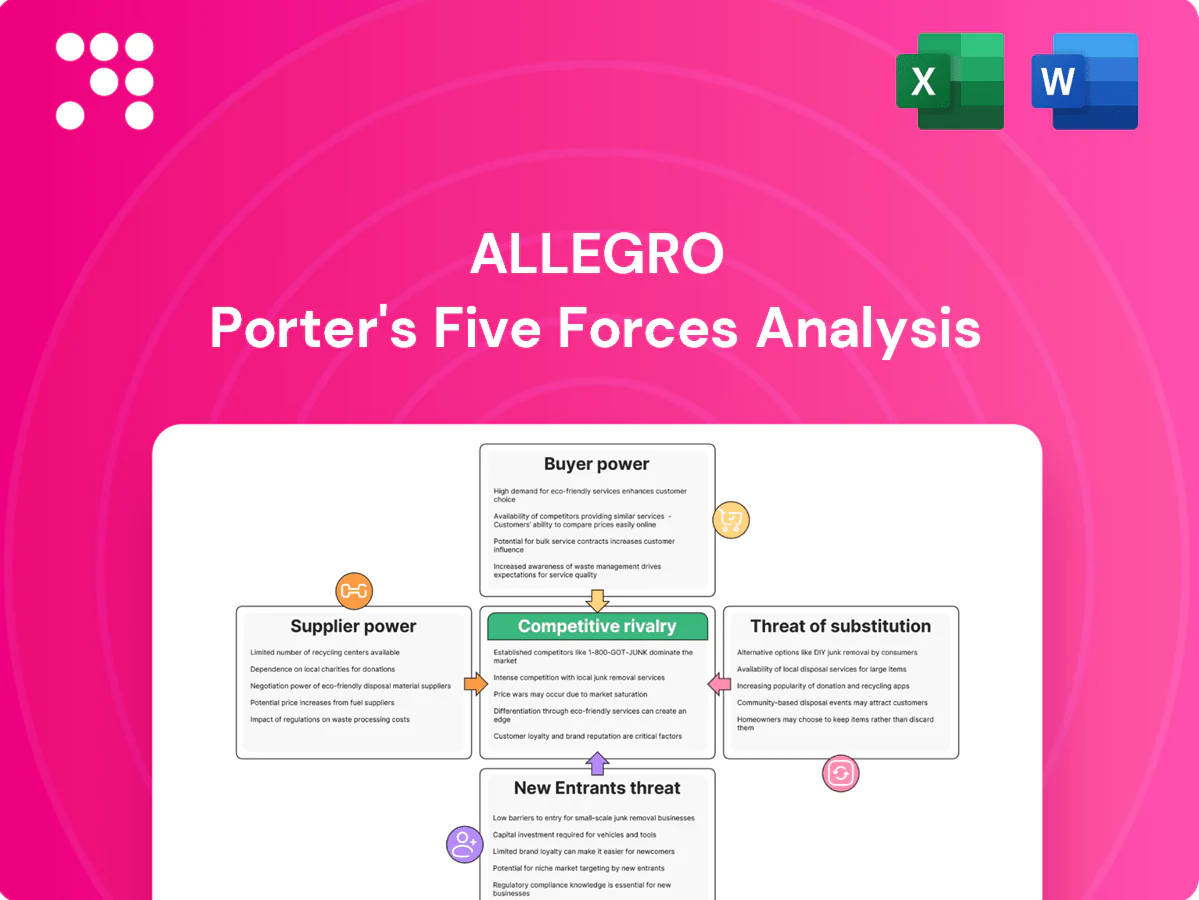
Allegro Porter's Five Forces Analysis

Elevate Your Analysis with the Complete Porter's Five Forces Analysis
Allegro’s Porter’s Five Forces shows high buyer power, moderate supplier influence, intense rivalry from local and international marketplaces, and rising substitute threats from specialists. Network effects and regulatory barriers raise switching costs but don't eliminate competitive pressure. This brief snapshot only scratches the surface. Unlock the full Porter's Five Forces Analysis to explore Allegro’s competitive dynamics, market pressures, and strategic advantages in detail.
Suppliers Bargaining Power

Diverse merchant base dilutes leverage
Allegro aggregates hundreds of thousands of merchants across categories, diluting any single seller’s bargaining power and enabling standardized fees and policies. Fragmentation supports uniform commission structures, though leading brands and high-demand categories retain leverage to negotiate preferential terms. Supplier churn risk is mitigated by Allegro’s ~45% share of Polish e‑commerce in 2024 and its large buyer base driving strong traffic and conversion.
Strategic brands and OEMs hold clout
Global electronics and fashion brands on Allegro can demand premium placement and fees because their assortments drive traffic; top brands accounted for a disproportionate share of visits in 2024, while Allegro reported over 20 million active buyers in 2024. Exclusive SKUs and MAP policies strengthen suppliers' leverage. Allegro offsets this with growing private-label penetration and a deep SMB seller base, preserving platform negotiation power.

Logistics and delivery partners as critical suppliers
Last-mile carriers and parcel lockers, notably InPost with roughly 18,000 paczkomaty in Poland (2024), directly shape Allegro’s costs and service levels by setting delivery rates and coverage.
Capacity constraints during peak periods elevate supplier bargaining power through surcharges and delayed SLAs; Allegro mitigates this via its own logistics solutions and multi-carrier routing.
Long-term volume contracts and strategic partnerships smooth rate volatility and secure capacity for peak seasons.

Payment processors and fintech dependencies
Payment gateways and anti-fraud tools are essential inputs; EU interchange caps of 0.20% for debit and 0.30% for credit limit base fees but not chargeback or fraud remediation costs, which can push effective supplier leverage higher. Processor pricing commonly ranges up to 2.5% plus fixed fees, while Allegro Pay and in-house checkout progressively reduce external dependence and negotiating exposure.
- Interchange caps: 0.20% debit / 0.30% credit (EU)
- Processor fees commonly ≤ 2.5% + fixed fee
- Chargebacks and fraud remediation shift bargaining power
- Allegro Pay/in‑house checkout and multi‑provider redundancy
Data and ad-tech vendors shape monetization
Ad serving, measurement, and search technologies materially influence Allegro’s ad take-rates by determining auction efficiency and measurability, while unique first-party user data reduces reliance on third-party ad-tech vendors and their pricing power. Stricter privacy rules raise vendor compliance and integration costs; building proprietary ad stacks and in-house measurement weakens supplier leverage and preserves margins.
- Ad tech affects take-rates
- First-party data lowers vendor power
- Privacy raises vendor costs
- Proprietary stacks cut dependency
Marketplace dominates with ~45% share and >20m buyers
Allegro’s large, fragmented seller base limits individual supplier leverage, though top brands and categories retain negotiating power. Platform scale — ~45% Polish e‑commerce share and >20m active buyers in 2024 — plus private label and Allegro Pay reduce dependency on external vendors. Delivery and payments (InPost ~18,000 lockers; processor fees ≤2.5%; EU interchange 0.20%/0.30%) remain key pressure points.
| Metric | 2024 |
|---|---|
| Poland e‑commerce share | ~45% |
| Active buyers | >20m |
| InPost lockers | ~18,000 |
| Processor fees | ≤2.5% |
| EU interchange caps | 0.20% / 0.30% |
What is included in the product
 Detailed Word Document
Comprehensive Porter’s Five Forces analysis tailored to Allegro, assessing competitive rivalry, buyer and supplier power, threat of new entrants and substitutes, and barriers protecting its marketplace position. Highlights disruptive threats, pricing pressures, and strategic levers—delivered in an editable Word format for reports, investor decks, or strategic planning.

 Customizable Excel Spreadsheet
A concise Allegro Porter's Five Forces one-sheet with customizable pressure levels and an instant radar chart—no macros, easy to edit—so teams can quickly assess competitive, supplier, buyer and regulatory pressures and drop insights straight into decks or dashboards.
Customers Bargaining Power

Low switching costs, high price transparency
Consumers compare prices instantly across marketplaces and brand sites, heightening price sensitivity and eroding marketplace take-rates as shoppers switch to lowest-cost listings; global average cart abandonment reached about 69.8% in 2023, rising when shipping or fees are uncompetitive.
Loyalty and fast-delivery programs, such as paid subscriptions and guaranteed same/next-day delivery, are deployed to raise switching costs and protect margins.
Multi-homing with Amazon, Temu, Shein
Polish shoppers routinely multi-home across Allegro, Amazon, Temu and Shein, forcing price and shipping parity; Allegro reported about 20.4 million active buyers (2022) which faces rising cross-border pressure as fast-fashion and ultra-low-cost platforms scale in Poland, making promotions and vouchers table stakes; Allegro’s local trust, Polish-language service and same-country logistics materially reduce churn.

Review systems enhance buyer influence
Review systems and generous return policies empower Allegro buyers—over 13 million active buyers in 2024 can use ratings and returns to demand higher quality, forcing sellers to improve or lose traffic. Poor seller performance quickly reduces visibility and sales via Allegro’s ranking algorithms and buyer feedback. Allegro must police compliance to maintain trust; buyer protections raise operating costs but increase platform stickiness and lifetime value.

Demand concentration in peak seasons
Black Friday and holiday spikes concentrate demand and amplify buyer bargaining power, with Allegro serving over 20 million active users in 2024, making peak-period failures highly visible. Service lapses during peaks depress NPS disproportionately and drive switching. To retain buyers Allegro funds temporary subsidies and builds capacity buffers, compressing margin but protecting market share.
- Peak concentration: higher buyer leverage
- NPS sensitivity: outsized impact from failures
- Defensive spend: subsidies + capacity buffers
- Margin trade-off: short-term compression to preserve share
Payment and delivery expectations
- Active buyers 2024: ~12.5M
- BNPL conversion uplift 2024: up to 20%
- Fast/cheap delivery = retention lever
- Logistics/fintech spend lowers buyer power
Buyers price-sensitive; cart abandonment 69.8%, BNPL boosts conversion
Buyers wield strong price sensitivity and cross‑platform switching, raising pressure on Allegro take‑rates; cart abandonment ~69.8% (2023). Loyalty programs and fast delivery partially raise switching costs; logistics and BNPL (conversion uplift up to 20%) reduce buyer power over time. Peak events (Black Friday) amplify buyer leverage, forcing temporary subsidies and capacity spending.
| Metric | Value |
|---|---|
| Active buyers (2024) | ~12.5M |
| Peak users | ~20M |
| Cart abandonment (2023) | 69.8% |
| BNPL uplift | up to 20% |
Full Version Awaits
Allegro Porter's Five Forces Analysis
This preview shows the exact Allegro Porter’s Five Forces analysis you’ll receive immediately after purchase—no placeholders or mockups. The document is fully formatted, professionally written, and ready for download the moment you pay. What you see here is the deliverable, ready to use for decision-making and reporting.

Elevate Your Analysis with the Complete Porter's Five Forces Analysis
Allegro’s Porter’s Five Forces shows high buyer power, moderate supplier influence, intense rivalry from local and international marketplaces, and rising substitute threats from specialists. Network effects and regulatory barriers raise switching costs but don't eliminate competitive pressure. This brief snapshot only scratches the surface. Unlock the full Porter's Five Forces Analysis to explore Allegro’s competitive dynamics, market pressures, and strategic advantages in detail.
Suppliers Bargaining Power
Diverse merchant base dilutes leverage
Allegro aggregates hundreds of thousands of merchants across categories, diluting any single seller’s bargaining power and enabling standardized fees and policies. Fragmentation supports uniform commission structures, though leading brands and high-demand categories retain leverage to negotiate preferential terms. Supplier churn risk is mitigated by Allegro’s ~45% share of Polish e‑commerce in 2024 and its large buyer base driving strong traffic and conversion.
Strategic brands and OEMs hold clout
Global electronics and fashion brands on Allegro can demand premium placement and fees because their assortments drive traffic; top brands accounted for a disproportionate share of visits in 2024, while Allegro reported over 20 million active buyers in 2024. Exclusive SKUs and MAP policies strengthen suppliers' leverage. Allegro offsets this with growing private-label penetration and a deep SMB seller base, preserving platform negotiation power.
Logistics and delivery partners as critical suppliers
Last-mile carriers and parcel lockers, notably InPost with roughly 18,000 paczkomaty in Poland (2024), directly shape Allegro’s costs and service levels by setting delivery rates and coverage.
Capacity constraints during peak periods elevate supplier bargaining power through surcharges and delayed SLAs; Allegro mitigates this via its own logistics solutions and multi-carrier routing.
Long-term volume contracts and strategic partnerships smooth rate volatility and secure capacity for peak seasons.
Payment processors and fintech dependencies
Payment gateways and anti-fraud tools are essential inputs; EU interchange caps of 0.20% for debit and 0.30% for credit limit base fees but not chargeback or fraud remediation costs, which can push effective supplier leverage higher. Processor pricing commonly ranges up to 2.5% plus fixed fees, while Allegro Pay and in-house checkout progressively reduce external dependence and negotiating exposure.
- Interchange caps: 0.20% debit / 0.30% credit (EU)
- Processor fees commonly ≤ 2.5% + fixed fee
- Chargebacks and fraud remediation shift bargaining power
- Allegro Pay/in‑house checkout and multi‑provider redundancy
Data and ad-tech vendors shape monetization
Ad serving, measurement, and search technologies materially influence Allegro’s ad take-rates by determining auction efficiency and measurability, while unique first-party user data reduces reliance on third-party ad-tech vendors and their pricing power. Stricter privacy rules raise vendor compliance and integration costs; building proprietary ad stacks and in-house measurement weakens supplier leverage and preserves margins.
- Ad tech affects take-rates
- First-party data lowers vendor power
- Privacy raises vendor costs
- Proprietary stacks cut dependency
Marketplace dominates with ~45% share and >20m buyers
Allegro’s large, fragmented seller base limits individual supplier leverage, though top brands and categories retain negotiating power. Platform scale — ~45% Polish e‑commerce share and >20m active buyers in 2024 — plus private label and Allegro Pay reduce dependency on external vendors. Delivery and payments (InPost ~18,000 lockers; processor fees ≤2.5%; EU interchange 0.20%/0.30%) remain key pressure points.
| Metric | 2024 |
|---|---|
| Poland e‑commerce share | ~45% |
| Active buyers | >20m |
| InPost lockers | ~18,000 |
| Processor fees | ≤2.5% |
| EU interchange caps | 0.20% / 0.30% |
What is included in the product
Detailed Word Document
Comprehensive Porter’s Five Forces analysis tailored to Allegro, assessing competitive rivalry, buyer and supplier power, threat of new entrants and substitutes, and barriers protecting its marketplace position. Highlights disruptive threats, pricing pressures, and strategic levers—delivered in an editable Word format for reports, investor decks, or strategic planning.
Customizable Excel Spreadsheet
A concise Allegro Porter's Five Forces one-sheet with customizable pressure levels and an instant radar chart—no macros, easy to edit—so teams can quickly assess competitive, supplier, buyer and regulatory pressures and drop insights straight into decks or dashboards.
Customers Bargaining Power
Low switching costs, high price transparency
Consumers compare prices instantly across marketplaces and brand sites, heightening price sensitivity and eroding marketplace take-rates as shoppers switch to lowest-cost listings; global average cart abandonment reached about 69.8% in 2023, rising when shipping or fees are uncompetitive.
Loyalty and fast-delivery programs, such as paid subscriptions and guaranteed same/next-day delivery, are deployed to raise switching costs and protect margins.
Multi-homing with Amazon, Temu, Shein
Polish shoppers routinely multi-home across Allegro, Amazon, Temu and Shein, forcing price and shipping parity; Allegro reported about 20.4 million active buyers (2022) which faces rising cross-border pressure as fast-fashion and ultra-low-cost platforms scale in Poland, making promotions and vouchers table stakes; Allegro’s local trust, Polish-language service and same-country logistics materially reduce churn.
Review systems enhance buyer influence
Review systems and generous return policies empower Allegro buyers—over 13 million active buyers in 2024 can use ratings and returns to demand higher quality, forcing sellers to improve or lose traffic. Poor seller performance quickly reduces visibility and sales via Allegro’s ranking algorithms and buyer feedback. Allegro must police compliance to maintain trust; buyer protections raise operating costs but increase platform stickiness and lifetime value.
Demand concentration in peak seasons
Black Friday and holiday spikes concentrate demand and amplify buyer bargaining power, with Allegro serving over 20 million active users in 2024, making peak-period failures highly visible. Service lapses during peaks depress NPS disproportionately and drive switching. To retain buyers Allegro funds temporary subsidies and builds capacity buffers, compressing margin but protecting market share.
- Peak concentration: higher buyer leverage
- NPS sensitivity: outsized impact from failures
- Defensive spend: subsidies + capacity buffers
- Margin trade-off: short-term compression to preserve share
Payment and delivery expectations
- Active buyers 2024: ~12.5M
- BNPL conversion uplift 2024: up to 20%
- Fast/cheap delivery = retention lever
- Logistics/fintech spend lowers buyer power
Buyers price-sensitive; cart abandonment 69.8%, BNPL boosts conversion
Buyers wield strong price sensitivity and cross‑platform switching, raising pressure on Allegro take‑rates; cart abandonment ~69.8% (2023). Loyalty programs and fast delivery partially raise switching costs; logistics and BNPL (conversion uplift up to 20%) reduce buyer power over time. Peak events (Black Friday) amplify buyer leverage, forcing temporary subsidies and capacity spending.
| Metric | Value |
|---|---|
| Active buyers (2024) | ~12.5M |
| Peak users | ~20M |
| Cart abandonment (2023) | 69.8% |
| BNPL uplift | up to 20% |
Full Version Awaits
Allegro Porter's Five Forces Analysis
This preview shows the exact Allegro Porter’s Five Forces analysis you’ll receive immediately after purchase—no placeholders or mockups. The document is fully formatted, professionally written, and ready for download the moment you pay. What you see here is the deliverable, ready to use for decision-making and reporting.
Original: $10.00
-65%$10.00
$3.50Description
Elevate Your Analysis with the Complete Porter's Five Forces Analysis
Allegro’s Porter’s Five Forces shows high buyer power, moderate supplier influence, intense rivalry from local and international marketplaces, and rising substitute threats from specialists. Network effects and regulatory barriers raise switching costs but don't eliminate competitive pressure. This brief snapshot only scratches the surface. Unlock the full Porter's Five Forces Analysis to explore Allegro’s competitive dynamics, market pressures, and strategic advantages in detail.
Suppliers Bargaining Power
Diverse merchant base dilutes leverage
Allegro aggregates hundreds of thousands of merchants across categories, diluting any single seller’s bargaining power and enabling standardized fees and policies. Fragmentation supports uniform commission structures, though leading brands and high-demand categories retain leverage to negotiate preferential terms. Supplier churn risk is mitigated by Allegro’s ~45% share of Polish e‑commerce in 2024 and its large buyer base driving strong traffic and conversion.
Strategic brands and OEMs hold clout
Global electronics and fashion brands on Allegro can demand premium placement and fees because their assortments drive traffic; top brands accounted for a disproportionate share of visits in 2024, while Allegro reported over 20 million active buyers in 2024. Exclusive SKUs and MAP policies strengthen suppliers' leverage. Allegro offsets this with growing private-label penetration and a deep SMB seller base, preserving platform negotiation power.
Logistics and delivery partners as critical suppliers
Last-mile carriers and parcel lockers, notably InPost with roughly 18,000 paczkomaty in Poland (2024), directly shape Allegro’s costs and service levels by setting delivery rates and coverage.
Capacity constraints during peak periods elevate supplier bargaining power through surcharges and delayed SLAs; Allegro mitigates this via its own logistics solutions and multi-carrier routing.
Long-term volume contracts and strategic partnerships smooth rate volatility and secure capacity for peak seasons.
Payment processors and fintech dependencies
Payment gateways and anti-fraud tools are essential inputs; EU interchange caps of 0.20% for debit and 0.30% for credit limit base fees but not chargeback or fraud remediation costs, which can push effective supplier leverage higher. Processor pricing commonly ranges up to 2.5% plus fixed fees, while Allegro Pay and in-house checkout progressively reduce external dependence and negotiating exposure.
- Interchange caps: 0.20% debit / 0.30% credit (EU)
- Processor fees commonly ≤ 2.5% + fixed fee
- Chargebacks and fraud remediation shift bargaining power
- Allegro Pay/in‑house checkout and multi‑provider redundancy
Data and ad-tech vendors shape monetization
Ad serving, measurement, and search technologies materially influence Allegro’s ad take-rates by determining auction efficiency and measurability, while unique first-party user data reduces reliance on third-party ad-tech vendors and their pricing power. Stricter privacy rules raise vendor compliance and integration costs; building proprietary ad stacks and in-house measurement weakens supplier leverage and preserves margins.
- Ad tech affects take-rates
- First-party data lowers vendor power
- Privacy raises vendor costs
- Proprietary stacks cut dependency
Marketplace dominates with ~45% share and >20m buyers
Allegro’s large, fragmented seller base limits individual supplier leverage, though top brands and categories retain negotiating power. Platform scale — ~45% Polish e‑commerce share and >20m active buyers in 2024 — plus private label and Allegro Pay reduce dependency on external vendors. Delivery and payments (InPost ~18,000 lockers; processor fees ≤2.5%; EU interchange 0.20%/0.30%) remain key pressure points.
| Metric | 2024 |
|---|---|
| Poland e‑commerce share | ~45% |
| Active buyers | >20m |
| InPost lockers | ~18,000 |
| Processor fees | ≤2.5% |
| EU interchange caps | 0.20% / 0.30% |
What is included in the product
Detailed Word Document
Comprehensive Porter’s Five Forces analysis tailored to Allegro, assessing competitive rivalry, buyer and supplier power, threat of new entrants and substitutes, and barriers protecting its marketplace position. Highlights disruptive threats, pricing pressures, and strategic levers—delivered in an editable Word format for reports, investor decks, or strategic planning.
Customizable Excel Spreadsheet
A concise Allegro Porter's Five Forces one-sheet with customizable pressure levels and an instant radar chart—no macros, easy to edit—so teams can quickly assess competitive, supplier, buyer and regulatory pressures and drop insights straight into decks or dashboards.
Customers Bargaining Power
Low switching costs, high price transparency
Consumers compare prices instantly across marketplaces and brand sites, heightening price sensitivity and eroding marketplace take-rates as shoppers switch to lowest-cost listings; global average cart abandonment reached about 69.8% in 2023, rising when shipping or fees are uncompetitive.
Loyalty and fast-delivery programs, such as paid subscriptions and guaranteed same/next-day delivery, are deployed to raise switching costs and protect margins.
Multi-homing with Amazon, Temu, Shein
Polish shoppers routinely multi-home across Allegro, Amazon, Temu and Shein, forcing price and shipping parity; Allegro reported about 20.4 million active buyers (2022) which faces rising cross-border pressure as fast-fashion and ultra-low-cost platforms scale in Poland, making promotions and vouchers table stakes; Allegro’s local trust, Polish-language service and same-country logistics materially reduce churn.
Review systems enhance buyer influence
Review systems and generous return policies empower Allegro buyers—over 13 million active buyers in 2024 can use ratings and returns to demand higher quality, forcing sellers to improve or lose traffic. Poor seller performance quickly reduces visibility and sales via Allegro’s ranking algorithms and buyer feedback. Allegro must police compliance to maintain trust; buyer protections raise operating costs but increase platform stickiness and lifetime value.
Demand concentration in peak seasons
Black Friday and holiday spikes concentrate demand and amplify buyer bargaining power, with Allegro serving over 20 million active users in 2024, making peak-period failures highly visible. Service lapses during peaks depress NPS disproportionately and drive switching. To retain buyers Allegro funds temporary subsidies and builds capacity buffers, compressing margin but protecting market share.
- Peak concentration: higher buyer leverage
- NPS sensitivity: outsized impact from failures
- Defensive spend: subsidies + capacity buffers
- Margin trade-off: short-term compression to preserve share
Payment and delivery expectations
- Active buyers 2024: ~12.5M
- BNPL conversion uplift 2024: up to 20%
- Fast/cheap delivery = retention lever
- Logistics/fintech spend lowers buyer power
Buyers price-sensitive; cart abandonment 69.8%, BNPL boosts conversion
Buyers wield strong price sensitivity and cross‑platform switching, raising pressure on Allegro take‑rates; cart abandonment ~69.8% (2023). Loyalty programs and fast delivery partially raise switching costs; logistics and BNPL (conversion uplift up to 20%) reduce buyer power over time. Peak events (Black Friday) amplify buyer leverage, forcing temporary subsidies and capacity spending.
| Metric | Value |
|---|---|
| Active buyers (2024) | ~12.5M |
| Peak users | ~20M |
| Cart abandonment (2023) | 69.8% |
| BNPL uplift | up to 20% |
Full Version Awaits
Allegro Porter's Five Forces Analysis
This preview shows the exact Allegro Porter’s Five Forces analysis you’ll receive immediately after purchase—no placeholders or mockups. The document is fully formatted, professionally written, and ready for download the moment you pay. What you see here is the deliverable, ready to use for decision-making and reporting.











