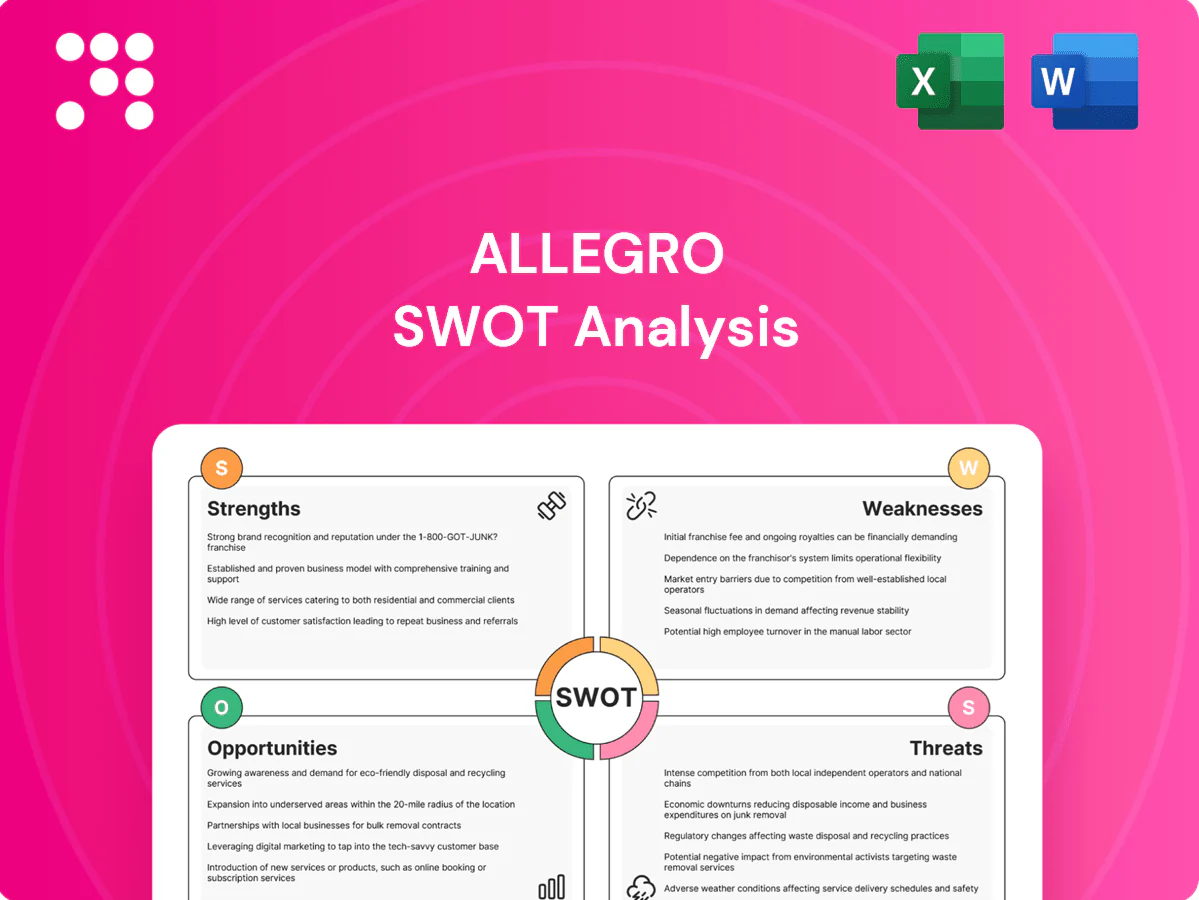
Allegro SWOT Analysis

Elevate Your Analysis with the Complete SWOT Report
Allegro's SWOT reveals strong market share and platform strengths, but also competitive and regulatory pressures that could reshape growth. Our full SWOT breaks down opportunities, risks, and strategic levers with data-driven commentary. Purchase the complete, editable Word + Excel report to inform investment, strategy, or pitch decks with confidence.
Strengths

Dominant Polish marketplace
Allegro commands roughly half of Poland’s online marketplace market share and is the default destination for domestic e-commerce, with over 11 million active buyers and leading monthly traffic that boosts conversion and seller interest. Dense buyer traffic and strong brand recognition create powerful network effects, improving buyer-seller liquidity and selection breadth. This scale cuts customer acquisition cost and expands monetization options across fees, advertising and logistics.
Broad product assortment
Allegro covers electronics, fashion, home and automotive in one marketplace, supporting one-stop shopping and category depth; the platform lists over 145 million offers and is Poland’s largest e-commerce site. A broad catalog drives larger baskets and higher purchase frequency, while cross-selling and recommendation engines lift ARPU. Category breadth cushions demand volatility by spreading GMV across segments.

Integrated payments and logistics
In-house payment processing (Allegro Pay) and logistics (Allegro Smart! and proprietary delivery network) reduce friction and boost trust, enabling faster delivery and secure transactions that elevate customer satisfaction. These integrated services increase platform stickiness for buyers and sellers and create incremental fee and margin streams; Allegro serves over 20 million active buyers in Poland.

Strong brand trust and local expertise
As a Polish-origin platform, Allegro aligns closely with local preferences and regulations, leveraging deep market knowledge to tailor merchandising and customer support to Polish shoppers.
Brand familiarity drives repeat usage—Allegro serves over 20 million active users (2024)—supporting higher NPS and smoother seller onboarding, which lowers churn for merchants.
- Local market leader: over 20 million active users (2024)
- Stronger localized support vs foreign generalists
- Improved seller onboarding and reduced churn
Data-driven marketplace operations
Allegro leverages behavioral data from over 20 million active buyers in 2024 to refine search, pricing and ad targeting, raising relevance and conversion and boosting advertiser ROI. Data insights reduce fraud, returns and inventory exposure through dynamic monitoring and scoring. Continuous optimization steadily improves unit economics and GMV efficiency year-over-year.
- large-scale behavioral data (20m+ active buyers, 2024)
- higher relevance → better conversion & advertiser ROI
- fraud/returns/inventory control via data
- continuous optimization improves unit economics
Poland marketplace leader: ~50% share, 20m+ buyers
Allegro holds roughly 50% of Poland’s online marketplace, with over 20 million active buyers (2024) and ~145 million listed offers, driving strong network effects, low CAC and high conversion. Integrated services (Allegro Pay, Allegro Smart!) and localized brand leadership improve trust, retention and monetization across fees, ads and logistics.
| Metric | 2024 |
|---|---|
| Market share | ~50% |
| Active buyers | 20m+ |
| Offers listed | ~145m |
What is included in the product
 Detailed Word Document
Provides a concise SWOT analysis of Allegro, highlighting its marketplace leadership, logistical and technology capabilities, financial and operational weaknesses, growth opportunities in e‑commerce and fintech, and external risks from competition, regulation, and macroeconomic pressures.

 Customizable Excel Spreadsheet
Provides a concise SWOT matrix tailored to Allegro for fast, visual strategy alignment and stakeholder-ready summaries; editable for quick updates to reflect market shifts and easy integration into reports.
Weaknesses

Heavy reliance on Poland
Heavy reliance on Poland leaves Allegro exposed to local macro and regulatory shocks, given it derives the vast majority of revenue from its home market and serves over 20 million active users. Geographic concentration limits growth diversification and makes long-term TAM dependent on successful regionalization. Expanding abroad will require new logistics, marketing spend and regulatory capabilities, raising execution risk and cost.
Thin margins in logistics
Delivery and fulfillment are capital- and cost-intensive for Allegro, with heavy investments in warehouses and last-mile operations driving up operating leverage. Competitive pressure to offer fast shipping compresses take rates and merchant fees, squeezing unit economics. Scaling logistics profitably requires continuous efficiency gains in automation and route optimisation. Any operational misstep can quickly erode EBITDA and cash flow.

Seller quality variability
Marketplace heterogeneity on Allegro leads to uneven customer experiences, with over 14 million active buyers facing issues like counterfeit listings, slow shipping and poor seller service that erode trust. Counterfeit and policy breaches force tighter policing and higher compliance costs, squeezing margins. Negative experiences drive churn to rivals such as Amazon and OLX.

Competitive price transparency
Competitive price transparency lets consumers compare offers instantly, constraining Allegro’s pricing power and ad monetization in sensitive categories; despite holding roughly 40% of Poland’s e-commerce market, Allegro faces margin pressure from visible competition. High price sensitivity drives churn among deal-seekers and forces frequent promotions, increasing marketing spend and subsidization. Continuous discounting erodes merchant and platform economics.
- price-comparison ease limits pricing power
- high shopper price sensitivity → churn
- requires constant promos/subsidies
Technology complexity at scale
Technology complexity at scale strains Allegro: maintaining search relevance, payments security and logistics orchestration for over 20 million active buyers and c.45% Polish e‑commerce share is technically demanding; outages or fraud spikes can quickly harm reputation. Continuous investment to match global leaders forces sustained capex and opex pressure.
- Search relevance: real-time ranking at scale
- Payments & fraud: real-time monitoring to prevent spikes
- Logistics orchestration: high unit costs, constant automation spend
Poland-heavy marketplace (>20m users, ~45% share) faces trust gaps and margin squeeze
Allegro’s weaknesses center on heavy Poland concentration (>20m active users; c.45% e‑commerce share), capital‑intensive logistics that compress margins, marketplace trust issues (c.14m buyers report negative experiences) and intense price transparency that forces constant promos and erodes unit economics.
| Metric | Value |
|---|---|
| Active users | >20m |
| Market share (PL) | ~45% |
| Buyers with issues | ~14m |
Same Document Delivered
Allegro SWOT Analysis
This is the actual Allegro SWOT analysis document you’ll receive upon purchase—no surprises, just professional quality. The preview below is taken directly from the full report you’ll get; purchase unlocks the complete, editable version. The file shown is the real analysis you’ll download post-payment.

Elevate Your Analysis with the Complete SWOT Report
Allegro's SWOT reveals strong market share and platform strengths, but also competitive and regulatory pressures that could reshape growth. Our full SWOT breaks down opportunities, risks, and strategic levers with data-driven commentary. Purchase the complete, editable Word + Excel report to inform investment, strategy, or pitch decks with confidence.
Strengths
Dominant Polish marketplace
Allegro commands roughly half of Poland’s online marketplace market share and is the default destination for domestic e-commerce, with over 11 million active buyers and leading monthly traffic that boosts conversion and seller interest. Dense buyer traffic and strong brand recognition create powerful network effects, improving buyer-seller liquidity and selection breadth. This scale cuts customer acquisition cost and expands monetization options across fees, advertising and logistics.
Broad product assortment
Allegro covers electronics, fashion, home and automotive in one marketplace, supporting one-stop shopping and category depth; the platform lists over 145 million offers and is Poland’s largest e-commerce site. A broad catalog drives larger baskets and higher purchase frequency, while cross-selling and recommendation engines lift ARPU. Category breadth cushions demand volatility by spreading GMV across segments.
Integrated payments and logistics
In-house payment processing (Allegro Pay) and logistics (Allegro Smart! and proprietary delivery network) reduce friction and boost trust, enabling faster delivery and secure transactions that elevate customer satisfaction. These integrated services increase platform stickiness for buyers and sellers and create incremental fee and margin streams; Allegro serves over 20 million active buyers in Poland.
Strong brand trust and local expertise
As a Polish-origin platform, Allegro aligns closely with local preferences and regulations, leveraging deep market knowledge to tailor merchandising and customer support to Polish shoppers.
Brand familiarity drives repeat usage—Allegro serves over 20 million active users (2024)—supporting higher NPS and smoother seller onboarding, which lowers churn for merchants.
- Local market leader: over 20 million active users (2024)
- Stronger localized support vs foreign generalists
- Improved seller onboarding and reduced churn
Data-driven marketplace operations
Allegro leverages behavioral data from over 20 million active buyers in 2024 to refine search, pricing and ad targeting, raising relevance and conversion and boosting advertiser ROI. Data insights reduce fraud, returns and inventory exposure through dynamic monitoring and scoring. Continuous optimization steadily improves unit economics and GMV efficiency year-over-year.
- large-scale behavioral data (20m+ active buyers, 2024)
- higher relevance → better conversion & advertiser ROI
- fraud/returns/inventory control via data
- continuous optimization improves unit economics
Poland marketplace leader: ~50% share, 20m+ buyers
Allegro holds roughly 50% of Poland’s online marketplace, with over 20 million active buyers (2024) and ~145 million listed offers, driving strong network effects, low CAC and high conversion. Integrated services (Allegro Pay, Allegro Smart!) and localized brand leadership improve trust, retention and monetization across fees, ads and logistics.
| Metric | 2024 |
|---|---|
| Market share | ~50% |
| Active buyers | 20m+ |
| Offers listed | ~145m |
What is included in the product
Detailed Word Document
Provides a concise SWOT analysis of Allegro, highlighting its marketplace leadership, logistical and technology capabilities, financial and operational weaknesses, growth opportunities in e‑commerce and fintech, and external risks from competition, regulation, and macroeconomic pressures.
Customizable Excel Spreadsheet
Provides a concise SWOT matrix tailored to Allegro for fast, visual strategy alignment and stakeholder-ready summaries; editable for quick updates to reflect market shifts and easy integration into reports.
Weaknesses
Heavy reliance on Poland
Heavy reliance on Poland leaves Allegro exposed to local macro and regulatory shocks, given it derives the vast majority of revenue from its home market and serves over 20 million active users. Geographic concentration limits growth diversification and makes long-term TAM dependent on successful regionalization. Expanding abroad will require new logistics, marketing spend and regulatory capabilities, raising execution risk and cost.
Thin margins in logistics
Delivery and fulfillment are capital- and cost-intensive for Allegro, with heavy investments in warehouses and last-mile operations driving up operating leverage. Competitive pressure to offer fast shipping compresses take rates and merchant fees, squeezing unit economics. Scaling logistics profitably requires continuous efficiency gains in automation and route optimisation. Any operational misstep can quickly erode EBITDA and cash flow.
Seller quality variability
Marketplace heterogeneity on Allegro leads to uneven customer experiences, with over 14 million active buyers facing issues like counterfeit listings, slow shipping and poor seller service that erode trust. Counterfeit and policy breaches force tighter policing and higher compliance costs, squeezing margins. Negative experiences drive churn to rivals such as Amazon and OLX.
Competitive price transparency
Competitive price transparency lets consumers compare offers instantly, constraining Allegro’s pricing power and ad monetization in sensitive categories; despite holding roughly 40% of Poland’s e-commerce market, Allegro faces margin pressure from visible competition. High price sensitivity drives churn among deal-seekers and forces frequent promotions, increasing marketing spend and subsidization. Continuous discounting erodes merchant and platform economics.
- price-comparison ease limits pricing power
- high shopper price sensitivity → churn
- requires constant promos/subsidies
Technology complexity at scale
Technology complexity at scale strains Allegro: maintaining search relevance, payments security and logistics orchestration for over 20 million active buyers and c.45% Polish e‑commerce share is technically demanding; outages or fraud spikes can quickly harm reputation. Continuous investment to match global leaders forces sustained capex and opex pressure.
- Search relevance: real-time ranking at scale
- Payments & fraud: real-time monitoring to prevent spikes
- Logistics orchestration: high unit costs, constant automation spend
Poland-heavy marketplace (>20m users, ~45% share) faces trust gaps and margin squeeze
Allegro’s weaknesses center on heavy Poland concentration (>20m active users; c.45% e‑commerce share), capital‑intensive logistics that compress margins, marketplace trust issues (c.14m buyers report negative experiences) and intense price transparency that forces constant promos and erodes unit economics.
| Metric | Value |
|---|---|
| Active users | >20m |
| Market share (PL) | ~45% |
| Buyers with issues | ~14m |
Same Document Delivered
Allegro SWOT Analysis
This is the actual Allegro SWOT analysis document you’ll receive upon purchase—no surprises, just professional quality. The preview below is taken directly from the full report you’ll get; purchase unlocks the complete, editable version. The file shown is the real analysis you’ll download post-payment.
Original: $10.00
-65%$10.00
$3.50Description
Elevate Your Analysis with the Complete SWOT Report
Allegro's SWOT reveals strong market share and platform strengths, but also competitive and regulatory pressures that could reshape growth. Our full SWOT breaks down opportunities, risks, and strategic levers with data-driven commentary. Purchase the complete, editable Word + Excel report to inform investment, strategy, or pitch decks with confidence.
Strengths
Dominant Polish marketplace
Allegro commands roughly half of Poland’s online marketplace market share and is the default destination for domestic e-commerce, with over 11 million active buyers and leading monthly traffic that boosts conversion and seller interest. Dense buyer traffic and strong brand recognition create powerful network effects, improving buyer-seller liquidity and selection breadth. This scale cuts customer acquisition cost and expands monetization options across fees, advertising and logistics.
Broad product assortment
Allegro covers electronics, fashion, home and automotive in one marketplace, supporting one-stop shopping and category depth; the platform lists over 145 million offers and is Poland’s largest e-commerce site. A broad catalog drives larger baskets and higher purchase frequency, while cross-selling and recommendation engines lift ARPU. Category breadth cushions demand volatility by spreading GMV across segments.
Integrated payments and logistics
In-house payment processing (Allegro Pay) and logistics (Allegro Smart! and proprietary delivery network) reduce friction and boost trust, enabling faster delivery and secure transactions that elevate customer satisfaction. These integrated services increase platform stickiness for buyers and sellers and create incremental fee and margin streams; Allegro serves over 20 million active buyers in Poland.
Strong brand trust and local expertise
As a Polish-origin platform, Allegro aligns closely with local preferences and regulations, leveraging deep market knowledge to tailor merchandising and customer support to Polish shoppers.
Brand familiarity drives repeat usage—Allegro serves over 20 million active users (2024)—supporting higher NPS and smoother seller onboarding, which lowers churn for merchants.
- Local market leader: over 20 million active users (2024)
- Stronger localized support vs foreign generalists
- Improved seller onboarding and reduced churn
Data-driven marketplace operations
Allegro leverages behavioral data from over 20 million active buyers in 2024 to refine search, pricing and ad targeting, raising relevance and conversion and boosting advertiser ROI. Data insights reduce fraud, returns and inventory exposure through dynamic monitoring and scoring. Continuous optimization steadily improves unit economics and GMV efficiency year-over-year.
- large-scale behavioral data (20m+ active buyers, 2024)
- higher relevance → better conversion & advertiser ROI
- fraud/returns/inventory control via data
- continuous optimization improves unit economics
Poland marketplace leader: ~50% share, 20m+ buyers
Allegro holds roughly 50% of Poland’s online marketplace, with over 20 million active buyers (2024) and ~145 million listed offers, driving strong network effects, low CAC and high conversion. Integrated services (Allegro Pay, Allegro Smart!) and localized brand leadership improve trust, retention and monetization across fees, ads and logistics.
| Metric | 2024 |
|---|---|
| Market share | ~50% |
| Active buyers | 20m+ |
| Offers listed | ~145m |
What is included in the product
Detailed Word Document
Provides a concise SWOT analysis of Allegro, highlighting its marketplace leadership, logistical and technology capabilities, financial and operational weaknesses, growth opportunities in e‑commerce and fintech, and external risks from competition, regulation, and macroeconomic pressures.
Customizable Excel Spreadsheet
Provides a concise SWOT matrix tailored to Allegro for fast, visual strategy alignment and stakeholder-ready summaries; editable for quick updates to reflect market shifts and easy integration into reports.
Weaknesses
Heavy reliance on Poland
Heavy reliance on Poland leaves Allegro exposed to local macro and regulatory shocks, given it derives the vast majority of revenue from its home market and serves over 20 million active users. Geographic concentration limits growth diversification and makes long-term TAM dependent on successful regionalization. Expanding abroad will require new logistics, marketing spend and regulatory capabilities, raising execution risk and cost.
Thin margins in logistics
Delivery and fulfillment are capital- and cost-intensive for Allegro, with heavy investments in warehouses and last-mile operations driving up operating leverage. Competitive pressure to offer fast shipping compresses take rates and merchant fees, squeezing unit economics. Scaling logistics profitably requires continuous efficiency gains in automation and route optimisation. Any operational misstep can quickly erode EBITDA and cash flow.
Seller quality variability
Marketplace heterogeneity on Allegro leads to uneven customer experiences, with over 14 million active buyers facing issues like counterfeit listings, slow shipping and poor seller service that erode trust. Counterfeit and policy breaches force tighter policing and higher compliance costs, squeezing margins. Negative experiences drive churn to rivals such as Amazon and OLX.
Competitive price transparency
Competitive price transparency lets consumers compare offers instantly, constraining Allegro’s pricing power and ad monetization in sensitive categories; despite holding roughly 40% of Poland’s e-commerce market, Allegro faces margin pressure from visible competition. High price sensitivity drives churn among deal-seekers and forces frequent promotions, increasing marketing spend and subsidization. Continuous discounting erodes merchant and platform economics.
- price-comparison ease limits pricing power
- high shopper price sensitivity → churn
- requires constant promos/subsidies
Technology complexity at scale
Technology complexity at scale strains Allegro: maintaining search relevance, payments security and logistics orchestration for over 20 million active buyers and c.45% Polish e‑commerce share is technically demanding; outages or fraud spikes can quickly harm reputation. Continuous investment to match global leaders forces sustained capex and opex pressure.
- Search relevance: real-time ranking at scale
- Payments & fraud: real-time monitoring to prevent spikes
- Logistics orchestration: high unit costs, constant automation spend
Poland-heavy marketplace (>20m users, ~45% share) faces trust gaps and margin squeeze
Allegro’s weaknesses center on heavy Poland concentration (>20m active users; c.45% e‑commerce share), capital‑intensive logistics that compress margins, marketplace trust issues (c.14m buyers report negative experiences) and intense price transparency that forces constant promos and erodes unit economics.
| Metric | Value |
|---|---|
| Active users | >20m |
| Market share (PL) | ~45% |
| Buyers with issues | ~14m |
Same Document Delivered
Allegro SWOT Analysis
This is the actual Allegro SWOT analysis document you’ll receive upon purchase—no surprises, just professional quality. The preview below is taken directly from the full report you’ll get; purchase unlocks the complete, editable version. The file shown is the real analysis you’ll download post-payment.











