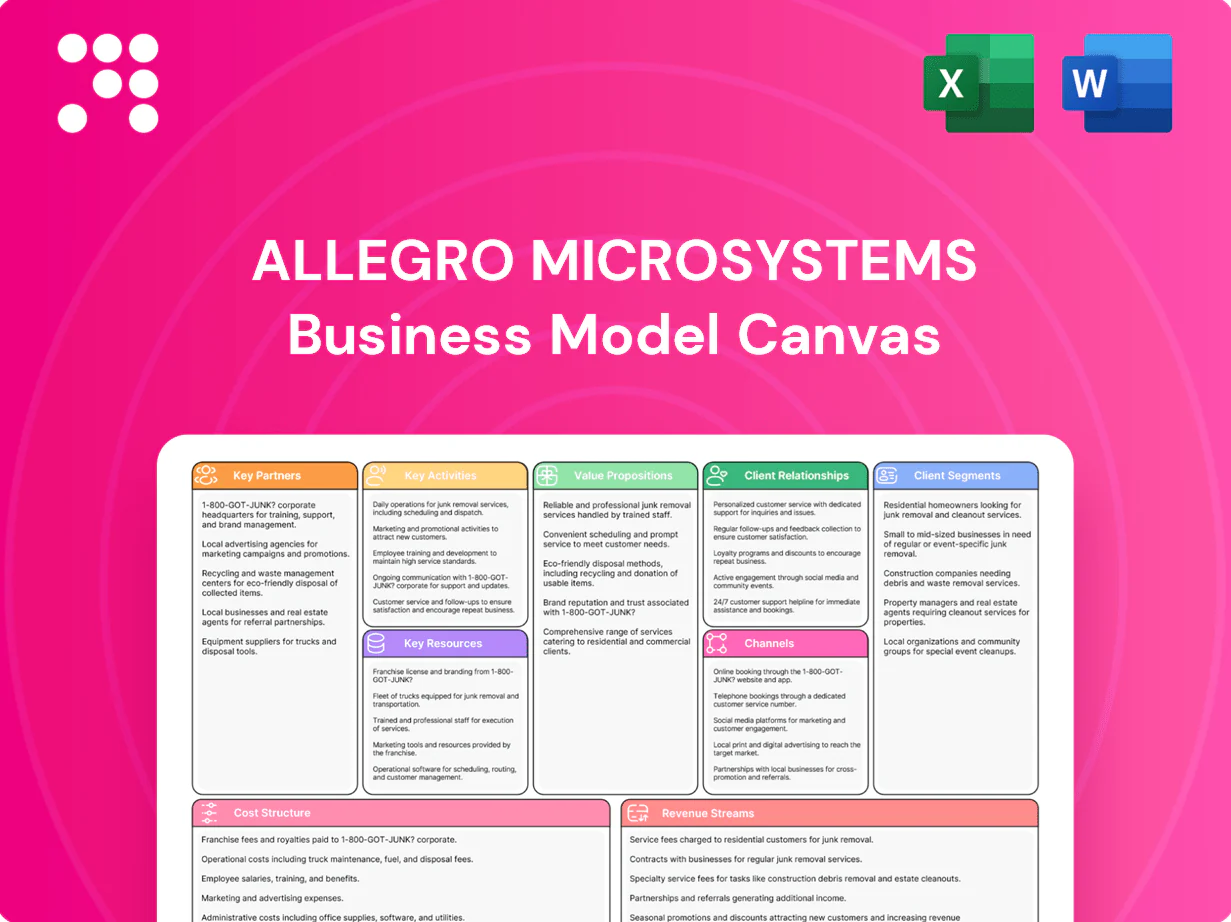
Allegro MicroSystems Business Model Canvas

Unlock a complete Business Model Canvas: value props, partners, revenue, growth
Unlock the full strategic blueprint behind Allegro MicroSystems's business model with our complete Business Model Canvas—detailing value propositions, key partners, revenue streams, and growth levers. Ideal for investors, consultants, and founders who need a ready-to-use, actionable strategic tool. Download the Word/Excel kit to benchmark and execute faster.
Partnerships

Automotive OEMs and Tier-1 suppliers
Collaborations with automotive OEMs and Tier-1 suppliers align Allegro product roadmaps to 2024 ADAS and electrification requirements, accelerating sensor and power IC integration across platforms.
Joint validation and co-engineering shorten qualification cycles, ensuring ISO 26262 compliance and meeting stringent OEM specs during certification.
Early design-in access raises platform win rates and, through multi-year agreements, stabilizes volumes and pricing, supporting predictable revenue with Allegro serving over 30 global OEMs in 2024.
Foundries and OSAT packaging/test houses
Wafer foundries supply advanced mixed-signal CMOS/BiCMOS nodes tuned for Allegro’s sensor and power ICs, while OSAT partners provide automotive-grade packaging and scale test capacity; dual-sourcing across regional foundries/OSATs mitigates supply risk and supports geographic diversification, and joint co-development programs with suppliers improve yield, lower cost, and enhance thermal/mechanical robustness amid a 2024 automotive semiconductor market near $70B.

Materials, magnetics, and component ecosystem partners
Materials and reference magnet suppliers provide controlled calibration environments critical for Allegro’s automotive-focused portfolio (automotive ~85% of 2024 revenue), while passives, connectors and power-stage partners enable turnkey application solutions; pre-validated BOMs and joint application notes shorten OEM integration cycles and accelerate time-to-market for mass-production programs.

EDA, IP, and safety-certification partners
As of 2024 Allegro leverages EDA vendors and IP licensors to sustain robust analog/mixed-signal design flows, while functional safety consultants and assessors accelerate ISO 26262 work-products and ASIL traceability. Third-party toolchains boost verification coverage and testability, and safety certifications reduce customer audit overhead and increase trust.
- EDA/IP partnerships: robust AMDS flows
- Safety consultants: ISO 26262, ASIL traceability
- Third-party tools: increased verification
- Certifications: lower audit burden, higher customer trust
Distributors and design-in channel partners
Global distributors such as Avnet and Arrow expand Allegro MicroSystems reach into industrial and long-tail customers, supporting sales across regions and channels.
Field application partners provide localized design support and logistics, accelerating design-in for automotive and industrial OEMs and lowering integration time.
Demand-creation programs drive sockets in fast-moving industrial markets while inventory services and consignment improve lead-time responsiveness and availability.
- Key partners: Avnet, Arrow, TTI
- Focus: design-in support, localized logistics
- Benefit: faster time-to-market, improved on-shelf availability
ADAS and electrification wins: 30+ OEMs, 85% 2024 auto revenue
Collaborations with OEMs and Tier-1s align Allegro roadmaps to 2024 ADAS and electrification, accelerating sensor and power IC integration. Dual-sourced foundries/OSATs and co-development improve yield, lower cost and mitigate supply risk; Allegro served 30+ global OEMs and automotive ~85% of 2024 revenue. Distributors, EDA/IP and safety partners shorten design-in and raise qualification win rates.
| Partner | Role | 2024 metric |
|---|---|---|
| OEMs/Tier-1 | Co-engineering/validation | 30+ OEMs |
| Foundries/OSAT | Manufacturing/packaging | Dual-sourced |
| Distributors | Channel/design support | Avnet, Arrow |
What is included in the product
 Detailed Word Document
A comprehensive Business Model Canvas for Allegro MicroSystems outlining customer segments, channels, value propositions, revenue streams, key partners, activities, resources, cost structure and distribution channels, with narrative on competitive advantages and linked SWOT analysis. Ideal for presentations, investor discussions and strategic validation using real-world operational insights.

 Customizable Excel Spreadsheet
High-level view of Allegro MicroSystems’ business model with editable cells, quickly revealing product, channel, and partner pain points for fast action and team alignment.
Activities

Analog/mixed-signal IC design and sensor innovation
Designing Hall-effect, magnetic position and current sensors plus analog power ICs is core to Allegro MicroSystems, which reported roughly $1.9B revenue in 2024 with R&D near 12% of sales (~$228M) to fund sensor innovation. Architecture, modeling and layout target accuracy, noise and efficiency to meet automotive-grade specs. Silicon prototyping typically requires 3–5 iterations to refine performance windows, and continuous innovation sustains competitive differentiation.
Automotive-grade qualification and reliability engineering
Automotive-grade qualification follows AEC-Q100 for Grade 0–2 reliability, validated by HTOL (typically 1000 h), thermal cycling (500–1000 cycles), ESD (ISO 10605/HBM ranges) and EMC/CISPR 25 testing; comprehensive PPAP packages expedite OEM and Tier‑1 onboarding, while ongoing field-return analysis drives iterative reliability improvements and yield gains in production programs.

Manufacturing, test development, and yield optimization
Ramp-to-volume uses DFT strategies and custom test programs to ensure manufacturability and test coverage during Allegro MicroSystems scale-up.
Statistical process control and analytics drive yield improvements and Cp/Cpk targets of ≥1.33, reducing scrap and cost per die.
Packaging selection balances form factor, thermal dissipation, and AEC-Q100 environmental requirements.
Supply orchestration aligns wafer starts, assembly slots, and final-test capacity to avoid bottlenecks.

Applications engineering and reference design creation
Allegro FAEs co-develop solutions for ADAS, traction inverters, BMS and factory automation, supporting customers amid a 2024 EV market exceeding 10 million units; reference designs and software tools cut integration time and speed time-to-market, while design guides and EVKs enable rapid evaluation and prototyping; on-site support addresses EMI, thermal and safety challenges.
- FAE co-development: ADAS, inverters, BMS, automation
- Reference designs/software: faster integration
- Design guides/EVKs: quick evaluation
- On-site support: EMI, thermal, safety
Quality systems, compliance, and lifecycle management
Allegro MicroSystems maintains IATF 16949 and ISO 9001 certified quality systems to ensure consistent automotive-grade production, with formal change control and PCN processes to protect customer lines; automotive programs commonly require 15+ year lifecycle support and obsolescence planning. Cybersecurity and export compliance frameworks enable global shipments and protect IP across suppliers and customers.
- IATF 16949/ISO 9001: certified quality backbone
- Change control/PCN: customer production protection
- Obsolescence/lifecycle: 15+ year platform support
- Cybersecurity/export compliance: global operations
Hall-effect & power ICs: $1.9B revenue, R&D 12%, >10M EVs
Designing Hall-effect, magnetic position/current sensors and analog power ICs (2024 revenue ~$1.9B; R&D ~12% ≈ $228M) with 3–5 silicon iterations, targeting automotive accuracy/noise/efficiency. Qualification per AEC-Q100 (HTOL 1000h, thermal cycling 500–1000) and Cp/Cpk ≥1.33 for volume ramp. FAEs deliver reference designs, EVKs and on-site support for >10M EVs in 2024.
| Metric | 2024 |
|---|---|
| Revenue | $1.9B |
| R&D | ~12% ($228M) |
| EV market | >10M units |
| HTOL | 1000h |
| Cp/Cpk target | ≥1.33 |
Full Document Unlocks After Purchase
Business Model Canvas
The Allegro MicroSystems Business Model Canvas shown here is a live preview of the exact deliverable you’ll receive after purchase. It’s not a mockup—this same file, fully structured and editable, will be available instantly for download. No hidden pages or altered layouts; what you see is what you get.

Unlock a complete Business Model Canvas: value props, partners, revenue, growth
Unlock the full strategic blueprint behind Allegro MicroSystems's business model with our complete Business Model Canvas—detailing value propositions, key partners, revenue streams, and growth levers. Ideal for investors, consultants, and founders who need a ready-to-use, actionable strategic tool. Download the Word/Excel kit to benchmark and execute faster.
Partnerships
Automotive OEMs and Tier-1 suppliers
Collaborations with automotive OEMs and Tier-1 suppliers align Allegro product roadmaps to 2024 ADAS and electrification requirements, accelerating sensor and power IC integration across platforms.
Joint validation and co-engineering shorten qualification cycles, ensuring ISO 26262 compliance and meeting stringent OEM specs during certification.
Early design-in access raises platform win rates and, through multi-year agreements, stabilizes volumes and pricing, supporting predictable revenue with Allegro serving over 30 global OEMs in 2024.
Foundries and OSAT packaging/test houses
Wafer foundries supply advanced mixed-signal CMOS/BiCMOS nodes tuned for Allegro’s sensor and power ICs, while OSAT partners provide automotive-grade packaging and scale test capacity; dual-sourcing across regional foundries/OSATs mitigates supply risk and supports geographic diversification, and joint co-development programs with suppliers improve yield, lower cost, and enhance thermal/mechanical robustness amid a 2024 automotive semiconductor market near $70B.
Materials, magnetics, and component ecosystem partners
Materials and reference magnet suppliers provide controlled calibration environments critical for Allegro’s automotive-focused portfolio (automotive ~85% of 2024 revenue), while passives, connectors and power-stage partners enable turnkey application solutions; pre-validated BOMs and joint application notes shorten OEM integration cycles and accelerate time-to-market for mass-production programs.
EDA, IP, and safety-certification partners
As of 2024 Allegro leverages EDA vendors and IP licensors to sustain robust analog/mixed-signal design flows, while functional safety consultants and assessors accelerate ISO 26262 work-products and ASIL traceability. Third-party toolchains boost verification coverage and testability, and safety certifications reduce customer audit overhead and increase trust.
- EDA/IP partnerships: robust AMDS flows
- Safety consultants: ISO 26262, ASIL traceability
- Third-party tools: increased verification
- Certifications: lower audit burden, higher customer trust
Distributors and design-in channel partners
Global distributors such as Avnet and Arrow expand Allegro MicroSystems reach into industrial and long-tail customers, supporting sales across regions and channels.
Field application partners provide localized design support and logistics, accelerating design-in for automotive and industrial OEMs and lowering integration time.
Demand-creation programs drive sockets in fast-moving industrial markets while inventory services and consignment improve lead-time responsiveness and availability.
- Key partners: Avnet, Arrow, TTI
- Focus: design-in support, localized logistics
- Benefit: faster time-to-market, improved on-shelf availability
ADAS and electrification wins: 30+ OEMs, 85% 2024 auto revenue
Collaborations with OEMs and Tier-1s align Allegro roadmaps to 2024 ADAS and electrification, accelerating sensor and power IC integration. Dual-sourced foundries/OSATs and co-development improve yield, lower cost and mitigate supply risk; Allegro served 30+ global OEMs and automotive ~85% of 2024 revenue. Distributors, EDA/IP and safety partners shorten design-in and raise qualification win rates.
| Partner | Role | 2024 metric |
|---|---|---|
| OEMs/Tier-1 | Co-engineering/validation | 30+ OEMs |
| Foundries/OSAT | Manufacturing/packaging | Dual-sourced |
| Distributors | Channel/design support | Avnet, Arrow |
What is included in the product
Detailed Word Document
A comprehensive Business Model Canvas for Allegro MicroSystems outlining customer segments, channels, value propositions, revenue streams, key partners, activities, resources, cost structure and distribution channels, with narrative on competitive advantages and linked SWOT analysis. Ideal for presentations, investor discussions and strategic validation using real-world operational insights.
Customizable Excel Spreadsheet
High-level view of Allegro MicroSystems’ business model with editable cells, quickly revealing product, channel, and partner pain points for fast action and team alignment.
Activities
Analog/mixed-signal IC design and sensor innovation
Designing Hall-effect, magnetic position and current sensors plus analog power ICs is core to Allegro MicroSystems, which reported roughly $1.9B revenue in 2024 with R&D near 12% of sales (~$228M) to fund sensor innovation. Architecture, modeling and layout target accuracy, noise and efficiency to meet automotive-grade specs. Silicon prototyping typically requires 3–5 iterations to refine performance windows, and continuous innovation sustains competitive differentiation.
Automotive-grade qualification and reliability engineering
Automotive-grade qualification follows AEC-Q100 for Grade 0–2 reliability, validated by HTOL (typically 1000 h), thermal cycling (500–1000 cycles), ESD (ISO 10605/HBM ranges) and EMC/CISPR 25 testing; comprehensive PPAP packages expedite OEM and Tier‑1 onboarding, while ongoing field-return analysis drives iterative reliability improvements and yield gains in production programs.
Manufacturing, test development, and yield optimization
Ramp-to-volume uses DFT strategies and custom test programs to ensure manufacturability and test coverage during Allegro MicroSystems scale-up.
Statistical process control and analytics drive yield improvements and Cp/Cpk targets of ≥1.33, reducing scrap and cost per die.
Packaging selection balances form factor, thermal dissipation, and AEC-Q100 environmental requirements.
Supply orchestration aligns wafer starts, assembly slots, and final-test capacity to avoid bottlenecks.
Applications engineering and reference design creation
Allegro FAEs co-develop solutions for ADAS, traction inverters, BMS and factory automation, supporting customers amid a 2024 EV market exceeding 10 million units; reference designs and software tools cut integration time and speed time-to-market, while design guides and EVKs enable rapid evaluation and prototyping; on-site support addresses EMI, thermal and safety challenges.
- FAE co-development: ADAS, inverters, BMS, automation
- Reference designs/software: faster integration
- Design guides/EVKs: quick evaluation
- On-site support: EMI, thermal, safety
Quality systems, compliance, and lifecycle management
Allegro MicroSystems maintains IATF 16949 and ISO 9001 certified quality systems to ensure consistent automotive-grade production, with formal change control and PCN processes to protect customer lines; automotive programs commonly require 15+ year lifecycle support and obsolescence planning. Cybersecurity and export compliance frameworks enable global shipments and protect IP across suppliers and customers.
- IATF 16949/ISO 9001: certified quality backbone
- Change control/PCN: customer production protection
- Obsolescence/lifecycle: 15+ year platform support
- Cybersecurity/export compliance: global operations
Hall-effect & power ICs: $1.9B revenue, R&D 12%, >10M EVs
Designing Hall-effect, magnetic position/current sensors and analog power ICs (2024 revenue ~$1.9B; R&D ~12% ≈ $228M) with 3–5 silicon iterations, targeting automotive accuracy/noise/efficiency. Qualification per AEC-Q100 (HTOL 1000h, thermal cycling 500–1000) and Cp/Cpk ≥1.33 for volume ramp. FAEs deliver reference designs, EVKs and on-site support for >10M EVs in 2024.
| Metric | 2024 |
|---|---|
| Revenue | $1.9B |
| R&D | ~12% ($228M) |
| EV market | >10M units |
| HTOL | 1000h |
| Cp/Cpk target | ≥1.33 |
Full Document Unlocks After Purchase
Business Model Canvas
The Allegro MicroSystems Business Model Canvas shown here is a live preview of the exact deliverable you’ll receive after purchase. It’s not a mockup—this same file, fully structured and editable, will be available instantly for download. No hidden pages or altered layouts; what you see is what you get.
Description
Unlock a complete Business Model Canvas: value props, partners, revenue, growth
Unlock the full strategic blueprint behind Allegro MicroSystems's business model with our complete Business Model Canvas—detailing value propositions, key partners, revenue streams, and growth levers. Ideal for investors, consultants, and founders who need a ready-to-use, actionable strategic tool. Download the Word/Excel kit to benchmark and execute faster.
Partnerships
Automotive OEMs and Tier-1 suppliers
Collaborations with automotive OEMs and Tier-1 suppliers align Allegro product roadmaps to 2024 ADAS and electrification requirements, accelerating sensor and power IC integration across platforms.
Joint validation and co-engineering shorten qualification cycles, ensuring ISO 26262 compliance and meeting stringent OEM specs during certification.
Early design-in access raises platform win rates and, through multi-year agreements, stabilizes volumes and pricing, supporting predictable revenue with Allegro serving over 30 global OEMs in 2024.
Foundries and OSAT packaging/test houses
Wafer foundries supply advanced mixed-signal CMOS/BiCMOS nodes tuned for Allegro’s sensor and power ICs, while OSAT partners provide automotive-grade packaging and scale test capacity; dual-sourcing across regional foundries/OSATs mitigates supply risk and supports geographic diversification, and joint co-development programs with suppliers improve yield, lower cost, and enhance thermal/mechanical robustness amid a 2024 automotive semiconductor market near $70B.
Materials, magnetics, and component ecosystem partners
Materials and reference magnet suppliers provide controlled calibration environments critical for Allegro’s automotive-focused portfolio (automotive ~85% of 2024 revenue), while passives, connectors and power-stage partners enable turnkey application solutions; pre-validated BOMs and joint application notes shorten OEM integration cycles and accelerate time-to-market for mass-production programs.
EDA, IP, and safety-certification partners
As of 2024 Allegro leverages EDA vendors and IP licensors to sustain robust analog/mixed-signal design flows, while functional safety consultants and assessors accelerate ISO 26262 work-products and ASIL traceability. Third-party toolchains boost verification coverage and testability, and safety certifications reduce customer audit overhead and increase trust.
- EDA/IP partnerships: robust AMDS flows
- Safety consultants: ISO 26262, ASIL traceability
- Third-party tools: increased verification
- Certifications: lower audit burden, higher customer trust
Distributors and design-in channel partners
Global distributors such as Avnet and Arrow expand Allegro MicroSystems reach into industrial and long-tail customers, supporting sales across regions and channels.
Field application partners provide localized design support and logistics, accelerating design-in for automotive and industrial OEMs and lowering integration time.
Demand-creation programs drive sockets in fast-moving industrial markets while inventory services and consignment improve lead-time responsiveness and availability.
- Key partners: Avnet, Arrow, TTI
- Focus: design-in support, localized logistics
- Benefit: faster time-to-market, improved on-shelf availability
ADAS and electrification wins: 30+ OEMs, 85% 2024 auto revenue
Collaborations with OEMs and Tier-1s align Allegro roadmaps to 2024 ADAS and electrification, accelerating sensor and power IC integration. Dual-sourced foundries/OSATs and co-development improve yield, lower cost and mitigate supply risk; Allegro served 30+ global OEMs and automotive ~85% of 2024 revenue. Distributors, EDA/IP and safety partners shorten design-in and raise qualification win rates.
| Partner | Role | 2024 metric |
|---|---|---|
| OEMs/Tier-1 | Co-engineering/validation | 30+ OEMs |
| Foundries/OSAT | Manufacturing/packaging | Dual-sourced |
| Distributors | Channel/design support | Avnet, Arrow |
What is included in the product
Detailed Word Document
A comprehensive Business Model Canvas for Allegro MicroSystems outlining customer segments, channels, value propositions, revenue streams, key partners, activities, resources, cost structure and distribution channels, with narrative on competitive advantages and linked SWOT analysis. Ideal for presentations, investor discussions and strategic validation using real-world operational insights.
Customizable Excel Spreadsheet
High-level view of Allegro MicroSystems’ business model with editable cells, quickly revealing product, channel, and partner pain points for fast action and team alignment.
Activities
Analog/mixed-signal IC design and sensor innovation
Designing Hall-effect, magnetic position and current sensors plus analog power ICs is core to Allegro MicroSystems, which reported roughly $1.9B revenue in 2024 with R&D near 12% of sales (~$228M) to fund sensor innovation. Architecture, modeling and layout target accuracy, noise and efficiency to meet automotive-grade specs. Silicon prototyping typically requires 3–5 iterations to refine performance windows, and continuous innovation sustains competitive differentiation.
Automotive-grade qualification and reliability engineering
Automotive-grade qualification follows AEC-Q100 for Grade 0–2 reliability, validated by HTOL (typically 1000 h), thermal cycling (500–1000 cycles), ESD (ISO 10605/HBM ranges) and EMC/CISPR 25 testing; comprehensive PPAP packages expedite OEM and Tier‑1 onboarding, while ongoing field-return analysis drives iterative reliability improvements and yield gains in production programs.
Manufacturing, test development, and yield optimization
Ramp-to-volume uses DFT strategies and custom test programs to ensure manufacturability and test coverage during Allegro MicroSystems scale-up.
Statistical process control and analytics drive yield improvements and Cp/Cpk targets of ≥1.33, reducing scrap and cost per die.
Packaging selection balances form factor, thermal dissipation, and AEC-Q100 environmental requirements.
Supply orchestration aligns wafer starts, assembly slots, and final-test capacity to avoid bottlenecks.
Applications engineering and reference design creation
Allegro FAEs co-develop solutions for ADAS, traction inverters, BMS and factory automation, supporting customers amid a 2024 EV market exceeding 10 million units; reference designs and software tools cut integration time and speed time-to-market, while design guides and EVKs enable rapid evaluation and prototyping; on-site support addresses EMI, thermal and safety challenges.
- FAE co-development: ADAS, inverters, BMS, automation
- Reference designs/software: faster integration
- Design guides/EVKs: quick evaluation
- On-site support: EMI, thermal, safety
Quality systems, compliance, and lifecycle management
Allegro MicroSystems maintains IATF 16949 and ISO 9001 certified quality systems to ensure consistent automotive-grade production, with formal change control and PCN processes to protect customer lines; automotive programs commonly require 15+ year lifecycle support and obsolescence planning. Cybersecurity and export compliance frameworks enable global shipments and protect IP across suppliers and customers.
- IATF 16949/ISO 9001: certified quality backbone
- Change control/PCN: customer production protection
- Obsolescence/lifecycle: 15+ year platform support
- Cybersecurity/export compliance: global operations
Hall-effect & power ICs: $1.9B revenue, R&D 12%, >10M EVs
Designing Hall-effect, magnetic position/current sensors and analog power ICs (2024 revenue ~$1.9B; R&D ~12% ≈ $228M) with 3–5 silicon iterations, targeting automotive accuracy/noise/efficiency. Qualification per AEC-Q100 (HTOL 1000h, thermal cycling 500–1000) and Cp/Cpk ≥1.33 for volume ramp. FAEs deliver reference designs, EVKs and on-site support for >10M EVs in 2024.
| Metric | 2024 |
|---|---|
| Revenue | $1.9B |
| R&D | ~12% ($228M) |
| EV market | >10M units |
| HTOL | 1000h |
| Cp/Cpk target | ≥1.33 |
Full Document Unlocks After Purchase
Business Model Canvas
The Allegro MicroSystems Business Model Canvas shown here is a live preview of the exact deliverable you’ll receive after purchase. It’s not a mockup—this same file, fully structured and editable, will be available instantly for download. No hidden pages or altered layouts; what you see is what you get.











