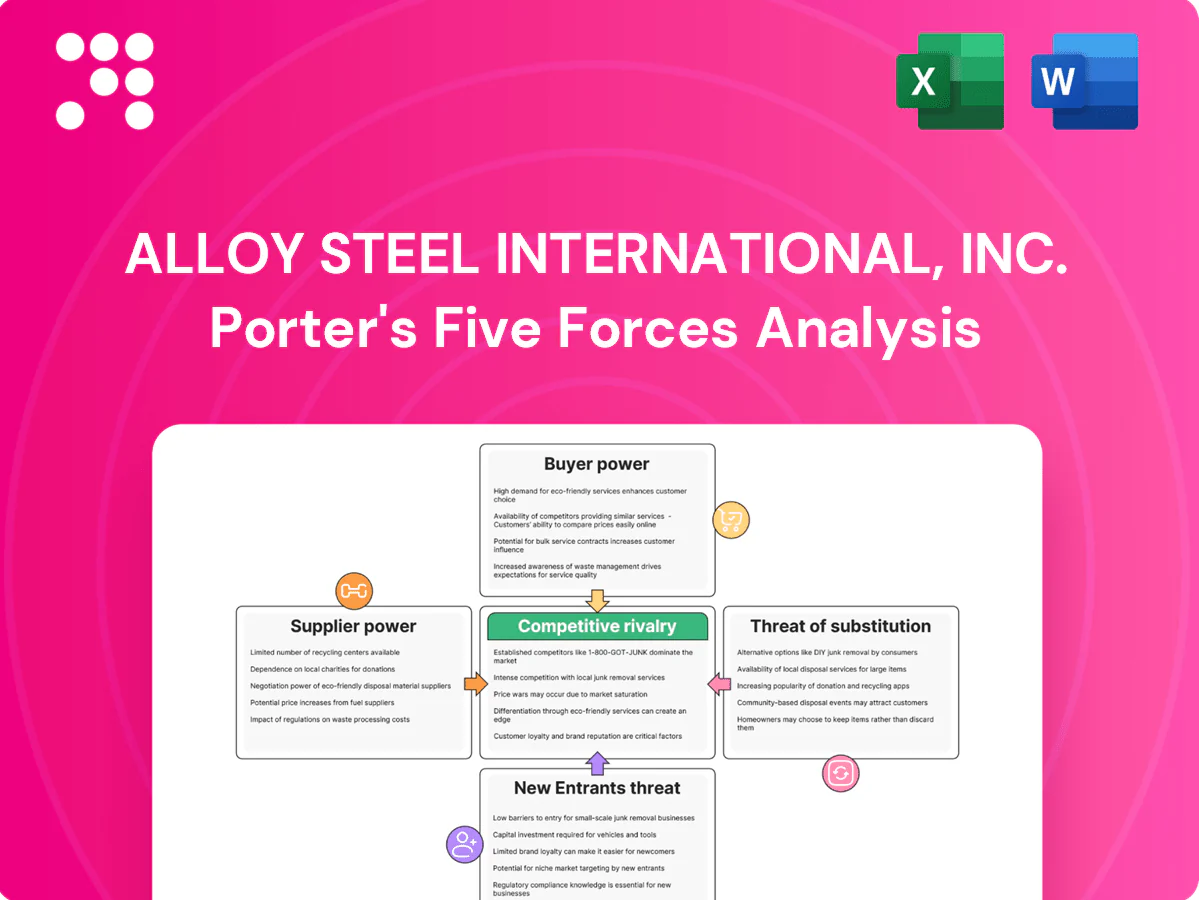
Alloy Steel International, Inc. Porter's Five Forces Analysis

Don't Miss the Bigger Picture
Alloy Steel International faces moderate rivalry from metal fabricators, limited supplier power due to commodity sourcing, and steady buyer power from industrial clients; barriers to entry are moderate while substitute materials pose a low-to-moderate threat. This brief snapshot only scratches the surface. Unlock the full Porter's Five Forces Analysis to explore strategic implications in detail.
Suppliers Bargaining Power

Specialty alloy input concentration
Specialty alloy input concentration gives suppliers outsized leverage for Alloy Steel International: qualified sources for chromium-carbide, molybdenum and nickel-enhanced plate remain few, so 2024 supply bottlenecks pushed lead times from typical 8 weeks to 12–20 weeks and generated rush premiums of roughly 15–35%. Dual-qualifying vendors reduces single-source risk but raises qualification costs materially, pressuring margins.
Quality certification requirements
Mining-grade QA/QC specifications narrow Alloy Steel International’s approved vendor pool, with industry reports in 2024 indicating typically fewer than one in eight mills able to meet strict mining metallurgy and traceability demands. Strict metallurgical consistency, heat-treatment certifications and batch-level traceability reduce substitutability and let compliant suppliers command price premiums. Suppliers meeting these standards gain bargaining power over pricing and contract terms. Requalification cycles, commonly 6–18 months in 2024, slow switching and reinforce incumbent supplier lock-in.

Volatile raw material and energy costs
Input costs for alloys, fluxes and energy-driven processes can swing rapidly; Brent crude averaged roughly $85/barrel in 2024, pushing feedstock and freight surcharges through the chain. Suppliers routinely pass surcharges, compressing Alloy Steel International margins absent indexed contracts. Hedging dampens volatility but adds administrative cost and complexity. Short-cycle spikes in 2024 forced some suppliers to reprice or defer orders, disrupting lead times.

Logistics and lead-time constraints
Logistics and lead-time constraints raise supplier leverage for Alloy Steel International, as heavy plate, castings and consumables face freight bottlenecks and regional shipping premiums often in the 10–30% range; international lead times commonly stretch 12–24 weeks, increasing supplier influence over scheduling. Inventory buffering ties up working capital, while nearshoring reduces lead time but can restrict material choices and quality options.
- Freight premiums: 10–30%
- Lead times: 12–24 weeks
- Higher inventory days → working capital pressure
- Nearshoring shortens lead time but limits material variety
Process know-how and consumable dependence
Overlay welding wires, fluxes and shielding gases often use proprietary blends, creating vendor reliance that raises switching costs because process tuning is optimized to those exact inputs.
Supplier technical support, including on-site process calibration, becomes embedded in production outcomes, transferring tacit know-how to vendors and strengthening their negotiating position.
Alloy scarcity: 12–20wk lead, 15–35% rush premiums
Specialty alloy supplier concentration and strict QA/QC grant strong leverage to vendors: 2024 lead times rose to 12–20 weeks and rush premiums hit 15–35%. Fewer than 1 in 8 mills meet mining-grade specs, enabling price premiums and 6–18 month requalification lock-in. Freight premiums (10–30%) and Brent at ~$85/barrel in 2024 further transmit cost volatility to Alloy Steel International.
| Metric | 2024 Value |
|---|---|
| Lead times | 12–20 weeks |
| Rush premiums | 15–35% |
| Approved mills | <1 in 8 |
| Requalification | 6–18 months |
| Freight premiums | 10–30% |
| Brent | ~$85/barrel |
What is included in the product
 Detailed Word Document
Tailored exclusively for Alloy Steel International, Inc., this Porter's Five Forces overview uncovers key competition drivers, supplier and buyer power, substitution threats, and entry barriers, identifying disruptive forces and market dynamics that influence pricing, profitability, and strategic positioning.

 Customizable Excel Spreadsheet
A concise one-sheet Porter's Five Forces for Alloy Steel International that maps supplier, buyer, entrant, substitute, and rivalry pressures into an editable spider chart—customize scores, swap in your own data, and drop straight into pitch decks or Excel dashboards without macros for rapid, boardroom-ready decision-making.
Customers Bargaining Power

Concentrated large mining customers
Global miners and contractors purchase sizable, recurring volumes—often tens to hundreds of millions USD per multi-site contract—giving buyers strong leverage over suppliers. They deploy RFPs, global tenders and centralized frameworks to extract discounts, with consolidated procurement routinely securing 5–15% lower prices on bulk alloy steel in 2024. Suppliers must supply quantifiable value proofs—cost-per-ton reductions, uptime data and total-cost-of-ownership models—to protect margins.
High switching costs and fitment risk
GET and wear parts must fit precisely and perform reliably, since switching missteps can trigger costly downtime and safety incidents; unplanned industrial downtime in 2024 was estimated to cost operators up to $100,000 per hour in high-value sectors, raising total cost of ownership. These risks reduce buyer propensity to churn despite price pressure. Proven field performance and documented reliability act as strong lock-in mechanisms for Alloy Steel International customers.

Lifecycle and TCO focus
Buyers prioritize wear life, availability and service responsiveness over unit price, with 2024 industry surveys showing lifecycle cost focus rising 12% year-over-year. Demonstrated cost-per-ton reductions—often cited up to 15–20% in case studies—can offset price sensitivity and support premium bids. Performance guarantees and real-time monitoring data strengthen justifications for higher margins. Poor documentation and service records increase buyer leverage and negotiation pressure.

Cyclical demand sensitivity
Cyclical demand sensitivity at Alloy Steel International, Inc. means buyers pressure for price cuts, extended payment terms and inventory consignment in downturns, while 2024 market tightness shifted buyer priorities to availability and reliability over price; World Steel Association 2024 noted modest global apparent steel use growth of about 1.5%, highlighting cycle-driven shifts in bargaining leverage.
- Downturn: higher price concessions, longer terms, consignment
- Upcycle: availability > price, shorter lead times
- Net: buyer power varies with cycle
- Mitigation: flexible contracting smooths extremes
Customization reduces comparability
Customization in Alloy Steel International offerings makes like-for-like comparisons difficult because application-specific design and metallurgy embed engineering value that differentiates products and narrows the competitive field in tenders, reducing buyer leverage. Buyers still can and do benchmark against standard plate options, keeping some price pressure.
- Customization embeds engineering value
- Narrows eligible bidders in tenders
- Reduces buyer bargaining power
- Standard plate benchmarks sustain price pressure
Miners win 5-15% bulk cuts; lifecycle lock-in drives 15-20% alloy premiums
Large miners/contractors buy in bulk and secure 5–15% lower prices via RFPs in 2024, pressuring margins. High downtime risk (up to $100,000/hour) and lifecycle-focus (+12% YoY in 2024) create lock-in for proven alloys, enabling 15–20% cost-per-ton premium claims. Buyer leverage varies with cycle; flexible contracting mitigates swings.
| Metric | 2024 |
|---|---|
| Bulk discount pressure | 5–15% |
| Downtime cost | up to $100,000/hr |
| Lifecycle focus change | +12% YoY |
| Cost-per-ton gains | 15–20% |
Full Version Awaits
Alloy Steel International, Inc. Porter's Five Forces Analysis
This Porter’s Five Forces analysis for Alloy Steel International, Inc. assesses competitive rivalry, supplier and buyer power, threat of substitutes, and barriers to entry with actionable insights on pricing pressure, raw material dependencies, and niche market defenses. The preview you see is the exact, fully formatted document you’ll receive immediately after purchase—no samples or placeholders. Use it right away for strategic planning or valuation.

Don't Miss the Bigger Picture
Alloy Steel International faces moderate rivalry from metal fabricators, limited supplier power due to commodity sourcing, and steady buyer power from industrial clients; barriers to entry are moderate while substitute materials pose a low-to-moderate threat. This brief snapshot only scratches the surface. Unlock the full Porter's Five Forces Analysis to explore strategic implications in detail.
Suppliers Bargaining Power
Specialty alloy input concentration
Specialty alloy input concentration gives suppliers outsized leverage for Alloy Steel International: qualified sources for chromium-carbide, molybdenum and nickel-enhanced plate remain few, so 2024 supply bottlenecks pushed lead times from typical 8 weeks to 12–20 weeks and generated rush premiums of roughly 15–35%. Dual-qualifying vendors reduces single-source risk but raises qualification costs materially, pressuring margins.
Quality certification requirements
Mining-grade QA/QC specifications narrow Alloy Steel International’s approved vendor pool, with industry reports in 2024 indicating typically fewer than one in eight mills able to meet strict mining metallurgy and traceability demands. Strict metallurgical consistency, heat-treatment certifications and batch-level traceability reduce substitutability and let compliant suppliers command price premiums. Suppliers meeting these standards gain bargaining power over pricing and contract terms. Requalification cycles, commonly 6–18 months in 2024, slow switching and reinforce incumbent supplier lock-in.
Volatile raw material and energy costs
Input costs for alloys, fluxes and energy-driven processes can swing rapidly; Brent crude averaged roughly $85/barrel in 2024, pushing feedstock and freight surcharges through the chain. Suppliers routinely pass surcharges, compressing Alloy Steel International margins absent indexed contracts. Hedging dampens volatility but adds administrative cost and complexity. Short-cycle spikes in 2024 forced some suppliers to reprice or defer orders, disrupting lead times.
Logistics and lead-time constraints
Logistics and lead-time constraints raise supplier leverage for Alloy Steel International, as heavy plate, castings and consumables face freight bottlenecks and regional shipping premiums often in the 10–30% range; international lead times commonly stretch 12–24 weeks, increasing supplier influence over scheduling. Inventory buffering ties up working capital, while nearshoring reduces lead time but can restrict material choices and quality options.
- Freight premiums: 10–30%
- Lead times: 12–24 weeks
- Higher inventory days → working capital pressure
- Nearshoring shortens lead time but limits material variety
Process know-how and consumable dependence
Overlay welding wires, fluxes and shielding gases often use proprietary blends, creating vendor reliance that raises switching costs because process tuning is optimized to those exact inputs.
Supplier technical support, including on-site process calibration, becomes embedded in production outcomes, transferring tacit know-how to vendors and strengthening their negotiating position.
Alloy scarcity: 12–20wk lead, 15–35% rush premiums
Specialty alloy supplier concentration and strict QA/QC grant strong leverage to vendors: 2024 lead times rose to 12–20 weeks and rush premiums hit 15–35%. Fewer than 1 in 8 mills meet mining-grade specs, enabling price premiums and 6–18 month requalification lock-in. Freight premiums (10–30%) and Brent at ~$85/barrel in 2024 further transmit cost volatility to Alloy Steel International.
| Metric | 2024 Value |
|---|---|
| Lead times | 12–20 weeks |
| Rush premiums | 15–35% |
| Approved mills | <1 in 8 |
| Requalification | 6–18 months |
| Freight premiums | 10–30% |
| Brent | ~$85/barrel |
What is included in the product
Detailed Word Document
Tailored exclusively for Alloy Steel International, Inc., this Porter's Five Forces overview uncovers key competition drivers, supplier and buyer power, substitution threats, and entry barriers, identifying disruptive forces and market dynamics that influence pricing, profitability, and strategic positioning.
Customizable Excel Spreadsheet
A concise one-sheet Porter's Five Forces for Alloy Steel International that maps supplier, buyer, entrant, substitute, and rivalry pressures into an editable spider chart—customize scores, swap in your own data, and drop straight into pitch decks or Excel dashboards without macros for rapid, boardroom-ready decision-making.
Customers Bargaining Power
Concentrated large mining customers
Global miners and contractors purchase sizable, recurring volumes—often tens to hundreds of millions USD per multi-site contract—giving buyers strong leverage over suppliers. They deploy RFPs, global tenders and centralized frameworks to extract discounts, with consolidated procurement routinely securing 5–15% lower prices on bulk alloy steel in 2024. Suppliers must supply quantifiable value proofs—cost-per-ton reductions, uptime data and total-cost-of-ownership models—to protect margins.
High switching costs and fitment risk
GET and wear parts must fit precisely and perform reliably, since switching missteps can trigger costly downtime and safety incidents; unplanned industrial downtime in 2024 was estimated to cost operators up to $100,000 per hour in high-value sectors, raising total cost of ownership. These risks reduce buyer propensity to churn despite price pressure. Proven field performance and documented reliability act as strong lock-in mechanisms for Alloy Steel International customers.
Lifecycle and TCO focus
Buyers prioritize wear life, availability and service responsiveness over unit price, with 2024 industry surveys showing lifecycle cost focus rising 12% year-over-year. Demonstrated cost-per-ton reductions—often cited up to 15–20% in case studies—can offset price sensitivity and support premium bids. Performance guarantees and real-time monitoring data strengthen justifications for higher margins. Poor documentation and service records increase buyer leverage and negotiation pressure.
Cyclical demand sensitivity
Cyclical demand sensitivity at Alloy Steel International, Inc. means buyers pressure for price cuts, extended payment terms and inventory consignment in downturns, while 2024 market tightness shifted buyer priorities to availability and reliability over price; World Steel Association 2024 noted modest global apparent steel use growth of about 1.5%, highlighting cycle-driven shifts in bargaining leverage.
- Downturn: higher price concessions, longer terms, consignment
- Upcycle: availability > price, shorter lead times
- Net: buyer power varies with cycle
- Mitigation: flexible contracting smooths extremes
Customization reduces comparability
Customization in Alloy Steel International offerings makes like-for-like comparisons difficult because application-specific design and metallurgy embed engineering value that differentiates products and narrows the competitive field in tenders, reducing buyer leverage. Buyers still can and do benchmark against standard plate options, keeping some price pressure.
- Customization embeds engineering value
- Narrows eligible bidders in tenders
- Reduces buyer bargaining power
- Standard plate benchmarks sustain price pressure
Miners win 5-15% bulk cuts; lifecycle lock-in drives 15-20% alloy premiums
Large miners/contractors buy in bulk and secure 5–15% lower prices via RFPs in 2024, pressuring margins. High downtime risk (up to $100,000/hour) and lifecycle-focus (+12% YoY in 2024) create lock-in for proven alloys, enabling 15–20% cost-per-ton premium claims. Buyer leverage varies with cycle; flexible contracting mitigates swings.
| Metric | 2024 |
|---|---|
| Bulk discount pressure | 5–15% |
| Downtime cost | up to $100,000/hr |
| Lifecycle focus change | +12% YoY |
| Cost-per-ton gains | 15–20% |
Full Version Awaits
Alloy Steel International, Inc. Porter's Five Forces Analysis
This Porter’s Five Forces analysis for Alloy Steel International, Inc. assesses competitive rivalry, supplier and buyer power, threat of substitutes, and barriers to entry with actionable insights on pricing pressure, raw material dependencies, and niche market defenses. The preview you see is the exact, fully formatted document you’ll receive immediately after purchase—no samples or placeholders. Use it right away for strategic planning or valuation.
Original: $10.00
-65%$10.00
$3.50Description
Don't Miss the Bigger Picture
Alloy Steel International faces moderate rivalry from metal fabricators, limited supplier power due to commodity sourcing, and steady buyer power from industrial clients; barriers to entry are moderate while substitute materials pose a low-to-moderate threat. This brief snapshot only scratches the surface. Unlock the full Porter's Five Forces Analysis to explore strategic implications in detail.
Suppliers Bargaining Power
Specialty alloy input concentration
Specialty alloy input concentration gives suppliers outsized leverage for Alloy Steel International: qualified sources for chromium-carbide, molybdenum and nickel-enhanced plate remain few, so 2024 supply bottlenecks pushed lead times from typical 8 weeks to 12–20 weeks and generated rush premiums of roughly 15–35%. Dual-qualifying vendors reduces single-source risk but raises qualification costs materially, pressuring margins.
Quality certification requirements
Mining-grade QA/QC specifications narrow Alloy Steel International’s approved vendor pool, with industry reports in 2024 indicating typically fewer than one in eight mills able to meet strict mining metallurgy and traceability demands. Strict metallurgical consistency, heat-treatment certifications and batch-level traceability reduce substitutability and let compliant suppliers command price premiums. Suppliers meeting these standards gain bargaining power over pricing and contract terms. Requalification cycles, commonly 6–18 months in 2024, slow switching and reinforce incumbent supplier lock-in.
Volatile raw material and energy costs
Input costs for alloys, fluxes and energy-driven processes can swing rapidly; Brent crude averaged roughly $85/barrel in 2024, pushing feedstock and freight surcharges through the chain. Suppliers routinely pass surcharges, compressing Alloy Steel International margins absent indexed contracts. Hedging dampens volatility but adds administrative cost and complexity. Short-cycle spikes in 2024 forced some suppliers to reprice or defer orders, disrupting lead times.
Logistics and lead-time constraints
Logistics and lead-time constraints raise supplier leverage for Alloy Steel International, as heavy plate, castings and consumables face freight bottlenecks and regional shipping premiums often in the 10–30% range; international lead times commonly stretch 12–24 weeks, increasing supplier influence over scheduling. Inventory buffering ties up working capital, while nearshoring reduces lead time but can restrict material choices and quality options.
- Freight premiums: 10–30%
- Lead times: 12–24 weeks
- Higher inventory days → working capital pressure
- Nearshoring shortens lead time but limits material variety
Process know-how and consumable dependence
Overlay welding wires, fluxes and shielding gases often use proprietary blends, creating vendor reliance that raises switching costs because process tuning is optimized to those exact inputs.
Supplier technical support, including on-site process calibration, becomes embedded in production outcomes, transferring tacit know-how to vendors and strengthening their negotiating position.
Alloy scarcity: 12–20wk lead, 15–35% rush premiums
Specialty alloy supplier concentration and strict QA/QC grant strong leverage to vendors: 2024 lead times rose to 12–20 weeks and rush premiums hit 15–35%. Fewer than 1 in 8 mills meet mining-grade specs, enabling price premiums and 6–18 month requalification lock-in. Freight premiums (10–30%) and Brent at ~$85/barrel in 2024 further transmit cost volatility to Alloy Steel International.
| Metric | 2024 Value |
|---|---|
| Lead times | 12–20 weeks |
| Rush premiums | 15–35% |
| Approved mills | <1 in 8 |
| Requalification | 6–18 months |
| Freight premiums | 10–30% |
| Brent | ~$85/barrel |
What is included in the product
Detailed Word Document
Tailored exclusively for Alloy Steel International, Inc., this Porter's Five Forces overview uncovers key competition drivers, supplier and buyer power, substitution threats, and entry barriers, identifying disruptive forces and market dynamics that influence pricing, profitability, and strategic positioning.
Customizable Excel Spreadsheet
A concise one-sheet Porter's Five Forces for Alloy Steel International that maps supplier, buyer, entrant, substitute, and rivalry pressures into an editable spider chart—customize scores, swap in your own data, and drop straight into pitch decks or Excel dashboards without macros for rapid, boardroom-ready decision-making.
Customers Bargaining Power
Concentrated large mining customers
Global miners and contractors purchase sizable, recurring volumes—often tens to hundreds of millions USD per multi-site contract—giving buyers strong leverage over suppliers. They deploy RFPs, global tenders and centralized frameworks to extract discounts, with consolidated procurement routinely securing 5–15% lower prices on bulk alloy steel in 2024. Suppliers must supply quantifiable value proofs—cost-per-ton reductions, uptime data and total-cost-of-ownership models—to protect margins.
High switching costs and fitment risk
GET and wear parts must fit precisely and perform reliably, since switching missteps can trigger costly downtime and safety incidents; unplanned industrial downtime in 2024 was estimated to cost operators up to $100,000 per hour in high-value sectors, raising total cost of ownership. These risks reduce buyer propensity to churn despite price pressure. Proven field performance and documented reliability act as strong lock-in mechanisms for Alloy Steel International customers.
Lifecycle and TCO focus
Buyers prioritize wear life, availability and service responsiveness over unit price, with 2024 industry surveys showing lifecycle cost focus rising 12% year-over-year. Demonstrated cost-per-ton reductions—often cited up to 15–20% in case studies—can offset price sensitivity and support premium bids. Performance guarantees and real-time monitoring data strengthen justifications for higher margins. Poor documentation and service records increase buyer leverage and negotiation pressure.
Cyclical demand sensitivity
Cyclical demand sensitivity at Alloy Steel International, Inc. means buyers pressure for price cuts, extended payment terms and inventory consignment in downturns, while 2024 market tightness shifted buyer priorities to availability and reliability over price; World Steel Association 2024 noted modest global apparent steel use growth of about 1.5%, highlighting cycle-driven shifts in bargaining leverage.
- Downturn: higher price concessions, longer terms, consignment
- Upcycle: availability > price, shorter lead times
- Net: buyer power varies with cycle
- Mitigation: flexible contracting smooths extremes
Customization reduces comparability
Customization in Alloy Steel International offerings makes like-for-like comparisons difficult because application-specific design and metallurgy embed engineering value that differentiates products and narrows the competitive field in tenders, reducing buyer leverage. Buyers still can and do benchmark against standard plate options, keeping some price pressure.
- Customization embeds engineering value
- Narrows eligible bidders in tenders
- Reduces buyer bargaining power
- Standard plate benchmarks sustain price pressure
Miners win 5-15% bulk cuts; lifecycle lock-in drives 15-20% alloy premiums
Large miners/contractors buy in bulk and secure 5–15% lower prices via RFPs in 2024, pressuring margins. High downtime risk (up to $100,000/hour) and lifecycle-focus (+12% YoY in 2024) create lock-in for proven alloys, enabling 15–20% cost-per-ton premium claims. Buyer leverage varies with cycle; flexible contracting mitigates swings.
| Metric | 2024 |
|---|---|
| Bulk discount pressure | 5–15% |
| Downtime cost | up to $100,000/hr |
| Lifecycle focus change | +12% YoY |
| Cost-per-ton gains | 15–20% |
Full Version Awaits
Alloy Steel International, Inc. Porter's Five Forces Analysis
This Porter’s Five Forces analysis for Alloy Steel International, Inc. assesses competitive rivalry, supplier and buyer power, threat of substitutes, and barriers to entry with actionable insights on pricing pressure, raw material dependencies, and niche market defenses. The preview you see is the exact, fully formatted document you’ll receive immediately after purchase—no samples or placeholders. Use it right away for strategic planning or valuation.











