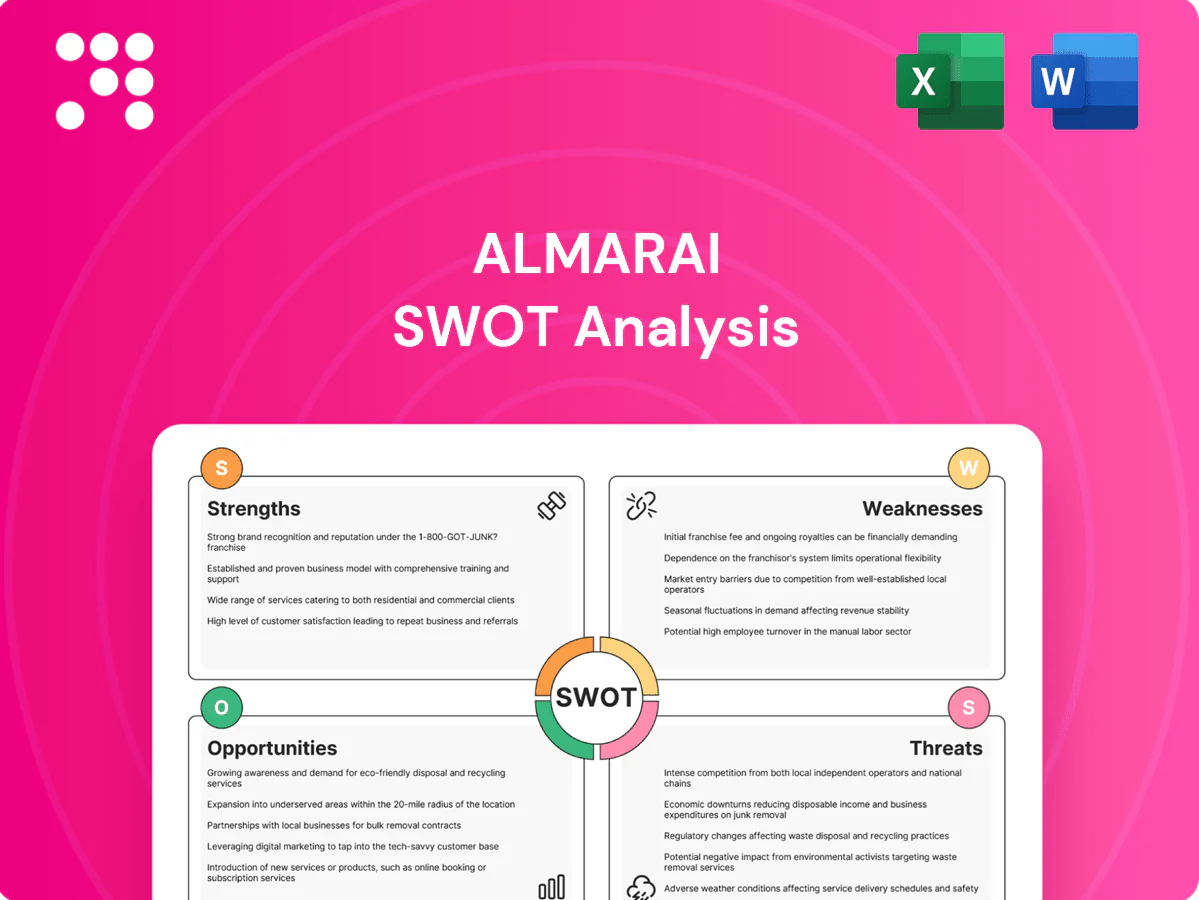
Almarai SWOT Analysis

Elevate Your Analysis with the Complete SWOT Report
Almarai’s dominant regional scale, strong brand equity, and integrated supply chain underpin resilient market leadership, while exposure to feed costs, water scarcity, and regional competition pose tangible risks; growth hinges on diversification and efficiency gains. Want the full strategic picture? Purchase the complete SWOT analysis for a research-backed, editable report and Excel tools to plan and invest with confidence.
Strengths

Scale and vertical integration
Almarai controls farming, processing and distribution end-to-end, driving cost efficiencies and tight quality controls across its operations. This integration stabilizes supply and reduces reliance on third parties, supporting consistent product availability across the six GCC countries. It also accelerates farm-to-shelf innovation cycles, enabling faster rollout of new SKUs and production improvements.
Diversified product portfolio
Almarai spans dairy, juice, bakery, poultry and infant nutrition, balancing cyclical demand across categories to reduce volatility. This diversification mitigates single-category shocks and supports stable cash flow. Cross-category promotions and bundled SKUs deepen basket size and loyalty. Shared R&D and manufacturing capacity spread development costs across multiple revenue streams.

Strong brand and distribution footprint
Almarai, founded in 1977, enjoys high brand recognition and trust across GCC households. Its dense cold-chain and route-to-market network reaches modern and traditional trade efficiently, with frequent delivery cycles that sustain freshness and shelf presence. These logistics and long-standing presence create significant barriers for new entrants lacking comparable reach.

Quality and food safety leadership
Almarai's rigorous standards and traceability reinforce premium positioning; the company, founded in 1977 (48 years), leverages FSSC 22000 and ISO food-safety certifications to support entry into infant nutrition and other sensitive segments. Consistent quality underpins pricing power in core dairy and lowers switching risk for consumers and retailers.
- Founded 1977 — 48 years
- FSSC 22000 / ISO food-safety certifications
- Premium positioning reduces switching risk
Operational excellence and scale efficiencies
Almarai leverages high-capacity plants and optimized logistics to lower unit costs, while data-driven forecasting enhances yield and reduces waste, reinforcing margin resilience and enabling competitive pricing.
- Procurement scale secures favorable input terms
- Optimized logistics cut distribution costs
- Forecasting reduces spoilage and improves utilization
GCC integrated food group: 48 years of scale and cold-chain edge
Almarai (founded 1977 — 48 years) delivers end-to-end integration across six GCC countries, supporting tight quality control (FSSC 22000/ISO) and lower unit costs via large-capacity plants and optimized cold-chain logistics. Diversified portfolio (dairy, juice, bakery, poultry, infant nutrition) stabilizes cash flows and boosts cross-category margins and loyalty.
| Metric | 2024/2025 Fact |
|---|---|
| Founded | 1977 (48 years) |
| Markets | 6 GCC countries |
| Certifications | FSSC 22000 / ISO |
| Core categories | Dairy, juice, bakery, poultry, infant nutrition |
What is included in the product
 Detailed Word Document
Delivers a strategic overview of Almarai’s internal and external business factors, outlining its strengths, weaknesses, opportunities and threats while mapping competitive position, growth drivers, operational gaps and market risks shaping the company’s future.

 Customizable Excel Spreadsheet
Provides a concise Almarai-focused SWOT matrix for fast strategic alignment and clear stakeholder presentations.
Weaknesses

High capital intensity
High capital intensity: farms, processing plants and cold-chain fleets need substantial ongoing capex, with Almarai's annual investment running above SAR 1.5 billion in recent years, tying up cash and increasing depreciation charges.
Return profile relies on high asset utilization and steady consumer demand; utilization shortfalls quickly depress margins and ROI.
Heavy fixed assets limit nimbleness in downturns, constraining cost cutting and strategic flexibility.
Exposure to imported feed and inputs
Livestock feed and packaging for Almarai are tied to global commodity markets, with the FAO Food Price Index having jumped about 20% in 2022, making input costs highly sensitive to international price swings. Currency exposure matters because key feed imports are invoiced in US dollars, amplifying cost volatility despite Saudi riyal stability. Hedging programs provide only partial protection against sudden spikes, complicating margin management during prolonged inflationary cycles.

Geographic concentration in GCC
Almarai's revenue remains heavily concentrated in the GCC, with over 80% of sales generated in Saudi Arabia and neighboring Gulf markets in 2024, limiting geographic diversification. Regional economic slowdowns or policy shifts can disproportionately affect group results. Consumer preferences in the GCC are region-specific, complicating replication. Expansion beyond the GCC requires new distribution, branding and regulatory capabilities.

Complex portfolio management
Almarai’s portfolio spans dairy, juice, bakery, poultry and infant nutrition, which increases operational complexity across supply chains and cold chain logistics. Competing categories can dilute marketing spend and strategic focus, forcing trade-offs in promotions and shelf space. Multiple innovation pipelines vie for capital and talent, slowing decision-making and execution in fast-moving segments.
- Operational complexity: multi-category supply chains
- Marketing dilution: competing budget priorities
- Resource conflict: R&D and capex competition
- Slower execution: elongated decision cycles
Premium pricing perception
Strong quality positioning gives Almarai a premium-priced image versus value brands, which in price-sensitive GCC segments can constrain volume share despite brand leadership on Tadawul (ticker 2280). During downturns promotional reliance may rise, increasing short-term sales but risking margin pressure. Excessive discounting over time can erode perceived quality and long-term brand equity.
- Premium image vs value competitors
- Limits share in price-sensitive segments
- Higher promotional dependence in tough markets
- Risk of brand equity erosion if discounts persist
High capex, >80% GCC revenue concentration and volatile inputs pressure margins
High capex burden: annual investment > SAR 1.5bn (2021–24 avg) limits cash flow and raises depreciation. Revenue concentration: >80% sales in GCC (2024) exposes Almarai to regional shocks. Input volatility: FAO Food Price Index rose ~20% in 2022, and USD-priced feed increases cost risk despite riyal stability. Premium pricing constrains share in price-sensitive segments, raising promo dependence.
| Metric | Value |
|---|---|
| Annual capex (avg) | SAR >1.5bn |
| GCC revenue share (2024) | >80% |
| FAO Food Price Index change (2022) | ~+20% |
| Tadawul ticker | 2280 |
Same Document Delivered
Almarai SWOT Analysis
This is the actual SWOT analysis document you’ll receive upon purchase—no surprises, just professional quality. The preview below is taken directly from the full SWOT report you'll get; purchase unlocks the entire in-depth, editable version. You’re viewing a live preview of the real file.

Elevate Your Analysis with the Complete SWOT Report
Almarai’s dominant regional scale, strong brand equity, and integrated supply chain underpin resilient market leadership, while exposure to feed costs, water scarcity, and regional competition pose tangible risks; growth hinges on diversification and efficiency gains. Want the full strategic picture? Purchase the complete SWOT analysis for a research-backed, editable report and Excel tools to plan and invest with confidence.
Strengths
Scale and vertical integration
Almarai controls farming, processing and distribution end-to-end, driving cost efficiencies and tight quality controls across its operations. This integration stabilizes supply and reduces reliance on third parties, supporting consistent product availability across the six GCC countries. It also accelerates farm-to-shelf innovation cycles, enabling faster rollout of new SKUs and production improvements.
Diversified product portfolio
Almarai spans dairy, juice, bakery, poultry and infant nutrition, balancing cyclical demand across categories to reduce volatility. This diversification mitigates single-category shocks and supports stable cash flow. Cross-category promotions and bundled SKUs deepen basket size and loyalty. Shared R&D and manufacturing capacity spread development costs across multiple revenue streams.
Strong brand and distribution footprint
Almarai, founded in 1977, enjoys high brand recognition and trust across GCC households. Its dense cold-chain and route-to-market network reaches modern and traditional trade efficiently, with frequent delivery cycles that sustain freshness and shelf presence. These logistics and long-standing presence create significant barriers for new entrants lacking comparable reach.
Quality and food safety leadership
Almarai's rigorous standards and traceability reinforce premium positioning; the company, founded in 1977 (48 years), leverages FSSC 22000 and ISO food-safety certifications to support entry into infant nutrition and other sensitive segments. Consistent quality underpins pricing power in core dairy and lowers switching risk for consumers and retailers.
- Founded 1977 — 48 years
- FSSC 22000 / ISO food-safety certifications
- Premium positioning reduces switching risk
Operational excellence and scale efficiencies
Almarai leverages high-capacity plants and optimized logistics to lower unit costs, while data-driven forecasting enhances yield and reduces waste, reinforcing margin resilience and enabling competitive pricing.
- Procurement scale secures favorable input terms
- Optimized logistics cut distribution costs
- Forecasting reduces spoilage and improves utilization
GCC integrated food group: 48 years of scale and cold-chain edge
Almarai (founded 1977 — 48 years) delivers end-to-end integration across six GCC countries, supporting tight quality control (FSSC 22000/ISO) and lower unit costs via large-capacity plants and optimized cold-chain logistics. Diversified portfolio (dairy, juice, bakery, poultry, infant nutrition) stabilizes cash flows and boosts cross-category margins and loyalty.
| Metric | 2024/2025 Fact |
|---|---|
| Founded | 1977 (48 years) |
| Markets | 6 GCC countries |
| Certifications | FSSC 22000 / ISO |
| Core categories | Dairy, juice, bakery, poultry, infant nutrition |
What is included in the product
Detailed Word Document
Delivers a strategic overview of Almarai’s internal and external business factors, outlining its strengths, weaknesses, opportunities and threats while mapping competitive position, growth drivers, operational gaps and market risks shaping the company’s future.
Customizable Excel Spreadsheet
Provides a concise Almarai-focused SWOT matrix for fast strategic alignment and clear stakeholder presentations.
Weaknesses
High capital intensity
High capital intensity: farms, processing plants and cold-chain fleets need substantial ongoing capex, with Almarai's annual investment running above SAR 1.5 billion in recent years, tying up cash and increasing depreciation charges.
Return profile relies on high asset utilization and steady consumer demand; utilization shortfalls quickly depress margins and ROI.
Heavy fixed assets limit nimbleness in downturns, constraining cost cutting and strategic flexibility.
Exposure to imported feed and inputs
Livestock feed and packaging for Almarai are tied to global commodity markets, with the FAO Food Price Index having jumped about 20% in 2022, making input costs highly sensitive to international price swings. Currency exposure matters because key feed imports are invoiced in US dollars, amplifying cost volatility despite Saudi riyal stability. Hedging programs provide only partial protection against sudden spikes, complicating margin management during prolonged inflationary cycles.
Geographic concentration in GCC
Almarai's revenue remains heavily concentrated in the GCC, with over 80% of sales generated in Saudi Arabia and neighboring Gulf markets in 2024, limiting geographic diversification. Regional economic slowdowns or policy shifts can disproportionately affect group results. Consumer preferences in the GCC are region-specific, complicating replication. Expansion beyond the GCC requires new distribution, branding and regulatory capabilities.
Complex portfolio management
Almarai’s portfolio spans dairy, juice, bakery, poultry and infant nutrition, which increases operational complexity across supply chains and cold chain logistics. Competing categories can dilute marketing spend and strategic focus, forcing trade-offs in promotions and shelf space. Multiple innovation pipelines vie for capital and talent, slowing decision-making and execution in fast-moving segments.
- Operational complexity: multi-category supply chains
- Marketing dilution: competing budget priorities
- Resource conflict: R&D and capex competition
- Slower execution: elongated decision cycles
Premium pricing perception
Strong quality positioning gives Almarai a premium-priced image versus value brands, which in price-sensitive GCC segments can constrain volume share despite brand leadership on Tadawul (ticker 2280). During downturns promotional reliance may rise, increasing short-term sales but risking margin pressure. Excessive discounting over time can erode perceived quality and long-term brand equity.
- Premium image vs value competitors
- Limits share in price-sensitive segments
- Higher promotional dependence in tough markets
- Risk of brand equity erosion if discounts persist
High capex, >80% GCC revenue concentration and volatile inputs pressure margins
High capex burden: annual investment > SAR 1.5bn (2021–24 avg) limits cash flow and raises depreciation. Revenue concentration: >80% sales in GCC (2024) exposes Almarai to regional shocks. Input volatility: FAO Food Price Index rose ~20% in 2022, and USD-priced feed increases cost risk despite riyal stability. Premium pricing constrains share in price-sensitive segments, raising promo dependence.
| Metric | Value |
|---|---|
| Annual capex (avg) | SAR >1.5bn |
| GCC revenue share (2024) | >80% |
| FAO Food Price Index change (2022) | ~+20% |
| Tadawul ticker | 2280 |
Same Document Delivered
Almarai SWOT Analysis
This is the actual SWOT analysis document you’ll receive upon purchase—no surprises, just professional quality. The preview below is taken directly from the full SWOT report you'll get; purchase unlocks the entire in-depth, editable version. You’re viewing a live preview of the real file.
Original: $10.00
-65%$10.00
$3.50Description
Elevate Your Analysis with the Complete SWOT Report
Almarai’s dominant regional scale, strong brand equity, and integrated supply chain underpin resilient market leadership, while exposure to feed costs, water scarcity, and regional competition pose tangible risks; growth hinges on diversification and efficiency gains. Want the full strategic picture? Purchase the complete SWOT analysis for a research-backed, editable report and Excel tools to plan and invest with confidence.
Strengths
Scale and vertical integration
Almarai controls farming, processing and distribution end-to-end, driving cost efficiencies and tight quality controls across its operations. This integration stabilizes supply and reduces reliance on third parties, supporting consistent product availability across the six GCC countries. It also accelerates farm-to-shelf innovation cycles, enabling faster rollout of new SKUs and production improvements.
Diversified product portfolio
Almarai spans dairy, juice, bakery, poultry and infant nutrition, balancing cyclical demand across categories to reduce volatility. This diversification mitigates single-category shocks and supports stable cash flow. Cross-category promotions and bundled SKUs deepen basket size and loyalty. Shared R&D and manufacturing capacity spread development costs across multiple revenue streams.
Strong brand and distribution footprint
Almarai, founded in 1977, enjoys high brand recognition and trust across GCC households. Its dense cold-chain and route-to-market network reaches modern and traditional trade efficiently, with frequent delivery cycles that sustain freshness and shelf presence. These logistics and long-standing presence create significant barriers for new entrants lacking comparable reach.
Quality and food safety leadership
Almarai's rigorous standards and traceability reinforce premium positioning; the company, founded in 1977 (48 years), leverages FSSC 22000 and ISO food-safety certifications to support entry into infant nutrition and other sensitive segments. Consistent quality underpins pricing power in core dairy and lowers switching risk for consumers and retailers.
- Founded 1977 — 48 years
- FSSC 22000 / ISO food-safety certifications
- Premium positioning reduces switching risk
Operational excellence and scale efficiencies
Almarai leverages high-capacity plants and optimized logistics to lower unit costs, while data-driven forecasting enhances yield and reduces waste, reinforcing margin resilience and enabling competitive pricing.
- Procurement scale secures favorable input terms
- Optimized logistics cut distribution costs
- Forecasting reduces spoilage and improves utilization
GCC integrated food group: 48 years of scale and cold-chain edge
Almarai (founded 1977 — 48 years) delivers end-to-end integration across six GCC countries, supporting tight quality control (FSSC 22000/ISO) and lower unit costs via large-capacity plants and optimized cold-chain logistics. Diversified portfolio (dairy, juice, bakery, poultry, infant nutrition) stabilizes cash flows and boosts cross-category margins and loyalty.
| Metric | 2024/2025 Fact |
|---|---|
| Founded | 1977 (48 years) |
| Markets | 6 GCC countries |
| Certifications | FSSC 22000 / ISO |
| Core categories | Dairy, juice, bakery, poultry, infant nutrition |
What is included in the product
Detailed Word Document
Delivers a strategic overview of Almarai’s internal and external business factors, outlining its strengths, weaknesses, opportunities and threats while mapping competitive position, growth drivers, operational gaps and market risks shaping the company’s future.
Customizable Excel Spreadsheet
Provides a concise Almarai-focused SWOT matrix for fast strategic alignment and clear stakeholder presentations.
Weaknesses
High capital intensity
High capital intensity: farms, processing plants and cold-chain fleets need substantial ongoing capex, with Almarai's annual investment running above SAR 1.5 billion in recent years, tying up cash and increasing depreciation charges.
Return profile relies on high asset utilization and steady consumer demand; utilization shortfalls quickly depress margins and ROI.
Heavy fixed assets limit nimbleness in downturns, constraining cost cutting and strategic flexibility.
Exposure to imported feed and inputs
Livestock feed and packaging for Almarai are tied to global commodity markets, with the FAO Food Price Index having jumped about 20% in 2022, making input costs highly sensitive to international price swings. Currency exposure matters because key feed imports are invoiced in US dollars, amplifying cost volatility despite Saudi riyal stability. Hedging programs provide only partial protection against sudden spikes, complicating margin management during prolonged inflationary cycles.
Geographic concentration in GCC
Almarai's revenue remains heavily concentrated in the GCC, with over 80% of sales generated in Saudi Arabia and neighboring Gulf markets in 2024, limiting geographic diversification. Regional economic slowdowns or policy shifts can disproportionately affect group results. Consumer preferences in the GCC are region-specific, complicating replication. Expansion beyond the GCC requires new distribution, branding and regulatory capabilities.
Complex portfolio management
Almarai’s portfolio spans dairy, juice, bakery, poultry and infant nutrition, which increases operational complexity across supply chains and cold chain logistics. Competing categories can dilute marketing spend and strategic focus, forcing trade-offs in promotions and shelf space. Multiple innovation pipelines vie for capital and talent, slowing decision-making and execution in fast-moving segments.
- Operational complexity: multi-category supply chains
- Marketing dilution: competing budget priorities
- Resource conflict: R&D and capex competition
- Slower execution: elongated decision cycles
Premium pricing perception
Strong quality positioning gives Almarai a premium-priced image versus value brands, which in price-sensitive GCC segments can constrain volume share despite brand leadership on Tadawul (ticker 2280). During downturns promotional reliance may rise, increasing short-term sales but risking margin pressure. Excessive discounting over time can erode perceived quality and long-term brand equity.
- Premium image vs value competitors
- Limits share in price-sensitive segments
- Higher promotional dependence in tough markets
- Risk of brand equity erosion if discounts persist
High capex, >80% GCC revenue concentration and volatile inputs pressure margins
High capex burden: annual investment > SAR 1.5bn (2021–24 avg) limits cash flow and raises depreciation. Revenue concentration: >80% sales in GCC (2024) exposes Almarai to regional shocks. Input volatility: FAO Food Price Index rose ~20% in 2022, and USD-priced feed increases cost risk despite riyal stability. Premium pricing constrains share in price-sensitive segments, raising promo dependence.
| Metric | Value |
|---|---|
| Annual capex (avg) | SAR >1.5bn |
| GCC revenue share (2024) | >80% |
| FAO Food Price Index change (2022) | ~+20% |
| Tadawul ticker | 2280 |
Same Document Delivered
Almarai SWOT Analysis
This is the actual SWOT analysis document you’ll receive upon purchase—no surprises, just professional quality. The preview below is taken directly from the full SWOT report you'll get; purchase unlocks the entire in-depth, editable version. You’re viewing a live preview of the real file.











