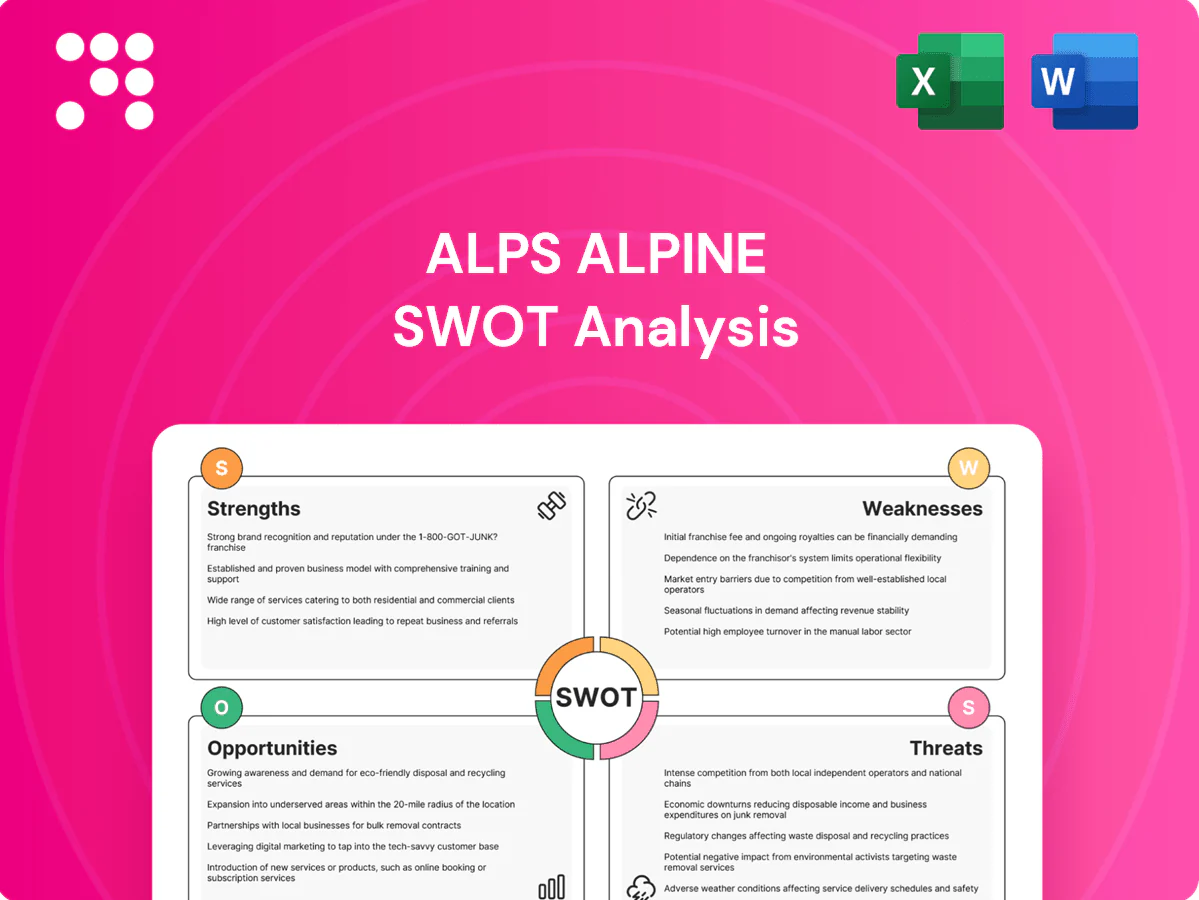
Alps Alpine SWOT Analysis

Dive Deeper Into the Company’s Strategic Blueprint
Alps Alpine's diversified automotive and electronic components portfolio, strong R&D and global supply chain position it well for EV and ADAS growth, but margin pressure and semiconductor volatility are key risks. Explore untapped markets and strategic levers in our full SWOT. Purchase the complete report for an editable, investor-ready Word and Excel package to plan and pitch with confidence.
Strengths

Broad HMI and sensor portfolio
Alps Alpine offers a broad HMI and sensor portfolio spanning tactile switches, touch/force sensors, actuators and environmental sensors that serve automotive, consumer and industrial applications. This breadth enables solution selling and higher content per device or vehicle while reducing reliance on any single product cycle and buffering demand swings. Deep portfolio depth supports differentiation through integration and miniaturization.
Deep automotive OEM relationships
Long design-in cycles and stringent OEM qualifications create sticky positions with global automakers and Tier-1s, reducing churn and supporting repeat business. A proven track record in infotainment and cockpit modules has driven repeat awards and deep trust across platforms. Embedded, co-developed programs deliver multi-year revenue visibility and alignment with future vehicle architecture needs.

Systems integration capability
Alps Alpine bundles sensors, connectivity, power and HMI into modular solutions that simplify OEM sourcing and supported consolidated net sales of ¥463.0 billion in FY2024. Integration raises switching costs and captures higher value-add versus discrete parts, boosting ASPs and margin potential. System-level tuning improves reliability and UX while standardised modules streamline compliance with UNECE and ISO automotive standards.

Quality manufacturing and global footprint
Automotive-grade quality systems and scalable production enable Alps Alpine to deliver consistent yields and high reliability across programs, while global operations in Asia, Europe and the Americas support just-in-time delivery and customer localization. This footprint diversifies supply-chain and regional risk and enhances responsiveness to program ramps and engineering changes.
- Automotive-grade systems
- Global JIT/localization
- Regional risk diversification
- Fast ramp & change response
Infotainment and connectivity know-how
Expertise in head units, telematics, antennas and Bluetooth/Wi‑Fi modules aligns Alps Alpine with connected car demand; the global connected‑car market is projected at about $220 billion by 2026 (MarketsandMarkets).
UX‑centric design and OEM partnerships improve in‑vehicle differentiation and reduce integration time for automakers.
Cross‑domain competence enables seamless HMI across screens and sensors, positioning the firm for the software‑defined cockpit shift.
- head‑units
- telematics
- UX‑centric HMI
- software‑defined cockpit
HMI/sensor integration boosts vehicle content; ¥463.0B sales, eyeing $220B market
Alps Alpine's broad HMI/sensor portfolio and system integration drives higher content per vehicle and resilience across cycles.
Sticky OEM design-ins and automotive-grade production yield multi-year revenue visibility; consolidated net sales ¥463.0 billion in FY2024.
Global manufacturing footprint enables JIT/localization and reduces supply risk, supporting ramps for connected-car demand (~$220 billion by 2026).
| Metric | Value |
|---|---|
| FY2024 Sales | ¥463.0B |
| Connected-car Mkt | $220B (2026) |
What is included in the product
 Detailed Word Document
Provides a concise SWOT overview of Alps Alpine, highlighting core strengths and operational weaknesses while mapping market opportunities and external threats that shape the company’s strategic outlook.

 Customizable Excel Spreadsheet
Provides a concise SWOT matrix tailored to Alps Alpine for fast strategic alignment and risk mitigation, enabling quick stakeholder updates and easy edits to reflect changing market dynamics.
Weaknesses

High auto-sector dependence
Alps Alpine derives roughly two-thirds of revenue from the automotive segment, exposing results to vehicle production cycles and OEM order timing. Macro slowdowns, dealer inventory corrections or model launch delays have an outsized impact on quarterly sales and margins. Diversification into industrial and consumer businesses remains smaller in scale, and sensitivity to regional mix—notably shifts between Japan, Europe and North America—adds revenue volatility.
Margin pressure and commoditization
Price competition in sensors and modules compresses gross margins, often shaving off hundreds of basis points as suppliers undercut each other; OEMs commonly enforce 3–5% annual cost-down targets per model year. Without rapid product differentiation, Alps Alpine risks being bid to lowest-cost suppliers. Volatile FX and materials (chip, copper) price swings further squeeze margins and operating leverage.

Software and ecosystem gaps
Alps Alpine struggles versus competitors bundling rich software stacks and cloud services, while Android Automotive and QNX had appeared in over 60 vehicle models by 2024, concentrating platform control with big-tech and Tier‑1 software players. Reliance on third‑party OS and middleware limits control over feature roadmaps and security patches. Without proprietary software layers, capturing recurring software/service revenues remains difficult and integration into big‑tech ecosystems can dilute Alps Alpine brand leverage.

Capital intensity and long cycles
Automotive qualification, tooling and compliance demand heavy upfront capital—tooling typically ranges $1–10M per program—and design-in to SOP often takes 2–5 years, stretching payback beyond five years if platforms underperform, raising project risk and reducing agility versus 12–24 month consumer-electronics cycles.
- High upfront capex
- 2–5 yr development lead-time
- Payback >5 yrs risk
- Less agile than 12–24m CE cycles
FX exposure and cost structure
Yen and other currency swings have materially affected reported results and component costs, with USD/JPY moving roughly 30% between 2022–24, complicating margins. Globalized supply chains increase hedging complexity and FX mismatch risk. Rising wage and energy inflation in 2023–24 eroded cost competitiveness while long OEM contracts limit pricing pass-through.
Auto ~66%, tooling $1–10M, long design‑in
Heavy reliance on automotive (~66% revenue) links results to vehicle cycles; tooling per program $1–10M and 2–5 yr design‑in stretch payback >5 yrs. OEM cost‑down targets 3–5%/yr and fierce price competition compress margins. USD/JPY swung ~30% 2022–24, wage/energy inflation in 2023–24 squeezed costs. Software/service revenues lag vs Android/QNX presence in >60 models by 2024.
| Metric | Value |
|---|---|
| Auto revenue share | ~66% |
| Tooling per program | $1–10M |
| Design‑in lead time | 2–5 yrs |
| USD/JPY move | ~30% (2022–24) |
| OEM cost‑down | 3–5%/yr |
| Android/QNX models | >60 (by 2024) |
What You See Is What You Get
Alps Alpine SWOT Analysis
This is a real excerpt from the complete Alps Alpine SWOT analysis document you’ll receive upon purchase—no surprises, just professional quality and structured insights. The preview below is taken directly from the full report; buy to unlock the entire in-depth, editable version. You’re viewing the actual file included in your download, ready for use after checkout.

Dive Deeper Into the Company’s Strategic Blueprint
Alps Alpine's diversified automotive and electronic components portfolio, strong R&D and global supply chain position it well for EV and ADAS growth, but margin pressure and semiconductor volatility are key risks. Explore untapped markets and strategic levers in our full SWOT. Purchase the complete report for an editable, investor-ready Word and Excel package to plan and pitch with confidence.
Strengths
Broad HMI and sensor portfolio
Alps Alpine offers a broad HMI and sensor portfolio spanning tactile switches, touch/force sensors, actuators and environmental sensors that serve automotive, consumer and industrial applications. This breadth enables solution selling and higher content per device or vehicle while reducing reliance on any single product cycle and buffering demand swings. Deep portfolio depth supports differentiation through integration and miniaturization.
Deep automotive OEM relationships
Long design-in cycles and stringent OEM qualifications create sticky positions with global automakers and Tier-1s, reducing churn and supporting repeat business. A proven track record in infotainment and cockpit modules has driven repeat awards and deep trust across platforms. Embedded, co-developed programs deliver multi-year revenue visibility and alignment with future vehicle architecture needs.
Systems integration capability
Alps Alpine bundles sensors, connectivity, power and HMI into modular solutions that simplify OEM sourcing and supported consolidated net sales of ¥463.0 billion in FY2024. Integration raises switching costs and captures higher value-add versus discrete parts, boosting ASPs and margin potential. System-level tuning improves reliability and UX while standardised modules streamline compliance with UNECE and ISO automotive standards.
Quality manufacturing and global footprint
Automotive-grade quality systems and scalable production enable Alps Alpine to deliver consistent yields and high reliability across programs, while global operations in Asia, Europe and the Americas support just-in-time delivery and customer localization. This footprint diversifies supply-chain and regional risk and enhances responsiveness to program ramps and engineering changes.
- Automotive-grade systems
- Global JIT/localization
- Regional risk diversification
- Fast ramp & change response
Infotainment and connectivity know-how
Expertise in head units, telematics, antennas and Bluetooth/Wi‑Fi modules aligns Alps Alpine with connected car demand; the global connected‑car market is projected at about $220 billion by 2026 (MarketsandMarkets).
UX‑centric design and OEM partnerships improve in‑vehicle differentiation and reduce integration time for automakers.
Cross‑domain competence enables seamless HMI across screens and sensors, positioning the firm for the software‑defined cockpit shift.
- head‑units
- telematics
- UX‑centric HMI
- software‑defined cockpit
HMI/sensor integration boosts vehicle content; ¥463.0B sales, eyeing $220B market
Alps Alpine's broad HMI/sensor portfolio and system integration drives higher content per vehicle and resilience across cycles.
Sticky OEM design-ins and automotive-grade production yield multi-year revenue visibility; consolidated net sales ¥463.0 billion in FY2024.
Global manufacturing footprint enables JIT/localization and reduces supply risk, supporting ramps for connected-car demand (~$220 billion by 2026).
| Metric | Value |
|---|---|
| FY2024 Sales | ¥463.0B |
| Connected-car Mkt | $220B (2026) |
What is included in the product
Detailed Word Document
Provides a concise SWOT overview of Alps Alpine, highlighting core strengths and operational weaknesses while mapping market opportunities and external threats that shape the company’s strategic outlook.
Customizable Excel Spreadsheet
Provides a concise SWOT matrix tailored to Alps Alpine for fast strategic alignment and risk mitigation, enabling quick stakeholder updates and easy edits to reflect changing market dynamics.
Weaknesses
High auto-sector dependence
Alps Alpine derives roughly two-thirds of revenue from the automotive segment, exposing results to vehicle production cycles and OEM order timing. Macro slowdowns, dealer inventory corrections or model launch delays have an outsized impact on quarterly sales and margins. Diversification into industrial and consumer businesses remains smaller in scale, and sensitivity to regional mix—notably shifts between Japan, Europe and North America—adds revenue volatility.
Margin pressure and commoditization
Price competition in sensors and modules compresses gross margins, often shaving off hundreds of basis points as suppliers undercut each other; OEMs commonly enforce 3–5% annual cost-down targets per model year. Without rapid product differentiation, Alps Alpine risks being bid to lowest-cost suppliers. Volatile FX and materials (chip, copper) price swings further squeeze margins and operating leverage.
Software and ecosystem gaps
Alps Alpine struggles versus competitors bundling rich software stacks and cloud services, while Android Automotive and QNX had appeared in over 60 vehicle models by 2024, concentrating platform control with big-tech and Tier‑1 software players. Reliance on third‑party OS and middleware limits control over feature roadmaps and security patches. Without proprietary software layers, capturing recurring software/service revenues remains difficult and integration into big‑tech ecosystems can dilute Alps Alpine brand leverage.
Capital intensity and long cycles
Automotive qualification, tooling and compliance demand heavy upfront capital—tooling typically ranges $1–10M per program—and design-in to SOP often takes 2–5 years, stretching payback beyond five years if platforms underperform, raising project risk and reducing agility versus 12–24 month consumer-electronics cycles.
- High upfront capex
- 2–5 yr development lead-time
- Payback >5 yrs risk
- Less agile than 12–24m CE cycles
FX exposure and cost structure
Yen and other currency swings have materially affected reported results and component costs, with USD/JPY moving roughly 30% between 2022–24, complicating margins. Globalized supply chains increase hedging complexity and FX mismatch risk. Rising wage and energy inflation in 2023–24 eroded cost competitiveness while long OEM contracts limit pricing pass-through.
Auto ~66%, tooling $1–10M, long design‑in
Heavy reliance on automotive (~66% revenue) links results to vehicle cycles; tooling per program $1–10M and 2–5 yr design‑in stretch payback >5 yrs. OEM cost‑down targets 3–5%/yr and fierce price competition compress margins. USD/JPY swung ~30% 2022–24, wage/energy inflation in 2023–24 squeezed costs. Software/service revenues lag vs Android/QNX presence in >60 models by 2024.
| Metric | Value |
|---|---|
| Auto revenue share | ~66% |
| Tooling per program | $1–10M |
| Design‑in lead time | 2–5 yrs |
| USD/JPY move | ~30% (2022–24) |
| OEM cost‑down | 3–5%/yr |
| Android/QNX models | >60 (by 2024) |
What You See Is What You Get
Alps Alpine SWOT Analysis
This is a real excerpt from the complete Alps Alpine SWOT analysis document you’ll receive upon purchase—no surprises, just professional quality and structured insights. The preview below is taken directly from the full report; buy to unlock the entire in-depth, editable version. You’re viewing the actual file included in your download, ready for use after checkout.
Original: $10.00
-65%$10.00
$3.50Description
Dive Deeper Into the Company’s Strategic Blueprint
Alps Alpine's diversified automotive and electronic components portfolio, strong R&D and global supply chain position it well for EV and ADAS growth, but margin pressure and semiconductor volatility are key risks. Explore untapped markets and strategic levers in our full SWOT. Purchase the complete report for an editable, investor-ready Word and Excel package to plan and pitch with confidence.
Strengths
Broad HMI and sensor portfolio
Alps Alpine offers a broad HMI and sensor portfolio spanning tactile switches, touch/force sensors, actuators and environmental sensors that serve automotive, consumer and industrial applications. This breadth enables solution selling and higher content per device or vehicle while reducing reliance on any single product cycle and buffering demand swings. Deep portfolio depth supports differentiation through integration and miniaturization.
Deep automotive OEM relationships
Long design-in cycles and stringent OEM qualifications create sticky positions with global automakers and Tier-1s, reducing churn and supporting repeat business. A proven track record in infotainment and cockpit modules has driven repeat awards and deep trust across platforms. Embedded, co-developed programs deliver multi-year revenue visibility and alignment with future vehicle architecture needs.
Systems integration capability
Alps Alpine bundles sensors, connectivity, power and HMI into modular solutions that simplify OEM sourcing and supported consolidated net sales of ¥463.0 billion in FY2024. Integration raises switching costs and captures higher value-add versus discrete parts, boosting ASPs and margin potential. System-level tuning improves reliability and UX while standardised modules streamline compliance with UNECE and ISO automotive standards.
Quality manufacturing and global footprint
Automotive-grade quality systems and scalable production enable Alps Alpine to deliver consistent yields and high reliability across programs, while global operations in Asia, Europe and the Americas support just-in-time delivery and customer localization. This footprint diversifies supply-chain and regional risk and enhances responsiveness to program ramps and engineering changes.
- Automotive-grade systems
- Global JIT/localization
- Regional risk diversification
- Fast ramp & change response
Infotainment and connectivity know-how
Expertise in head units, telematics, antennas and Bluetooth/Wi‑Fi modules aligns Alps Alpine with connected car demand; the global connected‑car market is projected at about $220 billion by 2026 (MarketsandMarkets).
UX‑centric design and OEM partnerships improve in‑vehicle differentiation and reduce integration time for automakers.
Cross‑domain competence enables seamless HMI across screens and sensors, positioning the firm for the software‑defined cockpit shift.
- head‑units
- telematics
- UX‑centric HMI
- software‑defined cockpit
HMI/sensor integration boosts vehicle content; ¥463.0B sales, eyeing $220B market
Alps Alpine's broad HMI/sensor portfolio and system integration drives higher content per vehicle and resilience across cycles.
Sticky OEM design-ins and automotive-grade production yield multi-year revenue visibility; consolidated net sales ¥463.0 billion in FY2024.
Global manufacturing footprint enables JIT/localization and reduces supply risk, supporting ramps for connected-car demand (~$220 billion by 2026).
| Metric | Value |
|---|---|
| FY2024 Sales | ¥463.0B |
| Connected-car Mkt | $220B (2026) |
What is included in the product
Detailed Word Document
Provides a concise SWOT overview of Alps Alpine, highlighting core strengths and operational weaknesses while mapping market opportunities and external threats that shape the company’s strategic outlook.
Customizable Excel Spreadsheet
Provides a concise SWOT matrix tailored to Alps Alpine for fast strategic alignment and risk mitigation, enabling quick stakeholder updates and easy edits to reflect changing market dynamics.
Weaknesses
High auto-sector dependence
Alps Alpine derives roughly two-thirds of revenue from the automotive segment, exposing results to vehicle production cycles and OEM order timing. Macro slowdowns, dealer inventory corrections or model launch delays have an outsized impact on quarterly sales and margins. Diversification into industrial and consumer businesses remains smaller in scale, and sensitivity to regional mix—notably shifts between Japan, Europe and North America—adds revenue volatility.
Margin pressure and commoditization
Price competition in sensors and modules compresses gross margins, often shaving off hundreds of basis points as suppliers undercut each other; OEMs commonly enforce 3–5% annual cost-down targets per model year. Without rapid product differentiation, Alps Alpine risks being bid to lowest-cost suppliers. Volatile FX and materials (chip, copper) price swings further squeeze margins and operating leverage.
Software and ecosystem gaps
Alps Alpine struggles versus competitors bundling rich software stacks and cloud services, while Android Automotive and QNX had appeared in over 60 vehicle models by 2024, concentrating platform control with big-tech and Tier‑1 software players. Reliance on third‑party OS and middleware limits control over feature roadmaps and security patches. Without proprietary software layers, capturing recurring software/service revenues remains difficult and integration into big‑tech ecosystems can dilute Alps Alpine brand leverage.
Capital intensity and long cycles
Automotive qualification, tooling and compliance demand heavy upfront capital—tooling typically ranges $1–10M per program—and design-in to SOP often takes 2–5 years, stretching payback beyond five years if platforms underperform, raising project risk and reducing agility versus 12–24 month consumer-electronics cycles.
- High upfront capex
- 2–5 yr development lead-time
- Payback >5 yrs risk
- Less agile than 12–24m CE cycles
FX exposure and cost structure
Yen and other currency swings have materially affected reported results and component costs, with USD/JPY moving roughly 30% between 2022–24, complicating margins. Globalized supply chains increase hedging complexity and FX mismatch risk. Rising wage and energy inflation in 2023–24 eroded cost competitiveness while long OEM contracts limit pricing pass-through.
Auto ~66%, tooling $1–10M, long design‑in
Heavy reliance on automotive (~66% revenue) links results to vehicle cycles; tooling per program $1–10M and 2–5 yr design‑in stretch payback >5 yrs. OEM cost‑down targets 3–5%/yr and fierce price competition compress margins. USD/JPY swung ~30% 2022–24, wage/energy inflation in 2023–24 squeezed costs. Software/service revenues lag vs Android/QNX presence in >60 models by 2024.
| Metric | Value |
|---|---|
| Auto revenue share | ~66% |
| Tooling per program | $1–10M |
| Design‑in lead time | 2–5 yrs |
| USD/JPY move | ~30% (2022–24) |
| OEM cost‑down | 3–5%/yr |
| Android/QNX models | >60 (by 2024) |
What You See Is What You Get
Alps Alpine SWOT Analysis
This is a real excerpt from the complete Alps Alpine SWOT analysis document you’ll receive upon purchase—no surprises, just professional quality and structured insights. The preview below is taken directly from the full report; buy to unlock the entire in-depth, editable version. You’re viewing the actual file included in your download, ready for use after checkout.











