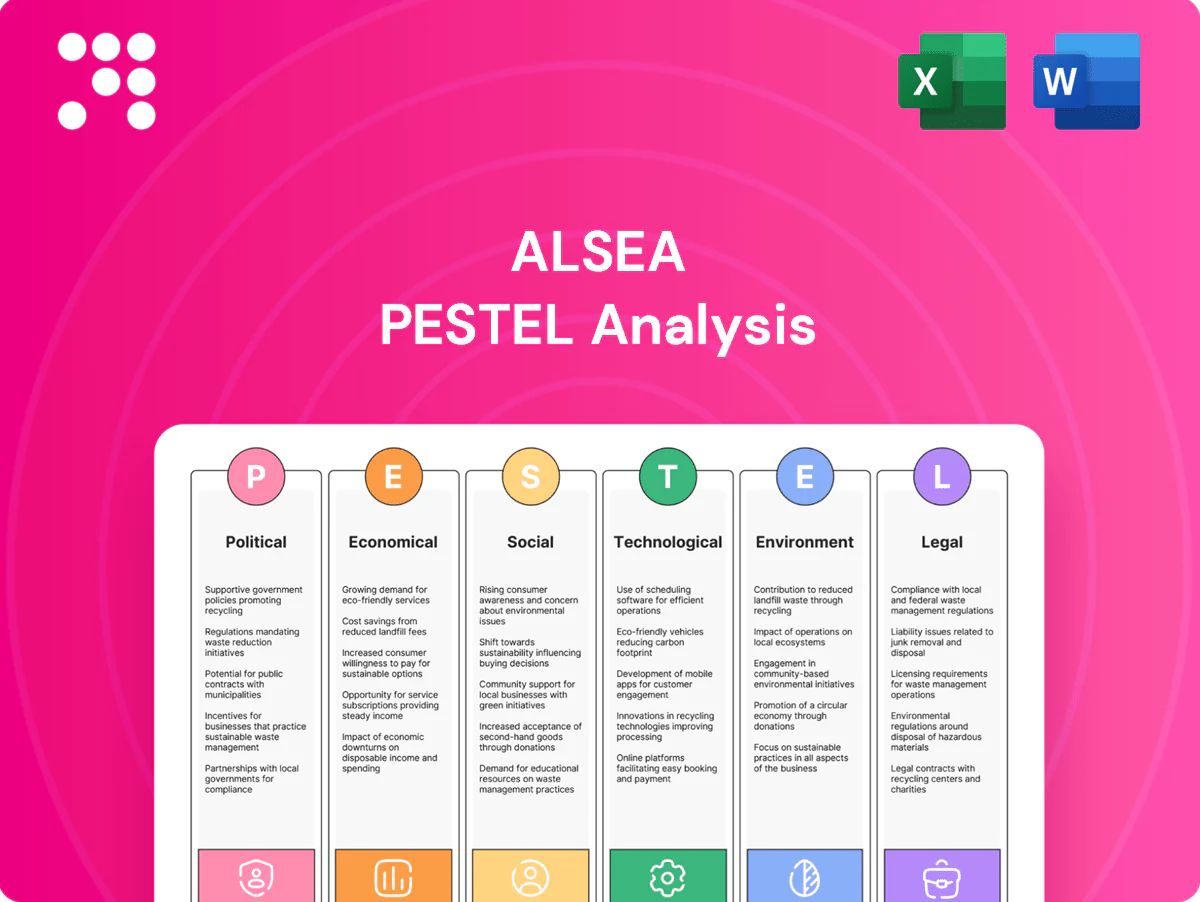
Alsea PESTLE Analysis

Plan Smarter. Present Sharper. Compete Stronger.
Our PESTLE analysis for Alsea reveals how political shifts, economic cycles, social trends, technological innovation, legal changes, and environmental pressures converge to shape its growth trajectory. These concise, evidence-based insights help investors and strategists identify risk exposures and growth levers. Buy the full PESTLE now to access the complete, editable report and turn external intelligence into actionable strategy.
Political factors

Regulatory stability across LATAM and Europe
Operating in Mexico, Argentina, Chile, Colombia, Spain and France exposes Alsea to shifting policy priorities and administrative changes that affect permits, store openings and franchising approvals. Stable regimes speed approvals and expansion while volatile environments delay rollouts and capex deployment. Close monitoring of municipal regulations is critical for licenses and operating hours. Proactive local stakeholder engagement helps pre-empt disruptions and compliance gaps.
Minimum wage and labor policy shifts
Frequent minimum-wage hikes—Mexico at ~MXN 207.44/day and Spain SMI ≈€1,080/month in 2024—compress store-level margins and raised Alsea’s labor expense pressure in 2024–25. Collective bargaining across Europe increases payroll and limits scheduling flexibility, lifting wage bills by double digits in some markets. Proactive workforce planning and productivity tools have offset part of the rise, while transparent labor practices strengthen brand trust under political scrutiny.

Trade, tariffs, and import dependencies
Coffee, dairy and equipment imports face tariff and customs risks that vary by country, affecting Alsea's input cost volatility; Brazil and Vietnam account for roughly 56% of global coffee production (2024), concentrating supply risk. Policy shifts on agricultural subsidies and trade deals can reset ingredient cost baselines. Diversified sourcing and local supplier development reduce exposure, while franchisor contract clauses often share or shift import-related risks.

Public health and nutrition agendas
Governments increasingly push sugar, sodium and calorie reduction via taxes and labeling mandates; by 2024 over 50 jurisdictions had implemented sugary‑drink taxes, raising regulatory risk for quick‑service operators. Political momentum for school‑zone restrictions and advertising limits can curb promotions; early reformulation and menu transparency reduce shock. Coordinated advocacy with brand partners preserves strategic options.
- Exposure: Alsea ~4,000+ restaurants (2024)
- Mitigation: reformulation + calorie labels
- Risk: taxes/ads limits across 50+ jurisdictions
Security and political unrest
Localized unrest and crime in several LATAM cities disrupt Alsea's store operations and supply routes, forcing investment in security, guarded logistics and contingency protocols to limit downtime.
When local policing weakens, store safety and route planning become de facto political issues; insurance coverages and crisis teams mitigate losses while a geographically balanced portfolio spreads risk across cities and countries.
- Operational disruption risk: localized unrest
- Mitigation: enhanced store security and guarded logistics
- Financial buffers: insurance and contingency protocols
- Strategic hedge: portfolio diversification across LATAM
Multicountry restaurant group faces wage, licensing and sugar-tax pressures across 6 markets
Operating in Mexico, Argentina, Chile, Colombia, Spain and France exposes Alsea to shifting permits, licensing and franchising rules that affect rollouts and capex timing.
Minimum wages—Mexico ≈ MXN 207.44/day; Spain SMI ≈ €1,080/month (2024)—and European collective bargaining compress store margins and lift payroll.
Sugary‑drink taxes exist in 50+ jurisdictions; Alsea ~4,000+ restaurants (2024); diversified sourcing and security spend mitigate trade and unrest risks.
| Metric | Value |
|---|---|
| Countries | 6 |
| Restaurants | 4,000+ |
| MX min wage | ≈ MXN 207.44/day (2024) |
| Spain SMI | ≈ €1,080/mo (2024) |
| Sugary‑tax jurisdictions | 50+ |
What is included in the product
 Detailed Word Document
Explores how macro-environmental factors uniquely affect Alsea across Political, Economic, Social, Technological, Environmental and Legal dimensions, with each section backed by relevant data and current trends; designed to support executives, consultants and investors with forward-looking insights, scenario guidance and ready-to-use content for reports and decks.

 Customizable Excel Spreadsheet
A concise, visually segmented PESTLE summary of Alsea that highlights regulatory, economic, and supply‑chain risks for quick team alignment, slide-ready use, and fast decision-making in planning sessions.
Economic factors

Consumer spending cycles and real income
Quick-service demand is highly sensitive to disposable income and inflation-adjusted wages; in 2024 Latin America inflation eased to roughly 6% while real wages remained pressured, shifting consumers toward value bundles and delivery promos. Downturns drive traffic to discounted combos and platform-led offers, with delivery penetration near 30% supporting volume recovery. Alsea, operating over 4,000 restaurants, can flex price architecture and portioning to protect traffic. Active mix management helps defend average ticket and margins by promoting higher-margin items and upsells.
Inflation and food input volatility
Commodity swings — e.g., arabica coffee (+28% 2023–24), cheese and wheat pressures and protein cost spikes — drive COGS uncertainty for Alsea and peers. LATAM inflation averaged about 5.7% in 2024 versus Eurozone 2.4%, and stronger FX passthrough in LATAM amplifies input-price volatility. Active hedging, forwards and SKU-level spec optimization have stabilized gross-margin swings historically by several percentage points. Menu engineering and price-pack trade-offs preserve value perception while offsetting cost shocks.

Currency fluctuations and translation risk
MXN, ARS, CLP and COP volatility versus EUR and USD materially affects Alsea’s consolidated results, with ARS remaining the most volatile in 2024 and peso movements influencing margin translation. Royalties to franchisors referenced in USD amplify FX pressure on reported earnings. Local sourcing and local-currency pricing provide natural hedges that reduce pass-through exposure. Treasury policies and selective financial hedges further bolster resilience.

Interest rates and capital access
Higher interest rates in 2024–25 increase Alsea’s lease liabilities, tighten new-unit economics and raise refinancing costs, so cash-flow discipline and periodic hurdle-rate reviews now govern the store-opening cadence. A higher franchising mix shifts capex off the balance sheet, while strong brand unit economics help secure bank and lessor support during tight funding cycles.
- Lease liabilities ↑ with rates
- Hurdle-rate reviews pace openings
- Franchising shifts capex risk
- Robust unit economics aid financing
Labor markets and unemployment trends
- Unemployment: Mexico ~3.5%, US ~3.7% (2024)
- Focus: training + retention
- Tooling: scheduling analytics
- Benefit: lower recruitment spend
Multicountry restaurant group faces wage, licensing and sugar-tax pressures across 6 markets
Income-sensitive QSR demand: LATAM inflation ~5.7% (2024) and real-wage pressure push customers to value bundles; delivery penetration ~30% aids volume recovery. Commodity cost swings (arabica +28% 2023–24) and FX volatility (ARS most volatile 2024) drive COGS and translation risk. Higher rates (2024–25) raise lease/refinancing costs; franchising and strong unit economics mitigate capex and funding stress.
| Metric | Value (2024) |
|---|---|
| Restaurants | 4,000+ |
| LATAM inflation | 5.7% |
| Delivery penetration | ~30% |
| Arabica price change | +28% (2023–24) |
| Unemployment MX/US | 3.5% / 3.7% |
Full Version Awaits
Alsea PESTLE Analysis
The Alsea PESTLE Analysis preview you see here provides a concise political, economic, social, technological, legal and environmental assessment tailored to Alsea’s markets. The content and structure shown in the preview is the same document you’ll download after payment. It’s fully formatted and ready to use for strategic planning.

Plan Smarter. Present Sharper. Compete Stronger.
Our PESTLE analysis for Alsea reveals how political shifts, economic cycles, social trends, technological innovation, legal changes, and environmental pressures converge to shape its growth trajectory. These concise, evidence-based insights help investors and strategists identify risk exposures and growth levers. Buy the full PESTLE now to access the complete, editable report and turn external intelligence into actionable strategy.
Political factors
Regulatory stability across LATAM and Europe
Operating in Mexico, Argentina, Chile, Colombia, Spain and France exposes Alsea to shifting policy priorities and administrative changes that affect permits, store openings and franchising approvals. Stable regimes speed approvals and expansion while volatile environments delay rollouts and capex deployment. Close monitoring of municipal regulations is critical for licenses and operating hours. Proactive local stakeholder engagement helps pre-empt disruptions and compliance gaps.
Minimum wage and labor policy shifts
Frequent minimum-wage hikes—Mexico at ~MXN 207.44/day and Spain SMI ≈€1,080/month in 2024—compress store-level margins and raised Alsea’s labor expense pressure in 2024–25. Collective bargaining across Europe increases payroll and limits scheduling flexibility, lifting wage bills by double digits in some markets. Proactive workforce planning and productivity tools have offset part of the rise, while transparent labor practices strengthen brand trust under political scrutiny.
Trade, tariffs, and import dependencies
Coffee, dairy and equipment imports face tariff and customs risks that vary by country, affecting Alsea's input cost volatility; Brazil and Vietnam account for roughly 56% of global coffee production (2024), concentrating supply risk. Policy shifts on agricultural subsidies and trade deals can reset ingredient cost baselines. Diversified sourcing and local supplier development reduce exposure, while franchisor contract clauses often share or shift import-related risks.
Public health and nutrition agendas
Governments increasingly push sugar, sodium and calorie reduction via taxes and labeling mandates; by 2024 over 50 jurisdictions had implemented sugary‑drink taxes, raising regulatory risk for quick‑service operators. Political momentum for school‑zone restrictions and advertising limits can curb promotions; early reformulation and menu transparency reduce shock. Coordinated advocacy with brand partners preserves strategic options.
- Exposure: Alsea ~4,000+ restaurants (2024)
- Mitigation: reformulation + calorie labels
- Risk: taxes/ads limits across 50+ jurisdictions
Security and political unrest
Localized unrest and crime in several LATAM cities disrupt Alsea's store operations and supply routes, forcing investment in security, guarded logistics and contingency protocols to limit downtime.
When local policing weakens, store safety and route planning become de facto political issues; insurance coverages and crisis teams mitigate losses while a geographically balanced portfolio spreads risk across cities and countries.
- Operational disruption risk: localized unrest
- Mitigation: enhanced store security and guarded logistics
- Financial buffers: insurance and contingency protocols
- Strategic hedge: portfolio diversification across LATAM
Multicountry restaurant group faces wage, licensing and sugar-tax pressures across 6 markets
Operating in Mexico, Argentina, Chile, Colombia, Spain and France exposes Alsea to shifting permits, licensing and franchising rules that affect rollouts and capex timing.
Minimum wages—Mexico ≈ MXN 207.44/day; Spain SMI ≈ €1,080/month (2024)—and European collective bargaining compress store margins and lift payroll.
Sugary‑drink taxes exist in 50+ jurisdictions; Alsea ~4,000+ restaurants (2024); diversified sourcing and security spend mitigate trade and unrest risks.
| Metric | Value |
|---|---|
| Countries | 6 |
| Restaurants | 4,000+ |
| MX min wage | ≈ MXN 207.44/day (2024) |
| Spain SMI | ≈ €1,080/mo (2024) |
| Sugary‑tax jurisdictions | 50+ |
What is included in the product
Detailed Word Document
Explores how macro-environmental factors uniquely affect Alsea across Political, Economic, Social, Technological, Environmental and Legal dimensions, with each section backed by relevant data and current trends; designed to support executives, consultants and investors with forward-looking insights, scenario guidance and ready-to-use content for reports and decks.
Customizable Excel Spreadsheet
A concise, visually segmented PESTLE summary of Alsea that highlights regulatory, economic, and supply‑chain risks for quick team alignment, slide-ready use, and fast decision-making in planning sessions.
Economic factors
Consumer spending cycles and real income
Quick-service demand is highly sensitive to disposable income and inflation-adjusted wages; in 2024 Latin America inflation eased to roughly 6% while real wages remained pressured, shifting consumers toward value bundles and delivery promos. Downturns drive traffic to discounted combos and platform-led offers, with delivery penetration near 30% supporting volume recovery. Alsea, operating over 4,000 restaurants, can flex price architecture and portioning to protect traffic. Active mix management helps defend average ticket and margins by promoting higher-margin items and upsells.
Inflation and food input volatility
Commodity swings — e.g., arabica coffee (+28% 2023–24), cheese and wheat pressures and protein cost spikes — drive COGS uncertainty for Alsea and peers. LATAM inflation averaged about 5.7% in 2024 versus Eurozone 2.4%, and stronger FX passthrough in LATAM amplifies input-price volatility. Active hedging, forwards and SKU-level spec optimization have stabilized gross-margin swings historically by several percentage points. Menu engineering and price-pack trade-offs preserve value perception while offsetting cost shocks.
Currency fluctuations and translation risk
MXN, ARS, CLP and COP volatility versus EUR and USD materially affects Alsea’s consolidated results, with ARS remaining the most volatile in 2024 and peso movements influencing margin translation. Royalties to franchisors referenced in USD amplify FX pressure on reported earnings. Local sourcing and local-currency pricing provide natural hedges that reduce pass-through exposure. Treasury policies and selective financial hedges further bolster resilience.
Interest rates and capital access
Higher interest rates in 2024–25 increase Alsea’s lease liabilities, tighten new-unit economics and raise refinancing costs, so cash-flow discipline and periodic hurdle-rate reviews now govern the store-opening cadence. A higher franchising mix shifts capex off the balance sheet, while strong brand unit economics help secure bank and lessor support during tight funding cycles.
- Lease liabilities ↑ with rates
- Hurdle-rate reviews pace openings
- Franchising shifts capex risk
- Robust unit economics aid financing
Labor markets and unemployment trends
- Unemployment: Mexico ~3.5%, US ~3.7% (2024)
- Focus: training + retention
- Tooling: scheduling analytics
- Benefit: lower recruitment spend
Multicountry restaurant group faces wage, licensing and sugar-tax pressures across 6 markets
Income-sensitive QSR demand: LATAM inflation ~5.7% (2024) and real-wage pressure push customers to value bundles; delivery penetration ~30% aids volume recovery. Commodity cost swings (arabica +28% 2023–24) and FX volatility (ARS most volatile 2024) drive COGS and translation risk. Higher rates (2024–25) raise lease/refinancing costs; franchising and strong unit economics mitigate capex and funding stress.
| Metric | Value (2024) |
|---|---|
| Restaurants | 4,000+ |
| LATAM inflation | 5.7% |
| Delivery penetration | ~30% |
| Arabica price change | +28% (2023–24) |
| Unemployment MX/US | 3.5% / 3.7% |
Full Version Awaits
Alsea PESTLE Analysis
The Alsea PESTLE Analysis preview you see here provides a concise political, economic, social, technological, legal and environmental assessment tailored to Alsea’s markets. The content and structure shown in the preview is the same document you’ll download after payment. It’s fully formatted and ready to use for strategic planning.
Description
Plan Smarter. Present Sharper. Compete Stronger.
Our PESTLE analysis for Alsea reveals how political shifts, economic cycles, social trends, technological innovation, legal changes, and environmental pressures converge to shape its growth trajectory. These concise, evidence-based insights help investors and strategists identify risk exposures and growth levers. Buy the full PESTLE now to access the complete, editable report and turn external intelligence into actionable strategy.
Political factors
Regulatory stability across LATAM and Europe
Operating in Mexico, Argentina, Chile, Colombia, Spain and France exposes Alsea to shifting policy priorities and administrative changes that affect permits, store openings and franchising approvals. Stable regimes speed approvals and expansion while volatile environments delay rollouts and capex deployment. Close monitoring of municipal regulations is critical for licenses and operating hours. Proactive local stakeholder engagement helps pre-empt disruptions and compliance gaps.
Minimum wage and labor policy shifts
Frequent minimum-wage hikes—Mexico at ~MXN 207.44/day and Spain SMI ≈€1,080/month in 2024—compress store-level margins and raised Alsea’s labor expense pressure in 2024–25. Collective bargaining across Europe increases payroll and limits scheduling flexibility, lifting wage bills by double digits in some markets. Proactive workforce planning and productivity tools have offset part of the rise, while transparent labor practices strengthen brand trust under political scrutiny.
Trade, tariffs, and import dependencies
Coffee, dairy and equipment imports face tariff and customs risks that vary by country, affecting Alsea's input cost volatility; Brazil and Vietnam account for roughly 56% of global coffee production (2024), concentrating supply risk. Policy shifts on agricultural subsidies and trade deals can reset ingredient cost baselines. Diversified sourcing and local supplier development reduce exposure, while franchisor contract clauses often share or shift import-related risks.
Public health and nutrition agendas
Governments increasingly push sugar, sodium and calorie reduction via taxes and labeling mandates; by 2024 over 50 jurisdictions had implemented sugary‑drink taxes, raising regulatory risk for quick‑service operators. Political momentum for school‑zone restrictions and advertising limits can curb promotions; early reformulation and menu transparency reduce shock. Coordinated advocacy with brand partners preserves strategic options.
- Exposure: Alsea ~4,000+ restaurants (2024)
- Mitigation: reformulation + calorie labels
- Risk: taxes/ads limits across 50+ jurisdictions
Security and political unrest
Localized unrest and crime in several LATAM cities disrupt Alsea's store operations and supply routes, forcing investment in security, guarded logistics and contingency protocols to limit downtime.
When local policing weakens, store safety and route planning become de facto political issues; insurance coverages and crisis teams mitigate losses while a geographically balanced portfolio spreads risk across cities and countries.
- Operational disruption risk: localized unrest
- Mitigation: enhanced store security and guarded logistics
- Financial buffers: insurance and contingency protocols
- Strategic hedge: portfolio diversification across LATAM
Multicountry restaurant group faces wage, licensing and sugar-tax pressures across 6 markets
Operating in Mexico, Argentina, Chile, Colombia, Spain and France exposes Alsea to shifting permits, licensing and franchising rules that affect rollouts and capex timing.
Minimum wages—Mexico ≈ MXN 207.44/day; Spain SMI ≈ €1,080/month (2024)—and European collective bargaining compress store margins and lift payroll.
Sugary‑drink taxes exist in 50+ jurisdictions; Alsea ~4,000+ restaurants (2024); diversified sourcing and security spend mitigate trade and unrest risks.
| Metric | Value |
|---|---|
| Countries | 6 |
| Restaurants | 4,000+ |
| MX min wage | ≈ MXN 207.44/day (2024) |
| Spain SMI | ≈ €1,080/mo (2024) |
| Sugary‑tax jurisdictions | 50+ |
What is included in the product
Detailed Word Document
Explores how macro-environmental factors uniquely affect Alsea across Political, Economic, Social, Technological, Environmental and Legal dimensions, with each section backed by relevant data and current trends; designed to support executives, consultants and investors with forward-looking insights, scenario guidance and ready-to-use content for reports and decks.
Customizable Excel Spreadsheet
A concise, visually segmented PESTLE summary of Alsea that highlights regulatory, economic, and supply‑chain risks for quick team alignment, slide-ready use, and fast decision-making in planning sessions.
Economic factors
Consumer spending cycles and real income
Quick-service demand is highly sensitive to disposable income and inflation-adjusted wages; in 2024 Latin America inflation eased to roughly 6% while real wages remained pressured, shifting consumers toward value bundles and delivery promos. Downturns drive traffic to discounted combos and platform-led offers, with delivery penetration near 30% supporting volume recovery. Alsea, operating over 4,000 restaurants, can flex price architecture and portioning to protect traffic. Active mix management helps defend average ticket and margins by promoting higher-margin items and upsells.
Inflation and food input volatility
Commodity swings — e.g., arabica coffee (+28% 2023–24), cheese and wheat pressures and protein cost spikes — drive COGS uncertainty for Alsea and peers. LATAM inflation averaged about 5.7% in 2024 versus Eurozone 2.4%, and stronger FX passthrough in LATAM amplifies input-price volatility. Active hedging, forwards and SKU-level spec optimization have stabilized gross-margin swings historically by several percentage points. Menu engineering and price-pack trade-offs preserve value perception while offsetting cost shocks.
Currency fluctuations and translation risk
MXN, ARS, CLP and COP volatility versus EUR and USD materially affects Alsea’s consolidated results, with ARS remaining the most volatile in 2024 and peso movements influencing margin translation. Royalties to franchisors referenced in USD amplify FX pressure on reported earnings. Local sourcing and local-currency pricing provide natural hedges that reduce pass-through exposure. Treasury policies and selective financial hedges further bolster resilience.
Interest rates and capital access
Higher interest rates in 2024–25 increase Alsea’s lease liabilities, tighten new-unit economics and raise refinancing costs, so cash-flow discipline and periodic hurdle-rate reviews now govern the store-opening cadence. A higher franchising mix shifts capex off the balance sheet, while strong brand unit economics help secure bank and lessor support during tight funding cycles.
- Lease liabilities ↑ with rates
- Hurdle-rate reviews pace openings
- Franchising shifts capex risk
- Robust unit economics aid financing
Labor markets and unemployment trends
- Unemployment: Mexico ~3.5%, US ~3.7% (2024)
- Focus: training + retention
- Tooling: scheduling analytics
- Benefit: lower recruitment spend
Multicountry restaurant group faces wage, licensing and sugar-tax pressures across 6 markets
Income-sensitive QSR demand: LATAM inflation ~5.7% (2024) and real-wage pressure push customers to value bundles; delivery penetration ~30% aids volume recovery. Commodity cost swings (arabica +28% 2023–24) and FX volatility (ARS most volatile 2024) drive COGS and translation risk. Higher rates (2024–25) raise lease/refinancing costs; franchising and strong unit economics mitigate capex and funding stress.
| Metric | Value (2024) |
|---|---|
| Restaurants | 4,000+ |
| LATAM inflation | 5.7% |
| Delivery penetration | ~30% |
| Arabica price change | +28% (2023–24) |
| Unemployment MX/US | 3.5% / 3.7% |
Full Version Awaits
Alsea PESTLE Analysis
The Alsea PESTLE Analysis preview you see here provides a concise political, economic, social, technological, legal and environmental assessment tailored to Alsea’s markets. The content and structure shown in the preview is the same document you’ll download after payment. It’s fully formatted and ready to use for strategic planning.











