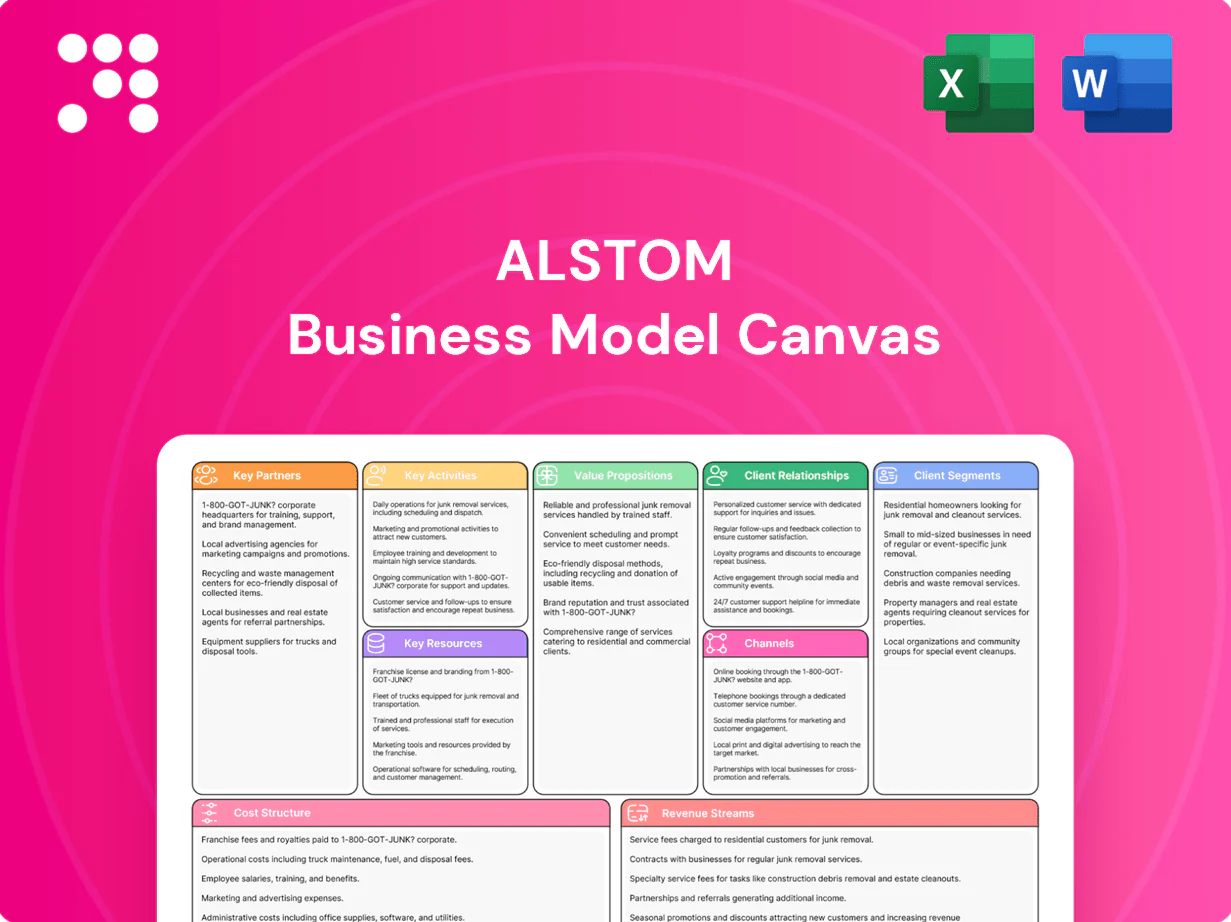
Alstom Business Model Canvas

Explore a rail industry's strategic Business Model Canvas in a concise 4-sentence snapshot
Discover Alstom’s strategic blueprint with a concise Business Model Canvas that maps its value propositions, key partners, revenue streams and competitive advantages. This 4-sentence snapshot teases actionable insights—purchase the full, editable Canvas to access all nine blocks, data-driven analysis and ready-to-use Word/Excel templates for benchmarking, strategy or investor work.
Partnerships

Public transport authorities & governments
Public transport authorities and governments are core partners for procurement, regulation and network access at national and city levels, with public procurement accounting for the majority (>50%) of rolling-stock demand. They define technical specs, safety standards and long-term mobility targets, often via multi-year frameworks of 5–10 years. Close alignment enables funding, permits and policy support for sustainable transport; Alstom employed about 70,000 people in 2024.
Infrastructure & civil engineering firms
Collaborating with infrastructure and civil engineering firms on turnkey projects for tracks, depots, power and stations enables Alstom to integrate delivery across scopes and timelines. Integration with EPC partners ensures on-time, on-budget delivery and shared risk while joint planning de-risks interfaces between rolling stock, signaling and infrastructure. Forming consortia boosts competitiveness on complex mega-projects.

Technology & digital providers
Alstom partners with signaling, telecoms, cybersecurity, AI and cloud providers to ensure interoperability with ETCS, CBTC, 5G and IoT ecosystems. These partnerships accelerate innovation cycles and reduce development costs by leveraging shared R&D and platforms. In 2024 Alstom employed about 75,000 people, scaling digital rollouts. Outcomes include enhanced safety, predictive maintenance and improved passenger experience.

Component & subsystem suppliers
Alstom pursues strategic sourcing for traction, bogies, braking, HVAC, batteries and interiors to control supplier cost and performance; procurement accounted for over 50% of industrial costs while group revenue was about €16.2bn in 2023/24. Dual-sourcing and local partners boost resilience and regulatory compliance; quality suppliers reduce lifecycle costs and co-engineering accelerates time-to-market and certification.
- Strategic sourcing: traction, bogies, brakes, HVAC, batteries, interiors
- Procurement weight: >50% of industrial cost
- Dual-sourcing/localization: resilience + compliance
- Quality partners: lower lifecycle costs, higher reliability
- Co-engineering: faster market entry, simpler certification
Financiers & PPP/lease partners
Financiers including banks, ECAs and lessors and PPP developers enable affordable procurement by offering ECA-backed loans (often covering up to 85% of contract value) and multi-year leases (typical terms 10–25 years), widening Alstom's addressable market to OPEX-focused operators. Structured finance packages increase bids won in capital-intensive projects through risk-sharing and balance-sheet-friendly OPEX models, while long-term leases secure recurring service and maintenance revenues.
- Banks: project loans, syndication
- ECAs: export cover up to 85%
- Lessors: 10–25 year leases
- PPP developers: risk-sharing, OPEX models
Public authorities, financiers and tech partners accelerate turnkey rail deliveries
Public transport authorities (>50% rolling-stock demand) set specs and funding; Alstom ~75,000 employees in 2024. EPC and civil partners enable turnkey delivery and risk sharing. Signaling/telecom/cloud partners speed digital services and predictive maintenance. Financiers/ECAs (export cover up to 85%) and lessors (10–25y) expand market access.
| Partner | Key metric | 2023/24 |
|---|---|---|
| Alstom group | Revenue / employees | €16.2bn / ~75,000 |
What is included in the product
 Detailed Word Document
A concise, pre-written Business Model Canvas for Alstom detailing nine blocks—customer segments, value propositions, channels, relationships, revenue streams, key resources, activities, partners, and cost structure—aligned with real-world rail mobility operations and strategic growth priorities for presentations and investor review.

 Customizable Excel Spreadsheet
Condenses Alstom’s complex rail and mobility strategy into a digestible, editable one-page canvas for quick review and team collaboration.
Activities

R&D and systems engineering
Design of rolling stock, signaling and digital platforms focuses on operational efficiency and safety, supported by Alstom’s ~€600m annual R&D investment and a 2024 workforce of ~75,000 across 70+ countries.
Modular architectures enable customization and scalability, shortening time-to-market and lowering unit costs within a global backlog near €70bn (2024).
Certification and validation comply with stringent international standards; continuous innovation targets lower energy use and reduced lifecycle costs.
Manufacturing & assembly
Global plants across over 120 manufacturing sites produce carshells, bogies and integrated trainsets, combining regional assembly with standardized modules. Lean operations and localization reduce costs and meet local content requirements for major contracts. End-of-line testing—performed on every trainset—ensures safety, reliability and regulatory compliance. Tight supply-chain orchestration keeps multi-country builds on schedule and protects delivery milestones.

Project management & turnkey delivery
Manage complex, multi-stakeholder programs from bid to commissioning, leveraging Alstom’s global footprint in 70 countries to coordinate suppliers and customers. Interface control across infrastructure, rolling stock and signaling is enforced through integrated engineering baselines. Rigorous risk, cost and schedule governance targets predictable outcomes and reduced variance. Formal handover processes certify operational readiness and safety for service entry.

Maintenance & lifecycle services
Preventive and predictive maintenance maximize fleet availability, with industry studies showing predictive approaches can reduce unplanned downtime by up to 50% and maintenance costs by ~20%. Spare parts, scheduled overhauls and mid-life upgrades extend asset life and retain residual value. Remote diagnostics cut time-to-fix and service costs through faster fault resolution. Performance-based contracts align Alstom incentives with operator KPIs and availability targets.
- Reduce downtime: -50% (predictive)
- Lower costs: -20% (maintenance)
- Extend life: overhauls & upgrades
- Align incentives: performance contracts
Digital integration & signaling deployment
- ETCS/CBTC capacity +20–30%
- Headway reduction up to 30%
- Energy savings 10–15%
- Asset life extension 10–15%
- Annual performance gain 5–10%
Modular rail platforms: €600m R&D, €70bn backlog, +20–30% capacity
Design and R&D (€600m, 2024) develop modular rolling stock, signaling and digital platforms from a 75,000-strong workforce across 70+ countries.
Global manufacturing (120+ sites) and standardized modules cut time-to-market and lower unit costs; backlog ~€70bn (2024).
Program management, certification and testing ensure on-time delivery and regulatory compliance.
Predictive maintenance, ETCS/CBTC and data platforms boost availability and cut energy and OPEX.
| Metric | 2024 |
|---|---|
| R&D spend | €600m |
| Workforce | ~75,000 |
| Backlog | ~€70bn |
| Manufacturing sites | 120+ |
| Predictive downtime | -50% |
| Maintenance cost | -20% |
| ETCS/CBTC capacity | +20–30% |
Full Document Unlocks After Purchase
Business Model Canvas
The Alstom Business Model Canvas shown here is a true preview of the final deliverable, not a mockup. When you purchase, you’ll receive this exact document—complete and ready to use—in editable Word and Excel formats. The structure, content, and layout will match what you see here, with no hidden sections or placeholders.

Explore a rail industry's strategic Business Model Canvas in a concise 4-sentence snapshot
Discover Alstom’s strategic blueprint with a concise Business Model Canvas that maps its value propositions, key partners, revenue streams and competitive advantages. This 4-sentence snapshot teases actionable insights—purchase the full, editable Canvas to access all nine blocks, data-driven analysis and ready-to-use Word/Excel templates for benchmarking, strategy or investor work.
Partnerships
Public transport authorities & governments
Public transport authorities and governments are core partners for procurement, regulation and network access at national and city levels, with public procurement accounting for the majority (>50%) of rolling-stock demand. They define technical specs, safety standards and long-term mobility targets, often via multi-year frameworks of 5–10 years. Close alignment enables funding, permits and policy support for sustainable transport; Alstom employed about 70,000 people in 2024.
Infrastructure & civil engineering firms
Collaborating with infrastructure and civil engineering firms on turnkey projects for tracks, depots, power and stations enables Alstom to integrate delivery across scopes and timelines. Integration with EPC partners ensures on-time, on-budget delivery and shared risk while joint planning de-risks interfaces between rolling stock, signaling and infrastructure. Forming consortia boosts competitiveness on complex mega-projects.
Technology & digital providers
Alstom partners with signaling, telecoms, cybersecurity, AI and cloud providers to ensure interoperability with ETCS, CBTC, 5G and IoT ecosystems. These partnerships accelerate innovation cycles and reduce development costs by leveraging shared R&D and platforms. In 2024 Alstom employed about 75,000 people, scaling digital rollouts. Outcomes include enhanced safety, predictive maintenance and improved passenger experience.
Component & subsystem suppliers
Alstom pursues strategic sourcing for traction, bogies, braking, HVAC, batteries and interiors to control supplier cost and performance; procurement accounted for over 50% of industrial costs while group revenue was about €16.2bn in 2023/24. Dual-sourcing and local partners boost resilience and regulatory compliance; quality suppliers reduce lifecycle costs and co-engineering accelerates time-to-market and certification.
- Strategic sourcing: traction, bogies, brakes, HVAC, batteries, interiors
- Procurement weight: >50% of industrial cost
- Dual-sourcing/localization: resilience + compliance
- Quality partners: lower lifecycle costs, higher reliability
- Co-engineering: faster market entry, simpler certification
Financiers & PPP/lease partners
Financiers including banks, ECAs and lessors and PPP developers enable affordable procurement by offering ECA-backed loans (often covering up to 85% of contract value) and multi-year leases (typical terms 10–25 years), widening Alstom's addressable market to OPEX-focused operators. Structured finance packages increase bids won in capital-intensive projects through risk-sharing and balance-sheet-friendly OPEX models, while long-term leases secure recurring service and maintenance revenues.
- Banks: project loans, syndication
- ECAs: export cover up to 85%
- Lessors: 10–25 year leases
- PPP developers: risk-sharing, OPEX models
Public authorities, financiers and tech partners accelerate turnkey rail deliveries
Public transport authorities (>50% rolling-stock demand) set specs and funding; Alstom ~75,000 employees in 2024. EPC and civil partners enable turnkey delivery and risk sharing. Signaling/telecom/cloud partners speed digital services and predictive maintenance. Financiers/ECAs (export cover up to 85%) and lessors (10–25y) expand market access.
| Partner | Key metric | 2023/24 |
|---|---|---|
| Alstom group | Revenue / employees | €16.2bn / ~75,000 |
What is included in the product
Detailed Word Document
A concise, pre-written Business Model Canvas for Alstom detailing nine blocks—customer segments, value propositions, channels, relationships, revenue streams, key resources, activities, partners, and cost structure—aligned with real-world rail mobility operations and strategic growth priorities for presentations and investor review.
Customizable Excel Spreadsheet
Condenses Alstom’s complex rail and mobility strategy into a digestible, editable one-page canvas for quick review and team collaboration.
Activities
R&D and systems engineering
Design of rolling stock, signaling and digital platforms focuses on operational efficiency and safety, supported by Alstom’s ~€600m annual R&D investment and a 2024 workforce of ~75,000 across 70+ countries.
Modular architectures enable customization and scalability, shortening time-to-market and lowering unit costs within a global backlog near €70bn (2024).
Certification and validation comply with stringent international standards; continuous innovation targets lower energy use and reduced lifecycle costs.
Manufacturing & assembly
Global plants across over 120 manufacturing sites produce carshells, bogies and integrated trainsets, combining regional assembly with standardized modules. Lean operations and localization reduce costs and meet local content requirements for major contracts. End-of-line testing—performed on every trainset—ensures safety, reliability and regulatory compliance. Tight supply-chain orchestration keeps multi-country builds on schedule and protects delivery milestones.
Project management & turnkey delivery
Manage complex, multi-stakeholder programs from bid to commissioning, leveraging Alstom’s global footprint in 70 countries to coordinate suppliers and customers. Interface control across infrastructure, rolling stock and signaling is enforced through integrated engineering baselines. Rigorous risk, cost and schedule governance targets predictable outcomes and reduced variance. Formal handover processes certify operational readiness and safety for service entry.
Maintenance & lifecycle services
Preventive and predictive maintenance maximize fleet availability, with industry studies showing predictive approaches can reduce unplanned downtime by up to 50% and maintenance costs by ~20%. Spare parts, scheduled overhauls and mid-life upgrades extend asset life and retain residual value. Remote diagnostics cut time-to-fix and service costs through faster fault resolution. Performance-based contracts align Alstom incentives with operator KPIs and availability targets.
- Reduce downtime: -50% (predictive)
- Lower costs: -20% (maintenance)
- Extend life: overhauls & upgrades
- Align incentives: performance contracts
Digital integration & signaling deployment
- ETCS/CBTC capacity +20–30%
- Headway reduction up to 30%
- Energy savings 10–15%
- Asset life extension 10–15%
- Annual performance gain 5–10%
Modular rail platforms: €600m R&D, €70bn backlog, +20–30% capacity
Design and R&D (€600m, 2024) develop modular rolling stock, signaling and digital platforms from a 75,000-strong workforce across 70+ countries.
Global manufacturing (120+ sites) and standardized modules cut time-to-market and lower unit costs; backlog ~€70bn (2024).
Program management, certification and testing ensure on-time delivery and regulatory compliance.
Predictive maintenance, ETCS/CBTC and data platforms boost availability and cut energy and OPEX.
| Metric | 2024 |
|---|---|
| R&D spend | €600m |
| Workforce | ~75,000 |
| Backlog | ~€70bn |
| Manufacturing sites | 120+ |
| Predictive downtime | -50% |
| Maintenance cost | -20% |
| ETCS/CBTC capacity | +20–30% |
Full Document Unlocks After Purchase
Business Model Canvas
The Alstom Business Model Canvas shown here is a true preview of the final deliverable, not a mockup. When you purchase, you’ll receive this exact document—complete and ready to use—in editable Word and Excel formats. The structure, content, and layout will match what you see here, with no hidden sections or placeholders.
Original: $10.00
-65%$10.00
$3.50Description
Explore a rail industry's strategic Business Model Canvas in a concise 4-sentence snapshot
Discover Alstom’s strategic blueprint with a concise Business Model Canvas that maps its value propositions, key partners, revenue streams and competitive advantages. This 4-sentence snapshot teases actionable insights—purchase the full, editable Canvas to access all nine blocks, data-driven analysis and ready-to-use Word/Excel templates for benchmarking, strategy or investor work.
Partnerships
Public transport authorities & governments
Public transport authorities and governments are core partners for procurement, regulation and network access at national and city levels, with public procurement accounting for the majority (>50%) of rolling-stock demand. They define technical specs, safety standards and long-term mobility targets, often via multi-year frameworks of 5–10 years. Close alignment enables funding, permits and policy support for sustainable transport; Alstom employed about 70,000 people in 2024.
Infrastructure & civil engineering firms
Collaborating with infrastructure and civil engineering firms on turnkey projects for tracks, depots, power and stations enables Alstom to integrate delivery across scopes and timelines. Integration with EPC partners ensures on-time, on-budget delivery and shared risk while joint planning de-risks interfaces between rolling stock, signaling and infrastructure. Forming consortia boosts competitiveness on complex mega-projects.
Technology & digital providers
Alstom partners with signaling, telecoms, cybersecurity, AI and cloud providers to ensure interoperability with ETCS, CBTC, 5G and IoT ecosystems. These partnerships accelerate innovation cycles and reduce development costs by leveraging shared R&D and platforms. In 2024 Alstom employed about 75,000 people, scaling digital rollouts. Outcomes include enhanced safety, predictive maintenance and improved passenger experience.
Component & subsystem suppliers
Alstom pursues strategic sourcing for traction, bogies, braking, HVAC, batteries and interiors to control supplier cost and performance; procurement accounted for over 50% of industrial costs while group revenue was about €16.2bn in 2023/24. Dual-sourcing and local partners boost resilience and regulatory compliance; quality suppliers reduce lifecycle costs and co-engineering accelerates time-to-market and certification.
- Strategic sourcing: traction, bogies, brakes, HVAC, batteries, interiors
- Procurement weight: >50% of industrial cost
- Dual-sourcing/localization: resilience + compliance
- Quality partners: lower lifecycle costs, higher reliability
- Co-engineering: faster market entry, simpler certification
Financiers & PPP/lease partners
Financiers including banks, ECAs and lessors and PPP developers enable affordable procurement by offering ECA-backed loans (often covering up to 85% of contract value) and multi-year leases (typical terms 10–25 years), widening Alstom's addressable market to OPEX-focused operators. Structured finance packages increase bids won in capital-intensive projects through risk-sharing and balance-sheet-friendly OPEX models, while long-term leases secure recurring service and maintenance revenues.
- Banks: project loans, syndication
- ECAs: export cover up to 85%
- Lessors: 10–25 year leases
- PPP developers: risk-sharing, OPEX models
Public authorities, financiers and tech partners accelerate turnkey rail deliveries
Public transport authorities (>50% rolling-stock demand) set specs and funding; Alstom ~75,000 employees in 2024. EPC and civil partners enable turnkey delivery and risk sharing. Signaling/telecom/cloud partners speed digital services and predictive maintenance. Financiers/ECAs (export cover up to 85%) and lessors (10–25y) expand market access.
| Partner | Key metric | 2023/24 |
|---|---|---|
| Alstom group | Revenue / employees | €16.2bn / ~75,000 |
What is included in the product
Detailed Word Document
A concise, pre-written Business Model Canvas for Alstom detailing nine blocks—customer segments, value propositions, channels, relationships, revenue streams, key resources, activities, partners, and cost structure—aligned with real-world rail mobility operations and strategic growth priorities for presentations and investor review.
Customizable Excel Spreadsheet
Condenses Alstom’s complex rail and mobility strategy into a digestible, editable one-page canvas for quick review and team collaboration.
Activities
R&D and systems engineering
Design of rolling stock, signaling and digital platforms focuses on operational efficiency and safety, supported by Alstom’s ~€600m annual R&D investment and a 2024 workforce of ~75,000 across 70+ countries.
Modular architectures enable customization and scalability, shortening time-to-market and lowering unit costs within a global backlog near €70bn (2024).
Certification and validation comply with stringent international standards; continuous innovation targets lower energy use and reduced lifecycle costs.
Manufacturing & assembly
Global plants across over 120 manufacturing sites produce carshells, bogies and integrated trainsets, combining regional assembly with standardized modules. Lean operations and localization reduce costs and meet local content requirements for major contracts. End-of-line testing—performed on every trainset—ensures safety, reliability and regulatory compliance. Tight supply-chain orchestration keeps multi-country builds on schedule and protects delivery milestones.
Project management & turnkey delivery
Manage complex, multi-stakeholder programs from bid to commissioning, leveraging Alstom’s global footprint in 70 countries to coordinate suppliers and customers. Interface control across infrastructure, rolling stock and signaling is enforced through integrated engineering baselines. Rigorous risk, cost and schedule governance targets predictable outcomes and reduced variance. Formal handover processes certify operational readiness and safety for service entry.
Maintenance & lifecycle services
Preventive and predictive maintenance maximize fleet availability, with industry studies showing predictive approaches can reduce unplanned downtime by up to 50% and maintenance costs by ~20%. Spare parts, scheduled overhauls and mid-life upgrades extend asset life and retain residual value. Remote diagnostics cut time-to-fix and service costs through faster fault resolution. Performance-based contracts align Alstom incentives with operator KPIs and availability targets.
- Reduce downtime: -50% (predictive)
- Lower costs: -20% (maintenance)
- Extend life: overhauls & upgrades
- Align incentives: performance contracts
Digital integration & signaling deployment
- ETCS/CBTC capacity +20–30%
- Headway reduction up to 30%
- Energy savings 10–15%
- Asset life extension 10–15%
- Annual performance gain 5–10%
Modular rail platforms: €600m R&D, €70bn backlog, +20–30% capacity
Design and R&D (€600m, 2024) develop modular rolling stock, signaling and digital platforms from a 75,000-strong workforce across 70+ countries.
Global manufacturing (120+ sites) and standardized modules cut time-to-market and lower unit costs; backlog ~€70bn (2024).
Program management, certification and testing ensure on-time delivery and regulatory compliance.
Predictive maintenance, ETCS/CBTC and data platforms boost availability and cut energy and OPEX.
| Metric | 2024 |
|---|---|
| R&D spend | €600m |
| Workforce | ~75,000 |
| Backlog | ~€70bn |
| Manufacturing sites | 120+ |
| Predictive downtime | -50% |
| Maintenance cost | -20% |
| ETCS/CBTC capacity | +20–30% |
Full Document Unlocks After Purchase
Business Model Canvas
The Alstom Business Model Canvas shown here is a true preview of the final deliverable, not a mockup. When you purchase, you’ll receive this exact document—complete and ready to use—in editable Word and Excel formats. The structure, content, and layout will match what you see here, with no hidden sections or placeholders.











