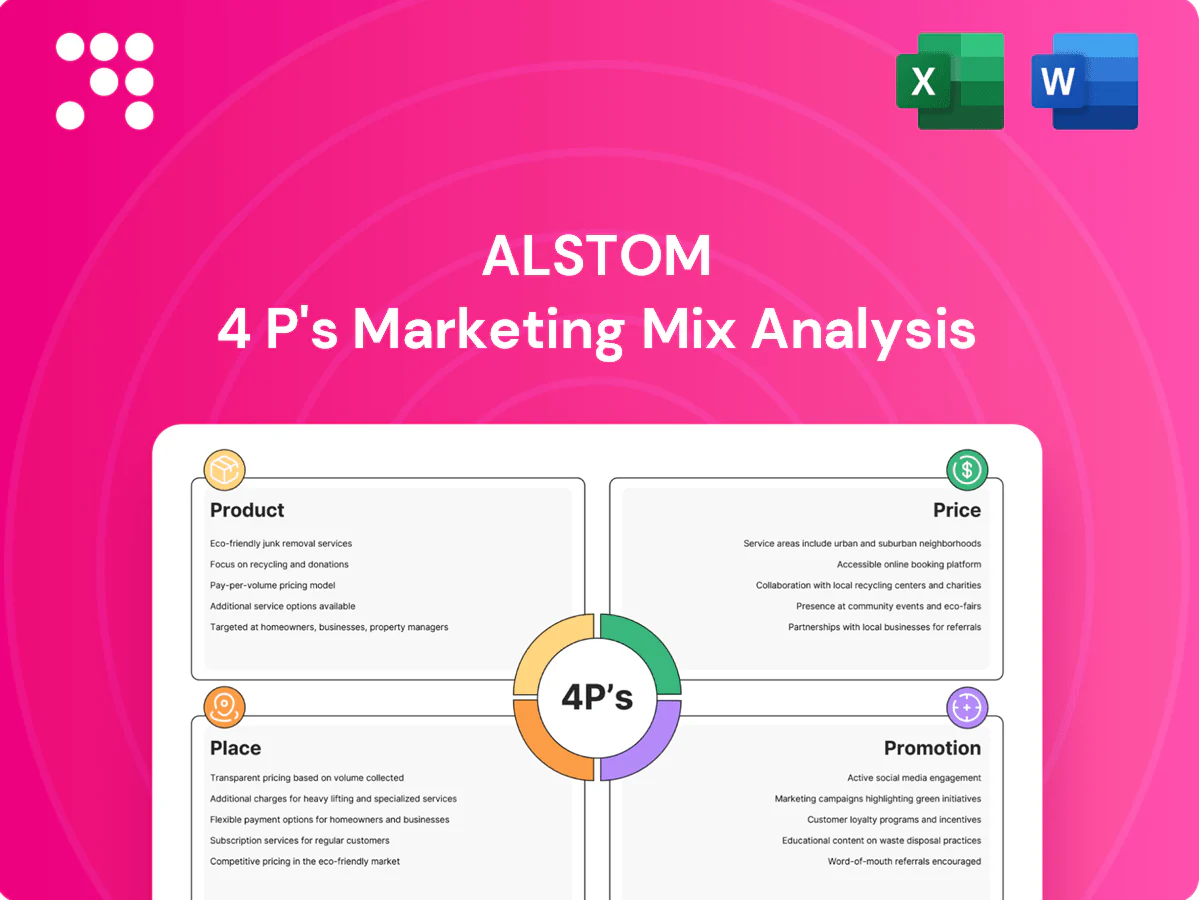
Alstom Marketing Mix

Go Beyond the Snapshot—Get the Full Strategy
Discover how Alstom’s Product innovation, strategic Pricing, global Place network, and targeted Promotion combine to drive rail-sector leadership. This concise 4P review highlights strengths, gaps, and competitive levers. Want the full, editable Marketing Mix Analysis with data, examples, and presentation-ready insights? Purchase the complete report to save research time and apply proven strategies.
Product

Integrated rolling stock portfolio
High-speed trains, metros, trams and monorails form Alstom’s modular suite tailored to city and intercity needs, supported by an order backlog above €50bn (2024). Designs prioritize reliability, passenger comfort and capacity optimization, with Avelia/Coradia-based platforms enabling platform commonality to speed delivery and reduce costs. Custom configurations address accessibility, safety and regulatory standards across markets.
Signaling and digital solutions
ETCS, CBTC and interlocking systems (ERTMS/CBTC) enhance safety and throughput—CBTC can enable headways as low as 90 seconds, boosting capacity by up to ~30% on metro lines. Digital platforms deliver fleet management, traffic control and predictive decision support; predictive maintenance programs commonly cut failures by ~25%. Robust cybersecurity and interoperability enable integration with legacy assets, while regular software updates extend functionality and protect customer investments.

Services and lifecycle support
Alstom services—maintenance, overhauls, spare parts and technical support—are structured to maximize uptime, with long-term service agreements tying fees to performance and availability targets (often >99%). Condition‑based and predictive maintenance can cut maintenance costs by up to 40% and unplanned failures by as much as 70%. Training, documentation and on‑site teams drive operational reliability and faster MTTR.

Sustainable, energy-efficient design
Sustainable, energy-efficient design uses lightweight materials and regenerative braking to cut traction energy by up to 30% and vehicle energy demand by around 10–15%, while eco-design lowers lifecycle emissions. Circularity initiatives enable refurbishment and component recycling, extending asset life and reducing material costs. Noise reduction and energy management systems improve urban livability; Alstom sites hold ISO 14001 environmental certification supporting customers’ sustainability targets.
- regenerative braking: up to 30% energy recovery
- lightweight materials: ~10–15% operational energy reduction
- circularity: refurbishment and component recycling
- certification: ISO 14001 for environmental management
Turnkey systems integration
Turnkey systems integration delivers end-to-end delivery across rolling stock, signaling, power and infrastructure, with Alstom reporting circa €18.2bn revenue in FY 2024 underpinning large-scale program capacity. Centralized project management, engineering and commissioning reduce program risk and speed delivery; standardized interfaces cut integration time by enabling modular scaling. Solutions are tailored to geography, ridership and policy requirements.
- Scope: rolling stock, signaling, power, infrastructure
- Capability: project management to commissioning
- Benefit: standardized interfaces for faster scaling
- Tailoring: geography, ridership, policy alignment
Modular rail wins: €50bn+, >99% availability
Alstom’s product portfolio—high‑speed trains, metros, trams, signalling and turnkey systems—focuses on reliability, modular platforms and sustainability, supported by a >€50bn order backlog (2024). Digital and ETCS/CBTC solutions raise capacity and cut failures via predictive maintenance. Services attach to performance‑linked contracts delivering >99% availability.
| Metric | Value |
|---|---|
| Order backlog (2024) | €50bn+ |
| FY24 revenue | €18.2bn |
| Energy recovery | up to 30% |
What is included in the product
 Detailed Word Document
Delivers a professionally written, company-specific deep dive into Alstom’s Product, Price, Place, and Promotion strategies, grounded in real brand practices and competitive context; formatted for easy use in reports, workshops, and strategic benchmarking.

 Customizable Excel Spreadsheet
Condenses Alstom’s 4P marketing mix into a concise, at-a-glance summary that resolves stakeholder misalignment and speeds decision-making. Designed for leadership briefings or workshops, it’s an easily customizable one-pager to communicate strategic direction and compare brands side-by-side.
Place

Global manufacturing footprint
Alstom's global manufacturing footprint spans 70+ plants and engineering centers across Europe, Asia, the Americas and Africa, operating in over 70 countries with ~75,000 employees. Distributed capacity shortens lead times, reduces transport costs and mitigates risk, supporting annual revenues above €16bn. Local testing and commissioning facilities speed approvals, while regional expertise ensures compliance with local standards.
Local partnerships and JVs
Collaborations with domestic manufacturers and suppliers drive localization in Alstom bids, leveraging its post-Bombardier footprint across 70+ countries and ~75,000 employees (2024) to source local content. Joint ventures meet mandated local-content thresholds and enable skills transfer through shared management and training programs. Co-production and shared facilities boost political acceptance and bid competitiveness while anchoring long-term service presence and spare-parts supply.

Project delivery and deployment
EPC capabilities coordinate civil works, power and systems installation to deliver integrated infrastructure packages. Staged delivery aligns rollouts with network readiness and funding milestones to minimize operational disruption. On-site commissioning teams manage trials and formal acceptance, while robust HSE and quality systems ensure safe, reliable deployments.

Aftermarket service network
Alstom’s aftermarket service network combines depot operations, mobile teams and regional spare-parts hubs to ensure rapid response across 70+ countries; remote diagnostics centers monitor fleets continuously, while SLA-driven support targets defined availability levels and local inventories cut downtime and logistics costs (2024 operations).
- Depot + mobile teams = faster MTTR
- Remote diagnostics = 24/7 fleet monitoring
- SLA-driven KPIs align availability
- Local inventories lower downtime & transport cost
Supply chain and localization
Alstom leverages multi-tier supplier networks to balance global scale with local sourcing across 70+ countries, using dual-sourcing and standardized components to enhance resilience and reduce lead-time risk. Localized content is tailored to meet policy and tender criteria, while supplier development programs have improved on-time delivery and quality across key regions.
- Multi-tier networks: 70+ countries
- Resilience: dual-sourcing + standard components
- Local content: tender/policy compliance
- Supplier programs: uplift delivery & quality
Global footprint shortens lead times, lowers transport costs and supports €16bn+ revenue
Alstom's distributed footprint (70+ plants/centers in 70+ countries) shortens lead times, cuts transport costs and mitigates delivery risk, supporting revenues above €16bn and ~75,000 employees (2024). Local JVs and supplier development enable tender-compliant local content and faster commissioning. Aftermarket hubs, depot + mobile teams and 24/7 remote diagnostics sustain high fleet availability.
| Metric | Value |
|---|---|
| Countries | 70+ |
| Plants & centers | 70+ |
| Employees (2024) | ~75,000 |
| Revenue (2024) | >€16bn |
Preview the Actual Deliverable
Alstom 4P's Marketing Mix Analysis
Alstom’s 4P marketing mix emphasizes advanced rolling stock and services (Product), value-based and contract pricing (Price), global supply chain and strategic rail networks (Place), and B2B stakeholder, trade expo and digital infrastructure promotion (Promotion). Targeting transit authorities, operators and governments. You’re viewing the exact version of the analysis you'll receive—fully complete, ready to use.

Go Beyond the Snapshot—Get the Full Strategy
Discover how Alstom’s Product innovation, strategic Pricing, global Place network, and targeted Promotion combine to drive rail-sector leadership. This concise 4P review highlights strengths, gaps, and competitive levers. Want the full, editable Marketing Mix Analysis with data, examples, and presentation-ready insights? Purchase the complete report to save research time and apply proven strategies.
Product
Integrated rolling stock portfolio
High-speed trains, metros, trams and monorails form Alstom’s modular suite tailored to city and intercity needs, supported by an order backlog above €50bn (2024). Designs prioritize reliability, passenger comfort and capacity optimization, with Avelia/Coradia-based platforms enabling platform commonality to speed delivery and reduce costs. Custom configurations address accessibility, safety and regulatory standards across markets.
Signaling and digital solutions
ETCS, CBTC and interlocking systems (ERTMS/CBTC) enhance safety and throughput—CBTC can enable headways as low as 90 seconds, boosting capacity by up to ~30% on metro lines. Digital platforms deliver fleet management, traffic control and predictive decision support; predictive maintenance programs commonly cut failures by ~25%. Robust cybersecurity and interoperability enable integration with legacy assets, while regular software updates extend functionality and protect customer investments.
Services and lifecycle support
Alstom services—maintenance, overhauls, spare parts and technical support—are structured to maximize uptime, with long-term service agreements tying fees to performance and availability targets (often >99%). Condition‑based and predictive maintenance can cut maintenance costs by up to 40% and unplanned failures by as much as 70%. Training, documentation and on‑site teams drive operational reliability and faster MTTR.
Sustainable, energy-efficient design
Sustainable, energy-efficient design uses lightweight materials and regenerative braking to cut traction energy by up to 30% and vehicle energy demand by around 10–15%, while eco-design lowers lifecycle emissions. Circularity initiatives enable refurbishment and component recycling, extending asset life and reducing material costs. Noise reduction and energy management systems improve urban livability; Alstom sites hold ISO 14001 environmental certification supporting customers’ sustainability targets.
- regenerative braking: up to 30% energy recovery
- lightweight materials: ~10–15% operational energy reduction
- circularity: refurbishment and component recycling
- certification: ISO 14001 for environmental management
Turnkey systems integration
Turnkey systems integration delivers end-to-end delivery across rolling stock, signaling, power and infrastructure, with Alstom reporting circa €18.2bn revenue in FY 2024 underpinning large-scale program capacity. Centralized project management, engineering and commissioning reduce program risk and speed delivery; standardized interfaces cut integration time by enabling modular scaling. Solutions are tailored to geography, ridership and policy requirements.
- Scope: rolling stock, signaling, power, infrastructure
- Capability: project management to commissioning
- Benefit: standardized interfaces for faster scaling
- Tailoring: geography, ridership, policy alignment
Modular rail wins: €50bn+, >99% availability
Alstom’s product portfolio—high‑speed trains, metros, trams, signalling and turnkey systems—focuses on reliability, modular platforms and sustainability, supported by a >€50bn order backlog (2024). Digital and ETCS/CBTC solutions raise capacity and cut failures via predictive maintenance. Services attach to performance‑linked contracts delivering >99% availability.
| Metric | Value |
|---|---|
| Order backlog (2024) | €50bn+ |
| FY24 revenue | €18.2bn |
| Energy recovery | up to 30% |
What is included in the product
Detailed Word Document
Delivers a professionally written, company-specific deep dive into Alstom’s Product, Price, Place, and Promotion strategies, grounded in real brand practices and competitive context; formatted for easy use in reports, workshops, and strategic benchmarking.
Customizable Excel Spreadsheet
Condenses Alstom’s 4P marketing mix into a concise, at-a-glance summary that resolves stakeholder misalignment and speeds decision-making. Designed for leadership briefings or workshops, it’s an easily customizable one-pager to communicate strategic direction and compare brands side-by-side.
Place
Global manufacturing footprint
Alstom's global manufacturing footprint spans 70+ plants and engineering centers across Europe, Asia, the Americas and Africa, operating in over 70 countries with ~75,000 employees. Distributed capacity shortens lead times, reduces transport costs and mitigates risk, supporting annual revenues above €16bn. Local testing and commissioning facilities speed approvals, while regional expertise ensures compliance with local standards.
Local partnerships and JVs
Collaborations with domestic manufacturers and suppliers drive localization in Alstom bids, leveraging its post-Bombardier footprint across 70+ countries and ~75,000 employees (2024) to source local content. Joint ventures meet mandated local-content thresholds and enable skills transfer through shared management and training programs. Co-production and shared facilities boost political acceptance and bid competitiveness while anchoring long-term service presence and spare-parts supply.
Project delivery and deployment
EPC capabilities coordinate civil works, power and systems installation to deliver integrated infrastructure packages. Staged delivery aligns rollouts with network readiness and funding milestones to minimize operational disruption. On-site commissioning teams manage trials and formal acceptance, while robust HSE and quality systems ensure safe, reliable deployments.
Aftermarket service network
Alstom’s aftermarket service network combines depot operations, mobile teams and regional spare-parts hubs to ensure rapid response across 70+ countries; remote diagnostics centers monitor fleets continuously, while SLA-driven support targets defined availability levels and local inventories cut downtime and logistics costs (2024 operations).
- Depot + mobile teams = faster MTTR
- Remote diagnostics = 24/7 fleet monitoring
- SLA-driven KPIs align availability
- Local inventories lower downtime & transport cost
Supply chain and localization
Alstom leverages multi-tier supplier networks to balance global scale with local sourcing across 70+ countries, using dual-sourcing and standardized components to enhance resilience and reduce lead-time risk. Localized content is tailored to meet policy and tender criteria, while supplier development programs have improved on-time delivery and quality across key regions.
- Multi-tier networks: 70+ countries
- Resilience: dual-sourcing + standard components
- Local content: tender/policy compliance
- Supplier programs: uplift delivery & quality
Global footprint shortens lead times, lowers transport costs and supports €16bn+ revenue
Alstom's distributed footprint (70+ plants/centers in 70+ countries) shortens lead times, cuts transport costs and mitigates delivery risk, supporting revenues above €16bn and ~75,000 employees (2024). Local JVs and supplier development enable tender-compliant local content and faster commissioning. Aftermarket hubs, depot + mobile teams and 24/7 remote diagnostics sustain high fleet availability.
| Metric | Value |
|---|---|
| Countries | 70+ |
| Plants & centers | 70+ |
| Employees (2024) | ~75,000 |
| Revenue (2024) | >€16bn |
Preview the Actual Deliverable
Alstom 4P's Marketing Mix Analysis
Alstom’s 4P marketing mix emphasizes advanced rolling stock and services (Product), value-based and contract pricing (Price), global supply chain and strategic rail networks (Place), and B2B stakeholder, trade expo and digital infrastructure promotion (Promotion). Targeting transit authorities, operators and governments. You’re viewing the exact version of the analysis you'll receive—fully complete, ready to use.
Description
Go Beyond the Snapshot—Get the Full Strategy
Discover how Alstom’s Product innovation, strategic Pricing, global Place network, and targeted Promotion combine to drive rail-sector leadership. This concise 4P review highlights strengths, gaps, and competitive levers. Want the full, editable Marketing Mix Analysis with data, examples, and presentation-ready insights? Purchase the complete report to save research time and apply proven strategies.
Product
Integrated rolling stock portfolio
High-speed trains, metros, trams and monorails form Alstom’s modular suite tailored to city and intercity needs, supported by an order backlog above €50bn (2024). Designs prioritize reliability, passenger comfort and capacity optimization, with Avelia/Coradia-based platforms enabling platform commonality to speed delivery and reduce costs. Custom configurations address accessibility, safety and regulatory standards across markets.
Signaling and digital solutions
ETCS, CBTC and interlocking systems (ERTMS/CBTC) enhance safety and throughput—CBTC can enable headways as low as 90 seconds, boosting capacity by up to ~30% on metro lines. Digital platforms deliver fleet management, traffic control and predictive decision support; predictive maintenance programs commonly cut failures by ~25%. Robust cybersecurity and interoperability enable integration with legacy assets, while regular software updates extend functionality and protect customer investments.
Services and lifecycle support
Alstom services—maintenance, overhauls, spare parts and technical support—are structured to maximize uptime, with long-term service agreements tying fees to performance and availability targets (often >99%). Condition‑based and predictive maintenance can cut maintenance costs by up to 40% and unplanned failures by as much as 70%. Training, documentation and on‑site teams drive operational reliability and faster MTTR.
Sustainable, energy-efficient design
Sustainable, energy-efficient design uses lightweight materials and regenerative braking to cut traction energy by up to 30% and vehicle energy demand by around 10–15%, while eco-design lowers lifecycle emissions. Circularity initiatives enable refurbishment and component recycling, extending asset life and reducing material costs. Noise reduction and energy management systems improve urban livability; Alstom sites hold ISO 14001 environmental certification supporting customers’ sustainability targets.
- regenerative braking: up to 30% energy recovery
- lightweight materials: ~10–15% operational energy reduction
- circularity: refurbishment and component recycling
- certification: ISO 14001 for environmental management
Turnkey systems integration
Turnkey systems integration delivers end-to-end delivery across rolling stock, signaling, power and infrastructure, with Alstom reporting circa €18.2bn revenue in FY 2024 underpinning large-scale program capacity. Centralized project management, engineering and commissioning reduce program risk and speed delivery; standardized interfaces cut integration time by enabling modular scaling. Solutions are tailored to geography, ridership and policy requirements.
- Scope: rolling stock, signaling, power, infrastructure
- Capability: project management to commissioning
- Benefit: standardized interfaces for faster scaling
- Tailoring: geography, ridership, policy alignment
Modular rail wins: €50bn+, >99% availability
Alstom’s product portfolio—high‑speed trains, metros, trams, signalling and turnkey systems—focuses on reliability, modular platforms and sustainability, supported by a >€50bn order backlog (2024). Digital and ETCS/CBTC solutions raise capacity and cut failures via predictive maintenance. Services attach to performance‑linked contracts delivering >99% availability.
| Metric | Value |
|---|---|
| Order backlog (2024) | €50bn+ |
| FY24 revenue | €18.2bn |
| Energy recovery | up to 30% |
What is included in the product
Detailed Word Document
Delivers a professionally written, company-specific deep dive into Alstom’s Product, Price, Place, and Promotion strategies, grounded in real brand practices and competitive context; formatted for easy use in reports, workshops, and strategic benchmarking.
Customizable Excel Spreadsheet
Condenses Alstom’s 4P marketing mix into a concise, at-a-glance summary that resolves stakeholder misalignment and speeds decision-making. Designed for leadership briefings or workshops, it’s an easily customizable one-pager to communicate strategic direction and compare brands side-by-side.
Place
Global manufacturing footprint
Alstom's global manufacturing footprint spans 70+ plants and engineering centers across Europe, Asia, the Americas and Africa, operating in over 70 countries with ~75,000 employees. Distributed capacity shortens lead times, reduces transport costs and mitigates risk, supporting annual revenues above €16bn. Local testing and commissioning facilities speed approvals, while regional expertise ensures compliance with local standards.
Local partnerships and JVs
Collaborations with domestic manufacturers and suppliers drive localization in Alstom bids, leveraging its post-Bombardier footprint across 70+ countries and ~75,000 employees (2024) to source local content. Joint ventures meet mandated local-content thresholds and enable skills transfer through shared management and training programs. Co-production and shared facilities boost political acceptance and bid competitiveness while anchoring long-term service presence and spare-parts supply.
Project delivery and deployment
EPC capabilities coordinate civil works, power and systems installation to deliver integrated infrastructure packages. Staged delivery aligns rollouts with network readiness and funding milestones to minimize operational disruption. On-site commissioning teams manage trials and formal acceptance, while robust HSE and quality systems ensure safe, reliable deployments.
Aftermarket service network
Alstom’s aftermarket service network combines depot operations, mobile teams and regional spare-parts hubs to ensure rapid response across 70+ countries; remote diagnostics centers monitor fleets continuously, while SLA-driven support targets defined availability levels and local inventories cut downtime and logistics costs (2024 operations).
- Depot + mobile teams = faster MTTR
- Remote diagnostics = 24/7 fleet monitoring
- SLA-driven KPIs align availability
- Local inventories lower downtime & transport cost
Supply chain and localization
Alstom leverages multi-tier supplier networks to balance global scale with local sourcing across 70+ countries, using dual-sourcing and standardized components to enhance resilience and reduce lead-time risk. Localized content is tailored to meet policy and tender criteria, while supplier development programs have improved on-time delivery and quality across key regions.
- Multi-tier networks: 70+ countries
- Resilience: dual-sourcing + standard components
- Local content: tender/policy compliance
- Supplier programs: uplift delivery & quality
Global footprint shortens lead times, lowers transport costs and supports €16bn+ revenue
Alstom's distributed footprint (70+ plants/centers in 70+ countries) shortens lead times, cuts transport costs and mitigates delivery risk, supporting revenues above €16bn and ~75,000 employees (2024). Local JVs and supplier development enable tender-compliant local content and faster commissioning. Aftermarket hubs, depot + mobile teams and 24/7 remote diagnostics sustain high fleet availability.
| Metric | Value |
|---|---|
| Countries | 70+ |
| Plants & centers | 70+ |
| Employees (2024) | ~75,000 |
| Revenue (2024) | >€16bn |
Preview the Actual Deliverable
Alstom 4P's Marketing Mix Analysis
Alstom’s 4P marketing mix emphasizes advanced rolling stock and services (Product), value-based and contract pricing (Price), global supply chain and strategic rail networks (Place), and B2B stakeholder, trade expo and digital infrastructure promotion (Promotion). Targeting transit authorities, operators and governments. You’re viewing the exact version of the analysis you'll receive—fully complete, ready to use.











