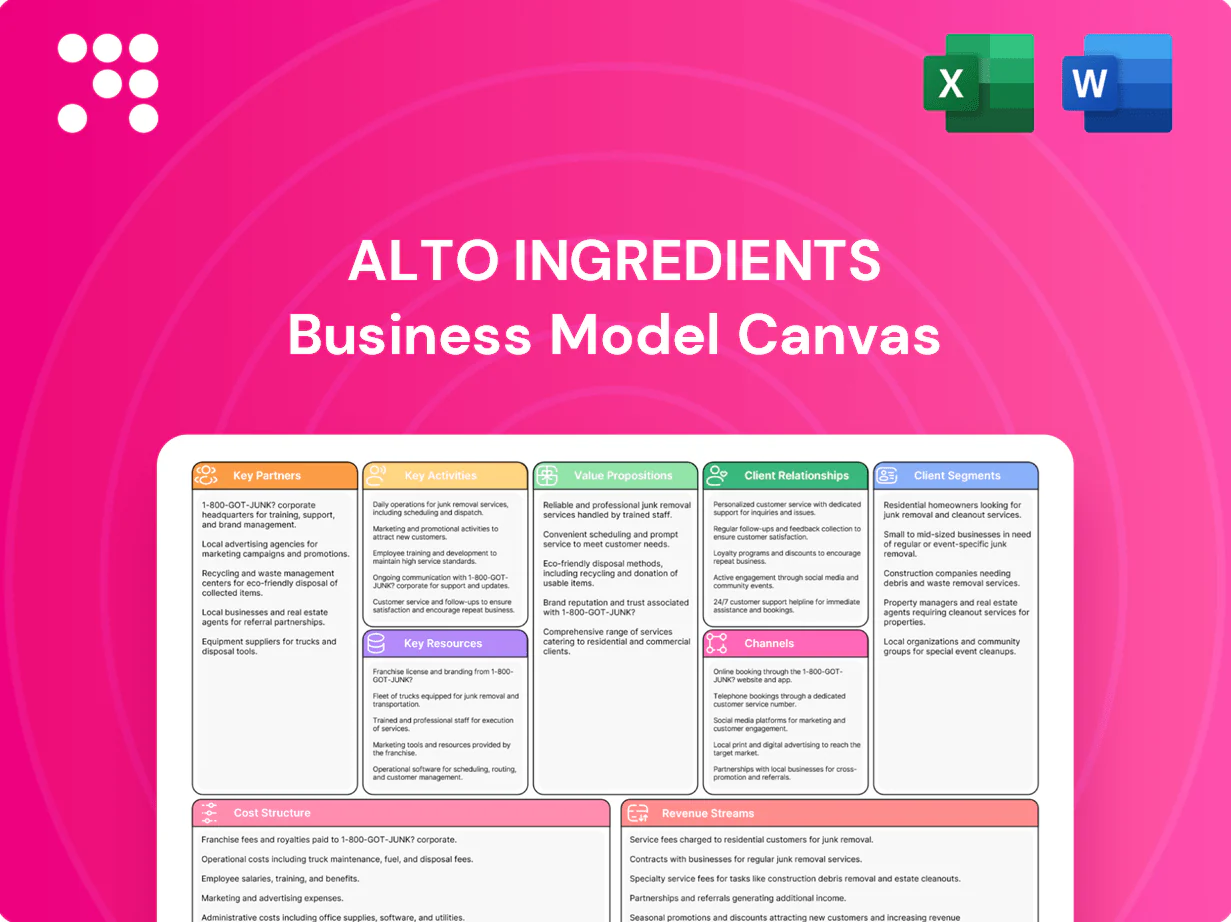
Alto Ingredients Business Model Canvas

Business Model Canvas: Strategic Blueprint for a Scalable Ingredients Company
Unlock the strategic blueprint behind Alto Ingredients with a concise Business Model Canvas that maps value propositions, customer segments, key partners, and revenue streams to show how the company scales and mitigates risk. Ideal for investors, consultants, and founders seeking actionable insight. Purchase the full Word/Excel canvas to benchmark, adapt, and accelerate your strategy.
Partnerships

Corn growers and grain elevators
Secure, high-quality corn supply underpins consistent fermentation yields and cost control for Alto Ingredients, anchored in the broader U.S. corn crop of about 13.8 billion bushels in 2023/24. Multi-year contracts stabilize input prices and reduce volatility. Traceability partnerships enable food, beverage and pharma-grade compliance. Regional elevator relationships lower logistics costs and shorten cycle times.
Logistics and distribution providers
Rail, trucking and terminal partners give Alto nationwide and export reach for bulk liquids and dry co-products, leveraging U.S. freight railroads that move roughly 40% of intercity ton-miles and trucking that handles about 72% of freight by weight. Cold-chain and hazmat-capable carriers preserve product integrity and compliance. Strategic railcar fleets and onsite storage speed shipments and improve inventory turns, while backhaul arrangements lower freight spend.

Energy and utilities suppliers
Natural gas, electricity, water, and steam partners keep Alto Ingredients plants operating and cost-competitive, with utility agreements targeting availability guarantees above 99% to limit downtime.
Demand-response programs and renewable PPAs have been shown to lower industrial energy spend by roughly 10–20% and materially reduce carbon intensity by enabling matched low-carbon supply.
Reliability contracts mitigate outage risk and shared utility data (real-time metering, interval data) supports continuous efficiency optimization and lower OPEX.

Technology, enzymes, and compliance partners
Process technology licensors and enzyme/yeast providers deliver higher yields and purity, with enzyme-driven saccharification lifts commonly cited around 10% in industry case studies in 2024; lab equipment and certification bodies ensure food, beverage and USP/FCC compliance for market access; digital MES/LIMS vendors improve traceability and QA, reducing batch deviations and recall risk; environmental consultants support permitting and LCFS/RIN documentation.
- Process licensors — yield/purity
- Enzyme/yeast suppliers — ~10% yield lift (industry 2024 case data)
- Labs/certifiers — USP/FCC/food safety
- MES/LIMS vendors — traceability/QA
- Environmental consultants — permitting, LCFS/RIN
Third-party producers and brokers
Alto Ingredients (NASDAQ: ALTO) leverages third-party producers and brokers to extend product breadth beyond owned capacity, improving fill rates and customer coverage through co-marketing. Brokers expand reach into niche geographies and end markets, while reciprocal supply agreements boost resilience during maintenance or demand spikes. These alliances support Alto's asset-light distribution strategy.
- Sourcing alliances: broaden portfolio beyond owned plants
- Co-marketing: higher fill rates and wider coverage
- Brokers: access niche geographies and end markets
- Reciprocal supply: operational resilience during outages
Multi-year corn contracts, logistics & tech partners drive 10% yield lift and stable costs
Alto secures multi‑year corn contracts (US crop 13.8B bu 2023/24) and logistics, energy and tech partners to stabilize costs, raise yields and ensure food/pharma compliance; enzyme/licensor leads ~10% saccharification lift; rail/truck reach supports national/export distribution.
| Partnership | Impact | 2024 metric |
|---|---|---|
| Corn supply | Price stability | US crop 13.8B bu (2023/24) |
| Logistics | National/export reach | Rail ~40% ton‑miles; Truck ~72% weight |
| Tech/enzyme | Yield/purity | ~10% yield lift |
| Energy | Lower OPEX/carbon | 10–20% savings |
What is included in the product
 Detailed Word Document
A concise, pre-written Business Model Canvas for Alto Ingredients outlining customer segments, channels, value propositions, revenue streams, key resources and partners across the 9 BMC blocks, reflecting its ethanol, specialty alcohols and ingredients operations. Ideal for investors and managers, it includes competitive advantages and SWOT-linked insights to support strategic decisions and funding discussions.

 Customizable Excel Spreadsheet
High-level, editable Business Model Canvas for Alto Ingredients that condenses strategy into a one-page snapshot, saving hours of structuring while enabling quick comparison, team collaboration, and fast executive deliverables.
Activities

Fermentation, distillation, and dehydration
Core production converts corn to specialty and fuel-grade alcohols at roughly 2.8 gallons per bushel. Tight control of fermentation, distillation and dehydration achieves 200 proof (99.5%) purity and consistent specs. Capacity planning balances specialty, industrial and fuel demand within a US ethanol industry producing about 15 billion gallons annually. Yield optimization—each 1% conversion gain—directly expands gross margins.
Quality assurance and certification management
QA/QC testing validates ingredient purity for food, beverage, and health applications, ensuring compliance with regulatory specs and customer requirements. As of 2024, GMP, USP, FCC, Kosher, and Halal remain recognized certifications that enable access to premium channels and higher-margin contracts. Robust batch traceability and documentation reduce audit findings and recall risk, while continuous improvement programs drive lower deviation rates and higher first-pass quality.

Supply chain and inventory optimization
Coordinating grain procurement, coproduct offtake and finished-goods balances reduces working capital and price exposure; Alto targets VMI with safety-stock coverage of 7–14 days to sustain >95% service levels. Railcar and tank scheduling cuts demurrage/detention (commonly $300–500/day per car) and improves throughput, while SIOP-driven planning boosts forecast accuracy and can shrink inventory 10–15%.

Marketing and distribution of own and third-party alcohols
Marketing and distribution of own and third-party alcohols uses multi-channel selling to expand customer access across beverage, fuel, and industrial segments. Aggregating third-party volumes boosts scale and product range, supporting margin improvement; 2024 filings highlight expanded third-party distribution initiatives. Contracting structures are used to manage price, basis, and freight risk while relationship management deepens wallet share.
- Multi-channel reach across industries
- Third-party aggregation increases scale
- Contracts hedge price/basis/freight
- Relationship management grows wallet share
Risk management and product development
In 2024 Alto deploys commodity hedging across corn, energy and ethanol to protect margins against spot volatility, while active LCFS and RIN optimization captures environmental credits and lifts realized revenue per gallon. Product development delivers tailor-made blends and denaturants for customer applications, and coproduct enhancement programs raise DDGS and corn oil value.
- hedging: corn, energy, ethanol
- credits: LCFS/RIN optimization
- products: custom blends & denaturants
- coproducts: improved DDGS & corn oil realizations
2.8 gal/bu corn conversion to ethanol for ~15B gal US market
Core operations convert corn at ~2.8 gal/bu to 200-proof alcohols, balancing specialty, industrial and fuel within a ~15B gal US ethanol market. QA/GMP/USP/FCC/Kosher/Halal certificates sustain premium channels. SIOP, VMI (7–14d) and >95% service levels cut working capital; rail/tank scheduling reduces $300–500/day demurrage. 2024 filings expand third-party distribution and LCFS/RIN optimization.
| Metric | 2024 |
|---|---|
| Yield | 2.8 gal/bu |
| US market | ~15B gal |
| Service level | >95% |
Full Document Unlocks After Purchase
Business Model Canvas
The document you're previewing is the actual Alto Ingredients Business Model Canvas, not a sample or mockup. When you purchase, you’ll receive this same complete, editable file ready for use. No surprises—what you see is what you’ll download and own.

Business Model Canvas: Strategic Blueprint for a Scalable Ingredients Company
Unlock the strategic blueprint behind Alto Ingredients with a concise Business Model Canvas that maps value propositions, customer segments, key partners, and revenue streams to show how the company scales and mitigates risk. Ideal for investors, consultants, and founders seeking actionable insight. Purchase the full Word/Excel canvas to benchmark, adapt, and accelerate your strategy.
Partnerships
Corn growers and grain elevators
Secure, high-quality corn supply underpins consistent fermentation yields and cost control for Alto Ingredients, anchored in the broader U.S. corn crop of about 13.8 billion bushels in 2023/24. Multi-year contracts stabilize input prices and reduce volatility. Traceability partnerships enable food, beverage and pharma-grade compliance. Regional elevator relationships lower logistics costs and shorten cycle times.
Logistics and distribution providers
Rail, trucking and terminal partners give Alto nationwide and export reach for bulk liquids and dry co-products, leveraging U.S. freight railroads that move roughly 40% of intercity ton-miles and trucking that handles about 72% of freight by weight. Cold-chain and hazmat-capable carriers preserve product integrity and compliance. Strategic railcar fleets and onsite storage speed shipments and improve inventory turns, while backhaul arrangements lower freight spend.
Energy and utilities suppliers
Natural gas, electricity, water, and steam partners keep Alto Ingredients plants operating and cost-competitive, with utility agreements targeting availability guarantees above 99% to limit downtime.
Demand-response programs and renewable PPAs have been shown to lower industrial energy spend by roughly 10–20% and materially reduce carbon intensity by enabling matched low-carbon supply.
Reliability contracts mitigate outage risk and shared utility data (real-time metering, interval data) supports continuous efficiency optimization and lower OPEX.
Technology, enzymes, and compliance partners
Process technology licensors and enzyme/yeast providers deliver higher yields and purity, with enzyme-driven saccharification lifts commonly cited around 10% in industry case studies in 2024; lab equipment and certification bodies ensure food, beverage and USP/FCC compliance for market access; digital MES/LIMS vendors improve traceability and QA, reducing batch deviations and recall risk; environmental consultants support permitting and LCFS/RIN documentation.
- Process licensors — yield/purity
- Enzyme/yeast suppliers — ~10% yield lift (industry 2024 case data)
- Labs/certifiers — USP/FCC/food safety
- MES/LIMS vendors — traceability/QA
- Environmental consultants — permitting, LCFS/RIN
Third-party producers and brokers
Alto Ingredients (NASDAQ: ALTO) leverages third-party producers and brokers to extend product breadth beyond owned capacity, improving fill rates and customer coverage through co-marketing. Brokers expand reach into niche geographies and end markets, while reciprocal supply agreements boost resilience during maintenance or demand spikes. These alliances support Alto's asset-light distribution strategy.
- Sourcing alliances: broaden portfolio beyond owned plants
- Co-marketing: higher fill rates and wider coverage
- Brokers: access niche geographies and end markets
- Reciprocal supply: operational resilience during outages
Multi-year corn contracts, logistics & tech partners drive 10% yield lift and stable costs
Alto secures multi‑year corn contracts (US crop 13.8B bu 2023/24) and logistics, energy and tech partners to stabilize costs, raise yields and ensure food/pharma compliance; enzyme/licensor leads ~10% saccharification lift; rail/truck reach supports national/export distribution.
| Partnership | Impact | 2024 metric |
|---|---|---|
| Corn supply | Price stability | US crop 13.8B bu (2023/24) |
| Logistics | National/export reach | Rail ~40% ton‑miles; Truck ~72% weight |
| Tech/enzyme | Yield/purity | ~10% yield lift |
| Energy | Lower OPEX/carbon | 10–20% savings |
What is included in the product
Detailed Word Document
A concise, pre-written Business Model Canvas for Alto Ingredients outlining customer segments, channels, value propositions, revenue streams, key resources and partners across the 9 BMC blocks, reflecting its ethanol, specialty alcohols and ingredients operations. Ideal for investors and managers, it includes competitive advantages and SWOT-linked insights to support strategic decisions and funding discussions.
Customizable Excel Spreadsheet
High-level, editable Business Model Canvas for Alto Ingredients that condenses strategy into a one-page snapshot, saving hours of structuring while enabling quick comparison, team collaboration, and fast executive deliverables.
Activities
Fermentation, distillation, and dehydration
Core production converts corn to specialty and fuel-grade alcohols at roughly 2.8 gallons per bushel. Tight control of fermentation, distillation and dehydration achieves 200 proof (99.5%) purity and consistent specs. Capacity planning balances specialty, industrial and fuel demand within a US ethanol industry producing about 15 billion gallons annually. Yield optimization—each 1% conversion gain—directly expands gross margins.
Quality assurance and certification management
QA/QC testing validates ingredient purity for food, beverage, and health applications, ensuring compliance with regulatory specs and customer requirements. As of 2024, GMP, USP, FCC, Kosher, and Halal remain recognized certifications that enable access to premium channels and higher-margin contracts. Robust batch traceability and documentation reduce audit findings and recall risk, while continuous improvement programs drive lower deviation rates and higher first-pass quality.
Supply chain and inventory optimization
Coordinating grain procurement, coproduct offtake and finished-goods balances reduces working capital and price exposure; Alto targets VMI with safety-stock coverage of 7–14 days to sustain >95% service levels. Railcar and tank scheduling cuts demurrage/detention (commonly $300–500/day per car) and improves throughput, while SIOP-driven planning boosts forecast accuracy and can shrink inventory 10–15%.
Marketing and distribution of own and third-party alcohols
Marketing and distribution of own and third-party alcohols uses multi-channel selling to expand customer access across beverage, fuel, and industrial segments. Aggregating third-party volumes boosts scale and product range, supporting margin improvement; 2024 filings highlight expanded third-party distribution initiatives. Contracting structures are used to manage price, basis, and freight risk while relationship management deepens wallet share.
- Multi-channel reach across industries
- Third-party aggregation increases scale
- Contracts hedge price/basis/freight
- Relationship management grows wallet share
Risk management and product development
In 2024 Alto deploys commodity hedging across corn, energy and ethanol to protect margins against spot volatility, while active LCFS and RIN optimization captures environmental credits and lifts realized revenue per gallon. Product development delivers tailor-made blends and denaturants for customer applications, and coproduct enhancement programs raise DDGS and corn oil value.
- hedging: corn, energy, ethanol
- credits: LCFS/RIN optimization
- products: custom blends & denaturants
- coproducts: improved DDGS & corn oil realizations
2.8 gal/bu corn conversion to ethanol for ~15B gal US market
Core operations convert corn at ~2.8 gal/bu to 200-proof alcohols, balancing specialty, industrial and fuel within a ~15B gal US ethanol market. QA/GMP/USP/FCC/Kosher/Halal certificates sustain premium channels. SIOP, VMI (7–14d) and >95% service levels cut working capital; rail/tank scheduling reduces $300–500/day demurrage. 2024 filings expand third-party distribution and LCFS/RIN optimization.
| Metric | 2024 |
|---|---|
| Yield | 2.8 gal/bu |
| US market | ~15B gal |
| Service level | >95% |
Full Document Unlocks After Purchase
Business Model Canvas
The document you're previewing is the actual Alto Ingredients Business Model Canvas, not a sample or mockup. When you purchase, you’ll receive this same complete, editable file ready for use. No surprises—what you see is what you’ll download and own.
Description
Business Model Canvas: Strategic Blueprint for a Scalable Ingredients Company
Unlock the strategic blueprint behind Alto Ingredients with a concise Business Model Canvas that maps value propositions, customer segments, key partners, and revenue streams to show how the company scales and mitigates risk. Ideal for investors, consultants, and founders seeking actionable insight. Purchase the full Word/Excel canvas to benchmark, adapt, and accelerate your strategy.
Partnerships
Corn growers and grain elevators
Secure, high-quality corn supply underpins consistent fermentation yields and cost control for Alto Ingredients, anchored in the broader U.S. corn crop of about 13.8 billion bushels in 2023/24. Multi-year contracts stabilize input prices and reduce volatility. Traceability partnerships enable food, beverage and pharma-grade compliance. Regional elevator relationships lower logistics costs and shorten cycle times.
Logistics and distribution providers
Rail, trucking and terminal partners give Alto nationwide and export reach for bulk liquids and dry co-products, leveraging U.S. freight railroads that move roughly 40% of intercity ton-miles and trucking that handles about 72% of freight by weight. Cold-chain and hazmat-capable carriers preserve product integrity and compliance. Strategic railcar fleets and onsite storage speed shipments and improve inventory turns, while backhaul arrangements lower freight spend.
Energy and utilities suppliers
Natural gas, electricity, water, and steam partners keep Alto Ingredients plants operating and cost-competitive, with utility agreements targeting availability guarantees above 99% to limit downtime.
Demand-response programs and renewable PPAs have been shown to lower industrial energy spend by roughly 10–20% and materially reduce carbon intensity by enabling matched low-carbon supply.
Reliability contracts mitigate outage risk and shared utility data (real-time metering, interval data) supports continuous efficiency optimization and lower OPEX.
Technology, enzymes, and compliance partners
Process technology licensors and enzyme/yeast providers deliver higher yields and purity, with enzyme-driven saccharification lifts commonly cited around 10% in industry case studies in 2024; lab equipment and certification bodies ensure food, beverage and USP/FCC compliance for market access; digital MES/LIMS vendors improve traceability and QA, reducing batch deviations and recall risk; environmental consultants support permitting and LCFS/RIN documentation.
- Process licensors — yield/purity
- Enzyme/yeast suppliers — ~10% yield lift (industry 2024 case data)
- Labs/certifiers — USP/FCC/food safety
- MES/LIMS vendors — traceability/QA
- Environmental consultants — permitting, LCFS/RIN
Third-party producers and brokers
Alto Ingredients (NASDAQ: ALTO) leverages third-party producers and brokers to extend product breadth beyond owned capacity, improving fill rates and customer coverage through co-marketing. Brokers expand reach into niche geographies and end markets, while reciprocal supply agreements boost resilience during maintenance or demand spikes. These alliances support Alto's asset-light distribution strategy.
- Sourcing alliances: broaden portfolio beyond owned plants
- Co-marketing: higher fill rates and wider coverage
- Brokers: access niche geographies and end markets
- Reciprocal supply: operational resilience during outages
Multi-year corn contracts, logistics & tech partners drive 10% yield lift and stable costs
Alto secures multi‑year corn contracts (US crop 13.8B bu 2023/24) and logistics, energy and tech partners to stabilize costs, raise yields and ensure food/pharma compliance; enzyme/licensor leads ~10% saccharification lift; rail/truck reach supports national/export distribution.
| Partnership | Impact | 2024 metric |
|---|---|---|
| Corn supply | Price stability | US crop 13.8B bu (2023/24) |
| Logistics | National/export reach | Rail ~40% ton‑miles; Truck ~72% weight |
| Tech/enzyme | Yield/purity | ~10% yield lift |
| Energy | Lower OPEX/carbon | 10–20% savings |
What is included in the product
Detailed Word Document
A concise, pre-written Business Model Canvas for Alto Ingredients outlining customer segments, channels, value propositions, revenue streams, key resources and partners across the 9 BMC blocks, reflecting its ethanol, specialty alcohols and ingredients operations. Ideal for investors and managers, it includes competitive advantages and SWOT-linked insights to support strategic decisions and funding discussions.
Customizable Excel Spreadsheet
High-level, editable Business Model Canvas for Alto Ingredients that condenses strategy into a one-page snapshot, saving hours of structuring while enabling quick comparison, team collaboration, and fast executive deliverables.
Activities
Fermentation, distillation, and dehydration
Core production converts corn to specialty and fuel-grade alcohols at roughly 2.8 gallons per bushel. Tight control of fermentation, distillation and dehydration achieves 200 proof (99.5%) purity and consistent specs. Capacity planning balances specialty, industrial and fuel demand within a US ethanol industry producing about 15 billion gallons annually. Yield optimization—each 1% conversion gain—directly expands gross margins.
Quality assurance and certification management
QA/QC testing validates ingredient purity for food, beverage, and health applications, ensuring compliance with regulatory specs and customer requirements. As of 2024, GMP, USP, FCC, Kosher, and Halal remain recognized certifications that enable access to premium channels and higher-margin contracts. Robust batch traceability and documentation reduce audit findings and recall risk, while continuous improvement programs drive lower deviation rates and higher first-pass quality.
Supply chain and inventory optimization
Coordinating grain procurement, coproduct offtake and finished-goods balances reduces working capital and price exposure; Alto targets VMI with safety-stock coverage of 7–14 days to sustain >95% service levels. Railcar and tank scheduling cuts demurrage/detention (commonly $300–500/day per car) and improves throughput, while SIOP-driven planning boosts forecast accuracy and can shrink inventory 10–15%.
Marketing and distribution of own and third-party alcohols
Marketing and distribution of own and third-party alcohols uses multi-channel selling to expand customer access across beverage, fuel, and industrial segments. Aggregating third-party volumes boosts scale and product range, supporting margin improvement; 2024 filings highlight expanded third-party distribution initiatives. Contracting structures are used to manage price, basis, and freight risk while relationship management deepens wallet share.
- Multi-channel reach across industries
- Third-party aggregation increases scale
- Contracts hedge price/basis/freight
- Relationship management grows wallet share
Risk management and product development
In 2024 Alto deploys commodity hedging across corn, energy and ethanol to protect margins against spot volatility, while active LCFS and RIN optimization captures environmental credits and lifts realized revenue per gallon. Product development delivers tailor-made blends and denaturants for customer applications, and coproduct enhancement programs raise DDGS and corn oil value.
- hedging: corn, energy, ethanol
- credits: LCFS/RIN optimization
- products: custom blends & denaturants
- coproducts: improved DDGS & corn oil realizations
2.8 gal/bu corn conversion to ethanol for ~15B gal US market
Core operations convert corn at ~2.8 gal/bu to 200-proof alcohols, balancing specialty, industrial and fuel within a ~15B gal US ethanol market. QA/GMP/USP/FCC/Kosher/Halal certificates sustain premium channels. SIOP, VMI (7–14d) and >95% service levels cut working capital; rail/tank scheduling reduces $300–500/day demurrage. 2024 filings expand third-party distribution and LCFS/RIN optimization.
| Metric | 2024 |
|---|---|
| Yield | 2.8 gal/bu |
| US market | ~15B gal |
| Service level | >95% |
Full Document Unlocks After Purchase
Business Model Canvas
The document you're previewing is the actual Alto Ingredients Business Model Canvas, not a sample or mockup. When you purchase, you’ll receive this same complete, editable file ready for use. No surprises—what you see is what you’ll download and own.











