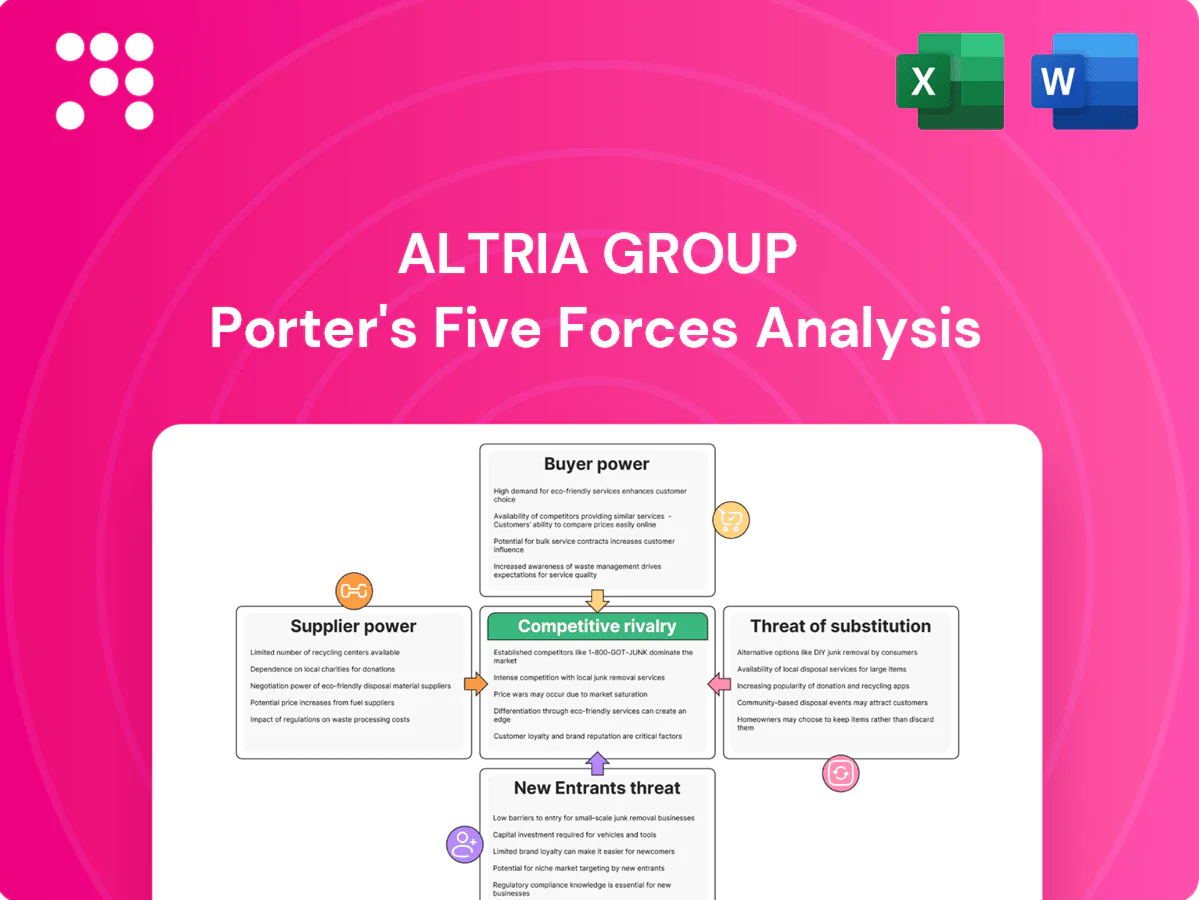
Altria Group Porter's Five Forces Analysis

Go Beyond the Preview—Access the Full Strategic Report
Altria Group faces intense rivalry from reduced-smoking trends and regulatory pressure, while buyer bargaining is moderate and supplier power limited; substitutes and new entrants pose variable threats. This snapshot highlights key pressures on margins and strategy. Unlock the full Porter's Five Forces Analysis to see force-by-force ratings, visuals, and strategic implications. Purchase the complete report to inform investment and planning.
Suppliers Bargaining Power

Leaf tobacco supply is diversified
Altria sources leaf from multiple regions and merchants, limiting any single grower’s leverage and relying on long-term contracts and grading standards to reduce price volatility and ensure quality. In 2024 specialty grades and compliant traceability requirements have tightened some supply niches, while weather, geopolitics and ESG pressures episodically lift supplier power.
Inputs are largely commodities
Inputs such as paper, filters, flavorings, packaging, glycerin and propylene glycol are widely available, keeping supplier power low for Altria. Scale purchasing and dual‑sourcing across suppliers reduce single‑vendor dependency. Inflation and 2024 logistics shocks caused temporary cost spikes, while regulatory limits on compliant additives modestly narrow supplier choice and raise influence.

Device and component specialization
For heated-tobacco and vapor, proprietary device designs, embedded electronics and IP create concentrated supplier power, as certification and reliability testing narrow qualified vendors. Partnership models such as JVs or OEM agreements can mitigate but not eliminate dependency. Component shortages or product recalls historically spike supplier leverage, increasing costs and procurement lead times for Altria’s device initiatives.

Compliance and quality requirements
FDA manufacturing oversight, Good Manufacturing Practice expectations for nicotine products, and traceability requirements restrict eligible suppliers for Altria, so vendors meeting these standards can negotiate stronger terms and margins.
Altria’s auditing, approved-vendor lists, and regulatory documentation reduce supply risk but shrink the supplier pool and raise switching costs for specialized inputs like tobacco blends and packaging materials.
- Regulatory gatekeeping: FDA oversight, GMP and traceability limit eligible suppliers
- Supplier leverage: compliant vendors command better pricing and terms
- Risk control: audits and approved-vendor lists reduce risk but narrow choices
- Higher switching costs: specialized inputs increase dependency on approved suppliers
Logistics and geopolitics
Global shipping disruptions, tariffs, and sanctions materially affect Altria’s leaf and component flows, with acute port closures or regional conflicts temporarily shifting bargaining power to suppliers; diversified routing and inventory buffers are used to mitigate this exposure. Currency swings alter landed costs and payment terms, making suppliers more influential during rapid FX moves.
- Shipping/sanctions heighten supplier leverage
- Diversified routes reduce single-point risk
- Inventory buffers limit short-term supplier power
- FX volatility increases landed-cost sensitivity
Diversified sourcing and long-term contracts limit supplier leverage amid 2024 traceability rules
Altria limits supplier power via diversified leaf sourcing, long-term contracts and approved-vendor lists, though 2024 traceability and ESG rules tightened niches and raised leverage episodically.
Commodities like paper and filters keep supplier power low; device components and proprietary IP for heated/vapor products create concentrated vendor power and higher switching costs.
Regulatory gatekeeping (FDA/GMP) and 2024 logistics/FX shocks increased supplier influence during disruptions.
| Metric | 2024 |
|---|---|
| Altria net revenue | $20.72B |
What is included in the product
 Detailed Word Document
Uncovers key drivers of competition, supplier and buyer influence, and market entry risks specific to Altria Group, assessing how regulation, brand strength, and retail distribution shape pricing and profitability. Identifies disruptive substitutes, regulatory threats, and industry dynamics that sustain incumbents and challenge Altria’s market share.

 Customizable Excel Spreadsheet
A concise Porter's Five Forces one-sheet for Altria Group that clarifies competitive pressures and regulatory risks to speed strategic decisions; customizable force levels and a ready-to-paste radar chart make it slide-deck and non-expert friendly.
Customers Bargaining Power

Consumers are fragmented but price sensitive
Roughly 30 million US adult smokers lack collective bargaining power yet respond sharply to price changes, with cigarette price elasticity estimated around -0.4 short-term, -0.6 long-term. Federal excise tax is $1.01/pack in 2024, with state taxes adding materially to shelf prices and amplifying elasticity. Discount tiers and trade-down promotions drive volume in downturns, and Marlboro’s roughly 40% share cushions but does not eliminate price sensitivity.
Retail consolidation shapes terms
Convenience stores accounted for about 70% of US tobacco retail sales in 2024, and top chains/wholesalers—roughly one-third of c-store distribution—use merchandising, rebates and data-sharing to extract concessions from Altria. Planogram control and scan-based promotions drive shelf influence and pricing. Compliance programs trade financial incentives for execution. Smaller independents lack comparable leverage.

Low switching costs across brands
Flavor and nicotine profiles are largely replicable across many SKUs, eroding product differentiation and increasing buyer leverage. Advertising restrictions since 2020 have pushed firms toward price, retail presence and loyalty programs, with Altria holding roughly 44% of U.S. cigarette retail share in 2024. In recessions, trade-down to discount brands lifts buyer power, though premium-loyal segments still provide some insulation.

Digital and alternative channels
Digital and alternative channels for Altria remain tightly constrained by federal and state age-verification and distribution rules; in 2024 Altria reported roughly $22.3 billion in net revenues, limiting DTC scale versus retail. Where permitted, direct relationships lower intermediary leverage, but platform policies and verification vendors introduce new gatekeepers, while illicit online markets erode price integrity.
- Age-gated e‑commerce: regulatory limits
- Direct DTC: reduces intermediary power
- Platforms/verification: new gatekeepers
- Illicit online: depresses pricing
Health and regulatory awareness
Rising health and regulatory awareness strengthens buyer power as roughly 11.5% of US adults smoked cigarettes (CDC 2022) and surveys show about 68% of smokers want to quit, driving switches to pouches, vapes or cessation aids; retail nicotine pouch and vape volumes grew double digits into 2023–24, and policy/news shocks rapidly shift preferences. Altria’s harm‑reduction positioning (reduced‑risk products, partnerships) aims to retain users within its portfolio.
- Buyer options: pouches, vapes, quit aids — power up
- Behavioral data: ~68% intend to quit
- Market trend: pouch/vape volumes up double digits (2023–24)
- Strategic response: harm‑reduction to limit churn
Price-sensitive US smokers (~30M) fuel pouch and vape growth as $1.01 tax lifts shelf prices
US smokers (~30M) remain price-sensitive (elasticity ≈ -0.4 short, -0.6 long); Marlboro ~44% US share cushions but not immune. C-stores ~70% of retail give chains planogram/rebate leverage; federal tax $1.01/pack (2024) raises shelf prices. Altria revenue $22.3B (2024); smoking prevalence 11.5% (CDC 2022), 68% intend to quit; pouches/vapes grew double digits (2023–24).
| Metric | Value (2024) |
|---|---|
| Adult smokers | ~30M |
| Elasticity (short/long) | -0.4 / -0.6 |
| Marlboro share | ~44% |
| C-store retail share | ~70% |
| Fed excise tax | $1.01/pack |
| Altria revenue | $22.3B |
| Smoking prevalence | 11.5% |
| Quit intent | 68% |
Same Document Delivered
Altria Group Porter's Five Forces Analysis
This preview shows the exact Altria Group Porter's Five Forces analysis you'll receive immediately after purchase—no placeholders or mockups. It is fully formatted and ready for download and use. The report covers supplier power, buyer power, competitive rivalry, threats of substitutes and new entrants, plus strategic implications. Instant access is granted upon payment.

Go Beyond the Preview—Access the Full Strategic Report
Altria Group faces intense rivalry from reduced-smoking trends and regulatory pressure, while buyer bargaining is moderate and supplier power limited; substitutes and new entrants pose variable threats. This snapshot highlights key pressures on margins and strategy. Unlock the full Porter's Five Forces Analysis to see force-by-force ratings, visuals, and strategic implications. Purchase the complete report to inform investment and planning.
Suppliers Bargaining Power
Leaf tobacco supply is diversified
Altria sources leaf from multiple regions and merchants, limiting any single grower’s leverage and relying on long-term contracts and grading standards to reduce price volatility and ensure quality. In 2024 specialty grades and compliant traceability requirements have tightened some supply niches, while weather, geopolitics and ESG pressures episodically lift supplier power.
Inputs are largely commodities
Inputs such as paper, filters, flavorings, packaging, glycerin and propylene glycol are widely available, keeping supplier power low for Altria. Scale purchasing and dual‑sourcing across suppliers reduce single‑vendor dependency. Inflation and 2024 logistics shocks caused temporary cost spikes, while regulatory limits on compliant additives modestly narrow supplier choice and raise influence.
Device and component specialization
For heated-tobacco and vapor, proprietary device designs, embedded electronics and IP create concentrated supplier power, as certification and reliability testing narrow qualified vendors. Partnership models such as JVs or OEM agreements can mitigate but not eliminate dependency. Component shortages or product recalls historically spike supplier leverage, increasing costs and procurement lead times for Altria’s device initiatives.
Compliance and quality requirements
FDA manufacturing oversight, Good Manufacturing Practice expectations for nicotine products, and traceability requirements restrict eligible suppliers for Altria, so vendors meeting these standards can negotiate stronger terms and margins.
Altria’s auditing, approved-vendor lists, and regulatory documentation reduce supply risk but shrink the supplier pool and raise switching costs for specialized inputs like tobacco blends and packaging materials.
- Regulatory gatekeeping: FDA oversight, GMP and traceability limit eligible suppliers
- Supplier leverage: compliant vendors command better pricing and terms
- Risk control: audits and approved-vendor lists reduce risk but narrow choices
- Higher switching costs: specialized inputs increase dependency on approved suppliers
Logistics and geopolitics
Global shipping disruptions, tariffs, and sanctions materially affect Altria’s leaf and component flows, with acute port closures or regional conflicts temporarily shifting bargaining power to suppliers; diversified routing and inventory buffers are used to mitigate this exposure. Currency swings alter landed costs and payment terms, making suppliers more influential during rapid FX moves.
- Shipping/sanctions heighten supplier leverage
- Diversified routes reduce single-point risk
- Inventory buffers limit short-term supplier power
- FX volatility increases landed-cost sensitivity
Diversified sourcing and long-term contracts limit supplier leverage amid 2024 traceability rules
Altria limits supplier power via diversified leaf sourcing, long-term contracts and approved-vendor lists, though 2024 traceability and ESG rules tightened niches and raised leverage episodically.
Commodities like paper and filters keep supplier power low; device components and proprietary IP for heated/vapor products create concentrated vendor power and higher switching costs.
Regulatory gatekeeping (FDA/GMP) and 2024 logistics/FX shocks increased supplier influence during disruptions.
| Metric | 2024 |
|---|---|
| Altria net revenue | $20.72B |
What is included in the product
Detailed Word Document
Uncovers key drivers of competition, supplier and buyer influence, and market entry risks specific to Altria Group, assessing how regulation, brand strength, and retail distribution shape pricing and profitability. Identifies disruptive substitutes, regulatory threats, and industry dynamics that sustain incumbents and challenge Altria’s market share.
Customizable Excel Spreadsheet
A concise Porter's Five Forces one-sheet for Altria Group that clarifies competitive pressures and regulatory risks to speed strategic decisions; customizable force levels and a ready-to-paste radar chart make it slide-deck and non-expert friendly.
Customers Bargaining Power
Consumers are fragmented but price sensitive
Roughly 30 million US adult smokers lack collective bargaining power yet respond sharply to price changes, with cigarette price elasticity estimated around -0.4 short-term, -0.6 long-term. Federal excise tax is $1.01/pack in 2024, with state taxes adding materially to shelf prices and amplifying elasticity. Discount tiers and trade-down promotions drive volume in downturns, and Marlboro’s roughly 40% share cushions but does not eliminate price sensitivity.
Retail consolidation shapes terms
Convenience stores accounted for about 70% of US tobacco retail sales in 2024, and top chains/wholesalers—roughly one-third of c-store distribution—use merchandising, rebates and data-sharing to extract concessions from Altria. Planogram control and scan-based promotions drive shelf influence and pricing. Compliance programs trade financial incentives for execution. Smaller independents lack comparable leverage.
Low switching costs across brands
Flavor and nicotine profiles are largely replicable across many SKUs, eroding product differentiation and increasing buyer leverage. Advertising restrictions since 2020 have pushed firms toward price, retail presence and loyalty programs, with Altria holding roughly 44% of U.S. cigarette retail share in 2024. In recessions, trade-down to discount brands lifts buyer power, though premium-loyal segments still provide some insulation.
Digital and alternative channels
Digital and alternative channels for Altria remain tightly constrained by federal and state age-verification and distribution rules; in 2024 Altria reported roughly $22.3 billion in net revenues, limiting DTC scale versus retail. Where permitted, direct relationships lower intermediary leverage, but platform policies and verification vendors introduce new gatekeepers, while illicit online markets erode price integrity.
- Age-gated e‑commerce: regulatory limits
- Direct DTC: reduces intermediary power
- Platforms/verification: new gatekeepers
- Illicit online: depresses pricing
Health and regulatory awareness
Rising health and regulatory awareness strengthens buyer power as roughly 11.5% of US adults smoked cigarettes (CDC 2022) and surveys show about 68% of smokers want to quit, driving switches to pouches, vapes or cessation aids; retail nicotine pouch and vape volumes grew double digits into 2023–24, and policy/news shocks rapidly shift preferences. Altria’s harm‑reduction positioning (reduced‑risk products, partnerships) aims to retain users within its portfolio.
- Buyer options: pouches, vapes, quit aids — power up
- Behavioral data: ~68% intend to quit
- Market trend: pouch/vape volumes up double digits (2023–24)
- Strategic response: harm‑reduction to limit churn
Price-sensitive US smokers (~30M) fuel pouch and vape growth as $1.01 tax lifts shelf prices
US smokers (~30M) remain price-sensitive (elasticity ≈ -0.4 short, -0.6 long); Marlboro ~44% US share cushions but not immune. C-stores ~70% of retail give chains planogram/rebate leverage; federal tax $1.01/pack (2024) raises shelf prices. Altria revenue $22.3B (2024); smoking prevalence 11.5% (CDC 2022), 68% intend to quit; pouches/vapes grew double digits (2023–24).
| Metric | Value (2024) |
|---|---|
| Adult smokers | ~30M |
| Elasticity (short/long) | -0.4 / -0.6 |
| Marlboro share | ~44% |
| C-store retail share | ~70% |
| Fed excise tax | $1.01/pack |
| Altria revenue | $22.3B |
| Smoking prevalence | 11.5% |
| Quit intent | 68% |
Same Document Delivered
Altria Group Porter's Five Forces Analysis
This preview shows the exact Altria Group Porter's Five Forces analysis you'll receive immediately after purchase—no placeholders or mockups. It is fully formatted and ready for download and use. The report covers supplier power, buyer power, competitive rivalry, threats of substitutes and new entrants, plus strategic implications. Instant access is granted upon payment.
Original: $10.00
-65%$10.00
$3.50Description
Go Beyond the Preview—Access the Full Strategic Report
Altria Group faces intense rivalry from reduced-smoking trends and regulatory pressure, while buyer bargaining is moderate and supplier power limited; substitutes and new entrants pose variable threats. This snapshot highlights key pressures on margins and strategy. Unlock the full Porter's Five Forces Analysis to see force-by-force ratings, visuals, and strategic implications. Purchase the complete report to inform investment and planning.
Suppliers Bargaining Power
Leaf tobacco supply is diversified
Altria sources leaf from multiple regions and merchants, limiting any single grower’s leverage and relying on long-term contracts and grading standards to reduce price volatility and ensure quality. In 2024 specialty grades and compliant traceability requirements have tightened some supply niches, while weather, geopolitics and ESG pressures episodically lift supplier power.
Inputs are largely commodities
Inputs such as paper, filters, flavorings, packaging, glycerin and propylene glycol are widely available, keeping supplier power low for Altria. Scale purchasing and dual‑sourcing across suppliers reduce single‑vendor dependency. Inflation and 2024 logistics shocks caused temporary cost spikes, while regulatory limits on compliant additives modestly narrow supplier choice and raise influence.
Device and component specialization
For heated-tobacco and vapor, proprietary device designs, embedded electronics and IP create concentrated supplier power, as certification and reliability testing narrow qualified vendors. Partnership models such as JVs or OEM agreements can mitigate but not eliminate dependency. Component shortages or product recalls historically spike supplier leverage, increasing costs and procurement lead times for Altria’s device initiatives.
Compliance and quality requirements
FDA manufacturing oversight, Good Manufacturing Practice expectations for nicotine products, and traceability requirements restrict eligible suppliers for Altria, so vendors meeting these standards can negotiate stronger terms and margins.
Altria’s auditing, approved-vendor lists, and regulatory documentation reduce supply risk but shrink the supplier pool and raise switching costs for specialized inputs like tobacco blends and packaging materials.
- Regulatory gatekeeping: FDA oversight, GMP and traceability limit eligible suppliers
- Supplier leverage: compliant vendors command better pricing and terms
- Risk control: audits and approved-vendor lists reduce risk but narrow choices
- Higher switching costs: specialized inputs increase dependency on approved suppliers
Logistics and geopolitics
Global shipping disruptions, tariffs, and sanctions materially affect Altria’s leaf and component flows, with acute port closures or regional conflicts temporarily shifting bargaining power to suppliers; diversified routing and inventory buffers are used to mitigate this exposure. Currency swings alter landed costs and payment terms, making suppliers more influential during rapid FX moves.
- Shipping/sanctions heighten supplier leverage
- Diversified routes reduce single-point risk
- Inventory buffers limit short-term supplier power
- FX volatility increases landed-cost sensitivity
Diversified sourcing and long-term contracts limit supplier leverage amid 2024 traceability rules
Altria limits supplier power via diversified leaf sourcing, long-term contracts and approved-vendor lists, though 2024 traceability and ESG rules tightened niches and raised leverage episodically.
Commodities like paper and filters keep supplier power low; device components and proprietary IP for heated/vapor products create concentrated vendor power and higher switching costs.
Regulatory gatekeeping (FDA/GMP) and 2024 logistics/FX shocks increased supplier influence during disruptions.
| Metric | 2024 |
|---|---|
| Altria net revenue | $20.72B |
What is included in the product
Detailed Word Document
Uncovers key drivers of competition, supplier and buyer influence, and market entry risks specific to Altria Group, assessing how regulation, brand strength, and retail distribution shape pricing and profitability. Identifies disruptive substitutes, regulatory threats, and industry dynamics that sustain incumbents and challenge Altria’s market share.
Customizable Excel Spreadsheet
A concise Porter's Five Forces one-sheet for Altria Group that clarifies competitive pressures and regulatory risks to speed strategic decisions; customizable force levels and a ready-to-paste radar chart make it slide-deck and non-expert friendly.
Customers Bargaining Power
Consumers are fragmented but price sensitive
Roughly 30 million US adult smokers lack collective bargaining power yet respond sharply to price changes, with cigarette price elasticity estimated around -0.4 short-term, -0.6 long-term. Federal excise tax is $1.01/pack in 2024, with state taxes adding materially to shelf prices and amplifying elasticity. Discount tiers and trade-down promotions drive volume in downturns, and Marlboro’s roughly 40% share cushions but does not eliminate price sensitivity.
Retail consolidation shapes terms
Convenience stores accounted for about 70% of US tobacco retail sales in 2024, and top chains/wholesalers—roughly one-third of c-store distribution—use merchandising, rebates and data-sharing to extract concessions from Altria. Planogram control and scan-based promotions drive shelf influence and pricing. Compliance programs trade financial incentives for execution. Smaller independents lack comparable leverage.
Low switching costs across brands
Flavor and nicotine profiles are largely replicable across many SKUs, eroding product differentiation and increasing buyer leverage. Advertising restrictions since 2020 have pushed firms toward price, retail presence and loyalty programs, with Altria holding roughly 44% of U.S. cigarette retail share in 2024. In recessions, trade-down to discount brands lifts buyer power, though premium-loyal segments still provide some insulation.
Digital and alternative channels
Digital and alternative channels for Altria remain tightly constrained by federal and state age-verification and distribution rules; in 2024 Altria reported roughly $22.3 billion in net revenues, limiting DTC scale versus retail. Where permitted, direct relationships lower intermediary leverage, but platform policies and verification vendors introduce new gatekeepers, while illicit online markets erode price integrity.
- Age-gated e‑commerce: regulatory limits
- Direct DTC: reduces intermediary power
- Platforms/verification: new gatekeepers
- Illicit online: depresses pricing
Health and regulatory awareness
Rising health and regulatory awareness strengthens buyer power as roughly 11.5% of US adults smoked cigarettes (CDC 2022) and surveys show about 68% of smokers want to quit, driving switches to pouches, vapes or cessation aids; retail nicotine pouch and vape volumes grew double digits into 2023–24, and policy/news shocks rapidly shift preferences. Altria’s harm‑reduction positioning (reduced‑risk products, partnerships) aims to retain users within its portfolio.
- Buyer options: pouches, vapes, quit aids — power up
- Behavioral data: ~68% intend to quit
- Market trend: pouch/vape volumes up double digits (2023–24)
- Strategic response: harm‑reduction to limit churn
Price-sensitive US smokers (~30M) fuel pouch and vape growth as $1.01 tax lifts shelf prices
US smokers (~30M) remain price-sensitive (elasticity ≈ -0.4 short, -0.6 long); Marlboro ~44% US share cushions but not immune. C-stores ~70% of retail give chains planogram/rebate leverage; federal tax $1.01/pack (2024) raises shelf prices. Altria revenue $22.3B (2024); smoking prevalence 11.5% (CDC 2022), 68% intend to quit; pouches/vapes grew double digits (2023–24).
| Metric | Value (2024) |
|---|---|
| Adult smokers | ~30M |
| Elasticity (short/long) | -0.4 / -0.6 |
| Marlboro share | ~44% |
| C-store retail share | ~70% |
| Fed excise tax | $1.01/pack |
| Altria revenue | $22.3B |
| Smoking prevalence | 11.5% |
| Quit intent | 68% |
Same Document Delivered
Altria Group Porter's Five Forces Analysis
This preview shows the exact Altria Group Porter's Five Forces analysis you'll receive immediately after purchase—no placeholders or mockups. It is fully formatted and ready for download and use. The report covers supplier power, buyer power, competitive rivalry, threats of substitutes and new entrants, plus strategic implications. Instant access is granted upon payment.











