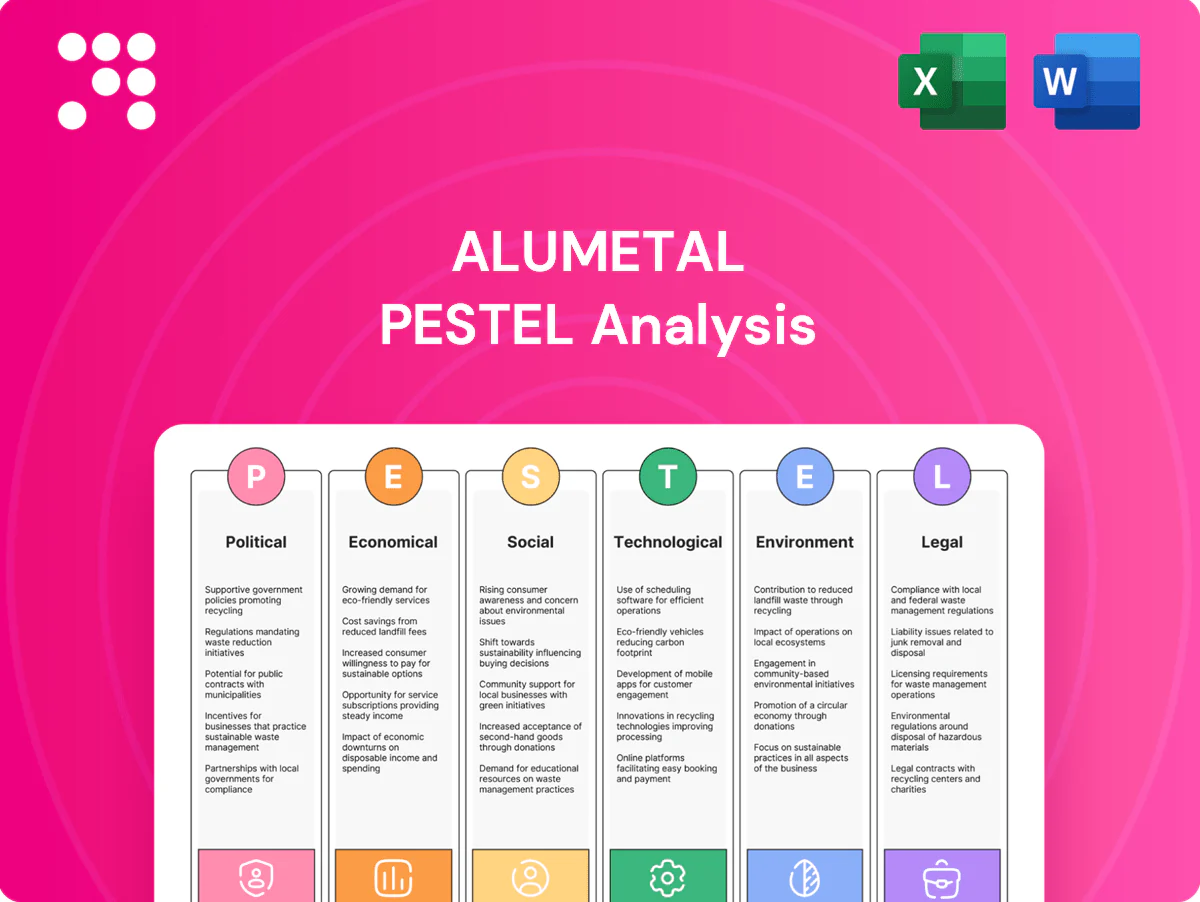
Alumetal PESTLE Analysis

Skip the Research. Get the Strategy.
Gain strategic clarity with our PESTLE analysis of Alumetal. We map political, economic, social, technological, legal and environmental drivers shaping the company’s outlook. Ideal for investors, consultants and strategists seeking actionable insights. Purchase the full report for deep, ready-to-use recommendations and data.
Political factors

EU industrial and climate policy
The EU Green Deal and Fit for 55 (55% GHG cut by 2030) plus carbon prices near €90/t in mid‑2025 shape energy, carbon and recycling incentives for aluminum producers. Alumetal benefits from circular‑economy demand for secondary aluminum but faces stricter decarbonization expectations. Access to the Innovation Fund (~€38bn) and tax credits can offset compliance costs and influence long‑term capex amid policy stability risks.
Trade measures and CBAM
EU CBAM, phased from Oct 2023 with transitional quarterly reporting, effectively prices embedded CO2 at EU ETS levels (average ~€88/t in 2024), improving competitiveness of low‑carbon imports versus non‑EU primary aluminum. Recycled aluminum emits ~95% less CO2 than primary, so Alumetal’s recycled profile gains margin advantage under carbon pricing. Shifts in tariffs or anti‑dumping duties on alloys/scrap can change input costs and market access, while CBAM raises administrative and data‑reporting burdens.

Energy security and geopolitical risk
Poland's power system remains coal‑heavy—about 70% of electricity in 2021 per IEA—while national gas demand was roughly 20 bcm/year and Baltic Pipe adds ~10 bcm/year capacity, making regional geopolitics key to electricity and gas availability. Eastern European tensions have previously driven spikes in European day‑ahead power prices (peaks near €300/MWh in 2022), raising fuel and logistics costs. Government interventions (price supports and market measures in 2022–23) can stabilize or distort costs, so long‑term energy contracts and PPAs serve as political‑risk hedges for Alumetal.

National subsidies and state aid rules
EU state aid rules set the framework for compensation of indirect ETS costs and green capex support; carbon prices near €85–100/t in 2024–25 amplify the need for compensation. Instruments such as the Innovation Fund (estimated up to €38bn NPV to 2030) and Modernisation/Recovery funds channel capital, so access to subsidies for electrification or waste-processing upgrades can be pivotal and timing-dependent.
- eligibility: policy design dictates who qualifies
- speed: disbursement timelines vary by instrument
- impact: €85–100/t carbon price raises indirect cost exposure
- action: align projects with Innovation Fund and national state-aid frameworks
Public procurement and OEM preferences
Government-backed infrastructure and automotive transition programs—backed by EU Fit for 55 (2030 target: -55% CO2 vs 1990) and public procurement (~14% of EU GDP)—are lifting demand for low-CO2 alloys; recycled aluminium emits ~95% less CO2 than primary, making recycled producers competitive when tenders favor low-carbon inputs, while political pushes for local content shift volumes to regional supply chains.
EU Green Deal, €85–95/t carbon and CBAM lift demand for ≈95%‑lower‑CO2 recycled aluminium
The EU Green Deal/Fit for 55 (-55% CO2 by 2030) and carbon prices ~€85–95/t (mid‑2024–mid‑2025) favor Alumetal’s low‑CO2 recycled aluminium (≈95% lower emissions) but raise compliance costs; Innovation Fund ≈€38bn and state aid can finance electrification; Poland’s 2021 coal share ~70% of power keeps power-price volatility risk; CBAM (phased from Oct 2023) increases reporting burden.
| Item | Value |
|---|---|
| Carbon price | €85–95/t (2024–mid‑2025) |
| Innovation Fund | ≈€38bn |
| Recycled CO2 saving | ≈95% |
| Poland coal power (2021) | ≈70% |
What is included in the product
 Detailed Word Document
Explores how external macro-environmental factors uniquely affect Alumetal across Political, Economic, Social, Technological, Environmental and Legal dimensions, with data-backed trends, region- and industry-specific subpoints, forward-looking insights and practical implications for executives, investors and strategists.

 Customizable Excel Spreadsheet
Alumetal PESTLE delivers a concise, visually segmented summary of external risks and opportunities for quick interpretation in meetings, and is easily dropped into presentations or shared across teams; users can add notes or regional context to tailor insights to their business line.
Economic factors

Aluminum price and scrap spreads
LME aluminum prices swung between roughly $1,900–$2,600/ton in 2024–H1 2025, making scrap-to-ingot spreads a primary margin driver. Alumetal’s profitability depends on securing quality scrap at discounts to ingot; spreads have periodically widened above $300–$400/ton. Hedging reduces exposure to these swings but adds cost and operational complexity. Tight inventory management is critical during cyclical downturns.
Automotive and construction cycles
Alloy demand closely follows global light-vehicle production (about 78 million units in 2024) and construction activity, with global construction output near $13.4 trillion in 2024; engineering and starts drive short-term swings. EV momentum (roughly 14 million EVs sold in 2024, ~18% of sales) and lightweighting support longer-term alloy volumes, though cyclical peaks persist. OEM destocking in 2023–24 produced sharp short-term order volatility, while Alumetal’s spread across automotive, construction and industrial customers helps smooth revenue.

Energy and carbon cost pass-through
Electricity, gas and EU ETS carbon costs materially influence Alumetal unit economics: EU industrial power averaged ~€0.14/kWh in 2024, TTF gas ~€25/MWh and EU carbon traded around €85–95/t in 2024–2025, all adding significant per-ton metal costs.
Contract structures and surcharges determine pass-through to customers, with short-term spot exposure raising volatility while index-linked tariffs enable partial recovery of input inflation.
Efficiency gains, fuel switching to gas or scrap-based processes and long-term PPAs (locking prices for 5–15 years) are proven levers to defend margins and stabilize cost curves.

FX and regional competitiveness
- FX exposure: PLN/EUR, PLN/USD
- Cost gap: ~60% lower vs Germany
- Risk mitigation: currency hedges
- Logistics: raises delivered prices
Capital intensity and financing
Upgrades to melting, filtration and emissions control require steady capex and are being accelerated by EU carbon pricing near €100/t in 2024–25, raising urgency and hurdle rates. Higher policy rates (ECB deposit rate ~4.25% mid‑2024) and tighter credit push required returns up. Access to sustainability‑linked loans and EIB green facilities can shave financing costs by roughly 50–125 bps. Strong cash conversion from scrap‑based operations supports reinvestment.
- Capex pressure: melting, filtration, emissions
- ECB rate ~4.25% raises hurdle rates
- EU ETS ~€100/t increases urgency
- SLBs/green loans can cut WACC 50–125 bps
- High cash conversion from scrap supports reinvestment
EU Green Deal, €85–95/t carbon and CBAM lift demand for ≈95%‑lower‑CO2 recycled aluminium
Aluminum ~ $2,200/t (2024–H1 2025); scrap‑to‑ingot spreads ~$300–400/t drive margins. Energy and EU ETS (~€85–95/t) plus PLN/EUR ~4.50, PLN/USD ~4.20 mid‑2025 materially affect costs; ECB rate ~4.25% raises hurdle rates. Capex for emissions and tariff pass‑through, plus SLBs/green loans that cut financing ~50–125 bps, shape investment and pricing.
| Metric | Value |
|---|---|
| LME price | $2,200/t |
| Spread | $300–400/t |
| EU ETS | €85–95/t |
| FX | PLN/EUR 4.50, PLN/USD 4.20 |
| ECB rate | ~4.25% |
| SLB benefit | 50–125 bps |
What You See Is What You Get
Alumetal PESTLE Analysis
The preview shown here is the exact Alumetal PESTLE Analysis you’ll receive after purchase—fully formatted and ready to use. This is a real screenshot of the product you’re buying—delivered exactly as shown, no surprises. The layout, content, and structure visible here are exactly what you’ll be able to download immediately after buying. No placeholders, no teasers—this is the final, professionally structured file.

Skip the Research. Get the Strategy.
Gain strategic clarity with our PESTLE analysis of Alumetal. We map political, economic, social, technological, legal and environmental drivers shaping the company’s outlook. Ideal for investors, consultants and strategists seeking actionable insights. Purchase the full report for deep, ready-to-use recommendations and data.
Political factors
EU industrial and climate policy
The EU Green Deal and Fit for 55 (55% GHG cut by 2030) plus carbon prices near €90/t in mid‑2025 shape energy, carbon and recycling incentives for aluminum producers. Alumetal benefits from circular‑economy demand for secondary aluminum but faces stricter decarbonization expectations. Access to the Innovation Fund (~€38bn) and tax credits can offset compliance costs and influence long‑term capex amid policy stability risks.
Trade measures and CBAM
EU CBAM, phased from Oct 2023 with transitional quarterly reporting, effectively prices embedded CO2 at EU ETS levels (average ~€88/t in 2024), improving competitiveness of low‑carbon imports versus non‑EU primary aluminum. Recycled aluminum emits ~95% less CO2 than primary, so Alumetal’s recycled profile gains margin advantage under carbon pricing. Shifts in tariffs or anti‑dumping duties on alloys/scrap can change input costs and market access, while CBAM raises administrative and data‑reporting burdens.
Energy security and geopolitical risk
Poland's power system remains coal‑heavy—about 70% of electricity in 2021 per IEA—while national gas demand was roughly 20 bcm/year and Baltic Pipe adds ~10 bcm/year capacity, making regional geopolitics key to electricity and gas availability. Eastern European tensions have previously driven spikes in European day‑ahead power prices (peaks near €300/MWh in 2022), raising fuel and logistics costs. Government interventions (price supports and market measures in 2022–23) can stabilize or distort costs, so long‑term energy contracts and PPAs serve as political‑risk hedges for Alumetal.
National subsidies and state aid rules
EU state aid rules set the framework for compensation of indirect ETS costs and green capex support; carbon prices near €85–100/t in 2024–25 amplify the need for compensation. Instruments such as the Innovation Fund (estimated up to €38bn NPV to 2030) and Modernisation/Recovery funds channel capital, so access to subsidies for electrification or waste-processing upgrades can be pivotal and timing-dependent.
- eligibility: policy design dictates who qualifies
- speed: disbursement timelines vary by instrument
- impact: €85–100/t carbon price raises indirect cost exposure
- action: align projects with Innovation Fund and national state-aid frameworks
Public procurement and OEM preferences
Government-backed infrastructure and automotive transition programs—backed by EU Fit for 55 (2030 target: -55% CO2 vs 1990) and public procurement (~14% of EU GDP)—are lifting demand for low-CO2 alloys; recycled aluminium emits ~95% less CO2 than primary, making recycled producers competitive when tenders favor low-carbon inputs, while political pushes for local content shift volumes to regional supply chains.
EU Green Deal, €85–95/t carbon and CBAM lift demand for ≈95%‑lower‑CO2 recycled aluminium
The EU Green Deal/Fit for 55 (-55% CO2 by 2030) and carbon prices ~€85–95/t (mid‑2024–mid‑2025) favor Alumetal’s low‑CO2 recycled aluminium (≈95% lower emissions) but raise compliance costs; Innovation Fund ≈€38bn and state aid can finance electrification; Poland’s 2021 coal share ~70% of power keeps power-price volatility risk; CBAM (phased from Oct 2023) increases reporting burden.
| Item | Value |
|---|---|
| Carbon price | €85–95/t (2024–mid‑2025) |
| Innovation Fund | ≈€38bn |
| Recycled CO2 saving | ≈95% |
| Poland coal power (2021) | ≈70% |
What is included in the product
Detailed Word Document
Explores how external macro-environmental factors uniquely affect Alumetal across Political, Economic, Social, Technological, Environmental and Legal dimensions, with data-backed trends, region- and industry-specific subpoints, forward-looking insights and practical implications for executives, investors and strategists.
Customizable Excel Spreadsheet
Alumetal PESTLE delivers a concise, visually segmented summary of external risks and opportunities for quick interpretation in meetings, and is easily dropped into presentations or shared across teams; users can add notes or regional context to tailor insights to their business line.
Economic factors
Aluminum price and scrap spreads
LME aluminum prices swung between roughly $1,900–$2,600/ton in 2024–H1 2025, making scrap-to-ingot spreads a primary margin driver. Alumetal’s profitability depends on securing quality scrap at discounts to ingot; spreads have periodically widened above $300–$400/ton. Hedging reduces exposure to these swings but adds cost and operational complexity. Tight inventory management is critical during cyclical downturns.
Automotive and construction cycles
Alloy demand closely follows global light-vehicle production (about 78 million units in 2024) and construction activity, with global construction output near $13.4 trillion in 2024; engineering and starts drive short-term swings. EV momentum (roughly 14 million EVs sold in 2024, ~18% of sales) and lightweighting support longer-term alloy volumes, though cyclical peaks persist. OEM destocking in 2023–24 produced sharp short-term order volatility, while Alumetal’s spread across automotive, construction and industrial customers helps smooth revenue.
Energy and carbon cost pass-through
Electricity, gas and EU ETS carbon costs materially influence Alumetal unit economics: EU industrial power averaged ~€0.14/kWh in 2024, TTF gas ~€25/MWh and EU carbon traded around €85–95/t in 2024–2025, all adding significant per-ton metal costs.
Contract structures and surcharges determine pass-through to customers, with short-term spot exposure raising volatility while index-linked tariffs enable partial recovery of input inflation.
Efficiency gains, fuel switching to gas or scrap-based processes and long-term PPAs (locking prices for 5–15 years) are proven levers to defend margins and stabilize cost curves.
FX and regional competitiveness
- FX exposure: PLN/EUR, PLN/USD
- Cost gap: ~60% lower vs Germany
- Risk mitigation: currency hedges
- Logistics: raises delivered prices
Capital intensity and financing
Upgrades to melting, filtration and emissions control require steady capex and are being accelerated by EU carbon pricing near €100/t in 2024–25, raising urgency and hurdle rates. Higher policy rates (ECB deposit rate ~4.25% mid‑2024) and tighter credit push required returns up. Access to sustainability‑linked loans and EIB green facilities can shave financing costs by roughly 50–125 bps. Strong cash conversion from scrap‑based operations supports reinvestment.
- Capex pressure: melting, filtration, emissions
- ECB rate ~4.25% raises hurdle rates
- EU ETS ~€100/t increases urgency
- SLBs/green loans can cut WACC 50–125 bps
- High cash conversion from scrap supports reinvestment
EU Green Deal, €85–95/t carbon and CBAM lift demand for ≈95%‑lower‑CO2 recycled aluminium
Aluminum ~ $2,200/t (2024–H1 2025); scrap‑to‑ingot spreads ~$300–400/t drive margins. Energy and EU ETS (~€85–95/t) plus PLN/EUR ~4.50, PLN/USD ~4.20 mid‑2025 materially affect costs; ECB rate ~4.25% raises hurdle rates. Capex for emissions and tariff pass‑through, plus SLBs/green loans that cut financing ~50–125 bps, shape investment and pricing.
| Metric | Value |
|---|---|
| LME price | $2,200/t |
| Spread | $300–400/t |
| EU ETS | €85–95/t |
| FX | PLN/EUR 4.50, PLN/USD 4.20 |
| ECB rate | ~4.25% |
| SLB benefit | 50–125 bps |
What You See Is What You Get
Alumetal PESTLE Analysis
The preview shown here is the exact Alumetal PESTLE Analysis you’ll receive after purchase—fully formatted and ready to use. This is a real screenshot of the product you’re buying—delivered exactly as shown, no surprises. The layout, content, and structure visible here are exactly what you’ll be able to download immediately after buying. No placeholders, no teasers—this is the final, professionally structured file.
Original: $10.00
-65%$10.00
$3.50Description
Skip the Research. Get the Strategy.
Gain strategic clarity with our PESTLE analysis of Alumetal. We map political, economic, social, technological, legal and environmental drivers shaping the company’s outlook. Ideal for investors, consultants and strategists seeking actionable insights. Purchase the full report for deep, ready-to-use recommendations and data.
Political factors
EU industrial and climate policy
The EU Green Deal and Fit for 55 (55% GHG cut by 2030) plus carbon prices near €90/t in mid‑2025 shape energy, carbon and recycling incentives for aluminum producers. Alumetal benefits from circular‑economy demand for secondary aluminum but faces stricter decarbonization expectations. Access to the Innovation Fund (~€38bn) and tax credits can offset compliance costs and influence long‑term capex amid policy stability risks.
Trade measures and CBAM
EU CBAM, phased from Oct 2023 with transitional quarterly reporting, effectively prices embedded CO2 at EU ETS levels (average ~€88/t in 2024), improving competitiveness of low‑carbon imports versus non‑EU primary aluminum. Recycled aluminum emits ~95% less CO2 than primary, so Alumetal’s recycled profile gains margin advantage under carbon pricing. Shifts in tariffs or anti‑dumping duties on alloys/scrap can change input costs and market access, while CBAM raises administrative and data‑reporting burdens.
Energy security and geopolitical risk
Poland's power system remains coal‑heavy—about 70% of electricity in 2021 per IEA—while national gas demand was roughly 20 bcm/year and Baltic Pipe adds ~10 bcm/year capacity, making regional geopolitics key to electricity and gas availability. Eastern European tensions have previously driven spikes in European day‑ahead power prices (peaks near €300/MWh in 2022), raising fuel and logistics costs. Government interventions (price supports and market measures in 2022–23) can stabilize or distort costs, so long‑term energy contracts and PPAs serve as political‑risk hedges for Alumetal.
National subsidies and state aid rules
EU state aid rules set the framework for compensation of indirect ETS costs and green capex support; carbon prices near €85–100/t in 2024–25 amplify the need for compensation. Instruments such as the Innovation Fund (estimated up to €38bn NPV to 2030) and Modernisation/Recovery funds channel capital, so access to subsidies for electrification or waste-processing upgrades can be pivotal and timing-dependent.
- eligibility: policy design dictates who qualifies
- speed: disbursement timelines vary by instrument
- impact: €85–100/t carbon price raises indirect cost exposure
- action: align projects with Innovation Fund and national state-aid frameworks
Public procurement and OEM preferences
Government-backed infrastructure and automotive transition programs—backed by EU Fit for 55 (2030 target: -55% CO2 vs 1990) and public procurement (~14% of EU GDP)—are lifting demand for low-CO2 alloys; recycled aluminium emits ~95% less CO2 than primary, making recycled producers competitive when tenders favor low-carbon inputs, while political pushes for local content shift volumes to regional supply chains.
EU Green Deal, €85–95/t carbon and CBAM lift demand for ≈95%‑lower‑CO2 recycled aluminium
The EU Green Deal/Fit for 55 (-55% CO2 by 2030) and carbon prices ~€85–95/t (mid‑2024–mid‑2025) favor Alumetal’s low‑CO2 recycled aluminium (≈95% lower emissions) but raise compliance costs; Innovation Fund ≈€38bn and state aid can finance electrification; Poland’s 2021 coal share ~70% of power keeps power-price volatility risk; CBAM (phased from Oct 2023) increases reporting burden.
| Item | Value |
|---|---|
| Carbon price | €85–95/t (2024–mid‑2025) |
| Innovation Fund | ≈€38bn |
| Recycled CO2 saving | ≈95% |
| Poland coal power (2021) | ≈70% |
What is included in the product
Detailed Word Document
Explores how external macro-environmental factors uniquely affect Alumetal across Political, Economic, Social, Technological, Environmental and Legal dimensions, with data-backed trends, region- and industry-specific subpoints, forward-looking insights and practical implications for executives, investors and strategists.
Customizable Excel Spreadsheet
Alumetal PESTLE delivers a concise, visually segmented summary of external risks and opportunities for quick interpretation in meetings, and is easily dropped into presentations or shared across teams; users can add notes or regional context to tailor insights to their business line.
Economic factors
Aluminum price and scrap spreads
LME aluminum prices swung between roughly $1,900–$2,600/ton in 2024–H1 2025, making scrap-to-ingot spreads a primary margin driver. Alumetal’s profitability depends on securing quality scrap at discounts to ingot; spreads have periodically widened above $300–$400/ton. Hedging reduces exposure to these swings but adds cost and operational complexity. Tight inventory management is critical during cyclical downturns.
Automotive and construction cycles
Alloy demand closely follows global light-vehicle production (about 78 million units in 2024) and construction activity, with global construction output near $13.4 trillion in 2024; engineering and starts drive short-term swings. EV momentum (roughly 14 million EVs sold in 2024, ~18% of sales) and lightweighting support longer-term alloy volumes, though cyclical peaks persist. OEM destocking in 2023–24 produced sharp short-term order volatility, while Alumetal’s spread across automotive, construction and industrial customers helps smooth revenue.
Energy and carbon cost pass-through
Electricity, gas and EU ETS carbon costs materially influence Alumetal unit economics: EU industrial power averaged ~€0.14/kWh in 2024, TTF gas ~€25/MWh and EU carbon traded around €85–95/t in 2024–2025, all adding significant per-ton metal costs.
Contract structures and surcharges determine pass-through to customers, with short-term spot exposure raising volatility while index-linked tariffs enable partial recovery of input inflation.
Efficiency gains, fuel switching to gas or scrap-based processes and long-term PPAs (locking prices for 5–15 years) are proven levers to defend margins and stabilize cost curves.
FX and regional competitiveness
- FX exposure: PLN/EUR, PLN/USD
- Cost gap: ~60% lower vs Germany
- Risk mitigation: currency hedges
- Logistics: raises delivered prices
Capital intensity and financing
Upgrades to melting, filtration and emissions control require steady capex and are being accelerated by EU carbon pricing near €100/t in 2024–25, raising urgency and hurdle rates. Higher policy rates (ECB deposit rate ~4.25% mid‑2024) and tighter credit push required returns up. Access to sustainability‑linked loans and EIB green facilities can shave financing costs by roughly 50–125 bps. Strong cash conversion from scrap‑based operations supports reinvestment.
- Capex pressure: melting, filtration, emissions
- ECB rate ~4.25% raises hurdle rates
- EU ETS ~€100/t increases urgency
- SLBs/green loans can cut WACC 50–125 bps
- High cash conversion from scrap supports reinvestment
EU Green Deal, €85–95/t carbon and CBAM lift demand for ≈95%‑lower‑CO2 recycled aluminium
Aluminum ~ $2,200/t (2024–H1 2025); scrap‑to‑ingot spreads ~$300–400/t drive margins. Energy and EU ETS (~€85–95/t) plus PLN/EUR ~4.50, PLN/USD ~4.20 mid‑2025 materially affect costs; ECB rate ~4.25% raises hurdle rates. Capex for emissions and tariff pass‑through, plus SLBs/green loans that cut financing ~50–125 bps, shape investment and pricing.
| Metric | Value |
|---|---|
| LME price | $2,200/t |
| Spread | $300–400/t |
| EU ETS | €85–95/t |
| FX | PLN/EUR 4.50, PLN/USD 4.20 |
| ECB rate | ~4.25% |
| SLB benefit | 50–125 bps |
What You See Is What You Get
Alumetal PESTLE Analysis
The preview shown here is the exact Alumetal PESTLE Analysis you’ll receive after purchase—fully formatted and ready to use. This is a real screenshot of the product you’re buying—delivered exactly as shown, no surprises. The layout, content, and structure visible here are exactly what you’ll be able to download immediately after buying. No placeholders, no teasers—this is the final, professionally structured file.











