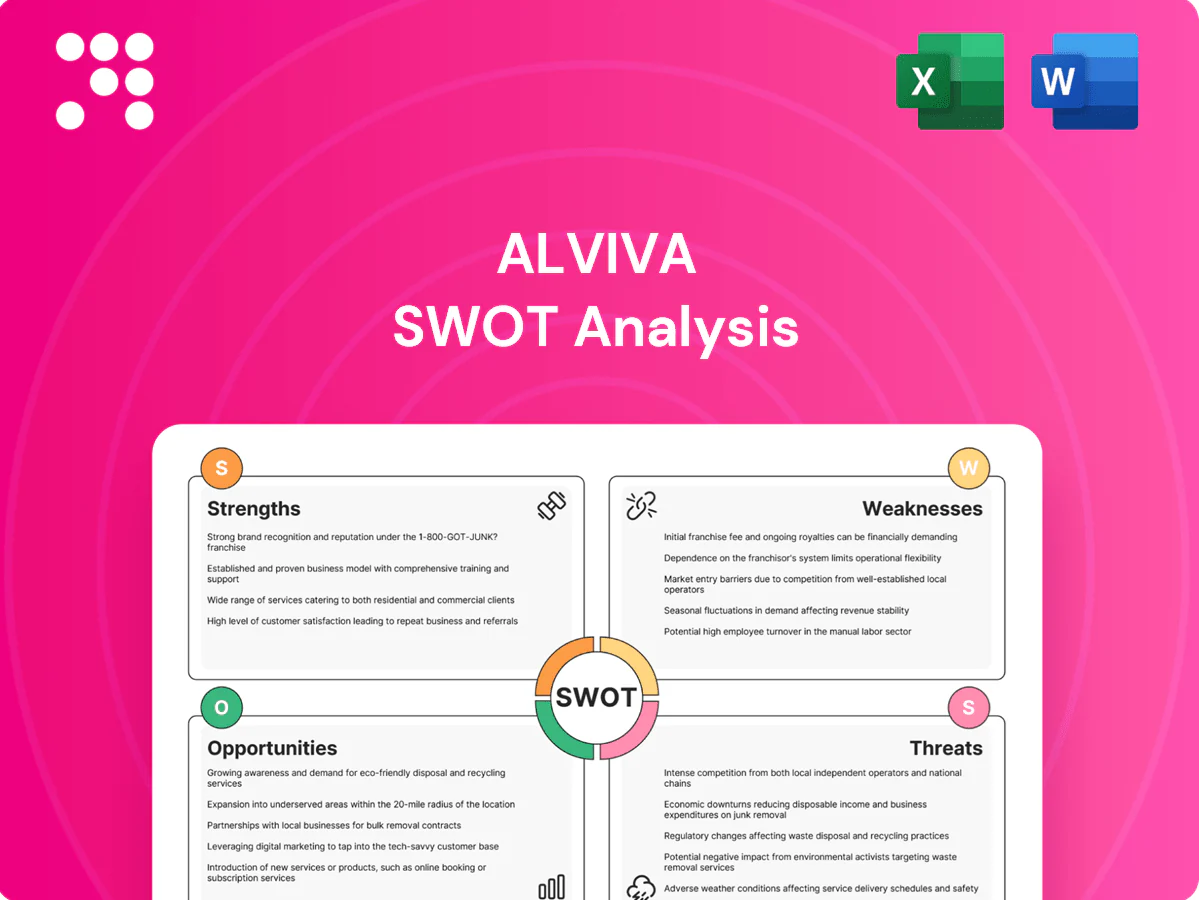
Alviva SWOT Analysis

Your Strategic Toolkit Starts Here
Alviva’s SWOT uncovers strong tech capabilities and diversified client base, balanced by execution risks and competitive pressures; growth opportunities lie in digital services and regional expansion. This snapshot highlights strategic trade-offs and near-term threats for investors and managers. Purchase the full SWOT analysis for a downloadable, editable Word and Excel report with research-backed recommendations to plan, pitch, or invest confidently.
Strengths

End-to-end ICT portfolio
Alviva delivers an end-to-end ICT portfolio across hardware, software and services, enabling bundled solutions and one-invoice procurement that drive cross-sell and upsell opportunities with enterprise and public clients, increase share-of-wallet, reduce vendor concentration at the solution level, and provide resilience across tech cycles while positioning the firm to capture lifecycle services from design through support.
Extensive reseller network
Alviva’s extensive reseller network delivers nationwide and regional channel reach that accelerates market penetration and lowers customer acquisition costs, backed by structured partner enablement and training programs that boost deal velocity. Tiered resellers and system integrators cover SMBs through large enterprises, creating a multi-segment funnel. These network effects—deep customer relationships, co-selling motion, and shared GTM assets—are costly for rivals to replicate.

Strong vendor partnerships
Preferred distributor status with major OEMs and software publishers grants Alviva prioritized allocations, rebates, MDF access and early product roadmaps, strengthening go-to-market timing. This status underpins credibility on complex bids and multi-vendor stacks, boosting procurement leverage and enabling competitive pricing for customers.

Embedded financing capability
- Frictionless credit and rental
- Higher conversion and AOV
- Recurring financing revenue
- Stronger service attach vs distributors
African market footprint
Alviva's deep local presence across African public and private sectors gives proven compliance know-how and strong ties to government procurement and major infrastructure programs, supporting bids on projects within a continental infrastructure gap estimated at about 170 billion USD/year (AfDB). The firm’s in-country logistics, importation channels and support teams reduce deployment time and cost, while rising digitization and ~46% internet penetration in Africa (ITU 2024) expand addressable demand.
- Local compliance + govt procurement links
- Logistics, importation & in-country support
- Growth tailwinds: digitization, 46% internet reach
End-to-end ICT bundles and embedded financing unlock Africa's multi-billion infra opportunity
Alviva offers end-to-end ICT bundles across hardware, software and services enabling higher share-of-wallet and lifecycle capture. A nationwide reseller network and preferred OEM status drive fast GTM, pricing leverage and hard-to-replicate channel effects. Embedded financing and strong local presence accelerate conversions, recurring revenue and bids on large public projects in Africa.
| Metric | Value / Source |
|---|---|
| Africa infra gap | ~170 billion USD/yr — AfDB |
| Internet penetration | ~46% — ITU 2024 |
| Channel | Nationwide tiered resellers |
What is included in the product
 Detailed Word Document
Provides a concise strategic overview of Alviva’s internal strengths and weaknesses and external opportunities and threats, highlighting key growth drivers, operational gaps, competitive position, and market risks shaping the company’s future.

 Customizable Excel Spreadsheet
Provides a clear SWOT matrix tailored to Alviva for rapid strategy alignment and pain-point resolution, enabling teams to pinpoint and address key risks and opportunities quickly. Editable format allows quick updates and easy integration into reports and presentations for fast stakeholder buy-in.
Weaknesses

Low-margin distribution
Structural gross margins in ICT distribution are narrow, typically 3–6% industry-wide. Pricing wars can shave 100–200 basis points and rebate timing can shift margin recognition and cashflow by weeks. High volumes are required to absorb fixed logistics and credit costs (~1–3% of revenue). Rigorous working-capital discipline (DSO commonly 45–75 days) is essential to protect returns.
Working capital intensity
Alviva carries heavy inventory and receivables burdens, with inventory days around 80 and receivables ~60 on large tenders and extended public sector payment terms, amplifying working capital intensity. Cash conversion cycle has shown volatility of +/-30 days year-on-year, increasing short-term funding needs and interest expense exposure as net debt rises. Fast-moving categories risk stock obsolescence without tight turnover controls. Rigorous credit vetting and hedging of FX/interest are essential to mitigate these exposures.

Integration complexity
Integration complexity arises from aligning Alviva’s hardware, software and services units, risking duplicated functions and systems across business lines. Industry studies show roughly 70% of M&A initiatives fail to capture projected synergies, underscoring execution risk in delivering cohesive end-to-end offerings. Change management and culture alignment from acquisitions can slow integration and increase operating costs.

Vendor rebate dependence
Heavy dependence on vendor rebates makes Alviva’s profit highly sensitive to OEM incentive programs and quarterly target resets, creating EBITDA volatility and margin compression when incentives shift mid-cycle. Forecasting becomes difficult as program rule changes or retroactive adjustments alter expected rebate flows, while sell-in timing can misalign with sell-through recognition, distorting reported revenue and working capital. Exposure rises if key vendors rationalize channels or tighten partner criteria, risking sudden rebate loss and customer displacement.
- Profit sensitivity: OEM incentives drive margin volatility
- Forecast risk: rule changes cause forecasting errors
- Recognition mismatch: sell-in vs sell-through timing
- Vendor concentration: channel rationalization risk
Concentration in South Africa
Alviva's concentration in South Africa exposes it to local macro swings, persistent Eskom load-shedding (Stages up to 6 reported in 2023–24) and lumpy public procurement cycles that create revenue timing risk. Rand volatility (around R18–R20/USD through 2024) and elevated interest rates increase financing costs and depress client demand. Complex B-BBEE and sector regulatory compliance complicate bid competitiveness and, without faster regional expansion, leave diversification limited.
- Exposure: South African macro & procurement
- Operational risk: load-shedding disruptions
- Financial: rand volatility; higher borrowing costs
- Regulatory: B-BBEE bid complexity
- Diversification: limited if regional growth lags
Thin ICT margins, rebate swings and heavy working capital amid R18–R20/USD and Eskom cuts
Thin ICT distribution margins (3–6%) and 100–200bps rebate swings compress EBITDA; heavy inventory (~80 days) and receivables (~60 days) heighten working-capital needs; integration and vendor-concentration risks impair synergy capture; SA exposure (rand R18–R20/USD; Eskom stages up to 6 in 2023–24) increases operational and financing strain.
| Metric | Value |
|---|---|
| Gross margin | 3–6% |
| Inventory days | ~80 |
| Receivables | ~60 |
| FX | R18–R20/USD |
Same Document Delivered
Alviva SWOT Analysis
This is the actual SWOT analysis document you’ll receive upon purchase—no surprises, just professional quality. The preview below is taken directly from the full report you'll get; purchase unlocks the complete, editable version. Buy now to download the full, detailed file.

Your Strategic Toolkit Starts Here
Alviva’s SWOT uncovers strong tech capabilities and diversified client base, balanced by execution risks and competitive pressures; growth opportunities lie in digital services and regional expansion. This snapshot highlights strategic trade-offs and near-term threats for investors and managers. Purchase the full SWOT analysis for a downloadable, editable Word and Excel report with research-backed recommendations to plan, pitch, or invest confidently.
Strengths
End-to-end ICT portfolio
Alviva delivers an end-to-end ICT portfolio across hardware, software and services, enabling bundled solutions and one-invoice procurement that drive cross-sell and upsell opportunities with enterprise and public clients, increase share-of-wallet, reduce vendor concentration at the solution level, and provide resilience across tech cycles while positioning the firm to capture lifecycle services from design through support.
Extensive reseller network
Alviva’s extensive reseller network delivers nationwide and regional channel reach that accelerates market penetration and lowers customer acquisition costs, backed by structured partner enablement and training programs that boost deal velocity. Tiered resellers and system integrators cover SMBs through large enterprises, creating a multi-segment funnel. These network effects—deep customer relationships, co-selling motion, and shared GTM assets—are costly for rivals to replicate.
Strong vendor partnerships
Preferred distributor status with major OEMs and software publishers grants Alviva prioritized allocations, rebates, MDF access and early product roadmaps, strengthening go-to-market timing. This status underpins credibility on complex bids and multi-vendor stacks, boosting procurement leverage and enabling competitive pricing for customers.
Embedded financing capability
- Frictionless credit and rental
- Higher conversion and AOV
- Recurring financing revenue
- Stronger service attach vs distributors
African market footprint
Alviva's deep local presence across African public and private sectors gives proven compliance know-how and strong ties to government procurement and major infrastructure programs, supporting bids on projects within a continental infrastructure gap estimated at about 170 billion USD/year (AfDB). The firm’s in-country logistics, importation channels and support teams reduce deployment time and cost, while rising digitization and ~46% internet penetration in Africa (ITU 2024) expand addressable demand.
- Local compliance + govt procurement links
- Logistics, importation & in-country support
- Growth tailwinds: digitization, 46% internet reach
End-to-end ICT bundles and embedded financing unlock Africa's multi-billion infra opportunity
Alviva offers end-to-end ICT bundles across hardware, software and services enabling higher share-of-wallet and lifecycle capture. A nationwide reseller network and preferred OEM status drive fast GTM, pricing leverage and hard-to-replicate channel effects. Embedded financing and strong local presence accelerate conversions, recurring revenue and bids on large public projects in Africa.
| Metric | Value / Source |
|---|---|
| Africa infra gap | ~170 billion USD/yr — AfDB |
| Internet penetration | ~46% — ITU 2024 |
| Channel | Nationwide tiered resellers |
What is included in the product
Detailed Word Document
Provides a concise strategic overview of Alviva’s internal strengths and weaknesses and external opportunities and threats, highlighting key growth drivers, operational gaps, competitive position, and market risks shaping the company’s future.
Customizable Excel Spreadsheet
Provides a clear SWOT matrix tailored to Alviva for rapid strategy alignment and pain-point resolution, enabling teams to pinpoint and address key risks and opportunities quickly. Editable format allows quick updates and easy integration into reports and presentations for fast stakeholder buy-in.
Weaknesses
Low-margin distribution
Structural gross margins in ICT distribution are narrow, typically 3–6% industry-wide. Pricing wars can shave 100–200 basis points and rebate timing can shift margin recognition and cashflow by weeks. High volumes are required to absorb fixed logistics and credit costs (~1–3% of revenue). Rigorous working-capital discipline (DSO commonly 45–75 days) is essential to protect returns.
Working capital intensity
Alviva carries heavy inventory and receivables burdens, with inventory days around 80 and receivables ~60 on large tenders and extended public sector payment terms, amplifying working capital intensity. Cash conversion cycle has shown volatility of +/-30 days year-on-year, increasing short-term funding needs and interest expense exposure as net debt rises. Fast-moving categories risk stock obsolescence without tight turnover controls. Rigorous credit vetting and hedging of FX/interest are essential to mitigate these exposures.
Integration complexity
Integration complexity arises from aligning Alviva’s hardware, software and services units, risking duplicated functions and systems across business lines. Industry studies show roughly 70% of M&A initiatives fail to capture projected synergies, underscoring execution risk in delivering cohesive end-to-end offerings. Change management and culture alignment from acquisitions can slow integration and increase operating costs.
Vendor rebate dependence
Heavy dependence on vendor rebates makes Alviva’s profit highly sensitive to OEM incentive programs and quarterly target resets, creating EBITDA volatility and margin compression when incentives shift mid-cycle. Forecasting becomes difficult as program rule changes or retroactive adjustments alter expected rebate flows, while sell-in timing can misalign with sell-through recognition, distorting reported revenue and working capital. Exposure rises if key vendors rationalize channels or tighten partner criteria, risking sudden rebate loss and customer displacement.
- Profit sensitivity: OEM incentives drive margin volatility
- Forecast risk: rule changes cause forecasting errors
- Recognition mismatch: sell-in vs sell-through timing
- Vendor concentration: channel rationalization risk
Concentration in South Africa
Alviva's concentration in South Africa exposes it to local macro swings, persistent Eskom load-shedding (Stages up to 6 reported in 2023–24) and lumpy public procurement cycles that create revenue timing risk. Rand volatility (around R18–R20/USD through 2024) and elevated interest rates increase financing costs and depress client demand. Complex B-BBEE and sector regulatory compliance complicate bid competitiveness and, without faster regional expansion, leave diversification limited.
- Exposure: South African macro & procurement
- Operational risk: load-shedding disruptions
- Financial: rand volatility; higher borrowing costs
- Regulatory: B-BBEE bid complexity
- Diversification: limited if regional growth lags
Thin ICT margins, rebate swings and heavy working capital amid R18–R20/USD and Eskom cuts
Thin ICT distribution margins (3–6%) and 100–200bps rebate swings compress EBITDA; heavy inventory (~80 days) and receivables (~60 days) heighten working-capital needs; integration and vendor-concentration risks impair synergy capture; SA exposure (rand R18–R20/USD; Eskom stages up to 6 in 2023–24) increases operational and financing strain.
| Metric | Value |
|---|---|
| Gross margin | 3–6% |
| Inventory days | ~80 |
| Receivables | ~60 |
| FX | R18–R20/USD |
Same Document Delivered
Alviva SWOT Analysis
This is the actual SWOT analysis document you’ll receive upon purchase—no surprises, just professional quality. The preview below is taken directly from the full report you'll get; purchase unlocks the complete, editable version. Buy now to download the full, detailed file.
Description
Your Strategic Toolkit Starts Here
Alviva’s SWOT uncovers strong tech capabilities and diversified client base, balanced by execution risks and competitive pressures; growth opportunities lie in digital services and regional expansion. This snapshot highlights strategic trade-offs and near-term threats for investors and managers. Purchase the full SWOT analysis for a downloadable, editable Word and Excel report with research-backed recommendations to plan, pitch, or invest confidently.
Strengths
End-to-end ICT portfolio
Alviva delivers an end-to-end ICT portfolio across hardware, software and services, enabling bundled solutions and one-invoice procurement that drive cross-sell and upsell opportunities with enterprise and public clients, increase share-of-wallet, reduce vendor concentration at the solution level, and provide resilience across tech cycles while positioning the firm to capture lifecycle services from design through support.
Extensive reseller network
Alviva’s extensive reseller network delivers nationwide and regional channel reach that accelerates market penetration and lowers customer acquisition costs, backed by structured partner enablement and training programs that boost deal velocity. Tiered resellers and system integrators cover SMBs through large enterprises, creating a multi-segment funnel. These network effects—deep customer relationships, co-selling motion, and shared GTM assets—are costly for rivals to replicate.
Strong vendor partnerships
Preferred distributor status with major OEMs and software publishers grants Alviva prioritized allocations, rebates, MDF access and early product roadmaps, strengthening go-to-market timing. This status underpins credibility on complex bids and multi-vendor stacks, boosting procurement leverage and enabling competitive pricing for customers.
Embedded financing capability
- Frictionless credit and rental
- Higher conversion and AOV
- Recurring financing revenue
- Stronger service attach vs distributors
African market footprint
Alviva's deep local presence across African public and private sectors gives proven compliance know-how and strong ties to government procurement and major infrastructure programs, supporting bids on projects within a continental infrastructure gap estimated at about 170 billion USD/year (AfDB). The firm’s in-country logistics, importation channels and support teams reduce deployment time and cost, while rising digitization and ~46% internet penetration in Africa (ITU 2024) expand addressable demand.
- Local compliance + govt procurement links
- Logistics, importation & in-country support
- Growth tailwinds: digitization, 46% internet reach
End-to-end ICT bundles and embedded financing unlock Africa's multi-billion infra opportunity
Alviva offers end-to-end ICT bundles across hardware, software and services enabling higher share-of-wallet and lifecycle capture. A nationwide reseller network and preferred OEM status drive fast GTM, pricing leverage and hard-to-replicate channel effects. Embedded financing and strong local presence accelerate conversions, recurring revenue and bids on large public projects in Africa.
| Metric | Value / Source |
|---|---|
| Africa infra gap | ~170 billion USD/yr — AfDB |
| Internet penetration | ~46% — ITU 2024 |
| Channel | Nationwide tiered resellers |
What is included in the product
Detailed Word Document
Provides a concise strategic overview of Alviva’s internal strengths and weaknesses and external opportunities and threats, highlighting key growth drivers, operational gaps, competitive position, and market risks shaping the company’s future.
Customizable Excel Spreadsheet
Provides a clear SWOT matrix tailored to Alviva for rapid strategy alignment and pain-point resolution, enabling teams to pinpoint and address key risks and opportunities quickly. Editable format allows quick updates and easy integration into reports and presentations for fast stakeholder buy-in.
Weaknesses
Low-margin distribution
Structural gross margins in ICT distribution are narrow, typically 3–6% industry-wide. Pricing wars can shave 100–200 basis points and rebate timing can shift margin recognition and cashflow by weeks. High volumes are required to absorb fixed logistics and credit costs (~1–3% of revenue). Rigorous working-capital discipline (DSO commonly 45–75 days) is essential to protect returns.
Working capital intensity
Alviva carries heavy inventory and receivables burdens, with inventory days around 80 and receivables ~60 on large tenders and extended public sector payment terms, amplifying working capital intensity. Cash conversion cycle has shown volatility of +/-30 days year-on-year, increasing short-term funding needs and interest expense exposure as net debt rises. Fast-moving categories risk stock obsolescence without tight turnover controls. Rigorous credit vetting and hedging of FX/interest are essential to mitigate these exposures.
Integration complexity
Integration complexity arises from aligning Alviva’s hardware, software and services units, risking duplicated functions and systems across business lines. Industry studies show roughly 70% of M&A initiatives fail to capture projected synergies, underscoring execution risk in delivering cohesive end-to-end offerings. Change management and culture alignment from acquisitions can slow integration and increase operating costs.
Vendor rebate dependence
Heavy dependence on vendor rebates makes Alviva’s profit highly sensitive to OEM incentive programs and quarterly target resets, creating EBITDA volatility and margin compression when incentives shift mid-cycle. Forecasting becomes difficult as program rule changes or retroactive adjustments alter expected rebate flows, while sell-in timing can misalign with sell-through recognition, distorting reported revenue and working capital. Exposure rises if key vendors rationalize channels or tighten partner criteria, risking sudden rebate loss and customer displacement.
- Profit sensitivity: OEM incentives drive margin volatility
- Forecast risk: rule changes cause forecasting errors
- Recognition mismatch: sell-in vs sell-through timing
- Vendor concentration: channel rationalization risk
Concentration in South Africa
Alviva's concentration in South Africa exposes it to local macro swings, persistent Eskom load-shedding (Stages up to 6 reported in 2023–24) and lumpy public procurement cycles that create revenue timing risk. Rand volatility (around R18–R20/USD through 2024) and elevated interest rates increase financing costs and depress client demand. Complex B-BBEE and sector regulatory compliance complicate bid competitiveness and, without faster regional expansion, leave diversification limited.
- Exposure: South African macro & procurement
- Operational risk: load-shedding disruptions
- Financial: rand volatility; higher borrowing costs
- Regulatory: B-BBEE bid complexity
- Diversification: limited if regional growth lags
Thin ICT margins, rebate swings and heavy working capital amid R18–R20/USD and Eskom cuts
Thin ICT distribution margins (3–6%) and 100–200bps rebate swings compress EBITDA; heavy inventory (~80 days) and receivables (~60 days) heighten working-capital needs; integration and vendor-concentration risks impair synergy capture; SA exposure (rand R18–R20/USD; Eskom stages up to 6 in 2023–24) increases operational and financing strain.
| Metric | Value |
|---|---|
| Gross margin | 3–6% |
| Inventory days | ~80 |
| Receivables | ~60 |
| FX | R18–R20/USD |
Same Document Delivered
Alviva SWOT Analysis
This is the actual SWOT analysis document you’ll receive upon purchase—no surprises, just professional quality. The preview below is taken directly from the full report you'll get; purchase unlocks the complete, editable version. Buy now to download the full, detailed file.











