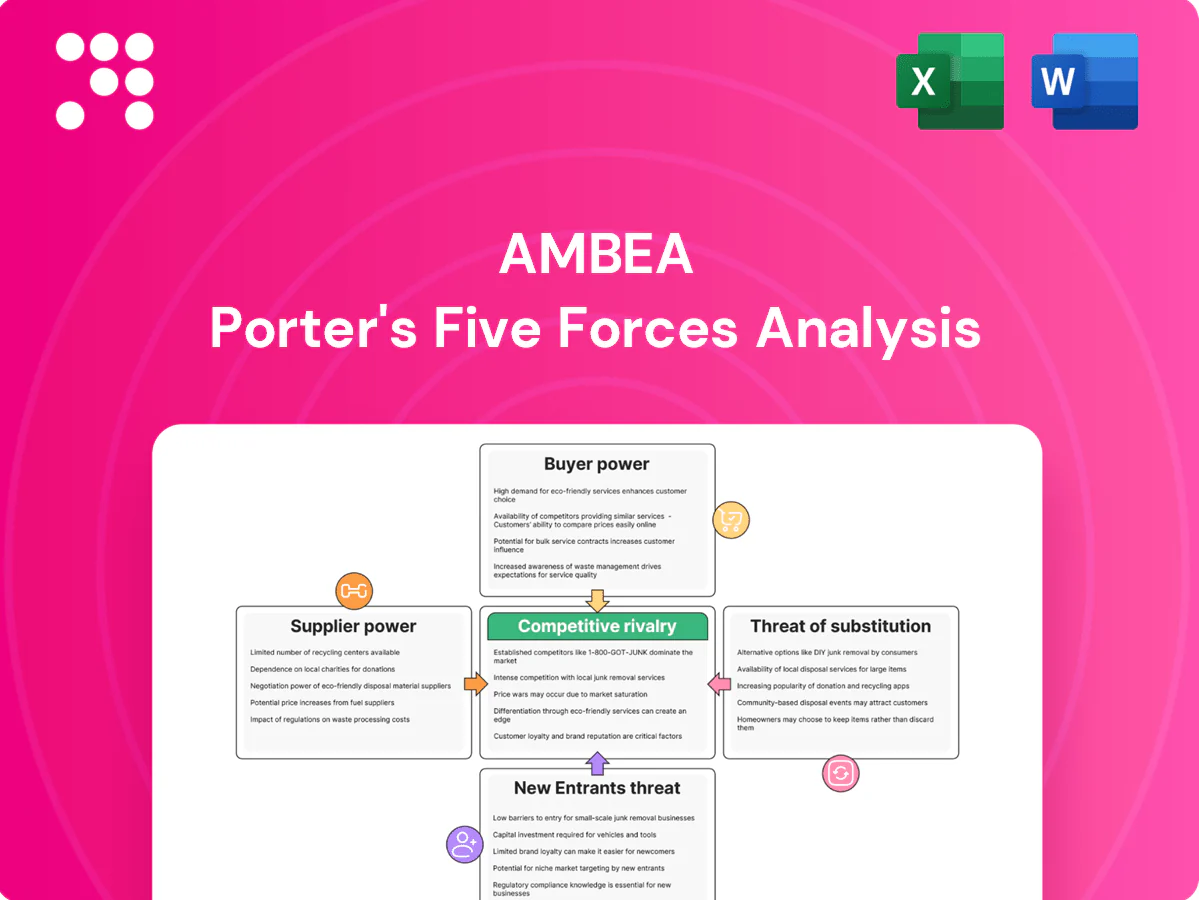
Ambea Porter's Five Forces Analysis

Elevate Your Analysis with the Complete Porter's Five Forces Analysis
Ambea faces moderate buyer power and fragmented supplier influence, while regulatory pressures and aging population trends shape demand; competitive rivalry is intense among regional care providers. This brief snapshot only scratches the surface. Unlock the full Porter's Five Forces Analysis to explore Ambea’s competitive dynamics, market pressures, and strategic advantages in detail.
Suppliers Bargaining Power

Scarce skilled labor
Registered nurses, care assistants and specialists are critical inputs and remain scarce across the Nordics, with double-digit vacancy rates reported in 2024, increasing suppliers’ bargaining power. Strong unions and collective bargaining set wage floors and recent 2024 wage settlements have pushed base pay and overtime premiums higher, inflating operating costs. Ambea counters through expanded training programs, employer branding and flexible staffing models to reduce reliance on external hires.
Staffing agencies leverage
Staffing agencies fill peak demand and sick‑leave gaps for Ambea but charge premiums—industry surveys in 2024 show agency rates commonly 25–60% above permanent-staff cost—raising supplier leverage. Dependence spikes during flu seasons and regulatory inspections, amplifying short-term supplier power. Long-term framework agreements cap rates and predictability. Building internal float pools reduces exposure and overall agency spend.

Regulated pharmaceuticals & medical supplies
Key consumables come from concentrated, regulated vendors: top 5 global pharmaceutical firms account for roughly 50–55% of prescription drug sales, while top device makers hold about 40–50% of market share. Compliance and product standardization limit substitution options. National tender frameworks for generics often cut prices 20–80%, damping prices but constraining flexibility. Inventory management and multi‑sourcing reduce single‑vendor risk and stockouts.

Real estate and facility services
- Narrow landlord pool
- Location scarcity
- Index‑linked long leases
- Build‑to‑suit/PPP as leverage
Digital systems & accreditation providers
EHR, scheduling and quality systems create tangible switching costs for Ambea via staff retraining and data migration; the global EHR market was estimated at about $40 billion in 2024, reinforcing vendor leverage. Vendor lock-in raises supplier power and outage risk, while mandatory certifications and external audits impose recurring compliance costs. Open APIs and phased migrations can reduce lock-in and restore negotiating leverage.
- High switching costs
- Vendor lock-in & outage risk
- Mandatory audit costs
- Open APIs/phased migration = leverage
Supplier power: double-digit vacancies; agencies +25-60%; top firms ~50-55%
Suppliers exert moderate‑to‑high power: staff shortages (double‑digit vacancy rates in 2024) and strong unions push wages up; agencies charge 25–60% premiums vs permanent staff; top pharma/device firms hold ~50% market share, limiting substitutes; EHR vendor lock‑in (global market ~$40bn in 2024) raises switching costs.
| Metric | 2024 value |
|---|---|
| Vacancy rates | Double‑digit |
| Agency premium | 25–60% |
| Pharma market share (top5) | 50–55% |
| EHR market | $40bn |
What is included in the product
 Detailed Word Document
Concise Porter's Five Forces analysis tailored to Ambea, evaluating competitive rivalry, supplier and buyer power, threat of substitutes and new entrants, and strategic implications for pricing and market positioning.

 Customizable Excel Spreadsheet
Clear one-sheet Porter's Five Forces tailored to Ambea—instantly reveal competitive pressures in eldercare and home services for fast strategic decisions; customize force levels, swap in current data, and export a clean spider chart or slide-ready summary for boardrooms and care-unit planning.
Customers Bargaining Power

Municipal and regional procurement
Public-sector tenders dominate Ambea demand with strict quality KPIs and price caps; EU public procurement accounts for roughly 12% of GDP, reflecting large buyer scale. Professional municipal procurement teams compress margins and drive tougher terms, while framework contracts—typically 3–5 years—intensify price negotiations. Performance scoring directly influences renewal probability and allowed rate adjustments.
Budget cycles and political shifts
Local government budget reallocations and policy shifts directly alter care volumes and pricing, raising buyer power when municipalities prioritize in‑house provision or cut external funding. Austerity cycles and political prioritization strengthen procurement leverage, while election cycles introduce contract uncertainty and renegotiation risk. Geographic diversification across municipalities and countries smooths exposure and reduces dependence on any single buyer.

Standardized service specs
Tenders often standardize scope, making offers directly comparable and price-driven; in the EU public procurement represented about 14% of GDP in 2024, amplifying buyer leverage. Differentiation for Ambea then hinges on measurable outcomes and patient satisfaction, compressing quality premiums unless KPIs explicitly reward them. Robust documented outcomes and third-party audits can defend pricing by linking payments to verified results.

Switching and re-tendering ease
Contracts are periodically re‑tendered (2024: Swedish municipal procurements typically 3–5 year cycles), enabling switching at defined intervals. Transition costs exist but are budgeted into public processes, limiting supplier lock‑in. Material performance issues can trigger early termination, while strong continuity metrics and transition support reduce churn risk.
- Re‑tender window: 3–5 years
- Transition costs planned into procurement
- Early termination for poor performance
- Continuity metrics lower churn
Private pay segments smaller
Individual private payers in home care and disability services exhibit high price sensitivity but represent a smaller volume of Ambea’s client base in 2024, increasing micro-level buyer power as they can shop across providers; brand strength and local reputation therefore disproportionately influence client choice. Bundled offerings and transparent pricing reduce churn and raise switching costs, supporting retention.
- Higher price sensitivity among private payers
- Smaller volume but active comparison shopping
- Brand/local reputation drives selection
- Bundling + transparent pricing = improved retention
Public tenders set prices: EU procurement ~14% GDP, 3–5yr frameworks
Public tenders drive procurement with strict KPIs, price caps and 3–5 year framework contracts that concentrate buyer leverage. EU public procurement equaled about 14% of GDP in 2024, amplifying municipal bargaining power and renewal-linked pricing. Private payers remain smaller in volume in 2024 but are highly price-sensitive, making brand and outcomes critical to defend margins.
| Metric | Value (2024) |
|---|---|
| EU public procurement | ~14% GDP |
| Typical re-tender cycle (Sweden) | 3–5 years |
| Private payer volume | Smaller share vs public (2024) |
Full Version Awaits
Ambea Porter's Five Forces Analysis
This preview shows the exact Ambea Porter's Five Forces Analysis you'll receive after purchase—no samples, no placeholders. The full document is professionally formatted, fully referenced and ready for immediate download and use the moment you complete payment. You're viewing the final deliverable, identical to the file that will be available to you instantly.

Elevate Your Analysis with the Complete Porter's Five Forces Analysis
Ambea faces moderate buyer power and fragmented supplier influence, while regulatory pressures and aging population trends shape demand; competitive rivalry is intense among regional care providers. This brief snapshot only scratches the surface. Unlock the full Porter's Five Forces Analysis to explore Ambea’s competitive dynamics, market pressures, and strategic advantages in detail.
Suppliers Bargaining Power
Scarce skilled labor
Registered nurses, care assistants and specialists are critical inputs and remain scarce across the Nordics, with double-digit vacancy rates reported in 2024, increasing suppliers’ bargaining power. Strong unions and collective bargaining set wage floors and recent 2024 wage settlements have pushed base pay and overtime premiums higher, inflating operating costs. Ambea counters through expanded training programs, employer branding and flexible staffing models to reduce reliance on external hires.
Staffing agencies leverage
Staffing agencies fill peak demand and sick‑leave gaps for Ambea but charge premiums—industry surveys in 2024 show agency rates commonly 25–60% above permanent-staff cost—raising supplier leverage. Dependence spikes during flu seasons and regulatory inspections, amplifying short-term supplier power. Long-term framework agreements cap rates and predictability. Building internal float pools reduces exposure and overall agency spend.
Regulated pharmaceuticals & medical supplies
Key consumables come from concentrated, regulated vendors: top 5 global pharmaceutical firms account for roughly 50–55% of prescription drug sales, while top device makers hold about 40–50% of market share. Compliance and product standardization limit substitution options. National tender frameworks for generics often cut prices 20–80%, damping prices but constraining flexibility. Inventory management and multi‑sourcing reduce single‑vendor risk and stockouts.
Real estate and facility services
- Narrow landlord pool
- Location scarcity
- Index‑linked long leases
- Build‑to‑suit/PPP as leverage
Digital systems & accreditation providers
EHR, scheduling and quality systems create tangible switching costs for Ambea via staff retraining and data migration; the global EHR market was estimated at about $40 billion in 2024, reinforcing vendor leverage. Vendor lock-in raises supplier power and outage risk, while mandatory certifications and external audits impose recurring compliance costs. Open APIs and phased migrations can reduce lock-in and restore negotiating leverage.
- High switching costs
- Vendor lock-in & outage risk
- Mandatory audit costs
- Open APIs/phased migration = leverage
Supplier power: double-digit vacancies; agencies +25-60%; top firms ~50-55%
Suppliers exert moderate‑to‑high power: staff shortages (double‑digit vacancy rates in 2024) and strong unions push wages up; agencies charge 25–60% premiums vs permanent staff; top pharma/device firms hold ~50% market share, limiting substitutes; EHR vendor lock‑in (global market ~$40bn in 2024) raises switching costs.
| Metric | 2024 value |
|---|---|
| Vacancy rates | Double‑digit |
| Agency premium | 25–60% |
| Pharma market share (top5) | 50–55% |
| EHR market | $40bn |
What is included in the product
Detailed Word Document
Concise Porter's Five Forces analysis tailored to Ambea, evaluating competitive rivalry, supplier and buyer power, threat of substitutes and new entrants, and strategic implications for pricing and market positioning.
Customizable Excel Spreadsheet
Clear one-sheet Porter's Five Forces tailored to Ambea—instantly reveal competitive pressures in eldercare and home services for fast strategic decisions; customize force levels, swap in current data, and export a clean spider chart or slide-ready summary for boardrooms and care-unit planning.
Customers Bargaining Power
Municipal and regional procurement
Public-sector tenders dominate Ambea demand with strict quality KPIs and price caps; EU public procurement accounts for roughly 12% of GDP, reflecting large buyer scale. Professional municipal procurement teams compress margins and drive tougher terms, while framework contracts—typically 3–5 years—intensify price negotiations. Performance scoring directly influences renewal probability and allowed rate adjustments.
Budget cycles and political shifts
Local government budget reallocations and policy shifts directly alter care volumes and pricing, raising buyer power when municipalities prioritize in‑house provision or cut external funding. Austerity cycles and political prioritization strengthen procurement leverage, while election cycles introduce contract uncertainty and renegotiation risk. Geographic diversification across municipalities and countries smooths exposure and reduces dependence on any single buyer.
Standardized service specs
Tenders often standardize scope, making offers directly comparable and price-driven; in the EU public procurement represented about 14% of GDP in 2024, amplifying buyer leverage. Differentiation for Ambea then hinges on measurable outcomes and patient satisfaction, compressing quality premiums unless KPIs explicitly reward them. Robust documented outcomes and third-party audits can defend pricing by linking payments to verified results.
Switching and re-tendering ease
Contracts are periodically re‑tendered (2024: Swedish municipal procurements typically 3–5 year cycles), enabling switching at defined intervals. Transition costs exist but are budgeted into public processes, limiting supplier lock‑in. Material performance issues can trigger early termination, while strong continuity metrics and transition support reduce churn risk.
- Re‑tender window: 3–5 years
- Transition costs planned into procurement
- Early termination for poor performance
- Continuity metrics lower churn
Private pay segments smaller
Individual private payers in home care and disability services exhibit high price sensitivity but represent a smaller volume of Ambea’s client base in 2024, increasing micro-level buyer power as they can shop across providers; brand strength and local reputation therefore disproportionately influence client choice. Bundled offerings and transparent pricing reduce churn and raise switching costs, supporting retention.
- Higher price sensitivity among private payers
- Smaller volume but active comparison shopping
- Brand/local reputation drives selection
- Bundling + transparent pricing = improved retention
Public tenders set prices: EU procurement ~14% GDP, 3–5yr frameworks
Public tenders drive procurement with strict KPIs, price caps and 3–5 year framework contracts that concentrate buyer leverage. EU public procurement equaled about 14% of GDP in 2024, amplifying municipal bargaining power and renewal-linked pricing. Private payers remain smaller in volume in 2024 but are highly price-sensitive, making brand and outcomes critical to defend margins.
| Metric | Value (2024) |
|---|---|
| EU public procurement | ~14% GDP |
| Typical re-tender cycle (Sweden) | 3–5 years |
| Private payer volume | Smaller share vs public (2024) |
Full Version Awaits
Ambea Porter's Five Forces Analysis
This preview shows the exact Ambea Porter's Five Forces Analysis you'll receive after purchase—no samples, no placeholders. The full document is professionally formatted, fully referenced and ready for immediate download and use the moment you complete payment. You're viewing the final deliverable, identical to the file that will be available to you instantly.
Description
Elevate Your Analysis with the Complete Porter's Five Forces Analysis
Ambea faces moderate buyer power and fragmented supplier influence, while regulatory pressures and aging population trends shape demand; competitive rivalry is intense among regional care providers. This brief snapshot only scratches the surface. Unlock the full Porter's Five Forces Analysis to explore Ambea’s competitive dynamics, market pressures, and strategic advantages in detail.
Suppliers Bargaining Power
Scarce skilled labor
Registered nurses, care assistants and specialists are critical inputs and remain scarce across the Nordics, with double-digit vacancy rates reported in 2024, increasing suppliers’ bargaining power. Strong unions and collective bargaining set wage floors and recent 2024 wage settlements have pushed base pay and overtime premiums higher, inflating operating costs. Ambea counters through expanded training programs, employer branding and flexible staffing models to reduce reliance on external hires.
Staffing agencies leverage
Staffing agencies fill peak demand and sick‑leave gaps for Ambea but charge premiums—industry surveys in 2024 show agency rates commonly 25–60% above permanent-staff cost—raising supplier leverage. Dependence spikes during flu seasons and regulatory inspections, amplifying short-term supplier power. Long-term framework agreements cap rates and predictability. Building internal float pools reduces exposure and overall agency spend.
Regulated pharmaceuticals & medical supplies
Key consumables come from concentrated, regulated vendors: top 5 global pharmaceutical firms account for roughly 50–55% of prescription drug sales, while top device makers hold about 40–50% of market share. Compliance and product standardization limit substitution options. National tender frameworks for generics often cut prices 20–80%, damping prices but constraining flexibility. Inventory management and multi‑sourcing reduce single‑vendor risk and stockouts.
Real estate and facility services
- Narrow landlord pool
- Location scarcity
- Index‑linked long leases
- Build‑to‑suit/PPP as leverage
Digital systems & accreditation providers
EHR, scheduling and quality systems create tangible switching costs for Ambea via staff retraining and data migration; the global EHR market was estimated at about $40 billion in 2024, reinforcing vendor leverage. Vendor lock-in raises supplier power and outage risk, while mandatory certifications and external audits impose recurring compliance costs. Open APIs and phased migrations can reduce lock-in and restore negotiating leverage.
- High switching costs
- Vendor lock-in & outage risk
- Mandatory audit costs
- Open APIs/phased migration = leverage
Supplier power: double-digit vacancies; agencies +25-60%; top firms ~50-55%
Suppliers exert moderate‑to‑high power: staff shortages (double‑digit vacancy rates in 2024) and strong unions push wages up; agencies charge 25–60% premiums vs permanent staff; top pharma/device firms hold ~50% market share, limiting substitutes; EHR vendor lock‑in (global market ~$40bn in 2024) raises switching costs.
| Metric | 2024 value |
|---|---|
| Vacancy rates | Double‑digit |
| Agency premium | 25–60% |
| Pharma market share (top5) | 50–55% |
| EHR market | $40bn |
What is included in the product
Detailed Word Document
Concise Porter's Five Forces analysis tailored to Ambea, evaluating competitive rivalry, supplier and buyer power, threat of substitutes and new entrants, and strategic implications for pricing and market positioning.
Customizable Excel Spreadsheet
Clear one-sheet Porter's Five Forces tailored to Ambea—instantly reveal competitive pressures in eldercare and home services for fast strategic decisions; customize force levels, swap in current data, and export a clean spider chart or slide-ready summary for boardrooms and care-unit planning.
Customers Bargaining Power
Municipal and regional procurement
Public-sector tenders dominate Ambea demand with strict quality KPIs and price caps; EU public procurement accounts for roughly 12% of GDP, reflecting large buyer scale. Professional municipal procurement teams compress margins and drive tougher terms, while framework contracts—typically 3–5 years—intensify price negotiations. Performance scoring directly influences renewal probability and allowed rate adjustments.
Budget cycles and political shifts
Local government budget reallocations and policy shifts directly alter care volumes and pricing, raising buyer power when municipalities prioritize in‑house provision or cut external funding. Austerity cycles and political prioritization strengthen procurement leverage, while election cycles introduce contract uncertainty and renegotiation risk. Geographic diversification across municipalities and countries smooths exposure and reduces dependence on any single buyer.
Standardized service specs
Tenders often standardize scope, making offers directly comparable and price-driven; in the EU public procurement represented about 14% of GDP in 2024, amplifying buyer leverage. Differentiation for Ambea then hinges on measurable outcomes and patient satisfaction, compressing quality premiums unless KPIs explicitly reward them. Robust documented outcomes and third-party audits can defend pricing by linking payments to verified results.
Switching and re-tendering ease
Contracts are periodically re‑tendered (2024: Swedish municipal procurements typically 3–5 year cycles), enabling switching at defined intervals. Transition costs exist but are budgeted into public processes, limiting supplier lock‑in. Material performance issues can trigger early termination, while strong continuity metrics and transition support reduce churn risk.
- Re‑tender window: 3–5 years
- Transition costs planned into procurement
- Early termination for poor performance
- Continuity metrics lower churn
Private pay segments smaller
Individual private payers in home care and disability services exhibit high price sensitivity but represent a smaller volume of Ambea’s client base in 2024, increasing micro-level buyer power as they can shop across providers; brand strength and local reputation therefore disproportionately influence client choice. Bundled offerings and transparent pricing reduce churn and raise switching costs, supporting retention.
- Higher price sensitivity among private payers
- Smaller volume but active comparison shopping
- Brand/local reputation drives selection
- Bundling + transparent pricing = improved retention
Public tenders set prices: EU procurement ~14% GDP, 3–5yr frameworks
Public tenders drive procurement with strict KPIs, price caps and 3–5 year framework contracts that concentrate buyer leverage. EU public procurement equaled about 14% of GDP in 2024, amplifying municipal bargaining power and renewal-linked pricing. Private payers remain smaller in volume in 2024 but are highly price-sensitive, making brand and outcomes critical to defend margins.
| Metric | Value (2024) |
|---|---|
| EU public procurement | ~14% GDP |
| Typical re-tender cycle (Sweden) | 3–5 years |
| Private payer volume | Smaller share vs public (2024) |
Full Version Awaits
Ambea Porter's Five Forces Analysis
This preview shows the exact Ambea Porter's Five Forces Analysis you'll receive after purchase—no samples, no placeholders. The full document is professionally formatted, fully referenced and ready for immediate download and use the moment you complete payment. You're viewing the final deliverable, identical to the file that will be available to you instantly.











