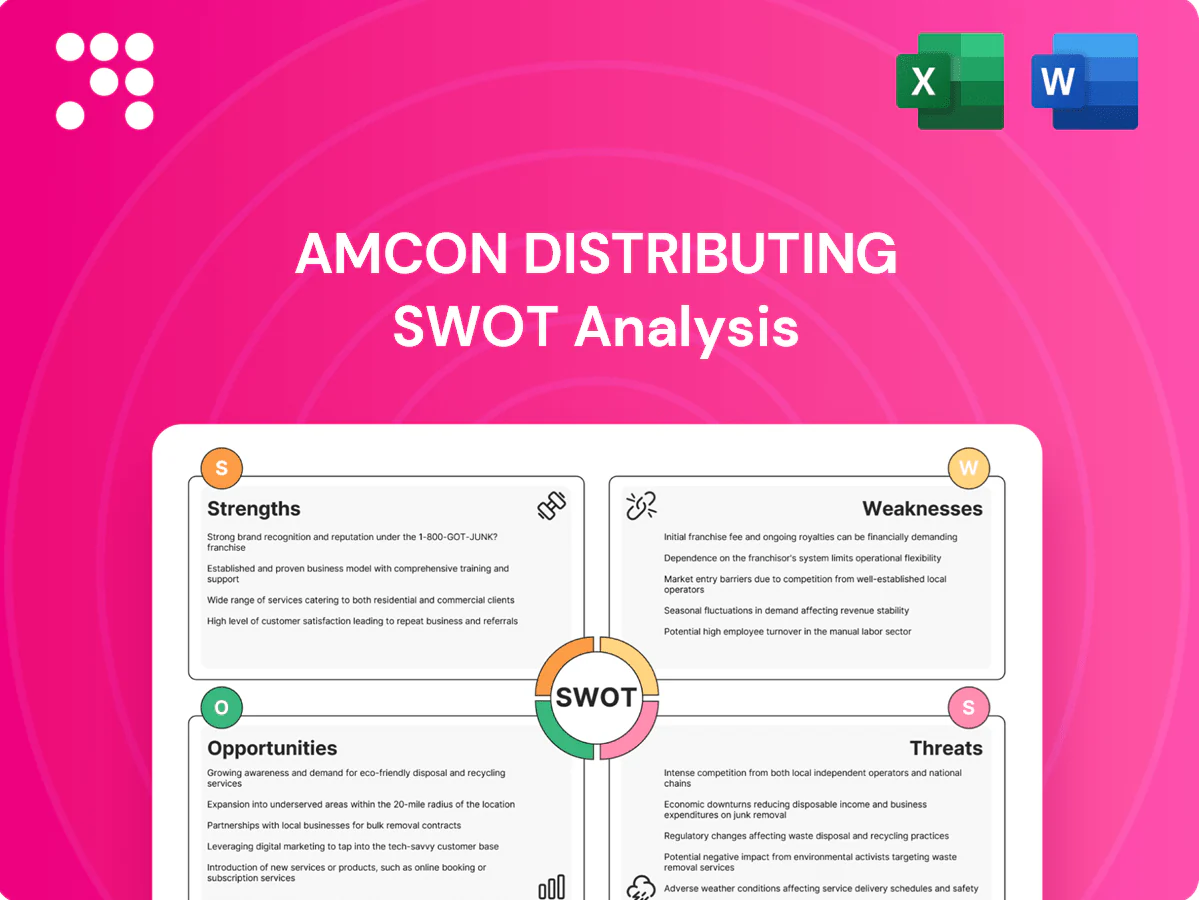
AMCON Distributing SWOT Analysis

Dive Deeper Into the Company’s Strategic Blueprint
AMCON Distributing shows resilient distribution networks and niche product reach but faces margin pressure from rising logistics costs and competitive national chains, with digital commerce execution a key growth hinge.
Discover the full SWOT report for deep, research-backed insights, editable Word and Excel deliverables, and strategic takeaways to inform investment or operational decisions—purchase now.
Strengths

Broad product portfolio
AMCON Distributing's broad product portfolio spanning cigarettes, tobacco, candy, groceries, beverages, foodservice, and automotive supplies diversifies revenue streams and reduces reliance on any single category. This mix supports basket-building and higher order frequency as retailers consolidate orders. Retail customers favor one-stop wholesalers for logistical efficiency and lower procurement costs. The category breadth cushions AMCON against category-specific downturns.
Deep convenience retail reach
Established relationships with c-stores, grocers and tobacco shops secure steady demand in a U.S. convenience market of about 152,000 stores (NACS 2023). Route density lowers per-stop costs and supports higher distribution margins. Deep local market knowledge refines assortment and pricing. Meaningful switching costs for retailers—inventory, POS setup and vendor credit—help protect share.

Operational distribution expertise
Experience in high-velocity, low-margin distribution sharpens AMCONs execution, driving inventory turns that support slim margins; automation and process improvements can cut warehousing labor costs by up to 30%. Efficient warehousing and route optimization routinely reduce delivery miles and fuel spend by 10–20%, protecting margins. Vendor programs and rebates commonly contribute 2–4% of cost savings, while regional scale often secures supplier discounts of several percentage points.

Diversified into health retail
Owned health product stores add a differentiated revenue stream and reduce dependence on tobacco sales, hedging AMCON against regulatory and demand shifts in the tobacco market. Cross-learning between channels can improve category management and inventory turns. The health-retail mix supports potential margin upgrade versus core tobacco distribution through higher-margin wellness SKUs.
- Diversified revenue stream
- Regulatory hedge vs tobacco
- Cross-channel category insights
- Potential margin uplift
Compliance and age-restricted handling
AMCONs capability to manage tobacco and other age-restricted products creates a strong barrier to entry given the federal Tobacco 21 requirement enacted in 2019 and ongoing FDA oversight; robust compliance lowers risk of costly enforcement and supply interruptions, supporting retailer preference for reliable suppliers and strengthening trust with regulators and manufacturers.
- Barrier to entry: regulated-handling expertise
- Risk reduction: fewer enforcement disruptions
- Retail value: preferred compliant supplier
- Stakeholder trust: regulators & manufacturers
Broad c-store supplier reaches ~152,000 US stores with 30% automation gains
AMCON’s broad mix across tobacco, candy, groceries, beverages and automotive reduces category concentration and supports basket-building. Established c-store relationships in a ~152,000-store US convenience market (NACS 2023) drive route density and steady demand. Operational efficiencies (warehouse automation up to 30%, delivery fuel savings 10–20%, vendor rebates 2–4%) protect slim margins.
| Metric | Value |
|---|---|
| US c-stores (NACS 2023) | ~152,000 |
| Warehouse automation gain | up to 30% |
| Delivery fuel savings | 10–20% |
| Vendor rebates | 2–4% |
What is included in the product
 Detailed Word Document
Provides a concise strategic overview of AMCON Distributing’s internal strengths and weaknesses and external opportunities and threats, mapping competitive position, growth drivers, operational gaps, and market risks to inform strategic decision-making.

 Customizable Excel Spreadsheet
Provides a concise SWOT matrix tailored to AMCON Distributing for rapid strategy alignment, easy stakeholder presentations, and quick updates as market priorities shift.
Weaknesses

Tobacco revenue dependence
Heavy reliance on cigarettes and OTP leaves AMCON exposed as U.S. cigarette volumes decline roughly 4% annually and adult smoking prevalence stood at 11.5% in 2022, while periodic state tax hikes and pricing pressure reduce volumes. Margins tied to trade rebates and slotting fees add earnings volatility, and ongoing category contraction risks outpacing any diversification efforts.
Thin margins business
Wholesale distribution yields limited gross margins—industry averages hovered around 18–22% in 2023–24 while net margins compressed to roughly 2–4%, stressing AMCON’s profitability. Cost shocks such as 2024 diesel spikes and freight inflation can quickly erode those slim spreads. High operating leverage from fleet and labor makes earnings highly sensitive to volume swings. Continuous scale is required to sustain per-unit efficiency and protect margins.

Regional concentration risk
If AMCON's operations are clustered, local shocks hit hard; 2023 saw 28 U.S. billion‑dollar weather disasters totaling about $85 billion (NOAA), underscoring weather exposure. Local labor‑market swings or competitor moves can quickly disrupt service levels and inventory turnover. A limited national footprint reduces supplier leverage, and meaningful expansion requires capital and execution bandwidth.

Complex SKU management
Thousands of SKUs raise inventory and obsolescence risk; industry obsolescence averages 2–3% of inventory (2024). Forecast errors on long‑tail SKUs often exceed 30%, driving write‑downs. Compliance/Hazmat SKUs add handling steps and up to 20% higher per‑unit costs. Continuous ERP/WMS upgrades impose recurring CAPEX (mid‑market upgrades reported in 2024 at $0.5–2M).
- Thousands of SKUs — higher obsolescence (2–3% 2024)
- Forecast error >30% for long tail
- Compliance SKUs +20% handling cost
- ERP/WMS upgrades $0.5–2M (2024)
Capital intensity in logistics
- Fleet cost tag: new trucks ~ $180,000 (2024)
- Fuel pressure: diesel ~ $4.00/gal (2024)
- Insurance rise: ~15% increase (2023–24)
- Constraint: less flexible vs asset‑light models
Tobacco wholesaler -4%/yr, 2-4% margins, high capex
AMCON is highly exposed to declining tobacco volumes (~-4%/yr) and 11.5% adult smoking prevalence (2022), concentrating revenue risk. Low wholesale net margins (~2–4%) and rebate/slotting volatility compress profitability. High capex and operating leverage—Class 8 trucks ~$180,000 (2024), diesel ~$4/gal (2024), insurance +15%—reduce flexibility and raise cash needs.
| Metric | Value |
|---|---|
| Cigarette volume trend | -4%/yr |
| Adult smoking (2022) | 11.5% |
| Net margin (wholesale) | 2–4% |
| Inventory obsolescence (2024) | 2–3% |
| Class 8 truck (2024) | $180,000 |
| Diesel (2024) | $4.00/gal |
| Insurance change | +15% (2023–24) |
What You See Is What You Get
AMCON Distributing SWOT Analysis
This is the actual AMCON Distributing SWOT analysis document you’ll receive upon purchase—no surprises, just professional quality. The preview below is taken directly from the full report and reflects the same structured, editable content. Buy now to unlock the complete, in-depth version immediately after checkout.

Dive Deeper Into the Company’s Strategic Blueprint
AMCON Distributing shows resilient distribution networks and niche product reach but faces margin pressure from rising logistics costs and competitive national chains, with digital commerce execution a key growth hinge.
Discover the full SWOT report for deep, research-backed insights, editable Word and Excel deliverables, and strategic takeaways to inform investment or operational decisions—purchase now.
Strengths
Broad product portfolio
AMCON Distributing's broad product portfolio spanning cigarettes, tobacco, candy, groceries, beverages, foodservice, and automotive supplies diversifies revenue streams and reduces reliance on any single category. This mix supports basket-building and higher order frequency as retailers consolidate orders. Retail customers favor one-stop wholesalers for logistical efficiency and lower procurement costs. The category breadth cushions AMCON against category-specific downturns.
Deep convenience retail reach
Established relationships with c-stores, grocers and tobacco shops secure steady demand in a U.S. convenience market of about 152,000 stores (NACS 2023). Route density lowers per-stop costs and supports higher distribution margins. Deep local market knowledge refines assortment and pricing. Meaningful switching costs for retailers—inventory, POS setup and vendor credit—help protect share.
Operational distribution expertise
Experience in high-velocity, low-margin distribution sharpens AMCONs execution, driving inventory turns that support slim margins; automation and process improvements can cut warehousing labor costs by up to 30%. Efficient warehousing and route optimization routinely reduce delivery miles and fuel spend by 10–20%, protecting margins. Vendor programs and rebates commonly contribute 2–4% of cost savings, while regional scale often secures supplier discounts of several percentage points.
Diversified into health retail
Owned health product stores add a differentiated revenue stream and reduce dependence on tobacco sales, hedging AMCON against regulatory and demand shifts in the tobacco market. Cross-learning between channels can improve category management and inventory turns. The health-retail mix supports potential margin upgrade versus core tobacco distribution through higher-margin wellness SKUs.
- Diversified revenue stream
- Regulatory hedge vs tobacco
- Cross-channel category insights
- Potential margin uplift
Compliance and age-restricted handling
AMCONs capability to manage tobacco and other age-restricted products creates a strong barrier to entry given the federal Tobacco 21 requirement enacted in 2019 and ongoing FDA oversight; robust compliance lowers risk of costly enforcement and supply interruptions, supporting retailer preference for reliable suppliers and strengthening trust with regulators and manufacturers.
- Barrier to entry: regulated-handling expertise
- Risk reduction: fewer enforcement disruptions
- Retail value: preferred compliant supplier
- Stakeholder trust: regulators & manufacturers
Broad c-store supplier reaches ~152,000 US stores with 30% automation gains
AMCON’s broad mix across tobacco, candy, groceries, beverages and automotive reduces category concentration and supports basket-building. Established c-store relationships in a ~152,000-store US convenience market (NACS 2023) drive route density and steady demand. Operational efficiencies (warehouse automation up to 30%, delivery fuel savings 10–20%, vendor rebates 2–4%) protect slim margins.
| Metric | Value |
|---|---|
| US c-stores (NACS 2023) | ~152,000 |
| Warehouse automation gain | up to 30% |
| Delivery fuel savings | 10–20% |
| Vendor rebates | 2–4% |
What is included in the product
Detailed Word Document
Provides a concise strategic overview of AMCON Distributing’s internal strengths and weaknesses and external opportunities and threats, mapping competitive position, growth drivers, operational gaps, and market risks to inform strategic decision-making.
Customizable Excel Spreadsheet
Provides a concise SWOT matrix tailored to AMCON Distributing for rapid strategy alignment, easy stakeholder presentations, and quick updates as market priorities shift.
Weaknesses
Tobacco revenue dependence
Heavy reliance on cigarettes and OTP leaves AMCON exposed as U.S. cigarette volumes decline roughly 4% annually and adult smoking prevalence stood at 11.5% in 2022, while periodic state tax hikes and pricing pressure reduce volumes. Margins tied to trade rebates and slotting fees add earnings volatility, and ongoing category contraction risks outpacing any diversification efforts.
Thin margins business
Wholesale distribution yields limited gross margins—industry averages hovered around 18–22% in 2023–24 while net margins compressed to roughly 2–4%, stressing AMCON’s profitability. Cost shocks such as 2024 diesel spikes and freight inflation can quickly erode those slim spreads. High operating leverage from fleet and labor makes earnings highly sensitive to volume swings. Continuous scale is required to sustain per-unit efficiency and protect margins.
Regional concentration risk
If AMCON's operations are clustered, local shocks hit hard; 2023 saw 28 U.S. billion‑dollar weather disasters totaling about $85 billion (NOAA), underscoring weather exposure. Local labor‑market swings or competitor moves can quickly disrupt service levels and inventory turnover. A limited national footprint reduces supplier leverage, and meaningful expansion requires capital and execution bandwidth.
Complex SKU management
Thousands of SKUs raise inventory and obsolescence risk; industry obsolescence averages 2–3% of inventory (2024). Forecast errors on long‑tail SKUs often exceed 30%, driving write‑downs. Compliance/Hazmat SKUs add handling steps and up to 20% higher per‑unit costs. Continuous ERP/WMS upgrades impose recurring CAPEX (mid‑market upgrades reported in 2024 at $0.5–2M).
- Thousands of SKUs — higher obsolescence (2–3% 2024)
- Forecast error >30% for long tail
- Compliance SKUs +20% handling cost
- ERP/WMS upgrades $0.5–2M (2024)
Capital intensity in logistics
- Fleet cost tag: new trucks ~ $180,000 (2024)
- Fuel pressure: diesel ~ $4.00/gal (2024)
- Insurance rise: ~15% increase (2023–24)
- Constraint: less flexible vs asset‑light models
Tobacco wholesaler -4%/yr, 2-4% margins, high capex
AMCON is highly exposed to declining tobacco volumes (~-4%/yr) and 11.5% adult smoking prevalence (2022), concentrating revenue risk. Low wholesale net margins (~2–4%) and rebate/slotting volatility compress profitability. High capex and operating leverage—Class 8 trucks ~$180,000 (2024), diesel ~$4/gal (2024), insurance +15%—reduce flexibility and raise cash needs.
| Metric | Value |
|---|---|
| Cigarette volume trend | -4%/yr |
| Adult smoking (2022) | 11.5% |
| Net margin (wholesale) | 2–4% |
| Inventory obsolescence (2024) | 2–3% |
| Class 8 truck (2024) | $180,000 |
| Diesel (2024) | $4.00/gal |
| Insurance change | +15% (2023–24) |
What You See Is What You Get
AMCON Distributing SWOT Analysis
This is the actual AMCON Distributing SWOT analysis document you’ll receive upon purchase—no surprises, just professional quality. The preview below is taken directly from the full report and reflects the same structured, editable content. Buy now to unlock the complete, in-depth version immediately after checkout.
Original: $10.00
-65%$10.00
$3.50Description
Dive Deeper Into the Company’s Strategic Blueprint
AMCON Distributing shows resilient distribution networks and niche product reach but faces margin pressure from rising logistics costs and competitive national chains, with digital commerce execution a key growth hinge.
Discover the full SWOT report for deep, research-backed insights, editable Word and Excel deliverables, and strategic takeaways to inform investment or operational decisions—purchase now.
Strengths
Broad product portfolio
AMCON Distributing's broad product portfolio spanning cigarettes, tobacco, candy, groceries, beverages, foodservice, and automotive supplies diversifies revenue streams and reduces reliance on any single category. This mix supports basket-building and higher order frequency as retailers consolidate orders. Retail customers favor one-stop wholesalers for logistical efficiency and lower procurement costs. The category breadth cushions AMCON against category-specific downturns.
Deep convenience retail reach
Established relationships with c-stores, grocers and tobacco shops secure steady demand in a U.S. convenience market of about 152,000 stores (NACS 2023). Route density lowers per-stop costs and supports higher distribution margins. Deep local market knowledge refines assortment and pricing. Meaningful switching costs for retailers—inventory, POS setup and vendor credit—help protect share.
Operational distribution expertise
Experience in high-velocity, low-margin distribution sharpens AMCONs execution, driving inventory turns that support slim margins; automation and process improvements can cut warehousing labor costs by up to 30%. Efficient warehousing and route optimization routinely reduce delivery miles and fuel spend by 10–20%, protecting margins. Vendor programs and rebates commonly contribute 2–4% of cost savings, while regional scale often secures supplier discounts of several percentage points.
Diversified into health retail
Owned health product stores add a differentiated revenue stream and reduce dependence on tobacco sales, hedging AMCON against regulatory and demand shifts in the tobacco market. Cross-learning between channels can improve category management and inventory turns. The health-retail mix supports potential margin upgrade versus core tobacco distribution through higher-margin wellness SKUs.
- Diversified revenue stream
- Regulatory hedge vs tobacco
- Cross-channel category insights
- Potential margin uplift
Compliance and age-restricted handling
AMCONs capability to manage tobacco and other age-restricted products creates a strong barrier to entry given the federal Tobacco 21 requirement enacted in 2019 and ongoing FDA oversight; robust compliance lowers risk of costly enforcement and supply interruptions, supporting retailer preference for reliable suppliers and strengthening trust with regulators and manufacturers.
- Barrier to entry: regulated-handling expertise
- Risk reduction: fewer enforcement disruptions
- Retail value: preferred compliant supplier
- Stakeholder trust: regulators & manufacturers
Broad c-store supplier reaches ~152,000 US stores with 30% automation gains
AMCON’s broad mix across tobacco, candy, groceries, beverages and automotive reduces category concentration and supports basket-building. Established c-store relationships in a ~152,000-store US convenience market (NACS 2023) drive route density and steady demand. Operational efficiencies (warehouse automation up to 30%, delivery fuel savings 10–20%, vendor rebates 2–4%) protect slim margins.
| Metric | Value |
|---|---|
| US c-stores (NACS 2023) | ~152,000 |
| Warehouse automation gain | up to 30% |
| Delivery fuel savings | 10–20% |
| Vendor rebates | 2–4% |
What is included in the product
Detailed Word Document
Provides a concise strategic overview of AMCON Distributing’s internal strengths and weaknesses and external opportunities and threats, mapping competitive position, growth drivers, operational gaps, and market risks to inform strategic decision-making.
Customizable Excel Spreadsheet
Provides a concise SWOT matrix tailored to AMCON Distributing for rapid strategy alignment, easy stakeholder presentations, and quick updates as market priorities shift.
Weaknesses
Tobacco revenue dependence
Heavy reliance on cigarettes and OTP leaves AMCON exposed as U.S. cigarette volumes decline roughly 4% annually and adult smoking prevalence stood at 11.5% in 2022, while periodic state tax hikes and pricing pressure reduce volumes. Margins tied to trade rebates and slotting fees add earnings volatility, and ongoing category contraction risks outpacing any diversification efforts.
Thin margins business
Wholesale distribution yields limited gross margins—industry averages hovered around 18–22% in 2023–24 while net margins compressed to roughly 2–4%, stressing AMCON’s profitability. Cost shocks such as 2024 diesel spikes and freight inflation can quickly erode those slim spreads. High operating leverage from fleet and labor makes earnings highly sensitive to volume swings. Continuous scale is required to sustain per-unit efficiency and protect margins.
Regional concentration risk
If AMCON's operations are clustered, local shocks hit hard; 2023 saw 28 U.S. billion‑dollar weather disasters totaling about $85 billion (NOAA), underscoring weather exposure. Local labor‑market swings or competitor moves can quickly disrupt service levels and inventory turnover. A limited national footprint reduces supplier leverage, and meaningful expansion requires capital and execution bandwidth.
Complex SKU management
Thousands of SKUs raise inventory and obsolescence risk; industry obsolescence averages 2–3% of inventory (2024). Forecast errors on long‑tail SKUs often exceed 30%, driving write‑downs. Compliance/Hazmat SKUs add handling steps and up to 20% higher per‑unit costs. Continuous ERP/WMS upgrades impose recurring CAPEX (mid‑market upgrades reported in 2024 at $0.5–2M).
- Thousands of SKUs — higher obsolescence (2–3% 2024)
- Forecast error >30% for long tail
- Compliance SKUs +20% handling cost
- ERP/WMS upgrades $0.5–2M (2024)
Capital intensity in logistics
- Fleet cost tag: new trucks ~ $180,000 (2024)
- Fuel pressure: diesel ~ $4.00/gal (2024)
- Insurance rise: ~15% increase (2023–24)
- Constraint: less flexible vs asset‑light models
Tobacco wholesaler -4%/yr, 2-4% margins, high capex
AMCON is highly exposed to declining tobacco volumes (~-4%/yr) and 11.5% adult smoking prevalence (2022), concentrating revenue risk. Low wholesale net margins (~2–4%) and rebate/slotting volatility compress profitability. High capex and operating leverage—Class 8 trucks ~$180,000 (2024), diesel ~$4/gal (2024), insurance +15%—reduce flexibility and raise cash needs.
| Metric | Value |
|---|---|
| Cigarette volume trend | -4%/yr |
| Adult smoking (2022) | 11.5% |
| Net margin (wholesale) | 2–4% |
| Inventory obsolescence (2024) | 2–3% |
| Class 8 truck (2024) | $180,000 |
| Diesel (2024) | $4.00/gal |
| Insurance change | +15% (2023–24) |
What You See Is What You Get
AMCON Distributing SWOT Analysis
This is the actual AMCON Distributing SWOT analysis document you’ll receive upon purchase—no surprises, just professional quality. The preview below is taken directly from the full report and reflects the same structured, editable content. Buy now to unlock the complete, in-depth version immediately after checkout.











