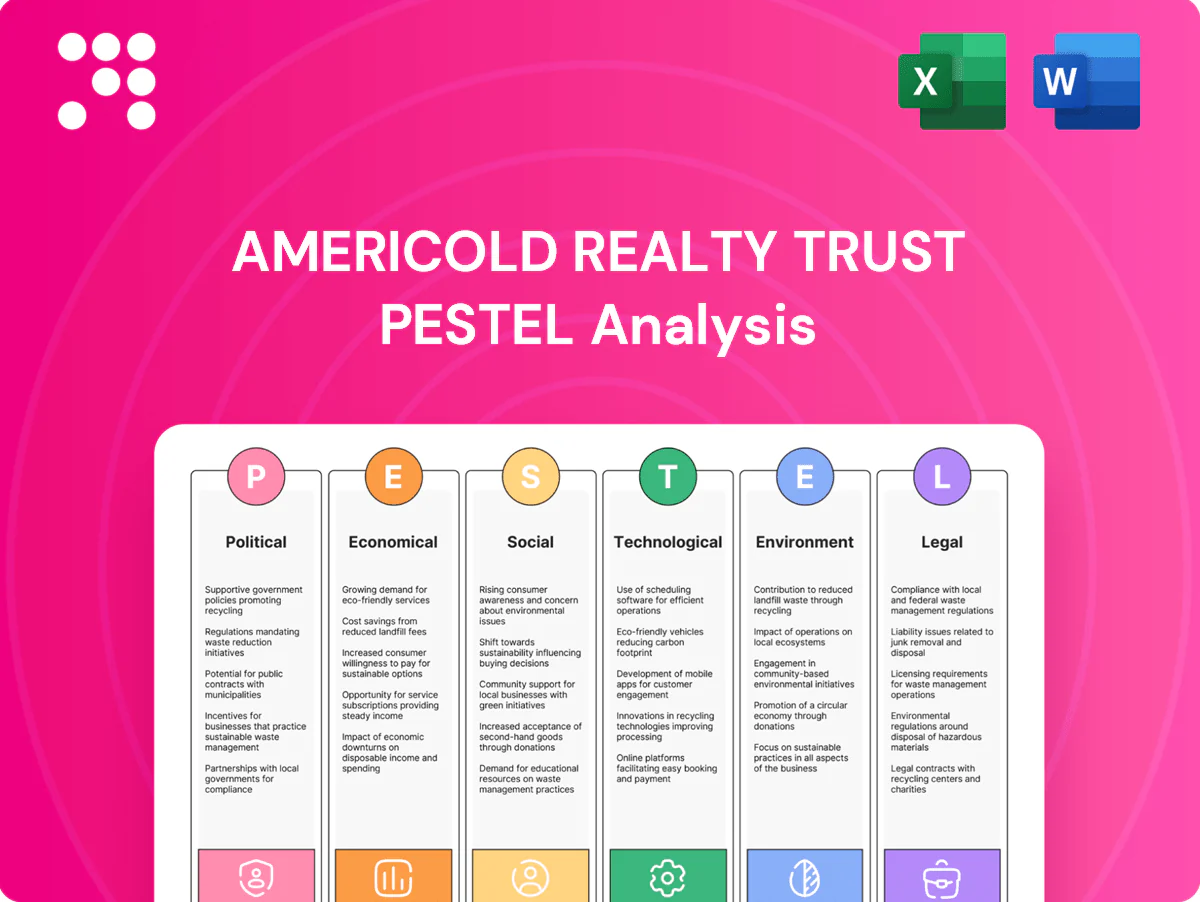
Americold Realty Trust PESTLE Analysis

Your Shortcut to Market Insight Starts Here
Our PESTLE analysis of Americold Realty Trust reveals how regulatory shifts, supply-chain economics, and rapid cold‑chain tech adoption are reshaping its growth prospects, risk profile, and capital strategy. Investors and strategists will gain concise, actionable context to inform allocation and operational decisions. Purchase the full, downloadable report for the complete deep‑dive and ready‑to‑use insights.
Political factors

Food security priorities
Governments elevating food security increase strategic value of Americold’s temperature-controlled assets as public policies favor resilient supply chains. Policy support can yield grants, tax incentives or expedited permits for cold storage projects; Americold’s ~245 facilities and ~2.0 billion cubic feet capacity plus 2024 revenue near $3.2B make it a prime beneficiary. Political shifts could divert funds away from logistics, so Americold must proactively align facilities with national and regional resilience plans.
Trade policy and tariffs
Trade rules on meat, produce and pharmaceuticals directly affect Americold throughput and occupancy; with roughly 270 facilities across 20 countries, shifts in import/export permissions change utilization rates. Tariffs and sanitary/phytosanitary barriers reroute volumes across ports and borders, forcing network rebalancing and higher transport costs. Sudden trade disputes drive demand volatility and pricing pressure, so Americold’s active scenario planning repositions capacity to trade-favored corridors.

Zoning and local incentives
Zoning and local incentives shape Americold’s site selection for its 240+ temperature-controlled facilities across 19 countries, with land use approvals and industrial development programs determining project timelines near ports and population centers. Community politics can delay or accelerate builds by months to years, affecting throughput capacity. Negotiated tax abatements and incentives improve project economics but require job, performance and compliance conditions. Proactive stakeholder engagement reduces entitlement risk and strengthens license to operate.

Energy policy direction
Energy policy shifts — including the Inflation Reduction Act tax credits (ITC up to 30% for qualifying renewables), efficiency standards and refrigerant rules — directly alter Americold’s operating costs; US power was ~22% renewable in 2024 and the Biden administration targets a carbon-free grid by 2035, affecting pricing and reliability. Demand-response programs and state rebates improve payback on VFDs and heat-recovery retrofits, letting Americold use incentives to de-risk cold-storage assets.
Labor and immigration stance
Warehouse operations and transportation rely on stable labor: US transportation and warehousing employed about 6.1 million workers in 2024 (BLS), and skill gaps affect uptime for Americold facilities. Visa caps such as the H-2B statutory cap of 66,000 limit seasonal hires, while federal minimum wage remains $7.25 and California reached $16.00 in 2024, pressuring labor costs and union negotiations.
- Labor pool: 6.1M (BLS, 2024)
- Visa constraint: H-2B cap 66,000
- Wage pressure: federal $7.25; CA $16.00 (2024)
- Mitigation: workforce development partnerships to upskill technicians/drivers
Govt policies raise cold storage value; 245 sites, $3.2B
Government food-security and trade policies raise Americold’s strategic value given ~245 facilities, ~2.0B cu ft capacity and 2024 revenue ~$3.2B; incentives and permits speed projects. Energy and refrigerant rules plus ITC (up to 30%) and 22% US renewables (2024) affect operating costs. Labor constraints (6.1M warehousing workforce; H-2B cap 66,000; CA min wage $16.00) pressure margins.
| Metric | 2024/Policy |
|---|---|
| Facilities / Capacity | ~245 / ~2.0B cu ft |
| Revenue | ~$3.2B (2024) |
| US renewables | 22% (2024) |
| ITC | Up to 30% |
| Labor pool / H-2B | 6.1M / 66,000 cap |
| CA min wage | $16.00 (2024) |
What is included in the product
 Detailed Word Document
Explores how Political, Economic, Social, Technological, Environmental and Legal forces specifically impact Americold Realty Trust, combining data-driven, region- and industry-specific insights with forward-looking scenario guidance to help executives, investors and advisors identify risks, opportunities and strategic actions.

 Customizable Excel Spreadsheet
Visually segmented by PESTEL categories, the Americold Realty Trust PESTLE summary eases meeting prep and highlights external risks at a glance. Its concise, presentation-ready format can be dropped into slides or shared across teams for faster strategic alignment.
Economic factors

Interest rates and cost of capital
As a REIT, Americold’s valuation and growth hinge on debt costs and cap rates; with the Fed funds rate at 5.25–5.50% and the 10-year Treasury near 4.3% in mid‑2025, borrowing costs and required yields have risen materially. Higher rates compress development spreads and force more selective acquisitions. Refinancing schedules and hedging strategies are critical to FFO stability, and disciplined leverage supports resilience across rate cycles.
Food demand resilience
Staple food consumption is relatively non-cyclical, keeping baseline cold-storage demand even in downturns; Americold operates over 250 temperature-controlled facilities and roughly 1.9 billion cubic feet of storage capacity, which cushions revenue swings. Shifts between retail and foodservice alter SKU velocity and dwell times, while premium frozen categories remain income-sensitive. Americold’s diversified customer base smooths economic volatility.

Energy price volatility
Electricity and fuel are major cost drivers for Americold’s refrigerated storage and transport; U.S. industrial electricity averaged about 0.072 USD/kWh in 2024 and U.S. diesel averaged roughly 4.00 USD/gal in 2024 (EIA). Spikes in power prices can compress margins unless contract pass-through clauses are effective. Regional differentials, e.g., California industrial rates near 0.15 USD/kWh, influence facility siting and customer allocation. Americold reports energy procurement and efficiency programs in its sustainability disclosures to buffer volatility.

Supply-demand for cold storage
Structural undersupply in key metros keeps occupancy high and pricing power intact, with US cold-storage vacancy near 5% in 2024 and top metros often under 3%. New builds face 18–24 month lead times and specialized costs often above 150 USD/sqft. A surge of speculative builds could depress rates if demand softens; pipeline discipline and pre-leasing materially cut absorption risk.
- vacancy: ~5% national / <3% top metros
- lead time: 18–24 months
- construction cost: >150 USD/sqft
- mitigation: pre-leasing, disciplined pipeline
Inflation and contract mechanics
Index-linked escalators and fuel/power surcharges have preserved real returns for Americold as US CPI averaged about 3.4% in 2024, but persistent inflation pushed construction and maintenance costs roughly 6% higher in 2024, squeezing development yields. Customers increasingly seek longer terms to cap input cost risk, reducing rate flexibility, while data-driven pricing optimizes mix across storage, handling and value-added services.
- Index-linked escalators
- Fuel/power surcharges
- Construction costs +~6% (2024)
- Customers favor longer terms
- Data-driven pricing
Govt policies raise cold storage value; 245 sites, $3.2B
Higher rates (Fed funds 5.25–5.50% mid‑2025; 10‑yr ~4.3%) raise borrowing costs and cap rates, pressuring spreads. Stable demand (vacancy ~5%; capacity ~1.9bn cu ft) supports occupancy and pricing. Energy (US industrial 0.072 USD/kWh; diesel ≈4.00 USD/gal in 2024) and construction (>150 USD/sqft; +6% cost in 2024) drive margins and development pace.
| Metric | Value |
|---|---|
| Fed funds | 5.25–5.50% |
| 10‑yr Treasury | ~4.3% |
| Vacancy | ~5% |
| Capacity | ~1.9bn cu ft |
| Electricity | 0.072 USD/kWh (2024) |
| Diesel | ~4.00 USD/gal (2024) |
| Construction cost | >150 USD/sqft; +6% (2024) |
What You See Is What You Get
Americold Realty Trust PESTLE Analysis
This Americold Realty Trust PESTLE Analysis preview is the exact, fully formatted document you’ll receive after purchase—professionally structured and ready to use. The content, layout, and data shown are identical to the downloadable file. No placeholders, no surprises.

Your Shortcut to Market Insight Starts Here
Our PESTLE analysis of Americold Realty Trust reveals how regulatory shifts, supply-chain economics, and rapid cold‑chain tech adoption are reshaping its growth prospects, risk profile, and capital strategy. Investors and strategists will gain concise, actionable context to inform allocation and operational decisions. Purchase the full, downloadable report for the complete deep‑dive and ready‑to‑use insights.
Political factors
Food security priorities
Governments elevating food security increase strategic value of Americold’s temperature-controlled assets as public policies favor resilient supply chains. Policy support can yield grants, tax incentives or expedited permits for cold storage projects; Americold’s ~245 facilities and ~2.0 billion cubic feet capacity plus 2024 revenue near $3.2B make it a prime beneficiary. Political shifts could divert funds away from logistics, so Americold must proactively align facilities with national and regional resilience plans.
Trade policy and tariffs
Trade rules on meat, produce and pharmaceuticals directly affect Americold throughput and occupancy; with roughly 270 facilities across 20 countries, shifts in import/export permissions change utilization rates. Tariffs and sanitary/phytosanitary barriers reroute volumes across ports and borders, forcing network rebalancing and higher transport costs. Sudden trade disputes drive demand volatility and pricing pressure, so Americold’s active scenario planning repositions capacity to trade-favored corridors.
Zoning and local incentives
Zoning and local incentives shape Americold’s site selection for its 240+ temperature-controlled facilities across 19 countries, with land use approvals and industrial development programs determining project timelines near ports and population centers. Community politics can delay or accelerate builds by months to years, affecting throughput capacity. Negotiated tax abatements and incentives improve project economics but require job, performance and compliance conditions. Proactive stakeholder engagement reduces entitlement risk and strengthens license to operate.
Energy policy direction
Energy policy shifts — including the Inflation Reduction Act tax credits (ITC up to 30% for qualifying renewables), efficiency standards and refrigerant rules — directly alter Americold’s operating costs; US power was ~22% renewable in 2024 and the Biden administration targets a carbon-free grid by 2035, affecting pricing and reliability. Demand-response programs and state rebates improve payback on VFDs and heat-recovery retrofits, letting Americold use incentives to de-risk cold-storage assets.
Labor and immigration stance
Warehouse operations and transportation rely on stable labor: US transportation and warehousing employed about 6.1 million workers in 2024 (BLS), and skill gaps affect uptime for Americold facilities. Visa caps such as the H-2B statutory cap of 66,000 limit seasonal hires, while federal minimum wage remains $7.25 and California reached $16.00 in 2024, pressuring labor costs and union negotiations.
- Labor pool: 6.1M (BLS, 2024)
- Visa constraint: H-2B cap 66,000
- Wage pressure: federal $7.25; CA $16.00 (2024)
- Mitigation: workforce development partnerships to upskill technicians/drivers
Govt policies raise cold storage value; 245 sites, $3.2B
Government food-security and trade policies raise Americold’s strategic value given ~245 facilities, ~2.0B cu ft capacity and 2024 revenue ~$3.2B; incentives and permits speed projects. Energy and refrigerant rules plus ITC (up to 30%) and 22% US renewables (2024) affect operating costs. Labor constraints (6.1M warehousing workforce; H-2B cap 66,000; CA min wage $16.00) pressure margins.
| Metric | 2024/Policy |
|---|---|
| Facilities / Capacity | ~245 / ~2.0B cu ft |
| Revenue | ~$3.2B (2024) |
| US renewables | 22% (2024) |
| ITC | Up to 30% |
| Labor pool / H-2B | 6.1M / 66,000 cap |
| CA min wage | $16.00 (2024) |
What is included in the product
Detailed Word Document
Explores how Political, Economic, Social, Technological, Environmental and Legal forces specifically impact Americold Realty Trust, combining data-driven, region- and industry-specific insights with forward-looking scenario guidance to help executives, investors and advisors identify risks, opportunities and strategic actions.
Customizable Excel Spreadsheet
Visually segmented by PESTEL categories, the Americold Realty Trust PESTLE summary eases meeting prep and highlights external risks at a glance. Its concise, presentation-ready format can be dropped into slides or shared across teams for faster strategic alignment.
Economic factors
Interest rates and cost of capital
As a REIT, Americold’s valuation and growth hinge on debt costs and cap rates; with the Fed funds rate at 5.25–5.50% and the 10-year Treasury near 4.3% in mid‑2025, borrowing costs and required yields have risen materially. Higher rates compress development spreads and force more selective acquisitions. Refinancing schedules and hedging strategies are critical to FFO stability, and disciplined leverage supports resilience across rate cycles.
Food demand resilience
Staple food consumption is relatively non-cyclical, keeping baseline cold-storage demand even in downturns; Americold operates over 250 temperature-controlled facilities and roughly 1.9 billion cubic feet of storage capacity, which cushions revenue swings. Shifts between retail and foodservice alter SKU velocity and dwell times, while premium frozen categories remain income-sensitive. Americold’s diversified customer base smooths economic volatility.
Energy price volatility
Electricity and fuel are major cost drivers for Americold’s refrigerated storage and transport; U.S. industrial electricity averaged about 0.072 USD/kWh in 2024 and U.S. diesel averaged roughly 4.00 USD/gal in 2024 (EIA). Spikes in power prices can compress margins unless contract pass-through clauses are effective. Regional differentials, e.g., California industrial rates near 0.15 USD/kWh, influence facility siting and customer allocation. Americold reports energy procurement and efficiency programs in its sustainability disclosures to buffer volatility.
Supply-demand for cold storage
Structural undersupply in key metros keeps occupancy high and pricing power intact, with US cold-storage vacancy near 5% in 2024 and top metros often under 3%. New builds face 18–24 month lead times and specialized costs often above 150 USD/sqft. A surge of speculative builds could depress rates if demand softens; pipeline discipline and pre-leasing materially cut absorption risk.
- vacancy: ~5% national / <3% top metros
- lead time: 18–24 months
- construction cost: >150 USD/sqft
- mitigation: pre-leasing, disciplined pipeline
Inflation and contract mechanics
Index-linked escalators and fuel/power surcharges have preserved real returns for Americold as US CPI averaged about 3.4% in 2024, but persistent inflation pushed construction and maintenance costs roughly 6% higher in 2024, squeezing development yields. Customers increasingly seek longer terms to cap input cost risk, reducing rate flexibility, while data-driven pricing optimizes mix across storage, handling and value-added services.
- Index-linked escalators
- Fuel/power surcharges
- Construction costs +~6% (2024)
- Customers favor longer terms
- Data-driven pricing
Govt policies raise cold storage value; 245 sites, $3.2B
Higher rates (Fed funds 5.25–5.50% mid‑2025; 10‑yr ~4.3%) raise borrowing costs and cap rates, pressuring spreads. Stable demand (vacancy ~5%; capacity ~1.9bn cu ft) supports occupancy and pricing. Energy (US industrial 0.072 USD/kWh; diesel ≈4.00 USD/gal in 2024) and construction (>150 USD/sqft; +6% cost in 2024) drive margins and development pace.
| Metric | Value |
|---|---|
| Fed funds | 5.25–5.50% |
| 10‑yr Treasury | ~4.3% |
| Vacancy | ~5% |
| Capacity | ~1.9bn cu ft |
| Electricity | 0.072 USD/kWh (2024) |
| Diesel | ~4.00 USD/gal (2024) |
| Construction cost | >150 USD/sqft; +6% (2024) |
What You See Is What You Get
Americold Realty Trust PESTLE Analysis
This Americold Realty Trust PESTLE Analysis preview is the exact, fully formatted document you’ll receive after purchase—professionally structured and ready to use. The content, layout, and data shown are identical to the downloadable file. No placeholders, no surprises.
Original: $10.00
-65%$10.00
$3.50Description
Your Shortcut to Market Insight Starts Here
Our PESTLE analysis of Americold Realty Trust reveals how regulatory shifts, supply-chain economics, and rapid cold‑chain tech adoption are reshaping its growth prospects, risk profile, and capital strategy. Investors and strategists will gain concise, actionable context to inform allocation and operational decisions. Purchase the full, downloadable report for the complete deep‑dive and ready‑to‑use insights.
Political factors
Food security priorities
Governments elevating food security increase strategic value of Americold’s temperature-controlled assets as public policies favor resilient supply chains. Policy support can yield grants, tax incentives or expedited permits for cold storage projects; Americold’s ~245 facilities and ~2.0 billion cubic feet capacity plus 2024 revenue near $3.2B make it a prime beneficiary. Political shifts could divert funds away from logistics, so Americold must proactively align facilities with national and regional resilience plans.
Trade policy and tariffs
Trade rules on meat, produce and pharmaceuticals directly affect Americold throughput and occupancy; with roughly 270 facilities across 20 countries, shifts in import/export permissions change utilization rates. Tariffs and sanitary/phytosanitary barriers reroute volumes across ports and borders, forcing network rebalancing and higher transport costs. Sudden trade disputes drive demand volatility and pricing pressure, so Americold’s active scenario planning repositions capacity to trade-favored corridors.
Zoning and local incentives
Zoning and local incentives shape Americold’s site selection for its 240+ temperature-controlled facilities across 19 countries, with land use approvals and industrial development programs determining project timelines near ports and population centers. Community politics can delay or accelerate builds by months to years, affecting throughput capacity. Negotiated tax abatements and incentives improve project economics but require job, performance and compliance conditions. Proactive stakeholder engagement reduces entitlement risk and strengthens license to operate.
Energy policy direction
Energy policy shifts — including the Inflation Reduction Act tax credits (ITC up to 30% for qualifying renewables), efficiency standards and refrigerant rules — directly alter Americold’s operating costs; US power was ~22% renewable in 2024 and the Biden administration targets a carbon-free grid by 2035, affecting pricing and reliability. Demand-response programs and state rebates improve payback on VFDs and heat-recovery retrofits, letting Americold use incentives to de-risk cold-storage assets.
Labor and immigration stance
Warehouse operations and transportation rely on stable labor: US transportation and warehousing employed about 6.1 million workers in 2024 (BLS), and skill gaps affect uptime for Americold facilities. Visa caps such as the H-2B statutory cap of 66,000 limit seasonal hires, while federal minimum wage remains $7.25 and California reached $16.00 in 2024, pressuring labor costs and union negotiations.
- Labor pool: 6.1M (BLS, 2024)
- Visa constraint: H-2B cap 66,000
- Wage pressure: federal $7.25; CA $16.00 (2024)
- Mitigation: workforce development partnerships to upskill technicians/drivers
Govt policies raise cold storage value; 245 sites, $3.2B
Government food-security and trade policies raise Americold’s strategic value given ~245 facilities, ~2.0B cu ft capacity and 2024 revenue ~$3.2B; incentives and permits speed projects. Energy and refrigerant rules plus ITC (up to 30%) and 22% US renewables (2024) affect operating costs. Labor constraints (6.1M warehousing workforce; H-2B cap 66,000; CA min wage $16.00) pressure margins.
| Metric | 2024/Policy |
|---|---|
| Facilities / Capacity | ~245 / ~2.0B cu ft |
| Revenue | ~$3.2B (2024) |
| US renewables | 22% (2024) |
| ITC | Up to 30% |
| Labor pool / H-2B | 6.1M / 66,000 cap |
| CA min wage | $16.00 (2024) |
What is included in the product
Detailed Word Document
Explores how Political, Economic, Social, Technological, Environmental and Legal forces specifically impact Americold Realty Trust, combining data-driven, region- and industry-specific insights with forward-looking scenario guidance to help executives, investors and advisors identify risks, opportunities and strategic actions.
Customizable Excel Spreadsheet
Visually segmented by PESTEL categories, the Americold Realty Trust PESTLE summary eases meeting prep and highlights external risks at a glance. Its concise, presentation-ready format can be dropped into slides or shared across teams for faster strategic alignment.
Economic factors
Interest rates and cost of capital
As a REIT, Americold’s valuation and growth hinge on debt costs and cap rates; with the Fed funds rate at 5.25–5.50% and the 10-year Treasury near 4.3% in mid‑2025, borrowing costs and required yields have risen materially. Higher rates compress development spreads and force more selective acquisitions. Refinancing schedules and hedging strategies are critical to FFO stability, and disciplined leverage supports resilience across rate cycles.
Food demand resilience
Staple food consumption is relatively non-cyclical, keeping baseline cold-storage demand even in downturns; Americold operates over 250 temperature-controlled facilities and roughly 1.9 billion cubic feet of storage capacity, which cushions revenue swings. Shifts between retail and foodservice alter SKU velocity and dwell times, while premium frozen categories remain income-sensitive. Americold’s diversified customer base smooths economic volatility.
Energy price volatility
Electricity and fuel are major cost drivers for Americold’s refrigerated storage and transport; U.S. industrial electricity averaged about 0.072 USD/kWh in 2024 and U.S. diesel averaged roughly 4.00 USD/gal in 2024 (EIA). Spikes in power prices can compress margins unless contract pass-through clauses are effective. Regional differentials, e.g., California industrial rates near 0.15 USD/kWh, influence facility siting and customer allocation. Americold reports energy procurement and efficiency programs in its sustainability disclosures to buffer volatility.
Supply-demand for cold storage
Structural undersupply in key metros keeps occupancy high and pricing power intact, with US cold-storage vacancy near 5% in 2024 and top metros often under 3%. New builds face 18–24 month lead times and specialized costs often above 150 USD/sqft. A surge of speculative builds could depress rates if demand softens; pipeline discipline and pre-leasing materially cut absorption risk.
- vacancy: ~5% national / <3% top metros
- lead time: 18–24 months
- construction cost: >150 USD/sqft
- mitigation: pre-leasing, disciplined pipeline
Inflation and contract mechanics
Index-linked escalators and fuel/power surcharges have preserved real returns for Americold as US CPI averaged about 3.4% in 2024, but persistent inflation pushed construction and maintenance costs roughly 6% higher in 2024, squeezing development yields. Customers increasingly seek longer terms to cap input cost risk, reducing rate flexibility, while data-driven pricing optimizes mix across storage, handling and value-added services.
- Index-linked escalators
- Fuel/power surcharges
- Construction costs +~6% (2024)
- Customers favor longer terms
- Data-driven pricing
Govt policies raise cold storage value; 245 sites, $3.2B
Higher rates (Fed funds 5.25–5.50% mid‑2025; 10‑yr ~4.3%) raise borrowing costs and cap rates, pressuring spreads. Stable demand (vacancy ~5%; capacity ~1.9bn cu ft) supports occupancy and pricing. Energy (US industrial 0.072 USD/kWh; diesel ≈4.00 USD/gal in 2024) and construction (>150 USD/sqft; +6% cost in 2024) drive margins and development pace.
| Metric | Value |
|---|---|
| Fed funds | 5.25–5.50% |
| 10‑yr Treasury | ~4.3% |
| Vacancy | ~5% |
| Capacity | ~1.9bn cu ft |
| Electricity | 0.072 USD/kWh (2024) |
| Diesel | ~4.00 USD/gal (2024) |
| Construction cost | >150 USD/sqft; +6% (2024) |
What You See Is What You Get
Americold Realty Trust PESTLE Analysis
This Americold Realty Trust PESTLE Analysis preview is the exact, fully formatted document you’ll receive after purchase—professionally structured and ready to use. The content, layout, and data shown are identical to the downloadable file. No placeholders, no surprises.











