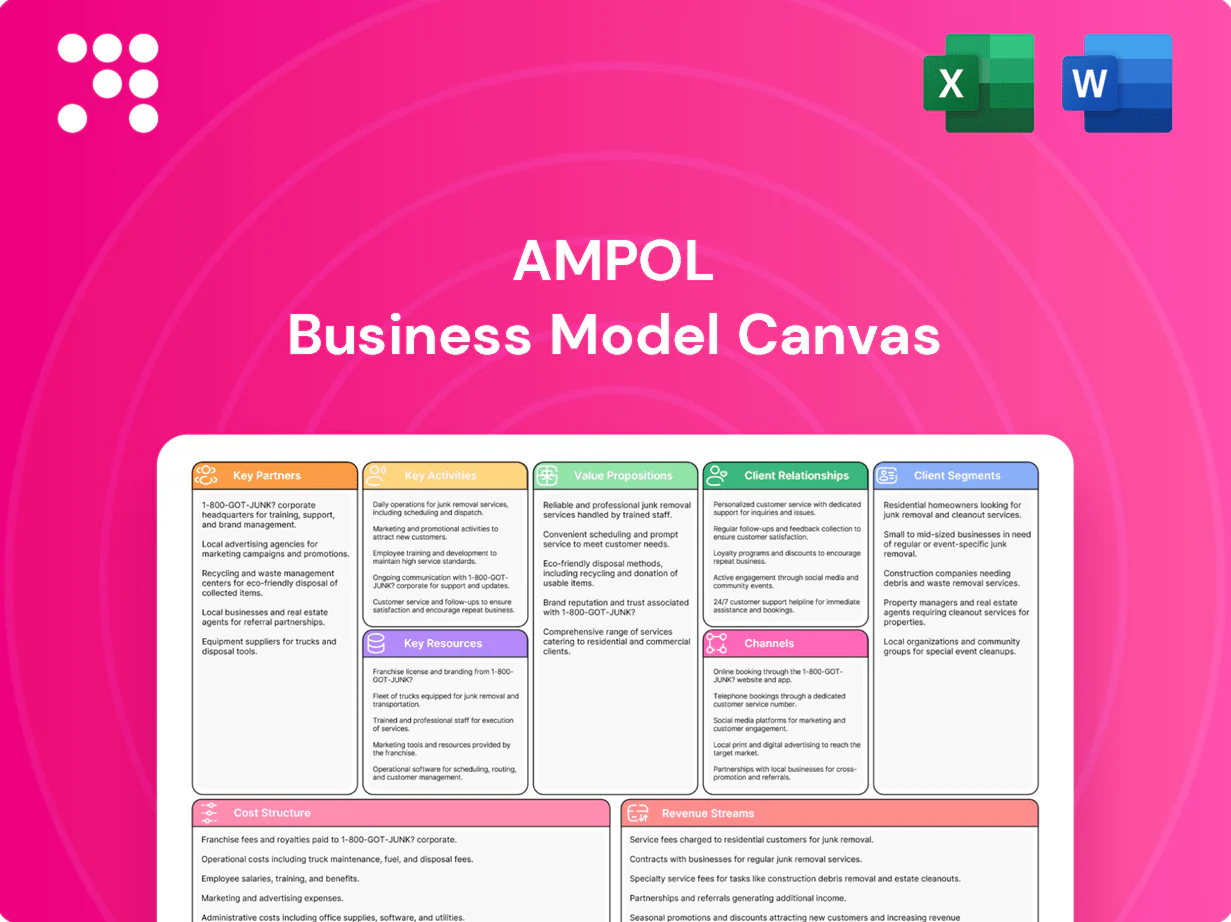
Ampol Business Model Canvas

Unlock a concise Business Model Canvas for energy sector strategy and investor planning
Unlock Ampol’s full strategic blueprint with a concise Business Model Canvas that maps value propositions, customer segments, revenue streams and cost structure. This 3–5 sentence snapshot turns strategy into action—ideal for investors, consultants and entrepreneurs. Download the complete Word/Excel canvas to benchmark, plan and scale—purchase now for the full analysis.
Partnerships

Crude and product suppliers
Ampol secures long-term indexed supply contracts with global producers and traders to underpin supply for its ~1,900 retail sites in 2024 and its Lytton refinery (~100,000 bbl/day capacity). The company diversifies feedstock across regions and grades to manage price and geopolitical risk. Ampol combines term and spot purchases to balance cost efficiency and operational flexibility.
Commercial offtake customers
Partner with airlines, miners, logistics firms and marine operators via multi-year offtake agreements to lock volumes and margins; Ampol operated about 1,900 retail sites and reported ~14.2 billion litres of fuel sales in FY24. Co-develop supply schedules, on-site fueling solutions and common quality standards to reduce disruption and handling costs. Align volume commitments with terminal and pipeline capacity to optimize utilisation and reduce congestion risk.

Convenience and food brands
Collaborate with quick-service restaurants, coffee and grocery suppliers to embed in-store offers and meal solutions across Ampol’s network of around 1,900 service stations in Australia and New Zealand (2024).
Co-branded formats and exclusive ranges drive footfall and increase basket size through bundled promotions and loyalty linkages.
Shared POS and customer data enable targeted promotions and optimized assortment by location and time of day.

New energy and tech providers
Ampol to form alliances for EV charging hardware, software platforms and energy management, piloting biofuels, e-fuels and hydrogen with specialist partners while integrating payment, telematics and loyalty tech for seamless customer journeys; global EV sales reached ~14 million in 2023, underscoring scale and urgency.
- EV charging partnerships: hardware + software + energy ops
- Fuel pilots: biofuels, e-fuels, hydrogen trials
- Tech integration: payments, telematics, loyalty
Logistics, terminal, and infrastructure partners
Ampol coordinates with haulage fleets, depot operators and pipeline owners across its network of around 1,900 retail sites and ~67 terminals (2024), entering storage and terminal joint ventures to expand reach and using shared capacity and contingency arrangements to improve delivery reliability and resilience.
- Coordinate haulage, depots, pipelines
- Storage & terminal JVs to expand network
- Shared capacity & contingency for reliability
Indexed fuel supply, blended procurement and low-carbon pilots secure national retail network
Ampol secures indexed long-term supply for ~1,900 retail sites and Lytton refinery (~100,000 bbl/day) while blending term and spot purchases to manage cost and risk. FY24 fuel sales ~14.2 billion litres and ~67 terminals underpin logistics; JV storage and haulage partnerships optimise capacity and resilience. EV charging, biofuel and hydrogen pilots with tech partners expand fuel mix and customer offerings.
| Metric | 2024 |
|---|---|
| Retail sites | ~1,900 |
| Fuel sales | 14.2b L |
| Refinery capacity | 100,000 bbl/day |
| Terminals | ~67 |
What is included in the product
 Detailed Word Document
A concise, pre-written Business Model Canvas for Ampol outlining customer segments, channels, value propositions, key activities, resources, partners, cost structure and revenue streams, with SWOT-linked insights and investor-ready presentation formatting.

 Customizable Excel Spreadsheet
High-level view of Ampol’s business model with editable cells to quickly pinpoint operational bottlenecks and align fuel, retail and logistics strategies for faster decision-making.
Activities

Refining, importing, and trading
Operate and optimize refinery runs based on crack spreads and demand, adjusting throughput to capture favourable margins while prioritising product slate alignment with market needs.
Import refined products to supplement local output, ensuring supply continuity across retail and commercial channels and managing regional supply-demand imbalances.
Hedge exposures and manage inventory through forward contracts and physical stock strategies to stabilise margins and reduce volatility.
Distribution and last-mile delivery
Transport fuels via terminals, pipelines and road tankers across a national logistics network, maintaining strict safety and quality protocols across the supply chain and using scheduled drops to retail sites and B2B customers for efficient last-mile delivery. In 2024 Ampol operated approximately 1,900 service stations across Australia and New Zealand.

Retail operations and merchandising
Run and maintain over 1,900 Ampol service stations across Australia and New Zealand with a focus on high forecourt uptime and store execution to maximize throughput. Curate convenience ranges, food-to-go and coffee offerings to increase basket size and dwell time. Use dynamic pricing, targeted promotions and disciplined planograms to lift conversion and average transaction value.

B2B sales and contract management
Tender, negotiate and service multi-site fleets and industrial accounts for Ampol, managing bids and bespoke contracts across national sites. Provide account portals, credit facilities and custom delivery windows (including 2-hour windows) to meet operational needs. Track SLAs and KPIs, targeting on-time delivery >98% and account retention >92% to grow share of wallet.
- Tendering and negotiation
- Account portals & credit
- SLA/KPI tracking
New energy development
Ampol is deploying EV chargers, securing renewable power contracts and rolling out lower-carbon fuels while running hydrogen and advanced biofuel pilots with key customers to validate supply chains and demand profiles.
- Deploy EV charging at forecourts and fleets
- Source renewables and integrate onsite solar/PPAs
- Pilot hydrogen and advanced biofuels with strategic customers
- Scale successful pilots via existing network footprint
Operate refinery runs, hedge margins, run ~1,900 stations with EV/H2 pilot
Operate and optimise refinery runs to capture crack spreads; import refined product to balance supply; manage hedging and inventory to stabilise margins; run ~1,900 service stations (2024) with high forecourt uptime while deploying EV chargers and piloting hydrogen/advanced biofuels.
| Activity | Metric | 2024 |
|---|---|---|
| Retail network | Service stations | ~1,900 |
| Logistics | On-time delivery | >98% |
| Accounts | Retention | >92% |
Full Version Awaits
Business Model Canvas
The Ampol Business Model Canvas you’re previewing is the actual deliverable, not a mockup—this same file will be provided to you upon purchase. When you complete your order you’ll receive the full, editable document formatted exactly as shown, ready for presentation or analysis. No surprises, just the exact content and structure you see here.

Unlock a concise Business Model Canvas for energy sector strategy and investor planning
Unlock Ampol’s full strategic blueprint with a concise Business Model Canvas that maps value propositions, customer segments, revenue streams and cost structure. This 3–5 sentence snapshot turns strategy into action—ideal for investors, consultants and entrepreneurs. Download the complete Word/Excel canvas to benchmark, plan and scale—purchase now for the full analysis.
Partnerships
Crude and product suppliers
Ampol secures long-term indexed supply contracts with global producers and traders to underpin supply for its ~1,900 retail sites in 2024 and its Lytton refinery (~100,000 bbl/day capacity). The company diversifies feedstock across regions and grades to manage price and geopolitical risk. Ampol combines term and spot purchases to balance cost efficiency and operational flexibility.
Commercial offtake customers
Partner with airlines, miners, logistics firms and marine operators via multi-year offtake agreements to lock volumes and margins; Ampol operated about 1,900 retail sites and reported ~14.2 billion litres of fuel sales in FY24. Co-develop supply schedules, on-site fueling solutions and common quality standards to reduce disruption and handling costs. Align volume commitments with terminal and pipeline capacity to optimize utilisation and reduce congestion risk.
Convenience and food brands
Collaborate with quick-service restaurants, coffee and grocery suppliers to embed in-store offers and meal solutions across Ampol’s network of around 1,900 service stations in Australia and New Zealand (2024).
Co-branded formats and exclusive ranges drive footfall and increase basket size through bundled promotions and loyalty linkages.
Shared POS and customer data enable targeted promotions and optimized assortment by location and time of day.
New energy and tech providers
Ampol to form alliances for EV charging hardware, software platforms and energy management, piloting biofuels, e-fuels and hydrogen with specialist partners while integrating payment, telematics and loyalty tech for seamless customer journeys; global EV sales reached ~14 million in 2023, underscoring scale and urgency.
- EV charging partnerships: hardware + software + energy ops
- Fuel pilots: biofuels, e-fuels, hydrogen trials
- Tech integration: payments, telematics, loyalty
Logistics, terminal, and infrastructure partners
Ampol coordinates with haulage fleets, depot operators and pipeline owners across its network of around 1,900 retail sites and ~67 terminals (2024), entering storage and terminal joint ventures to expand reach and using shared capacity and contingency arrangements to improve delivery reliability and resilience.
- Coordinate haulage, depots, pipelines
- Storage & terminal JVs to expand network
- Shared capacity & contingency for reliability
Indexed fuel supply, blended procurement and low-carbon pilots secure national retail network
Ampol secures indexed long-term supply for ~1,900 retail sites and Lytton refinery (~100,000 bbl/day) while blending term and spot purchases to manage cost and risk. FY24 fuel sales ~14.2 billion litres and ~67 terminals underpin logistics; JV storage and haulage partnerships optimise capacity and resilience. EV charging, biofuel and hydrogen pilots with tech partners expand fuel mix and customer offerings.
| Metric | 2024 |
|---|---|
| Retail sites | ~1,900 |
| Fuel sales | 14.2b L |
| Refinery capacity | 100,000 bbl/day |
| Terminals | ~67 |
What is included in the product
Detailed Word Document
A concise, pre-written Business Model Canvas for Ampol outlining customer segments, channels, value propositions, key activities, resources, partners, cost structure and revenue streams, with SWOT-linked insights and investor-ready presentation formatting.
Customizable Excel Spreadsheet
High-level view of Ampol’s business model with editable cells to quickly pinpoint operational bottlenecks and align fuel, retail and logistics strategies for faster decision-making.
Activities
Refining, importing, and trading
Operate and optimize refinery runs based on crack spreads and demand, adjusting throughput to capture favourable margins while prioritising product slate alignment with market needs.
Import refined products to supplement local output, ensuring supply continuity across retail and commercial channels and managing regional supply-demand imbalances.
Hedge exposures and manage inventory through forward contracts and physical stock strategies to stabilise margins and reduce volatility.
Distribution and last-mile delivery
Transport fuels via terminals, pipelines and road tankers across a national logistics network, maintaining strict safety and quality protocols across the supply chain and using scheduled drops to retail sites and B2B customers for efficient last-mile delivery. In 2024 Ampol operated approximately 1,900 service stations across Australia and New Zealand.
Retail operations and merchandising
Run and maintain over 1,900 Ampol service stations across Australia and New Zealand with a focus on high forecourt uptime and store execution to maximize throughput. Curate convenience ranges, food-to-go and coffee offerings to increase basket size and dwell time. Use dynamic pricing, targeted promotions and disciplined planograms to lift conversion and average transaction value.
B2B sales and contract management
Tender, negotiate and service multi-site fleets and industrial accounts for Ampol, managing bids and bespoke contracts across national sites. Provide account portals, credit facilities and custom delivery windows (including 2-hour windows) to meet operational needs. Track SLAs and KPIs, targeting on-time delivery >98% and account retention >92% to grow share of wallet.
- Tendering and negotiation
- Account portals & credit
- SLA/KPI tracking
New energy development
Ampol is deploying EV chargers, securing renewable power contracts and rolling out lower-carbon fuels while running hydrogen and advanced biofuel pilots with key customers to validate supply chains and demand profiles.
- Deploy EV charging at forecourts and fleets
- Source renewables and integrate onsite solar/PPAs
- Pilot hydrogen and advanced biofuels with strategic customers
- Scale successful pilots via existing network footprint
Operate refinery runs, hedge margins, run ~1,900 stations with EV/H2 pilot
Operate and optimise refinery runs to capture crack spreads; import refined product to balance supply; manage hedging and inventory to stabilise margins; run ~1,900 service stations (2024) with high forecourt uptime while deploying EV chargers and piloting hydrogen/advanced biofuels.
| Activity | Metric | 2024 |
|---|---|---|
| Retail network | Service stations | ~1,900 |
| Logistics | On-time delivery | >98% |
| Accounts | Retention | >92% |
Full Version Awaits
Business Model Canvas
The Ampol Business Model Canvas you’re previewing is the actual deliverable, not a mockup—this same file will be provided to you upon purchase. When you complete your order you’ll receive the full, editable document formatted exactly as shown, ready for presentation or analysis. No surprises, just the exact content and structure you see here.
Description
Unlock a concise Business Model Canvas for energy sector strategy and investor planning
Unlock Ampol’s full strategic blueprint with a concise Business Model Canvas that maps value propositions, customer segments, revenue streams and cost structure. This 3–5 sentence snapshot turns strategy into action—ideal for investors, consultants and entrepreneurs. Download the complete Word/Excel canvas to benchmark, plan and scale—purchase now for the full analysis.
Partnerships
Crude and product suppliers
Ampol secures long-term indexed supply contracts with global producers and traders to underpin supply for its ~1,900 retail sites in 2024 and its Lytton refinery (~100,000 bbl/day capacity). The company diversifies feedstock across regions and grades to manage price and geopolitical risk. Ampol combines term and spot purchases to balance cost efficiency and operational flexibility.
Commercial offtake customers
Partner with airlines, miners, logistics firms and marine operators via multi-year offtake agreements to lock volumes and margins; Ampol operated about 1,900 retail sites and reported ~14.2 billion litres of fuel sales in FY24. Co-develop supply schedules, on-site fueling solutions and common quality standards to reduce disruption and handling costs. Align volume commitments with terminal and pipeline capacity to optimize utilisation and reduce congestion risk.
Convenience and food brands
Collaborate with quick-service restaurants, coffee and grocery suppliers to embed in-store offers and meal solutions across Ampol’s network of around 1,900 service stations in Australia and New Zealand (2024).
Co-branded formats and exclusive ranges drive footfall and increase basket size through bundled promotions and loyalty linkages.
Shared POS and customer data enable targeted promotions and optimized assortment by location and time of day.
New energy and tech providers
Ampol to form alliances for EV charging hardware, software platforms and energy management, piloting biofuels, e-fuels and hydrogen with specialist partners while integrating payment, telematics and loyalty tech for seamless customer journeys; global EV sales reached ~14 million in 2023, underscoring scale and urgency.
- EV charging partnerships: hardware + software + energy ops
- Fuel pilots: biofuels, e-fuels, hydrogen trials
- Tech integration: payments, telematics, loyalty
Logistics, terminal, and infrastructure partners
Ampol coordinates with haulage fleets, depot operators and pipeline owners across its network of around 1,900 retail sites and ~67 terminals (2024), entering storage and terminal joint ventures to expand reach and using shared capacity and contingency arrangements to improve delivery reliability and resilience.
- Coordinate haulage, depots, pipelines
- Storage & terminal JVs to expand network
- Shared capacity & contingency for reliability
Indexed fuel supply, blended procurement and low-carbon pilots secure national retail network
Ampol secures indexed long-term supply for ~1,900 retail sites and Lytton refinery (~100,000 bbl/day) while blending term and spot purchases to manage cost and risk. FY24 fuel sales ~14.2 billion litres and ~67 terminals underpin logistics; JV storage and haulage partnerships optimise capacity and resilience. EV charging, biofuel and hydrogen pilots with tech partners expand fuel mix and customer offerings.
| Metric | 2024 |
|---|---|
| Retail sites | ~1,900 |
| Fuel sales | 14.2b L |
| Refinery capacity | 100,000 bbl/day |
| Terminals | ~67 |
What is included in the product
Detailed Word Document
A concise, pre-written Business Model Canvas for Ampol outlining customer segments, channels, value propositions, key activities, resources, partners, cost structure and revenue streams, with SWOT-linked insights and investor-ready presentation formatting.
Customizable Excel Spreadsheet
High-level view of Ampol’s business model with editable cells to quickly pinpoint operational bottlenecks and align fuel, retail and logistics strategies for faster decision-making.
Activities
Refining, importing, and trading
Operate and optimize refinery runs based on crack spreads and demand, adjusting throughput to capture favourable margins while prioritising product slate alignment with market needs.
Import refined products to supplement local output, ensuring supply continuity across retail and commercial channels and managing regional supply-demand imbalances.
Hedge exposures and manage inventory through forward contracts and physical stock strategies to stabilise margins and reduce volatility.
Distribution and last-mile delivery
Transport fuels via terminals, pipelines and road tankers across a national logistics network, maintaining strict safety and quality protocols across the supply chain and using scheduled drops to retail sites and B2B customers for efficient last-mile delivery. In 2024 Ampol operated approximately 1,900 service stations across Australia and New Zealand.
Retail operations and merchandising
Run and maintain over 1,900 Ampol service stations across Australia and New Zealand with a focus on high forecourt uptime and store execution to maximize throughput. Curate convenience ranges, food-to-go and coffee offerings to increase basket size and dwell time. Use dynamic pricing, targeted promotions and disciplined planograms to lift conversion and average transaction value.
B2B sales and contract management
Tender, negotiate and service multi-site fleets and industrial accounts for Ampol, managing bids and bespoke contracts across national sites. Provide account portals, credit facilities and custom delivery windows (including 2-hour windows) to meet operational needs. Track SLAs and KPIs, targeting on-time delivery >98% and account retention >92% to grow share of wallet.
- Tendering and negotiation
- Account portals & credit
- SLA/KPI tracking
New energy development
Ampol is deploying EV chargers, securing renewable power contracts and rolling out lower-carbon fuels while running hydrogen and advanced biofuel pilots with key customers to validate supply chains and demand profiles.
- Deploy EV charging at forecourts and fleets
- Source renewables and integrate onsite solar/PPAs
- Pilot hydrogen and advanced biofuels with strategic customers
- Scale successful pilots via existing network footprint
Operate refinery runs, hedge margins, run ~1,900 stations with EV/H2 pilot
Operate and optimise refinery runs to capture crack spreads; import refined product to balance supply; manage hedging and inventory to stabilise margins; run ~1,900 service stations (2024) with high forecourt uptime while deploying EV chargers and piloting hydrogen/advanced biofuels.
| Activity | Metric | 2024 |
|---|---|---|
| Retail network | Service stations | ~1,900 |
| Logistics | On-time delivery | >98% |
| Accounts | Retention | >92% |
Full Version Awaits
Business Model Canvas
The Ampol Business Model Canvas you’re previewing is the actual deliverable, not a mockup—this same file will be provided to you upon purchase. When you complete your order you’ll receive the full, editable document formatted exactly as shown, ready for presentation or analysis. No surprises, just the exact content and structure you see here.











