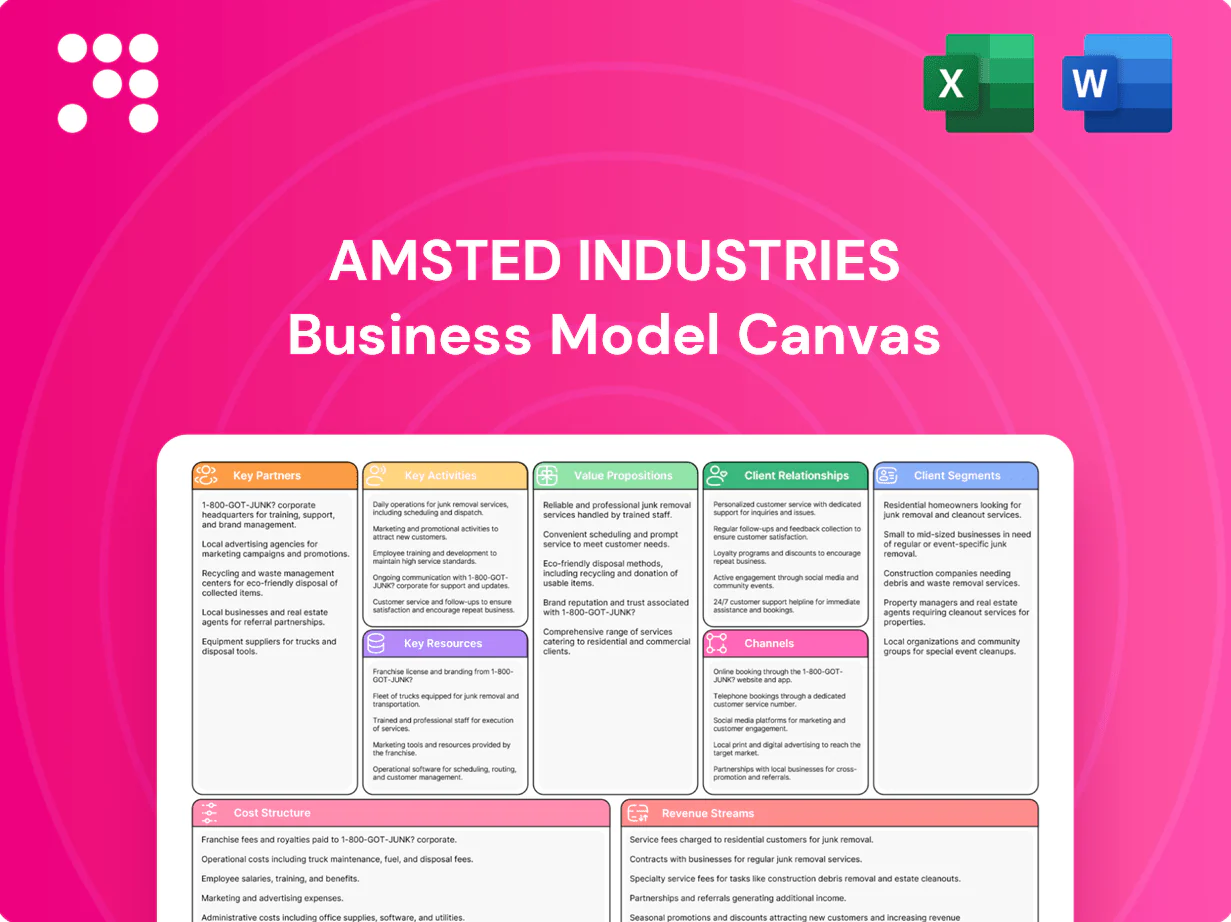
Amsted Industries Business Model Canvas

Unlock the strategic Business Model Canvas powering industrial value and revenue streams
Unlock the full strategic blueprint behind Amsted Industries’ Business Model Canvas. This concise preview highlights customer segments, value propositions, key partners and revenue streams that power its industrial leadership. Download the complete Word & Excel canvases for a detailed, actionable roadmap ideal for investors and strategists.
Partnerships

Strategic raw material suppliers
Securing steel, alloys and elastomers at scale is critical to controlling cost, lead times and product performance; long-term contracts and vendor-managed inventory stabilize pricing and availability. Collaborative metallurgical specs ensure components meet fatigue and load requirements. Joint sustainability programs cut Scope 3 exposure and help meet customer ESG mandates; global steel output was ~1.8 billion tonnes in 2023 and accounts for ~7% of CO2.
OEM and Tier-1 manufacturing partners
Design-in partnerships with railcar, truck, and heavy-equipment OEMs drive volume and platform standardization, accelerating time-to-market. Joint engineering aligns interfaces, tolerances, and lifecycle targets to reduce rework and warranty costs. Forecast sharing improves capacity planning and minimizes stockouts, while co-marketing strengthens end-customer confidence and speeds adoption; Amsted remains a privately held, Chicago-based manufacturer as of 2024.

Railroads, car builders, and MRO networks
Operational partnerships with railroads, car builders and MRO networks validate product performance in real-world duty cycles across North America’s ~1.6 million freight car fleet. Maintenance-shop feedback loops drive redesigns and material upgrades, shortening iteration cycles and informing engineering specs. Fleet trials de-risk rollouts and support FRA and other regulatory approvals while shared wear-and-failure data strengthens reliability programs.

Technology, testing labs, and universities
R&D partners (universities, national labs) accelerate innovation in materials science, fatigue modeling, and digital twins, helping Amsted cut prototype cycles and enable predictive maintenance; third-party ISO/IEC 17025 labs provide accredited testing for safety and standards compliance, supporting regulatory access and OEM contracts.
- R&D partnerships: joint IP creates defensible core components
- Testing labs: accredited compliance for rail and industrial standards
- Grants/consortia: lower development cost, shorten time-to-market ~20–30%
Logistics, machining, and specialty process vendors
3PLs and carriers deliver across Amsted’s global sites, leveraging a 2024 third-party logistics market valued at about $1.6 trillion to optimize costs and lead times. Outsourced heat treatment, coatings and precision machining add specialist capacity while helping meet tight PPAP and traceability standards required by Tier 1 OEMs. Flexible partner networks buffer demand swings and expedite critical orders, reducing disruption risk.
- 3PL market (2024): ~$1.6 trillion
- Outsourced specialty processes: capacity + specialization
- Quality-aligned partners: PPAP & traceability compliance
- Flexible networks: faster critical-order turnaround
Partnerships, OEM design-ins and 3PLs cut time-to-market 20–30%
Key partnerships secure steel/alloys and elastomers to control cost, lead times and performance; long-term contracts and VMI stabilize pricing. OEM design-ins and shared forecasts standardize platforms and reduce warranty risk. R&D, accredited labs and 3PLs accelerate innovation, compliance and delivery; consortia shorten time-to-market ~20–30%.
| Metric | Value |
|---|---|
| Global steel output (2023) | ~1.8B t |
| 3PL market (2024) | ~$1.6T |
| NA freight cars | ~1.6M |
| Time-to-market cut | 20–30% |
What is included in the product
 Detailed Word Document
A concise, pre-written Business Model Canvas for Amsted Industries outlining its nine blocks—customer segments, value propositions, channels, customer relationships, revenue streams, key resources, key activities, key partners, and cost structure. Tailored to heavy-industry manufacturing, it highlights competitive advantages, operational strengths, market opportunities, and investor-ready insights for strategic decisions.

 Customizable Excel Spreadsheet
High-level view of Amsted Industries’ business model with editable cells — condenses strategy into a digestible one-page snapshot to quickly identify core components and relieve pain from scattered planning. Shareable and editable for team collaboration, saving hours of formatting for fast deliverables or executive summaries.
Activities

Advanced engineering and product development
Finite element analysis, materials selection and rapid prototyping underpin Amsted’s durability claims by predicting stress life and guiding alloy choices. Co-design with customers tailors components to specific duty cycles, improving uptime and lifecycle cost. Rigorous validation testing de-risks field failures and limits warranty exposure. Continuous improvement programs capture cost-downs while preserving performance.
High-volume precision manufacturing
Foundry, forging, machining and assembly lines produce safety-critical rail and industrial components with consistent quality and scale through standardized workflows. Lean operations and targeted automation raise throughput and yield while reducing variance. Statistical process control maintains Cpk ≥ 1.33 for tight tolerances. Preventive maintenance programs sustain uptime above 95% to maximize capacity utilization.

Quality assurance and regulatory compliance
Traceability, PPAP, and maintained ISO 9001/IATF 16949 certifications in 2024 bolster customer trust and supplier qualification for rail and automotive customers. Rigorous inspections and NDT minimize scrap and rework while meeting AAR and FMVSS requirements that enable market access. Rapid root-cause analysis closes field-issue loops, shortening corrective action cycles and safeguarding uptime.

Supply chain and inventory management
Supply chain and inventory management at Amsted balances cost, risk and resilience through regional sourcing and 70+ global manufacturing sites as of 2024; safety-stock policies and S&OP processes align production with rail and industrial demand variability. Regular supplier audits, dual-sourcing for critical components, EDI integration and advanced forecasting tools increase visibility and responsiveness.
- Sourcing: regional + 70+ sites (2024)
- Inventory: safety stock + S&OP
- Risk: supplier audits, dual-sourcing
- Tech: EDI, forecasting tools
Aftermarket support and lifecycle services
As of 2024 Amsted's aftermarket support focuses on parts availability, kitting and field service to sustain fleet uptime, while remanufacturing and repair lower total cost of ownership; condition monitoring programs inform maintenance intervals and technical training enhances installer effectiveness and safety.
- Parts availability & kitting — sustain uptime
- Remanufacturing & repair — lower TCO
- Condition monitoring — optimizes intervals
- Technical training — boosts effectiveness & safety
FEA, rapid prototyping & lean automation — ≥1.33 Cpk, >95% uptime, 70+ sites
FEA, materials selection and co-design with customers drive durability and lower lifecycle cost; rapid prototyping and validation testing reduce field failures. Foundry, forging, machining and assembly use lean automation to maintain Cpk ≥ 1.33 and uptime >95%. Supply chain: regional sourcing across 70+ global sites (2024), S&OP, dual-sourcing; aftermarket: parts, reman and condition monitoring.
| Metric | 2024 Value |
|---|---|
| Global sites | 70+ |
| Process Cpk | ≥ 1.33 |
| Production uptime | >95% |
| Certifications | ISO 9001, IATF 16949 |
Full Version Awaits
Business Model Canvas
The Business Model Canvas for Amsted Industries shown here is the exact document you’ll receive—no mockups or samples. When you purchase, you’ll get the full, editable file formatted identically for immediate use in presentations or planning. This preview reflects the complete content and structure of the deliverable.

Unlock the strategic Business Model Canvas powering industrial value and revenue streams
Unlock the full strategic blueprint behind Amsted Industries’ Business Model Canvas. This concise preview highlights customer segments, value propositions, key partners and revenue streams that power its industrial leadership. Download the complete Word & Excel canvases for a detailed, actionable roadmap ideal for investors and strategists.
Partnerships
Strategic raw material suppliers
Securing steel, alloys and elastomers at scale is critical to controlling cost, lead times and product performance; long-term contracts and vendor-managed inventory stabilize pricing and availability. Collaborative metallurgical specs ensure components meet fatigue and load requirements. Joint sustainability programs cut Scope 3 exposure and help meet customer ESG mandates; global steel output was ~1.8 billion tonnes in 2023 and accounts for ~7% of CO2.
OEM and Tier-1 manufacturing partners
Design-in partnerships with railcar, truck, and heavy-equipment OEMs drive volume and platform standardization, accelerating time-to-market. Joint engineering aligns interfaces, tolerances, and lifecycle targets to reduce rework and warranty costs. Forecast sharing improves capacity planning and minimizes stockouts, while co-marketing strengthens end-customer confidence and speeds adoption; Amsted remains a privately held, Chicago-based manufacturer as of 2024.
Railroads, car builders, and MRO networks
Operational partnerships with railroads, car builders and MRO networks validate product performance in real-world duty cycles across North America’s ~1.6 million freight car fleet. Maintenance-shop feedback loops drive redesigns and material upgrades, shortening iteration cycles and informing engineering specs. Fleet trials de-risk rollouts and support FRA and other regulatory approvals while shared wear-and-failure data strengthens reliability programs.
Technology, testing labs, and universities
R&D partners (universities, national labs) accelerate innovation in materials science, fatigue modeling, and digital twins, helping Amsted cut prototype cycles and enable predictive maintenance; third-party ISO/IEC 17025 labs provide accredited testing for safety and standards compliance, supporting regulatory access and OEM contracts.
- R&D partnerships: joint IP creates defensible core components
- Testing labs: accredited compliance for rail and industrial standards
- Grants/consortia: lower development cost, shorten time-to-market ~20–30%
Logistics, machining, and specialty process vendors
3PLs and carriers deliver across Amsted’s global sites, leveraging a 2024 third-party logistics market valued at about $1.6 trillion to optimize costs and lead times. Outsourced heat treatment, coatings and precision machining add specialist capacity while helping meet tight PPAP and traceability standards required by Tier 1 OEMs. Flexible partner networks buffer demand swings and expedite critical orders, reducing disruption risk.
- 3PL market (2024): ~$1.6 trillion
- Outsourced specialty processes: capacity + specialization
- Quality-aligned partners: PPAP & traceability compliance
- Flexible networks: faster critical-order turnaround
Partnerships, OEM design-ins and 3PLs cut time-to-market 20–30%
Key partnerships secure steel/alloys and elastomers to control cost, lead times and performance; long-term contracts and VMI stabilize pricing. OEM design-ins and shared forecasts standardize platforms and reduce warranty risk. R&D, accredited labs and 3PLs accelerate innovation, compliance and delivery; consortia shorten time-to-market ~20–30%.
| Metric | Value |
|---|---|
| Global steel output (2023) | ~1.8B t |
| 3PL market (2024) | ~$1.6T |
| NA freight cars | ~1.6M |
| Time-to-market cut | 20–30% |
What is included in the product
Detailed Word Document
A concise, pre-written Business Model Canvas for Amsted Industries outlining its nine blocks—customer segments, value propositions, channels, customer relationships, revenue streams, key resources, key activities, key partners, and cost structure. Tailored to heavy-industry manufacturing, it highlights competitive advantages, operational strengths, market opportunities, and investor-ready insights for strategic decisions.
Customizable Excel Spreadsheet
High-level view of Amsted Industries’ business model with editable cells — condenses strategy into a digestible one-page snapshot to quickly identify core components and relieve pain from scattered planning. Shareable and editable for team collaboration, saving hours of formatting for fast deliverables or executive summaries.
Activities
Advanced engineering and product development
Finite element analysis, materials selection and rapid prototyping underpin Amsted’s durability claims by predicting stress life and guiding alloy choices. Co-design with customers tailors components to specific duty cycles, improving uptime and lifecycle cost. Rigorous validation testing de-risks field failures and limits warranty exposure. Continuous improvement programs capture cost-downs while preserving performance.
High-volume precision manufacturing
Foundry, forging, machining and assembly lines produce safety-critical rail and industrial components with consistent quality and scale through standardized workflows. Lean operations and targeted automation raise throughput and yield while reducing variance. Statistical process control maintains Cpk ≥ 1.33 for tight tolerances. Preventive maintenance programs sustain uptime above 95% to maximize capacity utilization.
Quality assurance and regulatory compliance
Traceability, PPAP, and maintained ISO 9001/IATF 16949 certifications in 2024 bolster customer trust and supplier qualification for rail and automotive customers. Rigorous inspections and NDT minimize scrap and rework while meeting AAR and FMVSS requirements that enable market access. Rapid root-cause analysis closes field-issue loops, shortening corrective action cycles and safeguarding uptime.
Supply chain and inventory management
Supply chain and inventory management at Amsted balances cost, risk and resilience through regional sourcing and 70+ global manufacturing sites as of 2024; safety-stock policies and S&OP processes align production with rail and industrial demand variability. Regular supplier audits, dual-sourcing for critical components, EDI integration and advanced forecasting tools increase visibility and responsiveness.
- Sourcing: regional + 70+ sites (2024)
- Inventory: safety stock + S&OP
- Risk: supplier audits, dual-sourcing
- Tech: EDI, forecasting tools
Aftermarket support and lifecycle services
As of 2024 Amsted's aftermarket support focuses on parts availability, kitting and field service to sustain fleet uptime, while remanufacturing and repair lower total cost of ownership; condition monitoring programs inform maintenance intervals and technical training enhances installer effectiveness and safety.
- Parts availability & kitting — sustain uptime
- Remanufacturing & repair — lower TCO
- Condition monitoring — optimizes intervals
- Technical training — boosts effectiveness & safety
FEA, rapid prototyping & lean automation — ≥1.33 Cpk, >95% uptime, 70+ sites
FEA, materials selection and co-design with customers drive durability and lower lifecycle cost; rapid prototyping and validation testing reduce field failures. Foundry, forging, machining and assembly use lean automation to maintain Cpk ≥ 1.33 and uptime >95%. Supply chain: regional sourcing across 70+ global sites (2024), S&OP, dual-sourcing; aftermarket: parts, reman and condition monitoring.
| Metric | 2024 Value |
|---|---|
| Global sites | 70+ |
| Process Cpk | ≥ 1.33 |
| Production uptime | >95% |
| Certifications | ISO 9001, IATF 16949 |
Full Version Awaits
Business Model Canvas
The Business Model Canvas for Amsted Industries shown here is the exact document you’ll receive—no mockups or samples. When you purchase, you’ll get the full, editable file formatted identically for immediate use in presentations or planning. This preview reflects the complete content and structure of the deliverable.
Description
Unlock the strategic Business Model Canvas powering industrial value and revenue streams
Unlock the full strategic blueprint behind Amsted Industries’ Business Model Canvas. This concise preview highlights customer segments, value propositions, key partners and revenue streams that power its industrial leadership. Download the complete Word & Excel canvases for a detailed, actionable roadmap ideal for investors and strategists.
Partnerships
Strategic raw material suppliers
Securing steel, alloys and elastomers at scale is critical to controlling cost, lead times and product performance; long-term contracts and vendor-managed inventory stabilize pricing and availability. Collaborative metallurgical specs ensure components meet fatigue and load requirements. Joint sustainability programs cut Scope 3 exposure and help meet customer ESG mandates; global steel output was ~1.8 billion tonnes in 2023 and accounts for ~7% of CO2.
OEM and Tier-1 manufacturing partners
Design-in partnerships with railcar, truck, and heavy-equipment OEMs drive volume and platform standardization, accelerating time-to-market. Joint engineering aligns interfaces, tolerances, and lifecycle targets to reduce rework and warranty costs. Forecast sharing improves capacity planning and minimizes stockouts, while co-marketing strengthens end-customer confidence and speeds adoption; Amsted remains a privately held, Chicago-based manufacturer as of 2024.
Railroads, car builders, and MRO networks
Operational partnerships with railroads, car builders and MRO networks validate product performance in real-world duty cycles across North America’s ~1.6 million freight car fleet. Maintenance-shop feedback loops drive redesigns and material upgrades, shortening iteration cycles and informing engineering specs. Fleet trials de-risk rollouts and support FRA and other regulatory approvals while shared wear-and-failure data strengthens reliability programs.
Technology, testing labs, and universities
R&D partners (universities, national labs) accelerate innovation in materials science, fatigue modeling, and digital twins, helping Amsted cut prototype cycles and enable predictive maintenance; third-party ISO/IEC 17025 labs provide accredited testing for safety and standards compliance, supporting regulatory access and OEM contracts.
- R&D partnerships: joint IP creates defensible core components
- Testing labs: accredited compliance for rail and industrial standards
- Grants/consortia: lower development cost, shorten time-to-market ~20–30%
Logistics, machining, and specialty process vendors
3PLs and carriers deliver across Amsted’s global sites, leveraging a 2024 third-party logistics market valued at about $1.6 trillion to optimize costs and lead times. Outsourced heat treatment, coatings and precision machining add specialist capacity while helping meet tight PPAP and traceability standards required by Tier 1 OEMs. Flexible partner networks buffer demand swings and expedite critical orders, reducing disruption risk.
- 3PL market (2024): ~$1.6 trillion
- Outsourced specialty processes: capacity + specialization
- Quality-aligned partners: PPAP & traceability compliance
- Flexible networks: faster critical-order turnaround
Partnerships, OEM design-ins and 3PLs cut time-to-market 20–30%
Key partnerships secure steel/alloys and elastomers to control cost, lead times and performance; long-term contracts and VMI stabilize pricing. OEM design-ins and shared forecasts standardize platforms and reduce warranty risk. R&D, accredited labs and 3PLs accelerate innovation, compliance and delivery; consortia shorten time-to-market ~20–30%.
| Metric | Value |
|---|---|
| Global steel output (2023) | ~1.8B t |
| 3PL market (2024) | ~$1.6T |
| NA freight cars | ~1.6M |
| Time-to-market cut | 20–30% |
What is included in the product
Detailed Word Document
A concise, pre-written Business Model Canvas for Amsted Industries outlining its nine blocks—customer segments, value propositions, channels, customer relationships, revenue streams, key resources, key activities, key partners, and cost structure. Tailored to heavy-industry manufacturing, it highlights competitive advantages, operational strengths, market opportunities, and investor-ready insights for strategic decisions.
Customizable Excel Spreadsheet
High-level view of Amsted Industries’ business model with editable cells — condenses strategy into a digestible one-page snapshot to quickly identify core components and relieve pain from scattered planning. Shareable and editable for team collaboration, saving hours of formatting for fast deliverables or executive summaries.
Activities
Advanced engineering and product development
Finite element analysis, materials selection and rapid prototyping underpin Amsted’s durability claims by predicting stress life and guiding alloy choices. Co-design with customers tailors components to specific duty cycles, improving uptime and lifecycle cost. Rigorous validation testing de-risks field failures and limits warranty exposure. Continuous improvement programs capture cost-downs while preserving performance.
High-volume precision manufacturing
Foundry, forging, machining and assembly lines produce safety-critical rail and industrial components with consistent quality and scale through standardized workflows. Lean operations and targeted automation raise throughput and yield while reducing variance. Statistical process control maintains Cpk ≥ 1.33 for tight tolerances. Preventive maintenance programs sustain uptime above 95% to maximize capacity utilization.
Quality assurance and regulatory compliance
Traceability, PPAP, and maintained ISO 9001/IATF 16949 certifications in 2024 bolster customer trust and supplier qualification for rail and automotive customers. Rigorous inspections and NDT minimize scrap and rework while meeting AAR and FMVSS requirements that enable market access. Rapid root-cause analysis closes field-issue loops, shortening corrective action cycles and safeguarding uptime.
Supply chain and inventory management
Supply chain and inventory management at Amsted balances cost, risk and resilience through regional sourcing and 70+ global manufacturing sites as of 2024; safety-stock policies and S&OP processes align production with rail and industrial demand variability. Regular supplier audits, dual-sourcing for critical components, EDI integration and advanced forecasting tools increase visibility and responsiveness.
- Sourcing: regional + 70+ sites (2024)
- Inventory: safety stock + S&OP
- Risk: supplier audits, dual-sourcing
- Tech: EDI, forecasting tools
Aftermarket support and lifecycle services
As of 2024 Amsted's aftermarket support focuses on parts availability, kitting and field service to sustain fleet uptime, while remanufacturing and repair lower total cost of ownership; condition monitoring programs inform maintenance intervals and technical training enhances installer effectiveness and safety.
- Parts availability & kitting — sustain uptime
- Remanufacturing & repair — lower TCO
- Condition monitoring — optimizes intervals
- Technical training — boosts effectiveness & safety
FEA, rapid prototyping & lean automation — ≥1.33 Cpk, >95% uptime, 70+ sites
FEA, materials selection and co-design with customers drive durability and lower lifecycle cost; rapid prototyping and validation testing reduce field failures. Foundry, forging, machining and assembly use lean automation to maintain Cpk ≥ 1.33 and uptime >95%. Supply chain: regional sourcing across 70+ global sites (2024), S&OP, dual-sourcing; aftermarket: parts, reman and condition monitoring.
| Metric | 2024 Value |
|---|---|
| Global sites | 70+ |
| Process Cpk | ≥ 1.33 |
| Production uptime | >95% |
| Certifications | ISO 9001, IATF 16949 |
Full Version Awaits
Business Model Canvas
The Business Model Canvas for Amsted Industries shown here is the exact document you’ll receive—no mockups or samples. When you purchase, you’ll get the full, editable file formatted identically for immediate use in presentations or planning. This preview reflects the complete content and structure of the deliverable.











