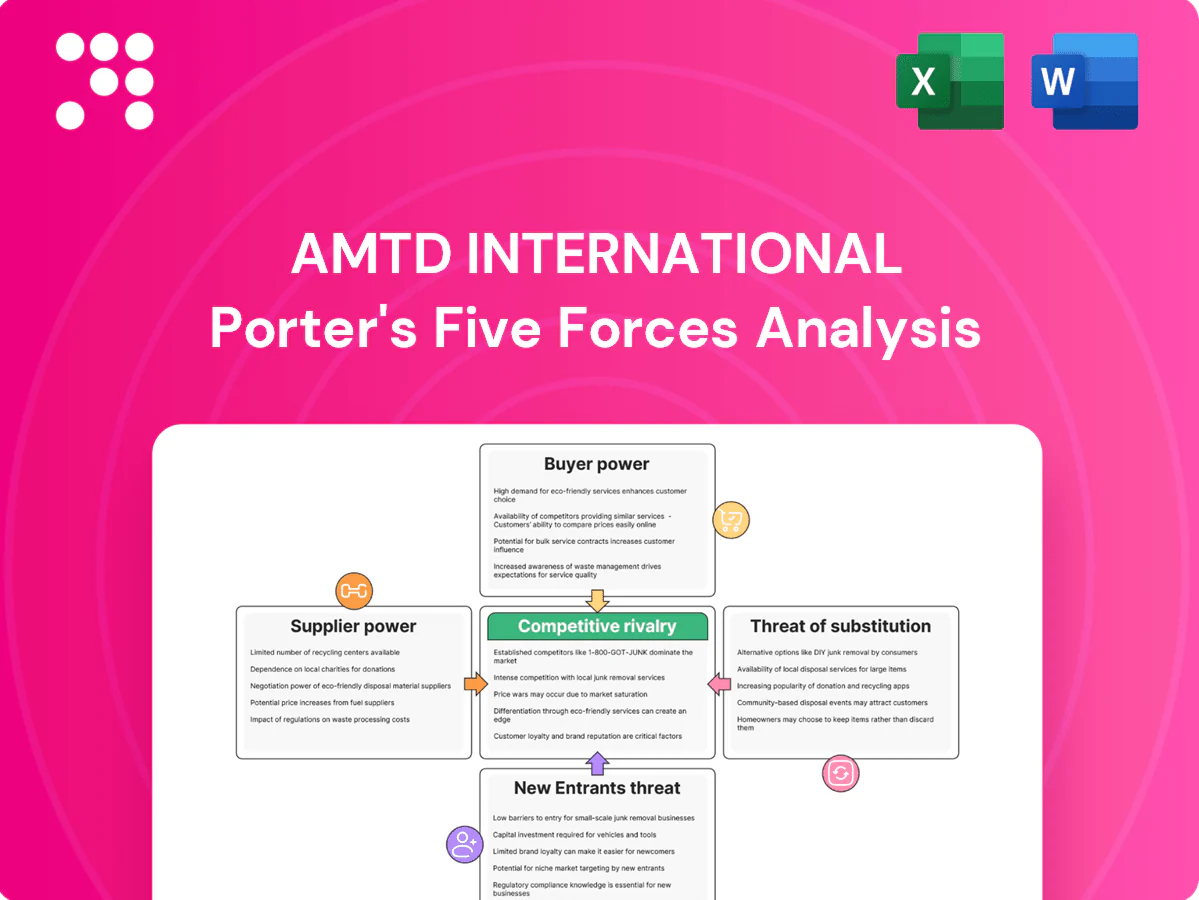
AMTD International Porter's Five Forces Analysis

A Must-Have Tool for Decision-Makers
AMTD International’s Porter's Five Forces snapshot highlights competitive intensity, supplier and buyer power, substitution risk, and barriers to entry—revealing where strategic advantage can be built or eroded; this brief only scratches the surface. Unlock the full Porter's Five Forces Analysis for force-by-force ratings, visuals, and actionable insights to inform smarter investment and strategic decisions.
Suppliers Bargaining Power

Scarce senior banking talent
Experienced rainmakers, sector bankers and ECM/DCM leaders remain scarce across Greater China and Asia, giving them strong leverage on pay and deal terms; AMTD depends on these specialists to secure IPO, M&A and debt mandates. Retention costs and guaranteed compensation packages materially compress margins. Aggressive poaching by global banks and top PRC houses further elevates supplier power. 2024 industry reports confirm continued talent tightness in the region.
Deal origination partners
Venture funds, private equity, incubators and law firms feed AMTD’s IPO/M&A pipelines and can steer mandates, with global venture investment near $200 billion in 2024 amplifying origination volumes. Their ability to bundle introductions across multiple issuers lets them extract economics, pushing AMTD to concede fees or co-lead slots to secure flow. Concentration among top-tier partners intensifies this leverage, skewing negotiation power toward a small set of gatekeepers.

Market infrastructure and data vendors
Exchanges, listing sponsors, rating agencies and data/analytics platforms are indispensable for deal execution and risk management; top venues such as NYSE, NASDAQ and HKEX remain primary listing channels in 2024. The Big Three rating agencies (S&P, Moody's, Fitch) control over 90% of the global ratings market (2024), creating limited substitution and switching frictions. Price hikes or tighter service terms from these vendors feed directly into AMTD’s cost base, while compliance tools and KYC providers represent non-discretionary operational spend.

Capital providers and syndicate partners
For placements and structured products, balance-sheet providers, anchor investors, and co-managers materially shape deal viability, often demanding allocations, enhanced economics, or preferential covenants; AMTD has historically reduced fees to secure cornerstone participation, particularly as investor appetite weakened in 2024 amid muted ECM activity.
- Higher supplier leverage: anchor investors demand preferred pricing
- Fee flexibility: AMTD cuts fees to secure cornerstone slots
- Winter windows: dependency rises when market appetite falls
Technology and compliance requirements
- RegTech market ~USD 13B (2024)
- Top 5 vendors ≈40% share in APAC
- Switching costs ~12–18 months integration spend
- Cybersecurity budgets +11% YoY (2024)
High supplier power and talent scarcity compress industry margins; RegTech and ratings raise costs
Supplier power is high: scarce senior bankers and top law firms push up retention costs, compressing AMTD margins; global talent tightness persisted in 2024. Exchanges and Big Three ratings control listing and credit gates, raising switching costs. RegTech/cybersecurity vendors (market ~USD13B in 2024) and anchor investors further constrain pricing flexibility.
| Metric | 2024 |
|---|---|
| Venture funding | ~USD200B |
| RegTech market | ~USD13B |
| Ratings concentration | >90% |
What is included in the product
 Detailed Word Document
Uncovers key drivers of competition, buyer and supplier power, substitutes, and entry barriers impacting AMTD International, identifying disruptive forces and market entry risks. Tailored analysis provides strategic commentary and actionable insights for investors, executives, and advisors.

 Customizable Excel Spreadsheet
One-sheet Porter's Five Forces for AMTD International—clear, slide-ready summary with customizable pressure levels and an instant spider chart to simplify strategic decisions; no macros, easy data swaps, and seamless Excel/dashboard integration for rapid boardroom-ready insights.
Customers Bargaining Power

Large issuers with multi-bank options
Blue-chip corporates and leading new-economy issuers routinely pit 4–8 banks against each other in multi-bank RFPs, extracting lower fees, expanded research coverage, and preferred syndicate spots. AMTD must differentiate through deep sector access and cross-border investor reach to win mandates. Multi-bank processes in 2024 intensified pricing pressure and compressed mandate fees across Asia-Pacific ECM.
Fee sensitivity in down markets
When issuance slows clients defer deals or demand discounts, and in the 2023–2024 downcycle global IPO proceeds contracted sharply (around a 40–50% drop versus prior peak), shrinking fee pools and shifting leverage to issuers. AMTD faces tougher economics to keep pipelines active, absorbing lower fees or funding marketing to sustain deal flow. Buyers increasingly extract value-add commitments such as aftermarket support and distribution guarantees to justify mandates.

Switching ease across advisors
Clients routinely rotate advisors between fundraising rounds or transactions; in 2024 about 62% of corporates used more than one advisor during a 12-month period, reflecting credential- and league-table-driven switching. Relationship stickiness helps retention, but documented credentials and recent deal rankings trigger moves. Switching costs are moderate — onboarding and due diligence typically take 4–6 weeks — keeping buyer power elevated.

Institutional asset owners
Institutional asset owners benchmark fees and performance tightly, with US passive share of equity AUM around 53% in 2024, enabling rapid reallocation to lower-cost passive or alternative managers; AMTD must demonstrably justify alpha and proprietary access to retain mandates. Mandate concentration—many mandates >$100m—amplifies buyer leverage, letting institutions extract fee concessions or shift entire allocations swiftly.
- Fee sensitivity: institutional benchmarks drive fee pressure
- Reallocation speed: >50% equity AUM passive (2024)
- Alpha requirement: must prove unique access/performance
- Concentration risk: large mandates boost buyer bargaining power
Demand for integrated solutions
Clients increasingly demand bundled IB, AM and strategic investment synergies; 2024 surveys indicate about 60% of institutional clients favor one-stop providers, making integrated service gaps a trigger for fragmented mandates. When AMTD cannot deliver end-to-end solutions, buyers split mandates and use integration expectations as negotiation levers, pressuring fees and service levels. Deep cross-sell (AUM penetration) can blunt this, but buyers still drive terms.
- ~60% institutional preference for bundled services (2024)
- Fragmentation raises pricing leverage for buyers
- Cross-sell depth reduces but does not eliminate buyer power
Clients pressure fees: 62% switch advisors; IPOs down 40-50% and 53% passive share
Clients wield strong bargaining power: multi-bank RFPs (4–8 banks) and 62% of corporates switching advisors in 12 months force fee compression. 2024 IPO proceeds fell ~40–50%, shrinking fee pools; US passive equity share ~53% increases reallocation risk. ~60% of institutions prefer bundled services, using integration gaps to demand discounts.
| Metric | 2024 |
|---|---|
| Multi-bank RFPs | 4–8 banks |
| Corporate advisor switching | 62% |
| IPO proceeds change | -40–50% |
| US passive equity share | 53% |
| Preference for bundled services | 60% |
Same Document Delivered
AMTD International Porter's Five Forces Analysis
This preview is the exact AMTD International Porter's Five Forces analysis you'll receive after purchase — no placeholders or summaries. It contains the full, professionally formatted evaluation of competitive rivalry, supplier and buyer power, threat of entry and substitutes. You'll get instant access to this identical file ready for download and use.

A Must-Have Tool for Decision-Makers
AMTD International’s Porter's Five Forces snapshot highlights competitive intensity, supplier and buyer power, substitution risk, and barriers to entry—revealing where strategic advantage can be built or eroded; this brief only scratches the surface. Unlock the full Porter's Five Forces Analysis for force-by-force ratings, visuals, and actionable insights to inform smarter investment and strategic decisions.
Suppliers Bargaining Power
Scarce senior banking talent
Experienced rainmakers, sector bankers and ECM/DCM leaders remain scarce across Greater China and Asia, giving them strong leverage on pay and deal terms; AMTD depends on these specialists to secure IPO, M&A and debt mandates. Retention costs and guaranteed compensation packages materially compress margins. Aggressive poaching by global banks and top PRC houses further elevates supplier power. 2024 industry reports confirm continued talent tightness in the region.
Deal origination partners
Venture funds, private equity, incubators and law firms feed AMTD’s IPO/M&A pipelines and can steer mandates, with global venture investment near $200 billion in 2024 amplifying origination volumes. Their ability to bundle introductions across multiple issuers lets them extract economics, pushing AMTD to concede fees or co-lead slots to secure flow. Concentration among top-tier partners intensifies this leverage, skewing negotiation power toward a small set of gatekeepers.
Market infrastructure and data vendors
Exchanges, listing sponsors, rating agencies and data/analytics platforms are indispensable for deal execution and risk management; top venues such as NYSE, NASDAQ and HKEX remain primary listing channels in 2024. The Big Three rating agencies (S&P, Moody's, Fitch) control over 90% of the global ratings market (2024), creating limited substitution and switching frictions. Price hikes or tighter service terms from these vendors feed directly into AMTD’s cost base, while compliance tools and KYC providers represent non-discretionary operational spend.
Capital providers and syndicate partners
For placements and structured products, balance-sheet providers, anchor investors, and co-managers materially shape deal viability, often demanding allocations, enhanced economics, or preferential covenants; AMTD has historically reduced fees to secure cornerstone participation, particularly as investor appetite weakened in 2024 amid muted ECM activity.
- Higher supplier leverage: anchor investors demand preferred pricing
- Fee flexibility: AMTD cuts fees to secure cornerstone slots
- Winter windows: dependency rises when market appetite falls
Technology and compliance requirements
- RegTech market ~USD 13B (2024)
- Top 5 vendors ≈40% share in APAC
- Switching costs ~12–18 months integration spend
- Cybersecurity budgets +11% YoY (2024)
High supplier power and talent scarcity compress industry margins; RegTech and ratings raise costs
Supplier power is high: scarce senior bankers and top law firms push up retention costs, compressing AMTD margins; global talent tightness persisted in 2024. Exchanges and Big Three ratings control listing and credit gates, raising switching costs. RegTech/cybersecurity vendors (market ~USD13B in 2024) and anchor investors further constrain pricing flexibility.
| Metric | 2024 |
|---|---|
| Venture funding | ~USD200B |
| RegTech market | ~USD13B |
| Ratings concentration | >90% |
What is included in the product
Detailed Word Document
Uncovers key drivers of competition, buyer and supplier power, substitutes, and entry barriers impacting AMTD International, identifying disruptive forces and market entry risks. Tailored analysis provides strategic commentary and actionable insights for investors, executives, and advisors.
Customizable Excel Spreadsheet
One-sheet Porter's Five Forces for AMTD International—clear, slide-ready summary with customizable pressure levels and an instant spider chart to simplify strategic decisions; no macros, easy data swaps, and seamless Excel/dashboard integration for rapid boardroom-ready insights.
Customers Bargaining Power
Large issuers with multi-bank options
Blue-chip corporates and leading new-economy issuers routinely pit 4–8 banks against each other in multi-bank RFPs, extracting lower fees, expanded research coverage, and preferred syndicate spots. AMTD must differentiate through deep sector access and cross-border investor reach to win mandates. Multi-bank processes in 2024 intensified pricing pressure and compressed mandate fees across Asia-Pacific ECM.
Fee sensitivity in down markets
When issuance slows clients defer deals or demand discounts, and in the 2023–2024 downcycle global IPO proceeds contracted sharply (around a 40–50% drop versus prior peak), shrinking fee pools and shifting leverage to issuers. AMTD faces tougher economics to keep pipelines active, absorbing lower fees or funding marketing to sustain deal flow. Buyers increasingly extract value-add commitments such as aftermarket support and distribution guarantees to justify mandates.
Switching ease across advisors
Clients routinely rotate advisors between fundraising rounds or transactions; in 2024 about 62% of corporates used more than one advisor during a 12-month period, reflecting credential- and league-table-driven switching. Relationship stickiness helps retention, but documented credentials and recent deal rankings trigger moves. Switching costs are moderate — onboarding and due diligence typically take 4–6 weeks — keeping buyer power elevated.
Institutional asset owners
Institutional asset owners benchmark fees and performance tightly, with US passive share of equity AUM around 53% in 2024, enabling rapid reallocation to lower-cost passive or alternative managers; AMTD must demonstrably justify alpha and proprietary access to retain mandates. Mandate concentration—many mandates >$100m—amplifies buyer leverage, letting institutions extract fee concessions or shift entire allocations swiftly.
- Fee sensitivity: institutional benchmarks drive fee pressure
- Reallocation speed: >50% equity AUM passive (2024)
- Alpha requirement: must prove unique access/performance
- Concentration risk: large mandates boost buyer bargaining power
Demand for integrated solutions
Clients increasingly demand bundled IB, AM and strategic investment synergies; 2024 surveys indicate about 60% of institutional clients favor one-stop providers, making integrated service gaps a trigger for fragmented mandates. When AMTD cannot deliver end-to-end solutions, buyers split mandates and use integration expectations as negotiation levers, pressuring fees and service levels. Deep cross-sell (AUM penetration) can blunt this, but buyers still drive terms.
- ~60% institutional preference for bundled services (2024)
- Fragmentation raises pricing leverage for buyers
- Cross-sell depth reduces but does not eliminate buyer power
Clients pressure fees: 62% switch advisors; IPOs down 40-50% and 53% passive share
Clients wield strong bargaining power: multi-bank RFPs (4–8 banks) and 62% of corporates switching advisors in 12 months force fee compression. 2024 IPO proceeds fell ~40–50%, shrinking fee pools; US passive equity share ~53% increases reallocation risk. ~60% of institutions prefer bundled services, using integration gaps to demand discounts.
| Metric | 2024 |
|---|---|
| Multi-bank RFPs | 4–8 banks |
| Corporate advisor switching | 62% |
| IPO proceeds change | -40–50% |
| US passive equity share | 53% |
| Preference for bundled services | 60% |
Same Document Delivered
AMTD International Porter's Five Forces Analysis
This preview is the exact AMTD International Porter's Five Forces analysis you'll receive after purchase — no placeholders or summaries. It contains the full, professionally formatted evaluation of competitive rivalry, supplier and buyer power, threat of entry and substitutes. You'll get instant access to this identical file ready for download and use.
Original: $10.00
-65%$10.00
$3.50Description
A Must-Have Tool for Decision-Makers
AMTD International’s Porter's Five Forces snapshot highlights competitive intensity, supplier and buyer power, substitution risk, and barriers to entry—revealing where strategic advantage can be built or eroded; this brief only scratches the surface. Unlock the full Porter's Five Forces Analysis for force-by-force ratings, visuals, and actionable insights to inform smarter investment and strategic decisions.
Suppliers Bargaining Power
Scarce senior banking talent
Experienced rainmakers, sector bankers and ECM/DCM leaders remain scarce across Greater China and Asia, giving them strong leverage on pay and deal terms; AMTD depends on these specialists to secure IPO, M&A and debt mandates. Retention costs and guaranteed compensation packages materially compress margins. Aggressive poaching by global banks and top PRC houses further elevates supplier power. 2024 industry reports confirm continued talent tightness in the region.
Deal origination partners
Venture funds, private equity, incubators and law firms feed AMTD’s IPO/M&A pipelines and can steer mandates, with global venture investment near $200 billion in 2024 amplifying origination volumes. Their ability to bundle introductions across multiple issuers lets them extract economics, pushing AMTD to concede fees or co-lead slots to secure flow. Concentration among top-tier partners intensifies this leverage, skewing negotiation power toward a small set of gatekeepers.
Market infrastructure and data vendors
Exchanges, listing sponsors, rating agencies and data/analytics platforms are indispensable for deal execution and risk management; top venues such as NYSE, NASDAQ and HKEX remain primary listing channels in 2024. The Big Three rating agencies (S&P, Moody's, Fitch) control over 90% of the global ratings market (2024), creating limited substitution and switching frictions. Price hikes or tighter service terms from these vendors feed directly into AMTD’s cost base, while compliance tools and KYC providers represent non-discretionary operational spend.
Capital providers and syndicate partners
For placements and structured products, balance-sheet providers, anchor investors, and co-managers materially shape deal viability, often demanding allocations, enhanced economics, or preferential covenants; AMTD has historically reduced fees to secure cornerstone participation, particularly as investor appetite weakened in 2024 amid muted ECM activity.
- Higher supplier leverage: anchor investors demand preferred pricing
- Fee flexibility: AMTD cuts fees to secure cornerstone slots
- Winter windows: dependency rises when market appetite falls
Technology and compliance requirements
- RegTech market ~USD 13B (2024)
- Top 5 vendors ≈40% share in APAC
- Switching costs ~12–18 months integration spend
- Cybersecurity budgets +11% YoY (2024)
High supplier power and talent scarcity compress industry margins; RegTech and ratings raise costs
Supplier power is high: scarce senior bankers and top law firms push up retention costs, compressing AMTD margins; global talent tightness persisted in 2024. Exchanges and Big Three ratings control listing and credit gates, raising switching costs. RegTech/cybersecurity vendors (market ~USD13B in 2024) and anchor investors further constrain pricing flexibility.
| Metric | 2024 |
|---|---|
| Venture funding | ~USD200B |
| RegTech market | ~USD13B |
| Ratings concentration | >90% |
What is included in the product
Detailed Word Document
Uncovers key drivers of competition, buyer and supplier power, substitutes, and entry barriers impacting AMTD International, identifying disruptive forces and market entry risks. Tailored analysis provides strategic commentary and actionable insights for investors, executives, and advisors.
Customizable Excel Spreadsheet
One-sheet Porter's Five Forces for AMTD International—clear, slide-ready summary with customizable pressure levels and an instant spider chart to simplify strategic decisions; no macros, easy data swaps, and seamless Excel/dashboard integration for rapid boardroom-ready insights.
Customers Bargaining Power
Large issuers with multi-bank options
Blue-chip corporates and leading new-economy issuers routinely pit 4–8 banks against each other in multi-bank RFPs, extracting lower fees, expanded research coverage, and preferred syndicate spots. AMTD must differentiate through deep sector access and cross-border investor reach to win mandates. Multi-bank processes in 2024 intensified pricing pressure and compressed mandate fees across Asia-Pacific ECM.
Fee sensitivity in down markets
When issuance slows clients defer deals or demand discounts, and in the 2023–2024 downcycle global IPO proceeds contracted sharply (around a 40–50% drop versus prior peak), shrinking fee pools and shifting leverage to issuers. AMTD faces tougher economics to keep pipelines active, absorbing lower fees or funding marketing to sustain deal flow. Buyers increasingly extract value-add commitments such as aftermarket support and distribution guarantees to justify mandates.
Switching ease across advisors
Clients routinely rotate advisors between fundraising rounds or transactions; in 2024 about 62% of corporates used more than one advisor during a 12-month period, reflecting credential- and league-table-driven switching. Relationship stickiness helps retention, but documented credentials and recent deal rankings trigger moves. Switching costs are moderate — onboarding and due diligence typically take 4–6 weeks — keeping buyer power elevated.
Institutional asset owners
Institutional asset owners benchmark fees and performance tightly, with US passive share of equity AUM around 53% in 2024, enabling rapid reallocation to lower-cost passive or alternative managers; AMTD must demonstrably justify alpha and proprietary access to retain mandates. Mandate concentration—many mandates >$100m—amplifies buyer leverage, letting institutions extract fee concessions or shift entire allocations swiftly.
- Fee sensitivity: institutional benchmarks drive fee pressure
- Reallocation speed: >50% equity AUM passive (2024)
- Alpha requirement: must prove unique access/performance
- Concentration risk: large mandates boost buyer bargaining power
Demand for integrated solutions
Clients increasingly demand bundled IB, AM and strategic investment synergies; 2024 surveys indicate about 60% of institutional clients favor one-stop providers, making integrated service gaps a trigger for fragmented mandates. When AMTD cannot deliver end-to-end solutions, buyers split mandates and use integration expectations as negotiation levers, pressuring fees and service levels. Deep cross-sell (AUM penetration) can blunt this, but buyers still drive terms.
- ~60% institutional preference for bundled services (2024)
- Fragmentation raises pricing leverage for buyers
- Cross-sell depth reduces but does not eliminate buyer power
Clients pressure fees: 62% switch advisors; IPOs down 40-50% and 53% passive share
Clients wield strong bargaining power: multi-bank RFPs (4–8 banks) and 62% of corporates switching advisors in 12 months force fee compression. 2024 IPO proceeds fell ~40–50%, shrinking fee pools; US passive equity share ~53% increases reallocation risk. ~60% of institutions prefer bundled services, using integration gaps to demand discounts.
| Metric | 2024 |
|---|---|
| Multi-bank RFPs | 4–8 banks |
| Corporate advisor switching | 62% |
| IPO proceeds change | -40–50% |
| US passive equity share | 53% |
| Preference for bundled services | 60% |
Same Document Delivered
AMTD International Porter's Five Forces Analysis
This preview is the exact AMTD International Porter's Five Forces analysis you'll receive after purchase — no placeholders or summaries. It contains the full, professionally formatted evaluation of competitive rivalry, supplier and buyer power, threat of entry and substitutes. You'll get instant access to this identical file ready for download and use.











