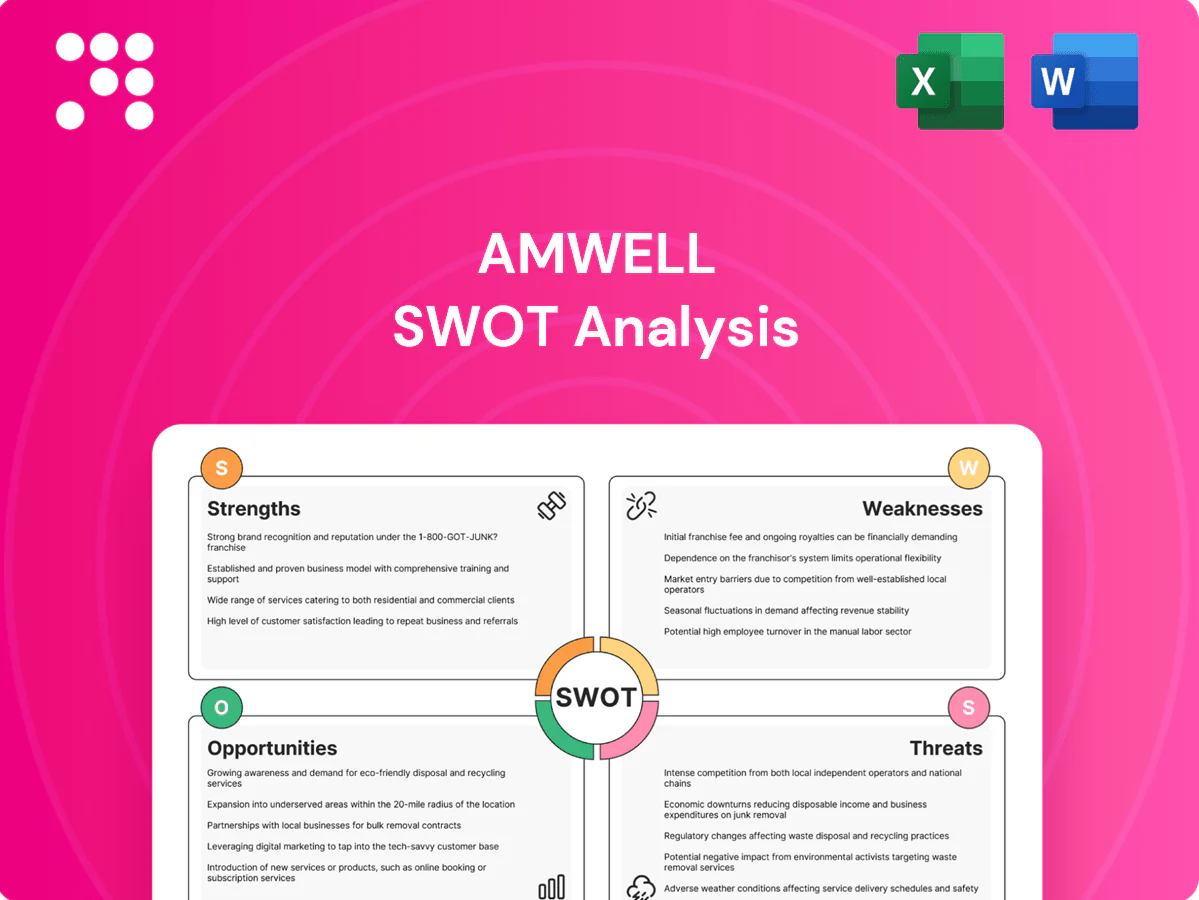
amwell SWOT Analysis

Dive Deeper Into the Company’s Strategic Blueprint
Explore Amwell’s strategic standing with our concise SWOT snapshot—highlighting clinical partnerships, telehealth scale opportunities, regulatory risks, and competitive pressures. Want deeper, actionable insights? Purchase the full SWOT report for a research-backed, editable Word and Excel package to inform investment, strategy, or pitch materials.
Strengths

Comprehensive virtual care platform
Amwells end-to-end virtual care stack—video, messaging, scheduling, triage and care management—boosts provider and payer stickiness and streamlines workflows across settings. The unified platform supports multiple specialties and care pathways, enabling cross-sell and higher ARPU per client. Amwell reported 2024 revenue of $243.6M, underscoring commercial traction.
Diverse multi-sided client base
Serving health systems, health plans, employers, and consumers spreads Amwell’s revenue across payer and provider channels, reducing concentration risk. Combined payer and provider footprints create network effects that expand clinician access and referral pathways. Multi-segment demand smooths utilization volatility across commercial and enterprise cycles and yields rich cross-segment data for product and clinical improvement.

Deep integrations and compliance
Deep EHR and claims integrations with major systems such as Epic and Cerner streamline clinical documentation and billing, reducing manual reconciliation and accelerating go-live. HIPAA and SOC2 compliance, together with healthcare-grade security controls, build enterprise trust and lower procurement barriers in regulated settings. Seamless interoperability cuts implementation friction for health systems and payers, enabling faster ROI and deployment.

Specialty breadth and clinical network
Coverage across urgent, primary, behavioral and specialty care expands Amwell's use cases, enabling referrals and follow-ups beyond single visits; its clinician network shortens wait times and improves fulfillment for partners. Specialty depth enhances value to payers and health systems by enabling care management and cost avoidance, supporting longitudinal relationships rather than one-off transactions.
- Use cases: cross-spectrum care
- Access: broader clinician fulfillment
- Payer value: specialty depth
- Care model: longitudinal support
Scalable, cloud-native infrastructure
Amwell’s scalable, cloud-native infrastructure elastically handles peak demand without major capex, using standardized modules that reduce marginal cost per visit and support higher throughput.
Platform scalability improves reliability and uptime, enabling enterprise-grade SLAs and underpinning commercial growth with predictable performance.
- Elastic architecture: reduces capex
- Standardized modules: lower marginal costs
- High scalability: improves uptime and SLAs
Unified virtual care stack and clinician network drive higher ARPU, referrals; 2024 revenue $243.6M
Amwell’s unified virtual care stack and multi-specialty clinician network drive provider and payer stickiness and higher ARPU per client. Serving health systems, payers, employers and consumers diversifies revenue and creates referral network effects. Deep EHR/claims integrations and cloud-native scalability speed deployments and support enterprise SLAs; 2024 revenue $243.6M.
| Metric | 2024 |
|---|---|
| Revenue | $243.6M |
What is included in the product
 Detailed Word Document
Provides a strategic overview of amwell’s internal strengths and weaknesses and external opportunities and threats, highlighting competitive position, growth drivers, operational gaps, and market risks shaping its telehealth business.

 Customizable Excel Spreadsheet
Provides a concise SWOT matrix that pinpoints Amwell’s strategic pain points—strengths to scale, weaknesses to mitigate, opportunities to capture, and threats to monitor—enabling rapid alignment and decision-making for telehealth leaders.
Weaknesses

Path to sustained profitability
High R&D and enterprise sales costs continue to pressure Amwell margins, limiting near-term free cash flow. Variable utilization across payer and enterprise channels can depress per-visit economics and amplify revenue volatility. Scaling specialty services requires significant upfront investment in clinicians and platform capabilities. Sustainable profitability hinges on a favorable mix shift toward higher-margin services and achieving operating leverage.
Dependence on reimbursement dynamics
Telehealth parity and CPT coverage materially influence Amwell revenue: Medicare's public health emergency ended May 11, 2023, and telehealth visits fell from about 13% of outpatient visits at the 2020 peak to roughly 2% in 2021–22 (McKinsey). Any reversal of pandemic-era flexibilities would further depress volumes. Complex, state- and payer-varying billing rules drive higher denials and cash-cycle friction, constraining pricing power tied to payer policy.

Intense competitive landscape
Amwell faces fierce competition from Teladoc, Optum, retail clinics and big-tech platforms, which drives aggressive price competition that compresses take rates and PMPM fees. Rapid feature parity across rivals erodes Amwell’s product differentiation and margins. Buyers run crowded RFPs that lengthen sales cycles and increase customer acquisition costs, stressing growth and cash flow.

Implementation complexity for enterprises
Implementation complexity for enterprises: custom integrations commonly prolong timelines and raise costs, while change management and clinician adoption remain nontrivial; workflow fragmentation across sites can impair ROI realization and large deployments risk scope creep and delays.
- AMWL publicly traded (NYSE: AMWL)
- Custom integrations extend timelines and increase costs
- Clinician adoption and change management challenges
- Workflow fragmentation reduces ROI; large deployments risk scope creep
Patient engagement and retention challenges
On-demand Amwell visits remain largely episodic with low patient loyalty, forcing conversion to longitudinal care that requires proactive outreach and care-coordination; Amwell highlighted in 2024 that recurring-care adoption lags episodic use. Digital-divide and UX barriers suppress uptake among older and low-income cohorts, increasing churn and customer-acquisition costs.
- Low loyalty → higher CAC
- Need proactive engagement for retention
- Digital divide limits market reach
- Churn pressures unit economics
Telehealth margins squeezed; volumes dropped from ~13% to ~2%
High R&D and sales costs compress margins; utilization volatility and episodic visits limit per-visit economics. Regulatory/payer billing complexity and potential rollback of pandemic flexibilities (telehealth peak ~13% outpatient visits in 2020 → ~2% in 2021–22) threaten volumes. Competitive pricing and implementation complexity lengthen sales cycles and raise CAC, while digital-divide suppresses retention.
| Metric | Value |
|---|---|
| Telehealth peak (2020) | ~13% |
| Telehealth (2021–22) | ~2% (McKinsey) |
| AMWL ticker | AMWL |
Full Version Awaits
amwell SWOT Analysis
This is a real excerpt from the complete Amwell SWOT analysis you’ll receive upon purchase—no surprises, just professional quality. The preview below is taken directly from the full report and reflects the same structure, findings, and editable content included in the download. Purchase unlocks the entire, detailed version ready for use in strategy or investment decisions.

Dive Deeper Into the Company’s Strategic Blueprint
Explore Amwell’s strategic standing with our concise SWOT snapshot—highlighting clinical partnerships, telehealth scale opportunities, regulatory risks, and competitive pressures. Want deeper, actionable insights? Purchase the full SWOT report for a research-backed, editable Word and Excel package to inform investment, strategy, or pitch materials.
Strengths
Comprehensive virtual care platform
Amwells end-to-end virtual care stack—video, messaging, scheduling, triage and care management—boosts provider and payer stickiness and streamlines workflows across settings. The unified platform supports multiple specialties and care pathways, enabling cross-sell and higher ARPU per client. Amwell reported 2024 revenue of $243.6M, underscoring commercial traction.
Diverse multi-sided client base
Serving health systems, health plans, employers, and consumers spreads Amwell’s revenue across payer and provider channels, reducing concentration risk. Combined payer and provider footprints create network effects that expand clinician access and referral pathways. Multi-segment demand smooths utilization volatility across commercial and enterprise cycles and yields rich cross-segment data for product and clinical improvement.
Deep integrations and compliance
Deep EHR and claims integrations with major systems such as Epic and Cerner streamline clinical documentation and billing, reducing manual reconciliation and accelerating go-live. HIPAA and SOC2 compliance, together with healthcare-grade security controls, build enterprise trust and lower procurement barriers in regulated settings. Seamless interoperability cuts implementation friction for health systems and payers, enabling faster ROI and deployment.
Specialty breadth and clinical network
Coverage across urgent, primary, behavioral and specialty care expands Amwell's use cases, enabling referrals and follow-ups beyond single visits; its clinician network shortens wait times and improves fulfillment for partners. Specialty depth enhances value to payers and health systems by enabling care management and cost avoidance, supporting longitudinal relationships rather than one-off transactions.
- Use cases: cross-spectrum care
- Access: broader clinician fulfillment
- Payer value: specialty depth
- Care model: longitudinal support
Scalable, cloud-native infrastructure
Amwell’s scalable, cloud-native infrastructure elastically handles peak demand without major capex, using standardized modules that reduce marginal cost per visit and support higher throughput.
Platform scalability improves reliability and uptime, enabling enterprise-grade SLAs and underpinning commercial growth with predictable performance.
- Elastic architecture: reduces capex
- Standardized modules: lower marginal costs
- High scalability: improves uptime and SLAs
Unified virtual care stack and clinician network drive higher ARPU, referrals; 2024 revenue $243.6M
Amwell’s unified virtual care stack and multi-specialty clinician network drive provider and payer stickiness and higher ARPU per client. Serving health systems, payers, employers and consumers diversifies revenue and creates referral network effects. Deep EHR/claims integrations and cloud-native scalability speed deployments and support enterprise SLAs; 2024 revenue $243.6M.
| Metric | 2024 |
|---|---|
| Revenue | $243.6M |
What is included in the product
Detailed Word Document
Provides a strategic overview of amwell’s internal strengths and weaknesses and external opportunities and threats, highlighting competitive position, growth drivers, operational gaps, and market risks shaping its telehealth business.
Customizable Excel Spreadsheet
Provides a concise SWOT matrix that pinpoints Amwell’s strategic pain points—strengths to scale, weaknesses to mitigate, opportunities to capture, and threats to monitor—enabling rapid alignment and decision-making for telehealth leaders.
Weaknesses
Path to sustained profitability
High R&D and enterprise sales costs continue to pressure Amwell margins, limiting near-term free cash flow. Variable utilization across payer and enterprise channels can depress per-visit economics and amplify revenue volatility. Scaling specialty services requires significant upfront investment in clinicians and platform capabilities. Sustainable profitability hinges on a favorable mix shift toward higher-margin services and achieving operating leverage.
Dependence on reimbursement dynamics
Telehealth parity and CPT coverage materially influence Amwell revenue: Medicare's public health emergency ended May 11, 2023, and telehealth visits fell from about 13% of outpatient visits at the 2020 peak to roughly 2% in 2021–22 (McKinsey). Any reversal of pandemic-era flexibilities would further depress volumes. Complex, state- and payer-varying billing rules drive higher denials and cash-cycle friction, constraining pricing power tied to payer policy.
Intense competitive landscape
Amwell faces fierce competition from Teladoc, Optum, retail clinics and big-tech platforms, which drives aggressive price competition that compresses take rates and PMPM fees. Rapid feature parity across rivals erodes Amwell’s product differentiation and margins. Buyers run crowded RFPs that lengthen sales cycles and increase customer acquisition costs, stressing growth and cash flow.
Implementation complexity for enterprises
Implementation complexity for enterprises: custom integrations commonly prolong timelines and raise costs, while change management and clinician adoption remain nontrivial; workflow fragmentation across sites can impair ROI realization and large deployments risk scope creep and delays.
- AMWL publicly traded (NYSE: AMWL)
- Custom integrations extend timelines and increase costs
- Clinician adoption and change management challenges
- Workflow fragmentation reduces ROI; large deployments risk scope creep
Patient engagement and retention challenges
On-demand Amwell visits remain largely episodic with low patient loyalty, forcing conversion to longitudinal care that requires proactive outreach and care-coordination; Amwell highlighted in 2024 that recurring-care adoption lags episodic use. Digital-divide and UX barriers suppress uptake among older and low-income cohorts, increasing churn and customer-acquisition costs.
- Low loyalty → higher CAC
- Need proactive engagement for retention
- Digital divide limits market reach
- Churn pressures unit economics
Telehealth margins squeezed; volumes dropped from ~13% to ~2%
High R&D and sales costs compress margins; utilization volatility and episodic visits limit per-visit economics. Regulatory/payer billing complexity and potential rollback of pandemic flexibilities (telehealth peak ~13% outpatient visits in 2020 → ~2% in 2021–22) threaten volumes. Competitive pricing and implementation complexity lengthen sales cycles and raise CAC, while digital-divide suppresses retention.
| Metric | Value |
|---|---|
| Telehealth peak (2020) | ~13% |
| Telehealth (2021–22) | ~2% (McKinsey) |
| AMWL ticker | AMWL |
Full Version Awaits
amwell SWOT Analysis
This is a real excerpt from the complete Amwell SWOT analysis you’ll receive upon purchase—no surprises, just professional quality. The preview below is taken directly from the full report and reflects the same structure, findings, and editable content included in the download. Purchase unlocks the entire, detailed version ready for use in strategy or investment decisions.
Original: $10.00
-65%$10.00
$3.50Description
Dive Deeper Into the Company’s Strategic Blueprint
Explore Amwell’s strategic standing with our concise SWOT snapshot—highlighting clinical partnerships, telehealth scale opportunities, regulatory risks, and competitive pressures. Want deeper, actionable insights? Purchase the full SWOT report for a research-backed, editable Word and Excel package to inform investment, strategy, or pitch materials.
Strengths
Comprehensive virtual care platform
Amwells end-to-end virtual care stack—video, messaging, scheduling, triage and care management—boosts provider and payer stickiness and streamlines workflows across settings. The unified platform supports multiple specialties and care pathways, enabling cross-sell and higher ARPU per client. Amwell reported 2024 revenue of $243.6M, underscoring commercial traction.
Diverse multi-sided client base
Serving health systems, health plans, employers, and consumers spreads Amwell’s revenue across payer and provider channels, reducing concentration risk. Combined payer and provider footprints create network effects that expand clinician access and referral pathways. Multi-segment demand smooths utilization volatility across commercial and enterprise cycles and yields rich cross-segment data for product and clinical improvement.
Deep integrations and compliance
Deep EHR and claims integrations with major systems such as Epic and Cerner streamline clinical documentation and billing, reducing manual reconciliation and accelerating go-live. HIPAA and SOC2 compliance, together with healthcare-grade security controls, build enterprise trust and lower procurement barriers in regulated settings. Seamless interoperability cuts implementation friction for health systems and payers, enabling faster ROI and deployment.
Specialty breadth and clinical network
Coverage across urgent, primary, behavioral and specialty care expands Amwell's use cases, enabling referrals and follow-ups beyond single visits; its clinician network shortens wait times and improves fulfillment for partners. Specialty depth enhances value to payers and health systems by enabling care management and cost avoidance, supporting longitudinal relationships rather than one-off transactions.
- Use cases: cross-spectrum care
- Access: broader clinician fulfillment
- Payer value: specialty depth
- Care model: longitudinal support
Scalable, cloud-native infrastructure
Amwell’s scalable, cloud-native infrastructure elastically handles peak demand without major capex, using standardized modules that reduce marginal cost per visit and support higher throughput.
Platform scalability improves reliability and uptime, enabling enterprise-grade SLAs and underpinning commercial growth with predictable performance.
- Elastic architecture: reduces capex
- Standardized modules: lower marginal costs
- High scalability: improves uptime and SLAs
Unified virtual care stack and clinician network drive higher ARPU, referrals; 2024 revenue $243.6M
Amwell’s unified virtual care stack and multi-specialty clinician network drive provider and payer stickiness and higher ARPU per client. Serving health systems, payers, employers and consumers diversifies revenue and creates referral network effects. Deep EHR/claims integrations and cloud-native scalability speed deployments and support enterprise SLAs; 2024 revenue $243.6M.
| Metric | 2024 |
|---|---|
| Revenue | $243.6M |
What is included in the product
Detailed Word Document
Provides a strategic overview of amwell’s internal strengths and weaknesses and external opportunities and threats, highlighting competitive position, growth drivers, operational gaps, and market risks shaping its telehealth business.
Customizable Excel Spreadsheet
Provides a concise SWOT matrix that pinpoints Amwell’s strategic pain points—strengths to scale, weaknesses to mitigate, opportunities to capture, and threats to monitor—enabling rapid alignment and decision-making for telehealth leaders.
Weaknesses
Path to sustained profitability
High R&D and enterprise sales costs continue to pressure Amwell margins, limiting near-term free cash flow. Variable utilization across payer and enterprise channels can depress per-visit economics and amplify revenue volatility. Scaling specialty services requires significant upfront investment in clinicians and platform capabilities. Sustainable profitability hinges on a favorable mix shift toward higher-margin services and achieving operating leverage.
Dependence on reimbursement dynamics
Telehealth parity and CPT coverage materially influence Amwell revenue: Medicare's public health emergency ended May 11, 2023, and telehealth visits fell from about 13% of outpatient visits at the 2020 peak to roughly 2% in 2021–22 (McKinsey). Any reversal of pandemic-era flexibilities would further depress volumes. Complex, state- and payer-varying billing rules drive higher denials and cash-cycle friction, constraining pricing power tied to payer policy.
Intense competitive landscape
Amwell faces fierce competition from Teladoc, Optum, retail clinics and big-tech platforms, which drives aggressive price competition that compresses take rates and PMPM fees. Rapid feature parity across rivals erodes Amwell’s product differentiation and margins. Buyers run crowded RFPs that lengthen sales cycles and increase customer acquisition costs, stressing growth and cash flow.
Implementation complexity for enterprises
Implementation complexity for enterprises: custom integrations commonly prolong timelines and raise costs, while change management and clinician adoption remain nontrivial; workflow fragmentation across sites can impair ROI realization and large deployments risk scope creep and delays.
- AMWL publicly traded (NYSE: AMWL)
- Custom integrations extend timelines and increase costs
- Clinician adoption and change management challenges
- Workflow fragmentation reduces ROI; large deployments risk scope creep
Patient engagement and retention challenges
On-demand Amwell visits remain largely episodic with low patient loyalty, forcing conversion to longitudinal care that requires proactive outreach and care-coordination; Amwell highlighted in 2024 that recurring-care adoption lags episodic use. Digital-divide and UX barriers suppress uptake among older and low-income cohorts, increasing churn and customer-acquisition costs.
- Low loyalty → higher CAC
- Need proactive engagement for retention
- Digital divide limits market reach
- Churn pressures unit economics
Telehealth margins squeezed; volumes dropped from ~13% to ~2%
High R&D and sales costs compress margins; utilization volatility and episodic visits limit per-visit economics. Regulatory/payer billing complexity and potential rollback of pandemic flexibilities (telehealth peak ~13% outpatient visits in 2020 → ~2% in 2021–22) threaten volumes. Competitive pricing and implementation complexity lengthen sales cycles and raise CAC, while digital-divide suppresses retention.
| Metric | Value |
|---|---|
| Telehealth peak (2020) | ~13% |
| Telehealth (2021–22) | ~2% (McKinsey) |
| AMWL ticker | AMWL |
Full Version Awaits
amwell SWOT Analysis
This is a real excerpt from the complete Amwell SWOT analysis you’ll receive upon purchase—no surprises, just professional quality. The preview below is taken directly from the full report and reflects the same structure, findings, and editable content included in the download. Purchase unlocks the entire, detailed version ready for use in strategy or investment decisions.











